What is ethics
Ethics
• Deeply influenced by morality
– Cultural factors
• History
• Traditions
• Education
• Religious beliefs
• Ethics does not create a moral behavior
• Ethics and morality taken as synonyms,
originally have the same meaning
The world of Ethics
• Human rights
• Law
• Duty
• Obligation
• Virtue
• Happiness
• Principles
• Consequences
The world of ethics
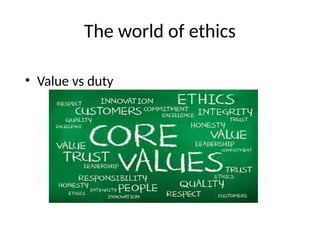
• Value vs duty
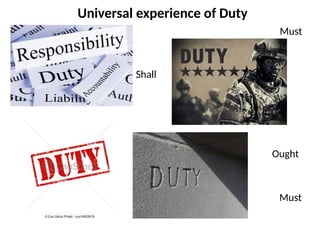
Must
Ought
Must
Shall
Universal experience of Duty
Moral experience is universal, but some
moral perceptions and judgments vary
Morality has been changing all over human
history. Moral values are different
depending on the place in which one is
living, the language one speaks, the
culture,the religions practiced.
Universality and variability of hum
an
m
orality
The nature of moral judgments
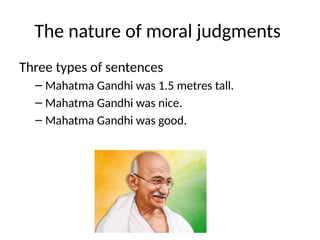
Three types of sentences
– Mahatma Gandhi was 1.5 metres tall.
– Mahatma Gandhi was nice.
– Mahatma Gandhi was good.
Moral criteria and moral Judgments
• Passion/emotion
– No possibility of agreement based on reason
• No rule of behavior can count as a moral
principle
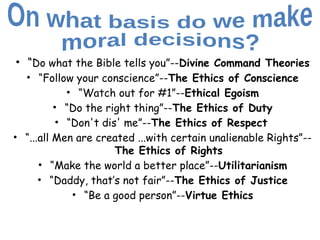
• “Do what the Bible tells you”--Divine Command Theories
• “Follow your conscience”--The Ethics of Conscience
• “Watch out for #1”--Ethical Egoism
• “Do the right thing”--The Ethics of Duty
• “Don't dis' me”--The Ethics of Respect
• “...all Men are created ...with certain unalienable Rights”--
The Ethics of Rights
• “Make the world a better place”--Utilitarianism
• “Daddy, that’s not fair”--The Ethics of Justice
• “Be a good person”--Virtue Ethics
"Do what the Bible tells you”
Divine Command Theories
• Being good is equivalent to
doing whatever the Bible--or
the Qur’an or some other
sacred text or source of
revelation--tells you to do.
• “What is right” equals “What
God tells me to do.”
“Follow your conscience”
The Ethics of Our Inner Voice
• Conscience tells us what is right or
wrong
• Often has a religious source
• May be founded in a notion of human
nature
• Is often negative in character, telling
us what is not right
"Watch out for #1”
Ethical Egoism
• the only person to look out
for is yourself
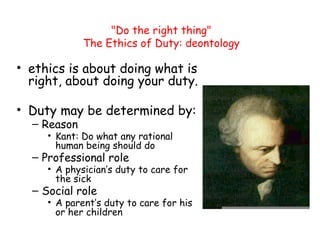
"Do the right thing"
The Ethics of Duty: deontology
• ethics is about doing what is
right, about doing your duty.
• Duty may be determined by:
– Reason
• Kant: Do what any rational
human being should do
– Professional role
• A physician’s duty to care for
the sick
– Social role
• A parent’s duty to care for his
or her children
"Do the right thing"
The Ethics of Duty: deontology
• a person's behavior can
be wrong even if it
results in the best
possible outcome.
• an act can be right even
if it results in a
negative outcome
"Don't dis' me"
The Ethics of Respect
• Human interactions should be
governed by rules of respect
• What counts as respect can vary
from one culture to another
– Examples:
• spitting in the sand
• showing the soles of one’s shoes--Richardson
• What is it that merits respect?
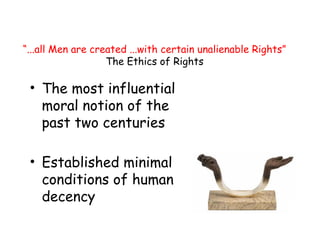
“...all Men are created ...with certain unalienable Rights”
The Ethics of Rights
• The most influential
moral notion of the
past two centuries
• Established minimal
conditions of human
decency
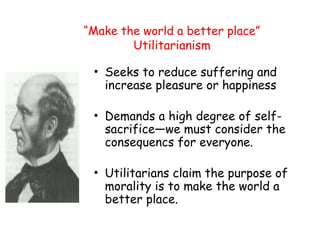
“Make the world a better place”
Utilitarianism
• Seeks to reduce suffering and
increase pleasure or happiness
• Demands a high degree of self-
sacrifice—we must consider the
consequencs for everyone.
• Utilitarians claim the purpose of
morality is to make the world a
better place.
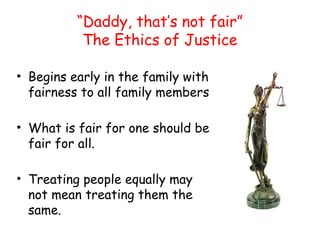
“Daddy, that’s not fair”
The Ethics of Justice
• Begins early in the family with
fairness to all family members
• What is fair for one should be
fair for all.
• Treating people equally may
not mean treating them the
same.
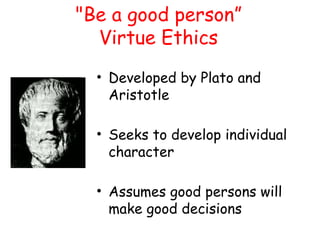
"Be a good person”
Virtue Ethics
• Developed by Plato and
Aristotle
• Seeks to develop individual
character
• Assumes good persons will
make good decisions
Conscience
• Response to moral dilemmas
• Personal
• Practical judgment
• Of individual acts
• right…. perform
• wrong ……avoid
• Involves knowledge and will
An Ethical Method of Reasoning
Step 1 : Case deliberation
a. The case: moral conflict
b. Deliberation about the facts: careful analysis of the
facts
Step 2: value deliberation
c. Identification of the moral problem
d. Choice of the main problem-choose one amongst the
many presented
e. The values at stake-identify the moral values at stake
An Ethical Method of Reasoning
Step 3: Duty Deliberation
a. Reflecting on the most challenging cases-ethical
dilemma
b. Reflecting on other cases-moral problems
An Ethical Method of Reasoning
Step 4: Testing Consistency
a. Apply the law
b. Ask ourselves questions
c. Do not be hasty in drawing conclusions in moral
reflection
An Ethical Method of Reasoning
Step 5: Conclusion
• The desired outcome of all these reflective activities is to arrive
at wise decisions.
• Practical wisdom, the art of making well-thought decisions is
the moral virtue par excellence.
• Well-thought decisions are not necessarily universally agreed
decisions.
• Serious and responsible people can disagree on ethical matters.
• However it has been said that the unexamined life is not worth
living and in medicine it is certainly true that the morally
unreflective life is to be deplored.
Bioethics
Bioethics
Bioethics is a relatively new concept coined by a
biochemist, Van Rensselaer Potter,
in 1970 in an endeavour to draw attention to the
fact that the rapid advances in science
had proceeded without due attention being paid
to values.
Bioethics
 Term to describe the application of ethics
to biological sciences, medicine and
related fields
 Branch of ethics concerned with issues
surrounding health care and biological
sciences
– Biotechnology advances applicable at three
different stages:
• Beginning of life (contraception and family
planning)
• Middle of life (genetic engineering and
abortion)
• End of life (death and euthanasia)
• Ethical theories can help define and clarify
the process whereby individuals search for
a rationale to support a particular course
of action.
• In the final analysis, ethics or moral
psychology is a field which studies how
one person makes a difficult, personal
choice at a particular moment in life.

Introduction to ethic and Bioethics.pptx

  • 1.
  • 2.
    Ethics • Deeply influencedby morality – Cultural factors • History • Traditions • Education • Religious beliefs • Ethics does not create a moral behavior • Ethics and morality taken as synonyms, originally have the same meaning
  • 3.
    The world ofEthics • Human rights • Law • Duty • Obligation • Virtue • Happiness • Principles • Consequences
  • 4.
    The world ofethics • Value vs duty
  • 5.
  • 6.
    Moral experience isuniversal, but some moral perceptions and judgments vary Morality has been changing all over human history. Moral values are different depending on the place in which one is living, the language one speaks, the culture,the religions practiced.
  • 7.
    Universality and variabilityof hum an m orality
  • 8.
    The nature ofmoral judgments Three types of sentences – Mahatma Gandhi was 1.5 metres tall. – Mahatma Gandhi was nice. – Mahatma Gandhi was good.
  • 9.
    Moral criteria andmoral Judgments • Passion/emotion – No possibility of agreement based on reason • No rule of behavior can count as a moral principle
  • 10.
    • “Do whatthe Bible tells you”--Divine Command Theories • “Follow your conscience”--The Ethics of Conscience • “Watch out for #1”--Ethical Egoism • “Do the right thing”--The Ethics of Duty • “Don't dis' me”--The Ethics of Respect • “...all Men are created ...with certain unalienable Rights”-- The Ethics of Rights • “Make the world a better place”--Utilitarianism • “Daddy, that’s not fair”--The Ethics of Justice • “Be a good person”--Virtue Ethics
  • 11.
    "Do what theBible tells you” Divine Command Theories • Being good is equivalent to doing whatever the Bible--or the Qur’an or some other sacred text or source of revelation--tells you to do. • “What is right” equals “What God tells me to do.”
  • 12.
    “Follow your conscience” TheEthics of Our Inner Voice • Conscience tells us what is right or wrong • Often has a religious source • May be founded in a notion of human nature • Is often negative in character, telling us what is not right
  • 13.
    "Watch out for#1” Ethical Egoism • the only person to look out for is yourself
  • 14.
    "Do the rightthing" The Ethics of Duty: deontology • ethics is about doing what is right, about doing your duty. • Duty may be determined by: – Reason • Kant: Do what any rational human being should do – Professional role • A physician’s duty to care for the sick – Social role • A parent’s duty to care for his or her children
  • 15.
    "Do the rightthing" The Ethics of Duty: deontology • a person's behavior can be wrong even if it results in the best possible outcome. • an act can be right even if it results in a negative outcome
  • 16.
    "Don't dis' me" TheEthics of Respect • Human interactions should be governed by rules of respect • What counts as respect can vary from one culture to another – Examples: • spitting in the sand • showing the soles of one’s shoes--Richardson • What is it that merits respect?
  • 17.
    “...all Men arecreated ...with certain unalienable Rights” The Ethics of Rights • The most influential moral notion of the past two centuries • Established minimal conditions of human decency
  • 18.
    “Make the worlda better place” Utilitarianism • Seeks to reduce suffering and increase pleasure or happiness • Demands a high degree of self- sacrifice—we must consider the consequencs for everyone. • Utilitarians claim the purpose of morality is to make the world a better place.
  • 19.
    “Daddy, that’s notfair” The Ethics of Justice • Begins early in the family with fairness to all family members • What is fair for one should be fair for all. • Treating people equally may not mean treating them the same.
  • 20.
    "Be a goodperson” Virtue Ethics • Developed by Plato and Aristotle • Seeks to develop individual character • Assumes good persons will make good decisions
  • 21.
    Conscience • Response tomoral dilemmas • Personal • Practical judgment • Of individual acts • right…. perform • wrong ……avoid • Involves knowledge and will
  • 22.
    An Ethical Methodof Reasoning Step 1 : Case deliberation a. The case: moral conflict b. Deliberation about the facts: careful analysis of the facts Step 2: value deliberation c. Identification of the moral problem d. Choice of the main problem-choose one amongst the many presented e. The values at stake-identify the moral values at stake
  • 23.
    An Ethical Methodof Reasoning Step 3: Duty Deliberation a. Reflecting on the most challenging cases-ethical dilemma b. Reflecting on other cases-moral problems
  • 24.
    An Ethical Methodof Reasoning Step 4: Testing Consistency a. Apply the law b. Ask ourselves questions c. Do not be hasty in drawing conclusions in moral reflection
  • 25.
    An Ethical Methodof Reasoning Step 5: Conclusion • The desired outcome of all these reflective activities is to arrive at wise decisions. • Practical wisdom, the art of making well-thought decisions is the moral virtue par excellence. • Well-thought decisions are not necessarily universally agreed decisions. • Serious and responsible people can disagree on ethical matters. • However it has been said that the unexamined life is not worth living and in medicine it is certainly true that the morally unreflective life is to be deplored.
  • 26.
  • 27.
    Bioethics Bioethics is arelatively new concept coined by a biochemist, Van Rensselaer Potter, in 1970 in an endeavour to draw attention to the fact that the rapid advances in science had proceeded without due attention being paid to values.
  • 28.
    Bioethics  Term todescribe the application of ethics to biological sciences, medicine and related fields  Branch of ethics concerned with issues surrounding health care and biological sciences
  • 29.
    – Biotechnology advancesapplicable at three different stages: • Beginning of life (contraception and family planning) • Middle of life (genetic engineering and abortion) • End of life (death and euthanasia)
  • 30.
    • Ethical theoriescan help define and clarify the process whereby individuals search for a rationale to support a particular course of action. • In the final analysis, ethics or moral psychology is a field which studies how one person makes a difficult, personal choice at a particular moment in life.

Editor's Notes

  • #2 Morality is a unique feature of the life of human beings. It is deeply influenced by several cultural factors, such as history, traditions, education, religious beliefs, etc. The intellectual analysis of this human dimension in all of its complexity is the goal of the discipline called Ethics. Ethics does not create morality or moral behaviour. The goal of ethics is much more modest: to explore the nature of moral experience, its universality and its diversity. Ethics and morality are generally taken as synonyms, because they originally had the same meaning: the study of the disposition, character, or attitude of a specific person, group of people or culture, and ways of promoting or perfecting it.
  • #3  There are ethical systems ordered around the ideas of human rights, law, duty, obligation, virtue, happiness, principles, consequences, etc. In an effort to capture the valuable insights of each of these approaches it will be useful to begin by analyzing the universal moral experience of human beings. Proceeding this way, two concepts emerge as basic: one is ‘value’ and the other is ‘duty’. Values can be identified amongst all peoples and societies and they often provide unique identifiers of those cultures. Values therefore predate the discipline called ethics, being promoted by religions, cultural traditions, history, etc. Values are the background of many other moral concepts derived from them, like principles, norms, laws, virtues, etc. One of the most important goals of ethics is the intellectual analysis of values and value conflicts, in order to define our duties. And duties always involve the values at stake in each specific situation, promoting them as much as possible.
  • #4 Values can be identified amongst all peoples and societies and they often provide unique identifiers of those cultures. Values therefore predate the discipline called ethics, being promoted by religions, cultural traditions, history, etc. Values are the background of many other moral concepts derived from them, like principles, norms, laws, virtues, etc. One of the most important goals of ethics is the intellectual analysis of values and value conflicts, in order to define our duties. And duties always involve the values at stake in each specific situation, promoting them as much as possible.
  • #5 We all consider that some things ought to be done and others avoided. We have a duty to act in certain ways rather than others. The experience of duty is one of the most universal characteristics of human life. There is no human language without the so-called ‘duty-verbs’, such as ‘must’, ‘ought’, ‘shall’, or without imperative moods, in order to express commands, like: ‘do no harm!’, ‘fulfil your promises!’, ‘do not steal!’, ‘do not lie!’. Similarly, there is no human society without some rules of conduct, either ‘prohibitions’ or ‘obligations’.
  • #6 Provide examples
  • #7  It follows from the previous statements that there are some universal and unchangeable elements in human morality, but others are historically conditioned and particular. Structurally, morality is always the same, but the contents are, at least to some extent, variable. In fact, moral values are constantly evolving. But at the same time, some moral duties remain unchanged, reflecting the logical limits of what counts as part of moral discourse. For instance, do not harm others, or tell the truth
  • #8 i. How do we resolve a disagreement about the first sentence? It is a matter of measurement. Though we might not be in a position to make the measurement we certainly know what it would be like to make it. Our understanding the sentence depends on such knowledge. If two people disagree about the claim made by the sentence one of them must be wrong. It is a question of objective fact, an empirical claim. ii. How do we resolve an apparent disagreement about the truth of this sentence? Each speaker might be able to give a reason for their statement. But they do not have to be able to do so and might simply say that they just like him. There is no logical limit to what people may like or dislike. The lesson is that the sentence is not in fact about Gandhi at all but about the speaker who is simply expressing a feeling he has about Gandhi. This is not therefore a statement at all but an expression of feeling. The speaker might be trying to deceive us but he cannot be mistaken. iii. How do we resolve a disagreement about the truth of the final sentence? No-one can say that they have no reason for the claim as it is not a matter of whim. Further there are limits to the kind of consideration which can count as a proper reason. It has to be a moral reason. Thus the fact that Gandhi was a man of peace who supported non-violent protest would be a justification of the claim. But another observer might consider that opting for non-violent protest is a sign of weakness which hinders the quest for justice. This would be a reason for disagreeing with the claim. Thus the same consideration can count either for or against the judgement. It follows that relevant criteria are called for but they might not guarantee agreement.
  • #9 Passion/emotion However it ignores the fact that there are logical limits to the feelings relevant to moral statements. It has been pointed out that we cannot simply experience feelings like pride by just trying hard. Rather we have to remember some achievement or relation to the object of pride in order to experience pride. Similarly we cannot experience the moral feeling of shame without recalling some unworthy event in our lives no rule of behavior can count as a moral principle It has also been pointed out that no rule of behaviour can count as a moral principle except it is related to a family of concepts like respect, truthfulness, pride, ostentation, harm, benefit and so on. These logical limits make moral statements appear to be akin to sentence i. Nevertheless reason has its role to play in moral deliberation for the logical limits to be respected. In many cases reasonable reflection will facilitate agreement but it simply cannot be guaranteed to do so.
  • #22 Ethics is both a theoretical and a practical discipline. The language of ethics refers to rights, duties and values. One goal of ethics is to determine right decisions, and in order to do that, it is necessary to go step by step, analyzing, first, the facts of the case, second, the values at stake, and third, the duties. Conflicts appear when a decision should be taken, and it is difficult to identify the best course of action, because in all possible actions important values are at stake, and selecting one implies the infringement of other compelling values. The goal of the ethical method of reasoning is always the same, to help people to resolve these kinds of problems, taking wise or decisions. When analyzing facts our perception of facts is influenced by our education, cultural background, personal expertise and experience. We might have been trained to perceive some facts, for instance, the medical ones, but we might not have the same sensitivity to perceive others, such as the patient’s socio-economic situation, which other people, with other training, perceive more readily
  • #23  A Jehovah Witness refuses a blood transfusion for himself in line with his sincere religious beliefs but at the same time asks for help in saving his life. The two main values at stake here are respect for his spiritual wellbeing on the one hand, and respect for his physical wellbeing on the other.
  • #24 It is important that moral reflection is consistent. Special pleading involves giving undue weight to one or more consideration because it is in the interest of the decision maker so to do. This will always prejudice the decision and undermine the proper role of reason in ethical reflection.