Understanding the Importance of
Crystallization Processes
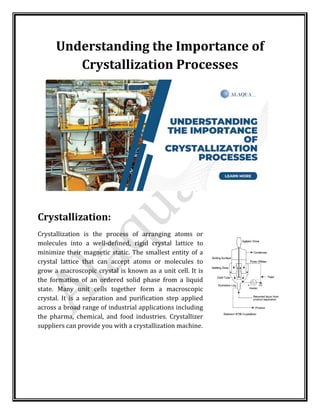
Crystallization:
Crystallization is the process of arranging atoms or
molecules into a well-defined, rigid crystal lattice to
minimize their magnetic static. The smallest entity of a
crystal lattice that can accept atoms or molecules to
grow a macroscopic crystal is known as a unit cell. It is
the formation of an ordered solid phase from a liquid
state. Many unit cells together form a macroscopic
crystal. It is a separation and purification step applied
across a broad range of industrial applications including
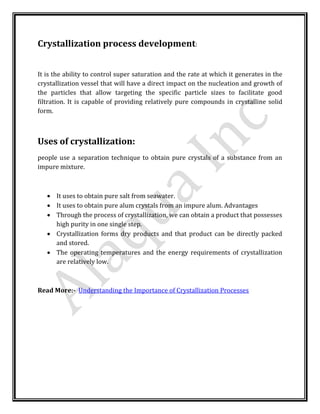
the pharma, chemical, and food industries. Crystallizer
suppliers can provide you with a crystallization machine.
Two key steps form crystals:
• Nucleation
• Growth
Nucleation-
Nucleation is the primary step. 1st atom in the mass becomes the center to form a
crystal and other atoms gather around the nucleus. When this process takes place,
more unit cells come around the nucleus and it forms small seed crystals.
It is important as the nucleus of the crystal determines the structure of the whole
crystal. Imperfections in the nucleus and the seed crystal lead to extreme
rearrangements as it continues to form crystals. The nucleation process occurs in a
super cooled liquid or a supersaturated solvent.
Growth-
In crystal growth, when the molecules and atoms surround the nucleus, they fall out
from symmetry which is already set up and adds to the seed crystal. This process
could occur very quickly or at a slow pace. It all depends upon the conditions.
Water crystallizes into ice in a couple of minutes but it takes a lot of time to form
geological crystals like quartz and diamonds. Crystals can take the shape of very few
geometric shapes. It determines by the bonds and interactions of the molecules.
The transfer of heat is vital because the temperature of the solution is critical to
driving the super saturation. So, the, molecules will have low solubility at low
temperatures and high solubility at elevated temperatures.
Crystallization process development:
It is the ability to control super saturation and the rate at which it generates in the
crystallization vessel that will have a direct impact on the nucleation and growth of
the particles that allow targeting the specific particle sizes to facilitate good
filtration. It is capable of providing relatively pure compounds in crystalline solid
form.
Uses of crystallization:
people use a separation technique to obtain pure crystals of a substance from an
impure mixture.
 It uses to obtain pure salt from seawater.
 It uses to obtain pure alum crystals from an impure alum. Advantages
 Through the process of crystallization, we can obtain a product that possesses
high purity in one single step.
 Crystallization forms dry products and that product can be directly packed
and stored.
 The operating temperatures and the energy requirements of crystallization
are relatively low.
Read More:- Understanding the Importance of Crystallization Processes

Understanding the Importance of Crystallization Processes.pdf

  • 1.
    Understanding the Importanceof Crystallization Processes Crystallization: Crystallization is the process of arranging atoms or molecules into a well-defined, rigid crystal lattice to minimize their magnetic static. The smallest entity of a crystal lattice that can accept atoms or molecules to grow a macroscopic crystal is known as a unit cell. It is the formation of an ordered solid phase from a liquid state. Many unit cells together form a macroscopic crystal. It is a separation and purification step applied across a broad range of industrial applications including the pharma, chemical, and food industries. Crystallizer suppliers can provide you with a crystallization machine.
  • 2.
    Two key stepsform crystals: • Nucleation • Growth Nucleation- Nucleation is the primary step. 1st atom in the mass becomes the center to form a crystal and other atoms gather around the nucleus. When this process takes place, more unit cells come around the nucleus and it forms small seed crystals. It is important as the nucleus of the crystal determines the structure of the whole crystal. Imperfections in the nucleus and the seed crystal lead to extreme rearrangements as it continues to form crystals. The nucleation process occurs in a super cooled liquid or a supersaturated solvent. Growth- In crystal growth, when the molecules and atoms surround the nucleus, they fall out from symmetry which is already set up and adds to the seed crystal. This process could occur very quickly or at a slow pace. It all depends upon the conditions. Water crystallizes into ice in a couple of minutes but it takes a lot of time to form geological crystals like quartz and diamonds. Crystals can take the shape of very few geometric shapes. It determines by the bonds and interactions of the molecules. The transfer of heat is vital because the temperature of the solution is critical to driving the super saturation. So, the, molecules will have low solubility at low temperatures and high solubility at elevated temperatures.
  • 3.
    Crystallization process development: Itis the ability to control super saturation and the rate at which it generates in the crystallization vessel that will have a direct impact on the nucleation and growth of the particles that allow targeting the specific particle sizes to facilitate good filtration. It is capable of providing relatively pure compounds in crystalline solid form. Uses of crystallization: people use a separation technique to obtain pure crystals of a substance from an impure mixture.  It uses to obtain pure salt from seawater.  It uses to obtain pure alum crystals from an impure alum. Advantages  Through the process of crystallization, we can obtain a product that possesses high purity in one single step.  Crystallization forms dry products and that product can be directly packed and stored.  The operating temperatures and the energy requirements of crystallization are relatively low. Read More:- Understanding the Importance of Crystallization Processes