WAVES
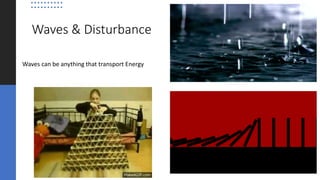
Waves & Disturbance
Waves can be anything that transport Energy
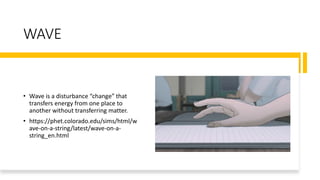
WAVE
• Wave is a disturbance “change” that
transfers energy from one place to
another without transferring matter.
• https://phet.colorado.edu/sims/html/w
ave-on-a-string/latest/wave-on-a-
string_en.html
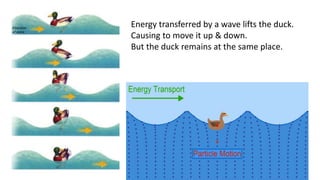
Energy transferred by a wave lifts the duck.
Causing to move it up & down.
But the duck remains at the same place.
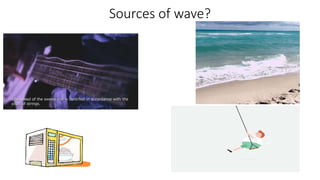
Sources of wave?
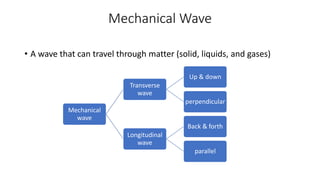
Mechanical Wave
• A wave that can travel through matter (solid, liquids, and gases)
Mechanical
wave
Transverse
wave
Up & down
perpendicular
Longitudinal
wave
Back & forth
parallel
SLIDE 7: Mechanical Wave+
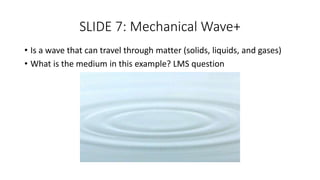
• Is a wave that can travel through matter (solids, liquids, and gases)
• What is the medium in this example? LMS question
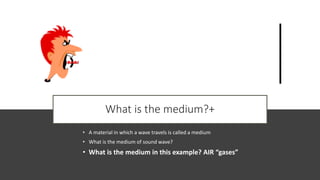
What is the medium?+
• A material in which a wave travels is called a medium
• What is the medium of sound wave?
• What is the medium in this example? AIR “gases”
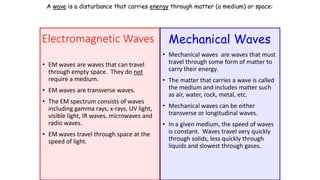
Electromagnetic Waves
• EM waves are waves that can travel
through empty space. They do not
require a medium.
• EM waves are transverse waves.
• The EM spectrum consists of waves
including gamma rays, x-rays, UV light,
visible light, IR waves, microwaves and
radio waves.
• EM waves travel through space at the
speed of light.
• Mechanical waves are waves that must
travel through some form of matter to
carry their energy.
• The matter that carries a wave is called
the medium and includes matter such
as air, water, rock, metal, etc.
• Mechanical waves can be either
transverse or longitudinal waves.
• In a given medium, the speed of waves
is constant. Waves travel very quickly
through solids, less quickly through
liquids and slowest through gases.
Mechanical Waves
A wave is a disturbance that carries energy through matter (a medium) or space:
Transverse wave & Longitudinal wave
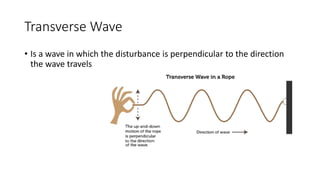
Transverse Wave
• Is a wave in which the disturbance is perpendicular to the direction
the wave travels
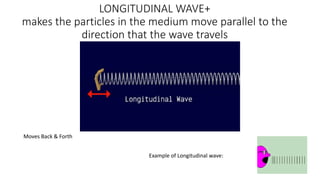
LONGITUDINAL WAVE+
makes the particles in the medium move parallel to the
direction that the wave travels
Moves Back & Forth
Example of Longitudinal wave:
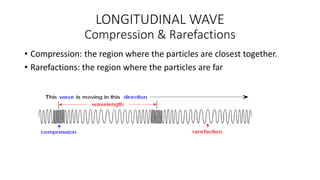
LONGITUDINAL WAVE
Compression & Rarefactions
• Compression: the region where the particles are closest together.
• Rarefactions: the region where the particles are far
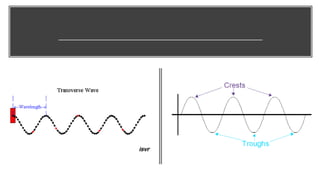
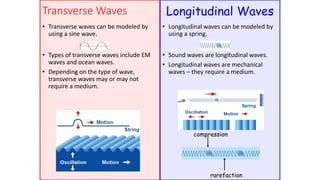
Transverse Waves
• Transverse waves can be modeled by
using a sine wave.
• Types of transverse waves include EM
waves and ocean waves.
• Depending on the type of wave,
transverse waves may or may not
require a medium.
• Longitudinal waves can be modeled by
using a spring.
• Sound waves are longitudinal waves.
• Longitudinal waves are mechanical
waves – they require a medium.
Longitudinal Waves
compression
rarefaction
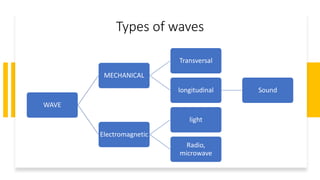
Types of waves
WAVE
MECHANICAL
Transversal
longitudinal Sound
Electromagnetic
light
Radio,
microwave
Waves
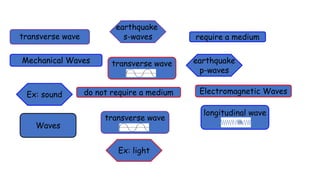
transverse wave
Mechanical Waves
Ex: sound
earthquake
s-waves
transverse wave
require a medium
do not require a medium
earthquake
p-waves
Electromagnetic Waves
longitudinal wave
transverse wave
Waves
Ex: light
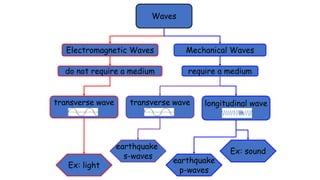
Waves
Electromagnetic Waves Mechanical Waves
do not require a medium require a medium
Waves
transverse wave longitudinal wave
earthquake
s-waves
earthquake
p-waves
Ex: light
Ex: sound
transverse wave
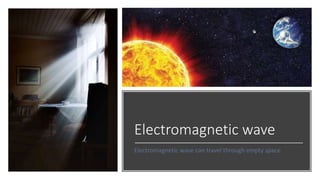
Electromagnetic wave
Electromagnetic wave can travel through empty space
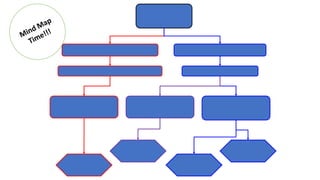
PRACTICE
• https://www.liveworksheets.com/rt1226546ep
Questions. Page: 134
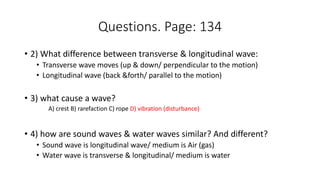
• 2) What difference between transverse & longitudinal wave:
• Transverse wave moves (up & down/ perpendicular to the motion)
• Longitudinal wave (back &forth/ parallel to the motion)
• 3) what cause a wave?
A) crest B) rarefaction C) rope D) vibration (disturbance)
• 4) how are sound waves & water waves similar? And different?
• Sound wave is longitudinal wave/ medium is Air (gas)
• Water wave is transverse & longitudinal/ medium is water
Question
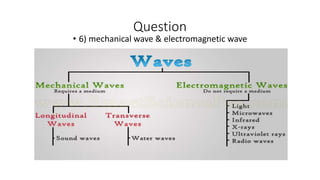
• 6) mechanical wave & electromagnetic wave

W.1 l.1 introduction to waves

  • 1.
  • 2.
    Waves & Disturbance Wavescan be anything that transport Energy
  • 3.
    WAVE • Wave isa disturbance “change” that transfers energy from one place to another without transferring matter. • https://phet.colorado.edu/sims/html/w ave-on-a-string/latest/wave-on-a- string_en.html
  • 4.
    Energy transferred bya wave lifts the duck. Causing to move it up & down. But the duck remains at the same place.
  • 5.
  • 6.
    Mechanical Wave • Awave that can travel through matter (solid, liquids, and gases) Mechanical wave Transverse wave Up & down perpendicular Longitudinal wave Back & forth parallel
  • 7.
    SLIDE 7: MechanicalWave+ • Is a wave that can travel through matter (solids, liquids, and gases) • What is the medium in this example? LMS question
  • 8.
    What is themedium?+ • A material in which a wave travels is called a medium • What is the medium of sound wave? • What is the medium in this example? AIR “gases”
  • 9.
    Electromagnetic Waves • EMwaves are waves that can travel through empty space. They do not require a medium. • EM waves are transverse waves. • The EM spectrum consists of waves including gamma rays, x-rays, UV light, visible light, IR waves, microwaves and radio waves. • EM waves travel through space at the speed of light. • Mechanical waves are waves that must travel through some form of matter to carry their energy. • The matter that carries a wave is called the medium and includes matter such as air, water, rock, metal, etc. • Mechanical waves can be either transverse or longitudinal waves. • In a given medium, the speed of waves is constant. Waves travel very quickly through solids, less quickly through liquids and slowest through gases. Mechanical Waves A wave is a disturbance that carries energy through matter (a medium) or space:
  • 10.
    Transverse wave &Longitudinal wave
  • 11.
    Transverse Wave • Isa wave in which the disturbance is perpendicular to the direction the wave travels
  • 13.
    LONGITUDINAL WAVE+ makes theparticles in the medium move parallel to the direction that the wave travels Moves Back & Forth Example of Longitudinal wave:
  • 14.
    LONGITUDINAL WAVE Compression &Rarefactions • Compression: the region where the particles are closest together. • Rarefactions: the region where the particles are far
  • 15.
    Transverse Waves • Transversewaves can be modeled by using a sine wave. • Types of transverse waves include EM waves and ocean waves. • Depending on the type of wave, transverse waves may or may not require a medium. • Longitudinal waves can be modeled by using a spring. • Sound waves are longitudinal waves. • Longitudinal waves are mechanical waves – they require a medium. Longitudinal Waves compression rarefaction
  • 16.
    Types of waves WAVE MECHANICAL Transversal longitudinalSound Electromagnetic light Radio, microwave
  • 17.
  • 18.
    transverse wave Mechanical Waves Ex:sound earthquake s-waves transverse wave require a medium do not require a medium earthquake p-waves Electromagnetic Waves longitudinal wave transverse wave Waves Ex: light
  • 19.
    Waves Electromagnetic Waves MechanicalWaves do not require a medium require a medium Waves transverse wave longitudinal wave earthquake s-waves earthquake p-waves Ex: light Ex: sound transverse wave
  • 20.
    Electromagnetic wave Electromagnetic wavecan travel through empty space
  • 21.
  • 22.
    Questions. Page: 134 •2) What difference between transverse & longitudinal wave: • Transverse wave moves (up & down/ perpendicular to the motion) • Longitudinal wave (back &forth/ parallel to the motion) • 3) what cause a wave? A) crest B) rarefaction C) rope D) vibration (disturbance) • 4) how are sound waves & water waves similar? And different? • Sound wave is longitudinal wave/ medium is Air (gas) • Water wave is transverse & longitudinal/ medium is water
  • 23.
    Question • 6) mechanicalwave & electromagnetic wave