Waves
Wave
-a wave is a disturbance that moves energy from
one place to another
-they transport energy from one point to another
without transferring matter.
-example: As the waves get
through, the rubber duck in
the tub moves up and down.
When the wave disappears,
it is back at its original position.
Types of Waves
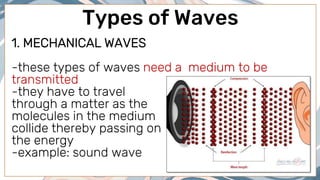
1. MECHANICAL WAVES
-these types of waves need a medium to be
transmitted
-they have to travel
through a matter as the
molecules in the medium
collide thereby passing on
the energy
-example: sound wave
Types of Waves
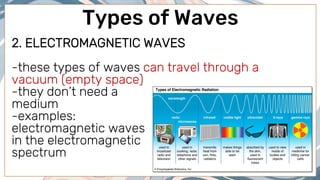
2. ELECTROMAGNETIC WAVES
-these types of waves can travel through a
vacuum (empty space)
-they don’t need a
medium
-examples:
electromagnetic waves
in the electromagnetic
spectrum
Types of Waves
3. TRANSVERSE WAVES
-the direction of the particles is perpendicular
(90° angle) to the direction of the wave,
examples: sea waves and light waves
-think of the wave moving from left to right,
while the particles
move up and down
-example: the rope
moves up and down
as the wave passes
through it
Types of Waves
4. LONGITUDINAL WAVES
-the particles move in the same direction of the
wave, examples: sound waves and seismic waves
-example: If the portion of the spring is
compressed and then let go, the wave will move
left to right.
At the same time,
the coils of the
spring will also
move left to right.
Type equation here.
4. LONGITUDINAL WAVES
-Compression: the part where the particles are
compressed
-Rarefaction: the part where particles are spread out
or stretched
Parts
of a
Wave
CREST: high point of a wave
TROUGH: low point of a wave
CREST
TROUGH
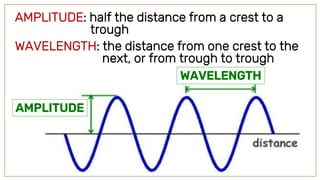
AMPLITUDE: half the distance from a crest to a
trough
WAVELENGTH: the distance from one crest to the
next, or from trough to trough
AMPLITUDE
WAVELENGTH
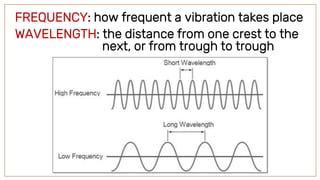
FREQUENCY: how frequent a vibration takes place
WAVELENGTH: the distance from one crest to the
next, or from trough to trough
CREST
TROUGH
AMPLITUDE
WAVELENGTH
WAVELENGTH: _______
AMPLITUDE: ________
WAVELENGTH: _______
AMPLITUDE: ________
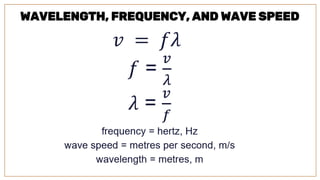
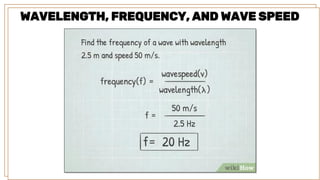
WAVELENGTH, FREQUENCY, AND WAVE SPEED
```1` 1`
WAVELENGTH, FREQUENCY, AND WAVE SPEED

Waves.pdf

  • 1.
  • 2.
    Wave -a wave isa disturbance that moves energy from one place to another -they transport energy from one point to another without transferring matter. -example: As the waves get through, the rubber duck in the tub moves up and down. When the wave disappears, it is back at its original position.
  • 3.
    Types of Waves 1.MECHANICAL WAVES -these types of waves need a medium to be transmitted -they have to travel through a matter as the molecules in the medium collide thereby passing on the energy -example: sound wave
  • 4.
    Types of Waves 2.ELECTROMAGNETIC WAVES -these types of waves can travel through a vacuum (empty space) -they don’t need a medium -examples: electromagnetic waves in the electromagnetic spectrum
  • 5.
    Types of Waves 3.TRANSVERSE WAVES -the direction of the particles is perpendicular (90° angle) to the direction of the wave, examples: sea waves and light waves -think of the wave moving from left to right, while the particles move up and down -example: the rope moves up and down as the wave passes through it
  • 6.
    Types of Waves 4.LONGITUDINAL WAVES -the particles move in the same direction of the wave, examples: sound waves and seismic waves -example: If the portion of the spring is compressed and then let go, the wave will move left to right. At the same time, the coils of the spring will also move left to right.
  • 7.
    Type equation here. 4.LONGITUDINAL WAVES -Compression: the part where the particles are compressed -Rarefaction: the part where particles are spread out or stretched
  • 8.
  • 9.
    CREST: high pointof a wave TROUGH: low point of a wave CREST TROUGH
  • 10.
    AMPLITUDE: half thedistance from a crest to a trough WAVELENGTH: the distance from one crest to the next, or from trough to trough AMPLITUDE WAVELENGTH
  • 11.
    FREQUENCY: how frequenta vibration takes place WAVELENGTH: the distance from one crest to the next, or from trough to trough
  • 12.
  • 13.
  • 14.
  • 15.
  • 16.
  • 17.
  • 18.