Historical
Methodology/Credibility
Credibility
When you're thinking critically, you're evaluating every claim against
what you already know to see if it seems plausible or implausible.
-For the purposes of this class, there are three methods or systems by
which a claim is deemed creditable:
1. Philosophically
2. Scientifically
3. Historically
Scientific Credibility
• -Science deals almost exclusively with providing explications
concerning the physical world, that is, providing a systematic
empirical account of the way in which the universe operates.
Two philosophical commitments of science:
1. Empiricism- knowledge comes only or primarily from
sensory experience.
2. Naturalism- idea or belief that only natural laws and
forces operate in the world.
Philosophy:
• -Remember that Philosophy is a search
for a fundamental understanding of the
world through the process of critical
thinking and critical discussion.
• -Subsequently, the primary method by
which philosophical claims are deemed
“reasonable” or “justifiable” is heavily
reliant upon logic and how well those
claims undergo logical scrutiny.
• -Since philosophy is not limited to a
strict empiricism, the scope of
philosophy is much larger than that of
science.
History
• History is a combination of three epistemological aspects:
1. The occurrence of historical events (or historical facts)- these are
events which are verifiable or documented and are
commonly accepted by professional historians.
2. The use of narrative (Theory)- narrative in history function the
same way that theory does in science, that is, narrative is what
connects historical facts and explains historical causation.
3. Naturalism- history is also committed to a form of naturalism in
that historical explanation must fall within the realm of known
possibility. Historical ideas must, in some sense, be testable.
Problem of sources/credibility
• The problem nowadays with
sources/credibility is the fact that it has
become increasingly difficult to make
the distinction between a creditable
source and a non-creditable one.
• Since information is so readily available,
and since dissenting (or opposing)
views are abundant, it is often times
difficult or impossible to tell which
view-point is backed by credible
evidence or authorities.
Evaluating a claims credibility
• Whether evidence is offered to
support the claim
• Whether there are any obvious
inaccuracies
• Whether the claim is an
observation or an inferred
conclusion
Expert Opinion
• Typically, when we are unsure about the
validity of a particular claim, our want
to legitimate our own view of a
particular claim, it is necessary to
appeal to experts.
• An expert is someone who knows more
than most people about a specific
subject. Remember that Expert opinion
doesn't guarantee truth, but it is usually
a reliable guide to it.
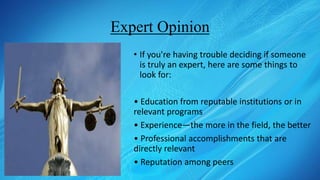
Expert Opinion
• If you're having trouble deciding if someone
is truly an expert, here are some things to
look for:
• Education from reputable institutions or in
relevant programs
• Experience—the more in the field, the better
• Professional accomplishments that are
directly relevant
• Reputation among peers
-Expertise loses credibility when the expert
• Makes a claim outside their area of expertise (remember the fallacy
of unqualified authority)
• Makes simple factual errors or mistakes in logic or reasoning
• Seems to be speaking from an emotional orientation
• Has a clear conflict of interests (e.g., being paid to present a specific
view)
• Doesn't provide sufficient support for tenuous claims
• Holds a view in direct opposition to most other experts in the same
subject area
What is the purpose of History?
• 1. First, historians are interested in providing conceptualizations
and factual descriptions of events and circumstances in the past.
• 2. Second, historians often want to answer “why” questions: “Why
did this event occur? What were the conditions and forces that
brought it about?”
• 3. Third, and related to the previous point, historians are sometimes
interested in answering a “how” question.
• 4. Fourth, often historians are interested in piecing together the
human meanings and intentions that underlie a given complex
series of historical actions.

WH 111, Historical methodology/credibility

  • 1.
  • 3.
    Credibility When you're thinkingcritically, you're evaluating every claim against what you already know to see if it seems plausible or implausible. -For the purposes of this class, there are three methods or systems by which a claim is deemed creditable: 1. Philosophically 2. Scientifically 3. Historically
  • 4.
    Scientific Credibility • -Sciencedeals almost exclusively with providing explications concerning the physical world, that is, providing a systematic empirical account of the way in which the universe operates. Two philosophical commitments of science: 1. Empiricism- knowledge comes only or primarily from sensory experience. 2. Naturalism- idea or belief that only natural laws and forces operate in the world.
  • 5.
    Philosophy: • -Remember thatPhilosophy is a search for a fundamental understanding of the world through the process of critical thinking and critical discussion. • -Subsequently, the primary method by which philosophical claims are deemed “reasonable” or “justifiable” is heavily reliant upon logic and how well those claims undergo logical scrutiny. • -Since philosophy is not limited to a strict empiricism, the scope of philosophy is much larger than that of science.
  • 6.
    History • History isa combination of three epistemological aspects: 1. The occurrence of historical events (or historical facts)- these are events which are verifiable or documented and are commonly accepted by professional historians. 2. The use of narrative (Theory)- narrative in history function the same way that theory does in science, that is, narrative is what connects historical facts and explains historical causation. 3. Naturalism- history is also committed to a form of naturalism in that historical explanation must fall within the realm of known possibility. Historical ideas must, in some sense, be testable.
  • 7.
    Problem of sources/credibility •The problem nowadays with sources/credibility is the fact that it has become increasingly difficult to make the distinction between a creditable source and a non-creditable one. • Since information is so readily available, and since dissenting (or opposing) views are abundant, it is often times difficult or impossible to tell which view-point is backed by credible evidence or authorities.
  • 8.
    Evaluating a claimscredibility • Whether evidence is offered to support the claim • Whether there are any obvious inaccuracies • Whether the claim is an observation or an inferred conclusion
  • 9.
    Expert Opinion • Typically,when we are unsure about the validity of a particular claim, our want to legitimate our own view of a particular claim, it is necessary to appeal to experts. • An expert is someone who knows more than most people about a specific subject. Remember that Expert opinion doesn't guarantee truth, but it is usually a reliable guide to it.
  • 10.
    Expert Opinion • Ifyou're having trouble deciding if someone is truly an expert, here are some things to look for: • Education from reputable institutions or in relevant programs • Experience—the more in the field, the better • Professional accomplishments that are directly relevant • Reputation among peers
  • 11.
    -Expertise loses credibilitywhen the expert • Makes a claim outside their area of expertise (remember the fallacy of unqualified authority) • Makes simple factual errors or mistakes in logic or reasoning • Seems to be speaking from an emotional orientation • Has a clear conflict of interests (e.g., being paid to present a specific view) • Doesn't provide sufficient support for tenuous claims • Holds a view in direct opposition to most other experts in the same subject area
  • 12.
    What is thepurpose of History? • 1. First, historians are interested in providing conceptualizations and factual descriptions of events and circumstances in the past. • 2. Second, historians often want to answer “why” questions: “Why did this event occur? What were the conditions and forces that brought it about?” • 3. Third, and related to the previous point, historians are sometimes interested in answering a “how” question. • 4. Fourth, often historians are interested in piecing together the human meanings and intentions that underlie a given complex series of historical actions.