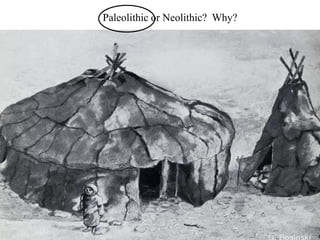
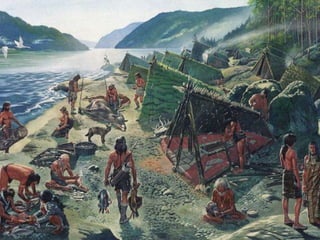
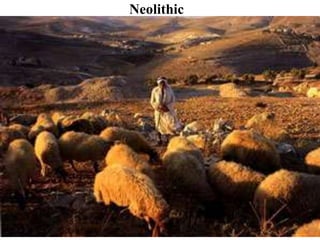
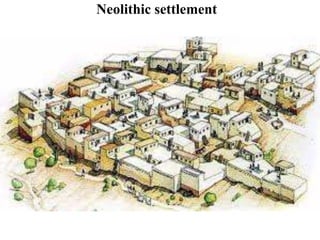
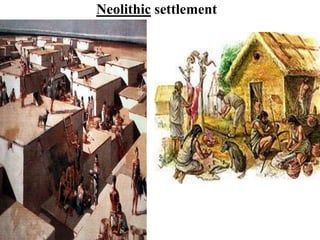
Paleolithic or Neolithic? Why?
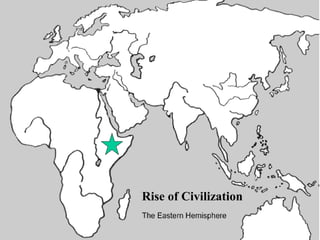
Rise of Civilization
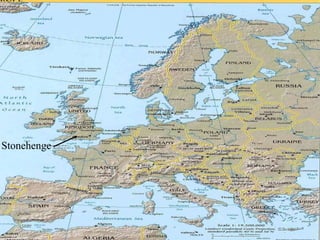
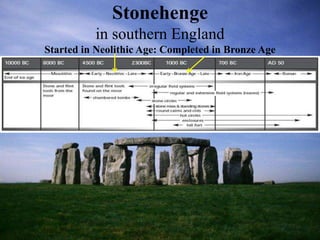
Stonehenge
in southern England
Neolithic
in southern England
Neolithic settlement
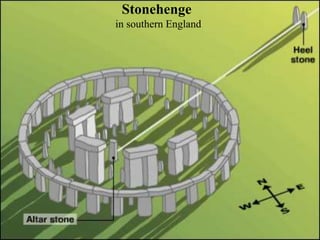
Stonehenge
Stonehenge
in southern England
Started in Neolithic Age: Completed in Bronze Age
Stonehenge
in southern England
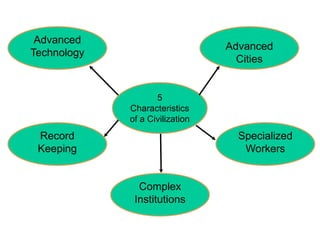
5
Characteristics
of a Civilization
Advanced
Cities
Specialized
Workers
Complex
Institutions
Record
Keeping
Advanced
Technology
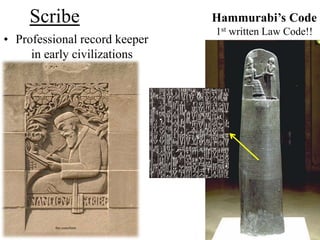
Scribe
• Professional record keeper
in early civilizations
See cuneiform
Hammurabi’s Code
1st written Law Code!!
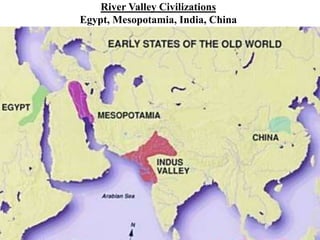
River Valley Civilizations
Egypt, Mesopotamia, India, China
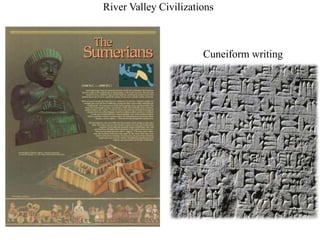
River Valley Civilizations
Cuneiform writing
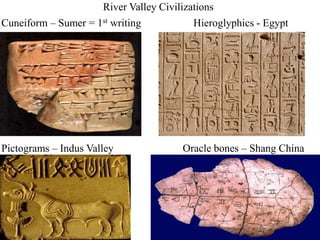
River Valley Civilizations
Cuneiform – Sumer = 1st writing Hieroglyphics - Egypt
Pictograms – Indus Valley Oracle bones – Shang China
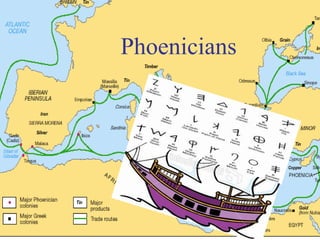
Phoenicians
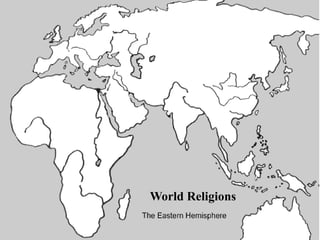
World Religions
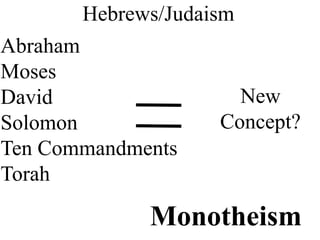
Hebrews/Judaism
Abraham
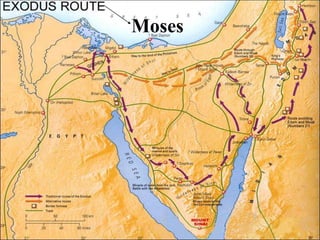
Moses
David
Solomon
Ten Commandments
Torah
New
Concept?
Monotheism
Moses
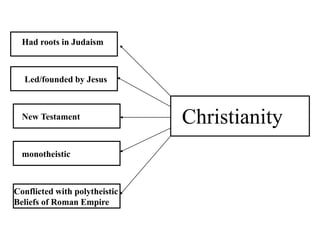
Christianity
Had roots in Judaism
Led/founded by Jesus
New Testament
monotheistic
Conflicted with polytheistic
Beliefs of Roman Empire
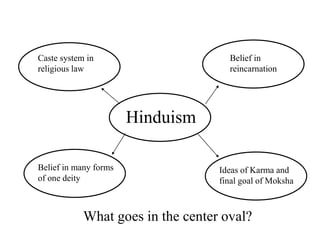
Hinduism
Caste system in
religious law
Belief in many forms
of one deity
Belief in
reincarnation
Ideas of Karma and
final goal of Moksha
What goes in the center oval?
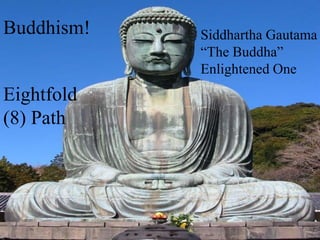
Buddhism! Siddhartha Gautama
“The Buddha”
Enlightened One
Eightfold
(8) Path
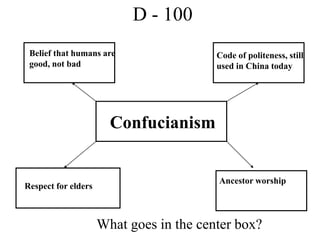
D - 100
Confucianism
Belief that humans are
good, not bad
Code of politeness, still
used in China today
Ancestor worship
Respect for elders
What goes in the center box?
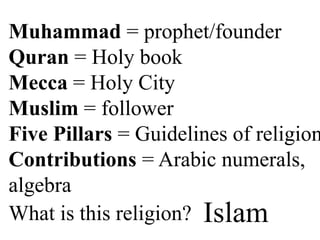
Muhammad = prophet/founder
Quran = Holy book
Mecca = Holy City
Muslim = follower
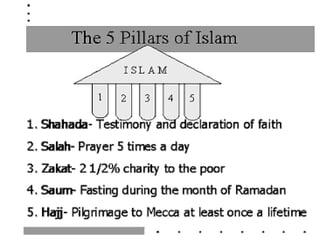
Five Pillars = Guidelines of religion
Contributions = Arabic numerals,
algebra
What is this religion? Islam
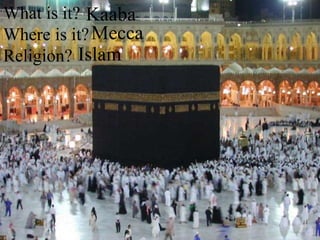
Kaaba in Mecca
What is it?
Where is it?
Religion?
Kaaba
Mecca
Islam
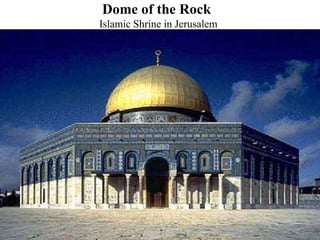
Dome of the Rock
Islamic Shrine in Jerusalem
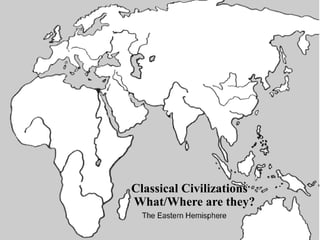
Classical Civilizations
What/Where are they?
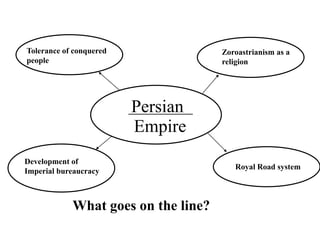
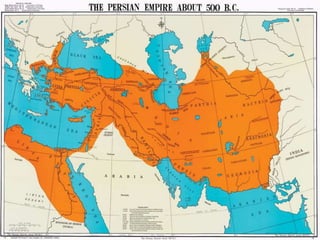
Persian_________
Empire
Tolerance of conquered
people
Development of
Imperial bureaucracy
Zoroastrianism as a
religion
Royal Road system
What goes on the line?
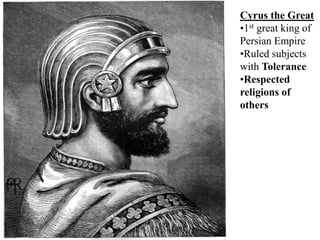
Cyrus the Great
•1st great king of
Persian Empire
•Ruled subjects
with Tolerance
•Respected
religions of
others
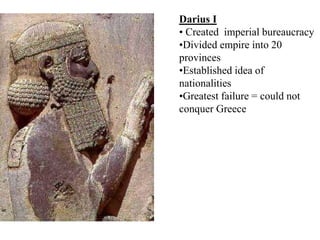
Darius I
• Created imperial bureaucracy
•Divided empire into 20
provinces
•Established idea of
nationalities
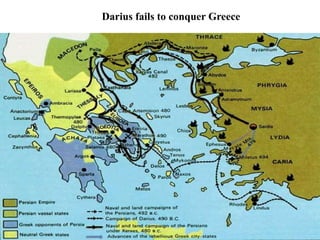
•Greatest failure = could not
conquer Greece
Darius fails to conquer Greece
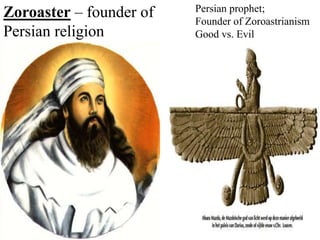
Zoroaster – founder of
Persian religion
Persian prophet;
Founder of Zoroastrianism
Good vs. Evil
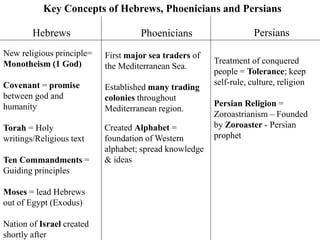
Key Concepts of Hebrews, Phoenicians and Persians
Hebrews PersiansPhoenicians
New religious principle=
Monotheism (1 God)
Covenant = promise
between god and
humanity
Torah = Holy
writings/Religious text
Ten Commandments =
Guiding principles
Moses = lead Hebrews
out of Egypt (Exodus)
Nation of Israel created
shortly after
First major sea traders of
the Mediterranean Sea.
Established many trading
colonies throughout
Mediterranean region.
Created Alphabet =
foundation of Western
alphabet; spread knowledge
& ideas
Treatment of conquered
people = Tolerance; keep
self-rule, culture, religion
Persian Religion =
Zoroastrianism – Founded
by Zoroaster - Persian
prophet
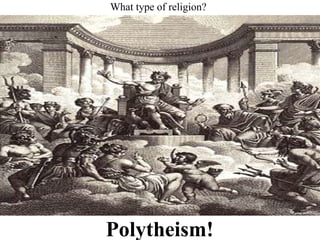
What type of religion?
Polytheism!
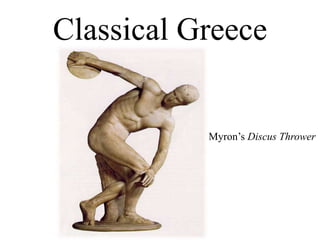
Classical Greece
Myron’s Discus Thrower
Impact of Geography on Ancient Greece Table of Contents
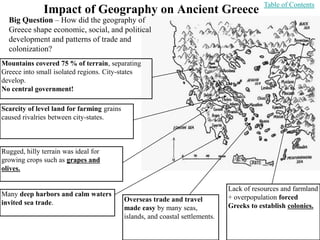
Big Question – How did the geography of
Greece shape economic, social, and political
development and patterns of trade and
colonization?
Mountains covered 75 % of terrain, separating
Greece into small isolated regions. City-states
develop.
No central government!
Scarcity of level land for farming grains
caused rivalries between city-states.
Rugged, hilly terrain was ideal for
growing crops such as grapes and
olives.
Many deep harbors and calm waters
invited sea trade. Overseas trade and travel
made easy by many seas,
islands, and coastal settlements.
Lack of resources and farmland
+ overpopulation forced
Greeks to establish colonies.
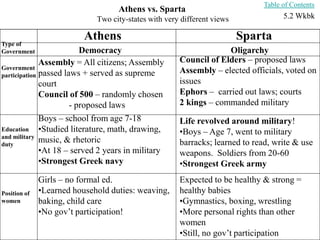
Athens vs. Sparta
Two city-states with very different views
Table of Contents
Athens Sparta
Type of
Government
Government
participation
Education
and military
duty
Position of
women
5.2 Wkbk
Democracy Oligarchy
Assembly = All citizens; Assembly
passed laws + served as supreme
court
Council of 500 – randomly chosen
- proposed laws
Boys – school from age 7-18
•Studied literature, math, drawing,
music, & rhetoric
•At 18 – served 2 years in military
•Strongest Greek navy
Girls – no formal ed.
•Learned household duties: weaving,
baking, child care
•No gov’t participation!
Council of Elders – proposed laws
Assembly – elected officials, voted on
issues
Ephors – carried out laws; courts
2 kings – commanded military
Life revolved around military!
•Boys – Age 7, went to military
barracks; learned to read, write & use
weapons. Soldiers from 20-60
•Strongest Greek army
Expected to be healthy & strong =
healthy babies
•Gymnastics, boxing, wrestling
•More personal rights than other
women
•Still, no gov’t participation
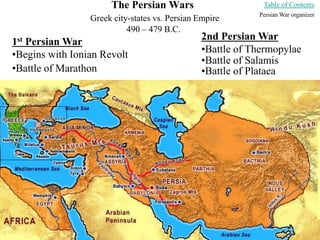
The Persian Wars
Greek city-states vs. Persian Empire
490 – 479 B.C.
Table of Contents
Persian War organizer
1st Persian War
•Begins with Ionian Revolt
2nd Persian War
•Battle of Thermopylae
•Battle of Marathon
•Battle of Salamis
•Battle of Plataea
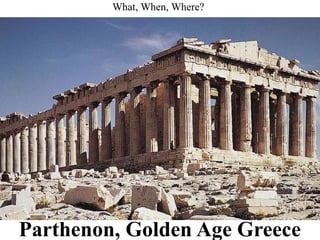
What, When, Where?
Parthenon, Golden Age Greece
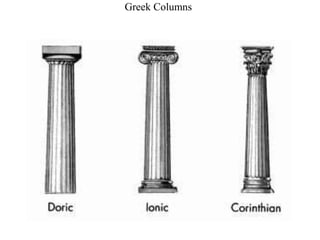
Greek Columns
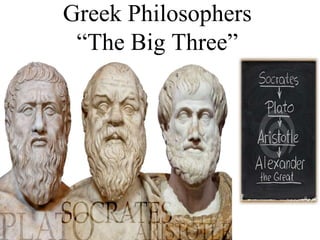
Greek Philosophers
“The Big Three”
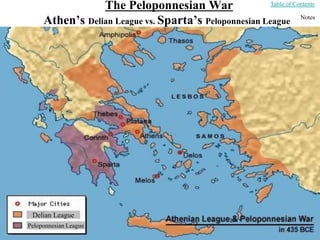
The Peloponnesian War
Athen’s Delian League vs. Sparta’s Peloponnesian League
Table of Contents
Notes
Delian League
Peloponnesian League
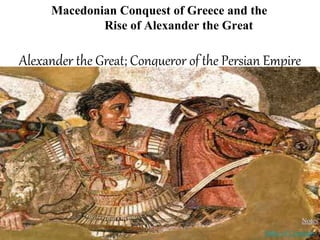
Alexander the Great; Conqueror of the Persian Empire
Macedonian Conquest of Greece and the
Rise of Alexander the Great
Table of Contents
Notes
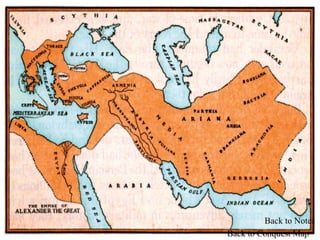
Back to Conquest Map
Back to Notes
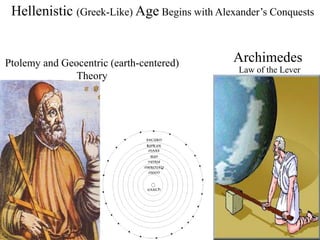
Ptolemy and Geocentric (earth-centered)
Theory
Hellenistic (Greek-Like) Age Begins with Alexander’s Conquests
Law of the Lever
Archimedes
48
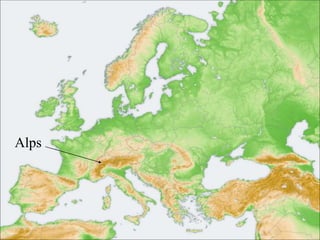
Alps
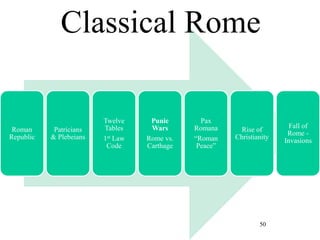
50
Roman
Republic
Patricians
& Plebeians
Twelve
Tables
1st Law
Code
Punic
Wars
Rome vs.
Carthage
Pax
Romana
“Roman
Peace”
Rise of
Christianity
Fall of
Rome -
Invasions
Classical Rome
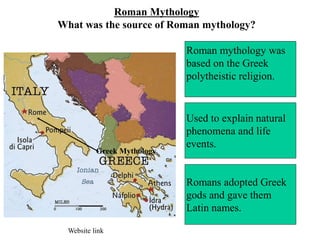
Roman Mythology
What was the source of Roman mythology?
Roman mythology was
based on the Greek
polytheistic religion.
Used to explain natural
phenomena and life
events.
Romans adopted Greek
gods and gave them
Latin names.
Greek Mythology
Website link
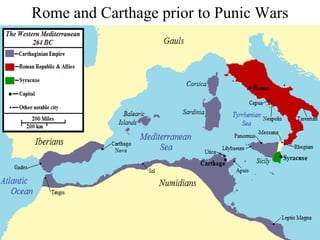
Rome and Carthage prior to Punic Wars
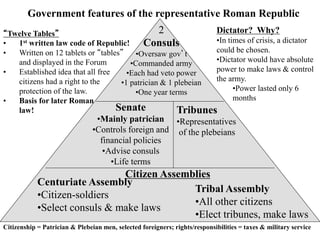
2
Consuls
•Oversaw gov’t
•Commanded army
•Each had veto power
•1 patrician & 1 plebeian
•One year terms
Senate
•Mainly patrician
•Controls foreign and
financial policies
•Advise consuls
•Life terms
Tribunes
•Representatives
of the plebeians
Citizen Assemblies
Government features of the representative Roman Republic
Centuriate Assembly
•Citizen-soldiers
•Select consuls & make laws
Tribal Assembly
•All other citizens
•Elect tribunes, make laws
Dictator? Why?
•In times of crisis, a dictator
could be chosen.
•Dictator would have absolute
power to make laws & control
the army.
•Power lasted only 6
months
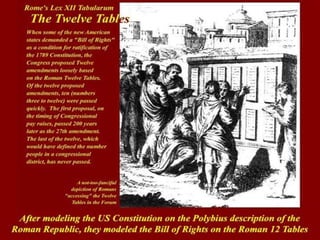
“Twelve Tables”
• 1st written law code of Republic!
• Written on 12 tablets or “tables”
and displayed in the Forum
• Established idea that all free
citizens had a right to the
protection of the law.
• Basis for later Roman
law!
Citizenship = Patrician & Plebeian men, selected foreigners; rights/responsibilities = taxes & military service
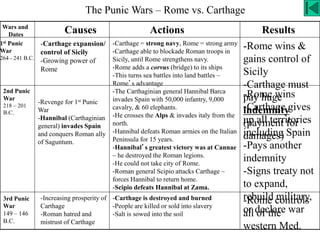
Wars and
Dates
ResultsActionsCauses
1st Punic
War
264 - 241 B.C.
3rd Punic
War
149 – 146
B.C.
2nd Punic
War
218 – 201
B.C.
-Carthage expansion/
control of Sicily
-Growing power of
Rome
-Carthage = strong navy, Rome = strong army
-Carthage able to blockade Roman troops in
Sicily, until Rome strengthens navy.

-Rome adds a corvus (bridge) to its ships
-This turns sea battles into land battles –
Rome’s advantage
-The Carthaginian general Hannibal Barca
invades Spain with 50,000 infantry, 9,000
cavalry, & 60 elephants.
-He crosses the Alps & invades italy from the
north.
-Hannibal defeats Roman armies on the Italian
Peninsula for 15 years.
-Hannibal’s greatest victory was at Cannae
– he destroyed the Roman legions.
-He could not take city of Rome.
-Roman general Scipio attacks Carthage –
forces Hannibal to return home.
-Scipio defeats Hannibal at Zama.
-Carthage is destroyed and burned
-People are killed or sold into slavery
-Salt is sowed into the soil
-Revenge for 1st Punic
War
-Hannibal (Carthaginian
general) invades Spain
and conquers Roman ally
of Saguntum.
-Increasing prosperity of
Carthage
-Roman hatred and
mistrust of Carthage
-Rome wins &
gains control of
Sicily
-Carthage must
pay huge
indemnity
(payment for
damages)
-Rome wins
-Carthage gives
up all territories
including Spain
-Pays another
indemnity
-Signs treaty not
to expand,
rebuild military,
or declare war
-Rome controls
all of the
western Med.
The Punic Wars – Rome vs. Carthage
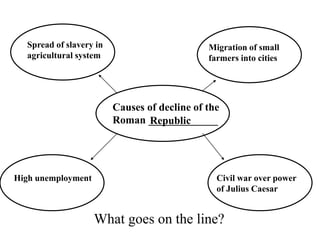
Republic
Spread of slavery in
agricultural system
Migration of small
farmers into cities
High unemployment Civil war over power
of Julius Caesar
What goes on the line?
Causes of decline of the
Roman _____________
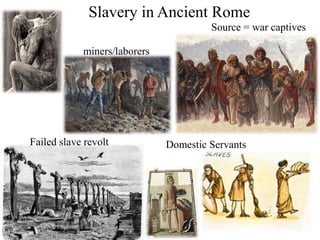
Slavery in Ancient Rome
Domestic Servants
Source = war captives
miners/laborers
Failed slave revolt
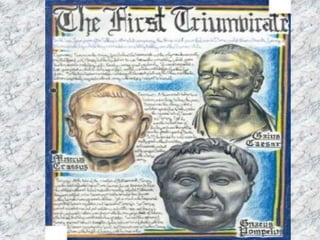
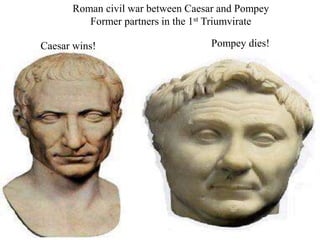
Roman civil war between Caesar and Pompey
Former partners in the 1st Triumvirate
Caesar wins! Pompey dies!
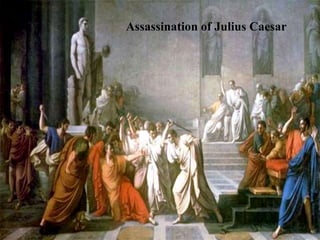
Assassination of Julius Caesar
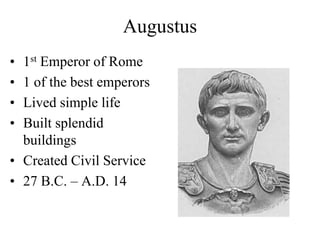
Augustus
• 1st Emperor of Rome
• 1 of the best emperors
• Lived simple life
• Built splendid
buildings
• Created Civil Service
• 27 B.C. – A.D. 14
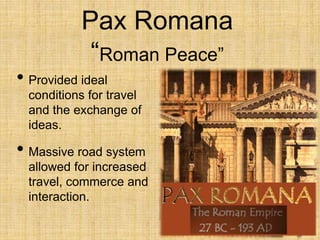
Pax Romana
“Roman Peace”
• Provided ideal
conditions for travel
and the exchange of
ideas.
• Massive road system
allowed for increased
travel, commerce and
interaction.
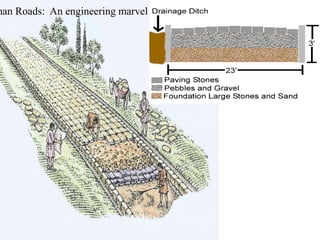
man Roads: An engineering marvel
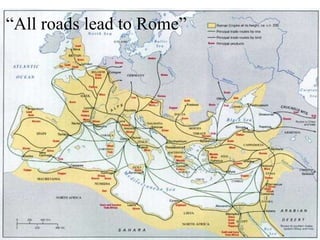
“All roads lead to Rome”
Contributions of
Ancient Rome
Architecture
Religion
Language
Literature
Art
Law
Law
Classical examples of Roman architecture
What is Greco-roman culture?
What is it often called?
Bas-Relief
Mosaics
Virgil
Ovid
Tacitus
Language of Rome?
Adoption by different people =
What was the long lasting impact of
Rome’s adoption of Christianity?
Arches -
Aqueducts -
Pantheon – Temple to the Gods
Coliseum
Forum
Summarize the 5 important
principles of Roman Law
What was the long-lasting impact of the Roman
Legal system?
Medicine Examples of Rome’s
Emphasis on Public Health
•Public baths
•Public water
systems
•Medical schools
New building material?
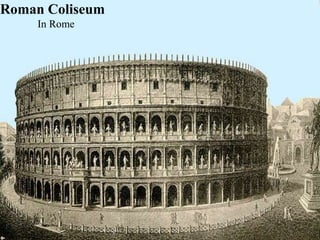
Roman Coliseum
In Rome
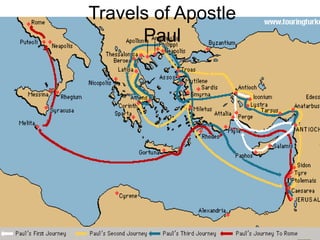
Travels of Apostle
Paul
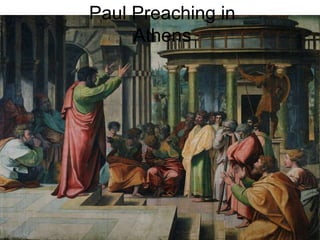
Paul Preaching in
Athens
Jesus and the Spread of Christianity
Rise of Christianity
A.D. 6 - Rome took control of Jewish kingdom of Judea, centered in Jerusalem.
Jesus was born around 6-4 B.C. in Bethlehem; raised in Nazareth
- Jesus was both a Jew and a Roman subject
- Took up trade of carpentry
- At 30, Jesus began ministry; for 3 years he preached, taught & healed
- His ideas contained ideas from Jewish tradition; monotheism, Ten
Commandments
- Jesus had 12 disciples; pupils/followers - later called apostles
- His message had great appeal to the poor; rejection of wealth and status,
and acceptance of everyone
A.D. 29 in Jerusalem - Death of Jesus
- Jewish priests deny Jesus is messiah; teachings were contempt for God.
- The Roman governor Pontius Pilate accused Jesus of challenging
authority of Rome
- According to Gospels - 3 days later, body was gone, he appeared to
followers, then ascended to heaven.
- Jesus becomes known as Jesus Christ from Greek Christos meaning
“messiah” or “savior”. Followers of teachings = Christians
- Christians were persecuted and killed for their beliefs
Apostles Spread Teachings
- Peter, one of the first apostles, spread teaching throughout Palestine and
Syria. Cross became symbol of beliefs.
- Paul – first opposed Christianity, then had vision of Christ, then
accepted beliefs & began teachings.
- Paul spread Christianity outside Palestine to Jews and Gentiles “non-Jews”
Emperors Contribution to the Spread of Christianity
- Constantine in A.D. 313 issued “Edict of Milan” allowing religious
freedom; ended persecution of Christians.
- Theodosius in A.D. 380 made Christianity the official religion of Roman Empire.
Christian Beliefs, Traditions, and Customs
- Monotheistic
- Trinity = Jesus as father, son, and holy spirit
- Life after death
- New Testament = accounts and teachings of Jesus & writings of early
Christians
- Christian doctrine established by early church councils
- Pope = head of Christian Church
- Bishop = head of all churches in one area
- Heresy = any belief or action that questioned the basic teachings
of the church.
Jewish Rebellions
- A.D. 66 Jews in Judea rebelled against Rome.
- Jewish fortress of Masada held out until A.D. 73; all committed suicide.
- Diaspora = Most Jews were exiled from their homelands.
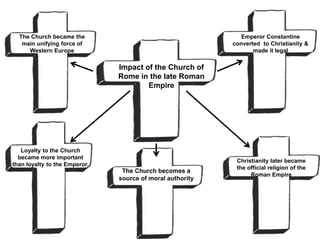
Loyalty to the Church
became more important
than loyalty to the Emperor.
Emperor Constantine
converted to Christianity &
made it legal
Christianity later became
the official religion of the
Roman Empire
The Church became the
main unifying force of
Western Europe
The Church becomes a
source of moral authority
Impact of the Church of
Rome in the late Roman
Empire
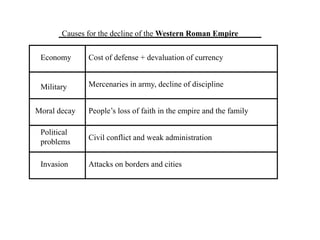
Western Roman Empire
Economy
Military
Moral decay
Political
problems
Invasion
Cost of defense + devaluation of currency
Mercenaries in army, decline of discipline
People’s loss of faith in the empire and the family
Civil conflict and weak administration
Attacks on borders and cities
Causes for the decline of the
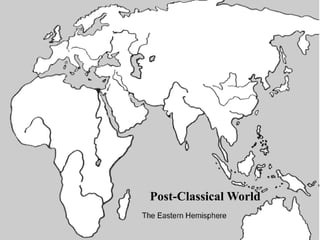
Post-Classical World
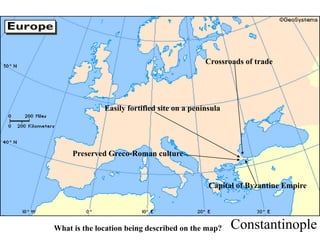
Constantinople
Crossroads of trade
Easily fortified site on a peninsula
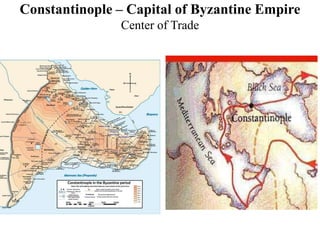
Capital of Byzantine Empire
Preserved Greco-Roman culture
What is the location being described on the map?
Constantinople – Capital of Byzantine Empire
Center of Trade
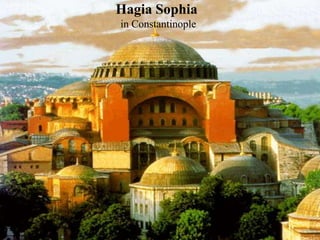
Hagia Sophia
in Constantinople
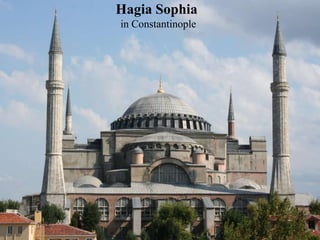
Hagia Sophia
in Constantinople
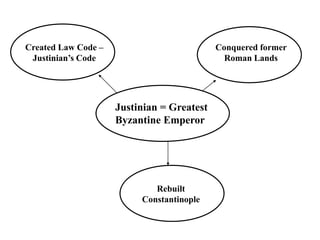
Created Law Code –
Justinian’s Code
Conquered former
Roman Lands
Rebuilt
Constantinople
Justinian = Greatest
Byzantine Emperor
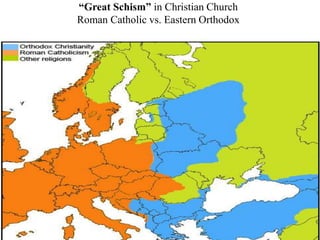
“Great Schism” in Christian Church
Roman Catholic vs. Eastern Orthodox
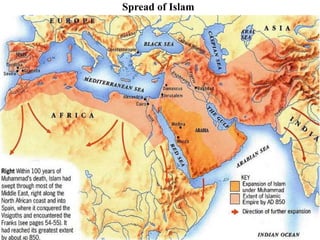
Spread of Islam
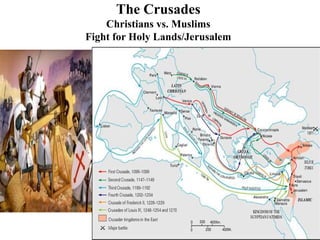
The Crusades
Christians vs. Muslims
Fight for Holy Lands/Jerusalem
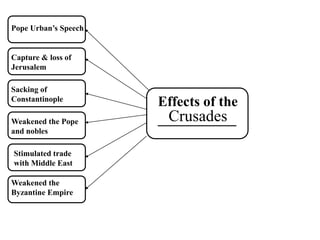
Crusades
Pope Urban’s Speech
Capture & loss of
Jerusalem
Sacking of
Constantinople
Weakened the Pope
and nobles
Stimulated trade
with Middle East
Weakened the
Byzantine Empire
Effects of the
___________
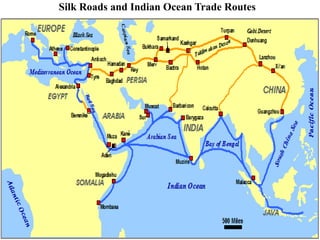
Silk Roads and Indian Ocean Trade Routes
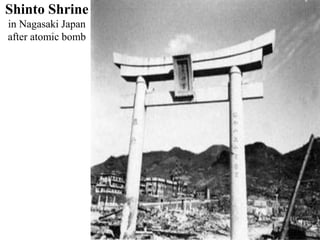
Shinto Shrine
in Nagasaki Japan
after atomic bomb
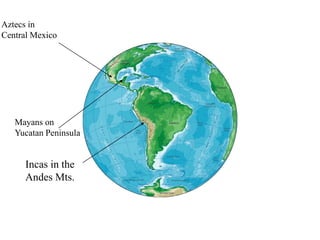
Incas in the
Andes Mts.
Mayans on
Yucatan Peninsula
Aztecs in
Central Mexico
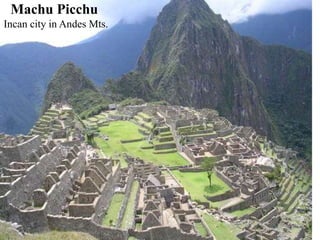
Machu Picchu
Incan city in Andes Mts.
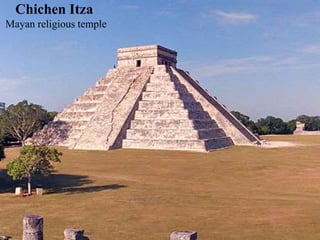
Chichen Itza
Mayan religious temple
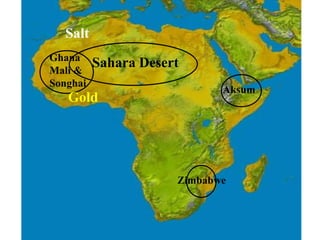
Sahara Desert
Aksum
Zimbabwe
Ghana
Mali &
Songhai
Gold
Salt
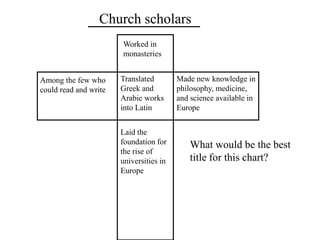
Church scholars
Among the few who
could read and write
Worked in
monasteries
Translated
Greek and
Arabic works
into Latin
Made new knowledge in
philosophy, medicine,
and science available in
Europe
Laid the
foundation for
the rise of
universities in
Europe
What would be the best
title for this chart?
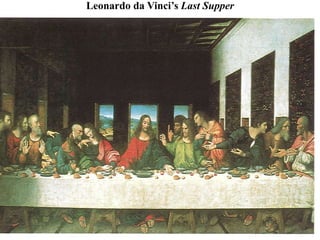
Leonardo da Vinci’s Last Supper
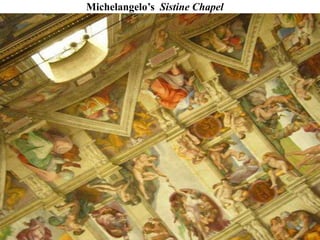
Michelangelo’s Sistine Chapel
Johann Gutenburg’s Printing Press
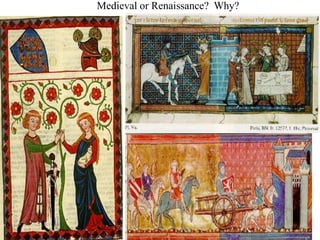
Medieval or Renaissance? Why?
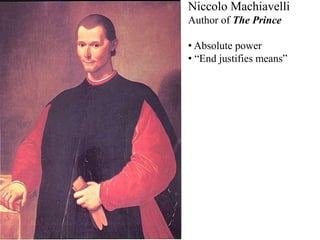
Niccolo Machiavelli
Author of The Prince
• Absolute power
• “End justifies means”
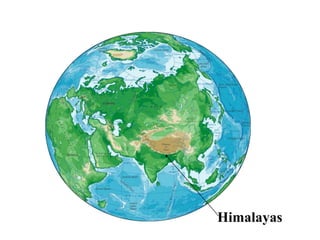
Himalayas
WH I SOL Review PowerPoint

WH I SOL Review PowerPoint

  • 2.
  • 3.
  • 4.
  • 5.
  • 6.
  • 7.
  • 8.
  • 9.
    Stonehenge in southern England Startedin Neolithic Age: Completed in Bronze Age
  • 10.
  • 11.
  • 12.
    Scribe • Professional recordkeeper in early civilizations See cuneiform Hammurabi’s Code 1st written Law Code!!
  • 13.
    River Valley Civilizations Egypt,Mesopotamia, India, China
  • 14.
  • 15.
    River Valley Civilizations Cuneiform– Sumer = 1st writing Hieroglyphics - Egypt Pictograms – Indus Valley Oracle bones – Shang China
  • 16.
  • 17.
  • 18.
  • 19.
  • 20.
    Christianity Had roots inJudaism Led/founded by Jesus New Testament monotheistic Conflicted with polytheistic Beliefs of Roman Empire
  • 21.
    Hinduism Caste system in religiouslaw Belief in many forms of one deity Belief in reincarnation Ideas of Karma and final goal of Moksha What goes in the center oval?
  • 22.
    Buddhism! Siddhartha Gautama “TheBuddha” Enlightened One Eightfold (8) Path
  • 23.
    D - 100 Confucianism Beliefthat humans are good, not bad Code of politeness, still used in China today Ancestor worship Respect for elders What goes in the center box?
  • 24.
    Muhammad = prophet/founder Quran= Holy book Mecca = Holy City Muslim = follower Five Pillars = Guidelines of religion Contributions = Arabic numerals, algebra What is this religion? Islam
  • 26.
    Kaaba in Mecca Whatis it? Where is it? Religion? Kaaba Mecca Islam
  • 27.
    Dome of theRock Islamic Shrine in Jerusalem
  • 28.
  • 29.
    Persian_________ Empire Tolerance of conquered people Developmentof Imperial bureaucracy Zoroastrianism as a religion Royal Road system What goes on the line?
  • 31.
    Cyrus the Great •1stgreat king of Persian Empire •Ruled subjects with Tolerance •Respected religions of others
  • 32.
    Darius I • Createdimperial bureaucracy •Divided empire into 20 provinces •Established idea of nationalities •Greatest failure = could not conquer Greece
  • 33.
    Darius fails toconquer Greece
  • 34.
    Zoroaster – founderof Persian religion Persian prophet; Founder of Zoroastrianism Good vs. Evil
  • 35.
    Key Concepts ofHebrews, Phoenicians and Persians Hebrews PersiansPhoenicians New religious principle= Monotheism (1 God) Covenant = promise between god and humanity Torah = Holy writings/Religious text Ten Commandments = Guiding principles Moses = lead Hebrews out of Egypt (Exodus) Nation of Israel created shortly after First major sea traders of the Mediterranean Sea. Established many trading colonies throughout Mediterranean region. Created Alphabet = foundation of Western alphabet; spread knowledge & ideas Treatment of conquered people = Tolerance; keep self-rule, culture, religion Persian Religion = Zoroastrianism – Founded by Zoroaster - Persian prophet
  • 36.
    What type ofreligion? Polytheism!
  • 37.
  • 38.
    Impact of Geographyon Ancient Greece Table of Contents Big Question – How did the geography of Greece shape economic, social, and political development and patterns of trade and colonization? Mountains covered 75 % of terrain, separating Greece into small isolated regions. City-states develop. No central government! Scarcity of level land for farming grains caused rivalries between city-states. Rugged, hilly terrain was ideal for growing crops such as grapes and olives. Many deep harbors and calm waters invited sea trade. Overseas trade and travel made easy by many seas, islands, and coastal settlements. Lack of resources and farmland + overpopulation forced Greeks to establish colonies.
  • 39.
    Athens vs. Sparta Twocity-states with very different views Table of Contents Athens Sparta Type of Government Government participation Education and military duty Position of women 5.2 Wkbk Democracy Oligarchy Assembly = All citizens; Assembly passed laws + served as supreme court Council of 500 – randomly chosen - proposed laws Boys – school from age 7-18 •Studied literature, math, drawing, music, & rhetoric •At 18 – served 2 years in military •Strongest Greek navy Girls – no formal ed. •Learned household duties: weaving, baking, child care •No gov’t participation! Council of Elders – proposed laws Assembly – elected officials, voted on issues Ephors – carried out laws; courts 2 kings – commanded military Life revolved around military! •Boys – Age 7, went to military barracks; learned to read, write & use weapons. Soldiers from 20-60 •Strongest Greek army Expected to be healthy & strong = healthy babies •Gymnastics, boxing, wrestling •More personal rights than other women •Still, no gov’t participation
  • 40.
    The Persian Wars Greekcity-states vs. Persian Empire 490 – 479 B.C. Table of Contents Persian War organizer 1st Persian War •Begins with Ionian Revolt 2nd Persian War •Battle of Thermopylae •Battle of Marathon •Battle of Salamis •Battle of Plataea
  • 41.
  • 42.
  • 43.
  • 44.
    The Peloponnesian War Athen’sDelian League vs. Sparta’s Peloponnesian League Table of Contents Notes Delian League Peloponnesian League
  • 45.
    Alexander the Great;Conqueror of the Persian Empire Macedonian Conquest of Greece and the Rise of Alexander the Great Table of Contents Notes
  • 46.
    Back to ConquestMap Back to Notes
  • 47.
    Ptolemy and Geocentric(earth-centered) Theory Hellenistic (Greek-Like) Age Begins with Alexander’s Conquests Law of the Lever Archimedes
  • 48.
  • 49.
  • 50.
    50 Roman Republic Patricians & Plebeians Twelve Tables 1st Law Code Punic Wars Romevs. Carthage Pax Romana “Roman Peace” Rise of Christianity Fall of Rome - Invasions Classical Rome
  • 51.
    Roman Mythology What wasthe source of Roman mythology? Roman mythology was based on the Greek polytheistic religion. Used to explain natural phenomena and life events. Romans adopted Greek gods and gave them Latin names. Greek Mythology Website link
  • 52.
    Rome and Carthageprior to Punic Wars
  • 53.
    2 Consuls •Oversaw gov’t •Commanded army •Eachhad veto power •1 patrician & 1 plebeian •One year terms Senate •Mainly patrician •Controls foreign and financial policies •Advise consuls •Life terms Tribunes •Representatives of the plebeians Citizen Assemblies Government features of the representative Roman Republic Centuriate Assembly •Citizen-soldiers •Select consuls & make laws Tribal Assembly •All other citizens •Elect tribunes, make laws Dictator? Why? •In times of crisis, a dictator could be chosen. •Dictator would have absolute power to make laws & control the army. •Power lasted only 6 months “Twelve Tables” • 1st written law code of Republic! • Written on 12 tablets or “tables” and displayed in the Forum • Established idea that all free citizens had a right to the protection of the law. • Basis for later Roman law! Citizenship = Patrician & Plebeian men, selected foreigners; rights/responsibilities = taxes & military service
  • 55.
    Wars and Dates ResultsActionsCauses 1st Punic War 264- 241 B.C. 3rd Punic War 149 – 146 B.C. 2nd Punic War 218 – 201 B.C. -Carthage expansion/ control of Sicily -Growing power of Rome -Carthage = strong navy, Rome = strong army -Carthage able to blockade Roman troops in Sicily, until Rome strengthens navy. -Rome adds a corvus (bridge) to its ships -This turns sea battles into land battles – Rome’s advantage -The Carthaginian general Hannibal Barca invades Spain with 50,000 infantry, 9,000 cavalry, & 60 elephants. -He crosses the Alps & invades italy from the north. -Hannibal defeats Roman armies on the Italian Peninsula for 15 years. -Hannibal’s greatest victory was at Cannae – he destroyed the Roman legions. -He could not take city of Rome. -Roman general Scipio attacks Carthage – forces Hannibal to return home. -Scipio defeats Hannibal at Zama. -Carthage is destroyed and burned -People are killed or sold into slavery -Salt is sowed into the soil -Revenge for 1st Punic War -Hannibal (Carthaginian general) invades Spain and conquers Roman ally of Saguntum. -Increasing prosperity of Carthage -Roman hatred and mistrust of Carthage -Rome wins & gains control of Sicily -Carthage must pay huge indemnity (payment for damages) -Rome wins -Carthage gives up all territories including Spain -Pays another indemnity -Signs treaty not to expand, rebuild military, or declare war -Rome controls all of the western Med. The Punic Wars – Rome vs. Carthage
  • 56.
    Republic Spread of slaveryin agricultural system Migration of small farmers into cities High unemployment Civil war over power of Julius Caesar What goes on the line? Causes of decline of the Roman _____________
  • 57.
    Slavery in AncientRome Domestic Servants Source = war captives miners/laborers Failed slave revolt
  • 59.
    Roman civil warbetween Caesar and Pompey Former partners in the 1st Triumvirate Caesar wins! Pompey dies!
  • 60.
  • 61.
    Augustus • 1st Emperorof Rome • 1 of the best emperors • Lived simple life • Built splendid buildings • Created Civil Service • 27 B.C. – A.D. 14
  • 62.
    Pax Romana “Roman Peace” •Provided ideal conditions for travel and the exchange of ideas. • Massive road system allowed for increased travel, commerce and interaction.
  • 63.
    man Roads: Anengineering marvel
  • 64.
  • 65.
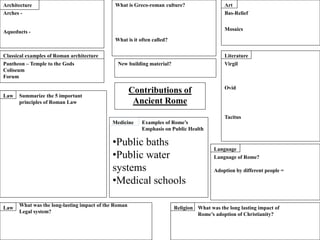
    Contributions of Ancient Rome Architecture Religion Language Literature Art Law Law Classicalexamples of Roman architecture What is Greco-roman culture? What is it often called? Bas-Relief Mosaics Virgil Ovid Tacitus Language of Rome? Adoption by different people = What was the long lasting impact of Rome’s adoption of Christianity? Arches - Aqueducts - Pantheon – Temple to the Gods Coliseum Forum Summarize the 5 important principles of Roman Law What was the long-lasting impact of the Roman Legal system? Medicine Examples of Rome’s Emphasis on Public Health •Public baths •Public water systems •Medical schools New building material?
  • 66.
  • 67.
  • 68.
  • 69.
    Jesus and theSpread of Christianity Rise of Christianity A.D. 6 - Rome took control of Jewish kingdom of Judea, centered in Jerusalem. Jesus was born around 6-4 B.C. in Bethlehem; raised in Nazareth - Jesus was both a Jew and a Roman subject - Took up trade of carpentry - At 30, Jesus began ministry; for 3 years he preached, taught & healed - His ideas contained ideas from Jewish tradition; monotheism, Ten Commandments - Jesus had 12 disciples; pupils/followers - later called apostles - His message had great appeal to the poor; rejection of wealth and status, and acceptance of everyone A.D. 29 in Jerusalem - Death of Jesus - Jewish priests deny Jesus is messiah; teachings were contempt for God. - The Roman governor Pontius Pilate accused Jesus of challenging authority of Rome - According to Gospels - 3 days later, body was gone, he appeared to followers, then ascended to heaven. - Jesus becomes known as Jesus Christ from Greek Christos meaning “messiah” or “savior”. Followers of teachings = Christians - Christians were persecuted and killed for their beliefs
  • 70.
    Apostles Spread Teachings -Peter, one of the first apostles, spread teaching throughout Palestine and Syria. Cross became symbol of beliefs. - Paul – first opposed Christianity, then had vision of Christ, then accepted beliefs & began teachings. - Paul spread Christianity outside Palestine to Jews and Gentiles “non-Jews” Emperors Contribution to the Spread of Christianity - Constantine in A.D. 313 issued “Edict of Milan” allowing religious freedom; ended persecution of Christians. - Theodosius in A.D. 380 made Christianity the official religion of Roman Empire. Christian Beliefs, Traditions, and Customs - Monotheistic - Trinity = Jesus as father, son, and holy spirit - Life after death - New Testament = accounts and teachings of Jesus & writings of early Christians - Christian doctrine established by early church councils - Pope = head of Christian Church - Bishop = head of all churches in one area - Heresy = any belief or action that questioned the basic teachings of the church. Jewish Rebellions - A.D. 66 Jews in Judea rebelled against Rome. - Jewish fortress of Masada held out until A.D. 73; all committed suicide. - Diaspora = Most Jews were exiled from their homelands.
  • 71.
    Loyalty to theChurch became more important than loyalty to the Emperor. Emperor Constantine converted to Christianity & made it legal Christianity later became the official religion of the Roman Empire The Church became the main unifying force of Western Europe The Church becomes a source of moral authority Impact of the Church of Rome in the late Roman Empire
  • 72.
    Western Roman Empire Economy Military Moraldecay Political problems Invasion Cost of defense + devaluation of currency Mercenaries in army, decline of discipline People’s loss of faith in the empire and the family Civil conflict and weak administration Attacks on borders and cities Causes for the decline of the
  • 73.
  • 74.
    Constantinople Crossroads of trade Easilyfortified site on a peninsula Capital of Byzantine Empire Preserved Greco-Roman culture What is the location being described on the map?
  • 75.
    Constantinople – Capitalof Byzantine Empire Center of Trade
  • 76.
  • 77.
  • 78.
    Created Law Code– Justinian’s Code Conquered former Roman Lands Rebuilt Constantinople Justinian = Greatest Byzantine Emperor
  • 79.
    “Great Schism” inChristian Church Roman Catholic vs. Eastern Orthodox
  • 80.
  • 81.
    The Crusades Christians vs.Muslims Fight for Holy Lands/Jerusalem
  • 82.
    Crusades Pope Urban’s Speech Capture& loss of Jerusalem Sacking of Constantinople Weakened the Pope and nobles Stimulated trade with Middle East Weakened the Byzantine Empire Effects of the ___________
  • 83.
    Silk Roads andIndian Ocean Trade Routes
  • 84.
    Shinto Shrine in NagasakiJapan after atomic bomb
  • 85.
    Incas in the AndesMts. Mayans on Yucatan Peninsula Aztecs in Central Mexico
  • 86.
  • 87.
  • 88.
  • 89.
    Church scholars Among thefew who could read and write Worked in monasteries Translated Greek and Arabic works into Latin Made new knowledge in philosophy, medicine, and science available in Europe Laid the foundation for the rise of universities in Europe What would be the best title for this chart?
  • 90.
  • 91.
  • 92.
  • 93.
  • 94.
    Niccolo Machiavelli Author ofThe Prince • Absolute power • “End justifies means”
  • 95.