JULIUS CAESAR
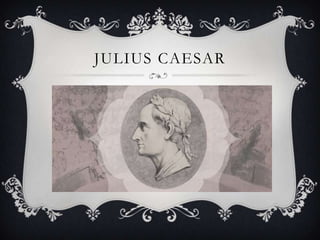
JULIUS CAESAR
 Played a large role in the demise of the Roman Republic—he was
the last dictator—and rise of Roman Empire
 Gallic Wars = unmatched military power
 Was assassinated in 44 B.C. (Ides of March) by conspirators
fearing he would become king
JULIUS CAESAR
“I only know that I know
nothing.”
- socrates
• classical Greek philosopher
• main founder of Western philosophy
• social and moral critic, was convicted
of corrupting the minds of the youth
• sentenced to death in 399 B.C.
socrate
s
socrates
socratic method i.e. method for
debate using a series of questions to
force your opponent to think critically
and agree with you
mentored Plato, another famous
ancient Greek philosopher
{
plato
Ancient Greek philosopher and mathematician
{
“Wise men talk because they
have something to say; fools
because they have to say
something.” – Plato
• Profound effect on Western philosophy and science
• Founded the Academy, first institution of higher
learning in the Western world
• Mentored Aristotle
• Died c. 348-347 B.C.
{Plato
• Ancient Greek philosopher
• Teacher of Alexander the Great
• Master of physics, government,
poetry, music, biology, and more
• Profound influence on Christian
theology and Western ideas
• Died in 322 B.C.
Aristotle
Pax Romana
• Period from the beginning of Augustus’
reign until the death of Marcus Aurelius
(27 B.C. to A.D. 180)
• “Roman Peace”
Paterfamilias
• absolute rule over his
household and
children
Rise of the Christianity in the late
Roman Empire
• Judea
• Based on the teachings of Jesus
• Christianity spread to all parts of the
Roman Empire
Collapse of Roman Empire
Greece
• Geographical influence - disadvantageous
for Greece
• Minoan culture was an important influence
on Greeks
• Mycenaean age - period where Greece
was dominated by invaders
• After reign of kings & tyrants, cities
adopted governments or democracies
Greek city-state
• Polis – Greek for city-state, originally
meant a fort
1. Small size
2. Small population
3. Original polis
4. Agora (public meeting place)
• Different developments through different
governments
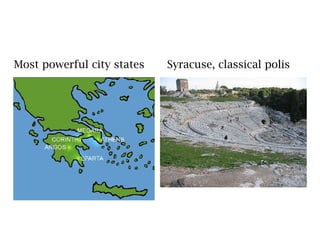
Most powerful city states Syracuse, classical polis
Alexander the Great
• conquered entire Persian empire
• made the possible development of
Hellenistic culture
• his empire was divided into three
kingdoms - Macedonia, Egypt, Syria
Hellenistic Culture
• Based on Greek ideas & features from
other cultures of Mediterranean region
• introduced through conquests of
Alexander the Great
• contributions to our understanding of
various subjects (Mathematics, science,
etc) remained influential to the world for
more than 1000 years
Rome
• lasted over 1200 years (753BC - AD 476)
• had great power & organization
• Romans dominated entire Mediterranean region
• early Rome - republic
• most important governing bodies [Senate,
Assembly of Centuries, & Assembly of Tribes]
• plebeians had many rights after struggle of order,
but nobility controlled the republic
Caesar Augustus
• succeeded Julius Caesar
• 1st emperor
• under his reign, Rome became an
empire, not a republic
Roman Empire
• continues to influence throughout the world
• roman buildings inspired architects
(Michelangelo)
• Roman law - adopted by many European
countries
• language (Latin) became origin of many
languages
Roman Republic
• In the early Roman Republic, voters elected their leaders.
• Assembly of Centuries, Assembly of Tribes, and the Senate helped govern
Rome.
• Assembly of Centuries: in charge of electing public officials to oversee the
daily affairs of government.
• Assembly of Tribes: consisted of citizens who elected 10 officials, called
tribunes. These people vetoed Senate Bills and the actions of public officials
if it was opposing to public interest.
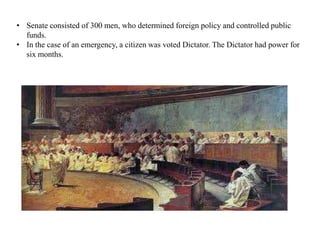
• Senate consisted of 300 men, who determined foreign policy and controlled public
funds.
• In the case of an emergency, a citizen was voted Dictator. The Dictator had power for
six months.
• Patricians: a powerful aristocratic class who gained control of the
government.
• Plebeians: regular Citizens.
• Plebeians were discriminated in many ways. They were
prevented by laws to hold public offices and marry patricians.
• Laws weren’t written down, so many plebeians didn’t know
what they stated.
• Things changed when plebeians forced the government to
write the laws down. Since then, Plebeians had power!
The Twelve Tables
The Twelve Tables were the earliest code of Roman civil, criminal, and religious
law, publicized in 451-450 bc
LAWS OF THE TWELVE TABLES
1.If you are called to go to court, you must go. If you don’t show up, you can be taken
to court by force.
2. If you need a witness to testify and he will not show up, you can go once every three
days and shout in front of his house
3.Should a tree on a neighbor's farm be bent crooked by the wind and lean over your
farm, you may take legal action for removal of that tree.
4.If it's your tree, it’s your fruit, even if it falls on another man’s land.
5.A person who had been found guilty of giving false witness shall be hurled down
from the Tarpeian Rock.
6.No person shall hold meetings by night in the city.
7.A dead man shall not be buried or burned within the city.
8.Marriages should not take place between plebeians and patricians.
Table 4:Paternal Power
• If a child is notably deformed, he shall be killed immediately.
Table 7: Real Property
• Should a tree on a neighbor's farm be bent crooked by the wind and lean over onto
your farm, you may take legal action for removal of that tree.
• If it's your tree, it’s your fruit, even if it falls on another man’s land.
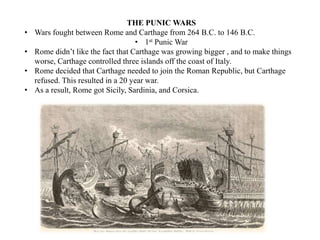
THE PUNIC WARS
• Wars fought between Rome and Carthage from 264 B.C. to 146 B.C.
• 1st Punic War
• Rome didn’t like the fact that Carthage was growing bigger , and to make things
worse, Carthage controlled three islands off the coast of Italy.
• Rome decided that Carthage needed to join the Roman Republic, but Carthage
refused. This resulted in a 20 year war.
• As a result, Rome got Sicily, Sardinia, and Corsica.
2nd PUNIC WAR
• Began in 218 B.C. and ended 201 B.C.
• Hannibal attacked the southern Italian countryside for 15 years.
• As a result, Rome attacked Carthage (the hometown of Hannibal).
• Hannibal tried to defend Carthage, but was defeated and asked for peace.
• Carthage had to pay $1,000 in war damages and had to give up their Spanish colonies.
3rd PUNIC WAR
• Began in 149 B.C. and ended 146 B.C.
• Rome attacked Carthage and seized it for three years.
• This resulted in the city
Sparta
• Dorians conquered the city of Sparta in about
1200 B.C.
• Devoted their culture to a militaristic idea
• Social groups: Dorian invader descendants,
“neighbors” and helots
• Government: had an Assembly elected by all
citizens, Council of Elders, and two ceremonial
kings
• Same basic aim: make every adult male citizen
part of an efficient military machine to control
helots and extend Spartan power
Athens: Birth of Democracy
• No military class of conquering invaders
• Athenians were sea traders
• Social groups: citizens, metics, slaves
• Early government: aristocratic
• Four reformers: Draco, Solon, Pisistratus, and
Cleisthenes
Pericles and Democracy
• Greatest
Athenian leader
• Led Athens from
461 B.C. to 429
B.C. (often called
Age of Pericles)
• Led Athenian
democracy to its
height
The Peloponnesian War
• Spartans started the fighting but the
Athenians provoked them into action
• Mostly took place in the Peloponneus
• Terrible plague broke out among Athenians
• Athens surrendered to the Spartans in 404
B.C.

Presentation1

  • 1.
  • 2.
    JULIUS CAESAR  Playeda large role in the demise of the Roman Republic—he was the last dictator—and rise of Roman Empire  Gallic Wars = unmatched military power  Was assassinated in 44 B.C. (Ides of March) by conspirators fearing he would become king
  • 3.
  • 4.
    “I only knowthat I know nothing.” - socrates
  • 5.
    • classical Greekphilosopher • main founder of Western philosophy • social and moral critic, was convicted of corrupting the minds of the youth • sentenced to death in 399 B.C. socrate s
  • 6.
    socrates socratic method i.e.method for debate using a series of questions to force your opponent to think critically and agree with you mentored Plato, another famous ancient Greek philosopher
  • 7.
  • 8.
    { “Wise men talkbecause they have something to say; fools because they have to say something.” – Plato • Profound effect on Western philosophy and science • Founded the Academy, first institution of higher learning in the Western world • Mentored Aristotle • Died c. 348-347 B.C.
  • 9.
  • 11.
    • Ancient Greekphilosopher • Teacher of Alexander the Great • Master of physics, government, poetry, music, biology, and more • Profound influence on Christian theology and Western ideas • Died in 322 B.C. Aristotle
  • 12.
    Pax Romana • Periodfrom the beginning of Augustus’ reign until the death of Marcus Aurelius (27 B.C. to A.D. 180) • “Roman Peace”
  • 13.
    Paterfamilias • absolute ruleover his household and children
  • 14.
    Rise of theChristianity in the late Roman Empire • Judea • Based on the teachings of Jesus • Christianity spread to all parts of the Roman Empire
  • 15.
  • 16.
    Greece • Geographical influence- disadvantageous for Greece • Minoan culture was an important influence on Greeks • Mycenaean age - period where Greece was dominated by invaders • After reign of kings & tyrants, cities adopted governments or democracies
  • 17.
    Greek city-state • Polis– Greek for city-state, originally meant a fort 1. Small size 2. Small population 3. Original polis 4. Agora (public meeting place) • Different developments through different governments
  • 18.
    Most powerful citystates Syracuse, classical polis
  • 19.
    Alexander the Great •conquered entire Persian empire • made the possible development of Hellenistic culture • his empire was divided into three kingdoms - Macedonia, Egypt, Syria
  • 20.
    Hellenistic Culture • Basedon Greek ideas & features from other cultures of Mediterranean region • introduced through conquests of Alexander the Great • contributions to our understanding of various subjects (Mathematics, science, etc) remained influential to the world for more than 1000 years
  • 21.
    Rome • lasted over1200 years (753BC - AD 476) • had great power & organization • Romans dominated entire Mediterranean region • early Rome - republic • most important governing bodies [Senate, Assembly of Centuries, & Assembly of Tribes] • plebeians had many rights after struggle of order, but nobility controlled the republic
  • 22.
    Caesar Augustus • succeededJulius Caesar • 1st emperor • under his reign, Rome became an empire, not a republic
  • 23.
    Roman Empire • continuesto influence throughout the world • roman buildings inspired architects (Michelangelo) • Roman law - adopted by many European countries • language (Latin) became origin of many languages
  • 24.
    Roman Republic • Inthe early Roman Republic, voters elected their leaders. • Assembly of Centuries, Assembly of Tribes, and the Senate helped govern Rome. • Assembly of Centuries: in charge of electing public officials to oversee the daily affairs of government. • Assembly of Tribes: consisted of citizens who elected 10 officials, called tribunes. These people vetoed Senate Bills and the actions of public officials if it was opposing to public interest.
  • 25.
    • Senate consistedof 300 men, who determined foreign policy and controlled public funds. • In the case of an emergency, a citizen was voted Dictator. The Dictator had power for six months.
  • 26.
    • Patricians: apowerful aristocratic class who gained control of the government. • Plebeians: regular Citizens. • Plebeians were discriminated in many ways. They were prevented by laws to hold public offices and marry patricians. • Laws weren’t written down, so many plebeians didn’t know what they stated. • Things changed when plebeians forced the government to write the laws down. Since then, Plebeians had power!
  • 27.
    The Twelve Tables TheTwelve Tables were the earliest code of Roman civil, criminal, and religious law, publicized in 451-450 bc
  • 28.
    LAWS OF THETWELVE TABLES 1.If you are called to go to court, you must go. If you don’t show up, you can be taken to court by force. 2. If you need a witness to testify and he will not show up, you can go once every three days and shout in front of his house 3.Should a tree on a neighbor's farm be bent crooked by the wind and lean over your farm, you may take legal action for removal of that tree. 4.If it's your tree, it’s your fruit, even if it falls on another man’s land. 5.A person who had been found guilty of giving false witness shall be hurled down from the Tarpeian Rock. 6.No person shall hold meetings by night in the city. 7.A dead man shall not be buried or burned within the city. 8.Marriages should not take place between plebeians and patricians.
  • 29.
    Table 4:Paternal Power •If a child is notably deformed, he shall be killed immediately. Table 7: Real Property • Should a tree on a neighbor's farm be bent crooked by the wind and lean over onto your farm, you may take legal action for removal of that tree. • If it's your tree, it’s your fruit, even if it falls on another man’s land.
  • 30.
    THE PUNIC WARS •Wars fought between Rome and Carthage from 264 B.C. to 146 B.C. • 1st Punic War • Rome didn’t like the fact that Carthage was growing bigger , and to make things worse, Carthage controlled three islands off the coast of Italy. • Rome decided that Carthage needed to join the Roman Republic, but Carthage refused. This resulted in a 20 year war. • As a result, Rome got Sicily, Sardinia, and Corsica.
  • 31.
    2nd PUNIC WAR •Began in 218 B.C. and ended 201 B.C. • Hannibal attacked the southern Italian countryside for 15 years. • As a result, Rome attacked Carthage (the hometown of Hannibal). • Hannibal tried to defend Carthage, but was defeated and asked for peace. • Carthage had to pay $1,000 in war damages and had to give up their Spanish colonies.
  • 32.
    3rd PUNIC WAR •Began in 149 B.C. and ended 146 B.C. • Rome attacked Carthage and seized it for three years. • This resulted in the city
  • 33.
    Sparta • Dorians conqueredthe city of Sparta in about 1200 B.C. • Devoted their culture to a militaristic idea • Social groups: Dorian invader descendants, “neighbors” and helots • Government: had an Assembly elected by all citizens, Council of Elders, and two ceremonial kings • Same basic aim: make every adult male citizen part of an efficient military machine to control helots and extend Spartan power
  • 34.
    Athens: Birth ofDemocracy • No military class of conquering invaders • Athenians were sea traders • Social groups: citizens, metics, slaves • Early government: aristocratic • Four reformers: Draco, Solon, Pisistratus, and Cleisthenes
  • 35.
    Pericles and Democracy •Greatest Athenian leader • Led Athens from 461 B.C. to 429 B.C. (often called Age of Pericles) • Led Athenian democracy to its height
  • 36.
    The Peloponnesian War •Spartans started the fighting but the Athenians provoked them into action • Mostly took place in the Peloponneus • Terrible plague broke out among Athenians • Athens surrendered to the Spartans in 404 B.C.