Greece and Rome
Unit 2 Notes
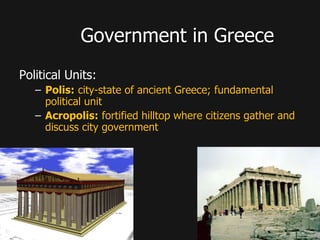
Government in Greece
Political Units:
– Polis: city-state of ancient Greece; fundamental
political unit
– Acropolis: fortified hilltop where citizens gather and
discuss city government
Athens and Sparta
A. Athens:
1. Attica Peninsula
2. Democracy: rule by the people
1. Wealthy boys only ones educated
B. Sparta:
1. Southern Greece/Gulf of Corinth
2. Helots
3. Military state
4. Boys and Girls trained
Sparta
• Sparta was small with a huge slave population
called helots
• All boys and girls educated- women considered
equals
• Military education, Farming economy
• Closed society- very paranoid- did not like outsiders
• No wall around city
• “Come back carrying your shield, or come back on
it.”
• Government: Oligarchy
– Small group voted on ideas
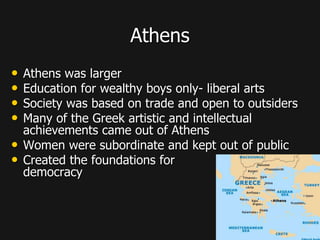
Athens
• Athens was larger
• Education for wealthy boys only- liberal arts
• Society was based on trade and open to outsiders
• Many of the Greek artistic and intellectual
achievements came out of Athens
• Women were subordinate and kept out of public
• Created the foundations for
democracy
Religion
• Polytheistic – 12 Chief Gods who were
believed to live on Mount Olympus
– Zeus, Hera, Athena, Apollo, Ares, Aphrodite,
Poseidon, Hades
• Believed in Oracles – where gods revealed
their plans to the priest
• Festivals were often held to please the
Gods
The Olympic Games
Ancient Olympics
• Honored Zeus
• In Olympia
• Chariot races, boxing, javelin,
discus , etc.
• Statues of cheaters
Greek Art
• Golden Age: growth of intellectual and
artistic learning
• Classical Art: portrays ideal beauty;
serenity, gracefulness
• Tragedies – Examined problems such as
the struggle between good and evil
– Oedipus Rex
Greek Art
Drama:
1. Tragedy: serious drama with a tragic flaw
2. Comedy: humorous
Homer: greatest storyteller of Greece
• The Iliad
• The Odyssey
Myths: traditional stories about Greek gods
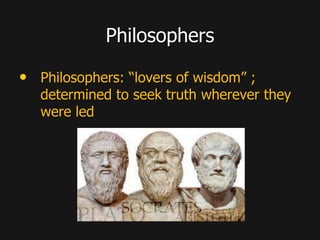
Philosophers
• Philosophers: “lovers of wisdom” ;
determined to seek truth wherever they
were led
Philosophers
Socrates
• Believed the goal of
education was only to
improve the individual
• Socratic Method – uses
a question/answer
format to lead his pupils
• Was accused and
convicted of corrupting
the youth by teaching
them to think for
themselves.
• He was sentenced to
death - Poison
“The unexamined life is
not worth living”
Philosophers
Plato
• Student of Socrates
• Fascinated with Reality
– How do we know what is real?
• The Republic – Establishes his
ideal gov’t
– Upper-class: Kings & Philosophers -
Wisdom
– Warriors - Courage
– The Masses - Desires
Philosophers
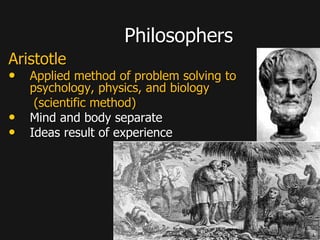
Aristotle
• Applied method of problem solving to
psychology, physics, and biology
(scientific method)
• Mind and body separate
• Ideas result of experience
Day 2 – Greek Wars
Persian Wars
Persian Wars
– Greece vs. Persia at Ionia; coast of Anatolia
– The Persians were seeking revenge for the
Athenians assistance in helping a Persian city-
state revolt
– 10,000 Greeks (Athenians) vs. 25,000
Persians
– Athenians arranged in Phalanx: ea. Soldier
stood side by side with spear and shield
– Athenians (Greeks) win
– Pheidippides runs from Marathon to Athens
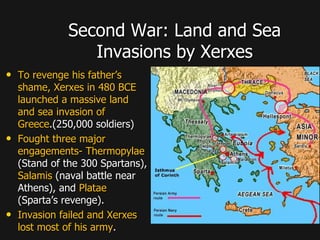
Second War: Land and Sea
Invasions by Xerxes
• To revenge his father’s
shame, Xerxes in 480 BCE
launched a massive land
and sea invasion of
Greece.(250,000 soldiers)
• Fought three major
engagements- Thermopylae
(Stand of the 300 Spartans),
Salamis (naval battle near
Athens), and Platae
(Sparta’s revenge).
• Invasion failed and Xerxes
lost most of his army.
Legacy of Persian Wars
• Greece now considered a Mediterranean power.
Athens and Sparta become the dominant city
states.
• Athens enters a “Golden Age” of intellectual and
artistic achievements.
• Jealously over Athenian dominance of Delian
League led to 25 years of civil warfare in
Greece. Athens vs. Sparta (Peloponnesian Wars)
• Leaves Greece open to foreign invasion-
Macedonia under King Philip invades and unites
Greek city-states under one king.
Peloponnesian War
• Civil War between Athens and Sparta
– Athenians planned to stay behind their walls
and only send out an Army for protection
– Plague hit 1/3 of population dies
– War last for 25 years
– Both sides were weakened and eventually
leads to the civilizations downfall.
Alexander the Great
• Peloponnesian War
weakened Greek city-states
• Philip II becomes king
• Killed at wedding
• Alexander becomes king
(20 yrs old)
• Student of Aristotle
• Expands the empire: Persia, Egypt
(Alexandria), Mesopotamia, Indus
Valley, Arabia
• Dies of Malaria (32 yrs old)
Alexander the Great
• Alexander the Great’s Legacy
– 3 different Greeks gain control of the Empire
• Antigonous of Macedonia
• Ptolemy seizes Egypt
• Seleucus took Old Persian Empire
– Adopts Persian customs
– Hellenistic culture emerges
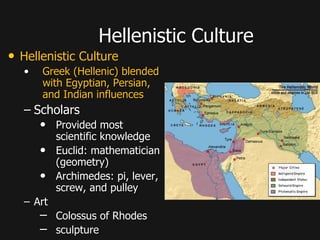
Hellenistic Culture
• Hellenistic Culture
• Greek (Hellenic) blended
with Egyptian, Persian,
and Indian influences
– Scholars
• Provided most
scientific knowledge
• Euclid: mathematician
(geometry)
• Archimedes: pi, lever,
screw, and pulley
– Art
– Colossus of Rhodes
– sculpture
Day 3 - Rome
Founded in 753 BC by
Romulus and Remus
(legend)
Located on the Tiber
River, in what is today
Italy, rolling hills and
Fertile soil
Origins of Roman
• Between 1500 - 1000 BCE the Latins settled
in the northern part of the Italian peninsula
and brought with them the Latin language
• Between 750 - 600 BCE the Greeks
established colonies and brought with them
Greek culture
• After 650 BCE the Etruscans came and
strongly influenced Rome with their Togas
and short Cloaks, as well as the organization
of the Roman army
Origins of Roman
Republic: Leader is not a monarch and
certain citizens vote for leaders
• After the Republic was established the next 50
years were spent fighting and establishing the
boundaries of Rome (the Greeks and
Etruscans were pushed out)
Roman Government
Roman Government
Parts of Roman Republic:
– Patricians: wealthy landowners (ruling class)
– Plebeians: common farmers, artisans, and
merchants (majority)
• Barred by law from holding important Govt. positions
–2 Consuls: led the gov’t and commanded the
army; (similar to President of U.S.)
–Senate: legislative assembly (served for life)
–Dictator: ruled in time of crisis (6 months)
–Legions: large military units
The Twelve Tables – Rome’s first code of
laws, applied to only Romans, evolved to a
more sophisticated system on laws over
time
– A person is innocent until proven guilty
– People accused of wrongdoing have the right
to defend themselves before a judge
– Judges weighed info and made decision
Roman Republic
Rome Spreads its Power
Punic Wars
Rome vs. Carthage (North Africa)
• 3 separate wars
• 1st: was fought over Sicily (264- 241 BCE)
– Carthage captured part of Sicily; Rome came to help
out.
– Also for glory and plunder
– Fought mostly at sea
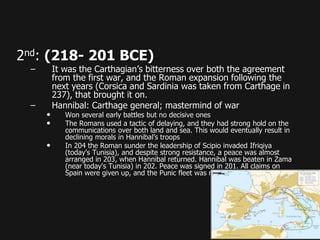
2nd: (218- 201 BCE)
– It was the Carthagian’s bitterness over both the agreement
from the first war, and the Roman expansion following the
next years (Corsica and Sardinia was taken from Carthage in
237), that brought it on.
– Hannibal: Carthage general; mastermind of war
• Won several early battles but no decisive ones
• The Romans used a tactic of delaying, and they had strong hold on the
communications over both land and sea. This would eventually result in
declining morals in Hannibal’s troops
• In 204 the Roman sunder the leadership of Scipio invaded Ifriqiya
(today's Tunisia), and despite strong resistance, a peace was almost
arranged in 203, when Hannibal returned. Hannibal was beaten in Zama
(near today's Tunisia) in 202. Peace was signed in 201. All claims on
Spain were given up, and the Punic fleet was reduced to ten ships.
3rd: (149- 146 BCE)
• The third war was entirely provoked by the Romans. After the second
defeat, Carthage managed once again to return to much of its former
glory, the economy prospered, and the fleet increased. But the memory
of the former Punic wars was strong in Rome; many hated the
Carthaginians especially because there seemed to be nothing that could
force them on their knees. Many Romans wanted to gain glory, and no
enemy was more attractive than Carthage, even if the city state now
longer aspired to become an empire.
The Roman Empire
• Empire emerges after Punic Wars; republic
becomes unstable
• Economic Turmoil
1. Rich live on big estates (with lots of slaves)
2. Small farmers had difficulty competing
3. Civil War: Tribunes tried for reforms but made
enemies with senators
• Generals start to gain power (recruiting soldiers turned
farmers—promising them land) and take over by force
• First Triumvirate is formed
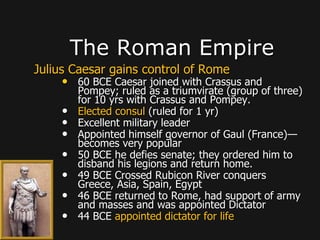
Julius Caesar gains control of Rome
• 60 BCE Caesar joined with Crassus and
Pompey; ruled as a triumvirate (group of three)
for 10 yrs with Crassus and Pompey.
• Elected consul (ruled for 1 yr)
• Excellent military leader
• Appointed himself governor of Gaul (France)—
becomes very popular
• 50 BCE he defies senate; they ordered him to
disband his legions and return home.
• 49 BCE Crossed Rubicon River conquers
Greece, Asia, Spain, Egypt
• 46 BCE returned to Rome, had support of army
and masses and was appointed Dictator
• 44 BCE appointed dictator for life
The Roman Empire
The Roman Empire
• Governed as an absolute ruler
• Reforms: Roman citizenship to people in the
provinces; expanded the senate; built new
public buildings that created new jobs for the
poor
• Some senators feared losing their influence;
some considered him a tyrant
• Caesar is killed by senators
March 15, 44 BCE
The Roman Empire
Beginning of the Empire
1. More civil war; Roman Republic destroyed
2. Octavian, Mark Antony and Lepidus
• Ruled for 10 yrs
• Jealousy and violence
• Lepidus retires, Octavian and Mark Antony rivals
3. Octavian rules; becomes Augustus Caesar
• Becomes 1st Emperor of Rome
4. Pax Romana (207 years)
– After Augustus’ death, empire remained stable
Art & Architecture
• Art
– Adopted many features from the Greek style of Art
– Greeks sculpted the Ideal form and Romans were
more Realistic
• Architecture
– First to use the Arch
– Used Concrete
– Built roads connecting the Empire
Society and Culture
Legacy
• Latin language; official language of Roman Catholic
Church into 20th century
• Aqueducts; brought water to cities
• Architecture; inspired public buildings
• Roman Roads; made of stone, concrete, and sand.
Lasted until Middle ages
• Laws; most lasting and widespread
• Fair and equal to all people
• Influenced by philosophers
• Equal treatment under law
• Innocent until proven guilty
Day 4 – Fall of Rome &
Christianity
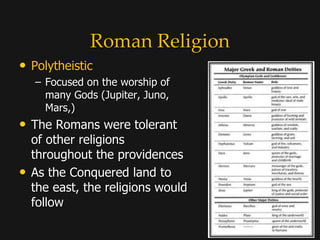
Roman Religion
• Polytheistic
– Focused on the worship of
many Gods (Jupiter, Juno,
Mars,)
• The Romans were tolerant
of other religions
throughout the providences
• As the Conquered land to
the east, the religions would
follow
Christianity
• Jesus – believed that it was his mission to
complete the salvation that God had
promised the Jews
• The Messiah
• Contained many ideas from Judaism
• Stressed importance of people’s love for God and
each other
• Promised salvation for those who repented their
sins
• Crucified for defying the Roman government
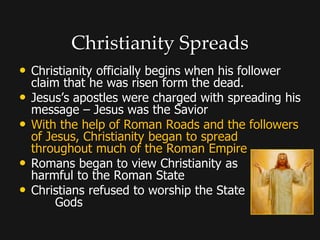
Christianity Spreads
• Christianity officially begins when his follower
claim that he was risen form the dead.
• Jesus’s apostles were charged with spreading his
message – Jesus was the Savior
• With the help of Roman Roads and the followers
of Jesus, Christianity began to spread
throughout much of the Roman Empire
• Romans began to view Christianity as
harmful to the Roman State
• Christians refused to worship the State
Gods
Christianity Spreads
Constantine
• Ends persecution (occurred b/c people didn’t
worship Roman gods—thousands were killed,
exiled, or imprisoned)
• Converts to Christianity and become the first
Christian Emperor
• Nicene Creed: basic beliefs of church – Helps
commission the first Bible – Christian Holy Book
Fall of the Roman Empire
Rome’s economy weakens
1. Inflation
2. Plague
3. Overworked soil
4. Military in disarray
Rome splits (empire no more)
1. West: remains Rome; Latin speaking
• Huns responsible for German invasions in West (Attila)
2. East: Byzantine Empire; Greek speaking
• Constantine secures, moves capitol
(Constantinople)
• Flourishes; preserves Greek and Roman culture
Fall of the Roman Empire
When the Roman Empire Falls in 476 the
world enters what would become known as
the Dark Ages

Unit 2 - Classical Civilizations

  • 1.
  • 2.
    Government in Greece PoliticalUnits: – Polis: city-state of ancient Greece; fundamental political unit – Acropolis: fortified hilltop where citizens gather and discuss city government
  • 3.
    Athens and Sparta A.Athens: 1. Attica Peninsula 2. Democracy: rule by the people 1. Wealthy boys only ones educated B. Sparta: 1. Southern Greece/Gulf of Corinth 2. Helots 3. Military state 4. Boys and Girls trained
  • 4.
    Sparta • Sparta wassmall with a huge slave population called helots • All boys and girls educated- women considered equals • Military education, Farming economy • Closed society- very paranoid- did not like outsiders • No wall around city • “Come back carrying your shield, or come back on it.” • Government: Oligarchy – Small group voted on ideas
  • 5.
    Athens • Athens waslarger • Education for wealthy boys only- liberal arts • Society was based on trade and open to outsiders • Many of the Greek artistic and intellectual achievements came out of Athens • Women were subordinate and kept out of public • Created the foundations for democracy
  • 6.
    Religion • Polytheistic –12 Chief Gods who were believed to live on Mount Olympus – Zeus, Hera, Athena, Apollo, Ares, Aphrodite, Poseidon, Hades • Believed in Oracles – where gods revealed their plans to the priest • Festivals were often held to please the Gods
  • 7.
    The Olympic Games AncientOlympics • Honored Zeus • In Olympia • Chariot races, boxing, javelin, discus , etc. • Statues of cheaters
  • 8.
    Greek Art • GoldenAge: growth of intellectual and artistic learning • Classical Art: portrays ideal beauty; serenity, gracefulness • Tragedies – Examined problems such as the struggle between good and evil – Oedipus Rex
  • 9.
    Greek Art Drama: 1. Tragedy:serious drama with a tragic flaw 2. Comedy: humorous Homer: greatest storyteller of Greece • The Iliad • The Odyssey Myths: traditional stories about Greek gods
  • 10.
    Philosophers • Philosophers: “loversof wisdom” ; determined to seek truth wherever they were led
  • 11.
    Philosophers Socrates • Believed thegoal of education was only to improve the individual • Socratic Method – uses a question/answer format to lead his pupils • Was accused and convicted of corrupting the youth by teaching them to think for themselves. • He was sentenced to death - Poison “The unexamined life is not worth living”
  • 12.
    Philosophers Plato • Student ofSocrates • Fascinated with Reality – How do we know what is real? • The Republic – Establishes his ideal gov’t – Upper-class: Kings & Philosophers - Wisdom – Warriors - Courage – The Masses - Desires
  • 13.
    Philosophers Aristotle • Applied methodof problem solving to psychology, physics, and biology (scientific method) • Mind and body separate • Ideas result of experience
  • 14.
    Day 2 –Greek Wars
  • 15.
    Persian Wars Persian Wars –Greece vs. Persia at Ionia; coast of Anatolia – The Persians were seeking revenge for the Athenians assistance in helping a Persian city- state revolt – 10,000 Greeks (Athenians) vs. 25,000 Persians – Athenians arranged in Phalanx: ea. Soldier stood side by side with spear and shield – Athenians (Greeks) win – Pheidippides runs from Marathon to Athens
  • 16.
    Second War: Landand Sea Invasions by Xerxes • To revenge his father’s shame, Xerxes in 480 BCE launched a massive land and sea invasion of Greece.(250,000 soldiers) • Fought three major engagements- Thermopylae (Stand of the 300 Spartans), Salamis (naval battle near Athens), and Platae (Sparta’s revenge). • Invasion failed and Xerxes lost most of his army.
  • 17.
    Legacy of PersianWars • Greece now considered a Mediterranean power. Athens and Sparta become the dominant city states. • Athens enters a “Golden Age” of intellectual and artistic achievements. • Jealously over Athenian dominance of Delian League led to 25 years of civil warfare in Greece. Athens vs. Sparta (Peloponnesian Wars) • Leaves Greece open to foreign invasion- Macedonia under King Philip invades and unites Greek city-states under one king.
  • 18.
    Peloponnesian War • CivilWar between Athens and Sparta – Athenians planned to stay behind their walls and only send out an Army for protection – Plague hit 1/3 of population dies – War last for 25 years – Both sides were weakened and eventually leads to the civilizations downfall.
  • 19.
    Alexander the Great •Peloponnesian War weakened Greek city-states • Philip II becomes king • Killed at wedding • Alexander becomes king (20 yrs old) • Student of Aristotle • Expands the empire: Persia, Egypt (Alexandria), Mesopotamia, Indus Valley, Arabia • Dies of Malaria (32 yrs old)
  • 21.
    Alexander the Great •Alexander the Great’s Legacy – 3 different Greeks gain control of the Empire • Antigonous of Macedonia • Ptolemy seizes Egypt • Seleucus took Old Persian Empire – Adopts Persian customs – Hellenistic culture emerges
  • 22.
    Hellenistic Culture • HellenisticCulture • Greek (Hellenic) blended with Egyptian, Persian, and Indian influences – Scholars • Provided most scientific knowledge • Euclid: mathematician (geometry) • Archimedes: pi, lever, screw, and pulley – Art – Colossus of Rhodes – sculpture
  • 23.
    Day 3 -Rome
  • 24.
    Founded in 753BC by Romulus and Remus (legend) Located on the Tiber River, in what is today Italy, rolling hills and Fertile soil Origins of Roman
  • 25.
    • Between 1500- 1000 BCE the Latins settled in the northern part of the Italian peninsula and brought with them the Latin language • Between 750 - 600 BCE the Greeks established colonies and brought with them Greek culture • After 650 BCE the Etruscans came and strongly influenced Rome with their Togas and short Cloaks, as well as the organization of the Roman army Origins of Roman
  • 26.
    Republic: Leader isnot a monarch and certain citizens vote for leaders • After the Republic was established the next 50 years were spent fighting and establishing the boundaries of Rome (the Greeks and Etruscans were pushed out) Roman Government
  • 27.
    Roman Government Parts ofRoman Republic: – Patricians: wealthy landowners (ruling class) – Plebeians: common farmers, artisans, and merchants (majority) • Barred by law from holding important Govt. positions –2 Consuls: led the gov’t and commanded the army; (similar to President of U.S.) –Senate: legislative assembly (served for life) –Dictator: ruled in time of crisis (6 months) –Legions: large military units
  • 28.
    The Twelve Tables– Rome’s first code of laws, applied to only Romans, evolved to a more sophisticated system on laws over time – A person is innocent until proven guilty – People accused of wrongdoing have the right to defend themselves before a judge – Judges weighed info and made decision Roman Republic
  • 29.
    Rome Spreads itsPower Punic Wars Rome vs. Carthage (North Africa) • 3 separate wars • 1st: was fought over Sicily (264- 241 BCE) – Carthage captured part of Sicily; Rome came to help out. – Also for glory and plunder – Fought mostly at sea
  • 30.
    2nd: (218- 201BCE) – It was the Carthagian’s bitterness over both the agreement from the first war, and the Roman expansion following the next years (Corsica and Sardinia was taken from Carthage in 237), that brought it on. – Hannibal: Carthage general; mastermind of war • Won several early battles but no decisive ones • The Romans used a tactic of delaying, and they had strong hold on the communications over both land and sea. This would eventually result in declining morals in Hannibal’s troops • In 204 the Roman sunder the leadership of Scipio invaded Ifriqiya (today's Tunisia), and despite strong resistance, a peace was almost arranged in 203, when Hannibal returned. Hannibal was beaten in Zama (near today's Tunisia) in 202. Peace was signed in 201. All claims on Spain were given up, and the Punic fleet was reduced to ten ships.
  • 31.
    3rd: (149- 146BCE) • The third war was entirely provoked by the Romans. After the second defeat, Carthage managed once again to return to much of its former glory, the economy prospered, and the fleet increased. But the memory of the former Punic wars was strong in Rome; many hated the Carthaginians especially because there seemed to be nothing that could force them on their knees. Many Romans wanted to gain glory, and no enemy was more attractive than Carthage, even if the city state now longer aspired to become an empire.
  • 32.
    The Roman Empire •Empire emerges after Punic Wars; republic becomes unstable • Economic Turmoil 1. Rich live on big estates (with lots of slaves) 2. Small farmers had difficulty competing 3. Civil War: Tribunes tried for reforms but made enemies with senators • Generals start to gain power (recruiting soldiers turned farmers—promising them land) and take over by force • First Triumvirate is formed
  • 33.
    Julius Caesar gainscontrol of Rome • 60 BCE Caesar joined with Crassus and Pompey; ruled as a triumvirate (group of three) for 10 yrs with Crassus and Pompey. • Elected consul (ruled for 1 yr) • Excellent military leader • Appointed himself governor of Gaul (France)— becomes very popular • 50 BCE he defies senate; they ordered him to disband his legions and return home. • 49 BCE Crossed Rubicon River conquers Greece, Asia, Spain, Egypt • 46 BCE returned to Rome, had support of army and masses and was appointed Dictator • 44 BCE appointed dictator for life The Roman Empire
  • 34.
    The Roman Empire •Governed as an absolute ruler • Reforms: Roman citizenship to people in the provinces; expanded the senate; built new public buildings that created new jobs for the poor • Some senators feared losing their influence; some considered him a tyrant • Caesar is killed by senators March 15, 44 BCE
  • 35.
    The Roman Empire Beginningof the Empire 1. More civil war; Roman Republic destroyed 2. Octavian, Mark Antony and Lepidus • Ruled for 10 yrs • Jealousy and violence • Lepidus retires, Octavian and Mark Antony rivals 3. Octavian rules; becomes Augustus Caesar • Becomes 1st Emperor of Rome 4. Pax Romana (207 years) – After Augustus’ death, empire remained stable
  • 36.
    Art & Architecture •Art – Adopted many features from the Greek style of Art – Greeks sculpted the Ideal form and Romans were more Realistic • Architecture – First to use the Arch – Used Concrete – Built roads connecting the Empire
  • 37.
    Society and Culture Legacy •Latin language; official language of Roman Catholic Church into 20th century • Aqueducts; brought water to cities • Architecture; inspired public buildings • Roman Roads; made of stone, concrete, and sand. Lasted until Middle ages • Laws; most lasting and widespread • Fair and equal to all people • Influenced by philosophers • Equal treatment under law • Innocent until proven guilty
  • 38.
    Day 4 –Fall of Rome & Christianity
  • 39.
    Roman Religion • Polytheistic –Focused on the worship of many Gods (Jupiter, Juno, Mars,) • The Romans were tolerant of other religions throughout the providences • As the Conquered land to the east, the religions would follow
  • 40.
    Christianity • Jesus –believed that it was his mission to complete the salvation that God had promised the Jews • The Messiah • Contained many ideas from Judaism • Stressed importance of people’s love for God and each other • Promised salvation for those who repented their sins • Crucified for defying the Roman government
  • 41.
    Christianity Spreads • Christianityofficially begins when his follower claim that he was risen form the dead. • Jesus’s apostles were charged with spreading his message – Jesus was the Savior • With the help of Roman Roads and the followers of Jesus, Christianity began to spread throughout much of the Roman Empire • Romans began to view Christianity as harmful to the Roman State • Christians refused to worship the State Gods
  • 42.
    Christianity Spreads Constantine • Endspersecution (occurred b/c people didn’t worship Roman gods—thousands were killed, exiled, or imprisoned) • Converts to Christianity and become the first Christian Emperor • Nicene Creed: basic beliefs of church – Helps commission the first Bible – Christian Holy Book
  • 43.
    Fall of theRoman Empire Rome’s economy weakens 1. Inflation 2. Plague 3. Overworked soil 4. Military in disarray Rome splits (empire no more) 1. West: remains Rome; Latin speaking • Huns responsible for German invasions in West (Attila) 2. East: Byzantine Empire; Greek speaking • Constantine secures, moves capitol (Constantinople) • Flourishes; preserves Greek and Roman culture
  • 44.
    Fall of theRoman Empire When the Roman Empire Falls in 476 the world enters what would become known as the Dark Ages