Estuaries- where river meets the sea
 Latin origin-”AESTUS”-Tide.
 A semi-enclosed coastal bodies of water that have a free connection with the open sea and
within which sea water is measurably diluted by freshwater.
 It is strongly affected by tidal action & some of wave action.
 According to Perillo(1995) : "an estuary is a semi-enclosed coastal body of water that
extends to the effective limit of tidal influence, within which sea water entering from one or
more free connections with the open sea, or any other saline coastal body of water, is
significantly diluted with fresh water derived from land drainage, and can sustain
euryhaline biological species from either part or the whole of their life cycle."
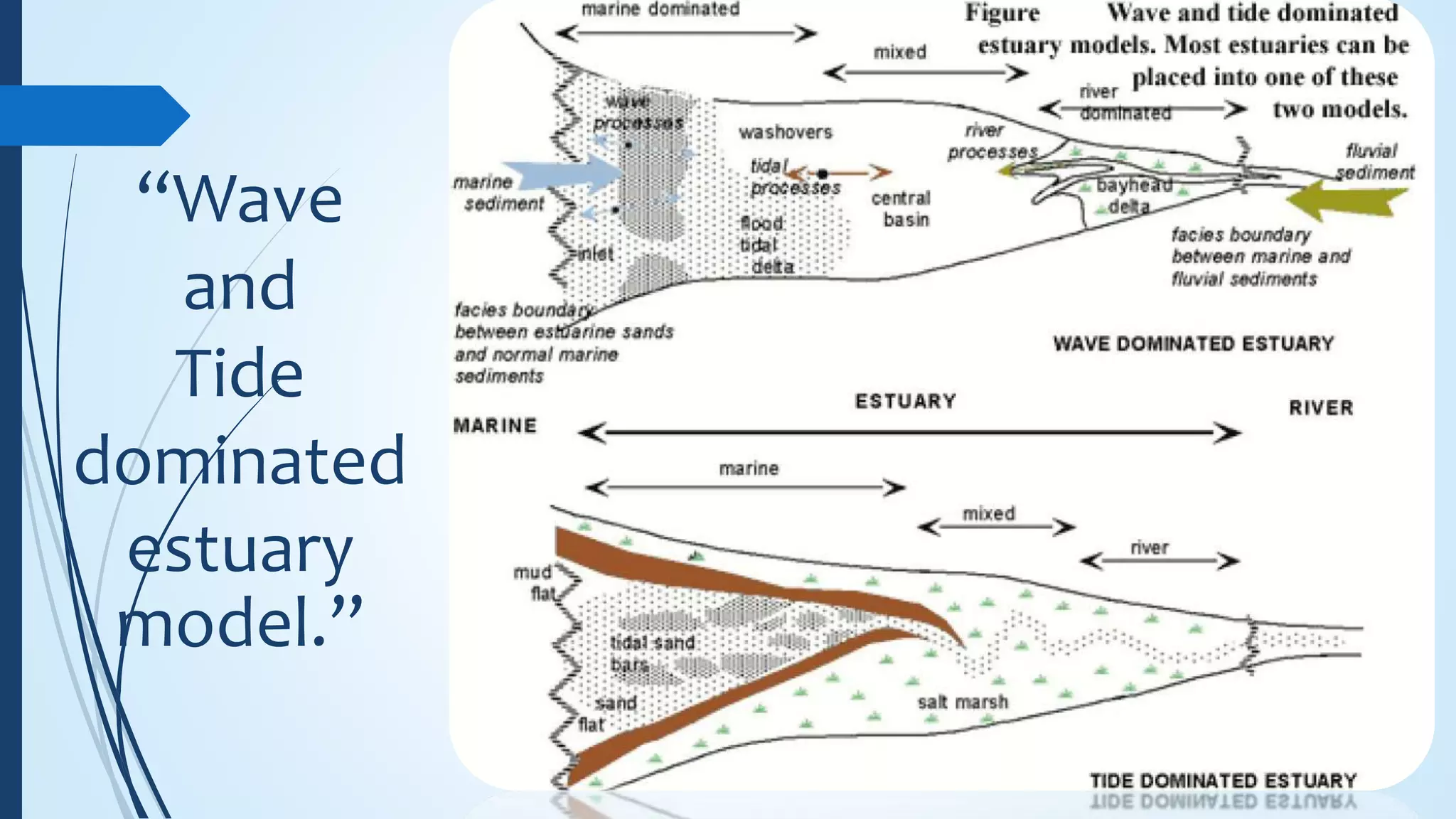
“Wave
and
Tide
dominated
estuary
model.”
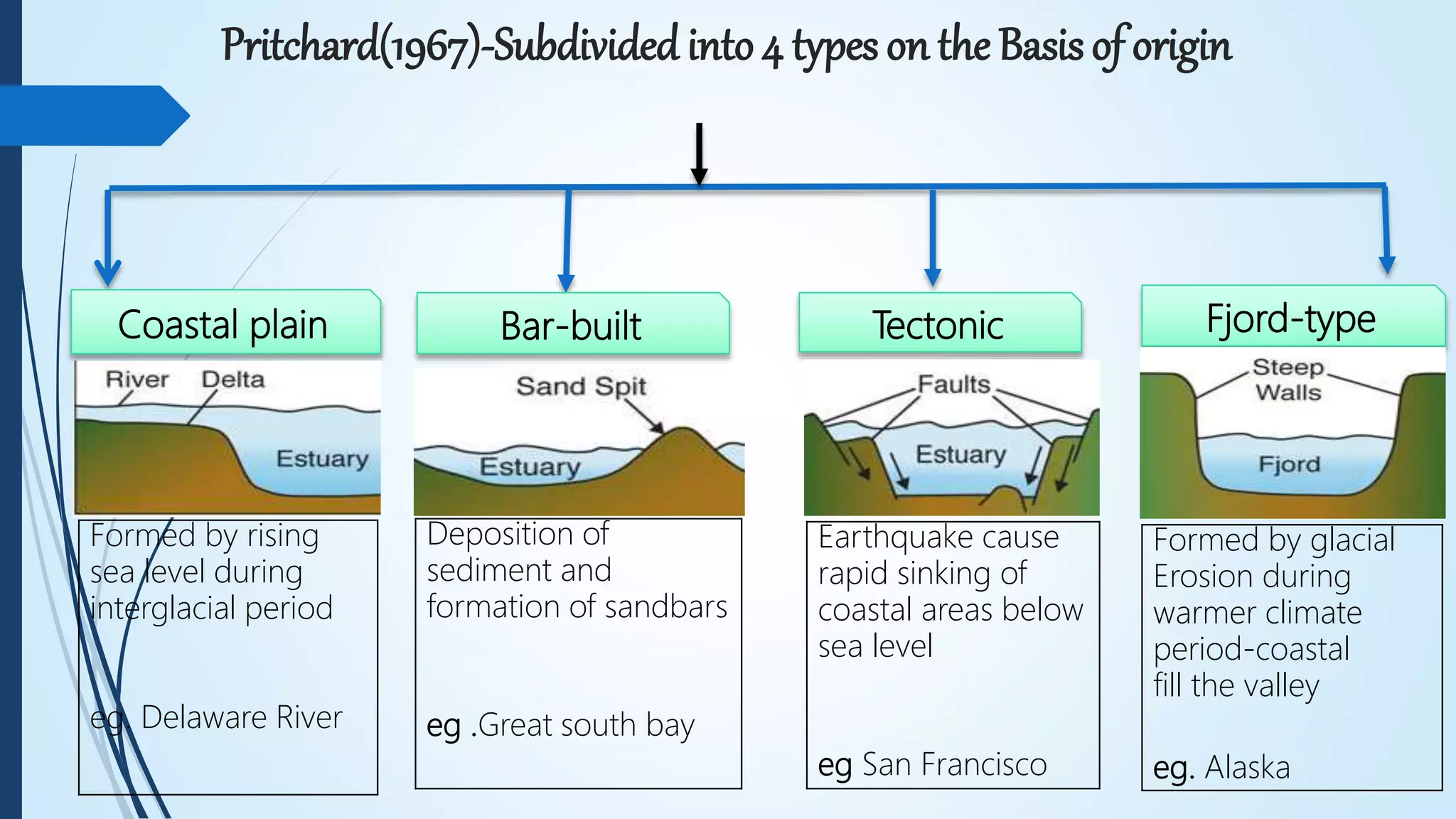
Coastal plain Bar-built Tectonic Fjord-type
Formed by rising
sea level during
interglacial period
eg. Delaware River
Deposition of
sediment and
formation of sandbars
eg .Great south bay
Earthquake cause
rapid sinking of
coastal areas below
sea level
eg San Francisco
Formed by glacial
Erosion during
warmer climate
period-coastal
fill the valley
eg. Alaska
Pritchard(1967)-Subdividedinto4 types on the Basis of origin
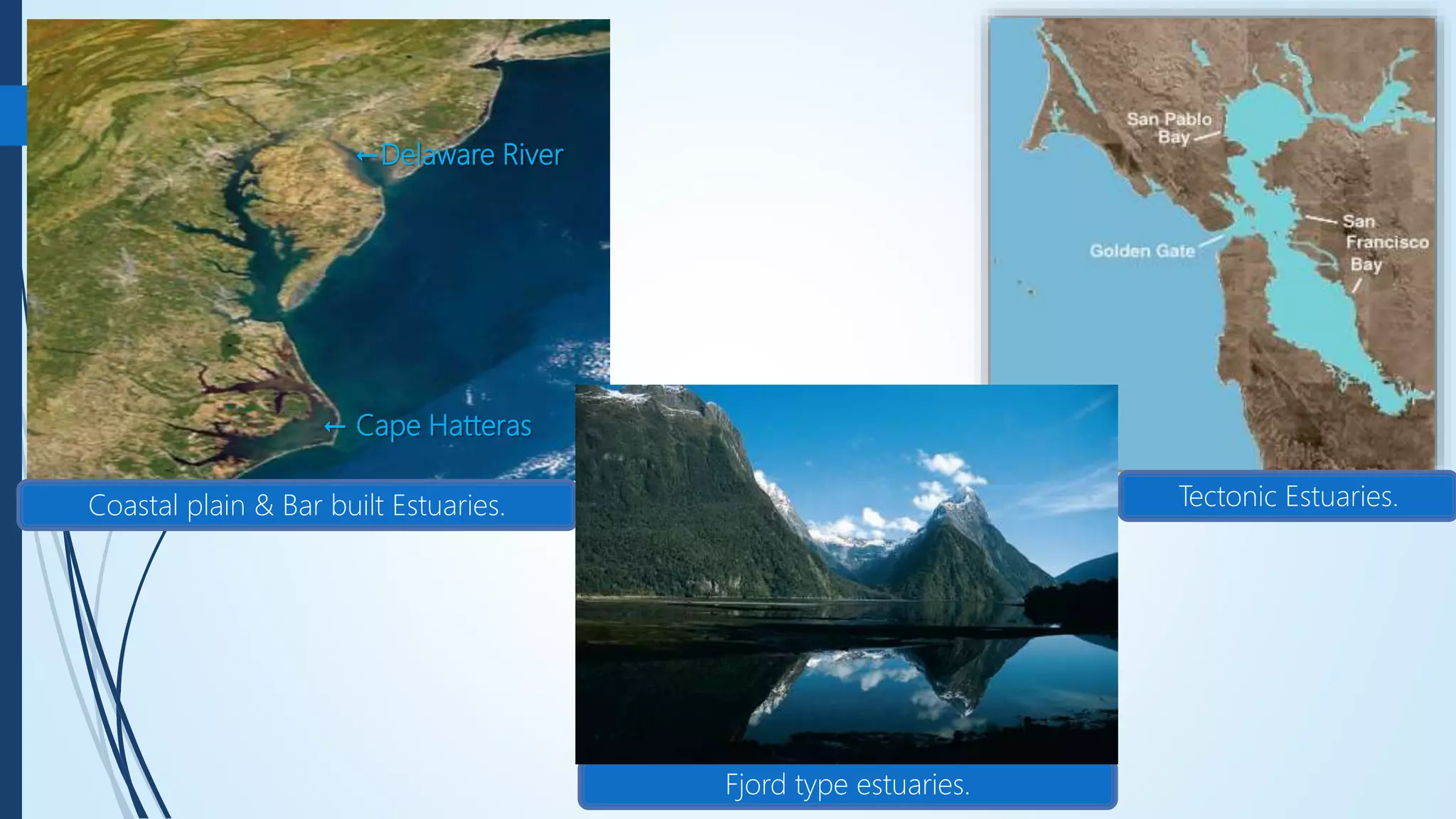
←Delaware River
← Cape Hatteras
Coastal plain & Bar built Estuaries. Tectonic Estuaries.
Fjord type estuaries.
←Delaware River
← Cape Hatteras
Coastal plain & Bar built Estuaries. Tectonic Estuaries.
Fjord type estuaries.
Basis on freshwater discharge/Salinity Condition
Positive estuary Negative estuary Neutral estuary
Freshwater dominates
over marine water
Marine water dominates
over fresh water
Relative constant in
relation to one another
ON THE BASIS OF CIRCULATION
 The water flow of river is
strongly dominant over tidal
action. So freshwater tends to
overflow the heavier salt water
forming a wedge.
 Characterized by the sharp
change in salinity from top to
bottom (Fig. 6).
 eg.-The Amazon river estuary
,the Nile river estuary
 River output is less than the
marine input
 Turbulence causes mixing of
the whole water column, such
that salt content varies both
horizontally and vertically
with moderate density
stratification.
 eg.--Chesapeake Bay
 The tidal action is
strongly dominant.
 The water tends to be
well mixed from top to
bottom and the salinity is
relatively high.
 eg- Bar-built estuaries.
Highly stratified Moderately stratified
Vertically/Completely
mixed
Major estuaries occur in the bay of
bengal. Many estuaries are locations
of some of the major seaports.
Most of the india’s major estuaries
occur on the east coast. In contrast,
the estuaries on the west coast are
smaller.
Two typical examples of estuaries on the
west coast are the mandovi and zuari
estuaries located to the north and south of
the main campus of the national institute of
oceanography at dona paula, goa.
Source: CSIR-NIO
ESTUARIES
Indian Coastal
States Estuaries
Avg. discharge
(m3/sec/day)
Gujarat
Ambica 1
Bhadar 16
Daman ganga 93
Dhatarwadi 2
Gulf of Kutch < 1
Machhundri 3
Madhuvanti 1
Mahi 383
Meghal 7
Narmada 190
Prabhas Patan 4
Sabarmati 33
Singoda 3
Tapi 210
Maharashtra
Daman ganga 93
Narmada 190
Karnataka
Karwar 128
Mandovi 56
Kerala Periar Estuary 8
Tamil Nadu
Cauvery 600
Ponnaiyar 21
Vaigai 28
Andhra Pradesh
Godavari 3, 500
Krishna 2, 100
Pennar 200
Odisha Mahanadi 2,100
West Bengal Ganges delta 35, 217
East coast West coast
West Bengal=1 Gujarat=14
Orissa=1 Maharashtra=2
Andra Pradesh=3 Karnataka=2
Tamil Nadu =3 Kerala=1
Total 8 19
Source:
Centre for Coastal Zone Management and Coastal
Shelter BeltHosted by Institute for Ocean
Management,Anna University Chennai
Sponsored by Ministry of Environment, Forests & Climate
Change, Govt of India
Estuaries
As
Ecosystem
Coping
With
Salinity
Fluctuations
Adapting
to
The
Mud
Clams extend
their siphons
for food and
oxygen
Problem::
• Nothing to hold on to
• Difficult to move on mud
• Depletion of oxygen
Benefit:
Salinity fluctuation is less
drastic
 Estuaries have been called the "nurseries of the sea".
 Important for the health of the oceans.
 Act as a buffer between the ocean and the land.
 Economically important. Coastal activities, commercial and
recreational fishing, boating, and tourism.
 A historical and cultural significance.
http://www.earthgauge.net/wp-content/images/Estuaries_Low.jpg
THREATS
 Excess silt flowing in from land clearance.
 Pollution from sewage, industrial wastes and agricultural run-off.
 Oil spills / oil spillage.
 Invasion by introduced species.
 Construction of harbours, channels, embankments and roads.
 Solid wastes, garbage, Liquid wastes disposal.
 Natural disasters (e.g. cyclone, earthquake)
 Conversion to mining, aquaculture, aquaculture, agriculture, salt pans, urban
development
 Over exploitation by traditional users.
 Different pests and diseases.
 Other hazardous chemicals.
 Lack of sustainable mangrove management etc.
HOW CAN WE
HELP TO PROTECT
OUR ESTUARIES
 Estuaries are a vital part of ecosystem. The huge amount of organisms living
in this environment are essential to the well being of other environments such
as the ocean and rivers.
 Essential to anadromous animals that travel up stream to spawn.
 They also act as the filter of the water travelling downstream towards the
ocean.
 Without estuaries, many species of plants and animals would not be able to
survive
BOOKS
Marine biology by Peter Castro, Michael E. Huber.
Biological oceanography : An introduction by Carol & parsons
WEBSITES
 https://oceanservice.noaa.gov/facts/estuary.html
 www.doc.govt.nz/nature/habitats/estuaries/about-estuaries/
Thank you for viewing.
We do not inherit the earth from our
ancestors, we borrow it from our
children. ~Native American Proverb

Estuaries-Where River meets the sea.

  • 2.
    Estuaries- where rivermeets the sea  Latin origin-”AESTUS”-Tide.  A semi-enclosed coastal bodies of water that have a free connection with the open sea and within which sea water is measurably diluted by freshwater.  It is strongly affected by tidal action & some of wave action.  According to Perillo(1995) : "an estuary is a semi-enclosed coastal body of water that extends to the effective limit of tidal influence, within which sea water entering from one or more free connections with the open sea, or any other saline coastal body of water, is significantly diluted with fresh water derived from land drainage, and can sustain euryhaline biological species from either part or the whole of their life cycle."
  • 3.
  • 4.
    Coastal plain Bar-builtTectonic Fjord-type Formed by rising sea level during interglacial period eg. Delaware River Deposition of sediment and formation of sandbars eg .Great south bay Earthquake cause rapid sinking of coastal areas below sea level eg San Francisco Formed by glacial Erosion during warmer climate period-coastal fill the valley eg. Alaska Pritchard(1967)-Subdividedinto4 types on the Basis of origin
  • 5.
    ←Delaware River ← CapeHatteras Coastal plain & Bar built Estuaries. Tectonic Estuaries. Fjord type estuaries.
  • 6.
    ←Delaware River ← CapeHatteras Coastal plain & Bar built Estuaries. Tectonic Estuaries. Fjord type estuaries.
  • 7.
    Basis on freshwaterdischarge/Salinity Condition Positive estuary Negative estuary Neutral estuary Freshwater dominates over marine water Marine water dominates over fresh water Relative constant in relation to one another
  • 8.
    ON THE BASISOF CIRCULATION  The water flow of river is strongly dominant over tidal action. So freshwater tends to overflow the heavier salt water forming a wedge.  Characterized by the sharp change in salinity from top to bottom (Fig. 6).  eg.-The Amazon river estuary ,the Nile river estuary  River output is less than the marine input  Turbulence causes mixing of the whole water column, such that salt content varies both horizontally and vertically with moderate density stratification.  eg.--Chesapeake Bay  The tidal action is strongly dominant.  The water tends to be well mixed from top to bottom and the salinity is relatively high.  eg- Bar-built estuaries. Highly stratified Moderately stratified Vertically/Completely mixed
  • 9.
    Major estuaries occurin the bay of bengal. Many estuaries are locations of some of the major seaports. Most of the india’s major estuaries occur on the east coast. In contrast, the estuaries on the west coast are smaller. Two typical examples of estuaries on the west coast are the mandovi and zuari estuaries located to the north and south of the main campus of the national institute of oceanography at dona paula, goa. Source: CSIR-NIO ESTUARIES
  • 11.
    Indian Coastal States Estuaries Avg.discharge (m3/sec/day) Gujarat Ambica 1 Bhadar 16 Daman ganga 93 Dhatarwadi 2 Gulf of Kutch < 1 Machhundri 3 Madhuvanti 1 Mahi 383 Meghal 7 Narmada 190 Prabhas Patan 4 Sabarmati 33 Singoda 3 Tapi 210 Maharashtra Daman ganga 93 Narmada 190 Karnataka Karwar 128 Mandovi 56 Kerala Periar Estuary 8 Tamil Nadu Cauvery 600 Ponnaiyar 21 Vaigai 28 Andhra Pradesh Godavari 3, 500 Krishna 2, 100 Pennar 200 Odisha Mahanadi 2,100 West Bengal Ganges delta 35, 217 East coast West coast West Bengal=1 Gujarat=14 Orissa=1 Maharashtra=2 Andra Pradesh=3 Karnataka=2 Tamil Nadu =3 Kerala=1 Total 8 19 Source: Centre for Coastal Zone Management and Coastal Shelter BeltHosted by Institute for Ocean Management,Anna University Chennai Sponsored by Ministry of Environment, Forests & Climate Change, Govt of India
  • 12.
    Estuaries As Ecosystem Coping With Salinity Fluctuations Adapting to The Mud Clams extend their siphons forfood and oxygen Problem:: • Nothing to hold on to • Difficult to move on mud • Depletion of oxygen Benefit: Salinity fluctuation is less drastic
  • 13.
     Estuaries havebeen called the "nurseries of the sea".  Important for the health of the oceans.  Act as a buffer between the ocean and the land.  Economically important. Coastal activities, commercial and recreational fishing, boating, and tourism.  A historical and cultural significance.
  • 14.
  • 15.
    THREATS  Excess siltflowing in from land clearance.  Pollution from sewage, industrial wastes and agricultural run-off.  Oil spills / oil spillage.  Invasion by introduced species.  Construction of harbours, channels, embankments and roads.  Solid wastes, garbage, Liquid wastes disposal.  Natural disasters (e.g. cyclone, earthquake)  Conversion to mining, aquaculture, aquaculture, agriculture, salt pans, urban development  Over exploitation by traditional users.  Different pests and diseases.  Other hazardous chemicals.  Lack of sustainable mangrove management etc.
  • 16.
    HOW CAN WE HELPTO PROTECT OUR ESTUARIES
  • 17.
     Estuaries area vital part of ecosystem. The huge amount of organisms living in this environment are essential to the well being of other environments such as the ocean and rivers.  Essential to anadromous animals that travel up stream to spawn.  They also act as the filter of the water travelling downstream towards the ocean.  Without estuaries, many species of plants and animals would not be able to survive
  • 18.
    BOOKS Marine biology byPeter Castro, Michael E. Huber. Biological oceanography : An introduction by Carol & parsons WEBSITES  https://oceanservice.noaa.gov/facts/estuary.html  www.doc.govt.nz/nature/habitats/estuaries/about-estuaries/
  • 19.
    Thank you forviewing. We do not inherit the earth from our ancestors, we borrow it from our children. ~Native American Proverb