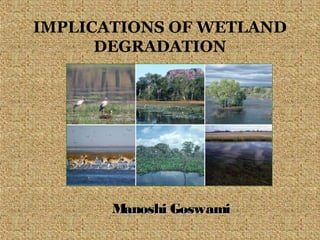
IMPLICATIONS OF WETLAND
DEGRADATION

M
anoshi Goswami
OUTLINE







Introduction
Ramsar Convention
Types of wetlands
Causes of degradation
Implications of Wetland Degradation
Case study of Deepar Beel
What are WETLANDS ?
“Wetlands are area of marsh, fen, peat land
or water, whether natural or artificial,
permanent or temporary, with water that is
static or flowing, fresh, brackish or salt,
including areas of marine water, the depth
of which at low tide does not exceed six
metres.’

(RAMSAR CONVENTION)
Key Attributes (Helps in identification)


Hydrology which is a degree of flooding
of soil saturation



Wetland vegetation (hydrophytes)



Hydric soils
Ramsar Convention --- path of recognizing
importance






Ramsar Convention on Wetlands, an intergovernmental
treaty which deals with conservation aspects of inland
waters and the near-shore coastal areas.
Signed on Feb 2, 1971, in Iranian city of RAMSAR this
provides a framework for national action and
international cooperation for the conservation and wise
use of wetlands and their resources.
There are at present 159 contracting Parties to the
Convention, with 1634 wetland sites, totaling 145.73
million hectares, designated for inclusion in the
Ramsar List of Wetlands of International Importance.


The Convention has 12 Articles which deal with the
various aspects of wetlands, including their definition,
criteria for designation of wetlands, wise use of
wetlands, establishing nature reserves, research,
monitoring, management of wetland species,
international cooperation and transboundary wetland
issues.



India is a signatory to Ramsar Convention and plays an
important role in conservation and wise use of
wetlands.
Conservation of Wetlands in India: A Profile
The Mission of the Ramsar Convention
‘The conservation and wise use of wetlands by
national action and international cooperation as
a means to achieving sustainable development
throughout the world.’

Source : Conservation of Wetlands in India: A Profile
Types










Glaciatic Wetlands (e.g., Tsomoriri in
Jammu and Kashmir, Chandertal in
Himachal Pradesh)
Tectonic Wetlands (Bhimtal in Uttaranchal)
Oxbow Wetlands (Wullur lake, Kashmir)
Lagoons (Chilka lake, Orissa)
Crater Wetlands (Lonar lake, Maharastra)
Salt water Wetlands (Sambhar, Rajastan)
Urban Wetlands (Dal lake, Kasmir)
Creeks (Thane , Maharastra)







Salt Marshes
Lakes
Riverine Wetlands
Mangroves
Coral Reefs
Peat bogs
Extent of Degradation of Wetlands


More than ½ of the worlds remaining wetlands
have been destroyed in the 20th century,
especially in developing countries by the
demands of industrialization.



1/3rd of Indian wetlands has already been wiped
out or has been severely degraded.



70 – 80 percent of individual fresh water marshes
and lakes in the Gangetic flood plains have been
lost in the last five decades.

(Sustainable Wetlands, Environmental Governance-2, 1999).


80 to 98% of wetlands immediately within or
adjacent to many of Canada's urban centers have
been lost (Govt. of Cannada, 1991)



Rate of loss is 2-3% per year



Indian mangrove areas have been halved almost
from 700,000 hectares in 1987 to 453,000 hectares
in 1995 (Sustainable Wetlands, Environmental
Governance-2, 1999).
Threats to wetlands


Uncontrolled weed infestation



Anthropogenic invasion or Encroachment on
wetland areas for various purposes leading to
habitat destruction



Hydrological interventions



Pollution



Climate Change
Cause

Contribution

H
unting & Associated
Disturbance

32%

H
uman Settlement

22%

F
ishing & Associated
activities

19%

Vegetation Removal

15%

Industrial Pollution

20%

Drainage for agriculture

23%

WCMC, 1998






Study on the effects of agricultural run-off in Frankline Bog,
Vermont, USA has revealed that forested and agricultural
runoff from the nearby watershed created differential
vegetation patterns in the wetland, including weedy species
introductions. The study also reported the nutrient induced
excessive vegetative growth in the study site.( Gustafson &
Wang, 2002)
Soil salinization is also reported to be a serious cause of
wetland degradation in the Yellow River Delta region of
china. (Jian-feng & Qi-xiang, 2005)
Climate change is predicted to threaten the wetland
ecosystems by its effect on wetland biodiversity
(Temperature), shrinkage of wetland area due to reduced
water availability and geographical distribution of
wetlands. (Tiwana et al. 2008)


Of the estimated 58.2 million hectares of wetlands in
India, 40.9 million hectares are under rice cultivation
(Anon. 1993).



Most of the coastal mangroves in Sunderbans & Andaman
in India are facing threat arising from economic demand
on shrimps.(P
rasad et al. 2002)



L of marine and coastal wetlands in Australia has been
oss
linked with human interference in E
stuaries, bays and
Gulfs for various activities . (Zann, 1995)



In US, that more than 53% of naturally occurring
wetlands (more than 117 million acres or 47.4 million
hectares; 1 acre = 0.405 hectare) have been converted
into urban and agricultural uses (B
endor & B
rozovic
2007).
Zhaou et al , Environ Model Assess (2009) 14:101–111
WETLAND SERVICES











Wetland products
Groundwater replenishments
Maintenance of water tables
Water storage and flood control
Shoreline protection and stabilization
Sediment and nutrient retention
Water purification - Kidneys of Nature
Habitats for biodiversity
Ecosystem functions
Recreation and tourism
Implications












Reduction in terrestrial carbon sequestration
Reduction in economic products
Reduction of Ground Water Recharge Potential
Reduced Water supply
Flood
Erosion of shoreline
Interrupted nutrient cycling
Loss of Water Quality
Biodiversity Depletion
Ecosystem Disruption
Study on Hadejia–Jama’are and Hadejia–Nguru wetlands
of Nigeria has revealed that loss of the wetland area has
resulted in drying up of many wells that are used by the
inhabitants.(Uluocha & Okeke, 2004)
M. Ando, 1999


Location : (lat. 26°03′26″–26°09′26″N and long.
90°36′39″–90°41′25″E) , 10 km southwest of
Guwahati town, Kamrup District .



The Beel has a perennial water-holding area of
about 10.1 km2, which extends up to 40.1 km2
during floods. (Bera et al., 2008)



Notified a Wildlife Sanctuary (proposed) under the
Wildlife Protection Act of India, 1972





Declared a Ramsar Site in August 2002
Recognized as a Important Bird Area site by
Birdlife International.
Justification for declaring a Ramsar Site:







Deepor Beel and is a representative wetland type found
within the biogeographic province, 'Burma Monsoon
Forest‘ .
Supports threatened species of birds like Spot billed
pelican, Lesser adjutant stork, Greater adjutant stork,
Black necked stork, and Large whistling teal.
The lake is one of the staging grounds on the migratory
flyways for several species.
Diversity

Species /Genera

P
hyoplankton

18

Zooplankton

F
amily

21

Cladocera (micro-crustacea)

45/
30

7

Angiosperm

435/
305

103

F
ish

50

19

Amphibia

20

L
izard

12

Snake

18

T
urtle/
T
ortoise

6

Source : Bera et al. 2008, ENVIS Newsletter, 2007, Sharma & Sharma, 2008 and

http://www.wwfindia.org/about_wwf/what_we_do/freshwater_wetlands/our_work/ramsar_sites/deepor_beel
Greater adjurdent stork
Spot billed pelican

Great blue heron

Asian elephants in B
eel

L
arge whistling teal
B
lack necked stork


A large no. of wetland fruits and vegetables and
medicinal plants are identified in the wetland.



Source of water for the wild animals from the
adjuscent Rani – Garbhanga Reserved Forest
including the Asiatic Elephants.



The only major storm water storage basin for the
city of Guwahati.



Resident rural community of nearby area (14
Village/1200 families) mostly dependant on the
natural wetland resources for their livilihood.
Degradation of Deepor B
eel


Present reported area is 9.27 sq. km. but the
actual water body is only 4.1 sq. km.



Heavily infested with water hyacinth and other
aquatic weeds, indicating high eutrophication.



Deterioration of water quality – pH - 4.7- 6.9,
DO -1.6 mg/l to 5.2 mg/l



Heavy metal content reported to be high.
(Report, Planning Comission, India, 2008)
Causes
Causes
Conservation M
easures











Demarcation of the boundary
Construction of embankment
Control of industrial activity
Control of commercial exploitation of aquatic
resources
Water quality restoration
Increasing water retention capacity
Complete stoppage of garbage dumping
Awareness campaign
Implementing sustainable wetland management
strategies.
Conclusion






Wetlands are very important ecosystems from the point of
global and local environmental conservation.
Human encroachment and developmental activities are
accelerating the degradation process of wetlands.
Conservation of wetlands should be given a prime
importance in all the environmental conservation policies.




Greater participation of local people, use of
indigenous knowledge in the management
strategies and application of scientific
techniques are needed.
Most importantly, we must be sincere enough
to increase awareness among public regarding
the importance of wetlands.
Impacts of wetland degradation

Impacts of wetland degradation

  • 1.
  • 2.
    OUTLINE       Introduction Ramsar Convention Types ofwetlands Causes of degradation Implications of Wetland Degradation Case study of Deepar Beel
  • 3.
    What are WETLANDS? “Wetlands are area of marsh, fen, peat land or water, whether natural or artificial, permanent or temporary, with water that is static or flowing, fresh, brackish or salt, including areas of marine water, the depth of which at low tide does not exceed six metres.’ (RAMSAR CONVENTION)
  • 4.
    Key Attributes (Helpsin identification)  Hydrology which is a degree of flooding of soil saturation  Wetland vegetation (hydrophytes)  Hydric soils
  • 5.
    Ramsar Convention ---path of recognizing importance    Ramsar Convention on Wetlands, an intergovernmental treaty which deals with conservation aspects of inland waters and the near-shore coastal areas. Signed on Feb 2, 1971, in Iranian city of RAMSAR this provides a framework for national action and international cooperation for the conservation and wise use of wetlands and their resources. There are at present 159 contracting Parties to the Convention, with 1634 wetland sites, totaling 145.73 million hectares, designated for inclusion in the Ramsar List of Wetlands of International Importance.
  • 6.
     The Convention has12 Articles which deal with the various aspects of wetlands, including their definition, criteria for designation of wetlands, wise use of wetlands, establishing nature reserves, research, monitoring, management of wetland species, international cooperation and transboundary wetland issues.  India is a signatory to Ramsar Convention and plays an important role in conservation and wise use of wetlands.
  • 7.
    Conservation of Wetlandsin India: A Profile
  • 8.
    Conservation of Wetlandsin India: A Profile
  • 9.
    The Mission ofthe Ramsar Convention ‘The conservation and wise use of wetlands by national action and international cooperation as a means to achieving sustainable development throughout the world.’ Source : Conservation of Wetlands in India: A Profile
  • 10.
    Types         Glaciatic Wetlands (e.g.,Tsomoriri in Jammu and Kashmir, Chandertal in Himachal Pradesh) Tectonic Wetlands (Bhimtal in Uttaranchal) Oxbow Wetlands (Wullur lake, Kashmir) Lagoons (Chilka lake, Orissa) Crater Wetlands (Lonar lake, Maharastra) Salt water Wetlands (Sambhar, Rajastan) Urban Wetlands (Dal lake, Kasmir) Creeks (Thane , Maharastra)
  • 11.
  • 14.
    Extent of Degradationof Wetlands  More than ½ of the worlds remaining wetlands have been destroyed in the 20th century, especially in developing countries by the demands of industrialization.  1/3rd of Indian wetlands has already been wiped out or has been severely degraded.  70 – 80 percent of individual fresh water marshes and lakes in the Gangetic flood plains have been lost in the last five decades. (Sustainable Wetlands, Environmental Governance-2, 1999).
  • 15.
     80 to 98%of wetlands immediately within or adjacent to many of Canada's urban centers have been lost (Govt. of Cannada, 1991)  Rate of loss is 2-3% per year  Indian mangrove areas have been halved almost from 700,000 hectares in 1987 to 453,000 hectares in 1995 (Sustainable Wetlands, Environmental Governance-2, 1999).
  • 16.
    Threats to wetlands  Uncontrolledweed infestation  Anthropogenic invasion or Encroachment on wetland areas for various purposes leading to habitat destruction  Hydrological interventions  Pollution  Climate Change
  • 17.
    Cause Contribution H unting & Associated Disturbance 32% H umanSettlement 22% F ishing & Associated activities 19% Vegetation Removal 15% Industrial Pollution 20% Drainage for agriculture 23% WCMC, 1998
  • 18.
       Study on theeffects of agricultural run-off in Frankline Bog, Vermont, USA has revealed that forested and agricultural runoff from the nearby watershed created differential vegetation patterns in the wetland, including weedy species introductions. The study also reported the nutrient induced excessive vegetative growth in the study site.( Gustafson & Wang, 2002) Soil salinization is also reported to be a serious cause of wetland degradation in the Yellow River Delta region of china. (Jian-feng & Qi-xiang, 2005) Climate change is predicted to threaten the wetland ecosystems by its effect on wetland biodiversity (Temperature), shrinkage of wetland area due to reduced water availability and geographical distribution of wetlands. (Tiwana et al. 2008)
  • 19.
     Of the estimated58.2 million hectares of wetlands in India, 40.9 million hectares are under rice cultivation (Anon. 1993).  Most of the coastal mangroves in Sunderbans & Andaman in India are facing threat arising from economic demand on shrimps.(P rasad et al. 2002)  L of marine and coastal wetlands in Australia has been oss linked with human interference in E stuaries, bays and Gulfs for various activities . (Zann, 1995)  In US, that more than 53% of naturally occurring wetlands (more than 117 million acres or 47.4 million hectares; 1 acre = 0.405 hectare) have been converted into urban and agricultural uses (B endor & B rozovic 2007).
  • 20.
    Zhaou et al, Environ Model Assess (2009) 14:101–111
  • 22.
    WETLAND SERVICES           Wetland products Groundwaterreplenishments Maintenance of water tables Water storage and flood control Shoreline protection and stabilization Sediment and nutrient retention Water purification - Kidneys of Nature Habitats for biodiversity Ecosystem functions Recreation and tourism
  • 23.
    Implications           Reduction in terrestrialcarbon sequestration Reduction in economic products Reduction of Ground Water Recharge Potential Reduced Water supply Flood Erosion of shoreline Interrupted nutrient cycling Loss of Water Quality Biodiversity Depletion Ecosystem Disruption
  • 24.
    Study on Hadejia–Jama’areand Hadejia–Nguru wetlands of Nigeria has revealed that loss of the wetland area has resulted in drying up of many wells that are used by the inhabitants.(Uluocha & Okeke, 2004)
  • 25.
  • 27.
     Location : (lat.26°03′26″–26°09′26″N and long. 90°36′39″–90°41′25″E) , 10 km southwest of Guwahati town, Kamrup District .  The Beel has a perennial water-holding area of about 10.1 km2, which extends up to 40.1 km2 during floods. (Bera et al., 2008)  Notified a Wildlife Sanctuary (proposed) under the Wildlife Protection Act of India, 1972   Declared a Ramsar Site in August 2002 Recognized as a Important Bird Area site by Birdlife International.
  • 28.
    Justification for declaringa Ramsar Site:    Deepor Beel and is a representative wetland type found within the biogeographic province, 'Burma Monsoon Forest‘ . Supports threatened species of birds like Spot billed pelican, Lesser adjutant stork, Greater adjutant stork, Black necked stork, and Large whistling teal. The lake is one of the staging grounds on the migratory flyways for several species.
  • 29.
    Diversity Species /Genera P hyoplankton 18 Zooplankton F amily 21 Cladocera (micro-crustacea) 45/ 30 7 Angiosperm 435/ 305 103 F ish 50 19 Amphibia 20 L izard 12 Snake 18 T urtle/ T ortoise 6 Source: Bera et al. 2008, ENVIS Newsletter, 2007, Sharma & Sharma, 2008 and http://www.wwfindia.org/about_wwf/what_we_do/freshwater_wetlands/our_work/ramsar_sites/deepor_beel
  • 31.
    Greater adjurdent stork Spotbilled pelican Great blue heron Asian elephants in B eel L arge whistling teal B lack necked stork
  • 32.
     A large no.of wetland fruits and vegetables and medicinal plants are identified in the wetland.  Source of water for the wild animals from the adjuscent Rani – Garbhanga Reserved Forest including the Asiatic Elephants.  The only major storm water storage basin for the city of Guwahati.  Resident rural community of nearby area (14 Village/1200 families) mostly dependant on the natural wetland resources for their livilihood.
  • 33.
    Degradation of DeeporB eel  Present reported area is 9.27 sq. km. but the actual water body is only 4.1 sq. km.  Heavily infested with water hyacinth and other aquatic weeds, indicating high eutrophication.  Deterioration of water quality – pH - 4.7- 6.9, DO -1.6 mg/l to 5.2 mg/l  Heavy metal content reported to be high. (Report, Planning Comission, India, 2008)
  • 34.
  • 35.
  • 36.
    Conservation M easures          Demarcation ofthe boundary Construction of embankment Control of industrial activity Control of commercial exploitation of aquatic resources Water quality restoration Increasing water retention capacity Complete stoppage of garbage dumping Awareness campaign Implementing sustainable wetland management strategies.
  • 37.
    Conclusion    Wetlands are veryimportant ecosystems from the point of global and local environmental conservation. Human encroachment and developmental activities are accelerating the degradation process of wetlands. Conservation of wetlands should be given a prime importance in all the environmental conservation policies.
  • 38.
      Greater participation oflocal people, use of indigenous knowledge in the management strategies and application of scientific techniques are needed. Most importantly, we must be sincere enough to increase awareness among public regarding the importance of wetlands.