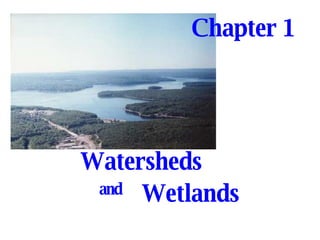
Watersheds   and Wetlands   Chapter 1
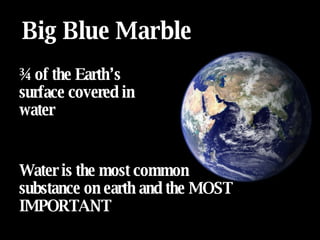
Big Blue Marble ¾ of the Earth’s surface covered in water Water is the most common substance on earth and the MOST IMPORTANT
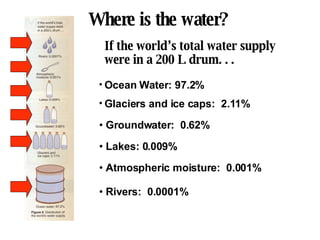
Where is the water? If the world’s total water supply were in a 200 L drum. . . Ocean Water: 97.2% Glaciers and ice caps:  2.11% Groundwater:  0.62% Lakes: 0.009% Atmospheric moisture:  0.001% Rivers:  0.0001%
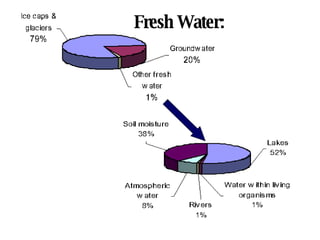
Fresh Water:
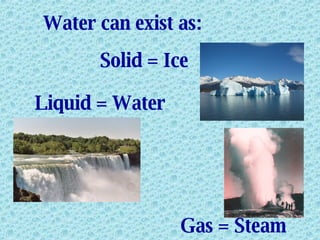
Water can exist as: Solid = Ice Liquid = Water Gas = Steam
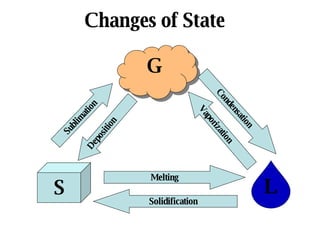
Changes of State S G Deposition Condensation Solidification  Vaporization Sublimation Melting  L
Several of these processes are part of the: WATER CYCLE
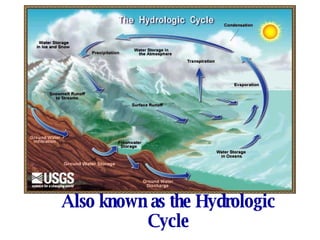
Also known as the Hydrologic Cycle
Evaporation: Change of state from liquid to gas over a period of time at various temperatures Transpiration: Plants release water vapor from their leaves   Precipitation:  liquid or solid  water that falls from  atmosphere to Earth In PA… ½ of our annual 42” rainfall is  returned to atmosphere via  evaporation and transpiration
Runoff: Precipitation that runs off the  ground back into streams, rivers or  oceans Groundwater: Precipitation that seeps into the ground and is stored beneath the Earth’s surface 22% of Earth’s freshwater is  groundwater In PA.. 1 billion gallons of ground water is used EACH DAY in  households, industries, agriculture  and mining
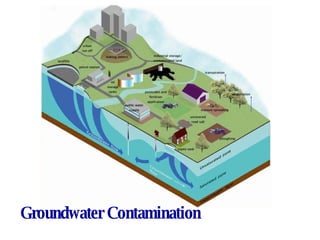
Groundwater Contamination
Groundwater Contamination Contaminants from natural sources As water travels over soil and  rocks  it dissolves certain minerals and  carries them away “ Hard water” is water that has high concentrations of Calcium High concentrations of iron make water “brown” and metallic tasting  High concentrations of hydrogen sulfide gives water “rotten egg” odor and taste
Groundwater Contamination Contaminants from human activities As population gets more dense and we  “take over” more and more space we contaminate the water supply Poorly installed and maintained septics Pesticides and fertilizers used on farms and lawns Landfills, chemical spills, leaking storage  tanks, salts used on icy roads
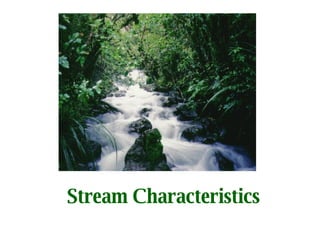
Stream Characteristics
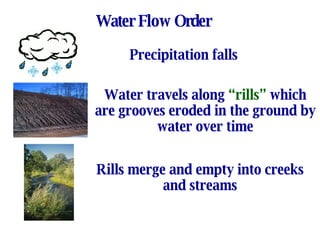
Water Flow Order Precipitation falls  Water travels along  “rills”  which are grooves eroded in the ground by water over time Rills merge and empty into creeks and streams
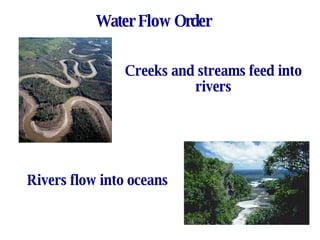
Water Flow Order Creeks and streams feed into rivers Rivers flow into oceans
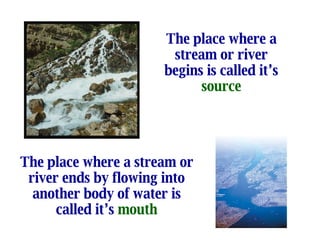
The place where a stream or river begins is called it’s  source The place where a stream or river ends by flowing into another body of water is called it’s  mouth
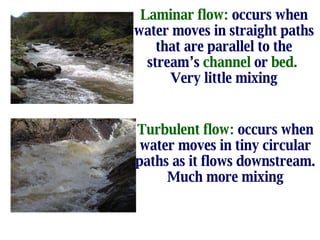
Laminar flow:  occurs when water moves in straight paths that are parallel to the stream’s  channel  or  bed.  Very little mixing Turbulent flow:  occurs when water moves in tiny circular paths as it flows downstream. Much more mixing
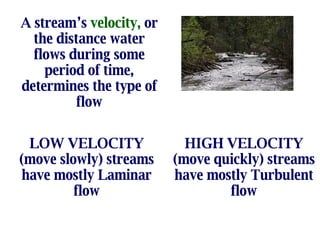
A stream’s  velocity,  or the distance water flows during some period of time, determines the type of flow LOW VELOCITY (move slowly) streams have mostly Laminar flow HIGH VELOCITY (move quickly) streams have mostly Turbulent flow
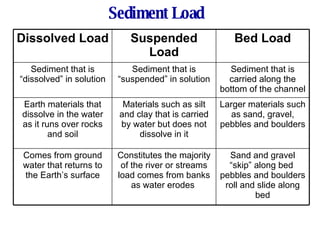
Sediment Load Sand and gravel “skip” along bed  pebbles and boulders roll and slide along bed Constitutes the majority of the river or streams load comes from banks as water erodes  Comes from ground water that returns to the Earth’s surface Larger materials such as sand, gravel, pebbles and boulders Materials such as silt and clay that is carried by water but does not dissolve in it Earth materials that dissolve in the water as it runs over rocks and soil Sediment that is carried along the bottom of the channel Sediment that is “suspended” in solution Sediment that is “dissolved” in solution Bed Load Suspended Load Dissolved Load
Sediment Load Sediment:  particles  that can be transported by fluid flow and which eventually is deposited as a layer of solid particles on the bed or bottom of a body of water or other liquid.  Sediment is carried in streams and rivers in three ways
 
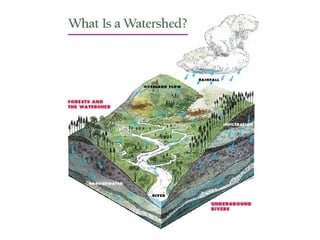
Watershed Also known as a drainage basin Region OF LAND that contributes water to a stream, lake or other body of water
Watersheds are surrounded by  divides Divide:  any ridge between two streams along which precipitation runs off. The Continental Divide-splits North America and some of Central America in two watersheds Watersheds can also be very small
Five of the Major Watersheds in PA PA State water plan:  104 watersheds We will be focusing on 5 that are considered to be Major Watersheds Great Lakes Basin (Erie and Genesee) Ohio River Basin Susquehanna/Chesapeake Basin Potomac Basin Delaware Basin
Great Lakes Basin Only about 1% of this basin actually lies in PA Divided into two sub-basins; Erie Basin and Genesee Basin Rivers and streams in both basins drain to the North into the Great Lakes
Ohio River Basin PA’s second largest watershed Ohio River is largest in this watershed Susquehanna/Chesapeake Basin PA’s  largest watershed Covers 46% of the state Largest river: Susquehanna
Potomac Basin Potomac River does not flow through PA PA’s Shenandoah River is the Potomac River’s largest tributary Delaware Basin 3 rd  largest watershed in PA Delaware river and it’s tributaries supply most of New York City’s freshwater needs
Stream Biology
Ecosystem :  all the plants, animals and micro organisms in an area that function together with the non-living factors of that environment Streams and Rivers are  aquatic ecosystems
Algae Plant like organisms (Protists) Producers :  Make their own food (also known as  autotrophs ) Use energy from sun and dissolved nutrients to make food Base of most aquatic food chains
Animal Like Protists Simple organisms that have same  characteristics as animals Eat bacteria, sediments that contain bacteria and algae Saprotrophs :  feed on decayed  organic material Raptors : protists that eat other  protists
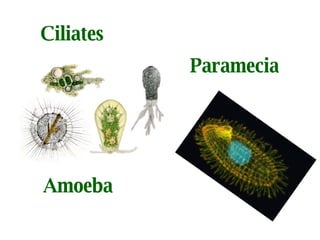
Ciliates Paramecia Amoeba
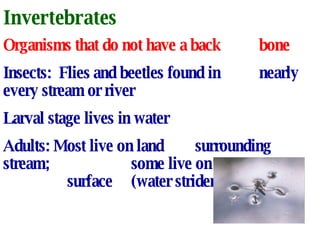
Invertebrates Organisms that do not have a back bone Insects:  Flies and beetles found in nearly every stream or river Larval stage lives in water Adults: Most live on land  surrounding stream;  some live on water  surface (water striders)
Invertebrates Shredders:   Eat tissue of other  organisms; organic matter; wood (bite and chew)  Predators:   ingest prey whole or pierce tissues and suck out fluids
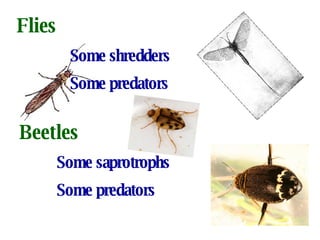
Flies Some shredders Some predators Beetles Some saprotrophs Some predators
Freshwater mollusks and some aquatic worms  Spend entire lives in water Most feed on algae and plants (Primary consumers, herbivores eat producers) Some eat other animals  (Secondary consumers, carnivores) Some eat both plants and animals (Secondary consumers, omnivores)
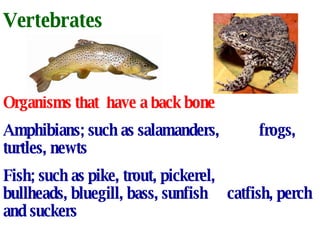
Vertebrates Organisms that  have a back bone Amphibians; such as salamanders,  frogs, turtles, newts Fish; such as pike, trout, pickerel,  bullheads, bluegill, bass, sunfish catfish, perch and suckers
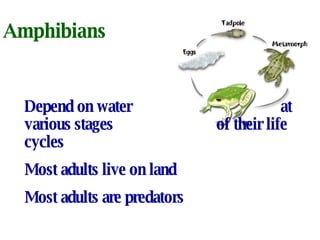
Amphibians Depend on water  at various stages of their life cycles Most adults live on land Most adults are predators
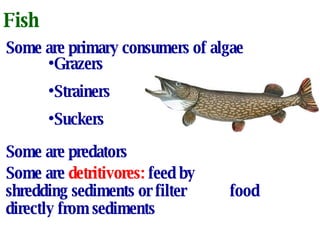
Fish Some are primary consumers of algae Grazers Strainers Suckers Some are predators Some are  detritivores:  feed by  shredding sediments or filter  food directly from sediments
Class Activity: Identifying Macro  Invertebrates!! http://people.virginia.edu/~sos-iwla/Stream-Study/Key/MacroKeyIntro.HTML
Notes on Factors that Affect Freshwater Ecosystems
Wetlands Wetland:   an area that contains unique types of soil, is home to plants adapted to the wet environment, and contains water all year or certain times during the year
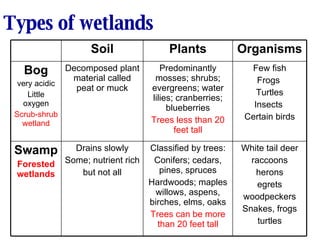
Types of wetlands White tail deer raccoons herons egrets woodpeckers Snakes, frogs turtles Classified by trees: Conifers; cedars, pines, spruces Hardwoods; maples willows, aspens, birches, elms, oaks Trees can be more than 20 feet tall Drains slowly Some; nutrient rich but not all Swamp Forested wetlands Few fish Frogs  Turtles Insects  Certain birds Predominantly mosses; shrubs; evergreens; water lilies; cranberries; blueberries Trees less than 20 feet tall Decomposed plant material called peat or muck Bog very acidic Little oxygen Scrub-shrub wetland Organisms Plants Soil
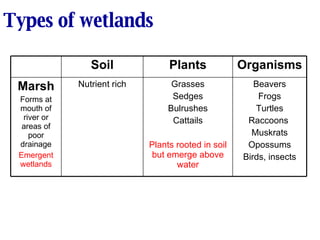
Types of wetlands Beavers Frogs Turtles Raccoons  Muskrats Opossums Birds, insects Grasses Sedges Bulrushes Cattails Plants rooted in soil but emerge above water Nutrient rich Marsh Forms at mouth of river or areas of poor drainage Emergent wetlands Organisms Plants Soil
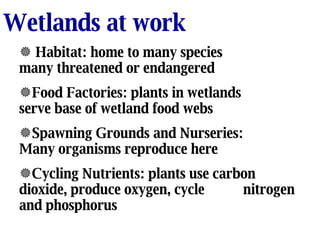
Wetlands at work Habitat: home to many species many threatened or endangered Food Factories: plants in wetlands  serve base of wetland food webs Spawning Grounds and Nurseries: Many organisms reproduce here Cycling Nutrients: plants use carbon dioxide, produce oxygen, cycle nitrogen and phosphorus
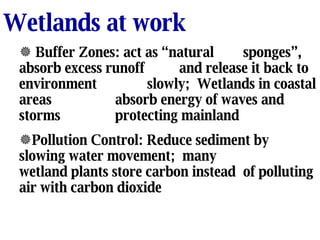
Wetlands at work Buffer Zones: act as “natural  sponges”, absorb excess runoff and release it back to environment  slowly;  Wetlands in coastal areas absorb energy of waves and storms protecting mainland Pollution Control: Reduce sediment by  slowing water movement;  many  wetland plants store carbon instead of polluting air with carbon dioxide
Factors That Affect Wetlands and Watersheds Human Activities: Agriculture Urbanization and construction Mining Industry Waste Disposal
Agriculture: Harvesting Irrigation ditches Animal wastes Overgrazing (erosion of soil) which increases sediment that runs off  Chemicals used in pesticides and  fertilizers
Urbanization and Construction Covering soil with concrete increases runoff that carries pollutants Construction of roads and bridges over wetlands; increases runoff and  restricts movements of organisms Paints, cleaners, salt, herbicides used  along roads damage wetlands by  increasing turbidity, lowering pH,  and decreasing dissolved oxygen Canals, ditches, levees divert water  from it’s natural flow
Mining: Mining of substances directly from  wetlands such as phosphorus and peat Mining of rocks and minerals:  acid  drainage; heavy metals; sediment Industry: Construction; reduces wetland acreage Pollutants Water intake, draining of wetlands Water release, thermal pollution which  can lead to algal blooms
Waste Disposal: Landfills: solid waste; toxic leakage Sludge and Wastewater Treatment; Introduce of biological pathogens to wetlands Rich in nitrogen and phosphorus which cause Algal blooms
Factors That Affect Wetlands and Watersheds Natural Events: Floods Erosion and Deposition Drought Volcanic Eruptions Fires Wind Global Climate Change
Floods: Positive impact: Move nutrients and organic materials  downstream Deposit silt into river banks Change shape and size of river channel;  form new channels Negative impact: Destroy riverbanks Carry organisms away from natural  habitat Landslides; increases sediment
Erosion and Deposition Erosion, sediment movement, and  deposition all happen as water flows over land Changes in precipitation causes more  erosion which can change size and  shape of stream or river channel Channel changes affects velocity, discharge and stream biology
Drought Drought:  period in which the amount of precipitation that falls in and area is lower than normal Reduce the volume of the water Lower volume affects clarity, salinity, temperature, pH and amount of sediment Some bodies of water disappear; causing loss of breeding and feeding grounds
Volcanic Eruptions Massive mudslides that cutoff streams and rivers Vegetation loss changes stream biology Ash changes pH of water and increases turbidity Temperature changes and ash kill organisms
Fires Damage or destroy vegetation; causing increase in runoff and erosion Loss of habitat Increase temperature of water Can be BENEFICIAL; pine tree reproduction Wind Carry and drop sediment Affects evaporation of water
Global Climate Changes Natural large scale changes in climate occur about every 10,000 years Cooler climate; freshwater locked in ice and glaciers Warmer climate; melt off increases sea level; causes flooding; causes salt water to move into fresh water wetlands Changes the salinity of wetlands Salt-tolerant species replace freshwater organisms Vegetation covered and dies changing wetlands into open water

Watersheds and Wetlands

  • 1.
    Watersheds and Wetlands Chapter 1
  • 2.
    Big Blue Marble¾ of the Earth’s surface covered in water Water is the most common substance on earth and the MOST IMPORTANT
  • 3.
    Where is thewater? If the world’s total water supply were in a 200 L drum. . . Ocean Water: 97.2% Glaciers and ice caps: 2.11% Groundwater: 0.62% Lakes: 0.009% Atmospheric moisture: 0.001% Rivers: 0.0001%
  • 4.
  • 5.
    Water can existas: Solid = Ice Liquid = Water Gas = Steam
  • 6.
    Changes of StateS G Deposition Condensation Solidification Vaporization Sublimation Melting L
  • 7.
    Several of theseprocesses are part of the: WATER CYCLE
  • 8.
    Also known asthe Hydrologic Cycle
  • 9.
    Evaporation: Change ofstate from liquid to gas over a period of time at various temperatures Transpiration: Plants release water vapor from their leaves Precipitation: liquid or solid water that falls from atmosphere to Earth In PA… ½ of our annual 42” rainfall is returned to atmosphere via evaporation and transpiration
  • 10.
    Runoff: Precipitation thatruns off the ground back into streams, rivers or oceans Groundwater: Precipitation that seeps into the ground and is stored beneath the Earth’s surface 22% of Earth’s freshwater is groundwater In PA.. 1 billion gallons of ground water is used EACH DAY in households, industries, agriculture and mining
  • 11.
  • 12.
    Groundwater Contamination Contaminantsfrom natural sources As water travels over soil and rocks it dissolves certain minerals and carries them away “ Hard water” is water that has high concentrations of Calcium High concentrations of iron make water “brown” and metallic tasting High concentrations of hydrogen sulfide gives water “rotten egg” odor and taste
  • 13.
    Groundwater Contamination Contaminantsfrom human activities As population gets more dense and we “take over” more and more space we contaminate the water supply Poorly installed and maintained septics Pesticides and fertilizers used on farms and lawns Landfills, chemical spills, leaking storage tanks, salts used on icy roads
  • 14.
  • 15.
    Water Flow OrderPrecipitation falls Water travels along “rills” which are grooves eroded in the ground by water over time Rills merge and empty into creeks and streams
  • 16.
    Water Flow OrderCreeks and streams feed into rivers Rivers flow into oceans
  • 17.
    The place wherea stream or river begins is called it’s source The place where a stream or river ends by flowing into another body of water is called it’s mouth
  • 18.
    Laminar flow: occurs when water moves in straight paths that are parallel to the stream’s channel or bed. Very little mixing Turbulent flow: occurs when water moves in tiny circular paths as it flows downstream. Much more mixing
  • 19.
    A stream’s velocity, or the distance water flows during some period of time, determines the type of flow LOW VELOCITY (move slowly) streams have mostly Laminar flow HIGH VELOCITY (move quickly) streams have mostly Turbulent flow
  • 20.
    Sediment Load Sandand gravel “skip” along bed pebbles and boulders roll and slide along bed Constitutes the majority of the river or streams load comes from banks as water erodes Comes from ground water that returns to the Earth’s surface Larger materials such as sand, gravel, pebbles and boulders Materials such as silt and clay that is carried by water but does not dissolve in it Earth materials that dissolve in the water as it runs over rocks and soil Sediment that is carried along the bottom of the channel Sediment that is “suspended” in solution Sediment that is “dissolved” in solution Bed Load Suspended Load Dissolved Load
  • 21.
    Sediment Load Sediment: particles that can be transported by fluid flow and which eventually is deposited as a layer of solid particles on the bed or bottom of a body of water or other liquid. Sediment is carried in streams and rivers in three ways
  • 22.
  • 23.
    Watershed Also knownas a drainage basin Region OF LAND that contributes water to a stream, lake or other body of water
  • 24.
    Watersheds are surroundedby divides Divide: any ridge between two streams along which precipitation runs off. The Continental Divide-splits North America and some of Central America in two watersheds Watersheds can also be very small
  • 25.
    Five of theMajor Watersheds in PA PA State water plan: 104 watersheds We will be focusing on 5 that are considered to be Major Watersheds Great Lakes Basin (Erie and Genesee) Ohio River Basin Susquehanna/Chesapeake Basin Potomac Basin Delaware Basin
  • 26.
    Great Lakes BasinOnly about 1% of this basin actually lies in PA Divided into two sub-basins; Erie Basin and Genesee Basin Rivers and streams in both basins drain to the North into the Great Lakes
  • 27.
    Ohio River BasinPA’s second largest watershed Ohio River is largest in this watershed Susquehanna/Chesapeake Basin PA’s largest watershed Covers 46% of the state Largest river: Susquehanna
  • 28.
    Potomac Basin PotomacRiver does not flow through PA PA’s Shenandoah River is the Potomac River’s largest tributary Delaware Basin 3 rd largest watershed in PA Delaware river and it’s tributaries supply most of New York City’s freshwater needs
  • 29.
  • 30.
    Ecosystem : all the plants, animals and micro organisms in an area that function together with the non-living factors of that environment Streams and Rivers are aquatic ecosystems
  • 31.
    Algae Plant likeorganisms (Protists) Producers : Make their own food (also known as autotrophs ) Use energy from sun and dissolved nutrients to make food Base of most aquatic food chains
  • 32.
    Animal Like ProtistsSimple organisms that have same characteristics as animals Eat bacteria, sediments that contain bacteria and algae Saprotrophs : feed on decayed organic material Raptors : protists that eat other protists
  • 33.
  • 34.
    Invertebrates Organisms thatdo not have a back bone Insects: Flies and beetles found in nearly every stream or river Larval stage lives in water Adults: Most live on land surrounding stream; some live on water surface (water striders)
  • 35.
    Invertebrates Shredders: Eat tissue of other organisms; organic matter; wood (bite and chew) Predators: ingest prey whole or pierce tissues and suck out fluids
  • 36.
    Flies Some shreddersSome predators Beetles Some saprotrophs Some predators
  • 37.
    Freshwater mollusks andsome aquatic worms Spend entire lives in water Most feed on algae and plants (Primary consumers, herbivores eat producers) Some eat other animals (Secondary consumers, carnivores) Some eat both plants and animals (Secondary consumers, omnivores)
  • 38.
    Vertebrates Organisms that have a back bone Amphibians; such as salamanders, frogs, turtles, newts Fish; such as pike, trout, pickerel, bullheads, bluegill, bass, sunfish catfish, perch and suckers
  • 39.
    Amphibians Depend onwater at various stages of their life cycles Most adults live on land Most adults are predators
  • 40.
    Fish Some areprimary consumers of algae Grazers Strainers Suckers Some are predators Some are detritivores: feed by shredding sediments or filter food directly from sediments
  • 41.
    Class Activity: IdentifyingMacro Invertebrates!! http://people.virginia.edu/~sos-iwla/Stream-Study/Key/MacroKeyIntro.HTML
  • 42.
    Notes on Factorsthat Affect Freshwater Ecosystems
  • 43.
    Wetlands Wetland: an area that contains unique types of soil, is home to plants adapted to the wet environment, and contains water all year or certain times during the year
  • 44.
    Types of wetlandsWhite tail deer raccoons herons egrets woodpeckers Snakes, frogs turtles Classified by trees: Conifers; cedars, pines, spruces Hardwoods; maples willows, aspens, birches, elms, oaks Trees can be more than 20 feet tall Drains slowly Some; nutrient rich but not all Swamp Forested wetlands Few fish Frogs Turtles Insects Certain birds Predominantly mosses; shrubs; evergreens; water lilies; cranberries; blueberries Trees less than 20 feet tall Decomposed plant material called peat or muck Bog very acidic Little oxygen Scrub-shrub wetland Organisms Plants Soil
  • 45.
    Types of wetlandsBeavers Frogs Turtles Raccoons Muskrats Opossums Birds, insects Grasses Sedges Bulrushes Cattails Plants rooted in soil but emerge above water Nutrient rich Marsh Forms at mouth of river or areas of poor drainage Emergent wetlands Organisms Plants Soil
  • 46.
    Wetlands at workHabitat: home to many species many threatened or endangered Food Factories: plants in wetlands serve base of wetland food webs Spawning Grounds and Nurseries: Many organisms reproduce here Cycling Nutrients: plants use carbon dioxide, produce oxygen, cycle nitrogen and phosphorus
  • 47.
    Wetlands at workBuffer Zones: act as “natural sponges”, absorb excess runoff and release it back to environment slowly; Wetlands in coastal areas absorb energy of waves and storms protecting mainland Pollution Control: Reduce sediment by slowing water movement; many wetland plants store carbon instead of polluting air with carbon dioxide
  • 48.
    Factors That AffectWetlands and Watersheds Human Activities: Agriculture Urbanization and construction Mining Industry Waste Disposal
  • 49.
    Agriculture: Harvesting Irrigationditches Animal wastes Overgrazing (erosion of soil) which increases sediment that runs off Chemicals used in pesticides and fertilizers
  • 50.
    Urbanization and ConstructionCovering soil with concrete increases runoff that carries pollutants Construction of roads and bridges over wetlands; increases runoff and restricts movements of organisms Paints, cleaners, salt, herbicides used along roads damage wetlands by increasing turbidity, lowering pH, and decreasing dissolved oxygen Canals, ditches, levees divert water from it’s natural flow
  • 51.
    Mining: Mining ofsubstances directly from wetlands such as phosphorus and peat Mining of rocks and minerals: acid drainage; heavy metals; sediment Industry: Construction; reduces wetland acreage Pollutants Water intake, draining of wetlands Water release, thermal pollution which can lead to algal blooms
  • 52.
    Waste Disposal: Landfills:solid waste; toxic leakage Sludge and Wastewater Treatment; Introduce of biological pathogens to wetlands Rich in nitrogen and phosphorus which cause Algal blooms
  • 53.
    Factors That AffectWetlands and Watersheds Natural Events: Floods Erosion and Deposition Drought Volcanic Eruptions Fires Wind Global Climate Change
  • 54.
    Floods: Positive impact:Move nutrients and organic materials downstream Deposit silt into river banks Change shape and size of river channel; form new channels Negative impact: Destroy riverbanks Carry organisms away from natural habitat Landslides; increases sediment
  • 55.
    Erosion and DepositionErosion, sediment movement, and deposition all happen as water flows over land Changes in precipitation causes more erosion which can change size and shape of stream or river channel Channel changes affects velocity, discharge and stream biology
  • 56.
    Drought Drought: period in which the amount of precipitation that falls in and area is lower than normal Reduce the volume of the water Lower volume affects clarity, salinity, temperature, pH and amount of sediment Some bodies of water disappear; causing loss of breeding and feeding grounds
  • 57.
    Volcanic Eruptions Massivemudslides that cutoff streams and rivers Vegetation loss changes stream biology Ash changes pH of water and increases turbidity Temperature changes and ash kill organisms
  • 58.
    Fires Damage ordestroy vegetation; causing increase in runoff and erosion Loss of habitat Increase temperature of water Can be BENEFICIAL; pine tree reproduction Wind Carry and drop sediment Affects evaporation of water
  • 59.
    Global Climate ChangesNatural large scale changes in climate occur about every 10,000 years Cooler climate; freshwater locked in ice and glaciers Warmer climate; melt off increases sea level; causes flooding; causes salt water to move into fresh water wetlands Changes the salinity of wetlands Salt-tolerant species replace freshwater organisms Vegetation covered and dies changing wetlands into open water