Coastal Zone Management in India
Dr. Prasanna Yennawar
Freshwater Biology Regional Centre
Zoological Survey of India
Hyderabad 500048 AP
 India is one of the 12 mega-biodiversity centres in the world.
 India – 4th largest producer of farmed shrimp in
the eastern hemisphere.
 Fishes: About 12% of all the world’s fishes are in India, or
about 2200 species.
 Wetlands: About 4 million ha (2.6 million are man-made).
 Significant erosion of India’s biodiversity at the ecosystem,
species and genetic level has already taken place.
PREAMBLE
Root casuses of loss of biodiversity
Qualitative in nature.
Major causes of loss of biodiversity include:
 habitat destruction and degradation,
 over-exploitation of living resources,
 introduction of exotics,
 human induced changes, and
 climate change
 increasing social, political and economic inequities;
 inapprorpiate and unclear tenurial arrangements and
inter-departmental conflicts;
 changes in cultural, ethical and moral values;
 lack of recognition of the full values of biodiversity;
 inappropriate, inflexible, weak and contradictory laws
and policies, demographic changes, etc.
Oceans
 Covers 71% of the globe.
 Support a wide spectrum of living and non-living resources.
 Provides over 1/5th of the food and oxygen used by the
mankind.
 Source of food, energy, metals and minerals, oil and gas
and a means of trade, transport and recreation.
 Out of an estimated 30 million species of flora and fauna on
the planet earth, the catalogued list is only 1.4 million species
with nearly 20% from oceans.
 Over 60% of the global population living along coastline.
 Human intervention become quite pronounced in case of
living resources due to growing demand for marine products
in both domestic and export markets.
Coastal zones are defined by the extent of territorial waters
up to the high water mark.
Generally the world’s coastal zones are long narrow features of
mainland, islands and seas, generally forming the outer
boundary of the coastal domain (from 200m above sea level to
200 m below sea level).
Coastal zones include the entire continental shelf and occupy
about 18% of the surface of the globe, supplying about 90% of
global fish catch and accounts for some 25% of global primary
productivity while at the same time being some of the most
endangered regions on the planet.
What is coastal zone?
• Protection from storms and hurricanes.
• Climate stabilization
• Treasures unique ecosystems
• Harbors rich diversity
• Provides varied resources
Uniqueness of the coast
Coastal Zone
• India’s coastline of over 8100 km.
• Supports a wide variety of coastal activities.
• Comprise various types of coastal habitats.
• Plays a major role in terms of economy and ecology.
• Natural processes and human interventions cause changes
in status of coastal zone resulting in degradation/loss of
amenities and habitats.
• An interface between land and sea with integrated complex
of marine, coastal land sub-systems and shoreline
environments.
• Includes beaches, sand dunes, coastal plains, inter-tidal
mudflats, mangrove forests, sea grass, coral reefs and
lagoons.
• Is dynamic with frequent changes in biological, chemical
and geological parameters.
Issues & problems
NATURAL MAN MADE
Sea Level Rise Pollution
Sedimentation Biodiversity Threats
Disasters Urbanization
Tsunamis Soil Erosion
Earthquakes Salinity Ingress
Flooding Population Stress
Cyclones Sewage Disposal
Resource Exploitation
Over Urbanization
Resources of Coastal Zone
• Natural renewable and non-renewable, cultural, historical and archaeological.
• Fishing of near-shore waters and farming of coastal lowlands are the major
economic activities.
• Provides for marine transportation, recreation, tourism and salt production.
• Highly productive with high biological diversity.
• Nursery habitats for many species.
• Coastal features form natural defence against storms, floods and erosion.
• Common and rich nature of resources, with open access, attract human
settlements along coastline.
• 20 % of the Indian population lives in the coastal areas.
• Increasing urbanisation and human settlements lead to over-exploitation of
coastal resources resulting in resource depletion and user conflicts.
 12% of the world fish genetic resources found in
Indian waters.
 Out of 20 000 documented fish species worldwide,
2546 finfish species recorded in India.
 Twenty-seven species are considered
rare/endangered/ vulnerable.
 Island ecosystems in India - two broad types:
coraline, as that of Lakshadweep, and submerged
mountain tops harbouring tropical rainforests, as in
A & N Islands.
Resources of Coastal Zone
Threats to Coastal Zone
and Related Ecosystems
 Rapidly increasing populations and associated urbanization,
 Commercialization and monetization,
 Technological improvement,
 Detrimental fishing methods,
 Logging of forests and mangroves,
 Pollution,
 Changing agricultural practices and coastal
developments or conversions
• Discharge of huge quantities of untreated sewage into
sea leads to eutrophication, resulting in toxic algal
blooms or “red-tides”.
• Expansion of urban settlements, exploitation for fuel,
agricultural development and construction of fish and
shrimp ponds put pressure on mangroves and coastal
wetlands.
• Almost 60% of world’s reefs threatened by human
activities.
• Coral reefs prone to severe damage from natural
disturbances - cyclones and temperature extremes.
• Climate change and storms lead to bleaching events.
Threats to Coastal Zone and Related Ecosystems
Legislation for Aquatic Biodiversity
Important Acts Relevant to Biodiversity
 Indian Forest Act 1927enables States to acquire ownership
over forests and their produce.
 Wildlife (Protection) Act, 1972 (amended further) provides for
protection of wild plants and animals and regulates hunting,
trade and collection of specific forest products.
 National Wildlife Action Plan, 1973 identifies broad goals of
establishing a network of representative protected areas and
developing appropriate management systems .
 Forest (Conservation) Act, 1980, deals primarily with using forest
lands for non-forestry purposes, mainly industry and mining.
 Environment (Protection) Act, 1986 empowers central
government to take appropriate measures for protecting and
improving the environment .
 Foreign Trade (Development and Regulation) Act, 1992 to stimulate
sustained economic growth and enhance technological strength
and efficiency of Indian agriculture, industry and services .
Other Conventions and International Agreements on
Biodiversity
• Acceded to Convention on International Trade in
Endangered Species of Wild Flora and Fauna (CITES) in
1976.
• India became a party to Ramsar Convention in October
1981 and designated Chilka Lake as a Ramsar Site, but
recently removed from the list.
• Under U. N. World Heritage Convention, India declared
Sundarbans National Park as a World Heritage Site.
• India is a signatory to:
 Convention on Biodiversity,
 Convention on Migratory Species,
 Framework Convention on Climate Change,
 U. N. Convention on the Law of the Sea, etc.
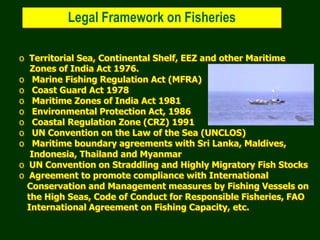
Legal Framework on Fisheries
o Territorial Sea, Continental Shelf, EEZ and other Maritime
Zones of India Act 1976.
o Marine Fishing Regulation Act (MFRA)
o Coast Guard Act 1978
o Maritime Zones of India Act 1981
o Environmental Protection Act, 1986
o Coastal Regulation Zone (CRZ) 1991
o UN Convention on the Law of the Sea (UNCLOS)
o Maritime boundary agreements with Sri Lanka, Maldives,
Indonesia, Thailand and Myanmar
o UN Convention on Straddling and Highly Migratory Fish Stocks
o Agreement to promote compliance with International
Conservation and Management measures by Fishing Vessels on
the High Seas, Code of Conduct for Responsible Fisheries, FAO
International Agreement on Fishing Capacity, etc.
Integrated Management Concept
 Involves comprehensive planning and managing of human
activities to minimize conflict among users;
 A collaborative approach that cannot be forced on anyone;
 A flexible and transparent planning process that respects
existing divisions of constitutional and departmental authority,
 Does not abrogate or derogate from any existing Aboriginal or
treaty rights.
Planning: involves six interrelated stages:
•defining and assessing a management area;
engaging affected interests;
•developing an Integrated Management plan;
•receiving endorsement of the plan;
•implementing the plan; and
•monitoring and evaluating outcomes.
Integrated Management Principles
 ecosystem-based management,
 sustainable development,
 precautionary approach,
 conservation;
 shared responsibility,
 flexibility and inclusiveness
 A simple and common sense approach, a modern and
qualitatively different way to use, protect and conserve oceans
and coastal waters
Research efforts to protect and conserve biodiversity
Ecosystem Surveys under the programmes for inventorying and
monitoring India’s biodiversity include Marine, Islands, Mangroves,
Wetlands and Coastal areas.
NIO, CMFRI, ZSI, BSI, Universities and academic institutions provide
institutional support in identifying, creating databases and monitoring
coastal and marine biodiversity .
National Remote Sensing Agency (NRSA), universities and other
institutions have launched a number of programmes to monitor India’s
coasts with the aid of satellites.
Marine Products Export Development Authority (MPEDA) has begun a
document on cultivable marine species.
National Bureau of Fish Genetic Resources (NBFGR) is devoted to
conservation and sustainable use of fish diversity in India.
MoEF conducted a survey and published the first wetland directory.
Under the Ganga Action Plan, improving sewage-treatment technologies
has been emphasized.
• Maximize the benefits provided by the coastal zone
• Minimize conflicts and harmful effects of activities upon each other,
resources and the environment
• To dissipate tidal and wave energy & reduce risk from disasters
• To stabilise the adjoining land.
• Promote linkages between sectoral activities
• Guide coastal area development in an ecologically sustainable fashion
Purpose of coastal zone management
Coastal Regulation Zone
Notification
Aim
To preserve and protect coastal zone
from activities that may cause
degradation of quality or loss of
coastal land
The CRZ Notification was introduced with three main principles:
• It is necessary to arrive at a balance between development needs and
protection of natural resources.
• Certain activities are harmful for both coastal communities and their
environment, and these should be prohibited or regulated.
• If coastal ecosystems are sustainably managed, then the livelihoods of
millions will be protected and their survival guaranteed.
Principles
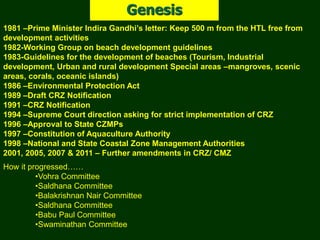
1981 –Prime Minister Indira Gandhi’s letter: Keep 500 m from the HTL free from
development activities
1982-Working Group on beach development guidelines
1983-Guidelines for the development of beaches (Tourism, Industrial
development, Urban and rural development Special areas –mangroves, scenic
areas, corals, oceanic islands)
1986 –Environmental Protection Act
1989 –Draft CRZ Notification
1991 –CRZ Notification
1994 –Supreme Court direction asking for strict implementation of CRZ
1996 –Approval to State CZMPs
1997 –Constitution of Aquaculture Authority
1998 –National and State Coastal Zone Management Authorities
2001, 2005, 2007 & 2011 – Further amendments in CRZ/ CMZ
How it progressed……
•Vohra Committee
•Saldhana Committee
•Balakrishnan Nair Committee
•Saldhana Committee
•Babu Paul Committee
•Swaminathan Committee
Genesis
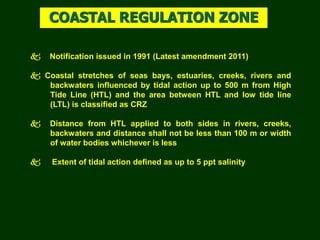
 Notification issued in 1991 (Latest amendment 2011)
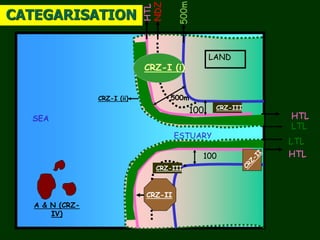
 Coastal stretches of seas bays, estuaries, creeks, rivers and
backwaters influenced by tidal action up to 500 m from High
Tide Line (HTL) and the area between HTL and low tide line
(LTL) is classified as CRZ
 Distance from HTL applied to both sides in rivers, creeks,
backwaters and distance shall not be less than 100 m or width
of water bodies whichever is less
 Extent of tidal action defined as up to 5 ppt salinity
COASTAL REGULATION ZONE
500
100 HTL
LTL
LTL
HTL
LAND
ESTUARY
SEA
A & N (CRZ-
IV)
CRZ-III
CRZ-II
CRZ-I (i)
NDZ
HTL
500mCRZ-I (ii)
100
CRZ-III
500m
CATEGARISATION
 Setting up of new or expansion of existing industries
except those requiring water fronts, projects of Atomic
Energy, Non-polluting industries of IT, SEZ; Desalination
plants, Non-conventional energy plants, Air strips in A & N
except in CRZ I
 Manufacture or handling of hazardous substances except
their transfer from ships to facilities with adoption of
safety regulations
 No fish processing industry including warehousing but
excluding hatcheries & natural fish drying - exceptions for
modernisation with NOC from PCBS
 Setting up and expansion of units for disposal of wastes,
effluents except facilities required for discharge of treated
effluents, storm water drains, treatment of wastes from
beach resorts, domestic wastes in islands
PROHIBITED ACTIVITIES
 Discharge of untreated wastes and effluents
from industries and municipalities etc. -
phasing out within 3 years - land filling - fly
ash or other waste dumping by power plants
 No land reclamation, bunding except
structures for coastal erosion, storm water
drains, jetties, structures for prevention of
salinity ingress and formation of sand bars
 Mining of sand & rock banned except for rare
minerals not available outside 500 mt. zone
except for sand mining in A& N islands upto
March 2004 with restrictions
PROHIBITED ACTIVITIES (CONT…..)
 Harvesting or drawl of ground water
within 200 m of HTL: 200 - 500 mt drawl
permitted through wells manually -
exceptions in areas of water scarcity
 Construction in CRZ 1 areas except those
permitted
 No alteration of hills, sand dunes for
beautification, etc.
 any construction activity except for carrying
waste water, operational discharges
through pipelines
PROHIBITED ACTIVITIES (CONT…..)
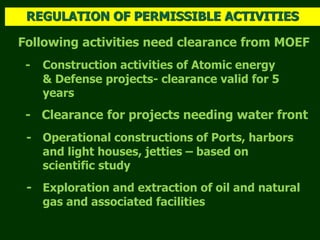
Following activities need clearance from MOEF
- Construction activities of Atomic energy
& Defense projects- clearance valid for 5
years
- Clearance for projects needing water front
- Operational constructions of Ports, harbors
and light houses, jetties – based on
scientific study
- Exploration and extraction of oil and natural
gas and associated facilities
REGULATION OF PERMISSIBLE ACTIVITIES
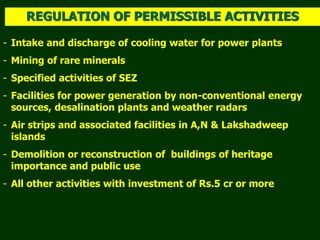
- Intake and discharge of cooling water for power plants
- Mining of rare minerals
- Specified activities of SEZ
- Facilities for power generation by non-conventional energy
sources, desalination plants and weather radars
- Air strips and associated facilities in A,N & Lakshadweep
islands
- Demolition or reconstruction of buildings of heritage
importance and public use
- All other activities with investment of Rs.5 cr or more
REGULATION OF PERMISSIBLE ACTIVITIES
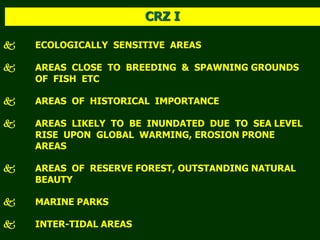
 ECOLOGICALLY SENSITIVE AREAS
 AREAS CLOSE TO BREEDING & SPAWNING GROUNDS
OF FISH ETC
 AREAS OF HISTORICAL IMPORTANCE
 AREAS LIKELY TO BE INUNDATED DUE TO SEA LEVEL
RISE UPON GLOBAL WARMING, EROSION PRONE
AREAS
 AREAS OF RESERVE FOREST, OUTSTANDING NATURAL
BEAUTY
 MARINE PARKS
 INTER-TIDAL AREAS
CRZ I
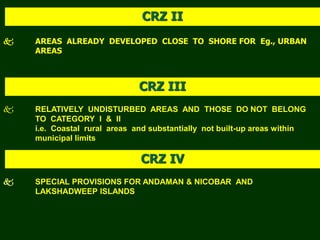
 AREAS ALREADY DEVELOPED CLOSE TO SHORE FOR Eg., URBAN
AREAS
CRZ II
 RELATIVELY UNDISTURBED AREAS AND THOSE DO NOT BELONG
TO CATEGORY I & II
i.e. Coastal rural areas and substantially not built-up areas within
municipal limits
CRZ III
CRZ IV
 SPECIAL PROVISIONS FOR ANDAMAN & NICOBAR AND
LAKSHADWEEP ISLANDS
 Steps to prepare Coastal Zone Management Plans
identifying and classifying CRZ areas and all
activities related as per the provisions of
notification
 All States have prepared Plans but in the process
of refining CRZ boundaries
 CZMP need approval of MoEF including their future
commitments
IMPLEMENTATION
 State and National authorities constituted in January
2002
 State Authorities have power to take measures for
protecting and improving quality of Coastal
Environment and controlling pollution
 Other functions are:
- Examination of proposals seeking changes in CRZ
classification and in CZMP
- Violation of provision of CRZ and to take
appropriate actions
COASTAL ZONE MANAGEMENT AUTHORITY (CZMA)
Coastal zone management in india

Coastal zone management in india

  • 1.
    Coastal Zone Managementin India Dr. Prasanna Yennawar Freshwater Biology Regional Centre Zoological Survey of India Hyderabad 500048 AP
  • 2.
     India isone of the 12 mega-biodiversity centres in the world.  India – 4th largest producer of farmed shrimp in the eastern hemisphere.  Fishes: About 12% of all the world’s fishes are in India, or about 2200 species.  Wetlands: About 4 million ha (2.6 million are man-made).  Significant erosion of India’s biodiversity at the ecosystem, species and genetic level has already taken place. PREAMBLE
  • 3.
    Root casuses ofloss of biodiversity Qualitative in nature. Major causes of loss of biodiversity include:  habitat destruction and degradation,  over-exploitation of living resources,  introduction of exotics,  human induced changes, and  climate change  increasing social, political and economic inequities;  inapprorpiate and unclear tenurial arrangements and inter-departmental conflicts;  changes in cultural, ethical and moral values;  lack of recognition of the full values of biodiversity;  inappropriate, inflexible, weak and contradictory laws and policies, demographic changes, etc.
  • 4.
    Oceans  Covers 71%of the globe.  Support a wide spectrum of living and non-living resources.  Provides over 1/5th of the food and oxygen used by the mankind.  Source of food, energy, metals and minerals, oil and gas and a means of trade, transport and recreation.  Out of an estimated 30 million species of flora and fauna on the planet earth, the catalogued list is only 1.4 million species with nearly 20% from oceans.  Over 60% of the global population living along coastline.  Human intervention become quite pronounced in case of living resources due to growing demand for marine products in both domestic and export markets.
  • 5.
    Coastal zones aredefined by the extent of territorial waters up to the high water mark. Generally the world’s coastal zones are long narrow features of mainland, islands and seas, generally forming the outer boundary of the coastal domain (from 200m above sea level to 200 m below sea level). Coastal zones include the entire continental shelf and occupy about 18% of the surface of the globe, supplying about 90% of global fish catch and accounts for some 25% of global primary productivity while at the same time being some of the most endangered regions on the planet. What is coastal zone?
  • 6.
    • Protection fromstorms and hurricanes. • Climate stabilization • Treasures unique ecosystems • Harbors rich diversity • Provides varied resources Uniqueness of the coast
  • 7.
    Coastal Zone • India’scoastline of over 8100 km. • Supports a wide variety of coastal activities. • Comprise various types of coastal habitats. • Plays a major role in terms of economy and ecology. • Natural processes and human interventions cause changes in status of coastal zone resulting in degradation/loss of amenities and habitats. • An interface between land and sea with integrated complex of marine, coastal land sub-systems and shoreline environments. • Includes beaches, sand dunes, coastal plains, inter-tidal mudflats, mangrove forests, sea grass, coral reefs and lagoons. • Is dynamic with frequent changes in biological, chemical and geological parameters.
  • 8.
    Issues & problems NATURALMAN MADE Sea Level Rise Pollution Sedimentation Biodiversity Threats Disasters Urbanization Tsunamis Soil Erosion Earthquakes Salinity Ingress Flooding Population Stress Cyclones Sewage Disposal Resource Exploitation Over Urbanization
  • 9.
    Resources of CoastalZone • Natural renewable and non-renewable, cultural, historical and archaeological. • Fishing of near-shore waters and farming of coastal lowlands are the major economic activities. • Provides for marine transportation, recreation, tourism and salt production. • Highly productive with high biological diversity. • Nursery habitats for many species. • Coastal features form natural defence against storms, floods and erosion. • Common and rich nature of resources, with open access, attract human settlements along coastline. • 20 % of the Indian population lives in the coastal areas. • Increasing urbanisation and human settlements lead to over-exploitation of coastal resources resulting in resource depletion and user conflicts.

  • 10.
     12% ofthe world fish genetic resources found in Indian waters.  Out of 20 000 documented fish species worldwide, 2546 finfish species recorded in India.  Twenty-seven species are considered rare/endangered/ vulnerable.  Island ecosystems in India - two broad types: coraline, as that of Lakshadweep, and submerged mountain tops harbouring tropical rainforests, as in A & N Islands. Resources of Coastal Zone
  • 11.
    Threats to CoastalZone and Related Ecosystems  Rapidly increasing populations and associated urbanization,  Commercialization and monetization,  Technological improvement,  Detrimental fishing methods,  Logging of forests and mangroves,  Pollution,  Changing agricultural practices and coastal developments or conversions
  • 12.
    • Discharge ofhuge quantities of untreated sewage into sea leads to eutrophication, resulting in toxic algal blooms or “red-tides”. • Expansion of urban settlements, exploitation for fuel, agricultural development and construction of fish and shrimp ponds put pressure on mangroves and coastal wetlands. • Almost 60% of world’s reefs threatened by human activities. • Coral reefs prone to severe damage from natural disturbances - cyclones and temperature extremes. • Climate change and storms lead to bleaching events. Threats to Coastal Zone and Related Ecosystems
  • 13.
    Legislation for AquaticBiodiversity Important Acts Relevant to Biodiversity  Indian Forest Act 1927enables States to acquire ownership over forests and their produce.  Wildlife (Protection) Act, 1972 (amended further) provides for protection of wild plants and animals and regulates hunting, trade and collection of specific forest products.  National Wildlife Action Plan, 1973 identifies broad goals of establishing a network of representative protected areas and developing appropriate management systems .  Forest (Conservation) Act, 1980, deals primarily with using forest lands for non-forestry purposes, mainly industry and mining.  Environment (Protection) Act, 1986 empowers central government to take appropriate measures for protecting and improving the environment .  Foreign Trade (Development and Regulation) Act, 1992 to stimulate sustained economic growth and enhance technological strength and efficiency of Indian agriculture, industry and services .
  • 14.
    Other Conventions andInternational Agreements on Biodiversity • Acceded to Convention on International Trade in Endangered Species of Wild Flora and Fauna (CITES) in 1976. • India became a party to Ramsar Convention in October 1981 and designated Chilka Lake as a Ramsar Site, but recently removed from the list. • Under U. N. World Heritage Convention, India declared Sundarbans National Park as a World Heritage Site. • India is a signatory to:  Convention on Biodiversity,  Convention on Migratory Species,  Framework Convention on Climate Change,  U. N. Convention on the Law of the Sea, etc.
  • 15.
    Legal Framework onFisheries o Territorial Sea, Continental Shelf, EEZ and other Maritime Zones of India Act 1976. o Marine Fishing Regulation Act (MFRA) o Coast Guard Act 1978 o Maritime Zones of India Act 1981 o Environmental Protection Act, 1986 o Coastal Regulation Zone (CRZ) 1991 o UN Convention on the Law of the Sea (UNCLOS) o Maritime boundary agreements with Sri Lanka, Maldives, Indonesia, Thailand and Myanmar o UN Convention on Straddling and Highly Migratory Fish Stocks o Agreement to promote compliance with International Conservation and Management measures by Fishing Vessels on the High Seas, Code of Conduct for Responsible Fisheries, FAO International Agreement on Fishing Capacity, etc.
  • 16.
    Integrated Management Concept Involves comprehensive planning and managing of human activities to minimize conflict among users;  A collaborative approach that cannot be forced on anyone;  A flexible and transparent planning process that respects existing divisions of constitutional and departmental authority,  Does not abrogate or derogate from any existing Aboriginal or treaty rights. Planning: involves six interrelated stages: •defining and assessing a management area; engaging affected interests; •developing an Integrated Management plan; •receiving endorsement of the plan; •implementing the plan; and •monitoring and evaluating outcomes.
  • 17.
    Integrated Management Principles IntegratedManagement Principles  ecosystem-based management,  sustainable development,  precautionary approach,  conservation;  shared responsibility,  flexibility and inclusiveness  A simple and common sense approach, a modern and qualitatively different way to use, protect and conserve oceans and coastal waters
  • 18.
    Research efforts toprotect and conserve biodiversity Ecosystem Surveys under the programmes for inventorying and monitoring India’s biodiversity include Marine, Islands, Mangroves, Wetlands and Coastal areas. NIO, CMFRI, ZSI, BSI, Universities and academic institutions provide institutional support in identifying, creating databases and monitoring coastal and marine biodiversity . National Remote Sensing Agency (NRSA), universities and other institutions have launched a number of programmes to monitor India’s coasts with the aid of satellites. Marine Products Export Development Authority (MPEDA) has begun a document on cultivable marine species. National Bureau of Fish Genetic Resources (NBFGR) is devoted to conservation and sustainable use of fish diversity in India. MoEF conducted a survey and published the first wetland directory. Under the Ganga Action Plan, improving sewage-treatment technologies has been emphasized.
  • 19.
    • Maximize thebenefits provided by the coastal zone • Minimize conflicts and harmful effects of activities upon each other, resources and the environment • To dissipate tidal and wave energy & reduce risk from disasters • To stabilise the adjoining land. • Promote linkages between sectoral activities • Guide coastal area development in an ecologically sustainable fashion Purpose of coastal zone management
  • 20.
    Coastal Regulation Zone Notification Aim Topreserve and protect coastal zone from activities that may cause degradation of quality or loss of coastal land
  • 21.
    The CRZ Notificationwas introduced with three main principles: • It is necessary to arrive at a balance between development needs and protection of natural resources. • Certain activities are harmful for both coastal communities and their environment, and these should be prohibited or regulated. • If coastal ecosystems are sustainably managed, then the livelihoods of millions will be protected and their survival guaranteed. Principles
  • 22.
    1981 –Prime MinisterIndira Gandhi’s letter: Keep 500 m from the HTL free from development activities 1982-Working Group on beach development guidelines 1983-Guidelines for the development of beaches (Tourism, Industrial development, Urban and rural development Special areas –mangroves, scenic areas, corals, oceanic islands) 1986 –Environmental Protection Act 1989 –Draft CRZ Notification 1991 –CRZ Notification 1994 –Supreme Court direction asking for strict implementation of CRZ 1996 –Approval to State CZMPs 1997 –Constitution of Aquaculture Authority 1998 –National and State Coastal Zone Management Authorities 2001, 2005, 2007 & 2011 – Further amendments in CRZ/ CMZ How it progressed…… •Vohra Committee •Saldhana Committee •Balakrishnan Nair Committee •Saldhana Committee •Babu Paul Committee •Swaminathan Committee Genesis
  • 23.
     Notification issuedin 1991 (Latest amendment 2011)  Coastal stretches of seas bays, estuaries, creeks, rivers and backwaters influenced by tidal action up to 500 m from High Tide Line (HTL) and the area between HTL and low tide line (LTL) is classified as CRZ  Distance from HTL applied to both sides in rivers, creeks, backwaters and distance shall not be less than 100 m or width of water bodies whichever is less  Extent of tidal action defined as up to 5 ppt salinity COASTAL REGULATION ZONE
  • 24.
    500 100 HTL LTL LTL HTL LAND ESTUARY SEA A &N (CRZ- IV) CRZ-III CRZ-II CRZ-I (i) NDZ HTL 500mCRZ-I (ii) 100 CRZ-III 500m CATEGARISATION
  • 25.
     Setting upof new or expansion of existing industries except those requiring water fronts, projects of Atomic Energy, Non-polluting industries of IT, SEZ; Desalination plants, Non-conventional energy plants, Air strips in A & N except in CRZ I  Manufacture or handling of hazardous substances except their transfer from ships to facilities with adoption of safety regulations  No fish processing industry including warehousing but excluding hatcheries & natural fish drying - exceptions for modernisation with NOC from PCBS  Setting up and expansion of units for disposal of wastes, effluents except facilities required for discharge of treated effluents, storm water drains, treatment of wastes from beach resorts, domestic wastes in islands PROHIBITED ACTIVITIES
  • 26.
     Discharge ofuntreated wastes and effluents from industries and municipalities etc. - phasing out within 3 years - land filling - fly ash or other waste dumping by power plants  No land reclamation, bunding except structures for coastal erosion, storm water drains, jetties, structures for prevention of salinity ingress and formation of sand bars  Mining of sand & rock banned except for rare minerals not available outside 500 mt. zone except for sand mining in A& N islands upto March 2004 with restrictions PROHIBITED ACTIVITIES (CONT…..)
  • 27.
     Harvesting ordrawl of ground water within 200 m of HTL: 200 - 500 mt drawl permitted through wells manually - exceptions in areas of water scarcity  Construction in CRZ 1 areas except those permitted  No alteration of hills, sand dunes for beautification, etc.  any construction activity except for carrying waste water, operational discharges through pipelines PROHIBITED ACTIVITIES (CONT…..)
  • 28.
    Following activities needclearance from MOEF - Construction activities of Atomic energy & Defense projects- clearance valid for 5 years - Clearance for projects needing water front - Operational constructions of Ports, harbors and light houses, jetties – based on scientific study - Exploration and extraction of oil and natural gas and associated facilities REGULATION OF PERMISSIBLE ACTIVITIES
  • 29.
    - Intake anddischarge of cooling water for power plants - Mining of rare minerals - Specified activities of SEZ - Facilities for power generation by non-conventional energy sources, desalination plants and weather radars - Air strips and associated facilities in A,N & Lakshadweep islands - Demolition or reconstruction of buildings of heritage importance and public use - All other activities with investment of Rs.5 cr or more REGULATION OF PERMISSIBLE ACTIVITIES
  • 30.
     ECOLOGICALLY SENSITIVEAREAS  AREAS CLOSE TO BREEDING & SPAWNING GROUNDS OF FISH ETC  AREAS OF HISTORICAL IMPORTANCE  AREAS LIKELY TO BE INUNDATED DUE TO SEA LEVEL RISE UPON GLOBAL WARMING, EROSION PRONE AREAS  AREAS OF RESERVE FOREST, OUTSTANDING NATURAL BEAUTY  MARINE PARKS  INTER-TIDAL AREAS CRZ I
  • 31.
     AREAS ALREADYDEVELOPED CLOSE TO SHORE FOR Eg., URBAN AREAS CRZ II  RELATIVELY UNDISTURBED AREAS AND THOSE DO NOT BELONG TO CATEGORY I & II i.e. Coastal rural areas and substantially not built-up areas within municipal limits CRZ III CRZ IV  SPECIAL PROVISIONS FOR ANDAMAN & NICOBAR AND LAKSHADWEEP ISLANDS
  • 32.
     Steps toprepare Coastal Zone Management Plans identifying and classifying CRZ areas and all activities related as per the provisions of notification  All States have prepared Plans but in the process of refining CRZ boundaries  CZMP need approval of MoEF including their future commitments IMPLEMENTATION
  • 33.
     State andNational authorities constituted in January 2002  State Authorities have power to take measures for protecting and improving quality of Coastal Environment and controlling pollution  Other functions are: - Examination of proposals seeking changes in CRZ classification and in CZMP - Violation of provision of CRZ and to take appropriate actions COASTAL ZONE MANAGEMENT AUTHORITY (CZMA)