Week 4:  April 29Personality and Emotions
OBJECTIVESDefine personality, how is it measured, what factors influence itMeyers Briggs Type IndicatorBig Five Personality modelDistinguish between emotions and moodsWhat are their sources?
PersonalityDefinition:The sum total of psychological traits that define how an individual  reacts and interacts with.A combination of traits that classifies individuals.Developed based on genetics and environmental factors.Affects the long-term performance of individuals.
PersonalityMeasuringPersonality tests are useful in hiring decisions.DeterminantsHeredity vs. EnvironmentHeredity – factors determined at conception:  height, gender, facial features, etc.
Single Traits of PersonalityLocus of controlDetermines the to which you believe that your behavior influences what happens to you.If you believe that your life is controlled from inside then you are an internalizer.If you believe that your life is controlled by external factors then you are an externalizer.Internals more resistant to pressure and less likely to change attitudes.Externals more receptive to structured jobshttp://www.keirsey.com/sorter/instruments2.aspx?partid=0
Myers-Briggs Type IndicatorMBTIMost widely used personality assessment instrument in the world.  100 questions.  Individuals are classified as :Extravert  -  IntrovertSensing   - IntuitiveThinking  - FeelingJudging  - Perceiving16 possible combinations.http://www.keirsey.com/sorter/instruments2.aspx?partid=0
Big Five Personality TraitsEXTRAVERSION –comfort level w/ Relationships (gregarious, assertive, social)AGREEABLENESS:  ability to defer to others (cooperative, warm, trusting)CONSCIENTIOUSNESS:  measure of reliability (responsible, organized, dependableEMOTIONAL STABILITY: ability to withstand stress (calm, self-confident, secure)OPENESS TO EXPERIENCE:  range of interests and fascination with novelty (creative, curious, artistic.
Emotions and moods
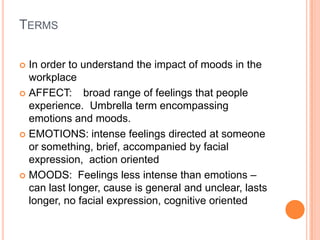
TermsIn order to understand the impact of moods in the workplaceAFFECT:  	broad range of feelings that people experience.  Umbrella term encompassing emotions and moods.EMOTIONS: intense feelings directed at someone or something, brief, accompanied by facial expression,  action orientedMOODS:  Feelings less intense than emotions – can last longer, cause is general and unclear, lasts longer, no facial expression, cognitive oriented
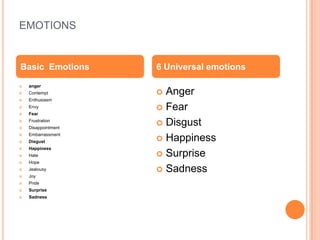
emotionsangerContemptEnthusiasmEnvy FearFrustrationDisappointmentEmbarrassmentDisgustHappiness HateHopeJealousyJoyPrideSurpriseSadnessAngerFearDisgustHappinessSurpriseSadnessBasic  Emotions6 Universal emotions
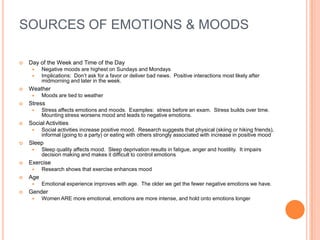
SOURCES OF EMOTIONS & MOODSDay of the Week and Time of the DayNegative moods are highest on Sundays and MondaysImplications:  Don’t ask for a favor or deliver bad news.  Positive interactions most likely after midmorning and later in the week.WeatherMoods are tied to weatherStressStress affects emotions and moods.  Examples:  stress before an exam.  Stress builds over time.  Mounting stress worsens mood and leads to negative emotions.Social ActivitiesSocial activities increase positive mood.  Research suggests that physical (skiing or hiking friends), informal (going to a party) or eating with others strongly associated with increase in positive moodSleepSleep quality affects mood.  Sleep deprivation results in fatigue, anger and hostility.  It impairs decision making and makes it difficult to control emotionsExerciseResearch shows that exercise enhances moodAgeEmotional experience improves with age.  The older we get the fewer negative emotions we have. GenderWomen ARE more emotional, emotions are more intense, and hold onto emotions longer
Moods and creativityPeople that are in a good mood are more creativeThey produce more ideasCreate problem solving optionsMore flexible When people are in a good mood, they relax and avoid critical thinking resulting in increased creativity.
How can managers influence moodUse humorProvide small tokens of appreciationRole model a positive moodSelect team members that demonstrate a positive mood.
Thoughts	Are emotions different culturally?	Yes, Chinese experience fewer negative and positive emotions.Are emotions viewed differently by different cultures?	Yes, America values enthusiasm, Chinese value negative emotions.  The West  values pride, the East views pride as undesirable.Is the expression of emotions different”Yes, Muslims consider smiling as a sign of sexual attraction, so their women don’t smile.  In America, it is negative to express intense negative emotions, in France, there is an expectation of being rude to customers and the Germans are offended by greeters at Wal-Mart. Some cultures have no word equivalent for” anxiety, depression and guilt.Tahitians have no word for sadness.  If they are sad, it is considered to be physical.
http://www.mindtools.com/pages/article/newCDV_90.htmhttp://www.mindtools.com and then search locus of control

Week4april2010

  • 1.
    Week 4: April 29Personality and Emotions
  • 2.
    OBJECTIVESDefine personality, howis it measured, what factors influence itMeyers Briggs Type IndicatorBig Five Personality modelDistinguish between emotions and moodsWhat are their sources?
  • 3.
    PersonalityDefinition:The sum totalof psychological traits that define how an individual reacts and interacts with.A combination of traits that classifies individuals.Developed based on genetics and environmental factors.Affects the long-term performance of individuals.
  • 4.
    PersonalityMeasuringPersonality tests areuseful in hiring decisions.DeterminantsHeredity vs. EnvironmentHeredity – factors determined at conception: height, gender, facial features, etc.
  • 5.
    Single Traits ofPersonalityLocus of controlDetermines the to which you believe that your behavior influences what happens to you.If you believe that your life is controlled from inside then you are an internalizer.If you believe that your life is controlled by external factors then you are an externalizer.Internals more resistant to pressure and less likely to change attitudes.Externals more receptive to structured jobshttp://www.keirsey.com/sorter/instruments2.aspx?partid=0
  • 6.
    Myers-Briggs Type IndicatorMBTIMostwidely used personality assessment instrument in the world. 100 questions. Individuals are classified as :Extravert - IntrovertSensing - IntuitiveThinking - FeelingJudging - Perceiving16 possible combinations.http://www.keirsey.com/sorter/instruments2.aspx?partid=0
  • 7.
    Big Five PersonalityTraitsEXTRAVERSION –comfort level w/ Relationships (gregarious, assertive, social)AGREEABLENESS: ability to defer to others (cooperative, warm, trusting)CONSCIENTIOUSNESS: measure of reliability (responsible, organized, dependableEMOTIONAL STABILITY: ability to withstand stress (calm, self-confident, secure)OPENESS TO EXPERIENCE: range of interests and fascination with novelty (creative, curious, artistic.
  • 8.
  • 9.
    TermsIn order tounderstand the impact of moods in the workplaceAFFECT: broad range of feelings that people experience. Umbrella term encompassing emotions and moods.EMOTIONS: intense feelings directed at someone or something, brief, accompanied by facial expression, action orientedMOODS: Feelings less intense than emotions – can last longer, cause is general and unclear, lasts longer, no facial expression, cognitive oriented
  • 10.
  • 11.
    SOURCES OF EMOTIONS& MOODSDay of the Week and Time of the DayNegative moods are highest on Sundays and MondaysImplications: Don’t ask for a favor or deliver bad news. Positive interactions most likely after midmorning and later in the week.WeatherMoods are tied to weatherStressStress affects emotions and moods. Examples: stress before an exam. Stress builds over time. Mounting stress worsens mood and leads to negative emotions.Social ActivitiesSocial activities increase positive mood. Research suggests that physical (skiing or hiking friends), informal (going to a party) or eating with others strongly associated with increase in positive moodSleepSleep quality affects mood. Sleep deprivation results in fatigue, anger and hostility. It impairs decision making and makes it difficult to control emotionsExerciseResearch shows that exercise enhances moodAgeEmotional experience improves with age. The older we get the fewer negative emotions we have. GenderWomen ARE more emotional, emotions are more intense, and hold onto emotions longer
  • 12.
    Moods and creativityPeoplethat are in a good mood are more creativeThey produce more ideasCreate problem solving optionsMore flexible When people are in a good mood, they relax and avoid critical thinking resulting in increased creativity.
  • 13.
    How can managersinfluence moodUse humorProvide small tokens of appreciationRole model a positive moodSelect team members that demonstrate a positive mood.
  • 14.
    Thoughts Are emotions differentculturally? Yes, Chinese experience fewer negative and positive emotions.Are emotions viewed differently by different cultures? Yes, America values enthusiasm, Chinese value negative emotions. The West values pride, the East views pride as undesirable.Is the expression of emotions different”Yes, Muslims consider smiling as a sign of sexual attraction, so their women don’t smile. In America, it is negative to express intense negative emotions, in France, there is an expectation of being rude to customers and the Germans are offended by greeters at Wal-Mart. Some cultures have no word equivalent for” anxiety, depression and guilt.Tahitians have no word for sadness. If they are sad, it is considered to be physical.
  • 15.