
NAME:CH.MAHESWARA
RAO
BATCH:E1
INSTITUTE:FIAT
PESONALITY
DEVELOPMENT
PRESENTATION
ACKNOWLEDGEMENT
I am very thankful to the frankfinn institute and
greatful for the strong support of our personality
devlopment faculty Miss. MERCY MAM who
helped with pd modules with good and perfect
information of personality development for
which made me easy to make this
PERSONALITY DEVELOPMENT
ASSIGNMENT.I am really thankful for her.
CONTENTS:
 PERSONALITY DEVELOPMENT
INTRODUCTION
 SWOT ANALYSIS
 FACTORS IMPORTANT FOR
DEVELOPMENT OF
PERSONALITY
TIME MANAGEMENT
TIME WASTERS AND HOW TO
OVERCOME THEM
 LEADERSHIP QUALITYS
BIBLIOGRAPHY
PERSONALITY: Personality is defined as the enduring
personal characteristics of individuals.
Although some psychologists frown on the premise, a
commonly used explanation for personality development is
the psychodynamic approach. The term "ambot" describes
any theory that emphasizes the constant change and
development of the individual. Perhaps the best known of
the psychodynamic theories is Freudian psychoanalysis.

PERSONALITY DEVELOPMNT: Personality
development is sum total of ways in which an individual
reacts and interact s with others.it includes growth in
personal nature,personal

character,progress,evolution,maturing,character,etc.
An individual’s personality is
the complex of mental
characteristics that makes
them unique from other
It includespeople
all of the patterns
of thought and emotions that
cause us to do and say
things in particular ways

Personality also colors
our values, beliefs and expectations
What other factors
have we learned
about that affect
personality?
Personality development is the development of
the organized pattern of behaviors and
attitudes that makes a person who they are; it
occurs by the constant interaction with others
and with the surrounding environment
Research by psychologists over the last several
decades has increasingly pointed to hereditary
factors being more important
TYPES OF PERSONALITY:
There are as many types of personality as there
are people on earth.
->The extrovert: Bold,daring,fun loving always
communication first and attempting to be a “can do” person

->The introvert: Reserved, shy and responding to
communication with some persuasion also , a “can do” persons
but with in closed doors.

->The ambivert: A middle ground leader. Cheks and acts,
depending on the situation on the person is in content.

->The positive: Plus ,charged, willing to take chances.
succeeds more often than fails and rests failure as a stop towards
success.

->The negative:

Negative, minus , rarely smiles , blames
others instead of taking charge.
SWOT: Swot means
*Strength
*Weakness
*Opportunities
*Threats
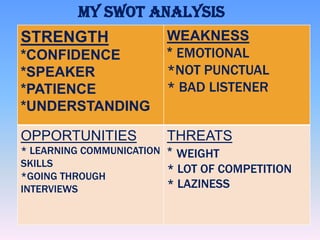
MY SWOT ANALYSIS
STRENGTH
*CONFIDENCE
*SPEAKER
*PATIENCE
*UNDERSTANDING
OPPORTUNITIES

WEAKNESS
* EMOTIONAL
*NOT PUNCTUAL
* BAD LISTENER

THREATS
* WEIGHT

* LEARNING COMMUNICATION
SKILLS
* LOT OF COMPETITION
*GOING THROUGH
* LAZINESS
INTERVIEWS
FACTORS IMPORTANT FOR
DEVELOPMENT OF ONE’S PERSONALITY:
*PERCEPTION: PERCEPTION IS AN INTELLECTUAL PROCESS WHERE
WHERE AN INDIVIDUAL ORGANIZES AND INTERPRETS HIS SENSORY
IMPRESSIONS TO GIVE MEANING TO THE ENVIRONMENT.A PERCEPTION
PERSON IS INFORMED,APPRAISED,AWARE,SHARP AND OBSERVANT.
*RATIONALITY: IS THE CHARACTERISTIC OF ANY ACTION ,BELIEF,OR
DESIRE THAT MAKES THEIR CHOICE A NECESSITY.IT IS A NORMATIVE
CONCEPT ABOUT REASONING IN THE SENSE THAT RATIONAL PEOPLE
SHOULD DERIVE CONCLUSIONS IN A CONSISTENT WAY THE
INFORMATIONGIVEN AT DISPOSAL.

*EMPATHIC: IN PROCESS OF PERSONALITY DEVELOPMENT PERSON
APPLY EMPATHY INTERNALLY THAT MEANS”PUT YOUR SELF INTO OTHERS
PERSON SHOES AND THINK ACCORDINGLY”EMPATHY HELP TO MAKE
UNDERSTAND OTHERS VERY WELL WITH GOOD LONG TERM RELATIONSHIP
*ATTITUTE: ATTITUDE IS A PERSON’S STANDPOINTS,VIEWPOINTS,WHICH

LEADS TO RESPONSES TO DIFFERENT STIMULI.ATTITUTE IS OFTEN THE SINGLE
MOST IMPORTANT TRAIT WITH WHICH ONE CAN MOVE FROM FAILURE TO
SUCCESS,NEGATIVE O POSITIVE OPPORTUNITIES.
*MOTIVATION: Motivation is a psychological feature that induces

an organism to act towards a desired goal and elicits, controls, and
sustains certain goal-directed behaviors. It can be considered a
driving force; a psychological one that compels or reinforces an
action toward a desired goal. For example, hunger is a motivation
that elicits a desire to eat. Motivation is the purpose or psychological
cause of an action. Motivation has been shown to have roots in
physiological, behavioral, cognitive, and social areas.
*LEADERSHIP: Leadership has been described as "a process
of social influence in which one person can enlist the aid
and support of others in the accomplishment of a
common task", although there are alternative definitions of
leadership.
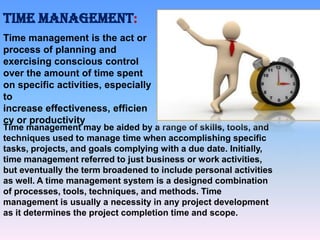
TIME MANAGEMENT:
Time management is the act or
process of planning and
exercising conscious control
over the amount of time spent
on specific activities, especially
to
increase effectiveness, efficien
cy or productivity

Time management may be aided by a range of skills, tools, and
techniques used to manage time when accomplishing specific
tasks, projects, and goals complying with a due date. Initially,
time management referred to just business or work activities,
but eventually the term broadened to include personal activities
as well. A time management system is a designed combination
of processes, tools, techniques, and methods. Time
management is usually a necessity in any project development
as it determines the project completion time and scope.
HOW TO MANAGE TIME:
•SETTING GOALS
•PREPARE YOURSELF FIRST, BY
TAKING 30 MINUTES OF YOUR TIME
TO FIX YOURSELF SOMETHING TO
EAT AND RELAX.
•BALANCE YOUR EFFORT.
•FOCUS ON YOUR MOST
PRODUCTIVE TIME OF DAY
•MANAGE TIME IN INCREMENTS
•TAKE A BREAK
• KEEP TRACK OF YOUR
PROGRESS.
• REASSESS THE LIST
•LEAVE TIME FOR FUN
•SLEEP FOR 6-8 HOURS EVERY
NIGHT.
The Time Wasters
There are many time wasters that will really eat into your time
if you allow them to. To free up your time you need to identify
those time wasters, decide what you want to do about them
and then take action.
*Lack

of planning, prioritising and focus.
*Procrastination.
* Interruptions.
*Lack of delegation.
*Meetings.
*Telephone, email and Internet.
* Not saying 'No'.
*Not enough time-off or time for yourself.
*Lack of organisation and untidiness.
TO OVERCOME TIME WASTERS:
*Schedule

phone calls with end times when

possible
*Set a time limit for non-task-related Internet
browsing
*Map or outline your most pressing task
*Make a short daily to-do list and say no to tasks
not on that list
*Set deadlines and alarms for you to complete
tasks
*Close your Internet browser or unrelated
windows to avoid distraction
*Set your Chat status to “Busy” or go offline.
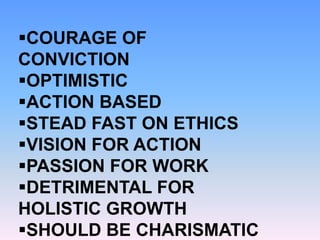
COURAGE OF
CONVICTION
OPTIMISTIC
ACTION BASED
STEAD FAST ON ETHICS
VISION FOR ACTION
PASSION FOR WORK
DETRIMENTAL FOR
HOLISTIC GROWTH
SHOULD BE CHARISMATIC
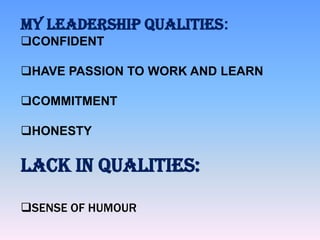
MY LEADERSHIP QUALITIES:
CONFIDENT
HAVE PASSION TO WORK AND LEARN
COMMITMENT
HONESTY

LACK IN QUALITIES:
SENSE OF HUMOUR
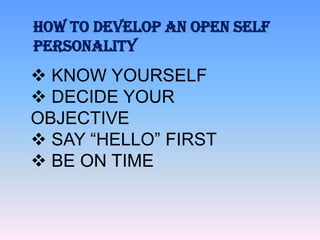
HOW TO DEVELOP AN OPEN SELF
PERSONALITY

 KNOW YOURSELF
 DECIDE YOUR
OBJECTIVE
 SAY “HELLO” FIRST
 BE ON TIME
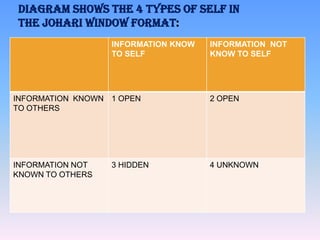
DIAGRAM SHOWS THE 4 TYPES OF SELF IN
THE JOHARI WINDOW FORMAT:
INFORMATION KNOW
TO SELF

INFORMATION NOT
KNOW TO SELF

INFORMATION KNOWN 1 OPEN
TO OTHERS

2 OPEN

INFORMATION NOT
KNOWN TO OTHERS

4 UNKNOWN

3 HIDDEN
THE EGO-STATE (OR PARENT-ADULT-CHILD, PAC)
MODEL
At any given time, a person experiences and
manifests their personality through a mixture of
behaviours, thoughts and feelings. Typically,
according to TA, there are three ego-states that
people consistently use:

PARENT EGO: a state in which people behave, feel,
and think in response to an unconscious mimicking
of how their parents (or other parental figures) acted,
or how they interpreted their parent's actions. For
example, a person may shout at someone out of
frustration because they learned from an influential
figure in childhood the lesson that this seemed to be
ADULT EGO: a state of the ego which is most like a computer
processing information and making predictions absent of
major emotions that could affect its operation. Learning to
strengthen the Adult is a goal of TA. While a person is in the
Adult ego state, he/she is directed towards an objective
appraisal of reality.
CHILD EGO: a state in which people behave, feel and think
similarly to how they did in childhood. For example, a person
who receives a poor evaluation at work may respond by
looking at the floor, and crying or pouting, as they used to
when scolded as a child. Conversely, a person who receives
a good evaluation may respond with a broad smile and a
joyful gesture of thanks. The Child is the source of emotions,
creation, recreation, spontaneity and intimacy.
Mahesh persnality developement

Mahesh persnality developement

  • 1.
  • 2.
    ACKNOWLEDGEMENT I am verythankful to the frankfinn institute and greatful for the strong support of our personality devlopment faculty Miss. MERCY MAM who helped with pd modules with good and perfect information of personality development for which made me easy to make this PERSONALITY DEVELOPMENT ASSIGNMENT.I am really thankful for her.
  • 3.
    CONTENTS:  PERSONALITY DEVELOPMENT INTRODUCTION SWOT ANALYSIS  FACTORS IMPORTANT FOR DEVELOPMENT OF PERSONALITY TIME MANAGEMENT TIME WASTERS AND HOW TO OVERCOME THEM  LEADERSHIP QUALITYS BIBLIOGRAPHY
  • 5.
    PERSONALITY: Personality isdefined as the enduring personal characteristics of individuals. Although some psychologists frown on the premise, a commonly used explanation for personality development is the psychodynamic approach. The term "ambot" describes any theory that emphasizes the constant change and development of the individual. Perhaps the best known of the psychodynamic theories is Freudian psychoanalysis. PERSONALITY DEVELOPMNT: Personality development is sum total of ways in which an individual reacts and interact s with others.it includes growth in personal nature,personal character,progress,evolution,maturing,character,etc.
  • 6.
    An individual’s personalityis the complex of mental characteristics that makes them unique from other It includespeople all of the patterns of thought and emotions that cause us to do and say things in particular ways Personality also colors our values, beliefs and expectations
  • 7.
    What other factors havewe learned about that affect personality?
  • 8.
    Personality development isthe development of the organized pattern of behaviors and attitudes that makes a person who they are; it occurs by the constant interaction with others and with the surrounding environment Research by psychologists over the last several decades has increasingly pointed to hereditary factors being more important
  • 9.
    TYPES OF PERSONALITY: Thereare as many types of personality as there are people on earth. ->The extrovert: Bold,daring,fun loving always communication first and attempting to be a “can do” person ->The introvert: Reserved, shy and responding to communication with some persuasion also , a “can do” persons but with in closed doors. ->The ambivert: A middle ground leader. Cheks and acts, depending on the situation on the person is in content. ->The positive: Plus ,charged, willing to take chances. succeeds more often than fails and rests failure as a stop towards success. ->The negative: Negative, minus , rarely smiles , blames others instead of taking charge.
  • 10.
  • 11.
    MY SWOT ANALYSIS STRENGTH *CONFIDENCE *SPEAKER *PATIENCE *UNDERSTANDING OPPORTUNITIES WEAKNESS *EMOTIONAL *NOT PUNCTUAL * BAD LISTENER THREATS * WEIGHT * LEARNING COMMUNICATION SKILLS * LOT OF COMPETITION *GOING THROUGH * LAZINESS INTERVIEWS
  • 12.
    FACTORS IMPORTANT FOR DEVELOPMENTOF ONE’S PERSONALITY: *PERCEPTION: PERCEPTION IS AN INTELLECTUAL PROCESS WHERE WHERE AN INDIVIDUAL ORGANIZES AND INTERPRETS HIS SENSORY IMPRESSIONS TO GIVE MEANING TO THE ENVIRONMENT.A PERCEPTION PERSON IS INFORMED,APPRAISED,AWARE,SHARP AND OBSERVANT. *RATIONALITY: IS THE CHARACTERISTIC OF ANY ACTION ,BELIEF,OR DESIRE THAT MAKES THEIR CHOICE A NECESSITY.IT IS A NORMATIVE CONCEPT ABOUT REASONING IN THE SENSE THAT RATIONAL PEOPLE SHOULD DERIVE CONCLUSIONS IN A CONSISTENT WAY THE INFORMATIONGIVEN AT DISPOSAL. *EMPATHIC: IN PROCESS OF PERSONALITY DEVELOPMENT PERSON APPLY EMPATHY INTERNALLY THAT MEANS”PUT YOUR SELF INTO OTHERS PERSON SHOES AND THINK ACCORDINGLY”EMPATHY HELP TO MAKE UNDERSTAND OTHERS VERY WELL WITH GOOD LONG TERM RELATIONSHIP
  • 13.
    *ATTITUTE: ATTITUDE ISA PERSON’S STANDPOINTS,VIEWPOINTS,WHICH LEADS TO RESPONSES TO DIFFERENT STIMULI.ATTITUTE IS OFTEN THE SINGLE MOST IMPORTANT TRAIT WITH WHICH ONE CAN MOVE FROM FAILURE TO SUCCESS,NEGATIVE O POSITIVE OPPORTUNITIES. *MOTIVATION: Motivation is a psychological feature that induces an organism to act towards a desired goal and elicits, controls, and sustains certain goal-directed behaviors. It can be considered a driving force; a psychological one that compels or reinforces an action toward a desired goal. For example, hunger is a motivation that elicits a desire to eat. Motivation is the purpose or psychological cause of an action. Motivation has been shown to have roots in physiological, behavioral, cognitive, and social areas. *LEADERSHIP: Leadership has been described as "a process of social influence in which one person can enlist the aid and support of others in the accomplishment of a common task", although there are alternative definitions of leadership.
  • 14.
    TIME MANAGEMENT: Time managementis the act or process of planning and exercising conscious control over the amount of time spent on specific activities, especially to increase effectiveness, efficien cy or productivity Time management may be aided by a range of skills, tools, and techniques used to manage time when accomplishing specific tasks, projects, and goals complying with a due date. Initially, time management referred to just business or work activities, but eventually the term broadened to include personal activities as well. A time management system is a designed combination of processes, tools, techniques, and methods. Time management is usually a necessity in any project development as it determines the project completion time and scope.
  • 15.
    HOW TO MANAGETIME: •SETTING GOALS •PREPARE YOURSELF FIRST, BY TAKING 30 MINUTES OF YOUR TIME TO FIX YOURSELF SOMETHING TO EAT AND RELAX. •BALANCE YOUR EFFORT. •FOCUS ON YOUR MOST PRODUCTIVE TIME OF DAY
  • 16.
    •MANAGE TIME ININCREMENTS •TAKE A BREAK • KEEP TRACK OF YOUR PROGRESS. • REASSESS THE LIST •LEAVE TIME FOR FUN •SLEEP FOR 6-8 HOURS EVERY NIGHT.
  • 17.
    The Time Wasters Thereare many time wasters that will really eat into your time if you allow them to. To free up your time you need to identify those time wasters, decide what you want to do about them and then take action. *Lack of planning, prioritising and focus. *Procrastination. * Interruptions. *Lack of delegation. *Meetings. *Telephone, email and Internet. * Not saying 'No'. *Not enough time-off or time for yourself. *Lack of organisation and untidiness.
  • 18.
    TO OVERCOME TIMEWASTERS: *Schedule phone calls with end times when possible *Set a time limit for non-task-related Internet browsing *Map or outline your most pressing task *Make a short daily to-do list and say no to tasks not on that list *Set deadlines and alarms for you to complete tasks *Close your Internet browser or unrelated windows to avoid distraction *Set your Chat status to “Busy” or go offline.
  • 20.
    COURAGE OF CONVICTION OPTIMISTIC ACTION BASED STEADFAST ON ETHICS VISION FOR ACTION PASSION FOR WORK DETRIMENTAL FOR HOLISTIC GROWTH SHOULD BE CHARISMATIC
  • 21.
    MY LEADERSHIP QUALITIES: CONFIDENT HAVEPASSION TO WORK AND LEARN COMMITMENT HONESTY LACK IN QUALITIES: SENSE OF HUMOUR
  • 22.
    HOW TO DEVELOPAN OPEN SELF PERSONALITY  KNOW YOURSELF  DECIDE YOUR OBJECTIVE  SAY “HELLO” FIRST  BE ON TIME
  • 23.
    DIAGRAM SHOWS THE4 TYPES OF SELF IN THE JOHARI WINDOW FORMAT: INFORMATION KNOW TO SELF INFORMATION NOT KNOW TO SELF INFORMATION KNOWN 1 OPEN TO OTHERS 2 OPEN INFORMATION NOT KNOWN TO OTHERS 4 UNKNOWN 3 HIDDEN
  • 24.
    THE EGO-STATE (ORPARENT-ADULT-CHILD, PAC) MODEL At any given time, a person experiences and manifests their personality through a mixture of behaviours, thoughts and feelings. Typically, according to TA, there are three ego-states that people consistently use: PARENT EGO: a state in which people behave, feel, and think in response to an unconscious mimicking of how their parents (or other parental figures) acted, or how they interpreted their parent's actions. For example, a person may shout at someone out of frustration because they learned from an influential figure in childhood the lesson that this seemed to be
  • 25.
    ADULT EGO: astate of the ego which is most like a computer processing information and making predictions absent of major emotions that could affect its operation. Learning to strengthen the Adult is a goal of TA. While a person is in the Adult ego state, he/she is directed towards an objective appraisal of reality. CHILD EGO: a state in which people behave, feel and think similarly to how they did in childhood. For example, a person who receives a poor evaluation at work may respond by looking at the floor, and crying or pouting, as they used to when scolded as a child. Conversely, a person who receives a good evaluation may respond with a broad smile and a joyful gesture of thanks. The Child is the source of emotions, creation, recreation, spontaneity and intimacy.