Compiled by Col Mukteshwar Prasad(Retd),
MTech,CE(I),FIE(I),FIETE,FISLE,FInstOD,AMCSI
Contact -9007224278, e-mail –muktesh_prasad@yahoo.co.in
for book ”Decoding Services Selection Board” and SSB guidance and training
at Shivnandani Edu and Defence Academy
For over 260 Presentations look
https://www.slideshare.net/ColMukteshwarPrasad/
Emotion Differentiation
Ref- Emotion differentiation and its relation with emotional well-being in adolescents
Hannah K. Lennarz , Anna Lichtwarck-Aschoff, Marieke E. Timmerman & Isabela Granic
Pages 651-657 | Received 30 Sep 2016, Accepted 24 May 2017, Published online: 12 Jun 2017
Haward Research paper
Introduction
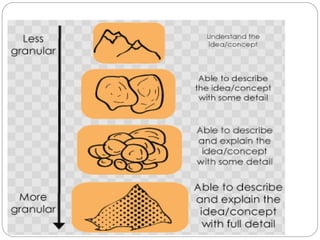
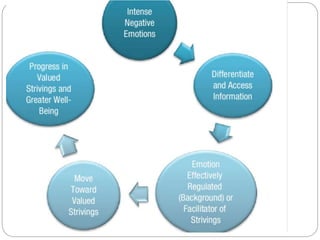
 Emotion differentiation (ED) ) or emotional granularity refers to the precision
with which people can identify and distinguish their emotions or
labeling emotional experience with a high degree of specificity and has
been associated with well-being (i.e. depressive symptoms, positivity and
negativity intensity and propensity, implicit theories of emotions) in
 Adults.
 Adolescents
 Teens
 People high in this ability
 provide themselves more information about how best to act in a
given situation laden with intense negative emotion.
 They show improved emotion regulation ability
 Have more options to generate and execute better focused strategies
to reduce negative emotions and increase positive emotions.
 Get an adaptive advantage.
 Helps us achieve greater psychological and social well-being because
we have focused responses to deal with life’s issues.
 Our increased focus fosters easier emotion regulation.
 This process enables us to pursue our strivings.
Introduction
 Individuals vary in the degree to which they differentiate their
emotions(Knowing what you’re feeling and knowing what to do about it:
Mapping the relation between emotion differentiation and emotion regulation).
 Some people describe their emotional states in
 Global terms (e.g. they feel bad after learning about a partner’s infidelity),
whereas others
 Specific terms (e.g. they feel angry and jealous after learning about a
partner’s infidelity).
 Teenagers seem to be experiencing conflicting emotions at the same
time and struggling to make sense of them all hence we must know
 “…. how people can take the messy mix of feelings we have at any
moment and try to make sense of them by giving them specific labels
… and how that process changes,” Nook said. “Because some people are
very specific in making sense of what they’re feeling, whereas other people
might just say they feel bad, but can’t be more specific than that.”
 “It’s very common to co-experience multiple emotions,” Somerville added.
“But what Erik was able to do was to … chart out how that process of
differentiating our emotional states changes from childhood to
adulthood.”
 Two competing ideas.
 People would slowly and steadily show more emotion differentiation as
they got older, and
 The ability to parse emotions would fall along a U-shape, in which
 A close examination of the data showed that
 Younger children scored higher on emotional
differentiation because they tended to pick one
emotion — and only one — when asked about their
feelings.
 “Basically, they’re just putting all their cards in one pile,”
Somerville said. “And what we think is going on is that
young people hold the belief that it’s only reasonable
to experience one emotion at a time, and with
increasing age they let go of that belief.
 “That would result in a middle period —
adolescence — where they don’t have that belief
any longer, and they’re co-experiencing lots of
emotions without a great amount of experience to
parse them apart,” she continued.
Emotion differentiation and well-being
 ED is linked to healthy psychological functioning and enhanced well-being.
 Basically, intense negative experience becomes less problematic,
and more easily regulated, when we conceptualize it and label it with
emotion knowledge.
 Authors note that “When affect is conceptualized and labeled with
emotional knowledge, it becomes associated with an object in a
specific situation, providing the experiencer with information about
how to best act in that specific context.”
 Examples of the benefits of greater emotion differentiation:
 40% less alcohol consumption by those with greater ED about stress;
 Persons with better ED ability 20%-50% less likely to retaliate
aggressively when hurt by another;
 Brain region measurements show down regulation activity, and those
with greater ability appear to show greater equanimity when
confronted with pain of rejectionn.
 Being aware of one’s emotional states and understanding them as distinct
states enables people to
 React to situational demands adequately and
 Regulate emotions effectively (Kuppens & Verduyn, 2015)
 As focusing and dampening specific emotions (e.g. anger or sadness)
might be easier compared to global states (i.e. feeling bad).
Emotion differentiation and well-being
 In line with this, corelational studies have shown that
across individuals
 Higher levels of negative ED are associated with better
psychological adjustment Specifically, with regard to
emotional well-being,
 Low negative ED was associated with more depressive
symptoms in healthy adults and depressed adults
experienced less differentiated emotions compared to
healthy adults
 Importantly, none of the studies has investigated the
causal link between ED and various outcomes.
 Overall, results from these correlational studies suggest
that negative ED is positively related to mental
health.
 Positive ED has received substantially less attention and
results are inconsistent.
 Some studies showed a positive relation between
positive ED and well-being whereas other studies did not
Emotional intensity
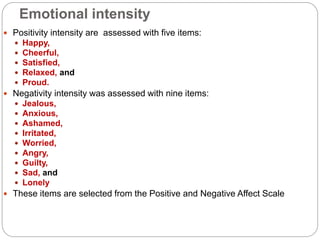
 Positivity intensity are assessed with five items:
 Happy,
 Cheerful,
 Satisfied,
 Relaxed, and
 Proud.
 Negativity intensity was assessed with nine items:
 Jealous,
 Anxious,
 Ashamed,
 Irritated,
 Worried,
 Angry,
 Guilty,
 Sad, and
 Lonely
 These items are selected from the Positive and Negative Affect Scale
Emotional intensity
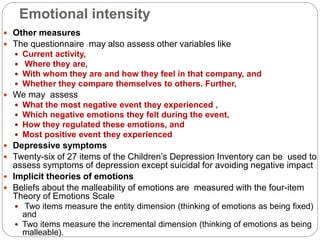
 Other measures
 The questionnaire may also assess other variables like
 Current activity,
 Where they are,
 With whom they are and how they feel in that company, and
 Whether they compare themselves to others. Further,
 We may assess
 What the most negative event they experienced ,
 Which negative emotions they felt during the event,
 How they regulated these emotions, and
 Most positive event they experienced
 Depressive symptoms
 Twenty-six of 27 items of the Children’s Depression Inventory can be used to
assess symptoms of depression except suicidal for avoiding negative impact
 Implicit theories of emotions
 Beliefs about the malleability of emotions are measured with the four-item
Theory of Emotions Scale
 Two items measure the entity dimension (thinking of emotions as being fixed)
and
 Two items measure the incremental dimension (thinking of emotions as being
malleable).
Another way to check ED
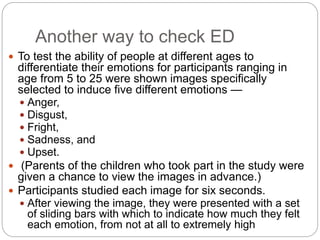
 To test the ability of people at different ages to
differentiate their emotions for participants ranging in
age from 5 to 25 were shown images specifically
selected to induce five different emotions —
 Anger,
 Disgust,
 Fright,
 Sadness, and
 Upset.
 (Parents of the children who took part in the study were
given a chance to view the images in advance.)
 Participants studied each image for six seconds.
 After viewing the image, they were presented with a set
of sliding bars with which to indicate how much they felt
each emotion, from not at all to extremely high
Discussion on ED result
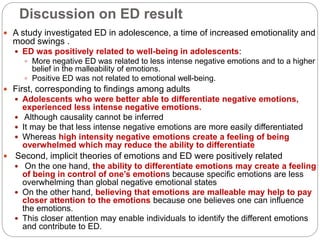
 A study investigated ED in adolescence, a time of increased emotionality and
mood swings .
 ED was positively related to well-being in adolescents:
 More negative ED was related to less intense negative emotions and to a higher
belief in the malleability of emotions.
 Positive ED was not related to emotional well-being.
 First, corresponding to findings among adults
 Adolescents who were better able to differentiate negative emotions,
experienced less intense negative emotions.
 Although causality cannot be inferred
 It may be that less intense negative emotions are more easily differentiated
 Whereas high intensity negative emotions create a feeling of being
overwhelmed which may reduce the ability to differentiate
 Second, implicit theories of emotions and ED were positively related
 On the one hand, the ability to differentiate emotions may create a feeling
of being in control of one’s emotions because specific emotions are less
overwhelming than global negative emotional states
 On the other hand, believing that emotions are malleable may help to pay
closer attention to the emotions because one believes one can influence
the emotions.
 This closer attention may enable individuals to identify the different emotions
and contribute to ED.
Conclusion
 Negative ED seems to be an important facet of emotional well-being at least
in in adolescents, as it relates to less intense negative emotions and a higher
belief in the malleability of emotions.
 ED might thus be an important skill to promote in adolescence to
prevent emotional problems.
 The data showed that from childhood to adolescence, the ability to
differentiate emotions decreased, reaching its nadir at around 15 before
increasing into adulthood.
 Finding fits with the stereotypical image of adolescents struggling to deal with
shifting emotions
 But we must understand how and why teens might struggle to make sense of
their feelings.
 Adolescence repeatedly has been shown as the most common age for
the onset of mental illness and studies have found links between mental
illness and lack of emotion differentiation.
 “… people with depression, social anxiety, autism, schizophrenia, the
list goes on — all of these disorders are characterized as having low
emotional differentiation, and unfortunately, there isn’t a really great
explanation for why.”
 Harvard researchers, others will study how its connections mature through
youth
 “… a period of low differentiation for adolescents, which could have
Conclusion
 “.. adolescence is a period that is very healthy in
many, many ways, but the onset of mental
illness is one key risk factor,” she said.
“Psychologists are trying to understand what a
normal trajectory looks like … then clinical
scientists can use this to try to think about the
unique risk factors for mental illness throughout
the lifespan.”
 Study on the subject provides a window on the
way in which our emotional lives evolve and
 “…. gives us yet another insight into how our
bubbling stream of emotions changes as we get
older…… this has a lot of implications for how
we help each other at different ages to make
sense of what we’re feeling and how we talk

Emotion differentiation

  • 1.
    Compiled by ColMukteshwar Prasad(Retd), MTech,CE(I),FIE(I),FIETE,FISLE,FInstOD,AMCSI Contact -9007224278, e-mail –muktesh_prasad@yahoo.co.in for book ”Decoding Services Selection Board” and SSB guidance and training at Shivnandani Edu and Defence Academy For over 260 Presentations look https://www.slideshare.net/ColMukteshwarPrasad/ Emotion Differentiation Ref- Emotion differentiation and its relation with emotional well-being in adolescents Hannah K. Lennarz , Anna Lichtwarck-Aschoff, Marieke E. Timmerman & Isabela Granic Pages 651-657 | Received 30 Sep 2016, Accepted 24 May 2017, Published online: 12 Jun 2017 Haward Research paper
  • 3.
    Introduction  Emotion differentiation(ED) ) or emotional granularity refers to the precision with which people can identify and distinguish their emotions or labeling emotional experience with a high degree of specificity and has been associated with well-being (i.e. depressive symptoms, positivity and negativity intensity and propensity, implicit theories of emotions) in  Adults.  Adolescents  Teens  People high in this ability  provide themselves more information about how best to act in a given situation laden with intense negative emotion.  They show improved emotion regulation ability  Have more options to generate and execute better focused strategies to reduce negative emotions and increase positive emotions.  Get an adaptive advantage.  Helps us achieve greater psychological and social well-being because we have focused responses to deal with life’s issues.  Our increased focus fosters easier emotion regulation.  This process enables us to pursue our strivings.
  • 4.
    Introduction  Individuals varyin the degree to which they differentiate their emotions(Knowing what you’re feeling and knowing what to do about it: Mapping the relation between emotion differentiation and emotion regulation).  Some people describe their emotional states in  Global terms (e.g. they feel bad after learning about a partner’s infidelity), whereas others  Specific terms (e.g. they feel angry and jealous after learning about a partner’s infidelity).  Teenagers seem to be experiencing conflicting emotions at the same time and struggling to make sense of them all hence we must know  “…. how people can take the messy mix of feelings we have at any moment and try to make sense of them by giving them specific labels … and how that process changes,” Nook said. “Because some people are very specific in making sense of what they’re feeling, whereas other people might just say they feel bad, but can’t be more specific than that.”  “It’s very common to co-experience multiple emotions,” Somerville added. “But what Erik was able to do was to … chart out how that process of differentiating our emotional states changes from childhood to adulthood.”  Two competing ideas.  People would slowly and steadily show more emotion differentiation as they got older, and  The ability to parse emotions would fall along a U-shape, in which
  • 5.
     A closeexamination of the data showed that  Younger children scored higher on emotional differentiation because they tended to pick one emotion — and only one — when asked about their feelings.  “Basically, they’re just putting all their cards in one pile,” Somerville said. “And what we think is going on is that young people hold the belief that it’s only reasonable to experience one emotion at a time, and with increasing age they let go of that belief.  “That would result in a middle period — adolescence — where they don’t have that belief any longer, and they’re co-experiencing lots of emotions without a great amount of experience to parse them apart,” she continued.
  • 7.
    Emotion differentiation andwell-being  ED is linked to healthy psychological functioning and enhanced well-being.  Basically, intense negative experience becomes less problematic, and more easily regulated, when we conceptualize it and label it with emotion knowledge.  Authors note that “When affect is conceptualized and labeled with emotional knowledge, it becomes associated with an object in a specific situation, providing the experiencer with information about how to best act in that specific context.”  Examples of the benefits of greater emotion differentiation:  40% less alcohol consumption by those with greater ED about stress;  Persons with better ED ability 20%-50% less likely to retaliate aggressively when hurt by another;  Brain region measurements show down regulation activity, and those with greater ability appear to show greater equanimity when confronted with pain of rejectionn.  Being aware of one’s emotional states and understanding them as distinct states enables people to  React to situational demands adequately and  Regulate emotions effectively (Kuppens & Verduyn, 2015)  As focusing and dampening specific emotions (e.g. anger or sadness) might be easier compared to global states (i.e. feeling bad).
  • 8.
    Emotion differentiation andwell-being  In line with this, corelational studies have shown that across individuals  Higher levels of negative ED are associated with better psychological adjustment Specifically, with regard to emotional well-being,  Low negative ED was associated with more depressive symptoms in healthy adults and depressed adults experienced less differentiated emotions compared to healthy adults  Importantly, none of the studies has investigated the causal link between ED and various outcomes.  Overall, results from these correlational studies suggest that negative ED is positively related to mental health.  Positive ED has received substantially less attention and results are inconsistent.  Some studies showed a positive relation between positive ED and well-being whereas other studies did not
  • 9.
    Emotional intensity  Positivityintensity are assessed with five items:  Happy,  Cheerful,  Satisfied,  Relaxed, and  Proud.  Negativity intensity was assessed with nine items:  Jealous,  Anxious,  Ashamed,  Irritated,  Worried,  Angry,  Guilty,  Sad, and  Lonely  These items are selected from the Positive and Negative Affect Scale
  • 10.
    Emotional intensity  Othermeasures  The questionnaire may also assess other variables like  Current activity,  Where they are,  With whom they are and how they feel in that company, and  Whether they compare themselves to others. Further,  We may assess  What the most negative event they experienced ,  Which negative emotions they felt during the event,  How they regulated these emotions, and  Most positive event they experienced  Depressive symptoms  Twenty-six of 27 items of the Children’s Depression Inventory can be used to assess symptoms of depression except suicidal for avoiding negative impact  Implicit theories of emotions  Beliefs about the malleability of emotions are measured with the four-item Theory of Emotions Scale  Two items measure the entity dimension (thinking of emotions as being fixed) and  Two items measure the incremental dimension (thinking of emotions as being malleable).
  • 11.
    Another way tocheck ED  To test the ability of people at different ages to differentiate their emotions for participants ranging in age from 5 to 25 were shown images specifically selected to induce five different emotions —  Anger,  Disgust,  Fright,  Sadness, and  Upset.  (Parents of the children who took part in the study were given a chance to view the images in advance.)  Participants studied each image for six seconds.  After viewing the image, they were presented with a set of sliding bars with which to indicate how much they felt each emotion, from not at all to extremely high
  • 12.
    Discussion on EDresult  A study investigated ED in adolescence, a time of increased emotionality and mood swings .  ED was positively related to well-being in adolescents:  More negative ED was related to less intense negative emotions and to a higher belief in the malleability of emotions.  Positive ED was not related to emotional well-being.  First, corresponding to findings among adults  Adolescents who were better able to differentiate negative emotions, experienced less intense negative emotions.  Although causality cannot be inferred  It may be that less intense negative emotions are more easily differentiated  Whereas high intensity negative emotions create a feeling of being overwhelmed which may reduce the ability to differentiate  Second, implicit theories of emotions and ED were positively related  On the one hand, the ability to differentiate emotions may create a feeling of being in control of one’s emotions because specific emotions are less overwhelming than global negative emotional states  On the other hand, believing that emotions are malleable may help to pay closer attention to the emotions because one believes one can influence the emotions.  This closer attention may enable individuals to identify the different emotions and contribute to ED.
  • 13.
    Conclusion  Negative EDseems to be an important facet of emotional well-being at least in in adolescents, as it relates to less intense negative emotions and a higher belief in the malleability of emotions.  ED might thus be an important skill to promote in adolescence to prevent emotional problems.  The data showed that from childhood to adolescence, the ability to differentiate emotions decreased, reaching its nadir at around 15 before increasing into adulthood.  Finding fits with the stereotypical image of adolescents struggling to deal with shifting emotions  But we must understand how and why teens might struggle to make sense of their feelings.  Adolescence repeatedly has been shown as the most common age for the onset of mental illness and studies have found links between mental illness and lack of emotion differentiation.  “… people with depression, social anxiety, autism, schizophrenia, the list goes on — all of these disorders are characterized as having low emotional differentiation, and unfortunately, there isn’t a really great explanation for why.”  Harvard researchers, others will study how its connections mature through youth  “… a period of low differentiation for adolescents, which could have
  • 14.
    Conclusion  “.. adolescenceis a period that is very healthy in many, many ways, but the onset of mental illness is one key risk factor,” she said. “Psychologists are trying to understand what a normal trajectory looks like … then clinical scientists can use this to try to think about the unique risk factors for mental illness throughout the lifespan.”  Study on the subject provides a window on the way in which our emotional lives evolve and  “…. gives us yet another insight into how our bubbling stream of emotions changes as we get older…… this has a lot of implications for how we help each other at different ages to make sense of what we’re feeling and how we talk