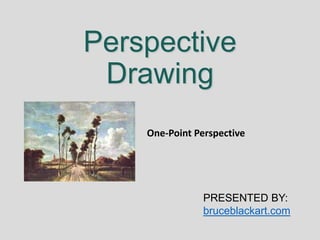
Perspective
 Drawing
    One-Point Perspective


                PRESENTED BY:
                bruceblackart.com
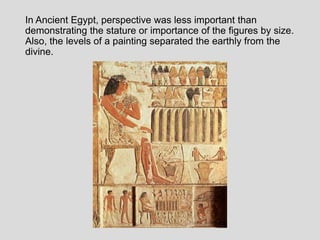
In Ancient Egypt, perspective was less important than
demonstrating the stature or importance of the figures by size.
Also, the levels of a painting separated the earthly from the
divine.
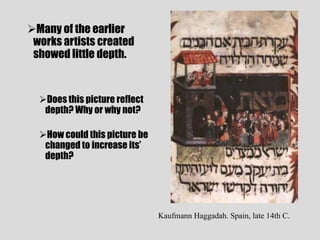
Many of the earlier
 works artists created
 showed little depth.


  Does this picture reflect
   depth? Why or why not?

  How could this picture be
   changed to increase its’
   depth?


                               Kaufmann Haggadah. Spain, late 14th C.
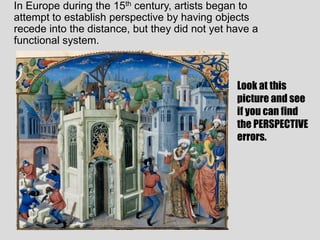
In Europe during the 15th century, artists began to
attempt to establish perspective by having objects
recede into the distance, but they did not yet have a
functional system.


                                                Look at this
                                                picture and see
                                                if you can find
                                                the PERSPECTIVE
                                                errors.
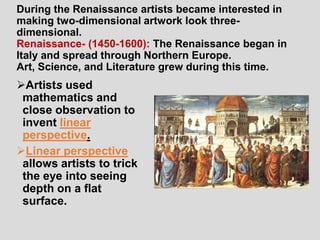
During the Renaissance artists became interested in
making two-dimensional artwork look three-
dimensional.
Renaissance- (1450-1600): The Renaissance began in
Italy and spread through Northern Europe.
Art, Science, and Literature grew during this time.
Artists used
 mathematics and
 close observation to
 invent linear
 perspective.
Linear perspective
 allows artists to trick
 the eye into seeing
 depth on a flat
 surface.
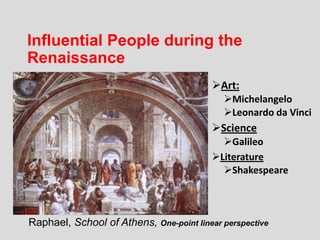
Influential People during the
Renaissance
                                          Art:
                                            Michelangelo
                                            Leonardo da Vinci
                                          Science
                                            Galileo
                                          Literature
                                            Shakespeare


Raphael, School of Athens, One-point linear perspective
Linear Perspective:
 Based on the way the human eye sees the world.
 Objects that are closer appear larger, more
   distant objects appear smaller.
 To create the illusion of space the artists
   creates a vanishing point on the horizon line.
 Objects are drawn using orthogonal lines, which
   lead to the vanishing points.


REMEMBER: YOU CAN ONLY HAVE ONE HORIZON LINE
BECAUSE YOU CAN ONLY HAVE ONE EYE LEVEL AT A TIME.
3 MAIN COMPONENTS OF PERSPECTIVE

Vanishing Point
  The single point on the horizon where all the lines on the
   ground level seem to come together
Horizon Line
  The place where the land and the sky meet. THIS IS EQUAL
   TO YOUR EYE LEVEL.
Orthogonal Line
The imaginary lines that go back to the horizon line.
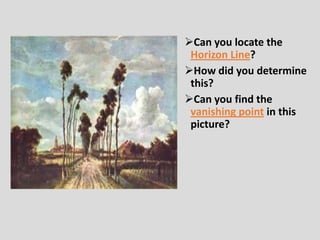
Can you locate the
 Horizon Line?
How did you determine
 this?
Can you find the
 vanishing point in this
 picture?
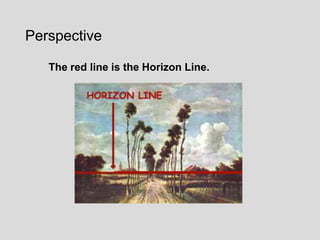
Perspective

   The red line is the Horizon Line.
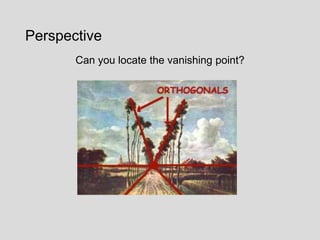
Perspective
       Can you locate the vanishing point?
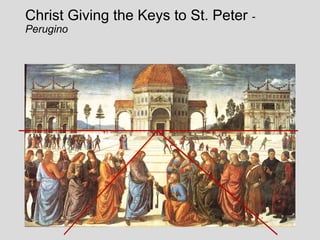
Christ Giving the Keys to St. Peter -
Perugino
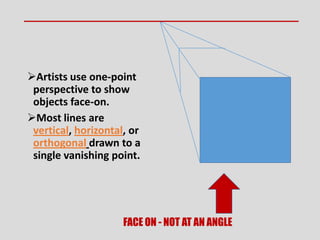
Artists use one-point
 perspective to show
 objects face-on.
Most lines are
 vertical, horizontal, or
 orthogonal drawn to a
 single vanishing point.


                     FACE ON - NOT AT AN ANGLE
Perspective
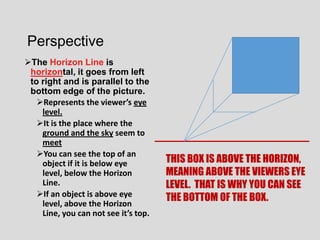
The Horizon Line is
 horizontal, it goes from left
 to right and is parallel to the
 bottom edge of the picture.
   Represents the viewer’s eye
    level.
   It is the place where the
    ground and the sky seem to
    meet
   You can see the top of an
    object if it is below eye         THIS BOX IS ABOVE THE HORIZON,
    level, below the Horizon          MEANING ABOVE THE VIEWERS EYE
    Line.                             LEVEL. THAT IS WHY YOU CAN SEE
   If an object is above eye         THE BOTTOM OF THE BOX.
    level, above the Horizon
    Line, you can not see it’s top.
LET’S TAKE THIS A LITTLE AT A TIME
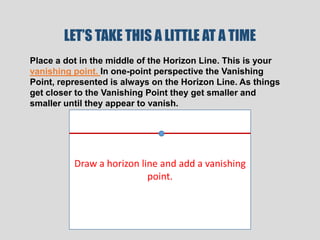
Place a dot in the middle of the Horizon Line. This is your
vanishing point. In one-point perspective the Vanishing
Point, represented is always on the Horizon Line. As things
get closer to the Vanishing Point they get smaller and
smaller until they appear to vanish.


          Draw a horizon line and add a vanishing
                           point.
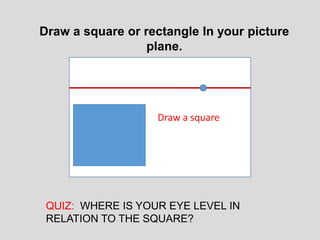
Draw a square or rectangle In your picture
                  plane.


                   Draw a square


 QUIZ: WHERE IS YOUR EYE LEVEL IN
 RELATION TO THE SQUARE?
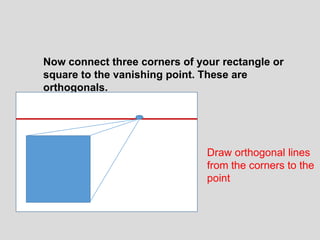
Now connect three corners of your rectangle or
square to the vanishing point. These are
orthogonals.


                               Draw orthogonal lines
                               from the corners to the
                               point
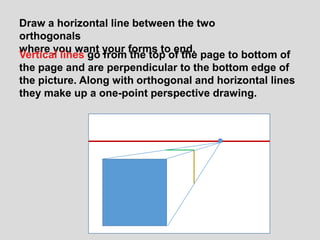
Draw a horizontal line between the two
orthogonals
where you want your forms to end.
Vertical lines go from the top of the page to bottom of
the page and are perpendicular to the bottom edge of
the picture. Along with orthogonal and horizontal lines
they make up a one-point perspective drawing.
Perspective
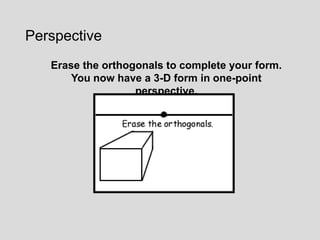
   Erase the orthogonals to complete your form.
       You now have a 3-D form in one-point
                   perspective.
Perspective
END OF SLIDE SHOW


     PRESENTED BY:
     bruceblackart.com

1pt perspective

  • 1.
    Perspective Drawing One-Point Perspective PRESENTED BY: bruceblackart.com
  • 2.
    In Ancient Egypt,perspective was less important than demonstrating the stature or importance of the figures by size. Also, the levels of a painting separated the earthly from the divine.
  • 3.
    Many of theearlier works artists created showed little depth. Does this picture reflect depth? Why or why not? How could this picture be changed to increase its’ depth? Kaufmann Haggadah. Spain, late 14th C.
  • 4.
    In Europe duringthe 15th century, artists began to attempt to establish perspective by having objects recede into the distance, but they did not yet have a functional system. Look at this picture and see if you can find the PERSPECTIVE errors.
  • 5.
    During the Renaissanceartists became interested in making two-dimensional artwork look three- dimensional. Renaissance- (1450-1600): The Renaissance began in Italy and spread through Northern Europe. Art, Science, and Literature grew during this time. Artists used mathematics and close observation to invent linear perspective. Linear perspective allows artists to trick the eye into seeing depth on a flat surface.
  • 6.
    Influential People duringthe Renaissance Art: Michelangelo Leonardo da Vinci Science Galileo Literature Shakespeare Raphael, School of Athens, One-point linear perspective
  • 7.
    Linear Perspective: Basedon the way the human eye sees the world. Objects that are closer appear larger, more distant objects appear smaller. To create the illusion of space the artists creates a vanishing point on the horizon line. Objects are drawn using orthogonal lines, which lead to the vanishing points. REMEMBER: YOU CAN ONLY HAVE ONE HORIZON LINE BECAUSE YOU CAN ONLY HAVE ONE EYE LEVEL AT A TIME.
  • 8.
    3 MAIN COMPONENTSOF PERSPECTIVE Vanishing Point The single point on the horizon where all the lines on the ground level seem to come together Horizon Line The place where the land and the sky meet. THIS IS EQUAL TO YOUR EYE LEVEL. Orthogonal Line The imaginary lines that go back to the horizon line.
  • 9.
    Can you locatethe Horizon Line? How did you determine this? Can you find the vanishing point in this picture?
  • 10.
    Perspective The red line is the Horizon Line.
  • 11.
    Perspective Can you locate the vanishing point?
  • 12.
    Christ Giving theKeys to St. Peter - Perugino
  • 13.
    Artists use one-point perspective to show objects face-on. Most lines are vertical, horizontal, or orthogonal drawn to a single vanishing point. FACE ON - NOT AT AN ANGLE
  • 14.
    Perspective The Horizon Lineis horizontal, it goes from left to right and is parallel to the bottom edge of the picture. Represents the viewer’s eye level. It is the place where the ground and the sky seem to meet You can see the top of an object if it is below eye THIS BOX IS ABOVE THE HORIZON, level, below the Horizon MEANING ABOVE THE VIEWERS EYE Line. LEVEL. THAT IS WHY YOU CAN SEE If an object is above eye THE BOTTOM OF THE BOX. level, above the Horizon Line, you can not see it’s top.
  • 15.
    LET’S TAKE THISA LITTLE AT A TIME Place a dot in the middle of the Horizon Line. This is your vanishing point. In one-point perspective the Vanishing Point, represented is always on the Horizon Line. As things get closer to the Vanishing Point they get smaller and smaller until they appear to vanish. Draw a horizon line and add a vanishing point.
  • 16.
    Draw a squareor rectangle In your picture plane. Draw a square QUIZ: WHERE IS YOUR EYE LEVEL IN RELATION TO THE SQUARE?
  • 17.
    Now connect threecorners of your rectangle or square to the vanishing point. These are orthogonals. Draw orthogonal lines from the corners to the point
  • 18.
    Draw a horizontalline between the two orthogonals where you want your forms to end. Vertical lines go from the top of the page to bottom of the page and are perpendicular to the bottom edge of the picture. Along with orthogonal and horizontal lines they make up a one-point perspective drawing.
  • 19.
    Perspective Erase the orthogonals to complete your form. You now have a 3-D form in one-point perspective.
  • 20.
  • 21.
    END OF SLIDESHOW PRESENTED BY: bruceblackart.com