Prepared by: Ms. Cherry Mae F.
Panong
CREATIVE INDUSTRIES I: ARTS AND
DESIGN APPRECIATION AND
PRODUCTION
LESSON 1: VISUAL ARTS
Identify and differentiate various forms and
contents of art.
Define visual art.
Distinguish the different visual design elements.
Determine the different forms of visual art.
Appreciate visual art and be able to produce
your own visual artwork.
LESSON OBJECTIVES
Identify the name and the artist of
the following paintings.
PRE-ACTIVITY
PAINTING NAME:
PAINTER:
PAINTING NAME:
Spoliarium
PAINTER: juan luna
PAINTING NAME:
PAINTER:
PAINTING NAME: girl with a
pearl earring
PAINTER: Johannes Vermeer
PAINTING NAME:
PAINTER:
PAINTING NAME: The
Starry Night
PAINTER: Vincent van
Gogh
PAINTING NAME:
PAINTER:
PAINTING NAME:
Planting Rice
PAINTER: Fernando
Amorsolo
PAINTING NAME:
PAINTER:
PAINTING NAME: Madonna Of
the Slums
PAINTER: Vicente Manansala
WHAT IS ART?
ART
Art is communication.
Art is a highly diverse range of
human activities engaged in
creating visual, auditory, or
performed artifacts— artworks
—that express the author’s
imaginative or technical skill and
are intended to be appreciated
for their beauty or emotional
power.
ART
Art may be characterized in
terms of mimesis (its
representation of reality),
expression, communication of
emotion, or other qualities.
Art is uniquely human and tied
directly to culture.
FORM
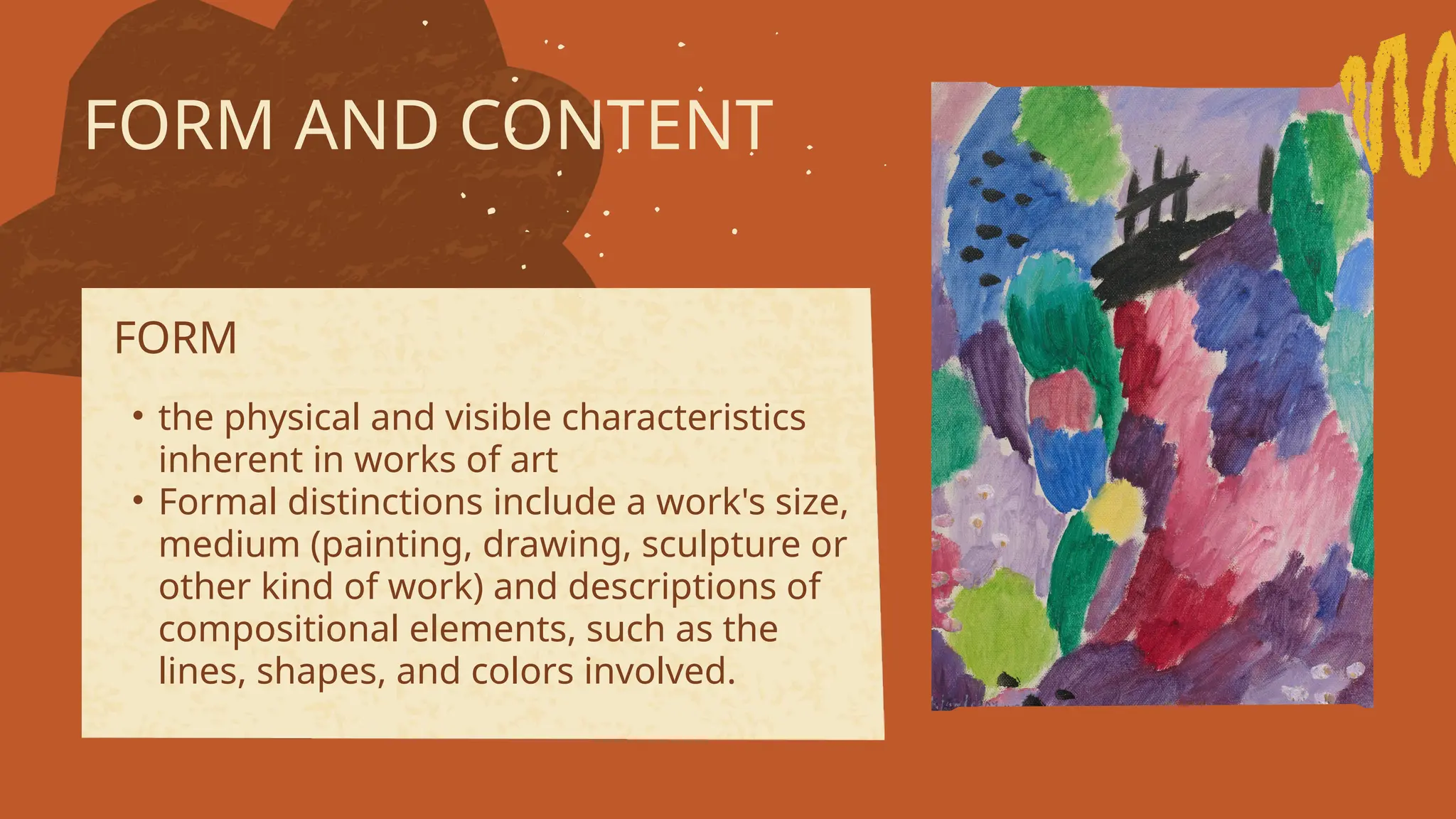
• the physical and visible characteristics
inherent in works of art
• Formal distinctions include a work's size,
medium (painting, drawing, sculpture or
other kind of work) and descriptions of
compositional elements, such as the
lines, shapes, and colors involved.
FORM AND CONTENT
CONTENT
• the meaning we derive from
them
• Content include any visual clues
that provide an understanding
of what the art tells us.
FORM AND CONTENT
PERSONAL
FUNCTIONS OF ART
SOCIAL
SPIRITUAL
PHYSICAL
EDUCATIONAL
VISUAL ART
Bonifacio Monument
by Guillermo Tolentino (1890-1976)
by Fernando Amorsolo
by BENCAB.
VISUAL ART
• The visual arts primarily involve using visual
representations and symbols to communicate
meaning- to express a story or personal vision,
emotion or concept.
• Artists often experiment and combine materials
and techniques into new art forms. Therefore,
visual art forms cannot always be strictly
categorized (Dinham 2014, p. 308).
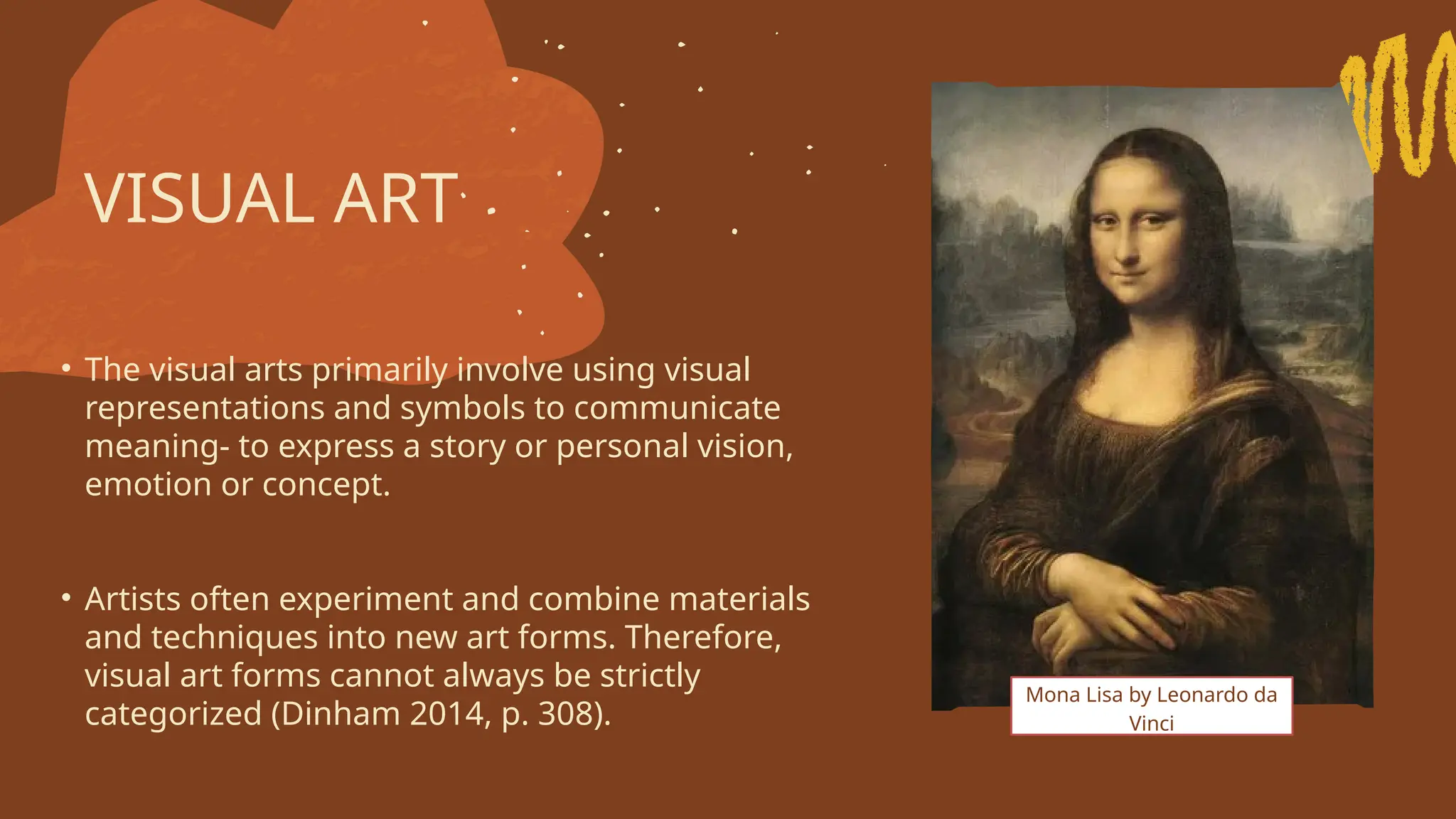
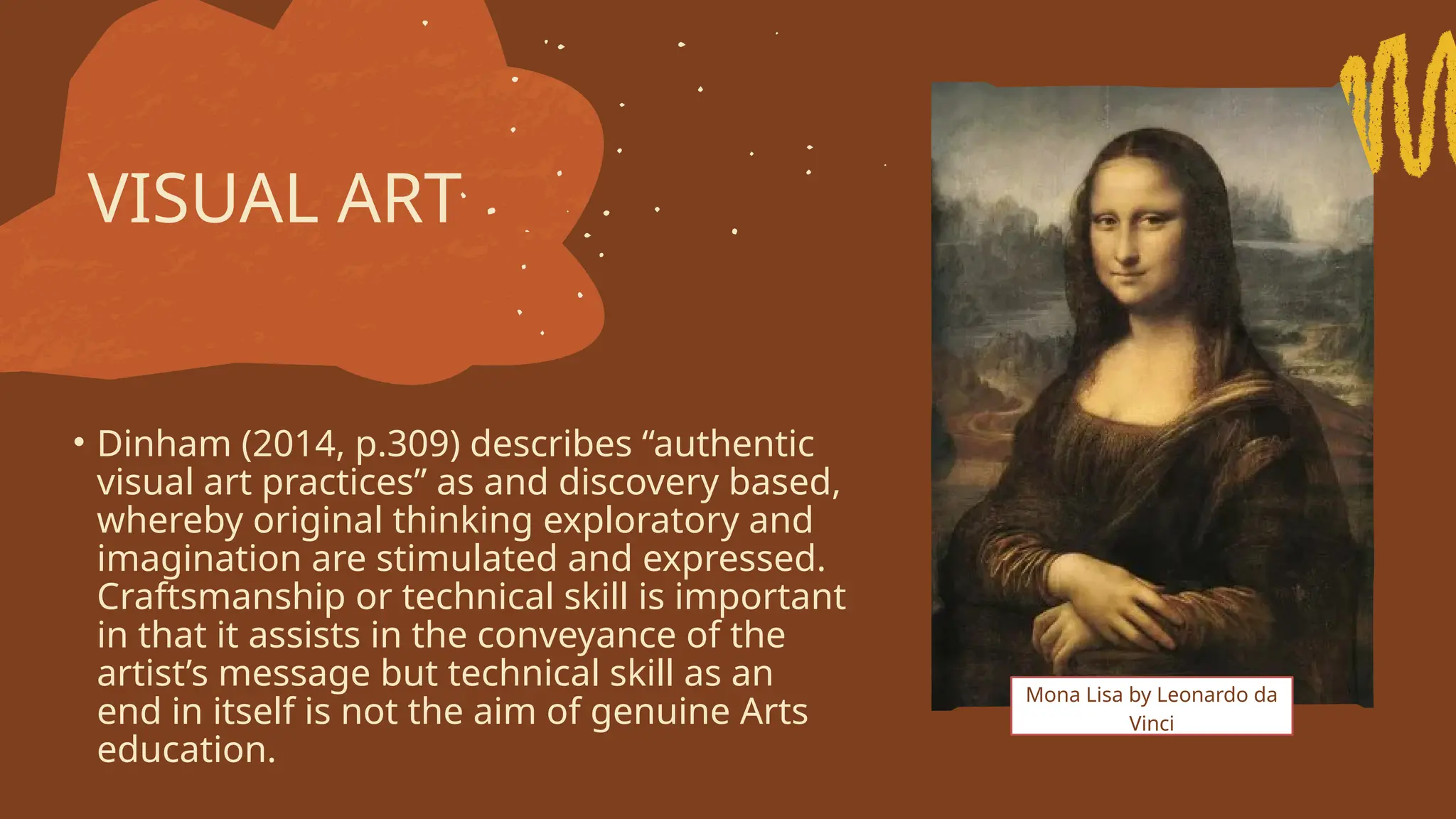
Mona Lisa by Leonardo da
Vinci
VISUAL ART
• Dinham (2014, p.309) describes “authentic
visual art practices” as and discovery based,
whereby original thinking exploratory and
imagination are stimulated and expressed.
Craftsmanship or technical skill is important
in that it assists in the conveyance of the
artist’s message but technical skill as an
end in itself is not the aim of genuine Arts
education.
Mona Lisa by Leonardo da
Vinci
VISUAL ART DESIGN
ELEMENTS
1.LINE
• Delineates contour
• Creates moods e.g. compare feeling of dark
angular line or soft wavy line
• Directs eye to focal point of composition
• Stimulates texture
• Creates sense of depth, distance &
perspective
• Shows direction of movement through
artwork
The most common use of line is
showing where an object ends. This
type of line is called a contour line.
Contour lines are most commonly
called outlines.
THE USES OF LINE
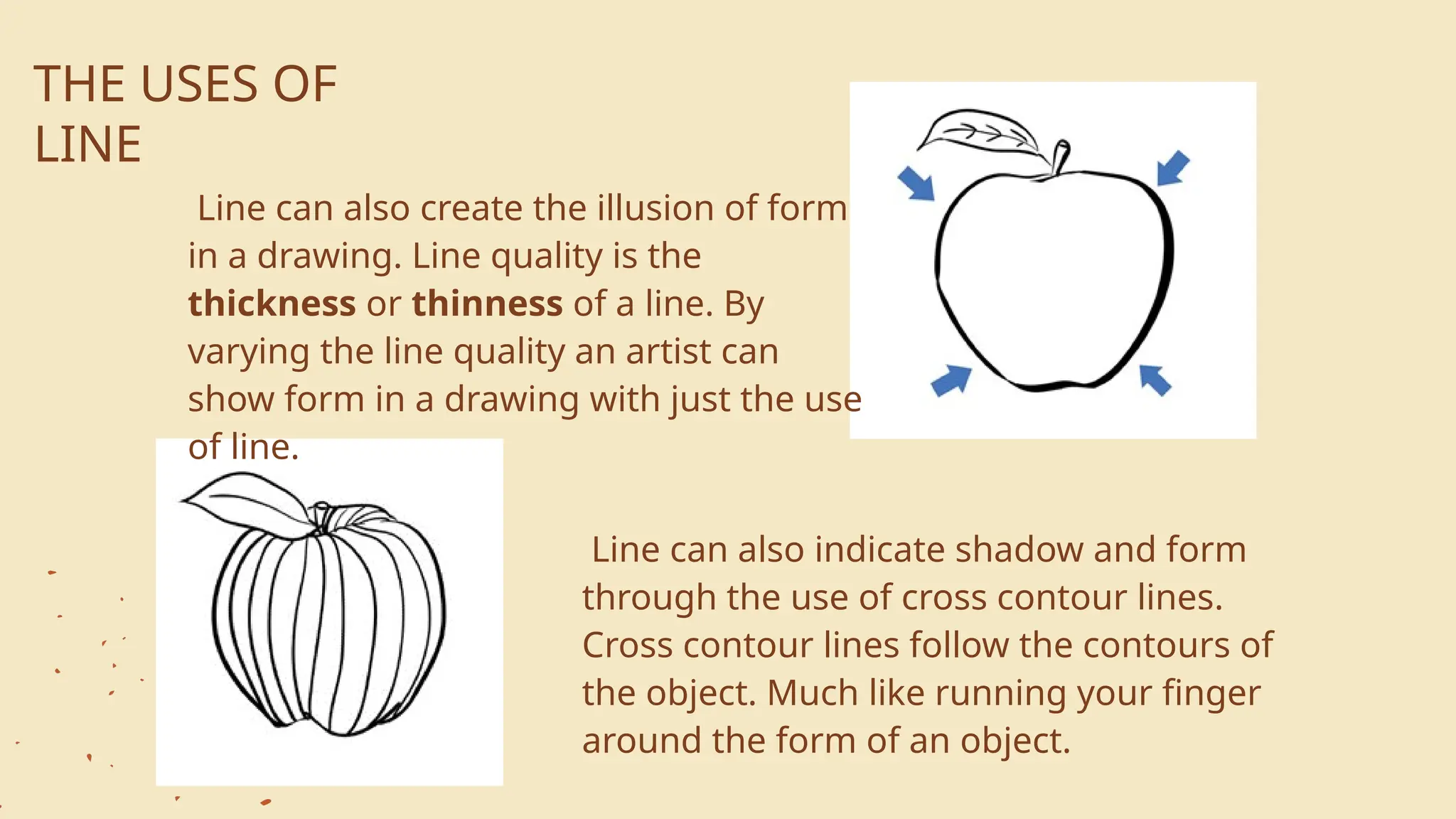
Line can also create the illusion of form
in a drawing. Line quality is the
thickness or thinness of a line. By
varying the line quality an artist can
show form in a drawing with just the use
of line.
THE USES OF
LINE
Line can also indicate shadow and form
through the use of cross contour lines.
Cross contour lines follow the contours of
the object. Much like running your finger
around the form of an object.
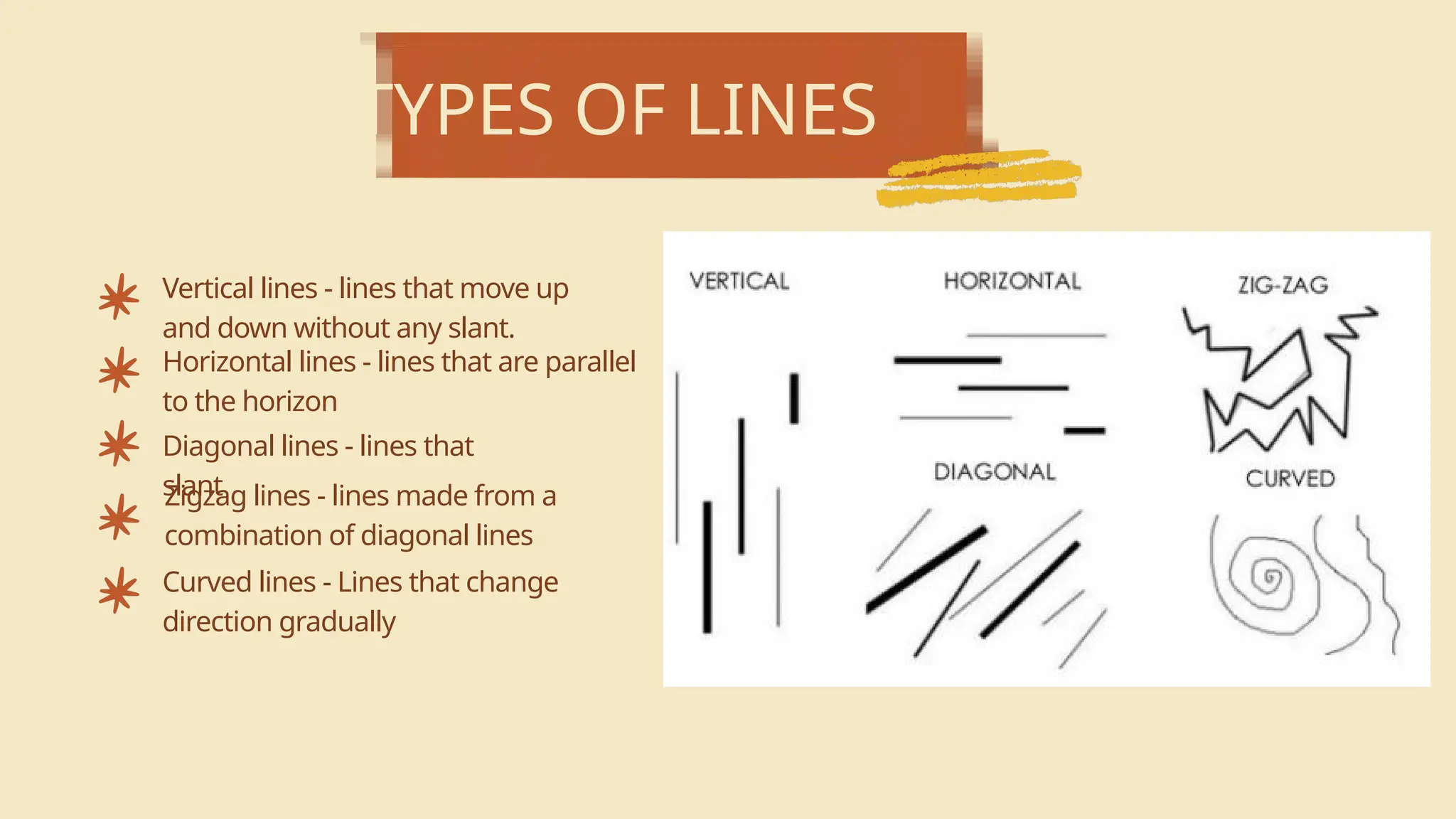
Vertical lines - lines that move up
and down without any slant.
Horizontal lines - lines that are parallel
to the horizon
Diagonal lines - lines that
slant
Zigzag lines - lines made from a
combination of diagonal lines
Curved lines - Lines that change
direction gradually
TYPES OF LINES
• Line Variation - adding
interest to your lines is
important in creating
successful artwork
• Length - lines can be long or
short
• Width - lines can be wide or
skinny
• Texture - lines can be rough
or smooth
• Direction - lines can move in
any direction
• Degree of curve - lines can curve
gradually or not at all
• Line quality or line weight - refers
to the thickness or thinness of a
line. By varying the line quality
artists can make objects appear
more 3-Deminsional and more
interesting
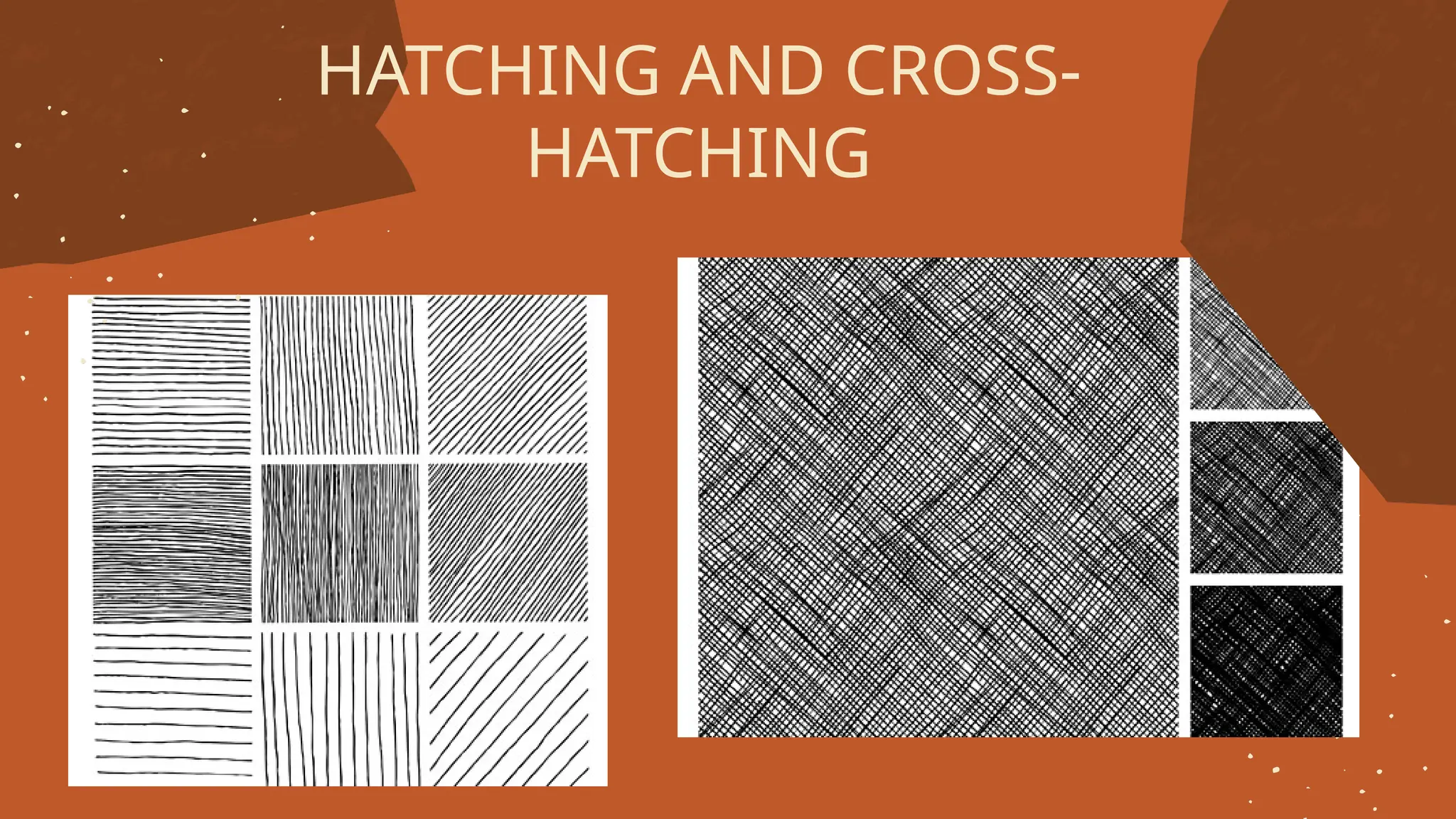
• Hatching and crosshatching -
using lines to create value
• Hatching - lines going in the same
direction
ELEMENTS OF LINES
HATCHING AND CROSS-
HATCHING
2. COLOR
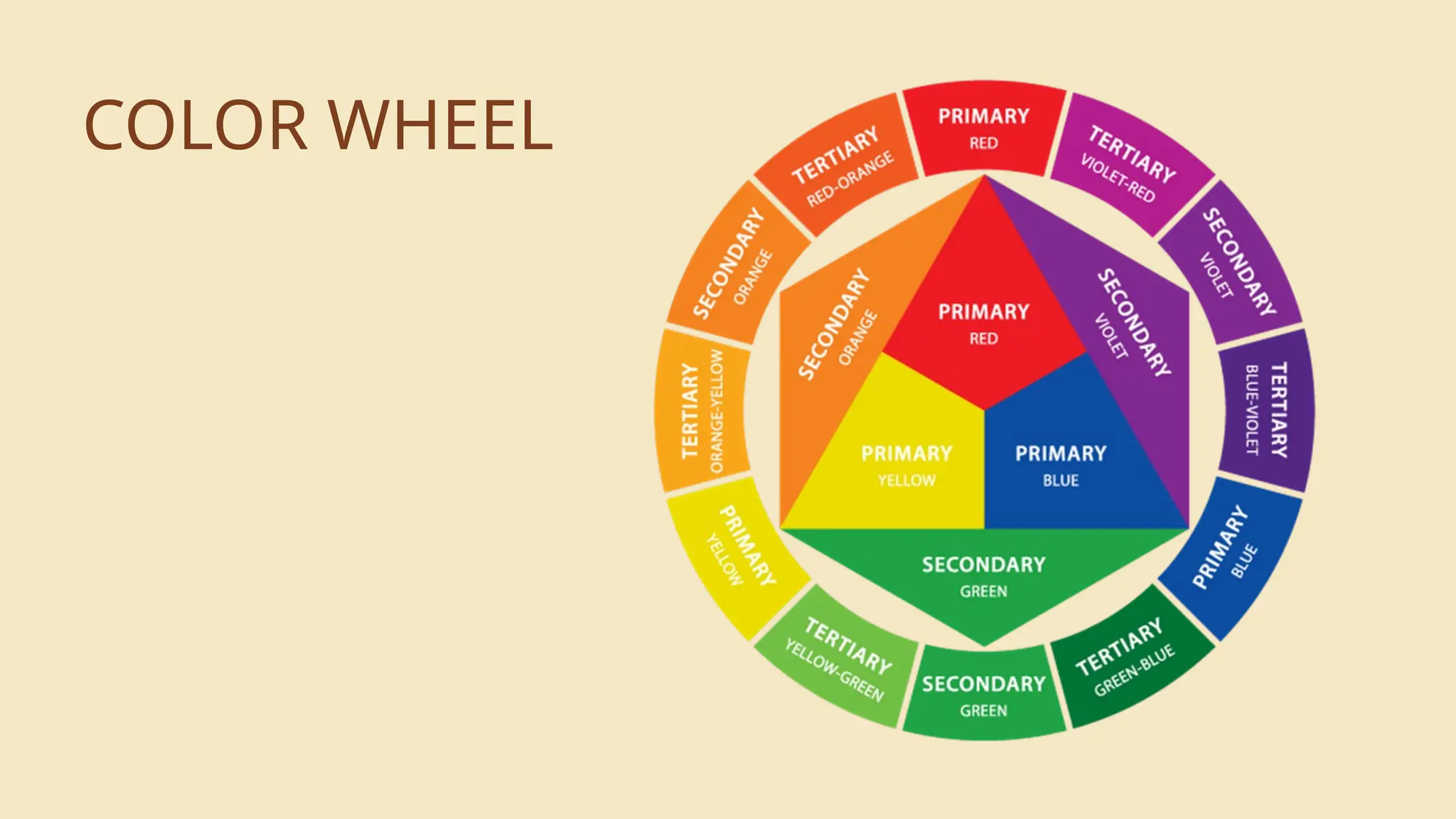
• Classified as - primary, secondary, tertiary
• Warm: colors containing red & yellow advance
• Cool: colors containing blue & green recede
• Value is changed by adding black or white(Black = shade
White = tint)
• Color used as symbol e.g. red traffic light = stop, green =
go.
• Affects psychological & even physiological response in
viewer (Gelineau, 2004)
• Color is the element of art that refers to reflected light.
COLOR
COLOR THEORY
COLOR WHEEL
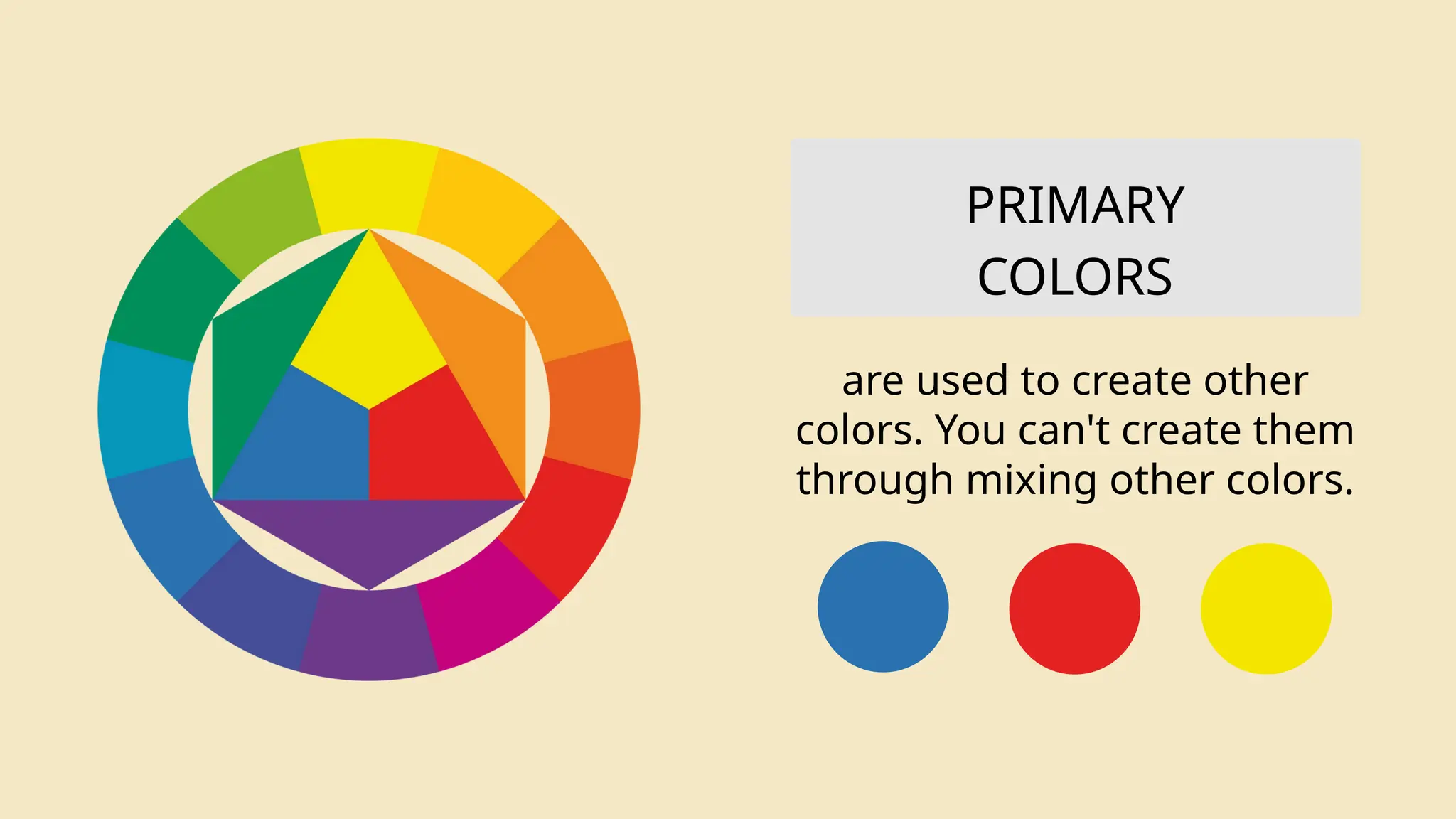
PRIMARY
COLORS
are used to create other
colors. You can't create them
through mixing other colors.
2 2
2
SECONDARY COLORS
are the colors that
we have as the result of
mixing two primary colors
together.
TERTIARY
COLORS
are the colors that
we have as the result of
mixing primary and
secondary colors.
3 3
3 3
3 3
WARM AND
COOL
COLORS
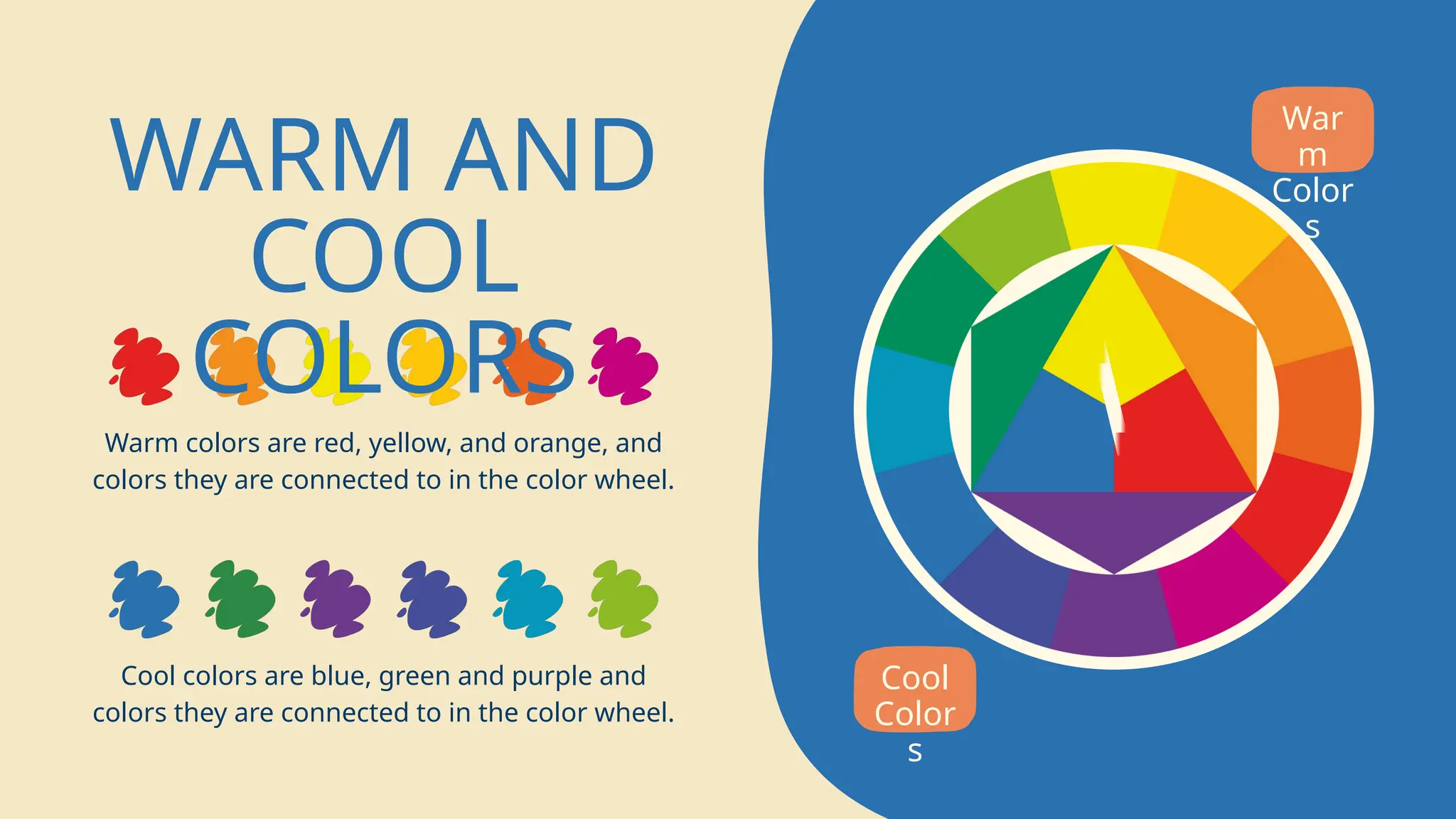
Warm colors are red, yellow, and orange, and
colors they are connected to in the color wheel.
Cool colors are blue, green and purple and
colors they are connected to in the color wheel.
War
m
Color
s
Cool
Color
s
What is the color?
Hue
HUE, VALUE, AND
SATURATION
How light or dark
is the color?
How strong or
faded is the color?
These are the three components of color.
Value Saturation
are pairs of colors that contrast with
each other, more than any other color.
They are positioned opposite
one another on the color wheel.
COMPLEMENTARY
COLORS
ANALOGOUS
COLORS
are three or more colors that are next
to each other on the color wheel.
They look very similar and when viewed
together they have a pleasing
appearance.
3. SHAPE
• A shape is formed when lines connect to enclose a space.
• Shapes can be geometric or organic
• Forms are shapes with mass or volume or drawn to give
the illusion of 3D (Dinham, 2014)
• In an artwork empty areas are named negative space. The
area of the composition occupied is named positive space
• Relationship between positive and negative spaces (shapes)
must be carefully considered to achieve a sense of
wholeness and point of focus
• Figure-ground is term referring to “a visual relationship
between foreground & background”
SHAPE
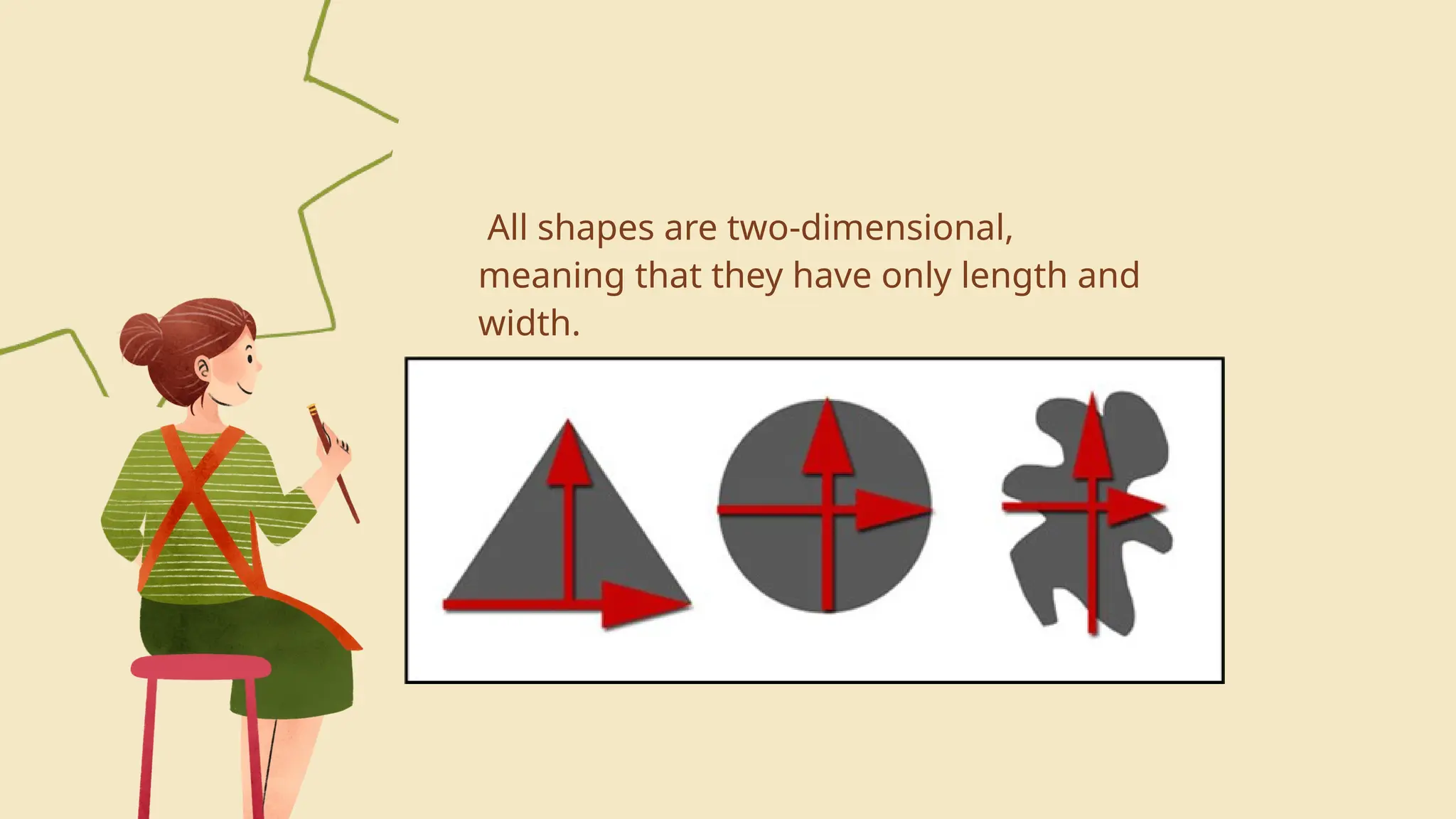
All shapes are two-dimensional,
meaning that they have only length and
width.
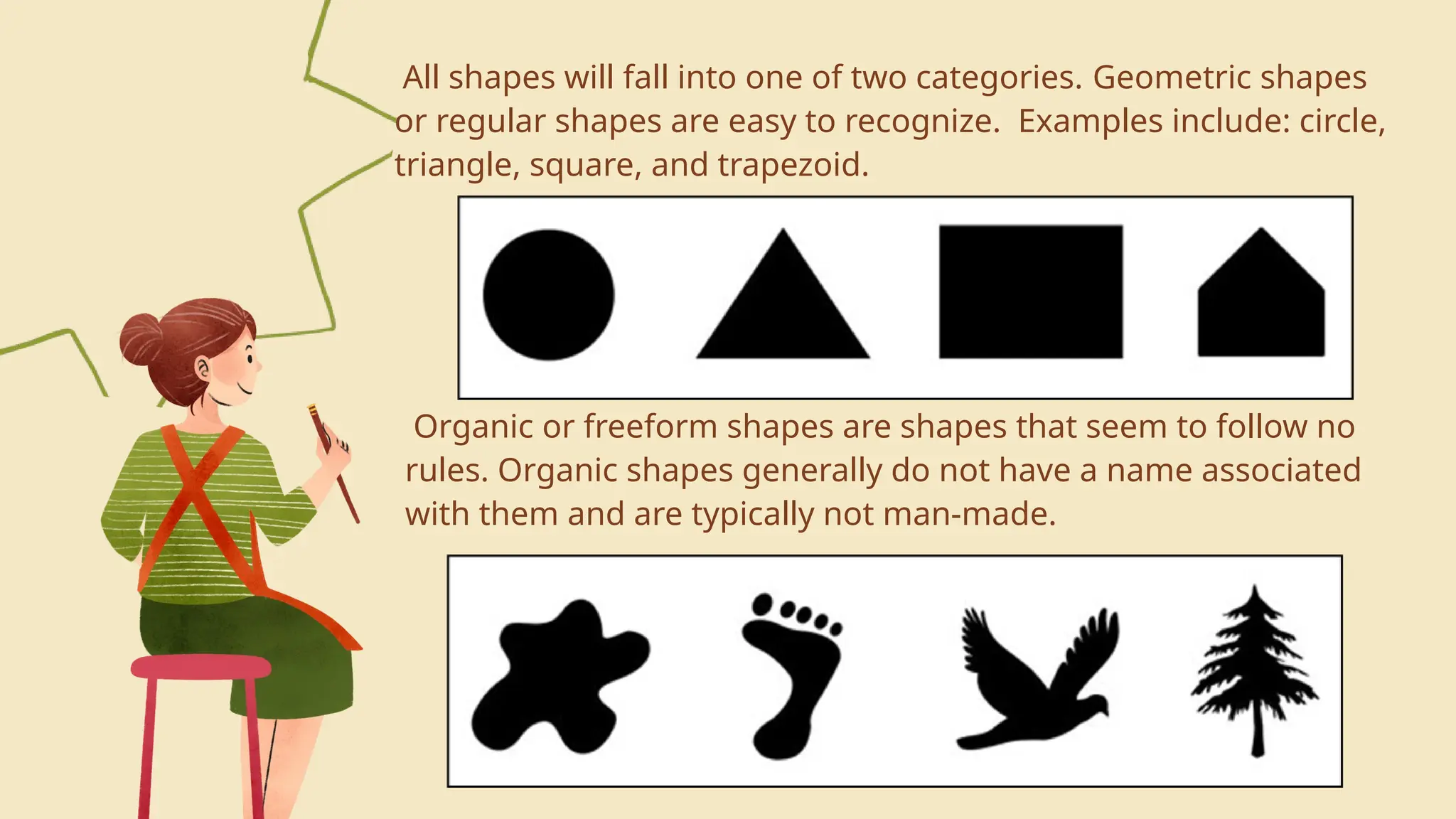
All shapes will fall into one of two categories. Geometric shapes
or regular shapes are easy to recognize. Examples include: circle,
triangle, square, and trapezoid.
Organic or freeform shapes are shapes that seem to follow no
rules. Organic shapes generally do not have a name associated
with them and are typically not man-made.
Shapes defined by objects are
positive shapes (space). Shapes
defined around objects are
negative shapes (space).
By organizing geometric and
organic shapes, we can draw
anything. Even complicated objects
become easy to draw when we
isolate basic geometric and organic
shapes.
4. TEXTURE
Texture is the surface
quality:
1.The way it feels to
physical touch.
2.Simulated texture e.g.
using artistic
techniques to convey a
smooth surface in a
picture.
Texture refers to the
way an object feels to
the touch or looks as
it may feel if it were
touched.
TEXTURE
• 3-D Texture - refers to the way an object feels to the touch 2-D Texture-
refers to the way an object looks as it may feel
• Visual texture - the illusion of a 3-D surface Simulated- imitate real textures
• Invented - 2-D patterns created by the repetition of lines of shapes
• Rough textures - reflect light unevenly
• Smooth textures - reflect light evenly
• Matte - surface that reflects a soft, dull light. Shiny surfaces are the
opposite of matte.
• Impasto - a painting technique in which the paint is built up on the surface
to create a texture
5. VALUE
• Differences in degrees of lightness
and darkness are named values.
• Light tones are named “high” in value,
dark tones named “low” in value.
• A full value scale ranges from pure
white to darkest black with a
multitude of tonal graduations
between these.
The whole point to value is to create the illusion of light. So, value
is used to basically create the illusion of highlights and shadows.
Highlights and shadows combine to create the illusion of a light
source. Remember, without light we cannot see. So technically,
without a light source, you have no illusion.
6. FORM
In terms of art, form refers to objects that are 3-
Dimensional, or have length, width, and height. The
world we live in made up almost entirely of forms.
Geometric forms have specific names
associated with them and are typically man-
made.
Organic forms do not have specific names associated with them
and are often associated with naturally occurring forms.
When drawing representationally, the goal is
to create the illusion of form. We can create
the illusion of form by understanding how
light reacts on the object.
• The highlight is the area where light is hitting the object
directly.
• The midtone is the middle value of the local color of the
object.
• The core shadow is the area(s) that is shaded on the object.
• The cast shadow is the area(s) that is shaded on surrounding
7. SPACE
In terms of art, space is the area around,
above, and within an object. With
consideration to drawings and paintings,
our goal is to create the illusion of space.
1.Overlapping - occurs when objects that
are closer to the viewer prevent the
view of objects that are behind them.
2. Placement - Objects placed higher
within the picture plane will appear further
away.
3. Size - Objects that are smaller will
appear further away from the viewer.
4. Detail - Objects that are further away
should have less detail than objects that
are closer to the viewer.
5. Color and Value - Objects that are
further away are cooler in color
temperature, while objects that are closer
are warmer. Objects that are further away
are lighter in value, while objects that are
closer are typically darker in value.
6. Perspective - Linear perspective is a
drawing method that uses lines to create
the illusion of space on a flat surface.
SUMMARY
• Art, in general, is a form of
communication. It means whatever the
artist intends it to mean, and this
meaning is shaped by the materials,
techniques, and forms it makes use of, as
well as the ideas and feelings it creates in
its viewers. Art is an act of expressing
feelings, thoughts, and observations.
• Visual art has seven elements. These are
line, color, space, form, shape, texture,
and value. This elements work hand-in-
hand in order to achieve not only an
aesthetic, but also a logical artwork.
THANK YOU!

Lesson 1 Visual Arts Elements of Art.pptx

  • 1.
    Prepared by: Ms.Cherry Mae F. Panong CREATIVE INDUSTRIES I: ARTS AND DESIGN APPRECIATION AND PRODUCTION LESSON 1: VISUAL ARTS
  • 2.
    Identify and differentiatevarious forms and contents of art. Define visual art. Distinguish the different visual design elements. Determine the different forms of visual art. Appreciate visual art and be able to produce your own visual artwork. LESSON OBJECTIVES
  • 3.
    Identify the nameand the artist of the following paintings. PRE-ACTIVITY
  • 4.
  • 5.
  • 6.
  • 7.
    PAINTING NAME: girlwith a pearl earring PAINTER: Johannes Vermeer
  • 8.
  • 9.
    PAINTING NAME: The StarryNight PAINTER: Vincent van Gogh
  • 10.
  • 11.
  • 12.
  • 13.
    PAINTING NAME: MadonnaOf the Slums PAINTER: Vicente Manansala
  • 14.
  • 15.
    ART Art is communication. Artis a highly diverse range of human activities engaged in creating visual, auditory, or performed artifacts— artworks —that express the author’s imaginative or technical skill and are intended to be appreciated for their beauty or emotional power.
  • 16.
    ART Art may becharacterized in terms of mimesis (its representation of reality), expression, communication of emotion, or other qualities. Art is uniquely human and tied directly to culture.
  • 17.
    FORM • the physicaland visible characteristics inherent in works of art • Formal distinctions include a work's size, medium (painting, drawing, sculpture or other kind of work) and descriptions of compositional elements, such as the lines, shapes, and colors involved. FORM AND CONTENT
  • 18.
    CONTENT • the meaningwe derive from them • Content include any visual clues that provide an understanding of what the art tells us. FORM AND CONTENT
  • 19.
  • 20.
    VISUAL ART Bonifacio Monument byGuillermo Tolentino (1890-1976) by Fernando Amorsolo by BENCAB.
  • 21.
    VISUAL ART • Thevisual arts primarily involve using visual representations and symbols to communicate meaning- to express a story or personal vision, emotion or concept. • Artists often experiment and combine materials and techniques into new art forms. Therefore, visual art forms cannot always be strictly categorized (Dinham 2014, p. 308). Mona Lisa by Leonardo da Vinci
  • 22.
    VISUAL ART • Dinham(2014, p.309) describes “authentic visual art practices” as and discovery based, whereby original thinking exploratory and imagination are stimulated and expressed. Craftsmanship or technical skill is important in that it assists in the conveyance of the artist’s message but technical skill as an end in itself is not the aim of genuine Arts education. Mona Lisa by Leonardo da Vinci
  • 23.
  • 24.
    1.LINE • Delineates contour •Creates moods e.g. compare feeling of dark angular line or soft wavy line • Directs eye to focal point of composition • Stimulates texture • Creates sense of depth, distance & perspective • Shows direction of movement through artwork
  • 25.
    The most commonuse of line is showing where an object ends. This type of line is called a contour line. Contour lines are most commonly called outlines. THE USES OF LINE
  • 26.
    Line can alsocreate the illusion of form in a drawing. Line quality is the thickness or thinness of a line. By varying the line quality an artist can show form in a drawing with just the use of line. THE USES OF LINE Line can also indicate shadow and form through the use of cross contour lines. Cross contour lines follow the contours of the object. Much like running your finger around the form of an object.
  • 27.
    Vertical lines -lines that move up and down without any slant. Horizontal lines - lines that are parallel to the horizon Diagonal lines - lines that slant Zigzag lines - lines made from a combination of diagonal lines Curved lines - Lines that change direction gradually TYPES OF LINES
  • 28.
    • Line Variation- adding interest to your lines is important in creating successful artwork • Length - lines can be long or short • Width - lines can be wide or skinny • Texture - lines can be rough or smooth • Direction - lines can move in any direction • Degree of curve - lines can curve gradually or not at all • Line quality or line weight - refers to the thickness or thinness of a line. By varying the line quality artists can make objects appear more 3-Deminsional and more interesting • Hatching and crosshatching - using lines to create value • Hatching - lines going in the same direction ELEMENTS OF LINES
  • 29.
  • 30.
  • 31.
    • Classified as- primary, secondary, tertiary • Warm: colors containing red & yellow advance • Cool: colors containing blue & green recede • Value is changed by adding black or white(Black = shade White = tint) • Color used as symbol e.g. red traffic light = stop, green = go. • Affects psychological & even physiological response in viewer (Gelineau, 2004) • Color is the element of art that refers to reflected light. COLOR
  • 32.
  • 33.
  • 34.
    PRIMARY COLORS are used tocreate other colors. You can't create them through mixing other colors.
  • 35.
    2 2 2 SECONDARY COLORS arethe colors that we have as the result of mixing two primary colors together.
  • 36.
    TERTIARY COLORS are the colorsthat we have as the result of mixing primary and secondary colors. 3 3 3 3 3 3
  • 37.
    WARM AND COOL COLORS Warm colorsare red, yellow, and orange, and colors they are connected to in the color wheel. Cool colors are blue, green and purple and colors they are connected to in the color wheel. War m Color s Cool Color s
  • 38.
    What is thecolor? Hue HUE, VALUE, AND SATURATION How light or dark is the color? How strong or faded is the color? These are the three components of color. Value Saturation
  • 39.
    are pairs ofcolors that contrast with each other, more than any other color. They are positioned opposite one another on the color wheel. COMPLEMENTARY COLORS
  • 40.
    ANALOGOUS COLORS are three ormore colors that are next to each other on the color wheel. They look very similar and when viewed together they have a pleasing appearance.
  • 41.
  • 42.
    • A shapeis formed when lines connect to enclose a space. • Shapes can be geometric or organic • Forms are shapes with mass or volume or drawn to give the illusion of 3D (Dinham, 2014) • In an artwork empty areas are named negative space. The area of the composition occupied is named positive space • Relationship between positive and negative spaces (shapes) must be carefully considered to achieve a sense of wholeness and point of focus • Figure-ground is term referring to “a visual relationship between foreground & background” SHAPE
  • 43.
    All shapes aretwo-dimensional, meaning that they have only length and width.
  • 44.
    All shapes willfall into one of two categories. Geometric shapes or regular shapes are easy to recognize. Examples include: circle, triangle, square, and trapezoid. Organic or freeform shapes are shapes that seem to follow no rules. Organic shapes generally do not have a name associated with them and are typically not man-made.
  • 45.
    Shapes defined byobjects are positive shapes (space). Shapes defined around objects are negative shapes (space).
  • 46.
    By organizing geometricand organic shapes, we can draw anything. Even complicated objects become easy to draw when we isolate basic geometric and organic shapes.
  • 47.
  • 48.
    Texture is thesurface quality: 1.The way it feels to physical touch. 2.Simulated texture e.g. using artistic techniques to convey a smooth surface in a picture. Texture refers to the way an object feels to the touch or looks as it may feel if it were touched. TEXTURE
  • 49.
    • 3-D Texture- refers to the way an object feels to the touch 2-D Texture- refers to the way an object looks as it may feel • Visual texture - the illusion of a 3-D surface Simulated- imitate real textures • Invented - 2-D patterns created by the repetition of lines of shapes • Rough textures - reflect light unevenly • Smooth textures - reflect light evenly • Matte - surface that reflects a soft, dull light. Shiny surfaces are the opposite of matte. • Impasto - a painting technique in which the paint is built up on the surface to create a texture
  • 50.
  • 51.
    • Differences indegrees of lightness and darkness are named values. • Light tones are named “high” in value, dark tones named “low” in value. • A full value scale ranges from pure white to darkest black with a multitude of tonal graduations between these. The whole point to value is to create the illusion of light. So, value is used to basically create the illusion of highlights and shadows. Highlights and shadows combine to create the illusion of a light source. Remember, without light we cannot see. So technically, without a light source, you have no illusion.
  • 52.
  • 53.
    In terms ofart, form refers to objects that are 3- Dimensional, or have length, width, and height. The world we live in made up almost entirely of forms.
  • 54.
    Geometric forms havespecific names associated with them and are typically man- made. Organic forms do not have specific names associated with them and are often associated with naturally occurring forms.
  • 55.
    When drawing representationally,the goal is to create the illusion of form. We can create the illusion of form by understanding how light reacts on the object. • The highlight is the area where light is hitting the object directly. • The midtone is the middle value of the local color of the object. • The core shadow is the area(s) that is shaded on the object. • The cast shadow is the area(s) that is shaded on surrounding
  • 56.
  • 57.
    In terms ofart, space is the area around, above, and within an object. With consideration to drawings and paintings, our goal is to create the illusion of space.
  • 58.
    1.Overlapping - occurswhen objects that are closer to the viewer prevent the view of objects that are behind them. 2. Placement - Objects placed higher within the picture plane will appear further away. 3. Size - Objects that are smaller will appear further away from the viewer.
  • 59.
    4. Detail -Objects that are further away should have less detail than objects that are closer to the viewer. 5. Color and Value - Objects that are further away are cooler in color temperature, while objects that are closer are warmer. Objects that are further away are lighter in value, while objects that are closer are typically darker in value. 6. Perspective - Linear perspective is a drawing method that uses lines to create the illusion of space on a flat surface.
  • 60.
    SUMMARY • Art, ingeneral, is a form of communication. It means whatever the artist intends it to mean, and this meaning is shaped by the materials, techniques, and forms it makes use of, as well as the ideas and feelings it creates in its viewers. Art is an act of expressing feelings, thoughts, and observations. • Visual art has seven elements. These are line, color, space, form, shape, texture, and value. This elements work hand-in- hand in order to achieve not only an aesthetic, but also a logical artwork.
  • 61.

Editor's Notes

  • #4 Spoliarium by Juan Luna The painting was submitted by Luna to the Exposición Nacional de Bellas Artes in 1884 in Madrid, where it garnered the first gold medal. The picture recreates a despoiling scene in a Roman circus where dead gladiators are stripped of weapons and garments.
  • #5 Spoliarium by Juan Luna The painting was submitted by Luna to the Exposición Nacional de Bellas Artes in 1884 in Madrid, where it garnered the first gold medal. The picture recreates a despoiling scene in a Roman circus where dead gladiators are stripped of weapons and garments.
  • #6 Girl with a Pearl Earring, oil painting on canvas (c. 1665) by Dutch artist Johannes Vermeer, one of his most well-known works. It depicts an imaginary young woman in exotic dress and a very large pearl earring.
  • #7 Girl with a Pearl Earring, oil painting on canvas (c. 1665) by Dutch artist Johannes Vermeer, one of his most well-known works. It depicts an imaginary young woman in exotic dress and a very large pearl earring.
  • #8 The Starry Night’ by Vincent van Gogh The Starry Night, considered to be Vincent van Gogh’s best and most renowned work, was painted from memory and depicts the view outside his sanitarium room’s window at night.
  • #9 The Starry Night’ by Vincent van Gogh The Starry Night, considered to be Vincent van Gogh’s best and most renowned work, was painted from memory and depicts the view outside his sanitarium room’s window at night.
  • #10 Planting Rice by Fernando Amorsolo Amorsolo painted a few versions of this painting. He wanted to capture the traditional Filipino occupation and the farm life of men and women in a hot sunny day. This representation depicts how enduring they are, and how the farmers work together.
  • #11 Planting Rice by Fernando Amorsolo Amorsolo painted a few versions of this painting. He wanted to capture the traditional Filipino occupation and the farm life of men and women in a hot sunny day. This representation depicts how enduring they are, and how the farmers work together.
  • #12 “Madonna Of the Slums” by Vicente Manansala (1950) It focuses on the transition from rural to urban settings. In it, Vicente portrays a mother and her child who recently relocated from the countryside to the city. The story is about the transition from rural to urban settings.
  • #13 “Madonna Of the Slums” by Vicente Manansala (1950) It focuses on the transition from rural to urban settings. In it, Vicente portrays a mother and her child who recently relocated from the countryside to the city. The story is about the transition from rural to urban settings.
  • #21 Here are some forms of visual art that we will discuss individually later on: 1. Painting 2. Drawing 3. Print-making 4. Collage 5. Sculpture 6. Ceramics 7. Installation art 8. Photography and film 9. Jewelry 10. Textile art and costume designing
  • #22 Here are some forms of visual art that we will discuss individually later on: 1. Painting 2. Drawing 3. Print-making 4. Collage 5. Sculpture 6. Ceramics 7. Installation art 8. Photography and film 9. Jewelry 10. Textile art and costume designing
  • #24 Delineates-indicate the exact position of (a border or boundary).