Elements and
Principles of Art
PRESENTATION BY: GROUP 2
The elements and principles of art are fundamental
concepts and components that artists use to create
visual compositions and convey meaning in their work.
These concepts serve as a foundation for
understanding and analyzing art. Here's an overview of
both:
Elements and
Principles of Art
PRESENTATION BY: GROUP 2
Elements of Art:
•LINE
•SPACE
•SHAPE
•FORM
•VALUE
•TEXTURE
•COLOR
PRESENTATION BY: GROUP 2
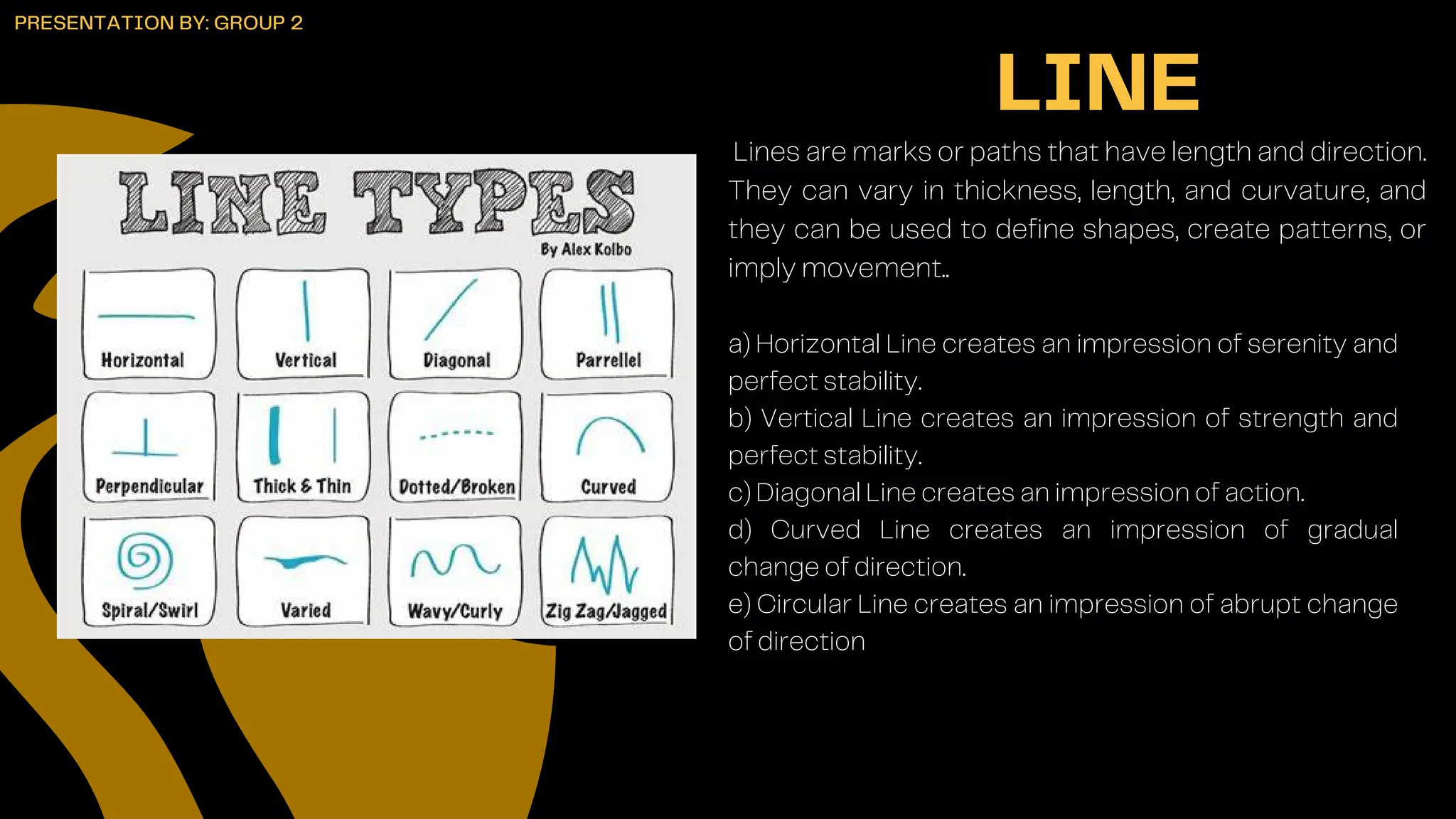
Lines are marks or paths that have length and direction.
They can vary in thickness, length, and curvature, and
they can be used to define shapes, create patterns, or
imply movement..
LINE
PRESENTATION BY: GROUP 2
a) Horizontal Line creates an impression of serenity and
perfect stability.
b) Vertical Line creates an impression of strength and
perfect stability.
c) Diagonal Line creates an impression of action.
d) Curved Line creates an impression of gradual
change of direction.
e) Circular Line creates an impression of abrupt change
of direction
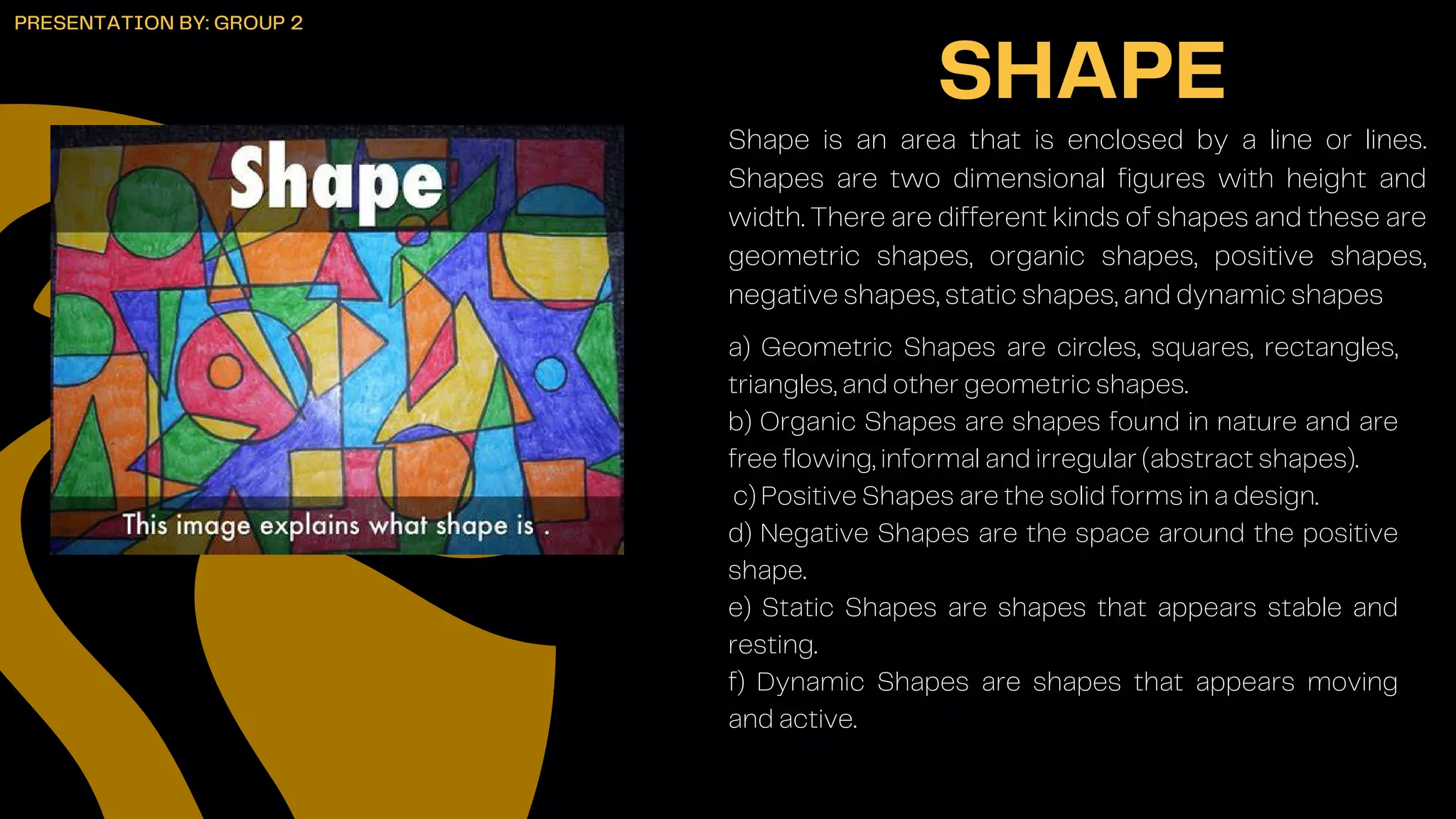
Shape is an area that is enclosed by a line or lines.
Shapes are two dimensional figures with height and
width. There are different kinds of shapes and these are
geometric shapes, organic shapes, positive shapes,
negative shapes, static shapes, and dynamic shapes
SHAPE
PRESENTATION BY: GROUP 2
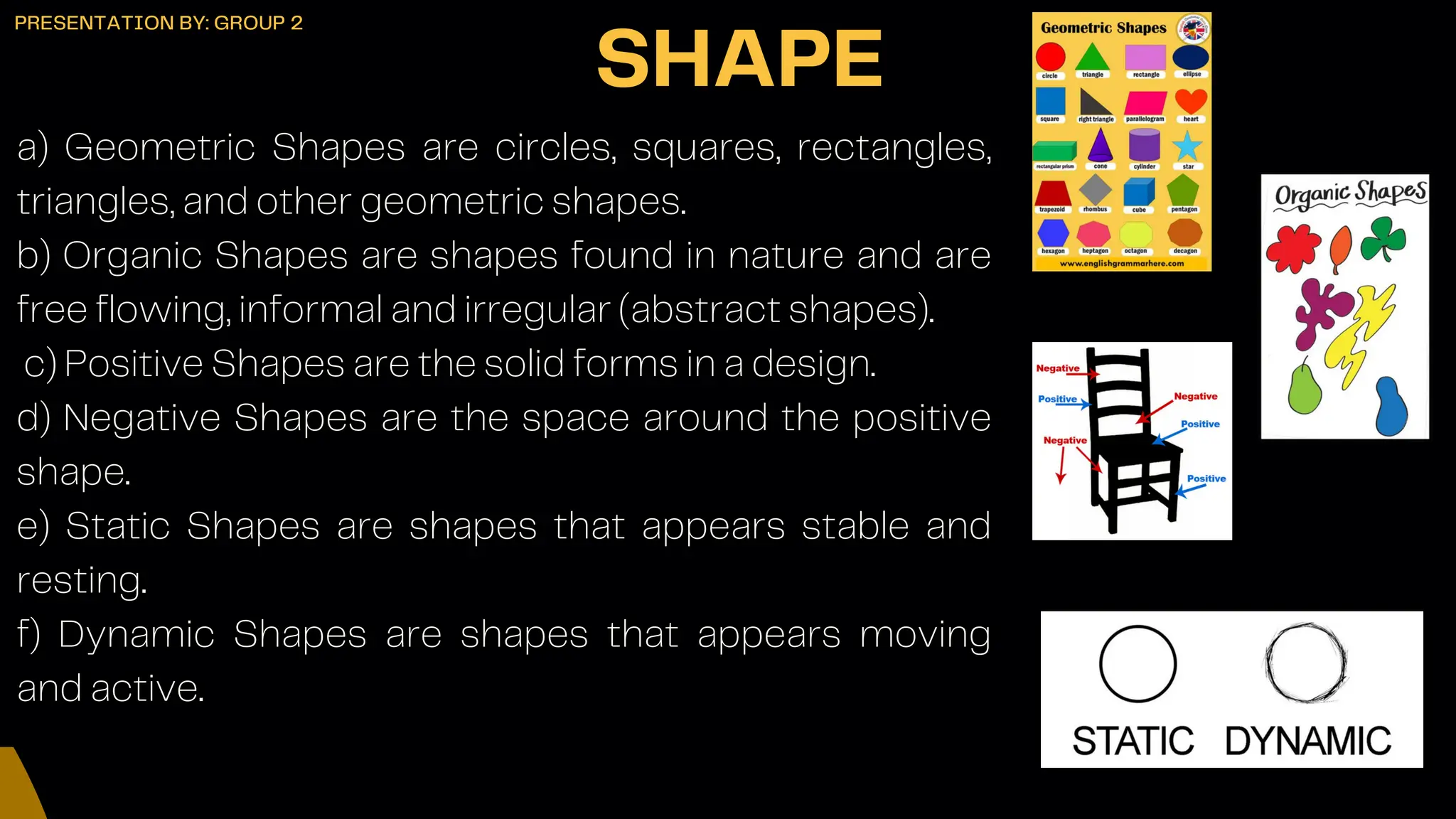
a) Geometric Shapes are circles, squares, rectangles,
triangles, and other geometric shapes.
b) Organic Shapes are shapes found in nature and are
free flowing, informal and irregular (abstract shapes).
c) Positive Shapes are the solid forms in a design.
d) Negative Shapes are the space around the positive
shape.
e) Static Shapes are shapes that appears stable and
resting.
f) Dynamic Shapes are shapes that appears moving
and active.
a) Geometric Shapes are circles, squares, rectangles,
triangles, and other geometric shapes.
b) Organic Shapes are shapes found in nature and are
free flowing, informal and irregular (abstract shapes).
c) Positive Shapes are the solid forms in a design.
d) Negative Shapes are the space around the positive
shape.
e) Static Shapes are shapes that appears stable and
resting.
f) Dynamic Shapes are shapes that appears moving
and active.
SHAPE
PRESENTATION BY: GROUP 2
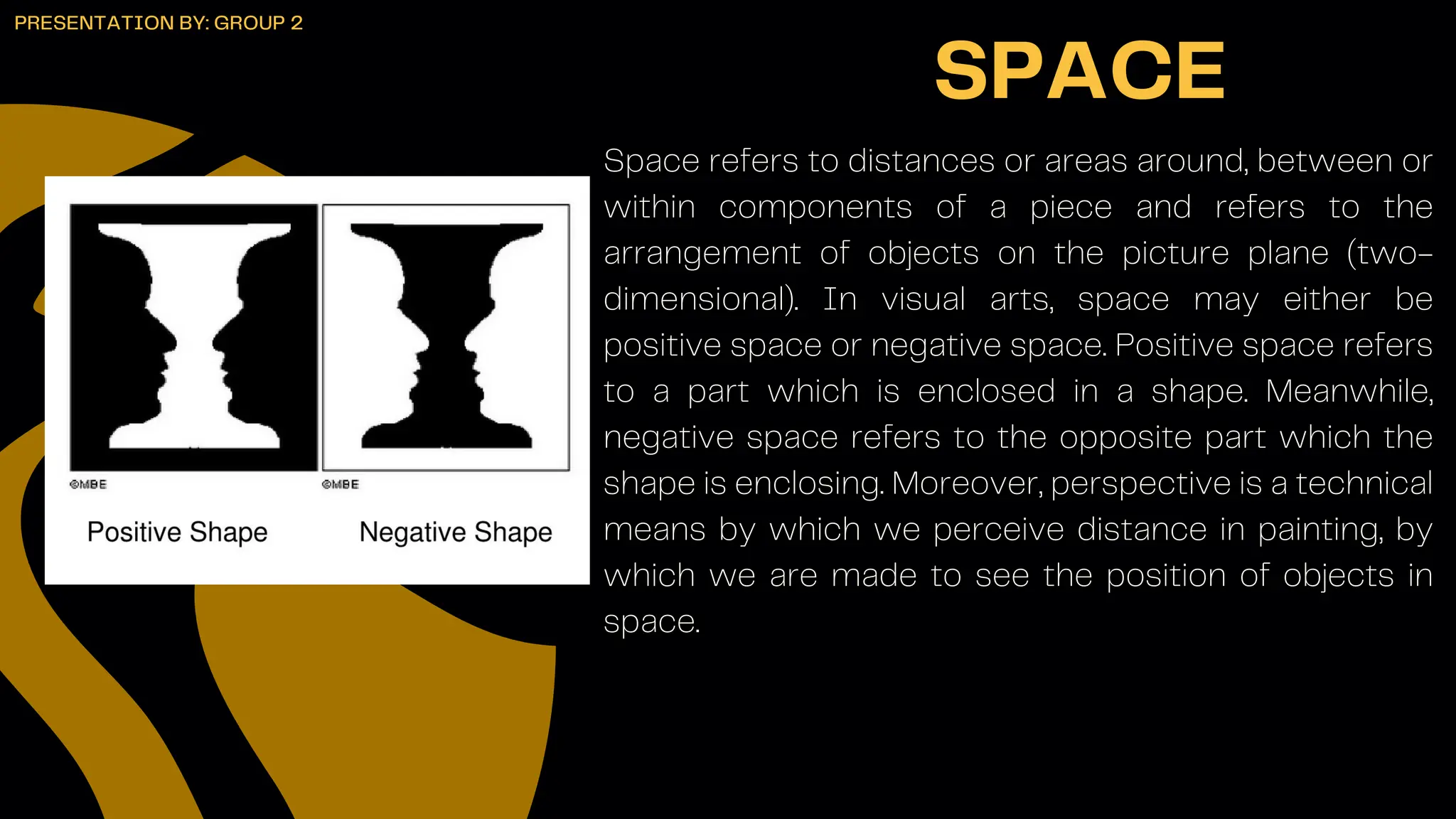
Space refers to distances or areas around, between or
within components of a piece and refers to the
arrangement of objects on the picture plane (two-
dimensional). In visual arts, space may either be
positive space or negative space. Positive space refers
to a part which is enclosed in a shape. Meanwhile,
negative space refers to the opposite part which the
shape is enclosing. Moreover, perspective is a technical
means by which we perceive distance in painting, by
which we are made to see the position of objects in
space.
SPACE
PRESENTATION BY: GROUP 2
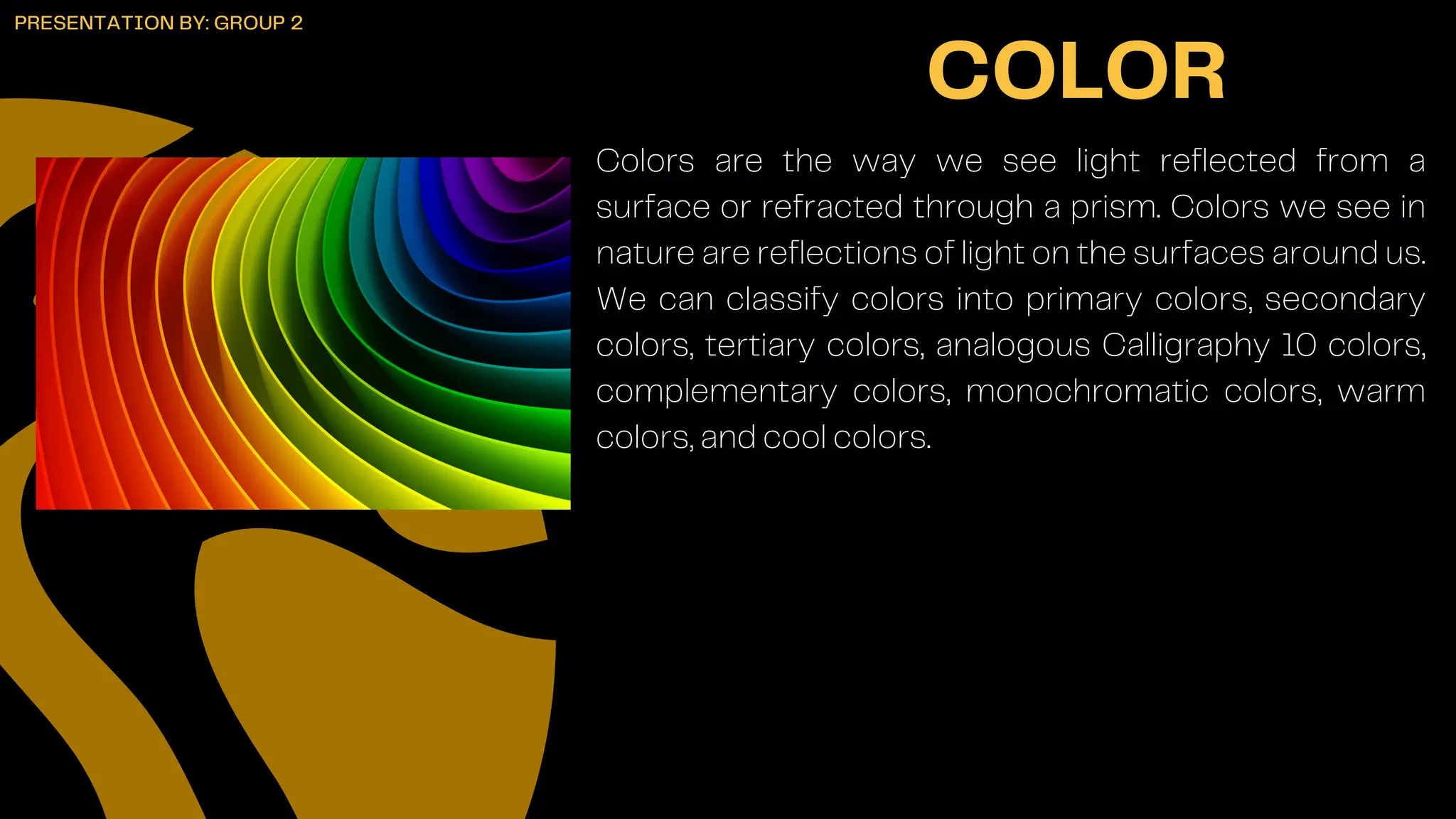
Colors are the way we see light reflected from a
surface or refracted through a prism. Colors we see in
nature are reflections of light on the surfaces around us.
We can classify colors into primary colors, secondary
colors, tertiary colors, analogous Calligraphy 10 colors,
complementary colors, monochromatic colors, warm
colors, and cool colors.
COLOR
PRESENTATION BY: GROUP 2
a) Primary colors are red, blue, and yellow.
b) Secondary colors are the resulting colors when the two of the primary colors are mix. The
secondary colors are purple, green, and orange.
c) Tertiary colors are the resulting colors when two of the primary and/or secondary colors are
mix. The tertiary colors are amber, vermilion, magenta, violet, teal, and chartreuse.
d) Analogous Colors are colors that lie nest to each other based on the color wheel. Example of
analogous colors are yellow, orange, and red.
e) Complementary colors are colors that are opposite to each other based on the color wheel.
Examples of complementary colors are red and green, blue and orange, and purple and yellow.
f) Monochromatic Colors are several values of one color.
g) Warm colors are colors that give the feeling of warmth. The warm colors are yellow, amber,
orange, vermilion, red, and magenta.
h) Cool colors are colors that give the feeling of coolness. The cool colors are purple, violet, blue,
teal, green, and chartreuse.
COLOR
PRESENTATION BY: GROUP 2
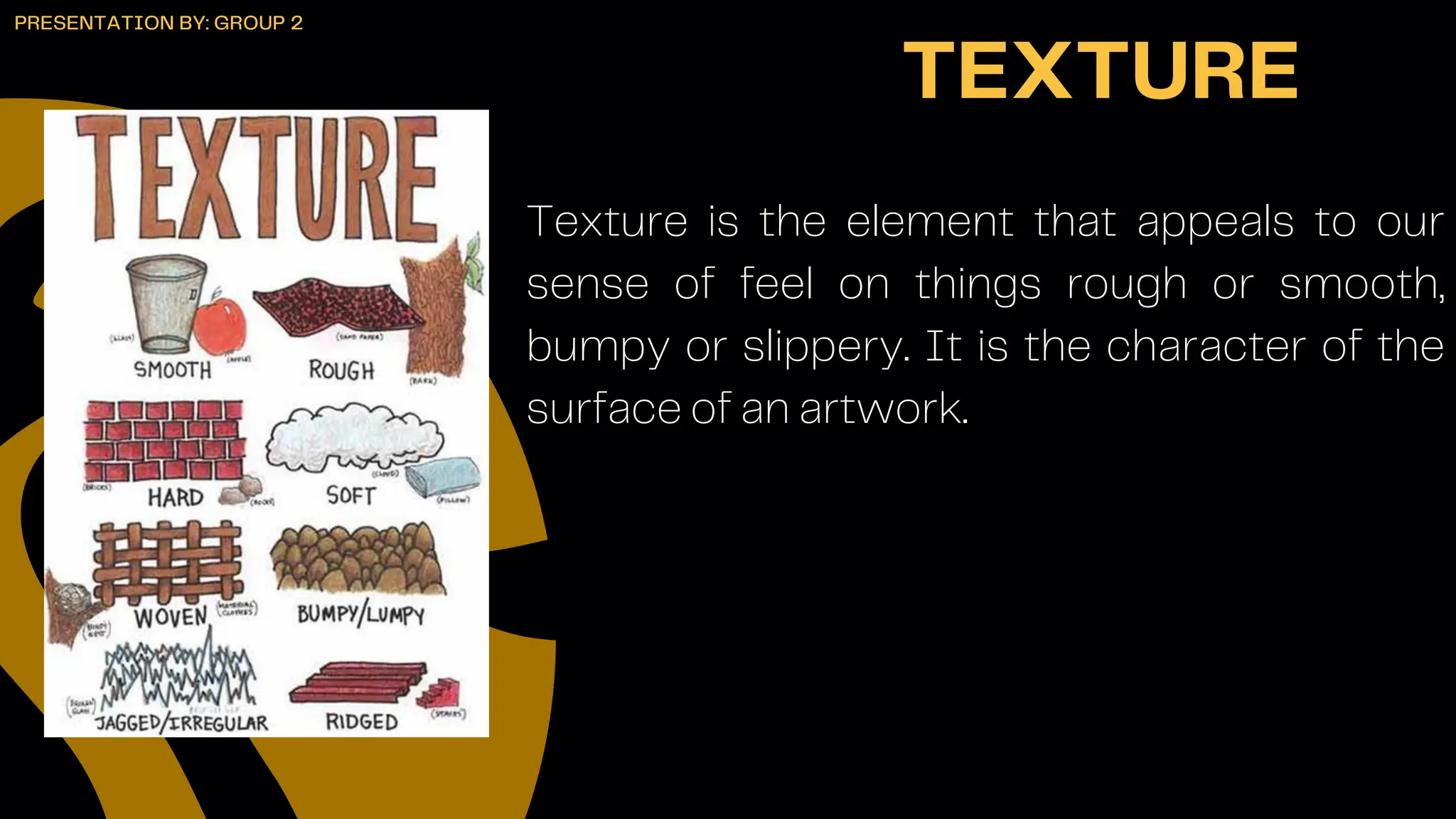
Texture is the element that appeals to our
sense of feel on things rough or smooth,
bumpy or slippery. It is the character of the
surface of an artwork.
TEXTURE
PRESENTATION BY: GROUP 2
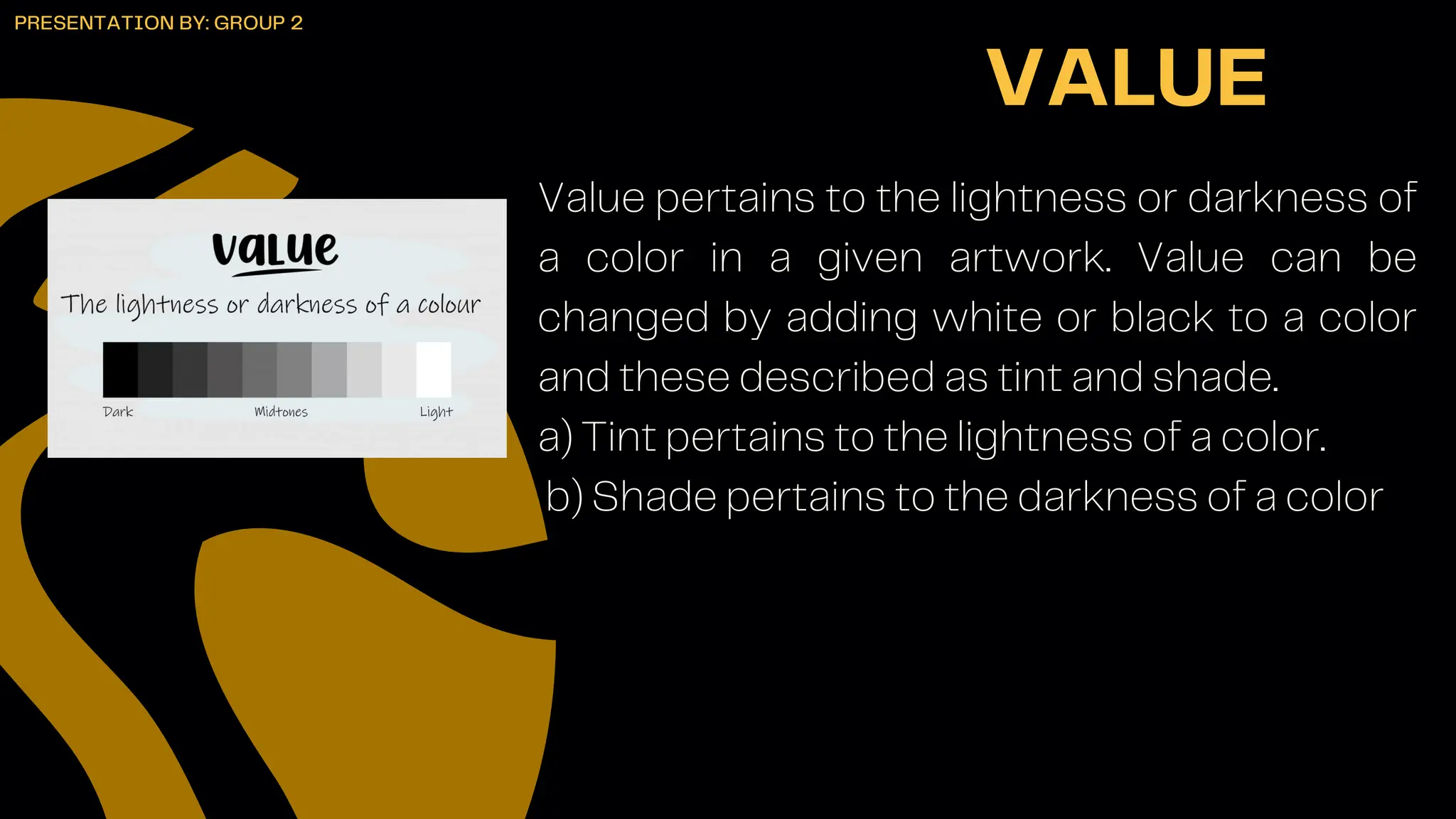
Value pertains to the lightness or darkness of
a color in a given artwork. Value can be
changed by adding white or black to a color
and these described as tint and shade.
a) Tint pertains to the lightness of a color.
b) Shade pertains to the darkness of a color
VALUE
PRESENTATION BY: GROUP 2
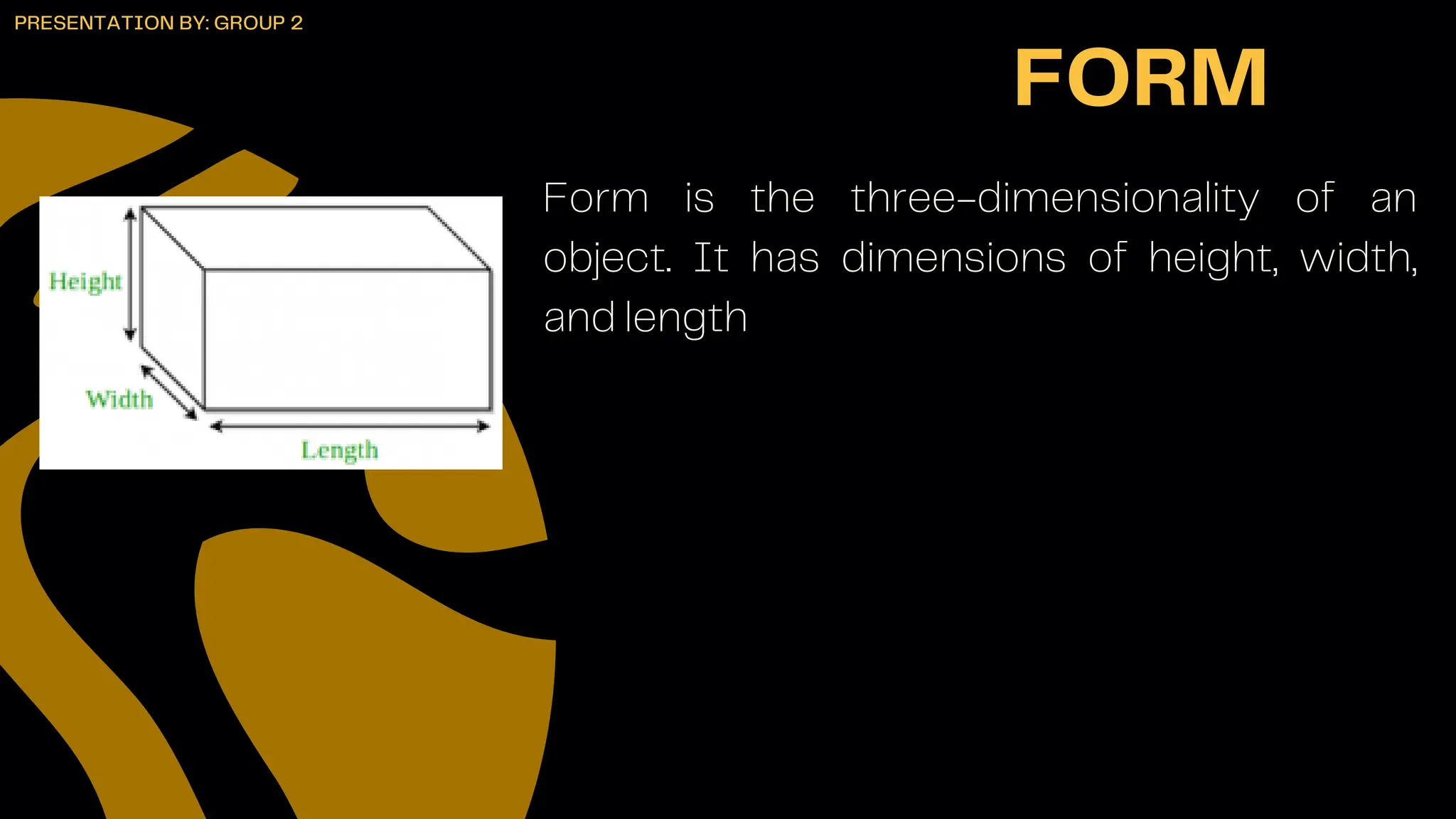
Form is the three-dimensionality of an
object. It has dimensions of height, width,
and length
FORM
PRESENTATION BY: GROUP 2
PRINCIPLES OF ART
•RHYTHM
•MOVEMENT
•BALANCE
•PROPORTION
•CONTRAST
•VARIETY
•EMPHASIS
•HARMONY
PRESENTATION BY: GROUP 2
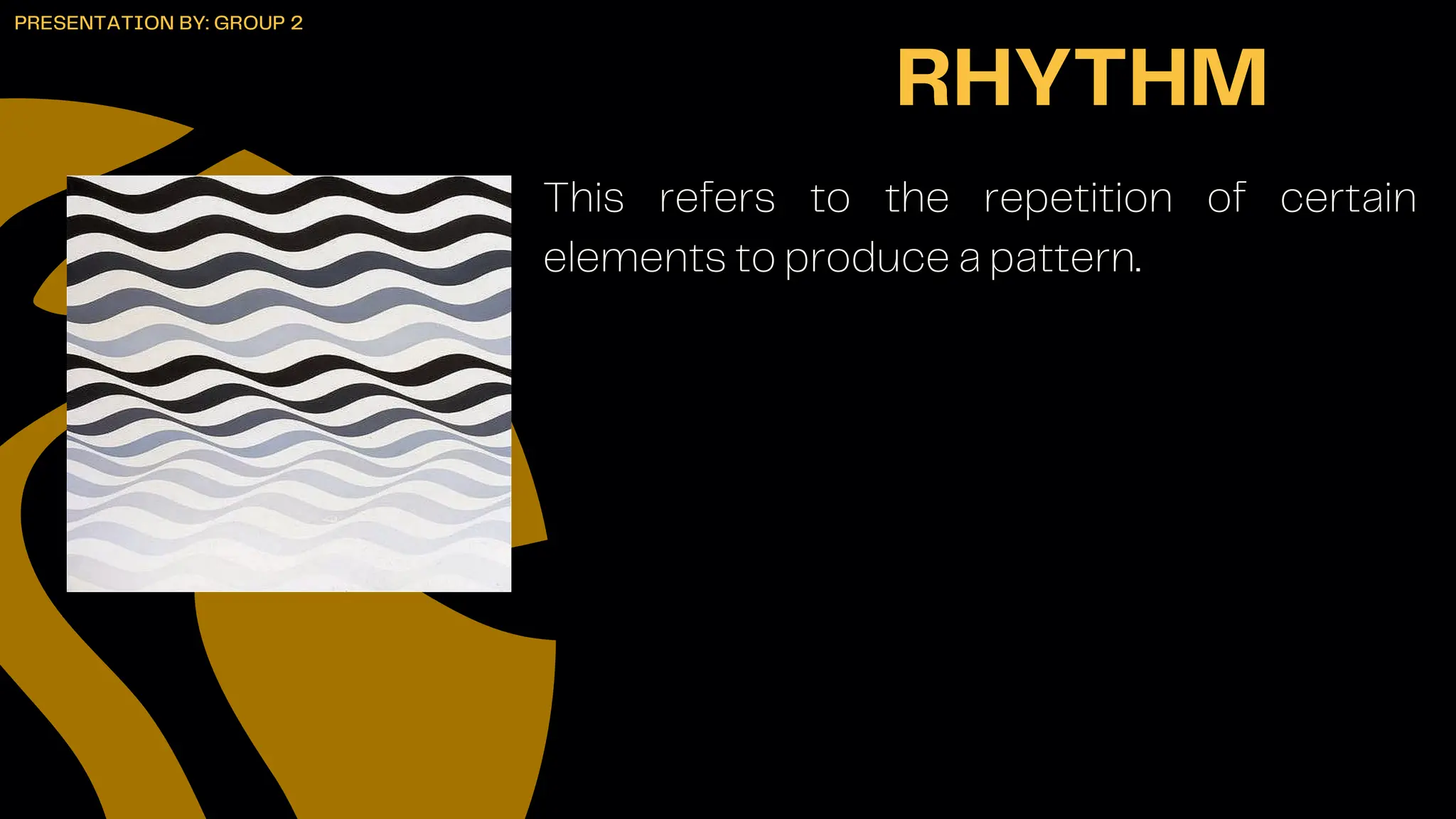
This refers to the repetition of certain
elements to produce a pattern.
RHYTHM
PRESENTATION BY: GROUP 2
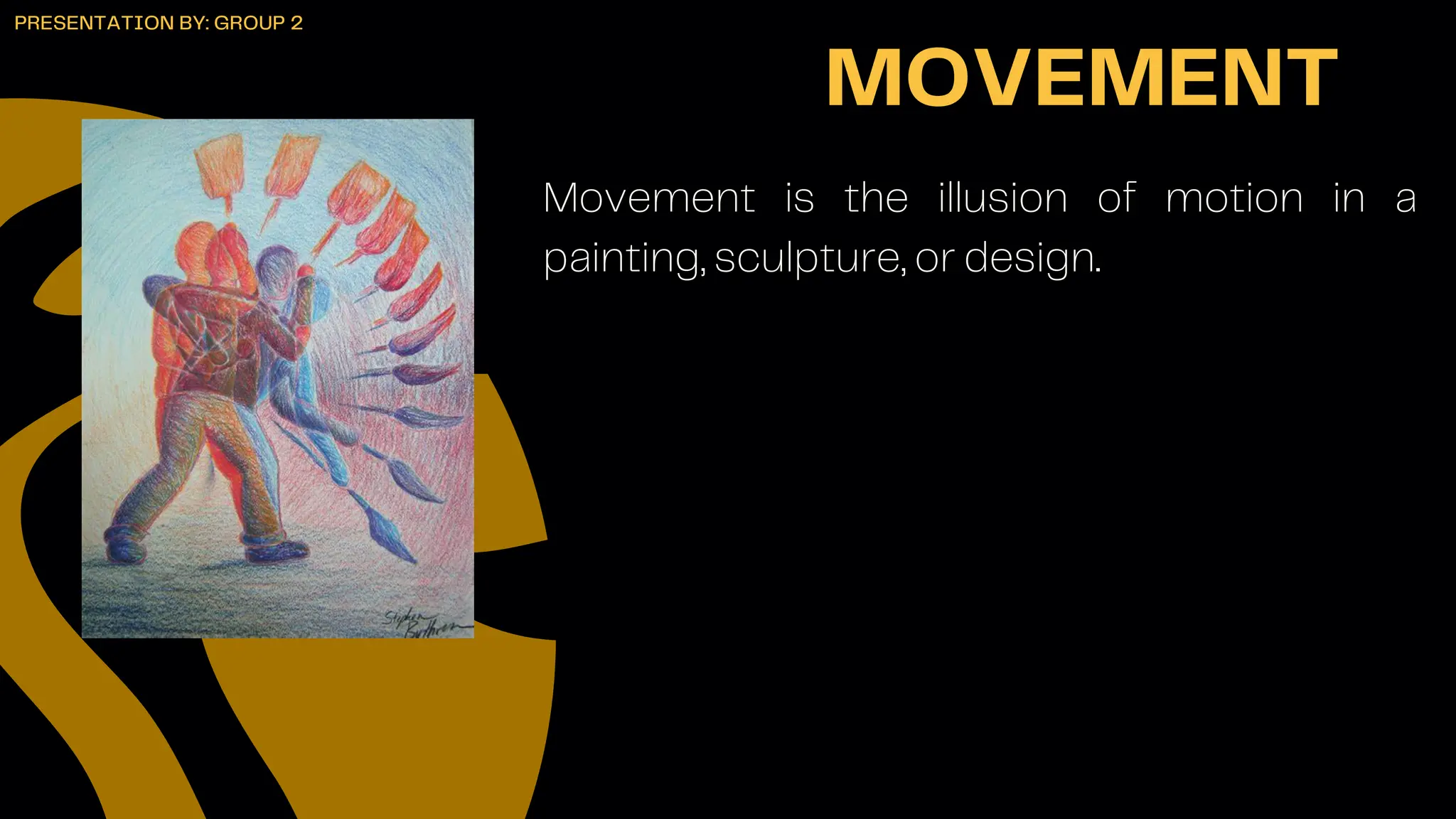
Movement is the illusion of motion in a
painting, sculpture, or design.
MOVEMENT
PRESENTATION BY: GROUP 2
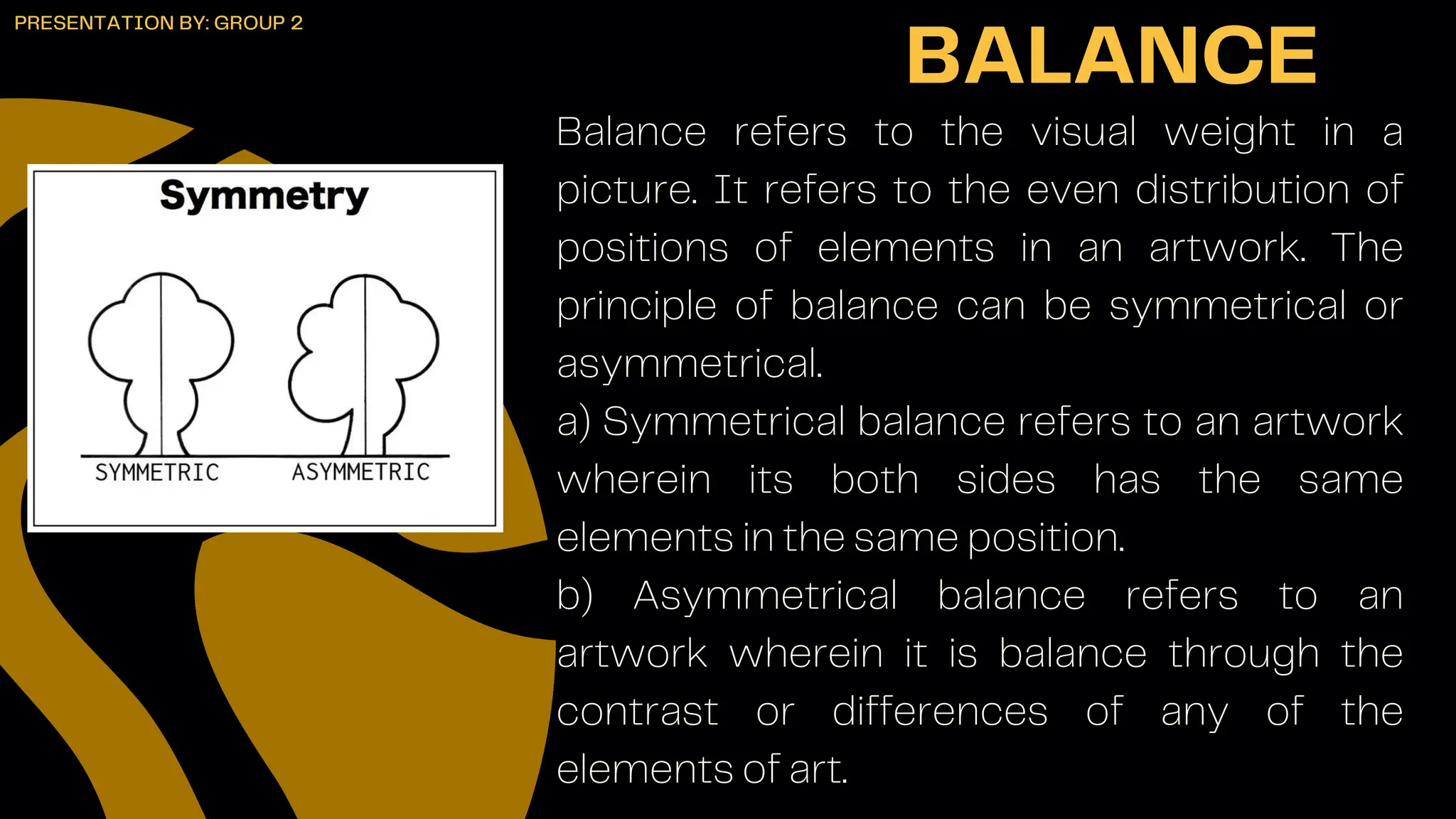
Balance refers to the visual weight in a
picture. It refers to the even distribution of
positions of elements in an artwork. The
principle of balance can be symmetrical or
asymmetrical.
a) Symmetrical balance refers to an artwork
wherein its both sides has the same
elements in the same position.
b) Asymmetrical balance refers to an
artwork wherein it is balance through the
contrast or differences of any of the
elements of art.
BALANCE
PRESENTATION BY: GROUP 2
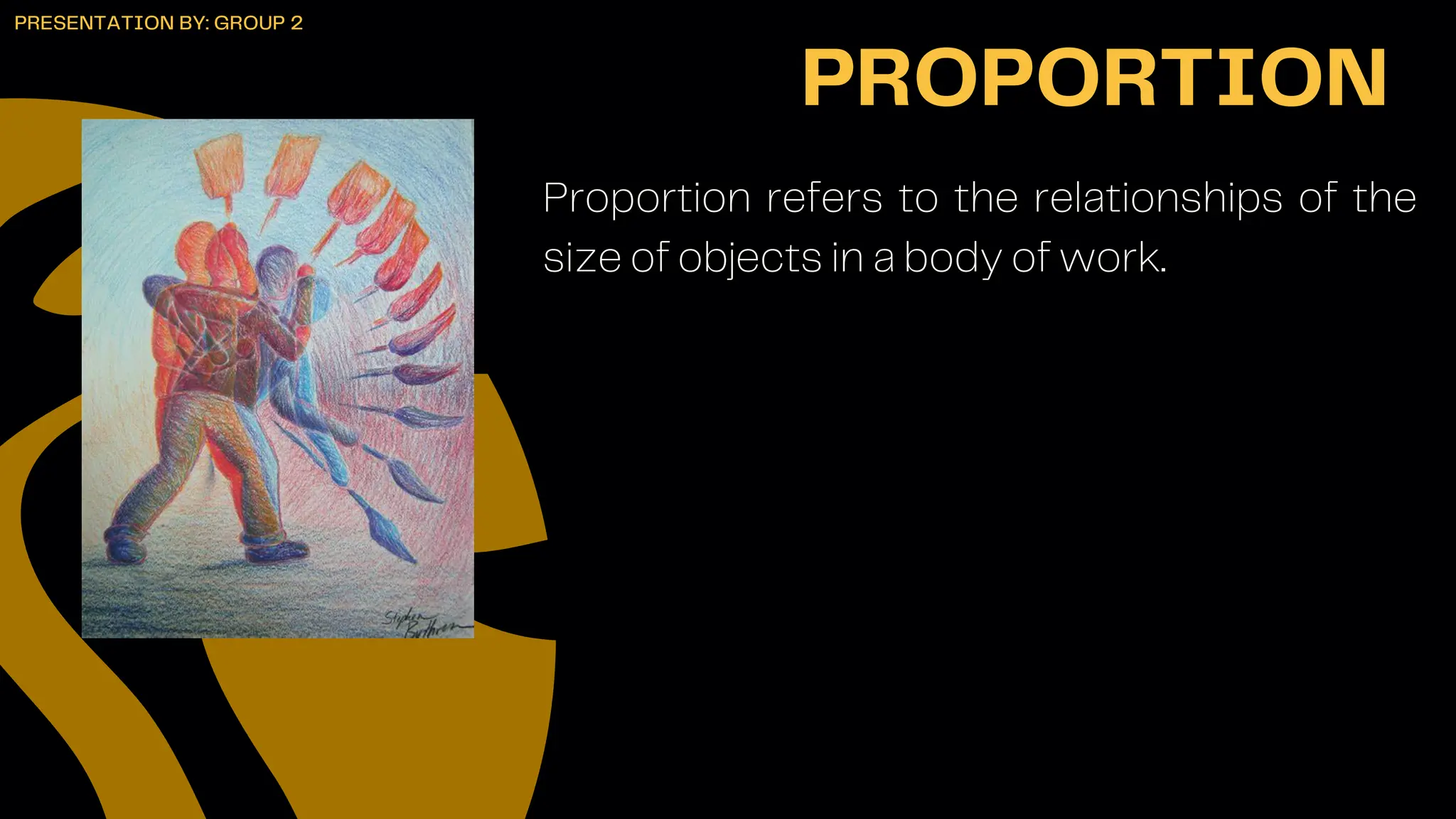
Proportion refers to the relationships of the
size of objects in a body of work.
PROPORTION
PRESENTATION BY: GROUP 2
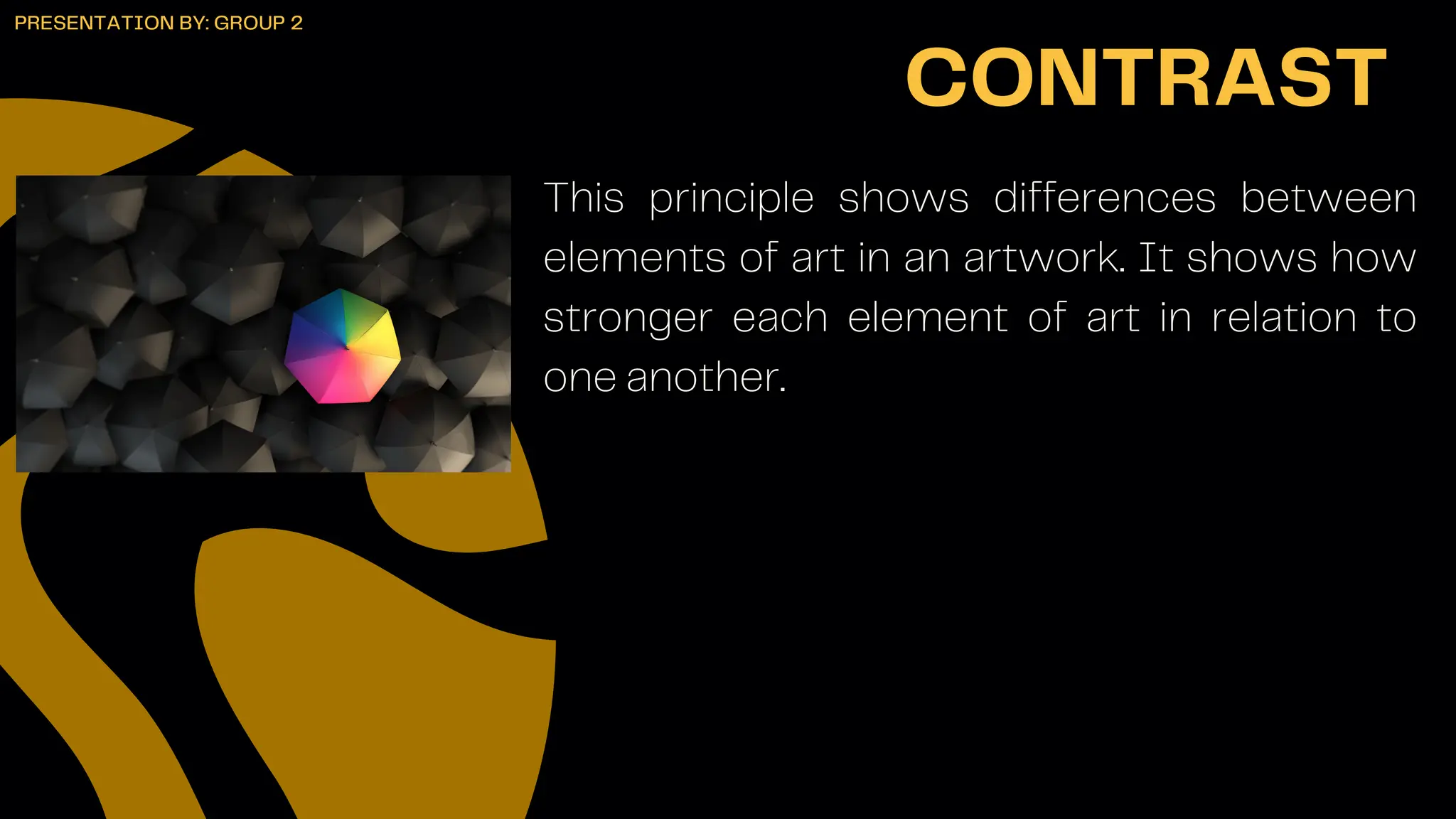
This principle shows differences between
elements of art in an artwork. It shows how
stronger each element of art in relation to
one another.
CONTRAST
PRESENTATION BY: GROUP 2
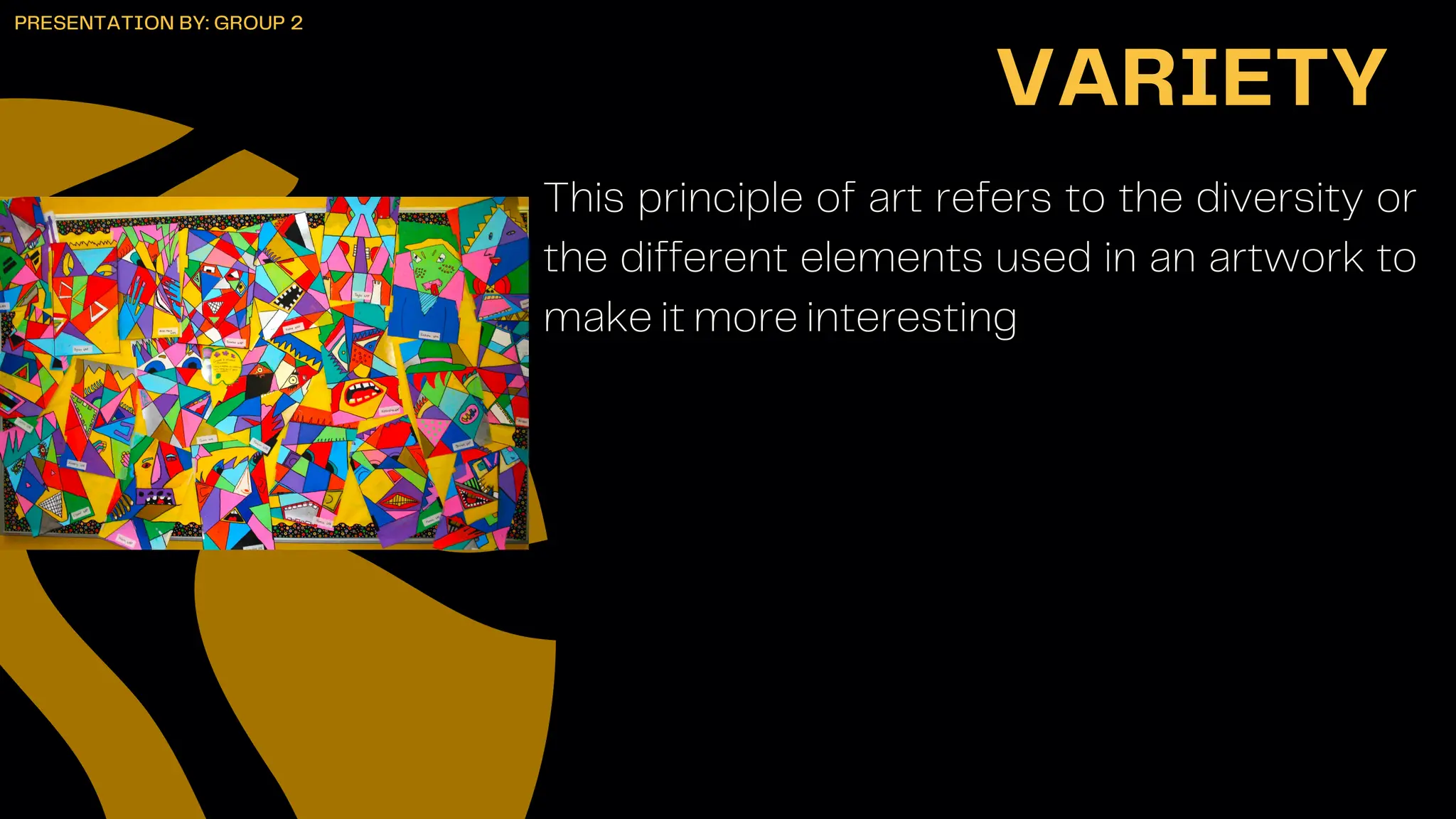
This principle of art refers to the diversity or
the different elements used in an artwork to
make it more interesting
VARIETY
PRESENTATION BY: GROUP 2
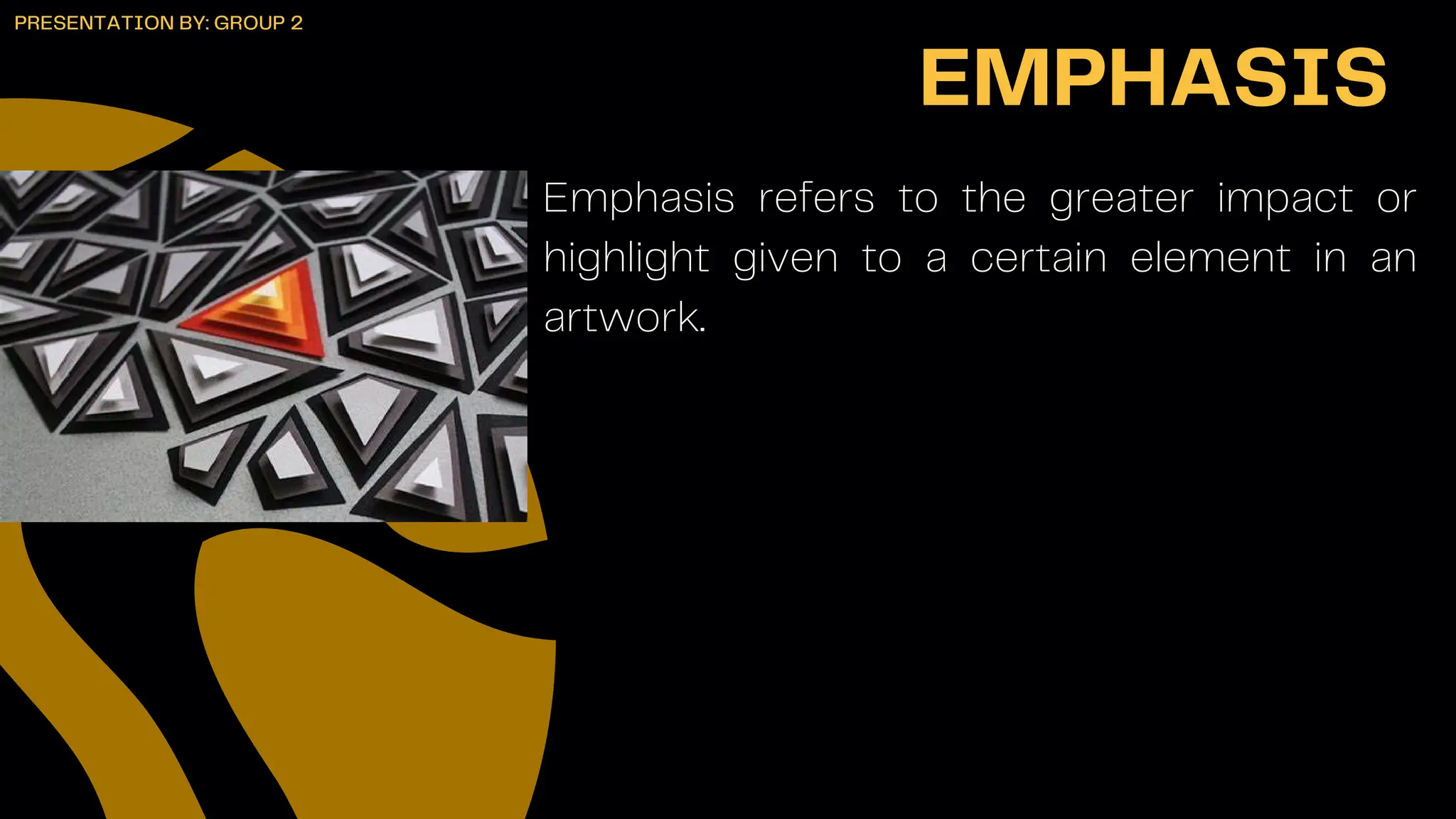
Emphasis refers to the greater impact or
highlight given to a certain element in an
artwork.
EMPHASIS
PRESENTATION BY: GROUP 2
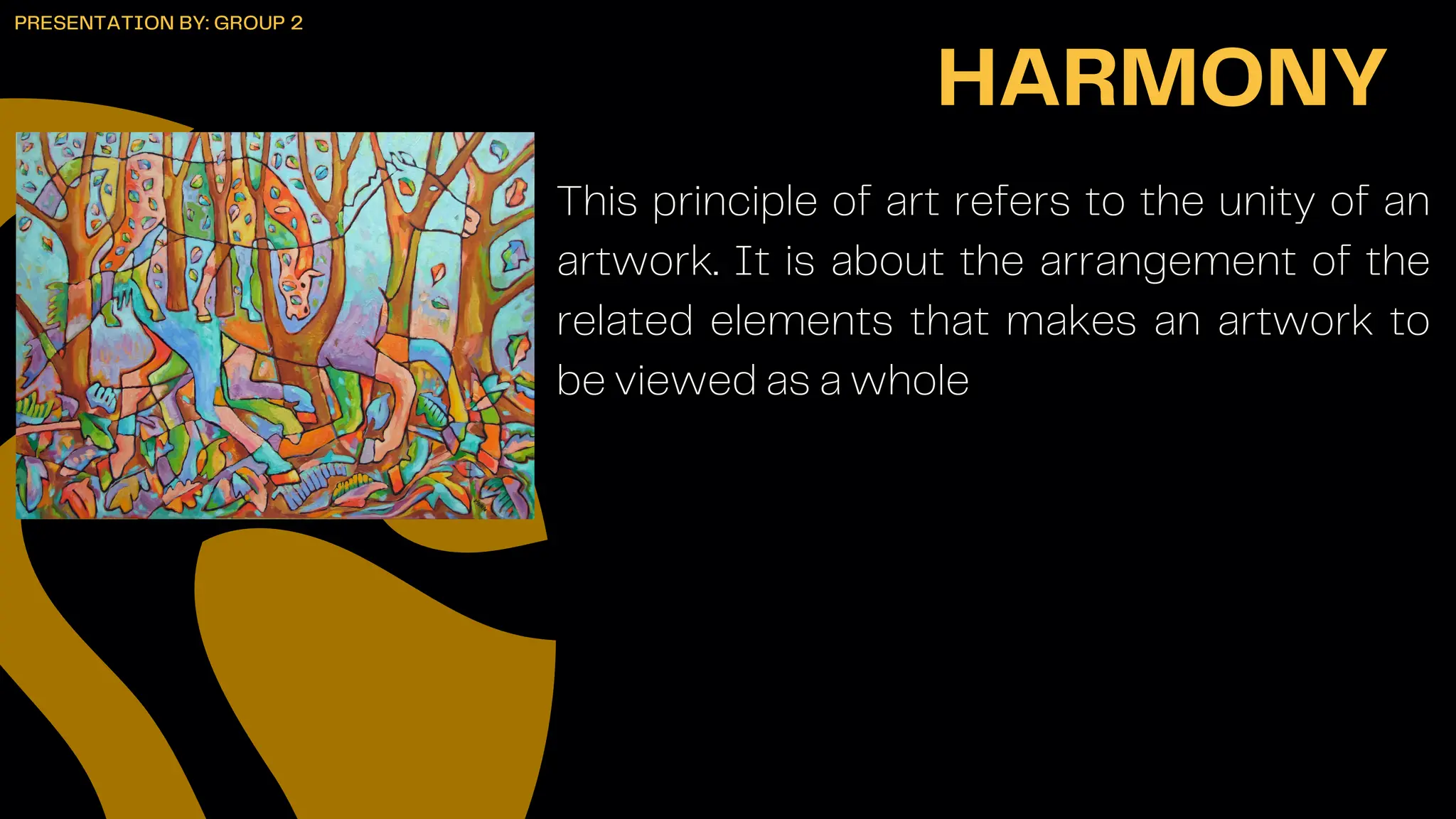
This principle of art refers to the unity of an
artwork. It is about the arrangement of the
related elements that makes an artwork to
be viewed as a whole
HARMONY
PRESENTATION BY: GROUP 2
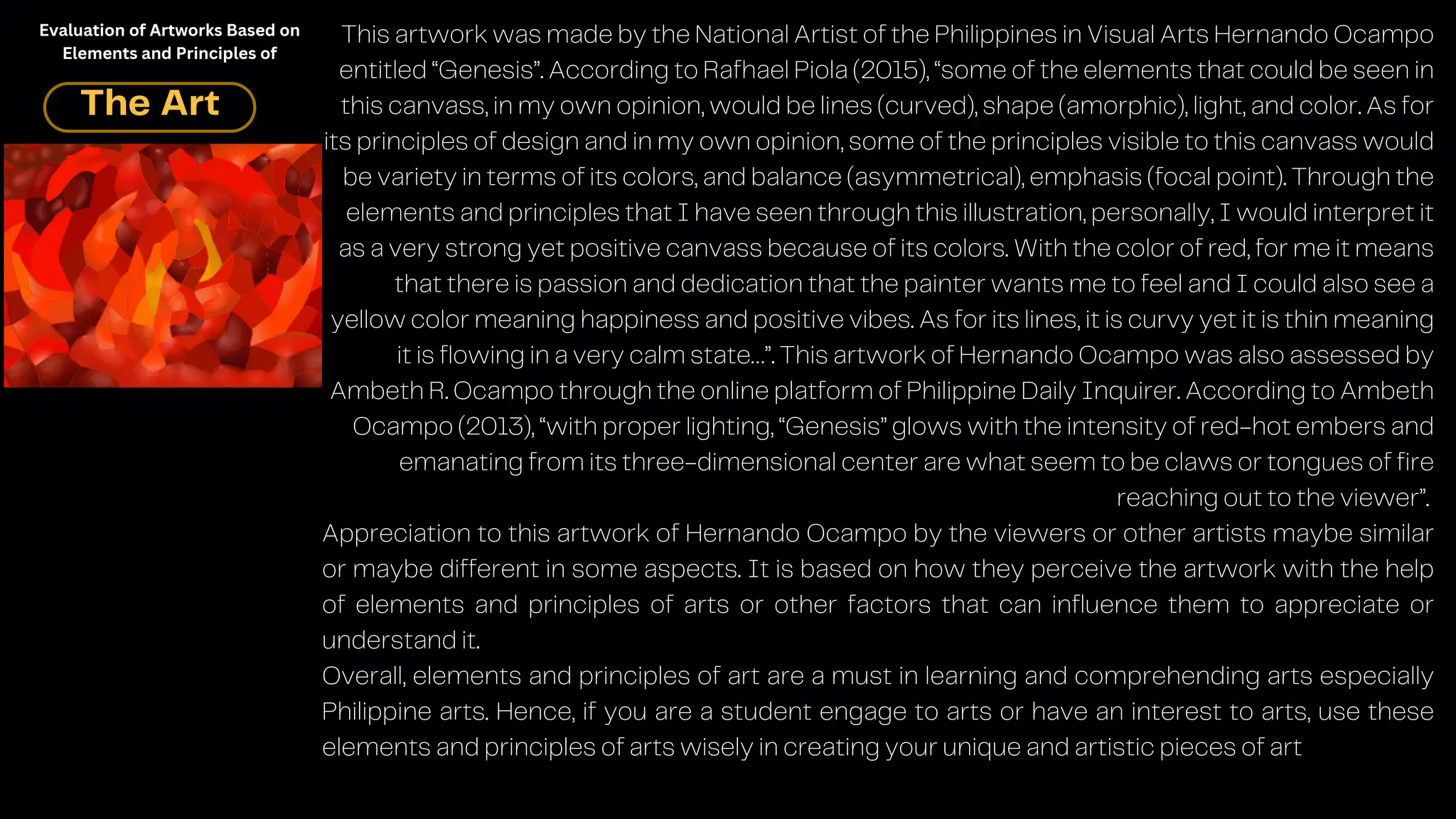
This artwork was made by the National Artist of the Philippines in Visual Arts Hernando Ocampo
entitled “Genesis”. According to Rafhael Piola (2015), “some of the elements that could be seen in
this canvass, in my own opinion, would be lines (curved), shape (amorphic), light, and color. As for
its principles of design and in my own opinion, some of the principles visible to this canvass would
be variety in terms of its colors, and balance (asymmetrical), emphasis (focal point). Through the
elements and principles that I have seen through this illustration, personally, I would interpret it
as a very strong yet positive canvass because of its colors. With the color of red, for me it means
that there is passion and dedication that the painter wants me to feel and I could also see a
yellow color meaning happiness and positive vibes. As for its lines, it is curvy yet it is thin meaning
it is flowing in a very calm state…”. This artwork of Hernando Ocampo was also assessed by
Ambeth R. Ocampo through the online platform of Philippine Daily Inquirer. According to Ambeth
Ocampo (2013), “with proper lighting, “Genesis” glows with the intensity of red-hot embers and
emanating from its three-dimensional center are what seem to be claws or tongues of fire
reaching out to the viewer”.
Appreciation to this artwork of Hernando Ocampo by the viewers or other artists maybe similar
or maybe different in some aspects. It is based on how they perceive the artwork with the help
of elements and principles of arts or other factors that can influence them to appreciate or
understand it.
Overall, elements and principles of art are a must in learning and comprehending arts especially
Philippine arts. Hence, if you are a student engage to arts or have an interest to arts, use these
elements and principles of arts wisely in creating your unique and artistic pieces of art
The Art
Evaluation of Artworks Based on
Elements and Principles of
These elements and principles are not rigid rules but rather tools that artists use to
create, communicate, and analyze art. They can be combined and manipulated in
countless ways to achieve different artistic effects and convey various messages or
emotions.
Conclusion
By: NATHANIEL
Thank
You

ELEMENTS AND PRINCIPLES OF ART

  • 1.
    Elements and Principles ofArt PRESENTATION BY: GROUP 2
  • 2.
    The elements andprinciples of art are fundamental concepts and components that artists use to create visual compositions and convey meaning in their work. These concepts serve as a foundation for understanding and analyzing art. Here's an overview of both: Elements and Principles of Art PRESENTATION BY: GROUP 2
  • 3.
  • 4.
    Lines are marksor paths that have length and direction. They can vary in thickness, length, and curvature, and they can be used to define shapes, create patterns, or imply movement.. LINE PRESENTATION BY: GROUP 2 a) Horizontal Line creates an impression of serenity and perfect stability. b) Vertical Line creates an impression of strength and perfect stability. c) Diagonal Line creates an impression of action. d) Curved Line creates an impression of gradual change of direction. e) Circular Line creates an impression of abrupt change of direction
  • 5.
    Shape is anarea that is enclosed by a line or lines. Shapes are two dimensional figures with height and width. There are different kinds of shapes and these are geometric shapes, organic shapes, positive shapes, negative shapes, static shapes, and dynamic shapes SHAPE PRESENTATION BY: GROUP 2 a) Geometric Shapes are circles, squares, rectangles, triangles, and other geometric shapes. b) Organic Shapes are shapes found in nature and are free flowing, informal and irregular (abstract shapes). c) Positive Shapes are the solid forms in a design. d) Negative Shapes are the space around the positive shape. e) Static Shapes are shapes that appears stable and resting. f) Dynamic Shapes are shapes that appears moving and active.
  • 6.
    a) Geometric Shapesare circles, squares, rectangles, triangles, and other geometric shapes. b) Organic Shapes are shapes found in nature and are free flowing, informal and irregular (abstract shapes). c) Positive Shapes are the solid forms in a design. d) Negative Shapes are the space around the positive shape. e) Static Shapes are shapes that appears stable and resting. f) Dynamic Shapes are shapes that appears moving and active. SHAPE PRESENTATION BY: GROUP 2
  • 7.
    Space refers todistances or areas around, between or within components of a piece and refers to the arrangement of objects on the picture plane (two- dimensional). In visual arts, space may either be positive space or negative space. Positive space refers to a part which is enclosed in a shape. Meanwhile, negative space refers to the opposite part which the shape is enclosing. Moreover, perspective is a technical means by which we perceive distance in painting, by which we are made to see the position of objects in space. SPACE PRESENTATION BY: GROUP 2
  • 8.
    Colors are theway we see light reflected from a surface or refracted through a prism. Colors we see in nature are reflections of light on the surfaces around us. We can classify colors into primary colors, secondary colors, tertiary colors, analogous Calligraphy 10 colors, complementary colors, monochromatic colors, warm colors, and cool colors. COLOR PRESENTATION BY: GROUP 2
  • 9.
    a) Primary colorsare red, blue, and yellow. b) Secondary colors are the resulting colors when the two of the primary colors are mix. The secondary colors are purple, green, and orange. c) Tertiary colors are the resulting colors when two of the primary and/or secondary colors are mix. The tertiary colors are amber, vermilion, magenta, violet, teal, and chartreuse. d) Analogous Colors are colors that lie nest to each other based on the color wheel. Example of analogous colors are yellow, orange, and red. e) Complementary colors are colors that are opposite to each other based on the color wheel. Examples of complementary colors are red and green, blue and orange, and purple and yellow. f) Monochromatic Colors are several values of one color. g) Warm colors are colors that give the feeling of warmth. The warm colors are yellow, amber, orange, vermilion, red, and magenta. h) Cool colors are colors that give the feeling of coolness. The cool colors are purple, violet, blue, teal, green, and chartreuse. COLOR PRESENTATION BY: GROUP 2
  • 10.
    Texture is theelement that appeals to our sense of feel on things rough or smooth, bumpy or slippery. It is the character of the surface of an artwork. TEXTURE PRESENTATION BY: GROUP 2
  • 11.
    Value pertains tothe lightness or darkness of a color in a given artwork. Value can be changed by adding white or black to a color and these described as tint and shade. a) Tint pertains to the lightness of a color. b) Shade pertains to the darkness of a color VALUE PRESENTATION BY: GROUP 2
  • 12.
    Form is thethree-dimensionality of an object. It has dimensions of height, width, and length FORM PRESENTATION BY: GROUP 2
  • 13.
  • 14.
    This refers tothe repetition of certain elements to produce a pattern. RHYTHM PRESENTATION BY: GROUP 2
  • 15.
    Movement is theillusion of motion in a painting, sculpture, or design. MOVEMENT PRESENTATION BY: GROUP 2
  • 16.
    Balance refers tothe visual weight in a picture. It refers to the even distribution of positions of elements in an artwork. The principle of balance can be symmetrical or asymmetrical. a) Symmetrical balance refers to an artwork wherein its both sides has the same elements in the same position. b) Asymmetrical balance refers to an artwork wherein it is balance through the contrast or differences of any of the elements of art. BALANCE PRESENTATION BY: GROUP 2
  • 17.
    Proportion refers tothe relationships of the size of objects in a body of work. PROPORTION PRESENTATION BY: GROUP 2
  • 18.
    This principle showsdifferences between elements of art in an artwork. It shows how stronger each element of art in relation to one another. CONTRAST PRESENTATION BY: GROUP 2
  • 19.
    This principle ofart refers to the diversity or the different elements used in an artwork to make it more interesting VARIETY PRESENTATION BY: GROUP 2
  • 20.
    Emphasis refers tothe greater impact or highlight given to a certain element in an artwork. EMPHASIS PRESENTATION BY: GROUP 2
  • 21.
    This principle ofart refers to the unity of an artwork. It is about the arrangement of the related elements that makes an artwork to be viewed as a whole HARMONY PRESENTATION BY: GROUP 2
  • 22.
    This artwork wasmade by the National Artist of the Philippines in Visual Arts Hernando Ocampo entitled “Genesis”. According to Rafhael Piola (2015), “some of the elements that could be seen in this canvass, in my own opinion, would be lines (curved), shape (amorphic), light, and color. As for its principles of design and in my own opinion, some of the principles visible to this canvass would be variety in terms of its colors, and balance (asymmetrical), emphasis (focal point). Through the elements and principles that I have seen through this illustration, personally, I would interpret it as a very strong yet positive canvass because of its colors. With the color of red, for me it means that there is passion and dedication that the painter wants me to feel and I could also see a yellow color meaning happiness and positive vibes. As for its lines, it is curvy yet it is thin meaning it is flowing in a very calm state…”. This artwork of Hernando Ocampo was also assessed by Ambeth R. Ocampo through the online platform of Philippine Daily Inquirer. According to Ambeth Ocampo (2013), “with proper lighting, “Genesis” glows with the intensity of red-hot embers and emanating from its three-dimensional center are what seem to be claws or tongues of fire reaching out to the viewer”. Appreciation to this artwork of Hernando Ocampo by the viewers or other artists maybe similar or maybe different in some aspects. It is based on how they perceive the artwork with the help of elements and principles of arts or other factors that can influence them to appreciate or understand it. Overall, elements and principles of art are a must in learning and comprehending arts especially Philippine arts. Hence, if you are a student engage to arts or have an interest to arts, use these elements and principles of arts wisely in creating your unique and artistic pieces of art The Art Evaluation of Artworks Based on Elements and Principles of
  • 23.
    These elements andprinciples are not rigid rules but rather tools that artists use to create, communicate, and analyze art. They can be combined and manipulated in countless ways to achieve different artistic effects and convey various messages or emotions. Conclusion By: NATHANIEL
  • 24.