Identification vs.
  Description &
 ART ELEMENTS
 ART ELEMENTS
Identification
 Identification is the capability to
  find, retrieve or report specific
  data.
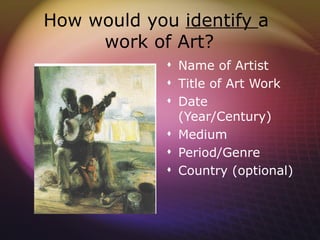
How would you identify a
     work of Art?
              Name of Artist
              Title of Art Work
              Date
               (Year/Century)
              Medium
              Period/Genre
              Country (optional)
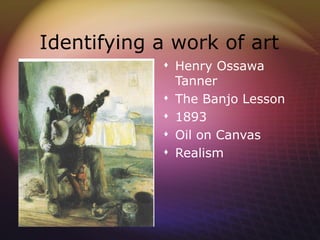
Identifying a work of art
             Henry Ossawa
              Tanner
             The Banjo Lesson
             1893
             Oil on Canvas
             Realism
Description
 A description seeks to provide a
  definition of something, such as what
  it looks like, sounds like or feels like.
 The product of thought bounded by
  context, similarities, differences and
  interpretation.
How do you describe
         a work of art?
 Use the vocabulary developed by the
  Ancient Roman Architect, Vitruvius.
 Elements of Art
 Principles of Design
Elements of Art
 The Elements of Art are the building
  blocks for a work of art.
 Artists use the elements in planned
  and organized ways.
 They are organized according to the
  Principles of Design.
Elements of Art
   Color
   Line
   Shape
   Form
   Value
   Texture
   Space
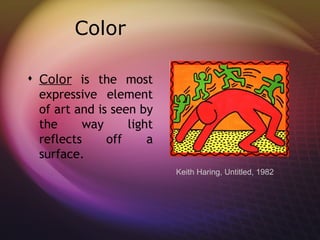
Color

 Color is the most
  expressive element
  of art and is seen by
  the     way      light
  reflects     off     a
  surface. 
                           Keith Haring, Untitled, 1982
Three Properties of Color
 All colors possess three basic qualities.
 Hue is another word for color and it is basically the
  color pigment present.
 Value involves the lightness and darkness of a color.
  A color is made lighter by adding white and darker
  by adding black. Each color also has natural value.
  From lightest to darkest are: Yellow, Orange, Red
  and Green, Blue and Violet.
 Intensity is the brightness or dullness of a color. A
  color can't be made brighter than the way the
  pigment comes to you in the paint tube.
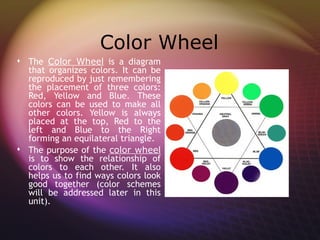
Color Wheel
 The Color Wheel is a diagram
  that organizes colors. It can be
  reproduced by just remembering
  the placement of three colors:
  Red, Yellow and Blue. These
  colors can be used to make all
  other colors. Yellow is always
  placed at the top, Red to the
  left and Blue to the Right
  forming an equilateral triangle.
 The purpose of the color wheel
  is to show the relationship of
  colors to each other. It also
  helps us to find ways colors look
  good together (color schemes
  will be addressed later in this
  unit).
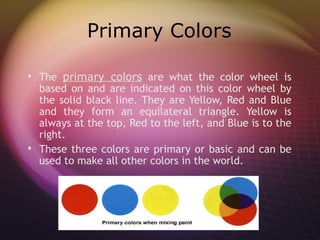
Primary Colors

 The primary colors are what the color wheel is
  based on and are indicated on this color wheel by
  the solid black line. They are Yellow, Red and Blue
  and they form an equilateral triangle. Yellow is
  always at the top, Red to the left, and Blue is to the
  right.
 These three colors are primary or basic and can be
  used to make all other colors in the world.
Secondary Colors

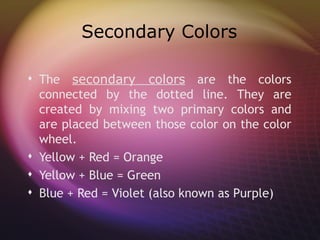
 The secondary colors are the colors
  connected by the dotted line. They are
  created by mixing two primary colors and
  are placed between those color on the color
  wheel.
 Yellow + Red = Orange
 Yellow + Blue = Green
 Blue + Red = Violet (also known as Purple)
Intermediate Colors

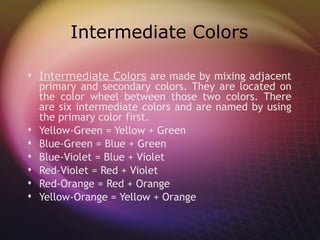
 Intermediate Colors are made by mixing adjacent
  primary and secondary colors. They are located on
  the color wheel between those two colors. There
  are six intermediate colors and are named by using
  the primary color first.
 Yellow-Green = Yellow + Green
 Blue-Green = Blue + Green
 Blue-Violet = Blue + Violet
 Red-Violet = Red + Violet
 Red-Orange = Red + Orange
 Yellow-Orange = Yellow + Orange
w
                   s

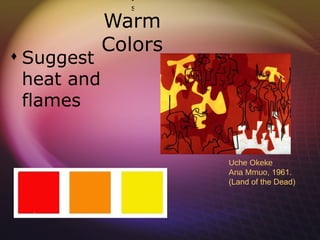
             Warm


             Colors
 Suggest
                
  heat and      
                
  flames        


                       Uche Okeke
                
                       Ana Mmuo, 1961.
                
                       (Land of the Dead)


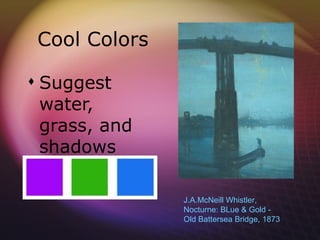
Cool Colors

 Suggest
  water,
  grass, and
  shadows

               J.A.McNeill Whistler,
               Nocturne: BLue & Gold -
               Old Battersea Bridge, 1873
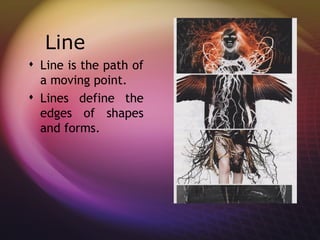
Line
 Line is the path of
  a moving point.
 Lines define the
  edges of shapes
  and forms.  
Three Basic Properties of
            Line
 Direction

 Measure

 Character
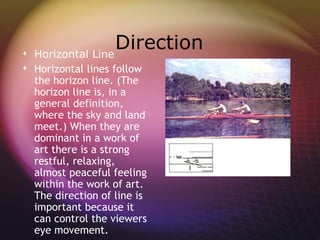
 Horizontal Line
                  Direction
 Horizontal lines follow
  the horizon line. (The
  horizon line is, in a
  general definition,
  where the sky and land
  meet.) When they are
  dominant in a work of
  art there is a strong
  restful, relaxing,
  almost peaceful feeling
  within the work of art.
  The direction of line is
  important because it
  can control the viewers
  eye movement.
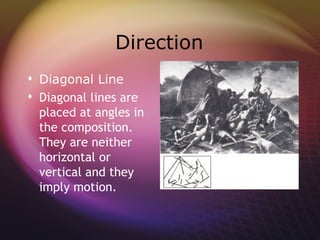
Direction
 Diagonal Line
 Diagonal lines are
  placed at angles in
  the composition.
  They are neither
  horizontal or
  vertical and they
  imply motion.
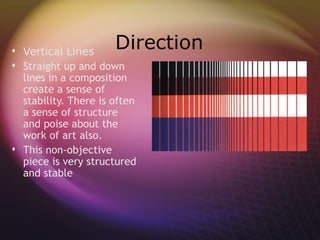
 Vertical Lines
                      Direction
 Straight up and down
  lines in a composition
  create a sense of
  stability. There is often
  a sense of structure
  and poise about the
  work of art also.
 This non-objective
  piece is very structured
  and stable
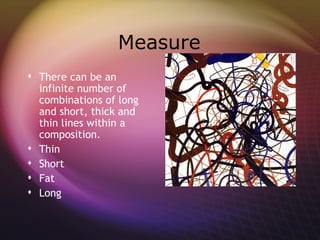
Measure
 There can be an
  infinite number of
  combinations of long
  and short, thick and
  thin lines within a
  composition.
 Thin
 Short
 Fat
 Long

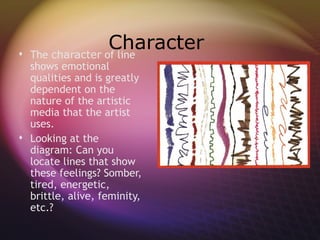
                   Character
    The character of line
  shows emotional
  qualities and is greatly
  dependent on the
  nature of the artistic
  media that the artist
  uses.
 Looking at the
  diagram: Can you
  locate lines that show
  these feelings? Somber,
  tired, energetic,
  brittle, alive, feminity,
  etc.?
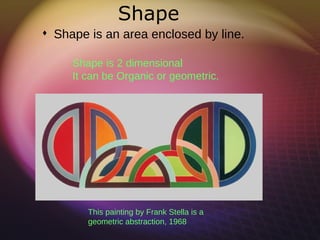
Shape
 Shape is an area enclosed by line.

     Shape is 2 dimensional
     It can be Organic or geometric.


        This painting by Frank Stella is a
        geometric abstraction, 1968
Geometric vs. Organic
                Shapes
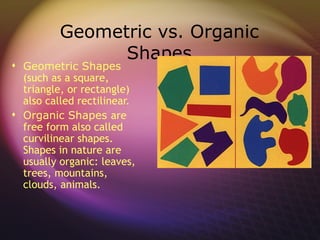
 Geometric Shapes
  (such as a square,
  triangle, or rectangle)
  also called rectilinear.
 Organic Shapes are
  free form also called
  curvilinear shapes.
  Shapes in nature are
  usually organic: leaves,
  trees, mountains,
  clouds, animals.
Shape
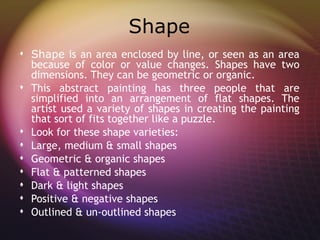
 Shape is an area enclosed by line, or seen as an area
  because of color or value changes. Shapes have two
  dimensions. They can be geometric or organic.
 This abstract painting has three people that are
  simplified into an arrangement of flat shapes. The
  artist used a variety of shapes in creating the painting
  that sort of fits together like a puzzle.
 Look for these shape varieties:
 Large, medium & small shapes
 Geometric & organic shapes
 Flat & patterned shapes
 Dark & light shapes
 Positive & negative shapes
 Outlined & un-outlined shapes
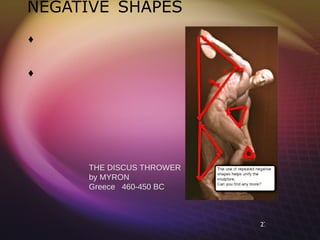
NEGATIVE SHAPES






     THE DISCUS THROWER
     by MYRON
     Greece 460-450 BC


                          27
Form
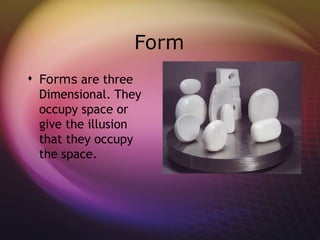
 Forms are three
  Dimensional. They
  occupy space or
  give the illusion
  that they occupy
  the space.
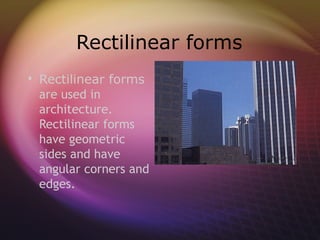
Rectilinear forms
 Rectilinear forms
  are used in
  architecture.
  Rectilinear forms
  have geometric
  sides and have
  angular corners and
  edges.
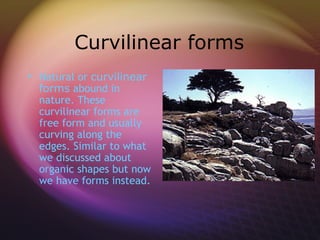
Curvilinear forms
 Natural or curvilinear
  forms abound in
  nature. These
  curvilinear forms are
  free form and usually
  curving along the
  edges. Similar to what
  we discussed about
  organic shapes but now
  we have forms instead.
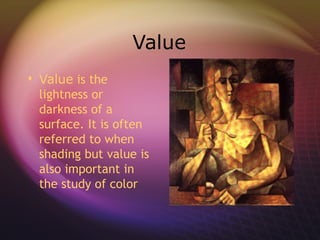
Value
 Value is the
  lightness or
  darkness of a
  surface. It is often
  referred to when
  shading but value is
  also important in
  the study of color
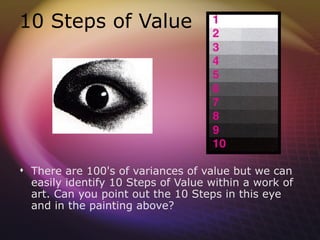
10 Steps of Value


 There are 100's of variances of value but we can
   easily identify 10 Steps of Value within a work of
   art. Can you point out the 10 Steps in this eye
   and in the painting above?
  
Texture
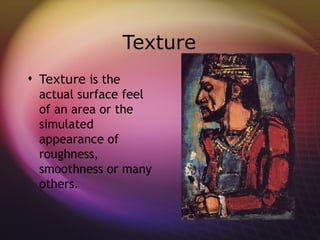
 Texture is the
  actual surface feel
  of an area or the
  simulated
  appearance of
  roughness,
  smoothness or many
  others.
Textural Painting
         Techniques
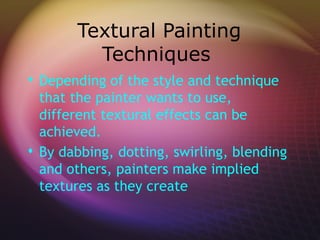
 Depending of the style and technique
  that the painter wants to use,
  different textural effects can be
  achieved.
 By dabbing, dotting, swirling, blending
  and others, painters make implied
  textures as they create
Space
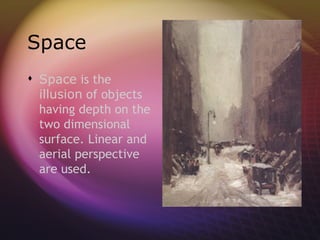
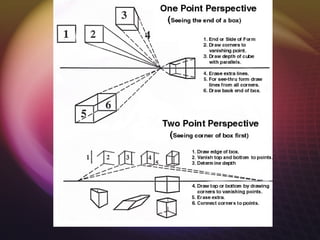
 Space is the
  illusion of objects
  having depth on the
  two dimensional
  surface. Linear and
  aerial perspective
  are used.
Linear Perspective
 Linear perspective was devised by the
  Renaissance artists to show depth to
  help accurately to draw buildings, both
  exterior and interior, and other box
  like forms.
this is the end of the
 introduction to the
     Art Elements
     Art Elements
LET’S MAKE ART!


                         38
39

ART ELEMENTS

  • 1.
    Identification vs. Description & ART ELEMENTS ART ELEMENTS
  • 2.
    Identification  Identification isthe capability to find, retrieve or report specific data.
  • 3.
    How would youidentify a work of Art?  Name of Artist  Title of Art Work  Date (Year/Century)  Medium  Period/Genre  Country (optional)
  • 4.
    Identifying a workof art  Henry Ossawa Tanner  The Banjo Lesson  1893  Oil on Canvas  Realism
  • 5.
    Description  A descriptionseeks to provide a definition of something, such as what it looks like, sounds like or feels like.  The product of thought bounded by context, similarities, differences and interpretation.
  • 6.
    How do youdescribe a work of art?  Use the vocabulary developed by the Ancient Roman Architect, Vitruvius.  Elements of Art  Principles of Design
  • 7.
    Elements of Art The Elements of Art are the building blocks for a work of art.  Artists use the elements in planned and organized ways.  They are organized according to the Principles of Design.
  • 8.
    Elements of Art  Color  Line  Shape  Form  Value  Texture  Space
  • 9.
    Color  Color isthe most expressive element of art and is seen by the way light reflects off a surface.  Keith Haring, Untitled, 1982
  • 10.
    Three Properties ofColor  All colors possess three basic qualities.  Hue is another word for color and it is basically the color pigment present.  Value involves the lightness and darkness of a color. A color is made lighter by adding white and darker by adding black. Each color also has natural value. From lightest to darkest are: Yellow, Orange, Red and Green, Blue and Violet.  Intensity is the brightness or dullness of a color. A color can't be made brighter than the way the pigment comes to you in the paint tube.
  • 11.
    Color Wheel  TheColor Wheel is a diagram that organizes colors. It can be reproduced by just remembering the placement of three colors: Red, Yellow and Blue. These colors can be used to make all other colors. Yellow is always placed at the top, Red to the left and Blue to the Right forming an equilateral triangle.  The purpose of the color wheel is to show the relationship of colors to each other. It also helps us to find ways colors look good together (color schemes will be addressed later in this unit).
  • 12.
    Primary Colors  Theprimary colors are what the color wheel is based on and are indicated on this color wheel by the solid black line. They are Yellow, Red and Blue and they form an equilateral triangle. Yellow is always at the top, Red to the left, and Blue is to the right.  These three colors are primary or basic and can be used to make all other colors in the world.
  • 13.
    Secondary Colors  Thesecondary colors are the colors connected by the dotted line. They are created by mixing two primary colors and are placed between those color on the color wheel.  Yellow + Red = Orange  Yellow + Blue = Green  Blue + Red = Violet (also known as Purple)
  • 14.
    Intermediate Colors  IntermediateColors are made by mixing adjacent primary and secondary colors. They are located on the color wheel between those two colors. There are six intermediate colors and are named by using the primary color first.  Yellow-Green = Yellow + Green  Blue-Green = Blue + Green  Blue-Violet = Blue + Violet  Red-Violet = Red + Violet  Red-Orange = Red + Orange  Yellow-Orange = Yellow + Orange
  • 15.
    w s Warm     Colors  Suggest   heat and     flames               Uche Okeke   Ana Mmuo, 1961.   (Land of the Dead)            
  • 16.
    Cool Colors  Suggest water, grass, and shadows J.A.McNeill Whistler, Nocturne: BLue & Gold - Old Battersea Bridge, 1873
  • 17.
    Line  Line isthe path of a moving point.  Lines define the edges of shapes and forms.  
  • 18.
    Three Basic Propertiesof Line  Direction  Measure  Character
  • 19.
     Horizontal Line Direction  Horizontal lines follow the horizon line. (The horizon line is, in a general definition, where the sky and land meet.) When they are dominant in a work of art there is a strong restful, relaxing, almost peaceful feeling within the work of art. The direction of line is important because it can control the viewers eye movement.
  • 20.
    Direction  Diagonal Line Diagonal lines are placed at angles in the composition. They are neither horizontal or vertical and they imply motion.
  • 21.
     Vertical Lines Direction  Straight up and down lines in a composition create a sense of stability. There is often a sense of structure and poise about the work of art also.  This non-objective piece is very structured and stable
  • 22.
    Measure  There canbe an infinite number of combinations of long and short, thick and thin lines within a composition.  Thin  Short  Fat  Long
  • 23.
    Character The character of line shows emotional qualities and is greatly dependent on the nature of the artistic media that the artist uses.  Looking at the diagram: Can you locate lines that show these feelings? Somber, tired, energetic, brittle, alive, feminity, etc.?
  • 24.
    Shape  Shape isan area enclosed by line. Shape is 2 dimensional It can be Organic or geometric. This painting by Frank Stella is a geometric abstraction, 1968
  • 25.
    Geometric vs. Organic Shapes  Geometric Shapes (such as a square, triangle, or rectangle) also called rectilinear.  Organic Shapes are free form also called curvilinear shapes. Shapes in nature are usually organic: leaves, trees, mountains, clouds, animals.
  • 26.
    Shape  Shape isan area enclosed by line, or seen as an area because of color or value changes. Shapes have two dimensions. They can be geometric or organic.  This abstract painting has three people that are simplified into an arrangement of flat shapes. The artist used a variety of shapes in creating the painting that sort of fits together like a puzzle.  Look for these shape varieties:  Large, medium & small shapes  Geometric & organic shapes  Flat & patterned shapes  Dark & light shapes  Positive & negative shapes  Outlined & un-outlined shapes
  • 27.
    NEGATIVE SHAPES   THE DISCUS THROWER by MYRON Greece 460-450 BC 27
  • 28.
    Form  Forms arethree Dimensional. They occupy space or give the illusion that they occupy the space.
  • 29.
    Rectilinear forms  Rectilinearforms are used in architecture. Rectilinear forms have geometric sides and have angular corners and edges.
  • 30.
    Curvilinear forms  Naturalor curvilinear forms abound in nature. These curvilinear forms are free form and usually curving along the edges. Similar to what we discussed about organic shapes but now we have forms instead.
  • 31.
    Value  Value isthe lightness or darkness of a surface. It is often referred to when shading but value is also important in the study of color
  • 32.
    10 Steps ofValue  There are 100's of variances of value but we can easily identify 10 Steps of Value within a work of art. Can you point out the 10 Steps in this eye and in the painting above?   
  • 33.
    Texture  Texture isthe actual surface feel of an area or the simulated appearance of roughness, smoothness or many others.
  • 34.
    Textural Painting Techniques  Depending of the style and technique that the painter wants to use, different textural effects can be achieved.  By dabbing, dotting, swirling, blending and others, painters make implied textures as they create
  • 35.
    Space  Space isthe illusion of objects having depth on the two dimensional surface. Linear and aerial perspective are used.
  • 36.
    Linear Perspective  Linearperspective was devised by the Renaissance artists to show depth to help accurately to draw buildings, both exterior and interior, and other box like forms.
  • 38.
    this is theend of the introduction to the Art Elements Art Elements LET’S MAKE ART! 38
  • 39.