Compositional Theories of Art

     Composition: An orderly
arrangement of elements using the
       principles of design.
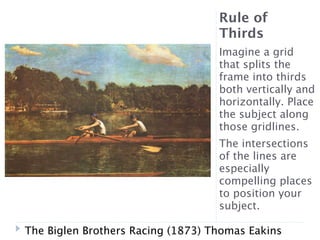
Rule of
                                   Thirds
                                   Imagine a grid
                                   that splits the
                                   frame into thirds
                                   both vertically and
                                   horizontally. Place
                                   the subject along
                                   those gridlines.
                                   The intersections
                                   of the lines are
                                   especially
                                   compelling places
                                   to position your
                                   subject.

The Biglen Brothers Racing (1873) Thomas Eakins
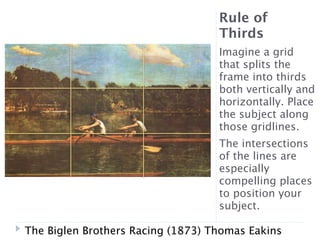
Rule of
                                   Thirds
                                   Imagine a grid
                                   that splits the
                                   frame into thirds
                                   both vertically and
                                   horizontally. Place
                                   the subject along
                                   those gridlines.
                                   The intersections
                                   of the lines are
                                   especially
                                   compelling places
                                   to position your
                                   subject.

The Biglen Brothers Racing (1873) Thomas Eakins
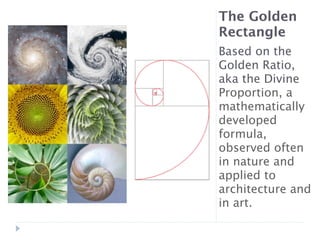
The Golden
Rectangle
Based on the
Golden Ratio,
aka the Divine
Proportion, a
mathematically
developed
formula,
observed often
in nature and
applied to
architecture and
in art.
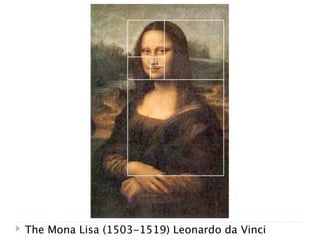
The Mona Lisa (1503-1519) Leonardo da Vinci
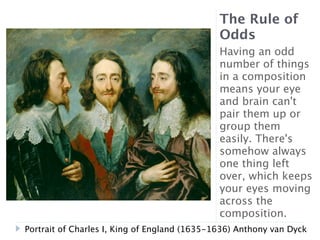
The Rule of
                                              Odds
                                              Having an odd
                                              number of things
                                              in a composition
                                              means your eye
                                              and brain can't
                                              pair them up or
                                              group them
                                              easily. There's
                                              somehow always
                                              one thing left
                                              over, which keeps
                                              your eyes moving
                                              across the
                                              composition.
Portrait of Charles I, King of England (1635-1636) Anthony van Dyck
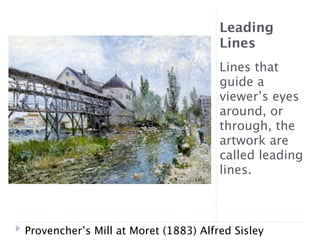
Leading
                                      Lines
                                      Lines that
                                      guide a
                                      viewer’s eyes
                                      around, or
                                      through, the
                                      artwork are
                                      called leading
                                      lines.


Provencher’s Mill at Moret (1883) Alfred Sisley
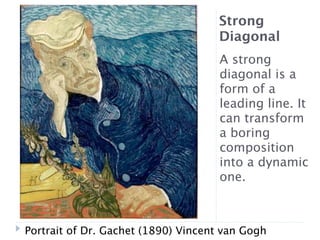
Strong
                                    Diagonal
                                     A strong
                                     diagonal is a
                                     form of a
                                     leading line. It
                                     can transform
                                     a boring
                                     composition
                                     into a dynamic
                                     one.


Portrait of Dr. Gachet (1890) Vincent van Gogh
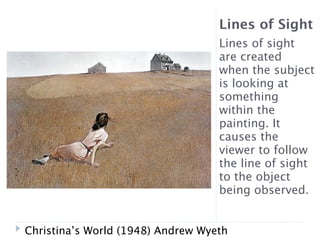
Lines of Sight
                                   Lines of sight
                                   are created
                                   when the subject
                                   is looking at
                                   something
                                   within the
                                   painting. It
                                   causes the
                                   viewer to follow
                                   the line of sight
                                   to the object
                                   being observed.


Christina’s World (1948) Andrew Wyeth
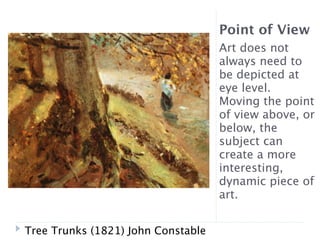
Point of View
                                    Art does not
                                    always need to
                                    be depicted at
                                    eye level.
                                    Moving the point
                                    of view above, or
                                    below, the
                                    subject can
                                    create a more
                                    interesting,
                                    dynamic piece of
                                    art.


Tree Trunks (1821) John Constable
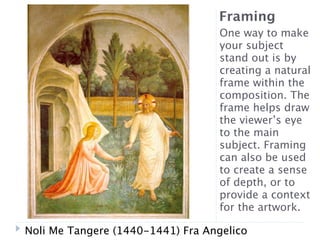
Framing
                                   One way to make
                                   your subject
                                   stand out is by
                                   creating a natural
                                   frame within the
                                   composition. The
                                   frame helps draw
                                   the viewer’s eye
                                   to the main
                                   subject. Framing
                                   can also be used
                                   to create a sense
                                   of depth, or to
                                   provide a context
                                   for the artwork.

Noli Me Tangere (1440-1441) Fra Angelico
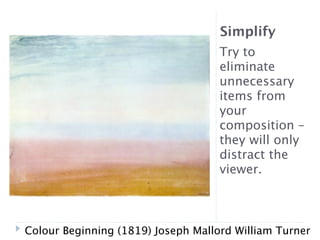
Simplify
                                    Try to
                                    eliminate
                                    unnecessary
                                    items from
                                    your
                                    composition –
                                    they will only
                                    distract the
                                    viewer.


Colour Beginning (1819) Joseph Mallord William Turner
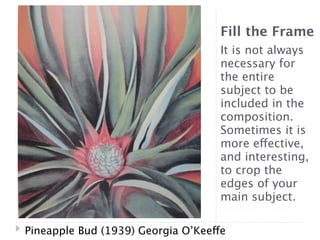
Fill the Frame
                                    It is not always
                                    necessary for
                                    the entire
                                    subject to be
                                    included in the
                                    composition.
                                    Sometimes it is
                                    more effective,
                                    and interesting,
                                    to crop the
                                    edges of your
                                    main subject.

Pineapple Bud (1939) Georgia O’Keeffe
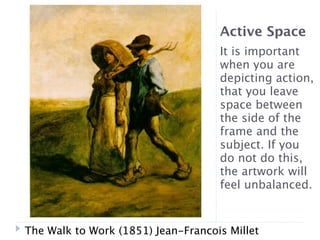
Active Space
                                    It is important
                                    when you are
                                    depicting action,
                                    that you leave
                                    space between
                                    the side of the
                                    frame and the
                                    subject. If you
                                    do not do this,
                                    the artwork will
                                    feel unbalanced.


The Walk to Work (1851) Jean-Francois Millet
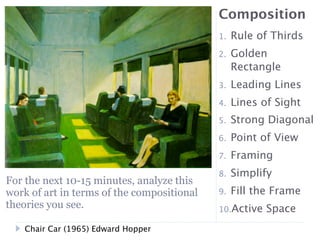
Composition
                                            1.   Rule of Thirds
                                            2.   Golden
                                                 Rectangle
                                            3.   Leading Lines
                                            4.   Lines of Sight
                                            5.   Strong Diagonal
                                            6.   Point of View
                                            7.   Framing
                                            8.   Simplify
For the next 10-15 minutes, analyze this
work of art in terms of the compositional   9.   Fill the Frame
theories you see.                           10.Active   Space
    Chair Car (1965) Edward Hopper

Theories of Composition

  • 1.
    Compositional Theories ofArt Composition: An orderly arrangement of elements using the principles of design.
  • 2.
    Rule of Thirds Imagine a grid that splits the frame into thirds both vertically and horizontally. Place the subject along those gridlines. The intersections of the lines are especially compelling places to position your subject. The Biglen Brothers Racing (1873) Thomas Eakins
  • 3.
    Rule of Thirds Imagine a grid that splits the frame into thirds both vertically and horizontally. Place the subject along those gridlines. The intersections of the lines are especially compelling places to position your subject. The Biglen Brothers Racing (1873) Thomas Eakins
  • 4.
    The Golden Rectangle Based onthe Golden Ratio, aka the Divine Proportion, a mathematically developed formula, observed often in nature and applied to architecture and in art.
  • 5.
    The Mona Lisa(1503-1519) Leonardo da Vinci
  • 6.
    The Rule of Odds Having an odd number of things in a composition means your eye and brain can't pair them up or group them easily. There's somehow always one thing left over, which keeps your eyes moving across the composition. Portrait of Charles I, King of England (1635-1636) Anthony van Dyck
  • 7.
    Leading Lines Lines that guide a viewer’s eyes around, or through, the artwork are called leading lines. Provencher’s Mill at Moret (1883) Alfred Sisley
  • 8.
    Strong Diagonal A strong diagonal is a form of a leading line. It can transform a boring composition into a dynamic one. Portrait of Dr. Gachet (1890) Vincent van Gogh
  • 9.
    Lines of Sight Lines of sight are created when the subject is looking at something within the painting. It causes the viewer to follow the line of sight to the object being observed. Christina’s World (1948) Andrew Wyeth
  • 10.
    Point of View Art does not always need to be depicted at eye level. Moving the point of view above, or below, the subject can create a more interesting, dynamic piece of art. Tree Trunks (1821) John Constable
  • 11.
    Framing One way to make your subject stand out is by creating a natural frame within the composition. The frame helps draw the viewer’s eye to the main subject. Framing can also be used to create a sense of depth, or to provide a context for the artwork. Noli Me Tangere (1440-1441) Fra Angelico
  • 12.
    Simplify Try to eliminate unnecessary items from your composition – they will only distract the viewer. Colour Beginning (1819) Joseph Mallord William Turner
  • 13.
    Fill the Frame It is not always necessary for the entire subject to be included in the composition. Sometimes it is more effective, and interesting, to crop the edges of your main subject. Pineapple Bud (1939) Georgia O’Keeffe
  • 14.
    Active Space It is important when you are depicting action, that you leave space between the side of the frame and the subject. If you do not do this, the artwork will feel unbalanced. The Walk to Work (1851) Jean-Francois Millet
  • 15.
    Composition 1. Rule of Thirds 2. Golden Rectangle 3. Leading Lines 4. Lines of Sight 5. Strong Diagonal 6. Point of View 7. Framing 8. Simplify For the next 10-15 minutes, analyze this work of art in terms of the compositional 9. Fill the Frame theories you see. 10.Active Space Chair Car (1965) Edward Hopper