Acrylic Paint
Tools, Tips and Techniques
-
Acrylic Paint Basics…
Developed in the late 1940s, acrylic paint has
only a brief history compared to other visual
arts media, such as watercolor and oil.
In the 1950's, the water-based acrylics were
developed. They became popular in the
1960's when pop artists used them, such as
Andy Warhol. Other art styles that explored
this medium were photorealism and Op Art
2Your footer here
History
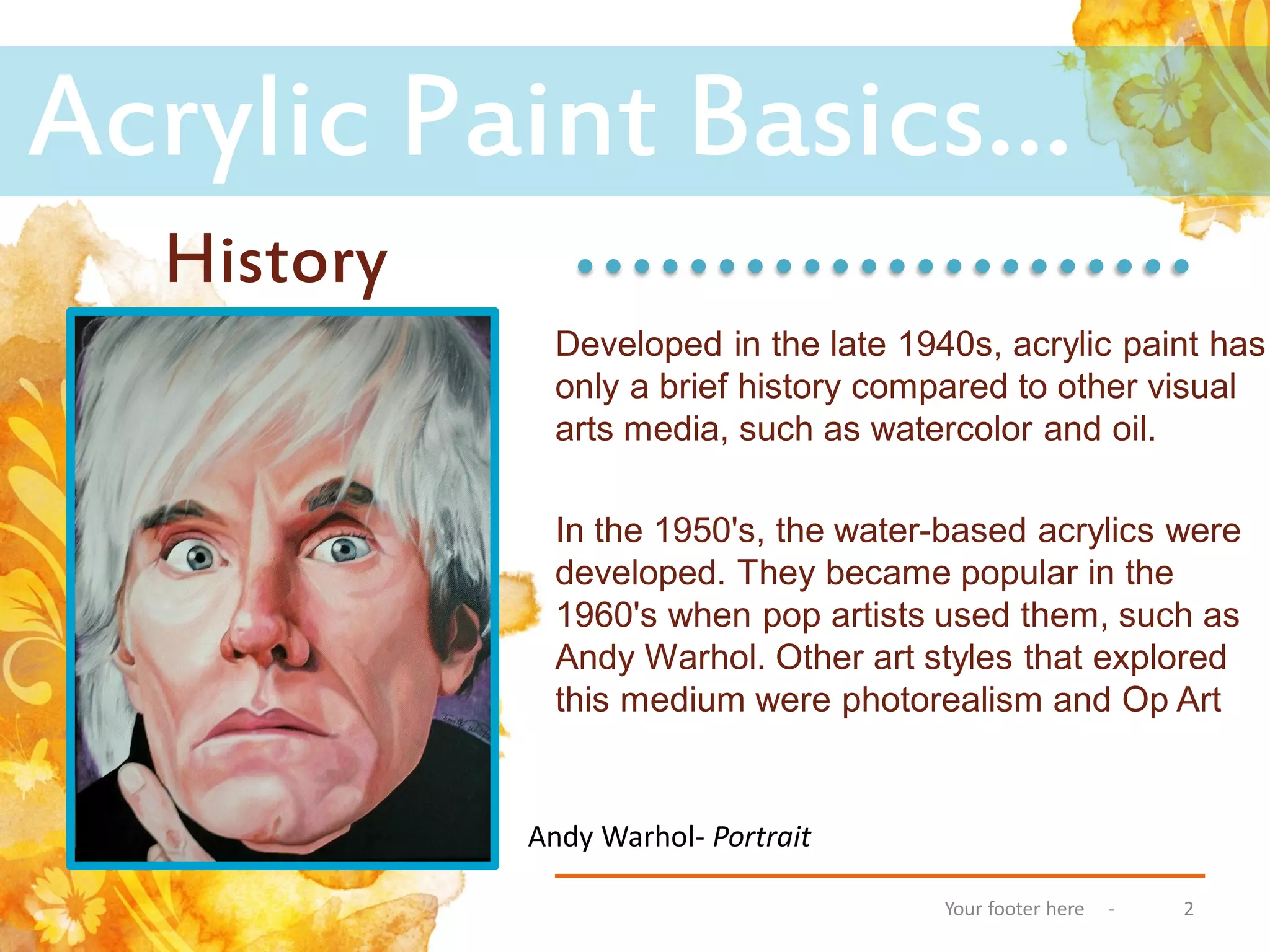
Andy Warhol- Portrait
-
Acrylic Paint Basics…
Acrylic paints are made from pigment, water
and an acrylic binder, which forms a hard, clear
film as the water evaporates. It is this
transparent film, reflecting light from the pigment
inside it, that gives acrylic color its brilliance.
Acrylics are water-soluble, non-toxic, easy to
clean, and dry quickly. They can be used
opaque (no light shows through) either through
thick paint application or by adding white. They
can be diluted with water and painted so they
are transparent (light shows through).
3Drawing and Painting II
Contents
-
Acrylic Paint Basics…
• Quick drying
• Harder to blend
• Harder Wet-On-Wet
4Drawing and Painting II
The GOOD The BAD
• Use Opaque
• Use saturated
• Clean up
• Cost effective
• Durability
-
Acrylic Paint Tools…
Acrylic paintbrushes come in
various shapes. Some of the
shapes are flat, round, pointed
round, detail round, filbert,
bright, angular flat, and fan.
Each shape comes in many
different sizes and are labeled
as previously discussed.
-Go over worksheet-
5Drawing and Painting II
Brushes
-
A paintbrush is made up of three parts: The handle,
the ferrule, and tuft (brush hairs or bristles).
1). The Tuft
• made of synthetic fibers, boar bristles, and various other
animal hairs.
2) The Ferrule
• the metal part of the brush that holds bristles to the handle.
The bristles are generally glued and the other end of ferrule
is wrapped around handle and crimped.
3) Brush Handles
• available in a short or long style and can be made of wood or
resin.
• Short handles are useful if you are not used to holding a
paintbrush. Gives a feeling of control and good for working
up close to the painting.
• Long-handled brushes are best for working on an easel
because the angle and distance are more conducive to
using the longer handle
Understanding Paintbrush
Construction & Use
-Fill out Graphic Organizer- 6
-
-
-
-
Care of Acrylic Brushes
• Always clean your brush immediately
after use.
• If color has dried on the brush, it is
ruined; never to be used again.
• Do not stand a brush on its handle-will
cause water to leak down into the
ferrule, loosening the glue that holds
the bristles together.
• Never leave brushes standing on their
bristles to dry- they will dry to that shape.
Care of Acrylic Brushes
Drawing and Painting II 10
-
• Brushes should be wiped clean on a lint-free rag and then rinsed under
running water.
• Clean brushes gently with cool water and mild soap, gently swirl the
soapy brush in the palm of your hand.
• Repeat washing and rinsing the brush until the soap and water run clear.
• Take particular care to ensure that the base of the brush head is clean.
• Some pigments may stain the brush slightly, but this will not affect the
performance or the life of the hair.
• Gently reshape the head and remove excess water from the brush
head.
• Dry the handle and ferrule and stand head up to allow the hair to dry
Cleaning of Acrylic
Brushes
Drawing and Painting II 11
-
1. Color Blocking
2. Wet-on-Wet
3. Hard Edges
4. Glazing
5. Scumbling
6. Impasto
7. Watercolor Effects
8. Grisaille Painting
Techniques
Drawing and Painting II 12
-
• under-painting in large flat shapes to lay out composition.
• After color blocking start painting details in the background
(like the sky) and then paint the next ground when finished
completely- work from the back to the front.
Techniques
Drawing and Painting II 13
Color Blocking
Keep it simple…
-
• mixing two wet colors/values of paint on canvas to
help blend/gradient colors
Techniques
Drawing and Painting II 14
Wet-on-Wet
• Acrylics dry fast- to help
keep paint moist, spritz with
water or use an acrylic
additive called “retarder” to
slow the drying process
down.
-
• Creating a clean, straight edge between objects
(colors/values)
Techniques
Drawing and Painting II 15
Hard Edge
-
• The application of broken color;
letting the color underneath to show
through.
• using a dry brush to create stippling
or texture- Dip tips of dry brush in
thin layer of paint and either pounce
the brush on the canvas or sweep
the brush across the canvas to
create different textures.
Techniques
Drawing and Painting II 16
Scumbling
-
Techniques
Drawing and Painting II 17
Impasto
• thick applied paint- usually done with a pallet
knife
-
• Transparent layers of paint that create rich color.
• Acrylic paint is mixed with a gloss medium.
Techniques
Drawing and Painting II 18
Glazing
• Glazing for Depth- glaze is made by
diluting acrylic paint with the help of
water.
• This combination of gloss medium and
paint is used to add a depth to the
painting by
• making a translucent glaze that can be
painted which gives a 3D appearance.
-
• By thinning acrylics with water have similar
effects of transparent watercolor.
Techniques
Drawing and Painting II 19
Transparent (watercolor)
-
https://www.youtube.com/watch?v=Nj3886C0cVY
• monochrome underpainting executed in
one tone ranging from dark to light (1).
Then glazing transparent color on top at
the end (2).
• Old Masters called it "dead coloring" which
means colors not used in initial painting
• finished grisaille underpainting can stand
alone as a finished
artwork.
Techniques
Drawing and Painting II 20
Grisaille Painting: Grisaille=French word (means gray tones)
https://www.youtube.com/watch?v=Nj3886C0cVY
https://www.youtube.com/watch?v=FdsiwCi6u40
-
:
• START from the BACKGROUND and work your way
forward. This will keep you from having to paint in
between little details- its faster to work this way!!
• Diffuse edges (blend) with a dry brush by dabbing lightly.
• Acrylics become darker in tone as they dry, so remember to
allow for this effect when mixing your colors.
• Acrylics are resistant to water once dry, which means they
can be over-painted without disturbing the previous color.
Once dry, colors cannot be dissolved with a damp brush.
• If trying to remove-While paint is wet, wipe with damp rag.
Helpful Hints:
Drawing and Painting II 21
-
Instead of using black and brown out of the of the bottle
you have to mix them from Primary colors.
BLACK: about 90% base color and 10% complement
• Warm black: start with red and add green
• Cool black: start with blue and add orange
BROWN: about 50% base color and 50% complement
• Warm Brown: base is red and little less green
• Cool Brown: Base Blue and little less orange
Mixing Neutrals:
Drawing and Painting II 22
-
:
1. Create a Graphic Organizer with the first 7 painting
techniques. Make sure to label all 7.
2. Create a 3 value scale of Black/grey tones
3. Create a 3 value scale of Brown tones.
4. Try a script Brush and label it.
Preliminary Work:
Drawing and Painting II 23
5. On a separate sheet of paper try
to replicate the picture of this
pear (provided) using the
Grisaille Painting technique.
-
1. 2. 3.
4. 5.

Acrylic Paint: Tools, Tips and Techniques

  • 1.
  • 2.
    - Acrylic Paint Basics… Developedin the late 1940s, acrylic paint has only a brief history compared to other visual arts media, such as watercolor and oil. In the 1950's, the water-based acrylics were developed. They became popular in the 1960's when pop artists used them, such as Andy Warhol. Other art styles that explored this medium were photorealism and Op Art 2Your footer here History Andy Warhol- Portrait
  • 3.
    - Acrylic Paint Basics… Acrylicpaints are made from pigment, water and an acrylic binder, which forms a hard, clear film as the water evaporates. It is this transparent film, reflecting light from the pigment inside it, that gives acrylic color its brilliance. Acrylics are water-soluble, non-toxic, easy to clean, and dry quickly. They can be used opaque (no light shows through) either through thick paint application or by adding white. They can be diluted with water and painted so they are transparent (light shows through). 3Drawing and Painting II Contents
  • 4.
    - Acrylic Paint Basics… •Quick drying • Harder to blend • Harder Wet-On-Wet 4Drawing and Painting II The GOOD The BAD • Use Opaque • Use saturated • Clean up • Cost effective • Durability
  • 5.
    - Acrylic Paint Tools… Acrylicpaintbrushes come in various shapes. Some of the shapes are flat, round, pointed round, detail round, filbert, bright, angular flat, and fan. Each shape comes in many different sizes and are labeled as previously discussed. -Go over worksheet- 5Drawing and Painting II Brushes
  • 6.
    - A paintbrush ismade up of three parts: The handle, the ferrule, and tuft (brush hairs or bristles). 1). The Tuft • made of synthetic fibers, boar bristles, and various other animal hairs. 2) The Ferrule • the metal part of the brush that holds bristles to the handle. The bristles are generally glued and the other end of ferrule is wrapped around handle and crimped. 3) Brush Handles • available in a short or long style and can be made of wood or resin. • Short handles are useful if you are not used to holding a paintbrush. Gives a feeling of control and good for working up close to the painting. • Long-handled brushes are best for working on an easel because the angle and distance are more conducive to using the longer handle Understanding Paintbrush Construction & Use -Fill out Graphic Organizer- 6
  • 7.
  • 8.
  • 9.
  • 10.
    - Care of AcrylicBrushes • Always clean your brush immediately after use. • If color has dried on the brush, it is ruined; never to be used again. • Do not stand a brush on its handle-will cause water to leak down into the ferrule, loosening the glue that holds the bristles together. • Never leave brushes standing on their bristles to dry- they will dry to that shape. Care of Acrylic Brushes Drawing and Painting II 10
  • 11.
    - • Brushes shouldbe wiped clean on a lint-free rag and then rinsed under running water. • Clean brushes gently with cool water and mild soap, gently swirl the soapy brush in the palm of your hand. • Repeat washing and rinsing the brush until the soap and water run clear. • Take particular care to ensure that the base of the brush head is clean. • Some pigments may stain the brush slightly, but this will not affect the performance or the life of the hair. • Gently reshape the head and remove excess water from the brush head. • Dry the handle and ferrule and stand head up to allow the hair to dry Cleaning of Acrylic Brushes Drawing and Painting II 11
  • 12.
    - 1. Color Blocking 2.Wet-on-Wet 3. Hard Edges 4. Glazing 5. Scumbling 6. Impasto 7. Watercolor Effects 8. Grisaille Painting Techniques Drawing and Painting II 12
  • 13.
    - • under-painting inlarge flat shapes to lay out composition. • After color blocking start painting details in the background (like the sky) and then paint the next ground when finished completely- work from the back to the front. Techniques Drawing and Painting II 13 Color Blocking Keep it simple…
  • 14.
    - • mixing twowet colors/values of paint on canvas to help blend/gradient colors Techniques Drawing and Painting II 14 Wet-on-Wet • Acrylics dry fast- to help keep paint moist, spritz with water or use an acrylic additive called “retarder” to slow the drying process down.
  • 15.
    - • Creating aclean, straight edge between objects (colors/values) Techniques Drawing and Painting II 15 Hard Edge
  • 16.
    - • The applicationof broken color; letting the color underneath to show through. • using a dry brush to create stippling or texture- Dip tips of dry brush in thin layer of paint and either pounce the brush on the canvas or sweep the brush across the canvas to create different textures. Techniques Drawing and Painting II 16 Scumbling
  • 17.
    - Techniques Drawing and PaintingII 17 Impasto • thick applied paint- usually done with a pallet knife
  • 18.
    - • Transparent layersof paint that create rich color. • Acrylic paint is mixed with a gloss medium. Techniques Drawing and Painting II 18 Glazing • Glazing for Depth- glaze is made by diluting acrylic paint with the help of water. • This combination of gloss medium and paint is used to add a depth to the painting by • making a translucent glaze that can be painted which gives a 3D appearance.
  • 19.
    - • By thinningacrylics with water have similar effects of transparent watercolor. Techniques Drawing and Painting II 19 Transparent (watercolor)
  • 20.
    - https://www.youtube.com/watch?v=Nj3886C0cVY • monochrome underpaintingexecuted in one tone ranging from dark to light (1). Then glazing transparent color on top at the end (2). • Old Masters called it "dead coloring" which means colors not used in initial painting • finished grisaille underpainting can stand alone as a finished artwork. Techniques Drawing and Painting II 20 Grisaille Painting: Grisaille=French word (means gray tones) https://www.youtube.com/watch?v=Nj3886C0cVY https://www.youtube.com/watch?v=FdsiwCi6u40
  • 21.
    - : • START fromthe BACKGROUND and work your way forward. This will keep you from having to paint in between little details- its faster to work this way!! • Diffuse edges (blend) with a dry brush by dabbing lightly. • Acrylics become darker in tone as they dry, so remember to allow for this effect when mixing your colors. • Acrylics are resistant to water once dry, which means they can be over-painted without disturbing the previous color. Once dry, colors cannot be dissolved with a damp brush. • If trying to remove-While paint is wet, wipe with damp rag. Helpful Hints: Drawing and Painting II 21
  • 22.
    - Instead of usingblack and brown out of the of the bottle you have to mix them from Primary colors. BLACK: about 90% base color and 10% complement • Warm black: start with red and add green • Cool black: start with blue and add orange BROWN: about 50% base color and 50% complement • Warm Brown: base is red and little less green • Cool Brown: Base Blue and little less orange Mixing Neutrals: Drawing and Painting II 22
  • 23.
    - : 1. Create aGraphic Organizer with the first 7 painting techniques. Make sure to label all 7. 2. Create a 3 value scale of Black/grey tones 3. Create a 3 value scale of Brown tones. 4. Try a script Brush and label it. Preliminary Work: Drawing and Painting II 23 5. On a separate sheet of paper try to replicate the picture of this pear (provided) using the Grisaille Painting technique.
  • 24.