Pastels
15th-16th Century Pastel
•The manufacture of pastels originated in the 15th century.
• The pastel medium was mentioned by Leonardo da Vinci, who
learned of it from the French artist Jean Perréal after that artist's arrival
in Milan in 1499.
•Pastel were only used as a medium for preparatory studies (sketching)
by 16th-century artists, notably Federico Barocci. In the Renaissance,
pastel was used sparingly, adding highlight or color to drawings usually
executed in natural chalks.
•The first French artist to specialize in pastel portraits as the final
medium was Joseph Vivien. He became the first artist to be received in
the French Académie Royale de Peinture et de Sculpture in 1701 as a
"painter in pastel."
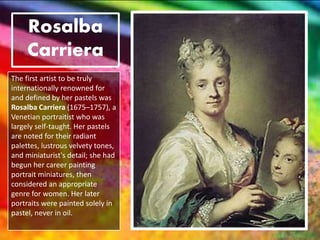
Rosalba
Carriera
The first artist to be truly
internationally renowned for
and defined by her pastels was
Rosalba Carriera (1675–1757), a
Venetian portraitist who was
largely self-taught. Her pastels
are noted for their radiant
palettes, lustrous velvety tones,
and miniaturist's detail; she had
begun her career painting
portrait miniatures, then
considered an appropriate
genre for women. Her later
portraits were painted solely in
pastel, never in oil.
American Pastel Artists
•Shortly after Carriera started using pastels as a main medium a galaxy of artists,
including Manet, Renoir, Toulouse-Lautrec, Whistler, and Degas (just to list the
more familiar names) used pastel as finished work rather than merely for
preliminary sketches.
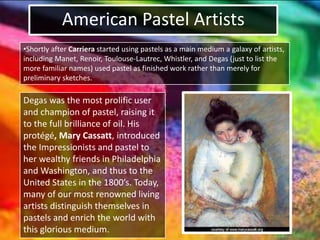
Degas was the most prolific user
and champion of pastel, raising it
to the full brilliance of oil. His
protégé, Mary Cassatt, introduced
the Impressionists and pastel to
her wealthy friends in Philadelphia
and Washington, and thus to the
United States in the 1800’s. Today,
many of our most renowned living
artists distinguish themselves in
pastels and enrich the world with
this glorious medium.
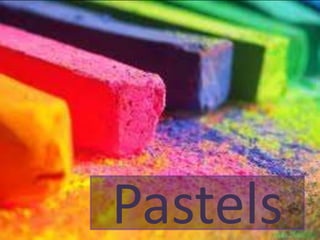
What are Pastels?
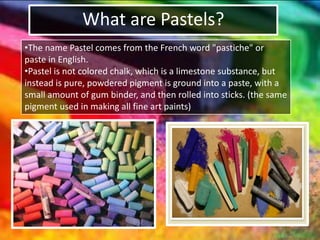
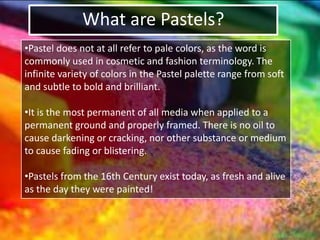
•The name Pastel comes from the French word "pastiche" or
paste in English.
•Pastel is not colored chalk, which is a limestone substance, but
instead is pure, powdered pigment is ground into a paste, with a
small amount of gum binder, and then rolled into sticks. (the same
pigment used in making all fine art paints)
What are Pastels?
•Pastel does not at all refer to pale colors, as the word is
commonly used in cosmetic and fashion terminology. The
infinite variety of colors in the Pastel palette range from soft
and subtle to bold and brilliant.
•It is the most permanent of all media when applied to a
permanent ground and properly framed. There is no oil to
cause darkening or cracking, nor other substance or medium
to cause fading or blistering.
•Pastels from the 16th Century exist today, as fresh and alive
as the day they were painted!
Drawing vs. Painting with
Pastels
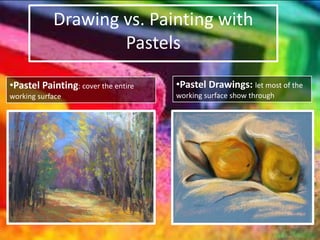
•Pastel Painting: cover the entire
working surface
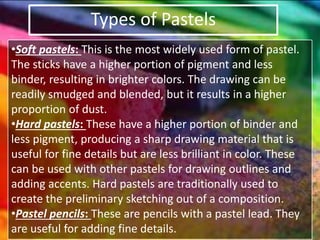
•Pastel Drawings: let most of the
working surface show through
Types of Pastels
•Soft pastels: This is the most widely used form of pastel.
The sticks have a higher portion of pigment and less
binder, resulting in brighter colors. The drawing can be
readily smudged and blended, but it results in a higher
proportion of dust.
•Hard pastels: These have a higher portion of binder and
less pigment, producing a sharp drawing material that is
useful for fine details but are less brilliant in color. These
can be used with other pastels for drawing outlines and
adding accents. Hard pastels are traditionally used to
create the preliminary sketching out of a composition.
•Pastel pencils: These are pencils with a pastel lead. They
are useful for adding fine details.
Working with Pastels
Surfaces: Pastel supports need to provide a "tooth" for
the pastel to adhere and hold the pigment in place. Most
Supports include:
1. laid paper is most commonly used and is usually of a
medium value/color- woven paper with tooth
2. abrasive supports include things such as wood, fine
sand paper, or canvas and sometimes have a surface of
finely ground pumice or marble dust
Fixatives: is used for two purposes
1. Create tooth in a surface that is saturated with pastel
2. Keep the image from moving either temporarily or
permanently (workable and final fixative)
Working with Pastels
Blending: Though pastels are considered a dry
medium they are still very fluid. There are
several tools that can be used for blending.
1. Fingers
2. Paper stumps
3. Paint Brushes
4. Cotton balls
Much like many other mediums including paint
and colored pencils-blending is a personal
preference. Many pastel artist like the raw
strokes of the medium and prefer NOT to blend.
Pastel Techniques
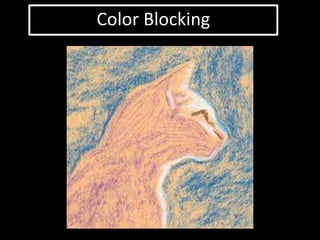
1. Color blocking
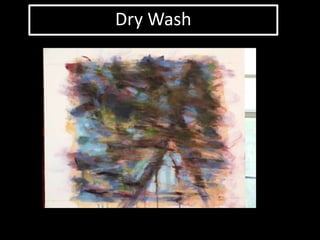
2. Dry wash (paper towel)
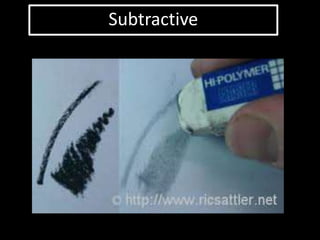
3. Subtractive (eraser)
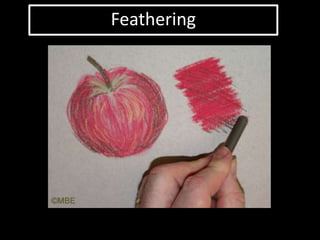
4. Feathering
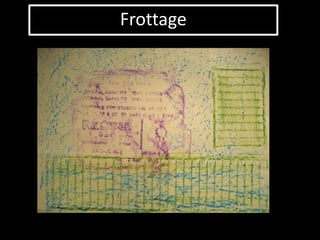
5. Frottage (rubbing over texture)
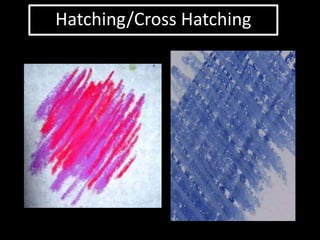
6. Hatching/cross hatching
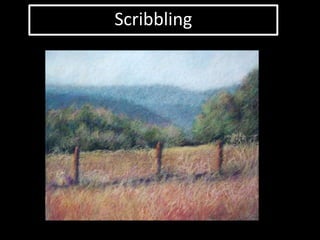
7. Scribbling
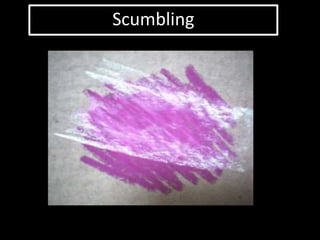
8. Scumbling
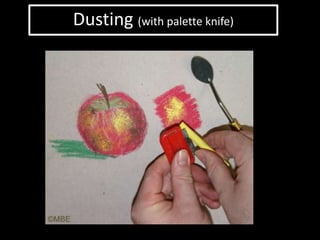
9. Dusting with a pallet knife
Color Blocking
Dry Wash
Subtractive
Feathering
Frottage
Hatching/Cross Hatching
Scribbling
Scumbling
Dusting (with palette knife)

Pastels

  • 1.
  • 2.
    15th-16th Century Pastel •Themanufacture of pastels originated in the 15th century. • The pastel medium was mentioned by Leonardo da Vinci, who learned of it from the French artist Jean Perréal after that artist's arrival in Milan in 1499. •Pastel were only used as a medium for preparatory studies (sketching) by 16th-century artists, notably Federico Barocci. In the Renaissance, pastel was used sparingly, adding highlight or color to drawings usually executed in natural chalks. •The first French artist to specialize in pastel portraits as the final medium was Joseph Vivien. He became the first artist to be received in the French Académie Royale de Peinture et de Sculpture in 1701 as a "painter in pastel."
  • 3.
    Rosalba Carriera The first artistto be truly internationally renowned for and defined by her pastels was Rosalba Carriera (1675–1757), a Venetian portraitist who was largely self-taught. Her pastels are noted for their radiant palettes, lustrous velvety tones, and miniaturist's detail; she had begun her career painting portrait miniatures, then considered an appropriate genre for women. Her later portraits were painted solely in pastel, never in oil.
  • 4.
    American Pastel Artists •Shortlyafter Carriera started using pastels as a main medium a galaxy of artists, including Manet, Renoir, Toulouse-Lautrec, Whistler, and Degas (just to list the more familiar names) used pastel as finished work rather than merely for preliminary sketches. Degas was the most prolific user and champion of pastel, raising it to the full brilliance of oil. His protégé, Mary Cassatt, introduced the Impressionists and pastel to her wealthy friends in Philadelphia and Washington, and thus to the United States in the 1800’s. Today, many of our most renowned living artists distinguish themselves in pastels and enrich the world with this glorious medium.
  • 5.
    What are Pastels? •Thename Pastel comes from the French word "pastiche" or paste in English. •Pastel is not colored chalk, which is a limestone substance, but instead is pure, powdered pigment is ground into a paste, with a small amount of gum binder, and then rolled into sticks. (the same pigment used in making all fine art paints)
  • 6.
    What are Pastels? •Pasteldoes not at all refer to pale colors, as the word is commonly used in cosmetic and fashion terminology. The infinite variety of colors in the Pastel palette range from soft and subtle to bold and brilliant. •It is the most permanent of all media when applied to a permanent ground and properly framed. There is no oil to cause darkening or cracking, nor other substance or medium to cause fading or blistering. •Pastels from the 16th Century exist today, as fresh and alive as the day they were painted!
  • 7.
    Drawing vs. Paintingwith Pastels •Pastel Painting: cover the entire working surface •Pastel Drawings: let most of the working surface show through
  • 8.
    Types of Pastels •Softpastels: This is the most widely used form of pastel. The sticks have a higher portion of pigment and less binder, resulting in brighter colors. The drawing can be readily smudged and blended, but it results in a higher proportion of dust. •Hard pastels: These have a higher portion of binder and less pigment, producing a sharp drawing material that is useful for fine details but are less brilliant in color. These can be used with other pastels for drawing outlines and adding accents. Hard pastels are traditionally used to create the preliminary sketching out of a composition. •Pastel pencils: These are pencils with a pastel lead. They are useful for adding fine details.
  • 9.
    Working with Pastels Surfaces:Pastel supports need to provide a "tooth" for the pastel to adhere and hold the pigment in place. Most Supports include: 1. laid paper is most commonly used and is usually of a medium value/color- woven paper with tooth 2. abrasive supports include things such as wood, fine sand paper, or canvas and sometimes have a surface of finely ground pumice or marble dust Fixatives: is used for two purposes 1. Create tooth in a surface that is saturated with pastel 2. Keep the image from moving either temporarily or permanently (workable and final fixative)
  • 10.
    Working with Pastels Blending:Though pastels are considered a dry medium they are still very fluid. There are several tools that can be used for blending. 1. Fingers 2. Paper stumps 3. Paint Brushes 4. Cotton balls Much like many other mediums including paint and colored pencils-blending is a personal preference. Many pastel artist like the raw strokes of the medium and prefer NOT to blend.
  • 11.
    Pastel Techniques 1. Colorblocking 2. Dry wash (paper towel) 3. Subtractive (eraser) 4. Feathering 5. Frottage (rubbing over texture) 6. Hatching/cross hatching 7. Scribbling 8. Scumbling 9. Dusting with a pallet knife
  • 12.
  • 13.
  • 14.
  • 15.
  • 16.
  • 17.
  • 18.
  • 19.
  • 20.