Grammatical Gender    in English 이겨레하나 박지현
What is Grammatical Gender? In linguistics,  ‘grammatical gender’ ,   also called  ‘noun  classes’ , are classes of nouns reflected in the behavior  of associated words.
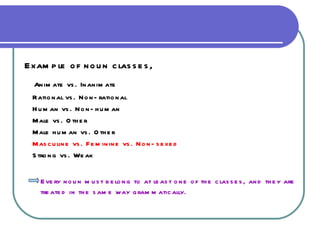
Example of noun classes, Animate vs. Inanimate Rational vs. Non-rational Human vs. Non-human Male vs. Other Male human vs. Other Masculine vs. Feminine vs. Non-sexed Strong vs. Weak Every noun must belong to at least one of the classes, and they are  treated in the same way grammatically.
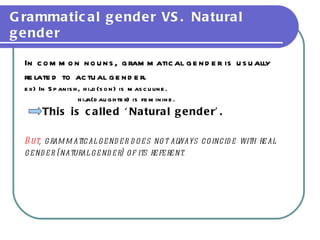
Grammatical gender VS. Natural gender In common nouns, grammatical gender is usually  related to actual gender.  ex) In Spanish, hijo(son) is masculine. hija(daughter) is feminine. This is called ‘Natural gender’. But , grammatical gender does not always coincide with real  gender (natural gender) of its referent.
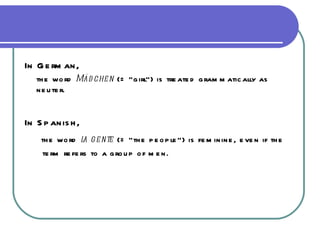
In German, the word  Mädchen  (= “girl”) is treated grammatically as neuter. In Spanish, the word  la gente  (= “the people”) is feminine, even if the  term refers to a group of men.
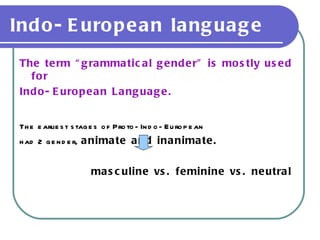
Indo-European language The term “grammatical gender” is mostly used for  Indo-European Language. The earliest stages of Proto-Indo-European had 2 gender,  animate and inanimate. masculine vs. feminine vs. neutral
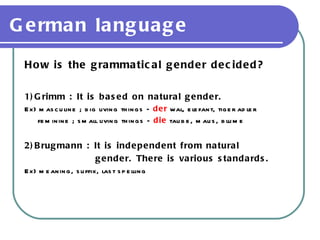
German language How is the grammatical gender decided? 1)Grimm : It is based on natural gender. Ex) masculine ; big living things –  der  wal, elefant, tiger adler feminine ; small living things –  die  taube, maus, blume 2)Brugmann : It is independent from natural  gender. There is various standards. Ex) meaning, suffix, last spelling
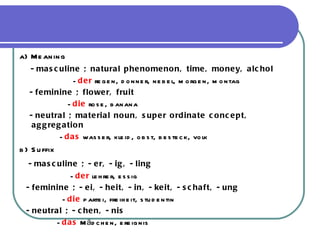
a) Meaning -masculine ; natural phenomenon, time, money, alchol - der  regen, donner, nebel, morgen, montag -feminine ; flower, fruit - die  rose, banana -neutral ; material noun, super ordinate concept, aggregation - das  wasser, kleid, obst, besteck, volk b) Suffix -masculine ; -er, -ig, -ling - der  lehrer, essig  -feminine ; -ei, -heit, -in, -keit, -schaft, -ung - die  partei, freiheit, studentin -neutral ; -chen, -nis - das   Mädchen, ereignis
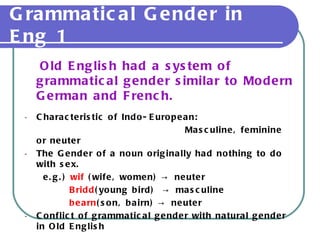
Grammatical Gender in Eng 1 Old English had a system of grammatical gender similar to Modern German and French. Characteristic of Indo-European:  Masculine, feminine or neuter The Gender of a noun originally had nothing to do with sex. e.g.)  wif  (wife, women) -> neuter  Bridd (young bird)  -> masculine bearn (son, bairn) -> neuter Conflict of grammatical gender with natural gender in Old English
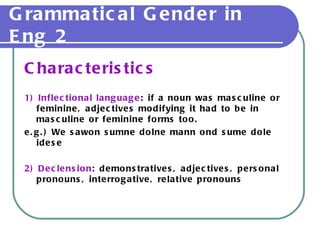
Grammatical Gender in Eng 2  Characteristics 1) Inflectional language : if a noun was masculine or feminine, adjectives modifying it had to be in masculine or feminine forms too.  e.g.) We sawon sumne dolne mann ond sume dole idese 2) Declension : demonstratives, adjectives, personal pronouns, interrogative, relative pronouns
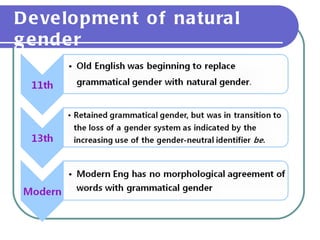
Development of natural gender
Development of natural gender Loss of grammatical gender  Reduction of inflections Leveling of unstressed vowels  a, o, u -> e [ə] The number of distinct inflectional endings in English was drastically reduced. e.g) Weak adjective ending  –a (masculine nominative),  –e (neuter nominative-accusative and feminine nominative) ⇒ fell together as  –e -  Indicator of gender was lost! Old English:  masculine nominative-accusative plurals ended in  –as , feminines in  –a , and short-stemmed neuters in  –u ⇒  Middle English:  a handful of nouns acquired the same plural endings  -es
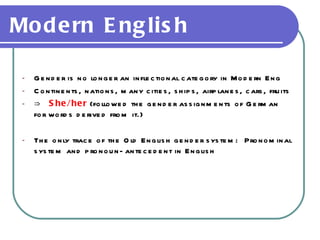
Modern English  Gender is no longer an inflectional category in Modern Eng Continents, nations, many cities, ships, airplanes, cars, fruits ⇒  She/her  (followed the gender assignments of German for words derived from it.) The only trace of the Old English gender system:  Pronominal system and pronoun-antecedent in English

Grammatical gender

  • 1.
    Grammatical Gender in English 이겨레하나 박지현
  • 2.
    What is GrammaticalGender? In linguistics, ‘grammatical gender’ , also called ‘noun classes’ , are classes of nouns reflected in the behavior of associated words.
  • 3.
    Example of nounclasses, Animate vs. Inanimate Rational vs. Non-rational Human vs. Non-human Male vs. Other Male human vs. Other Masculine vs. Feminine vs. Non-sexed Strong vs. Weak Every noun must belong to at least one of the classes, and they are treated in the same way grammatically.
  • 4.
    Grammatical gender VS.Natural gender In common nouns, grammatical gender is usually related to actual gender. ex) In Spanish, hijo(son) is masculine. hija(daughter) is feminine. This is called ‘Natural gender’. But , grammatical gender does not always coincide with real gender (natural gender) of its referent.
  • 5.
    In German, theword Mädchen (= “girl”) is treated grammatically as neuter. In Spanish, the word la gente (= “the people”) is feminine, even if the term refers to a group of men.
  • 6.
    Indo-European language Theterm “grammatical gender” is mostly used for Indo-European Language. The earliest stages of Proto-Indo-European had 2 gender, animate and inanimate. masculine vs. feminine vs. neutral
  • 7.
    German language Howis the grammatical gender decided? 1)Grimm : It is based on natural gender. Ex) masculine ; big living things – der wal, elefant, tiger adler feminine ; small living things – die taube, maus, blume 2)Brugmann : It is independent from natural gender. There is various standards. Ex) meaning, suffix, last spelling
  • 8.
    a) Meaning -masculine; natural phenomenon, time, money, alchol - der regen, donner, nebel, morgen, montag -feminine ; flower, fruit - die rose, banana -neutral ; material noun, super ordinate concept, aggregation - das wasser, kleid, obst, besteck, volk b) Suffix -masculine ; -er, -ig, -ling - der lehrer, essig -feminine ; -ei, -heit, -in, -keit, -schaft, -ung - die partei, freiheit, studentin -neutral ; -chen, -nis - das Mädchen, ereignis
  • 9.
    Grammatical Gender inEng 1 Old English had a system of grammatical gender similar to Modern German and French. Characteristic of Indo-European: Masculine, feminine or neuter The Gender of a noun originally had nothing to do with sex. e.g.) wif (wife, women) -> neuter Bridd (young bird) -> masculine bearn (son, bairn) -> neuter Conflict of grammatical gender with natural gender in Old English
  • 10.
    Grammatical Gender inEng 2 Characteristics 1) Inflectional language : if a noun was masculine or feminine, adjectives modifying it had to be in masculine or feminine forms too. e.g.) We sawon sumne dolne mann ond sume dole idese 2) Declension : demonstratives, adjectives, personal pronouns, interrogative, relative pronouns
  • 11.
  • 12.
    Development of naturalgender Loss of grammatical gender Reduction of inflections Leveling of unstressed vowels a, o, u -> e [ə] The number of distinct inflectional endings in English was drastically reduced. e.g) Weak adjective ending –a (masculine nominative), –e (neuter nominative-accusative and feminine nominative) ⇒ fell together as –e - Indicator of gender was lost! Old English: masculine nominative-accusative plurals ended in –as , feminines in –a , and short-stemmed neuters in –u ⇒ Middle English: a handful of nouns acquired the same plural endings -es
  • 13.
    Modern English Gender is no longer an inflectional category in Modern Eng Continents, nations, many cities, ships, airplanes, cars, fruits ⇒ She/her (followed the gender assignments of German for words derived from it.) The only trace of the Old English gender system: Pronominal system and pronoun-antecedent in English