Universidad Técnica de Ambato
Jennifer Manzano
6th “C”
—Carl Rogers
“The only person who is educated
is the one who has learned how
to learn …and change.”
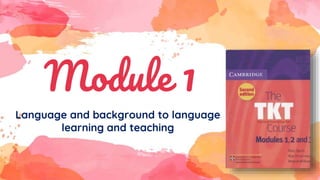
Module 1
Language and background to language
learning and teaching
Part 1
Describing language and language skills
Unit 1: Grammar
What is gramar?
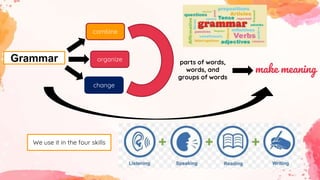
combine
organize
change
Grammar parts of words,
words, and
groups of words
make meaning
We use it in the four skills
We use grammar as teachers, to describe language. We do
this by referring to its forms and it uses.
What are
gramatical
forms?
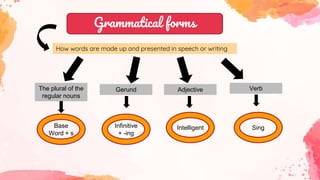
Grammatical forms
How words are made up and presented in speech or writing
The plural of the
regular nouns
Gerund Adjective Verb
Base
Word + s
Infinitive
+ -ing
Intelligent Sing
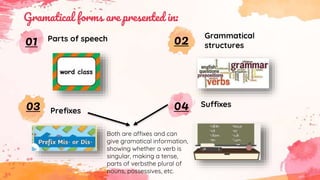
Prefixes
Parts of speech Grammatical
structures01
Suffixes
02
03 04
Gramatical forms are presented in:
Both are affixes and can
give gramatical information,
showing whether a verb is
singular, making a tense,
parts of verbsthe plural of
nouns, possessives, etc.
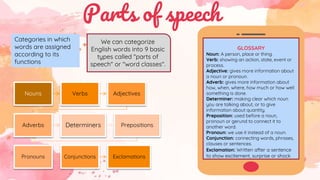
Parts of speech
Categories in which
words are assigned
according to its
functions
We can categorize
English words into 9 basic
types called "parts of
speech" or "word classes".
Nouns Verbs Adjectives
Adverbs Determiners Prepositions
Pronouns Conjunctions Exclamations
GLOSSARY
Noun: A person, place or thing.
Verb: showing an action, state, event or
process.
Adjective: gives more information about
a noun or pronoun.
Adverb: gives more information about
how, when, where, how much or how well
something is done.
Determiner: making clear which noun
you are talking about, or to give
information about quantity.
Preposition: used before a noun,
pronoun or gerund to connect it to
another word.
Pronoun: we use it instead of a noun.
Conjunction: connecting words, phrases,
clauses or sentences.
Exclamation: Written after a sentence
to show excitement, surprise or shock
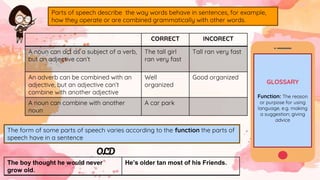
Parts of speech describe the way words behave in sentences, for example,
how they operate or are combined grammatically with other words.
CORRECT INCORECT
A noun can act as a subject of a verb,
but an adjective can’t
The tall girl
ran very fast
Tall ran very fast
An adverb can be combined with an
adjective, but an adjective can’t
combine with another adjective
Well
organized
Good organized
A noun can combine with another
noun
A car park
The form of some parts of speech varies according to the function the parts of
speech have in a sentence
OLD
The boy thought he would never
grow old.
He’s older tan most of his Friends.
GLOSSARY
Function: The reason
or purpose for using
language, e.g. making
a suggestion; giving
advice
What is a gramatical
structure?
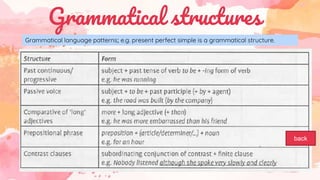
Grammatical structures
Grammatical language patterns; e.g. present perfect simple is a grammatical structure.
back
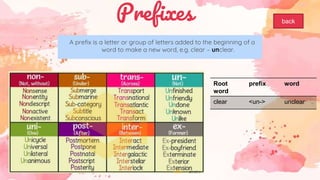
A prefix is a letter or group of letters added to the beginning of a
word to make a new word, e.g. clear – unclear.
Prefixes back
Root
word
prefix word
clear <un-> unclear
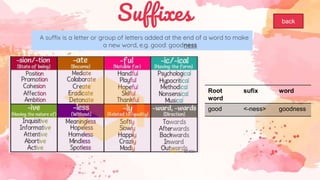
A suffix is a letter or group of letters added at the end of a word to make
a new word, e.g. good: goodness
Suffixes back
Root
word
sufix word
good <-ness> goodness
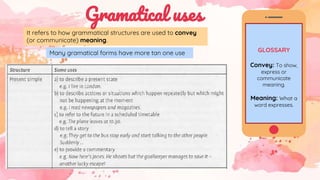
What are gramatical
uses?
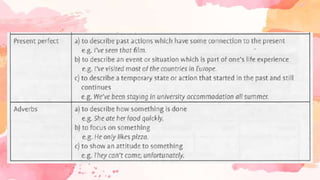
Many gramatical forms have more tan one use
It refers to how grammatical structures are used to convey
(or communicate) meaning.
Gramatical uses
GLOSSARY
Convey: To show,
express or
communicate
meaning.
Meaning: What a
word expresses.
Language concepts
and the language
teaching classroom
Grammar rules
traditionally describe
written language
rather than spoken
language
Grammar
rules are not
fixed
Speakers speak
and write the
language without
knowing
grammar
Teachers need to
make learners
aware of patterns
and practicing
UNIT 2: LEXIS
What is lexis?
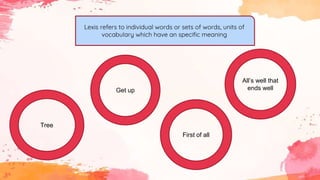
Lexis refers to individual words or sets of words, units of
vocabulary which have an specific meaning
Tree
Get up
First of all
All’s well that
ends well
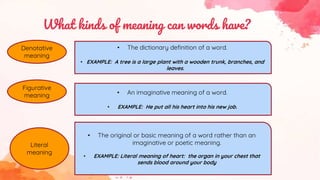
What kinds of meaning can words have?
• The dictionary definition of a word.
• EXAMPLE: A tree is a large plant with a wooden trunk, branches, and
leaves.
Denotative
meaning
Figurative
meaning • An imaginative meaning of a word.
• EXAMPLE: He put all his heart into his new job.
Literal
meaning
• The original or basic meaning of a word rather than an
imaginative or poetic meaning.
• EXAMPLE: Literal meaning of heart: the organ in your chest that
sends blood around your body
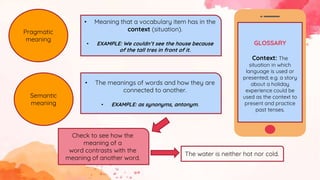
Pragmatic
meaning
• Meaning that a vocabulary item has in the
context (situation).
• EXAMPLE: We couldn’t see the house because
of the tall tres in front of it.
GLOSSARY
Context: The
situation in which
language is used or
presented; e.g. a story
about a holiday
experience could be
used as the context to
present and practice
past tenses.
Semantic
meaning
• The meanings of words and how they are
connected to another.
• EXAMPLE: as synonyms, antonym.
Check to see how the
meaning of a
word contrasts with the
meaning of another word.
The water is neither hot nor cold.
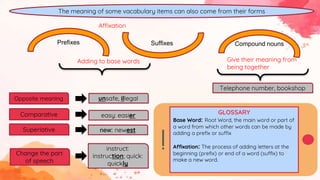
The meaning of some vacabulary items can also come from their forms
Prefixes Compound nounsSuffixes
Opposite meaning
Comparative
unsafe, illegal
easy: easier
Superlative new: newest
Change the part
of speech
instruct:
instruction; quick:
quickly
Adding to base words Give their meaning from
being together
Telephone number, bookshop
GLOSSARY
Base Word: Root Word, the main word or part of
a word from which other words can be made by
adding a prefix or suffix
Affixation: The process of adding letters at the
beginning (prefix) or end of a word (suffix) to
make a new word.
Affixation
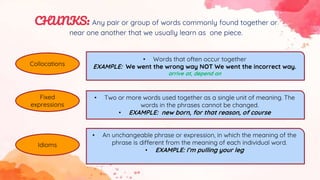
Collocations
Fixed
expressions
Idioms
• Words that often occur together
EXAMPLE: We went the wrong way NOT We went the incorrect way.
arrive at, depend on
• Two or more words used together as a single unit of meaning. The
words in the phrases cannot be changed.
• EXAMPLE: new born, for that reason, of course
• An unchangeable phrase or expression, in which the meaning of the
phrase is different from the meaning of each individual word.
• EXAMPLE: I’m pulling your leg
CHUNKS: Any pair or group of words commonly found together or
near one another that we usually learn as one piece.
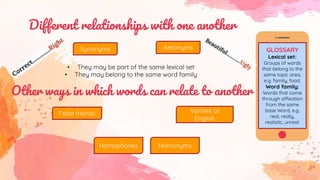
Different relationships with one another
Synonyms Antonyms
Other ways in which words can relate to another
False friends
Homophones
Varities of
English
• They may be part of the same lexical set
• They may belong to the same word family
GLOSSARY
Lexical set:
Groups of words
that belong to the
same topic area,
e.g. family, food.
Word family:
Words that come
through affixation
from the same
base Word, e.g.
real, really,
realistic, unreal.
Homonyms
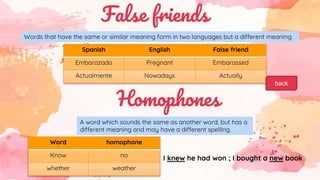
False friends
Words that have the same or similar meaning form in two languages but a different meaning.
Spanish English False friend
Embarazado Pregnant Embarassed
Actualmente Nowadays Actually
back
Homophones
A word which sounds the same as another word, but has a
different meaning and may have a different spelling.
Word homophone
Know no
whether weather
I knew he had won ; I bought a new book
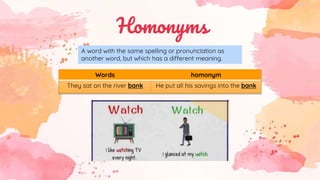
Homonyms
A word with the same spelling or pronunciation as
another word, but which has a different meaning.
Words homonym
They sat on the river bank He put all his savings into the bank
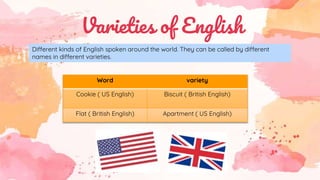
Varieties of English
Different kinds of English spoken around the world. They can be called by different
names in different varieties.
Word variety
Cookie ( US English) Biscuit ( British English)
Flat ( British English) Apartment ( US English)
Learners need to
learn the same
word again and
again as they
advice in their
language learning
Knowing a
word involves
understanding
its forms and
meaning
We can
recognize a
word or the
meaning of
more words
before we use
them
It is useful for
learner to keep
vocabulary
records
Language concepts and the language
teaching classroom
Bibliography
Spratt, M., Pulverness, A., & William, M. (2011). The TKT Teaching Knowledge Test
Course. Madrid: Cambridge University Press.

1 and 2 copia

  • 1.
    Universidad Técnica deAmbato Jennifer Manzano 6th “C”
  • 2.
    —Carl Rogers “The onlyperson who is educated is the one who has learned how to learn …and change.”
  • 3.
    Module 1 Language andbackground to language learning and teaching
  • 4.
    Part 1 Describing languageand language skills Unit 1: Grammar
  • 5.
  • 6.
    combine organize change Grammar parts ofwords, words, and groups of words make meaning We use it in the four skills
  • 7.
    We use grammaras teachers, to describe language. We do this by referring to its forms and it uses. What are gramatical forms?
  • 8.
    Grammatical forms How wordsare made up and presented in speech or writing The plural of the regular nouns Gerund Adjective Verb Base Word + s Infinitive + -ing Intelligent Sing
  • 9.
    Prefixes Parts of speechGrammatical structures01 Suffixes 02 03 04 Gramatical forms are presented in: Both are affixes and can give gramatical information, showing whether a verb is singular, making a tense, parts of verbsthe plural of nouns, possessives, etc.
  • 10.
    Parts of speech Categoriesin which words are assigned according to its functions We can categorize English words into 9 basic types called "parts of speech" or "word classes". Nouns Verbs Adjectives Adverbs Determiners Prepositions Pronouns Conjunctions Exclamations GLOSSARY Noun: A person, place or thing. Verb: showing an action, state, event or process. Adjective: gives more information about a noun or pronoun. Adverb: gives more information about how, when, where, how much or how well something is done. Determiner: making clear which noun you are talking about, or to give information about quantity. Preposition: used before a noun, pronoun or gerund to connect it to another word. Pronoun: we use it instead of a noun. Conjunction: connecting words, phrases, clauses or sentences. Exclamation: Written after a sentence to show excitement, surprise or shock
  • 11.
    Parts of speechdescribe the way words behave in sentences, for example, how they operate or are combined grammatically with other words. CORRECT INCORECT A noun can act as a subject of a verb, but an adjective can’t The tall girl ran very fast Tall ran very fast An adverb can be combined with an adjective, but an adjective can’t combine with another adjective Well organized Good organized A noun can combine with another noun A car park The form of some parts of speech varies according to the function the parts of speech have in a sentence OLD The boy thought he would never grow old. He’s older tan most of his Friends. GLOSSARY Function: The reason or purpose for using language, e.g. making a suggestion; giving advice
  • 12.
    What is agramatical structure?
  • 13.
    Grammatical structures Grammatical languagepatterns; e.g. present perfect simple is a grammatical structure. back
  • 14.
    A prefix isa letter or group of letters added to the beginning of a word to make a new word, e.g. clear – unclear. Prefixes back Root word prefix word clear <un-> unclear
  • 15.
    A suffix isa letter or group of letters added at the end of a word to make a new word, e.g. good: goodness Suffixes back Root word sufix word good <-ness> goodness
  • 16.
  • 17.
    Many gramatical formshave more tan one use It refers to how grammatical structures are used to convey (or communicate) meaning. Gramatical uses GLOSSARY Convey: To show, express or communicate meaning. Meaning: What a word expresses.
  • 19.
    Language concepts and thelanguage teaching classroom
  • 20.
    Grammar rules traditionally describe writtenlanguage rather than spoken language Grammar rules are not fixed Speakers speak and write the language without knowing grammar Teachers need to make learners aware of patterns and practicing
  • 21.
  • 22.
  • 23.
    Lexis refers toindividual words or sets of words, units of vocabulary which have an specific meaning Tree Get up First of all All’s well that ends well
  • 24.
    What kinds ofmeaning can words have? • The dictionary definition of a word. • EXAMPLE: A tree is a large plant with a wooden trunk, branches, and leaves. Denotative meaning Figurative meaning • An imaginative meaning of a word. • EXAMPLE: He put all his heart into his new job. Literal meaning • The original or basic meaning of a word rather than an imaginative or poetic meaning. • EXAMPLE: Literal meaning of heart: the organ in your chest that sends blood around your body
  • 25.
    Pragmatic meaning • Meaning thata vocabulary item has in the context (situation). • EXAMPLE: We couldn’t see the house because of the tall tres in front of it. GLOSSARY Context: The situation in which language is used or presented; e.g. a story about a holiday experience could be used as the context to present and practice past tenses. Semantic meaning • The meanings of words and how they are connected to another. • EXAMPLE: as synonyms, antonym. Check to see how the meaning of a word contrasts with the meaning of another word. The water is neither hot nor cold.
  • 26.
    The meaning ofsome vacabulary items can also come from their forms Prefixes Compound nounsSuffixes Opposite meaning Comparative unsafe, illegal easy: easier Superlative new: newest Change the part of speech instruct: instruction; quick: quickly Adding to base words Give their meaning from being together Telephone number, bookshop GLOSSARY Base Word: Root Word, the main word or part of a word from which other words can be made by adding a prefix or suffix Affixation: The process of adding letters at the beginning (prefix) or end of a word (suffix) to make a new word. Affixation
  • 27.
    Collocations Fixed expressions Idioms • Words thatoften occur together EXAMPLE: We went the wrong way NOT We went the incorrect way. arrive at, depend on • Two or more words used together as a single unit of meaning. The words in the phrases cannot be changed. • EXAMPLE: new born, for that reason, of course • An unchangeable phrase or expression, in which the meaning of the phrase is different from the meaning of each individual word. • EXAMPLE: I’m pulling your leg CHUNKS: Any pair or group of words commonly found together or near one another that we usually learn as one piece.
  • 28.
    Different relationships withone another Synonyms Antonyms Other ways in which words can relate to another False friends Homophones Varities of English • They may be part of the same lexical set • They may belong to the same word family GLOSSARY Lexical set: Groups of words that belong to the same topic area, e.g. family, food. Word family: Words that come through affixation from the same base Word, e.g. real, really, realistic, unreal. Homonyms
  • 29.
    False friends Words thathave the same or similar meaning form in two languages but a different meaning. Spanish English False friend Embarazado Pregnant Embarassed Actualmente Nowadays Actually back Homophones A word which sounds the same as another word, but has a different meaning and may have a different spelling. Word homophone Know no whether weather I knew he had won ; I bought a new book
  • 30.
    Homonyms A word withthe same spelling or pronunciation as another word, but which has a different meaning. Words homonym They sat on the river bank He put all his savings into the bank
  • 31.
    Varieties of English Differentkinds of English spoken around the world. They can be called by different names in different varieties. Word variety Cookie ( US English) Biscuit ( British English) Flat ( British English) Apartment ( US English)
  • 32.
    Learners need to learnthe same word again and again as they advice in their language learning Knowing a word involves understanding its forms and meaning We can recognize a word or the meaning of more words before we use them It is useful for learner to keep vocabulary records Language concepts and the language teaching classroom
  • 33.
    Bibliography Spratt, M., Pulverness,A., & William, M. (2011). The TKT Teaching Knowledge Test Course. Madrid: Cambridge University Press.