
Cultural Globalization
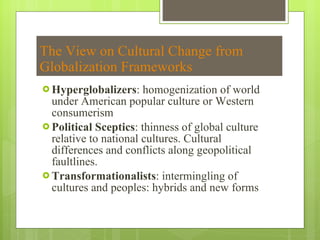
The View on Cultural Change from Globalization Frameworks Hyperglobalizers : homogenization of world under American popular culture or Western consumerism Political Sceptics : thinness of global culture relative to national cultures. Cultural differences and conflicts along geopolitical faultlines. Transformationalists : intermingling of cultures and peoples: hybrids and new forms
What is Culture?
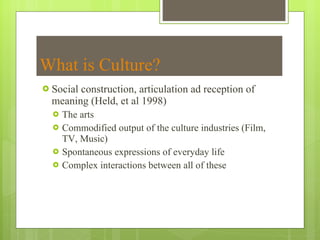
What is Culture? Social construction, articulation ad reception of meaning (Held, et al 1998) The arts Commodified output of the culture industries (Film, TV, Music) Spontaneous expressions of everyday life Complex interactions between all of these
What is Culture? Religion Ethnicity Nationalism Language Other forms of Identity The importance of forms of Communication
Cultural Globalization-concepts Cultural globalization: the transmission of culture globally Facilitated by the movement of people, objects, signs and symbols.  Travel Movement of books and cultural artifacts Key: forms of communication and transportation
Cultural Globalization-Concepts Stretching Diffusion Deepening: wearing the groove deeper Diverse encounters:  Homogenization Contestation Hybridization Indifference
Cultural Globalization-Concepts Is it all Coercion? Proselytism Evangelism Empire Better:  “Modes of interaction” Imposition Emulation Diffusion: hierarchical, contagious, relocation
Cultural Globalization-Concepts Infrastructures and Institutionalization: regularized and embedded change Transportation and communication technologies Social organization and systems: shipbuilding, mapmaking, shipping companies, international satellite companies, regulatory regimes, TV programming Languages: educational systems, training of teachers
Cultural Globalization: Historical Perspective World Religions Empires Modern national cultures Transnational secular ideologies Contemporary cultural globalization
Cultural Globalization: Historical Perspective World Religions: Christianity, Islam, Confucianism, Hinduism, Judaism, Buddhism- none is present everywhere Some odd pockets  1 million Japanese Shintoists in Brazil  Goan Catholics on west coast of India Religious/Political/Military Power Christianity Islam No proselytizing: Confusionism/Hinduism
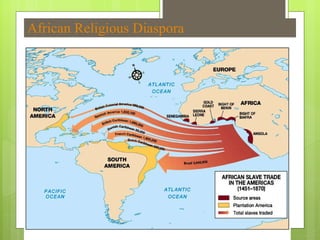
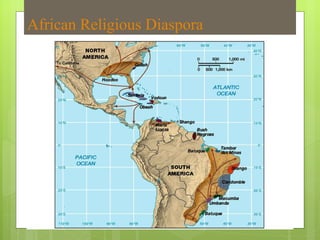
African Religious Diaspora
Cultural Globalization: Historical Perspective By 3 C. bce: Buddhism and Hinduism had their contemporary spread 700 ce: Islam in core regions 16 th /17 th  C. :Christianity reaches global presence (Books) World religions have given religious and political elites immense power and resources, ability to mobilize armies, and  “governance”
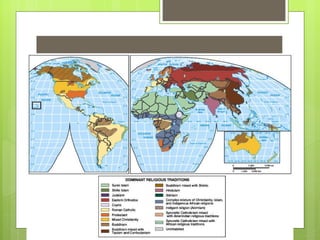
Dominant Religious Traditions
Empires Role of cultural power in creating and maintaining political empires Difficult to enforce rule at a distance Armies and governments are expensive Indirect rule: Universal ruling class Kinship, belief, religion Political divisions become vertical between classes Diffusion of culture provides cohesion
Roman Empire Capacity to deploy political power.  Accomplished through innovations: Logistical capabilities and civil engineering Political community Class solidarity Shared cultural beliefs, rituals and aesthetics Literacy was key among ruling class Drama and poetry were used to build allegiance
The British Empire Most global of any formal empire:  “the sun never sets on the British Empire” Imperial educational policy English medium schools in India, etc. Elites went to Oxford and Cambridge Imperial communications infrastructure Telegraph to India by 1870
Modern National Cultures Nation: cross-class community, whose shared sense of identity, solidarity and interest is rooted in an national identity ad common historical experience (real, imagined or interpreted) and whose central political project is the possession of a distinctive state in a bounded territory.  Nationalism: Psychological and cultural affiliation creating a connection with the community of the nation Ethnic nationalism Civic nationalism National culture: complex bodies of real and imagined practice, belief, ritual and attitude
Modern National Cultures Non existent before 18th century: Treaty of Westphalia National cultures invented and developed over time Cultural preconditions:  Literacy National histories, myths and rituals,  Importance of state powers of taxation and conscription
National Cultures Task undertaken by diverse institutions Official language National schooling system Postal service and Communications structures (NBC, ABC etc.) National press Standing army Suppression or eradication of competing identities and peripheral nationalisms Key factors Memories/histories/myths Role of land/landscapes/places:  Monuments National Parks sites of battle
Transnational Secular Ideologies European modern culture is secular Socialism and Marxism Enlightenment ideologies:  Modern scientific worldview  liberal political discourse:  civil and political rights Limited government Self-determination Capitalism Globalism?
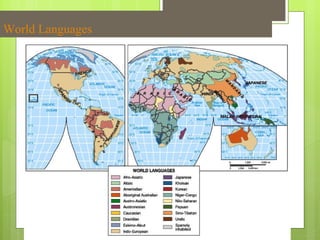
World Languages
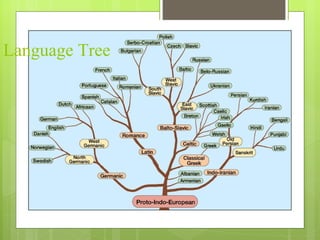
Language Tree
Cultural Globalization/Global Culture Markets Technologically driven Economic liberalization driven: mergers and acquisitions,deregulation, free trade barriers reduced  concentration of ownership Dominated by US, but Japanese, UK, and others are present (see chart)
Global Media Radio and the music industry Political instrument: Voice of America, Radio Venceremos  Instrument of Localism Major source of communication in developing countries for community/political/entertainment Music is highly compatible with globalization: no need for translation Musical diaspora: religious, African, American  Modern forms are more mixed: Orquesta de Luz, El Vez, World Music
Cinema and Television US Dominates Film Increasing growth of new film industries  Other industries: see chart Television: more recent, higher level of individual capital investment Public quality initially, now Satellite and Cable have changed control to private.
Tourism Issues:  Expanding Awareness  Sex Tourism Ecotourism and Rural Tourism: Contradictions?  Cultural Survival:  Who controls the production of culture? Tourism as an economic generator
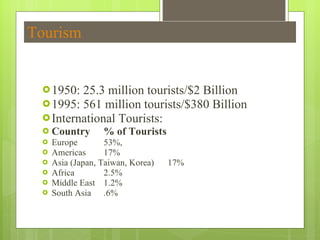
Tourism 1950: 25.3 million tourists/$2 Billion 1995: 561 million tourists/$380 Billion International Tourists: Country   % of Tourists Europe 53%, Americas 17% Asia (Japan, Taiwan, Korea) 17% Africa 2.5% Middle East 1.2% South Asia .6%

Week 1 globlization

  • 1.
  • 2.
    The View onCultural Change from Globalization Frameworks Hyperglobalizers : homogenization of world under American popular culture or Western consumerism Political Sceptics : thinness of global culture relative to national cultures. Cultural differences and conflicts along geopolitical faultlines. Transformationalists : intermingling of cultures and peoples: hybrids and new forms
  • 3.
  • 4.
    What is Culture?Social construction, articulation ad reception of meaning (Held, et al 1998) The arts Commodified output of the culture industries (Film, TV, Music) Spontaneous expressions of everyday life Complex interactions between all of these
  • 5.
    What is Culture?Religion Ethnicity Nationalism Language Other forms of Identity The importance of forms of Communication
  • 6.
    Cultural Globalization-concepts Culturalglobalization: the transmission of culture globally Facilitated by the movement of people, objects, signs and symbols. Travel Movement of books and cultural artifacts Key: forms of communication and transportation
  • 7.
    Cultural Globalization-Concepts StretchingDiffusion Deepening: wearing the groove deeper Diverse encounters: Homogenization Contestation Hybridization Indifference
  • 8.
    Cultural Globalization-Concepts Isit all Coercion? Proselytism Evangelism Empire Better: “Modes of interaction” Imposition Emulation Diffusion: hierarchical, contagious, relocation
  • 9.
    Cultural Globalization-Concepts Infrastructuresand Institutionalization: regularized and embedded change Transportation and communication technologies Social organization and systems: shipbuilding, mapmaking, shipping companies, international satellite companies, regulatory regimes, TV programming Languages: educational systems, training of teachers
  • 10.
    Cultural Globalization: HistoricalPerspective World Religions Empires Modern national cultures Transnational secular ideologies Contemporary cultural globalization
  • 11.
    Cultural Globalization: HistoricalPerspective World Religions: Christianity, Islam, Confucianism, Hinduism, Judaism, Buddhism- none is present everywhere Some odd pockets 1 million Japanese Shintoists in Brazil Goan Catholics on west coast of India Religious/Political/Military Power Christianity Islam No proselytizing: Confusionism/Hinduism
  • 12.
  • 13.
  • 14.
    Cultural Globalization: HistoricalPerspective By 3 C. bce: Buddhism and Hinduism had their contemporary spread 700 ce: Islam in core regions 16 th /17 th C. :Christianity reaches global presence (Books) World religions have given religious and political elites immense power and resources, ability to mobilize armies, and “governance”
  • 15.
  • 16.
    Empires Role ofcultural power in creating and maintaining political empires Difficult to enforce rule at a distance Armies and governments are expensive Indirect rule: Universal ruling class Kinship, belief, religion Political divisions become vertical between classes Diffusion of culture provides cohesion
  • 17.
    Roman Empire Capacityto deploy political power. Accomplished through innovations: Logistical capabilities and civil engineering Political community Class solidarity Shared cultural beliefs, rituals and aesthetics Literacy was key among ruling class Drama and poetry were used to build allegiance
  • 18.
    The British EmpireMost global of any formal empire: “the sun never sets on the British Empire” Imperial educational policy English medium schools in India, etc. Elites went to Oxford and Cambridge Imperial communications infrastructure Telegraph to India by 1870
  • 19.
    Modern National CulturesNation: cross-class community, whose shared sense of identity, solidarity and interest is rooted in an national identity ad common historical experience (real, imagined or interpreted) and whose central political project is the possession of a distinctive state in a bounded territory. Nationalism: Psychological and cultural affiliation creating a connection with the community of the nation Ethnic nationalism Civic nationalism National culture: complex bodies of real and imagined practice, belief, ritual and attitude
  • 20.
    Modern National CulturesNon existent before 18th century: Treaty of Westphalia National cultures invented and developed over time Cultural preconditions: Literacy National histories, myths and rituals, Importance of state powers of taxation and conscription
  • 21.
    National Cultures Taskundertaken by diverse institutions Official language National schooling system Postal service and Communications structures (NBC, ABC etc.) National press Standing army Suppression or eradication of competing identities and peripheral nationalisms Key factors Memories/histories/myths Role of land/landscapes/places: Monuments National Parks sites of battle
  • 22.
    Transnational Secular IdeologiesEuropean modern culture is secular Socialism and Marxism Enlightenment ideologies: Modern scientific worldview liberal political discourse: civil and political rights Limited government Self-determination Capitalism Globalism?
  • 23.
  • 24.
  • 25.
    Cultural Globalization/Global CultureMarkets Technologically driven Economic liberalization driven: mergers and acquisitions,deregulation, free trade barriers reduced  concentration of ownership Dominated by US, but Japanese, UK, and others are present (see chart)
  • 26.
    Global Media Radioand the music industry Political instrument: Voice of America, Radio Venceremos Instrument of Localism Major source of communication in developing countries for community/political/entertainment Music is highly compatible with globalization: no need for translation Musical diaspora: religious, African, American Modern forms are more mixed: Orquesta de Luz, El Vez, World Music
  • 27.
    Cinema and TelevisionUS Dominates Film Increasing growth of new film industries Other industries: see chart Television: more recent, higher level of individual capital investment Public quality initially, now Satellite and Cable have changed control to private.
  • 28.
    Tourism Issues: Expanding Awareness Sex Tourism Ecotourism and Rural Tourism: Contradictions? Cultural Survival: Who controls the production of culture? Tourism as an economic generator
  • 29.
    Tourism 1950: 25.3million tourists/$2 Billion 1995: 561 million tourists/$380 Billion International Tourists: Country % of Tourists Europe 53%, Americas 17% Asia (Japan, Taiwan, Korea) 17% Africa 2.5% Middle East 1.2% South Asia .6%