A WORLD OF IDEAS
THE CONTEMPORARY WORLD
GLOBAL MEDIA
CULTURES
GLOBALIZATION
OF RELIGION
GLOBALIZATION
OF
TECHNOLOGY
GLOBALIZATION
OF
LIFESTYLE
GLOBALIZATION
OF
EDUCATION
CULTURE
SYMBOLS
ILLUSTRATIONS
LANGUAGE
VALUES
BELIEFS
PRACTICES
CULTURE
MATERIAL NON-MATERIAL
Clothes
Infrastructure
Beliefs
Traditions
Practices
GLOBALIZATION AND
CULTURE
Cultural Flow- a term often used to refer this dynamics of
culture in the age of globalization.
CULTURAL DIFFERENTIALISM
Religious convictions and
ideologies shared by members
of a particular society.
CULTURAL HYBRIDIZATION
Ethnoscapes- movement of
people
Technoscapes- technology
Financescapes
Mediascapes
Ideoscapes
CULTURE
CULTURAL
CONVERGENCE
ISOMORPHIC
CULTURAL
ASSIMILATION
CULTURAL
IMPERIALISM
DETERRIIALIZATION
MEDIA
⮚Are the communication outlets or tools used
to store and deliver information or data
⮚Various means of communication
MEDIA
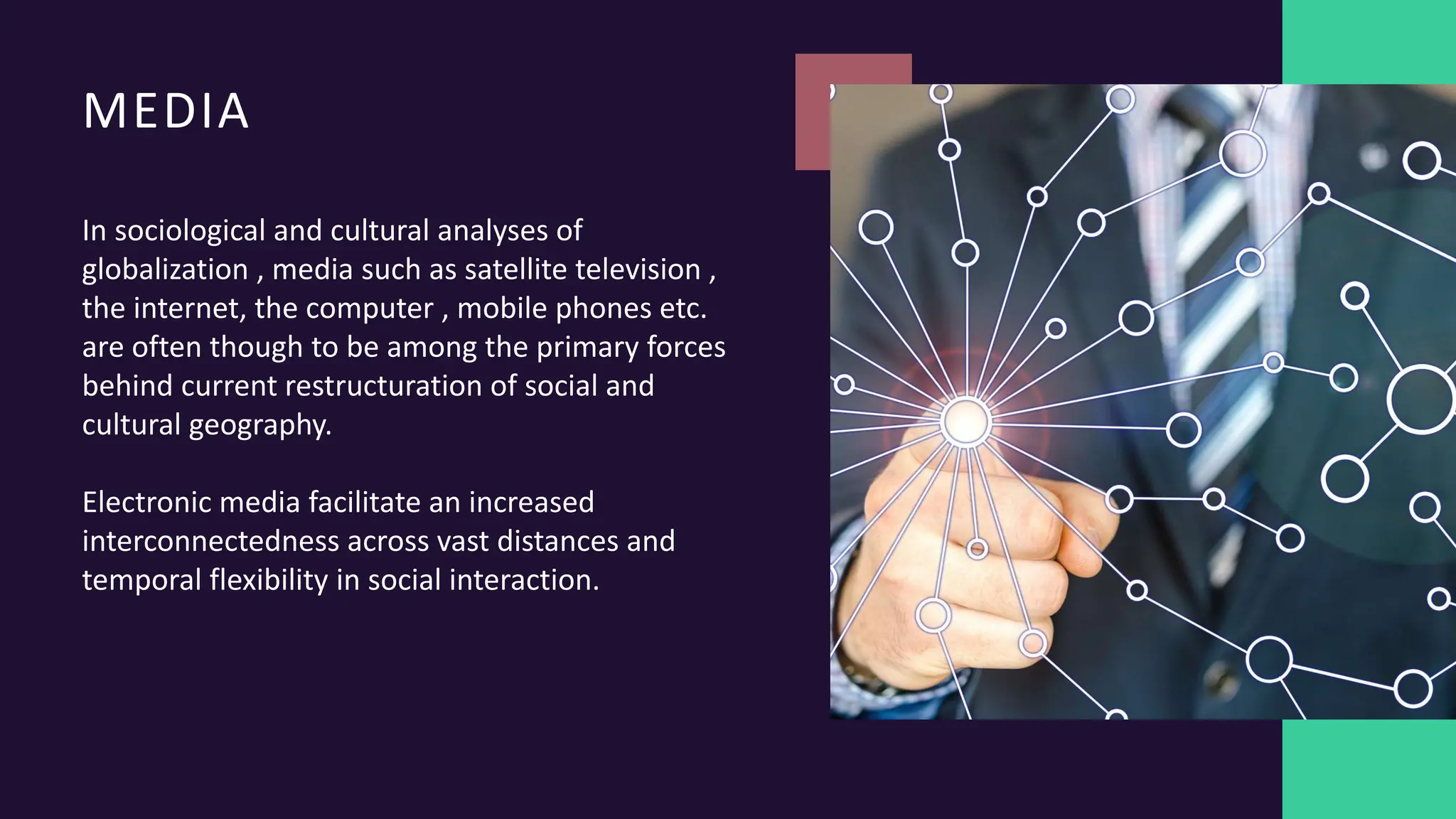
In sociological and cultural analyses of
globalization , media such as satellite television ,
the internet, the computer , mobile phones etc.
are often though to be among the primary forces
behind current restructuration of social and
cultural geography.
Electronic media facilitate an increased
interconnectedness across vast distances and
temporal flexibility in social interaction.
Global media and communication is an
international , peer-reviewed journal
that provides a platform for research
and debate on the continuously
changing global media and
communication environment. This
journal is a member of the committee
on publication Ethics.
GLOBAL MEDIA
CULTURAL SOCIALIZATION
We learn culture from our homes and communities.
CULTURAL EXCHANGE
We experience a different culture
ACCULTURATION
Adapting the certain values and practices of the new
culture
ACCOMODATION
Adopting new culture only when we are in
public
a. Newspaper-information, opinion,
current events, and news
a. Television-system of transmitting visual
images and sound used for broadcast
Internet-network system of the interconnected
computer systems
TYPES OF MEDIA
Traditional/Old Media
> Print media such as books, newspapers,
magazines, newsletters, journals, pamphlets,
fliers, broadsides,
billboards
New media- means of communication
using digital technologies such as :
Telephone, computers, social media,
mobile phones
STAGES OF
EVOLUTION
PRE INDUSTRIAL AGE
⮚Began when electronic equipment, including
computers came into use Realization of the
importance and relevance of Information as a
commodity
⮚Development of fax machine and cellphones-
faster way of transmitting messages
⮚Cable and satellite technologies
⮚Development of broadcast industry; expansion
of radio and television
⮚Portable gadgets like Walkman and discman
revolutionized the access to mass media
DIGITAL AGE
⮚Starting 1970’s with introduction of personal
computer and subsequent
technology
⮚
Refers to our current age; information is seen
as commodity
⮚Evolution of personal computer- Apple, IBM
Company,Windows
⮚emergence of digital photography with
digital single lens reflex camera known as
DSLR
CULTURAL IMPERIALISM
Argues that audiences across the globe are heavily affected by media
messages emanating from the Western
industrialized countries.
-Nation-states as primary actors in international relations. They imputed
rich, industrialized, and Western nation-states with intentions and actions
by which they export their cultural products and impose their sociocultural
values on poorer and weaker nations in the developing world.
-flow of news and entertainment was biased in favor of industrialized
countries.
-This bias was clear both in terms of quantity, because most media flows
were exported by Western countries and imported by developing
nations, and in terms of quality, because developing nations received
scant and prejudicial coverage in Western media.
CULTURAL IMPERIALISM
✗ The global media debate was launched during the 1973 General
Conference of the United Nations Educational, Scientific, and Cultural
Organization (UNESCO) in Nairobi, Kenya.
✗ As a specialized agency of the United Nations, the mission of UNESCO
includes issues of communication and culture.
CULTURAL IMPERIALISM TO GLOBALIZATION
First, the end of the Cold War as a global framework for ideological,
geopolitical, and economic competition calls for a rethinking of the
analytical categories and paradigms of thought.
Second, according to John Tomlinson (1991), globalization replaced cultura
imperialism because it conveys a process with less coherence and direction
which will weaken the cultural unity of all nation-states, not only those in
the developing world.
Finally, globalization has emerged as a key perspective across the
humanities and social sciences, a current undoubtedly affecting the
discipline of communication.
ISSUES IN MEDIA CULTURES
•ACCESS
-WHO HAS ACCESS TO MEDIA?
-IS IT SOMETHING THAT EVERYONE NEEDS IT CAN
GET HOLD OF?
-OR ARE THERE ONLY A FEW GROUPS OF PEOPLE
WHO HAS ACCESS TO I T BECAUSE OF CERTAIN
SOCIOECONOMIC ADVANTAGE?
ISSUES IN MEDIA CULTURES
•PRODUCTION AND
CONSUMPTION
-WHAT MEDIA CONTENTS ARE MADE AVAILABLE
FOR CONSUMPTION?
-WHO DECIDES WHAT O PRODUCE OR NOT TO
PRODUCE?
-WHAT ARE THE INTENTIONS FOR PRODUCING
SUCH CONTENTS?
-WHO CONTROLS WHAT TO CONVEY AND HOW?
ISSUES IN MEDIA CULTURES
•INCLUSION AND PARTICIPATION
-HOW ARE PEOPLE REPRESENTED IN MEDIA?
-ARE THESE PORTRAYALS EMPOWERING OR DIMINUTIVE?
-DOES THE MEDIA CULTURE PROMOTE A CULTURE OF DIGNITY?
ISSUES IN MEDIA CULTURES
•CULTURAL INTEGRITY
-HOW DOES THE MEDIA CULTURE SHAPE IN THE INHERENT CULTURE
IN THE LOCAL SPHERE?
-HOW IS CULTURE FRAMED IN MEDIA?
GLOBALIZATION OF RELIGION
RELIGION- a unified system of beliefs and practice related to
faith, the sacred, higher moral values
SECULARIZATION- diminishing role of religion in the society
GLOCALIZATION OF RELIGION- intermingling of universal and
local religious beliefs
GLOBALIZATION OF RELIGION
RELIGION- a unified system of beliefs and practice related to
faith, the sacred, higher moral values
SECULARIZATION- diminishing role of religion in the society
GLOCALIZATION OF RELIGION- intermingling of universal and
local religious beliefs
“No doubt, when all we do is consider the formulas literally, these
religious beliefs and practices appear disconcerting, and our
inclination might be to write them off to some sort of inborn
aberration. But we must know how to reach beneath the symbol to
grasp the reality it represents and that gives the symbols its true
meaning. The most bizarre or barbarous rites and the strangest
myths translate some human need and some aspect of life, whether
social or individual”
-Emile Durkheim, “ The Elementary Form of Religious Life”
SIZE OF MAJOR
RELIGION GROUPS,
2010
PERCENTAGE OF THE GLOBAL POPULATION
THERE ARE MORE THAN 7 BILLION PEOPLE IN THE
WORLD TODAY, AND ALMOST 84 PERCENT OF THE
PEOPLE IDENTIFY THEMSELVES AS PART OF A
RELIGIOUS GROUP
Size of Major Religious Groups, 2010
Christian Muslims Unaffiliated Hindus Buddhists Folk Regionists Other Religions Jews
Christian 31.50%
Muslims 23.20%
Unaffiliated 16.30%
Hindus 15.00%
Buddhists 7.10%
Folk
Religionists 5.9
Jews 0.20%
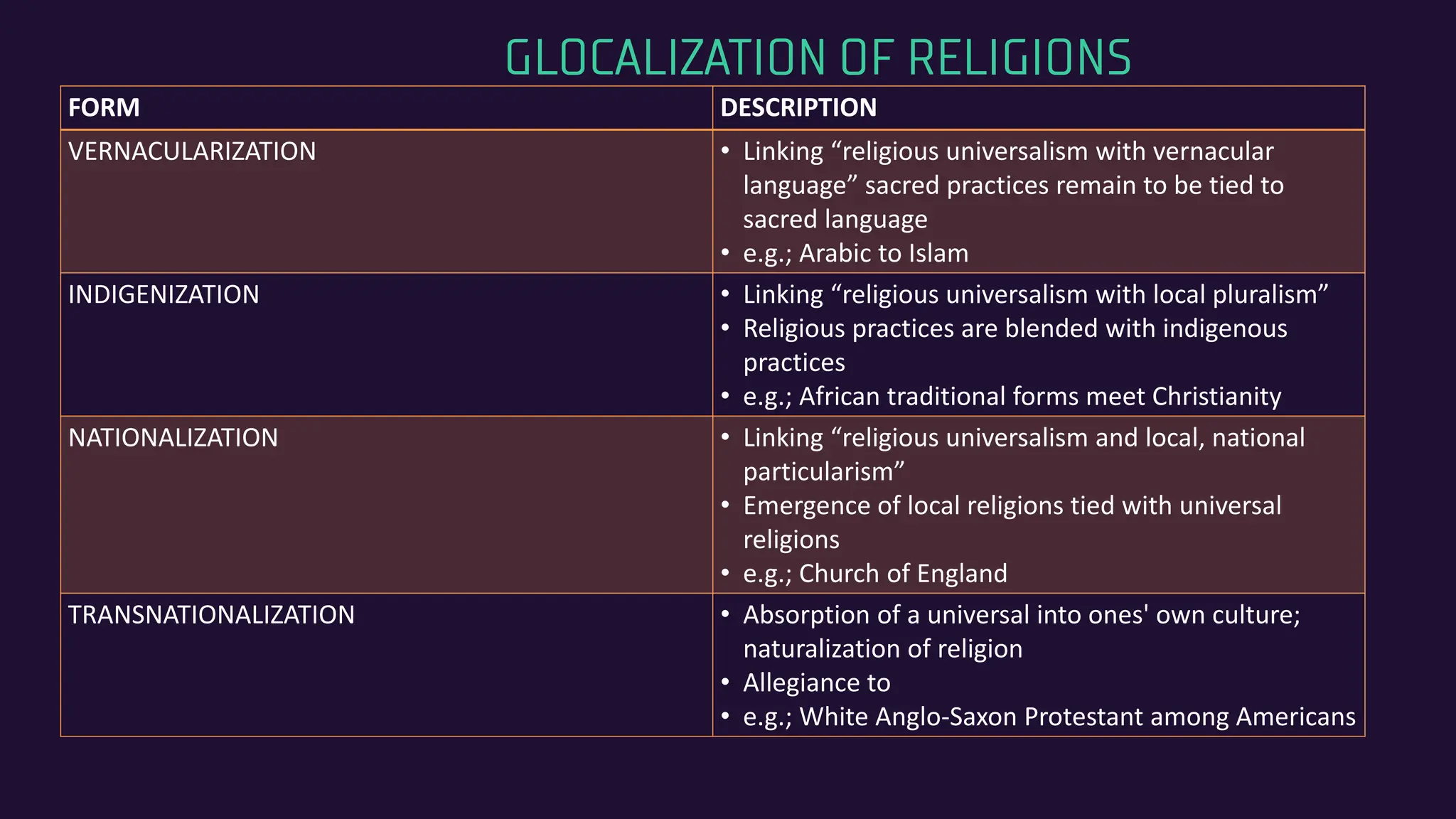
GLOCALIZATION OF RELIGIONS
FORM DESCRIPTION
VERNACULARIZATION • Linking “religious universalism with vernacular
language” sacred practices remain to be tied to
sacred language
• e.g.; Arabic to Islam
INDIGENIZATION • Linking “religious universalism with local pluralism”
• Religious practices are blended with indigenous
practices
• e.g.; African traditional forms meet Christianity
NATIONALIZATION • Linking “religious universalism and local, national
particularism”
• Emergence of local religions tied with universal
religions
• e.g.; Church of England
TRANSNATIONALIZATION • Absorption of a universal into ones' own culture;
naturalization of religion
• Allegiance to
• e.g.; White Anglo-Saxon Protestant among Americans
GLOBALIZATION
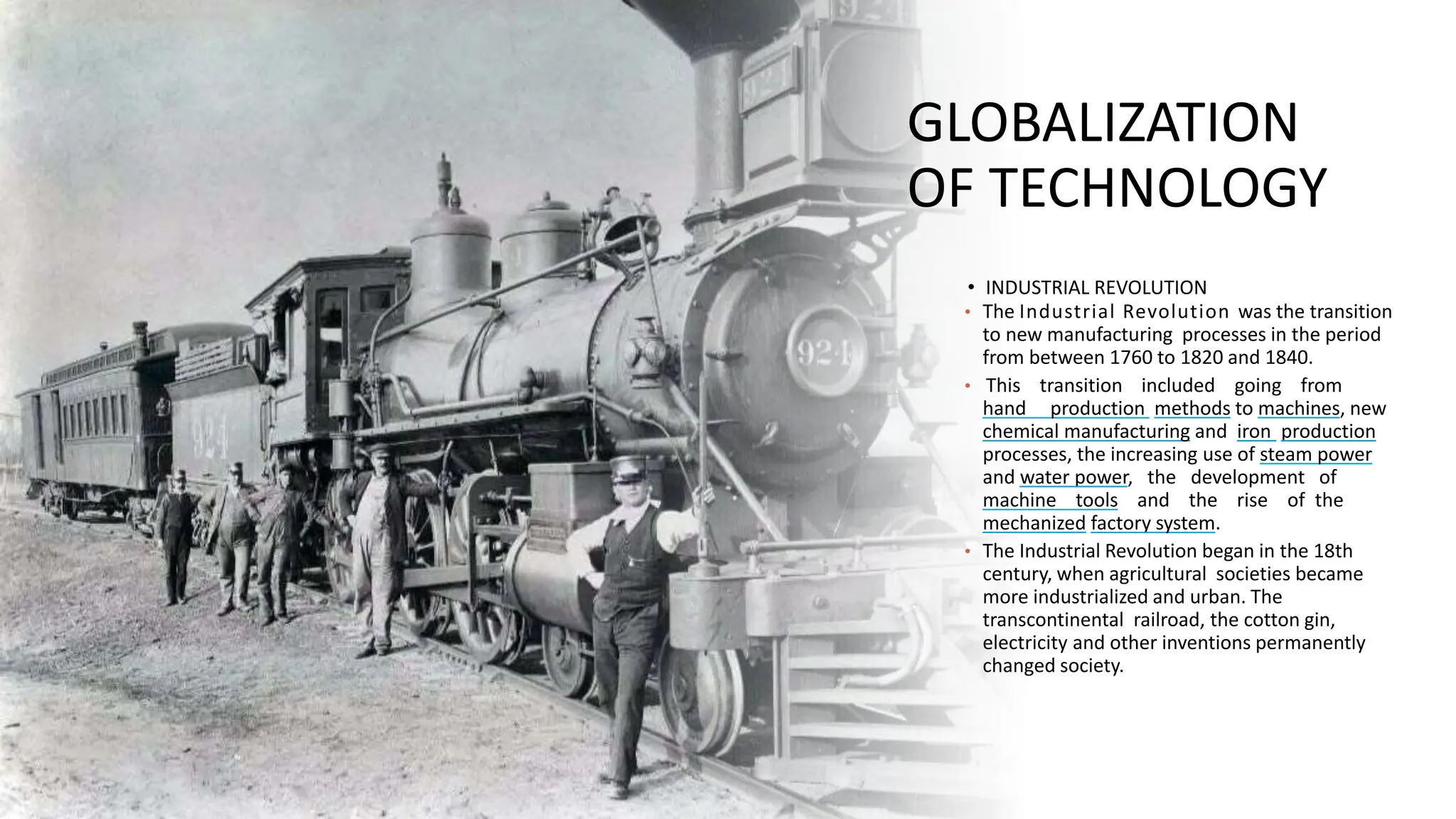
OF TECHNOLOGY
• INDUSTRIAL REVOLUTION
• The Industrial Revolution was the transition
to new manufacturing processes in the period
from between 1760 to 1820 and 1840.
• This transition included going from
hand production methods to machines, new
chemical manufacturing and iron production
processes, the increasing use of steam power
and water power, the development of
machine tools and the rise of the
mechanized factory system.
• The Industrial Revolution began in the 18th
century, when agricultural societies became
more industrialized and urban. The
transcontinental railroad, the cotton gin,
electricity and other inventions permanently
changed society.
• It all began with the first industrial
revolution, or what most historians refer to
as simply “The Industrial Revolution.”
• This waswhen the primary means
of manufacturing moved from
manpower to machine power.
• Fuel sources like steam and coal made
machine-use more feasible, and the idea of
manufacturing with machines quickly
spread.
• Machines allowed faster and easier
production, and they made all kinds of new
innovations and technologies possible as
well.
Industry 1.0 – The Industrial Revolution
• The first Industrial Revolution
represented the period between
the 1760s and around 1840.
• This is where the second
industrial revolution picked up.
• Historians sometimes refer to this
as “The Technological
Revolution,” where superior
electrical technology allowed
even greater production and
more sophisticated machines.
Industry 2.0 – The Technological
Revolution
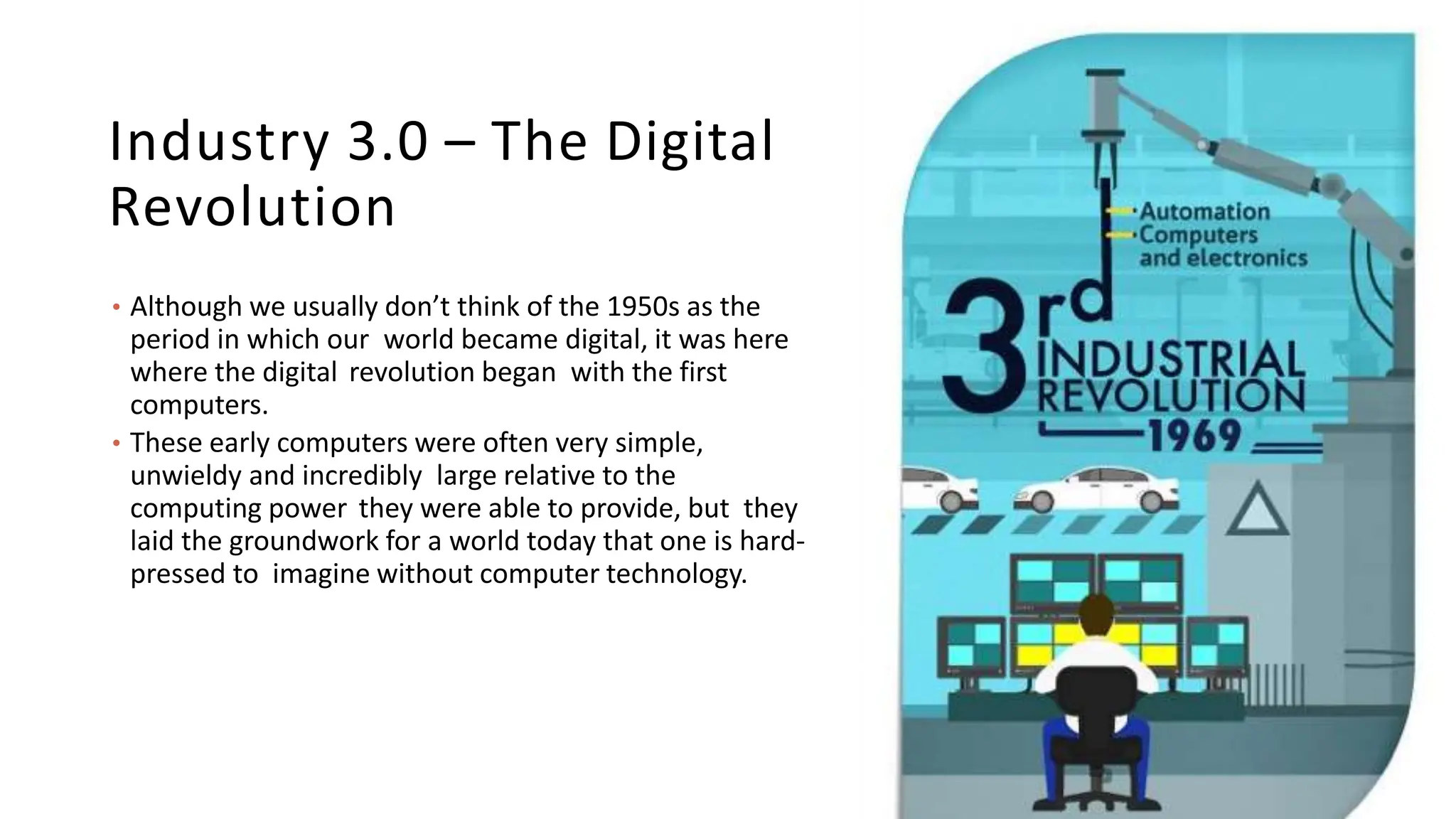
Industry 3.0 – The Digital
Revolution
• Although we usually don’t think of the 1950s as the
period in which our world became digital, it was here
where the digital revolution began with the first
computers.
• These early computers were often very simple,
unwieldy and incredibly large relative to the
computing power they were able to provide, but they
laid the groundwork for a world today that one is hard-
pressed to imagine without computer technology.
Industry 4.0 – The
Automation
Revolution
• Proponents of Industry 4.0 refer
to the concept in terms akin to
the smart home — a network of
“smart factories,” so to speak. In a
smart home, the various luxuries
and security features of a modern
day residence — lights,
appliances, alarms, clocks — are
enhanced with digital capabilities,
such as sensing, scanning,
programming memory and voice
and facial recognition.
Industry 4.0 – The
Automation
Revolution
• Cyber-physical system — a
mechanical device that is run by
computer-based algorithms.
• The Internet of things (IoT) —
interconnected networks of
machine devices and vehicles
embedded with computerized
sensing, scanning and monitoring
capabilities.
• Cloud computing — offsite network
hosting and data backup.
• Cognitive computing —
technological platforms that employ
artificial intelligence.
● The term Industry 5.0 refers to people
working alongside robots and smart machines.
● It’s about robots helping humans work better
and faster by leveraging advanced technologies
like the Internet of Things (IoT) and big data.
● It adds a personal human touch to
the Industry 4.0 pillars of
automation and efficiency.
Industry 5.0 – The Personalizable (HMI) Revolution
HISTORY OF INDUSTRIAL REVOLUTION
TECHNOLOGICAL DIFFUSION
In the age of globalization, technology also
flows in and out across borders. This process
can be referred to as technological diffusion.
It is essential to look at technology diffusion,
because the inflow and outflow of technology
is simultaneous to economic, political and
cultural flows.
TECHNOLOGICAL TRENDS IN THE AGE OF
GLOBALIZATION
INFORMATION AND COMMUNICATION
TECHNOLOGICAL TRENDS IN THE AGE OF
GLOBALIZATION
TRANSPORTATION
TECHNOLOGICAL TRENDS IN THE AGE OF
GLOBALIZATION
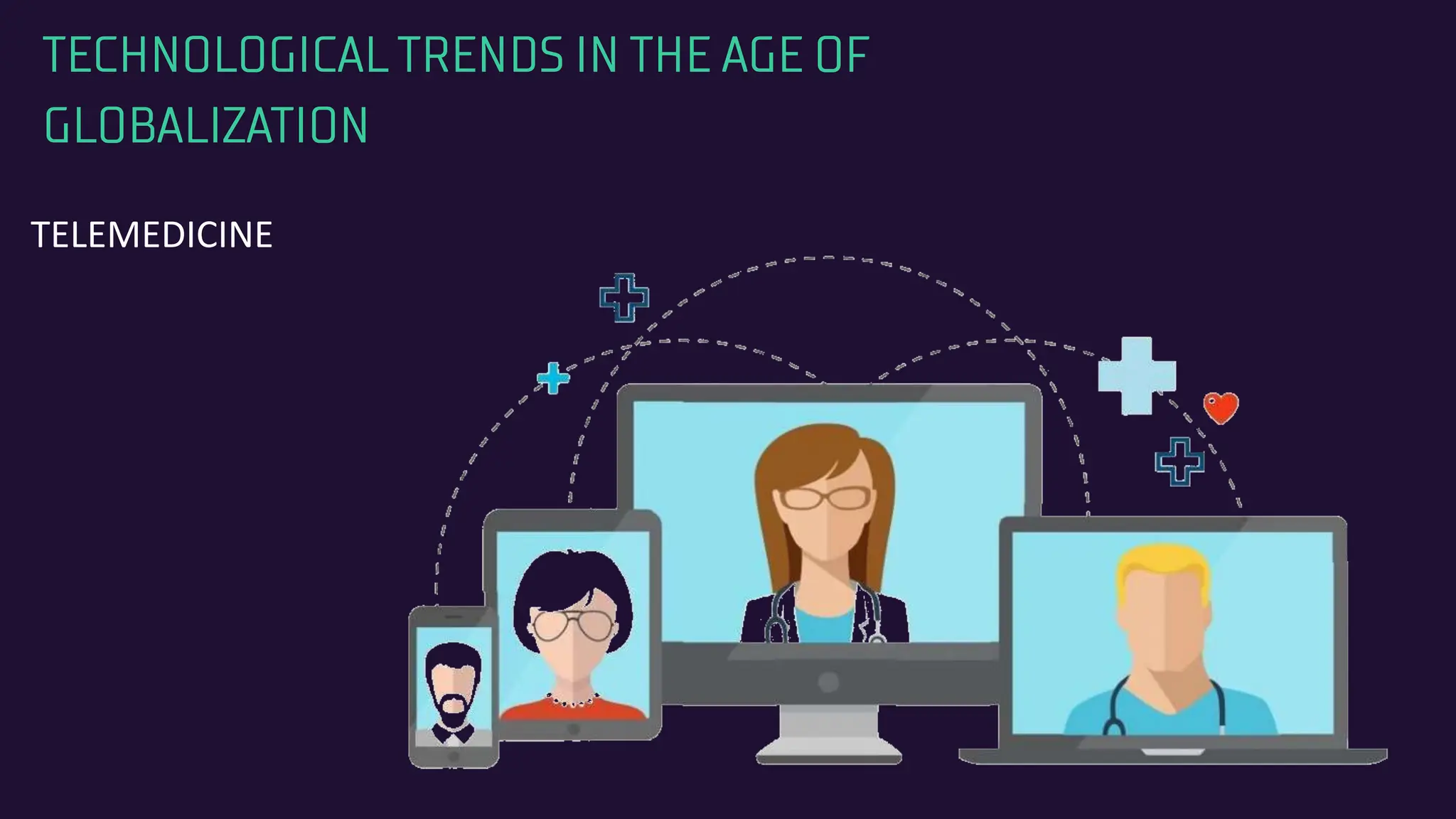
TELEMEDICINE
TECHNOLOGICAL TRENDS IN THE AGE OF
GLOBALIZATION
ARCHITECTURE, ENERGY AND THE ENVIRONMENT
TECHNOLOGICAL TRENDS IN THE AGE OF
GLOBALIZATION
COMMERCE
TECHNOLOGICAL TRENDS IN THE AGE OF
GLOBALIZATION
SPACE SCIENCE
TECHNOLOGICAL TRENDS IN THE AGE OF
GLOBALIZATION
AI, ROBOTS AND NANOTECHNOLOGY
GLOBALIZATIO
N OF LIFESTYLE
• LIFESTYLE- it is a multidimensional,
pluralistic, and crosscutting concept
referring to the way we live or
everyday, as well as the factors
influencing this process
INTRODUCTION
Earlier, we have discussed that cultural flows are prevalent in the age of globalization. In this
lesson, we will look more specifically on patterns and manifestations of cultural flows in various
aspects of our lifestyle. While saying that culture now freely crosses territorial borders is not so
difficult to comprehend, being able to observe interpenetration of cultures in the food we eat, in
the clothes we wear, and even in the arts and music we produce and consume, provide a much
more profound experience as to how this cultural flow shapes us individually and collectively.
Mikael Jensen (2007), in his article “Defining lifestyle,” offered an exhaustive discussion on how
lifestyle can be defined and construed. Jensen (2007) argued that lifestyle should be
understood in a “pluralistic way” (p.63), such that it cuts across various human activities.
Reviewing various literatures on the subject, Jensen conveyed that lifestyle is defined differently:
(a)as the “how” of doing things and living one’s life,
(b)as a totality of factors that enable us to keep ourselves healthy, and
(c)as our consumption behaviour.
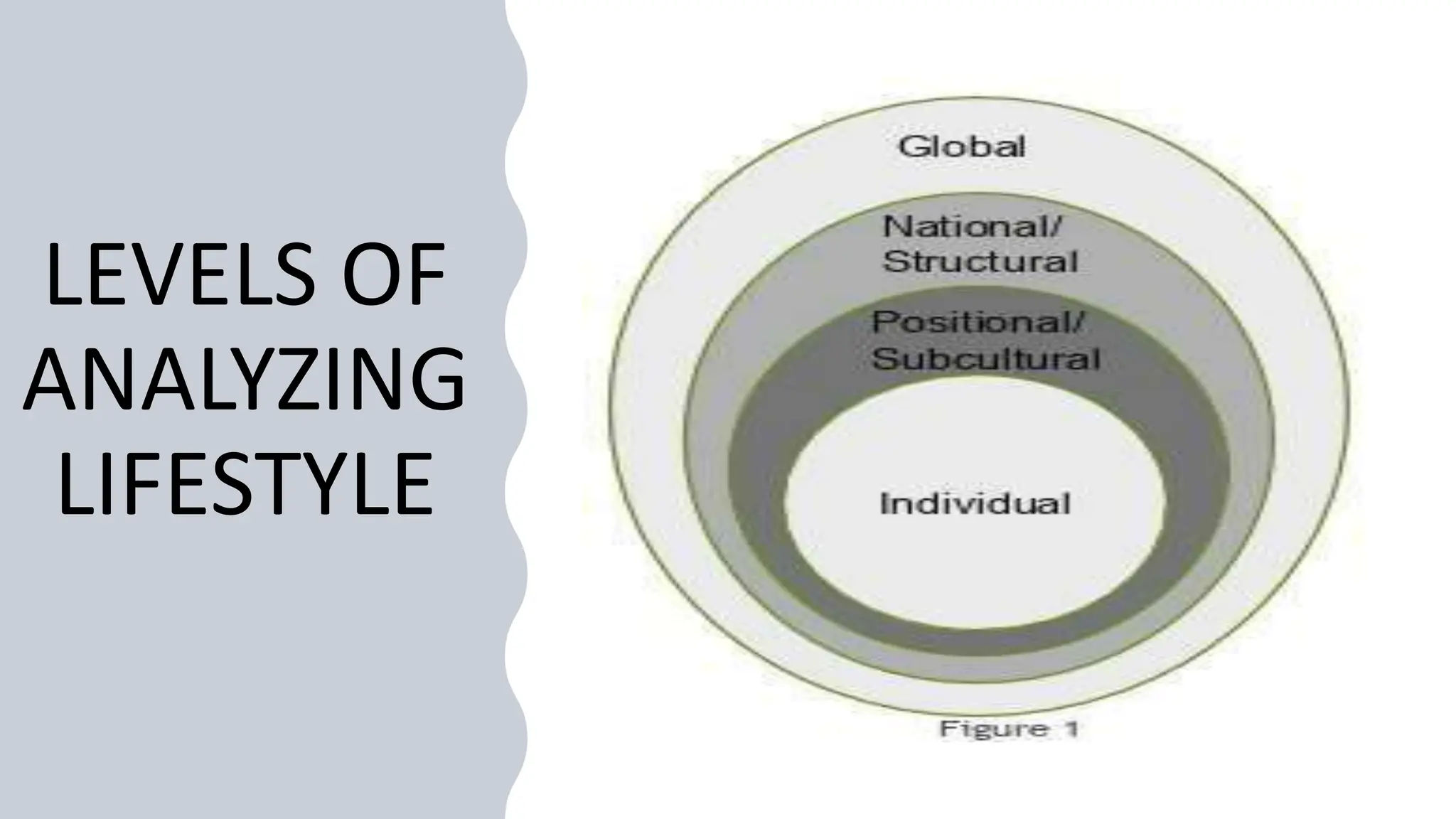
Considering how complex the concept of lifestyle is, Jensen suggested that it has to be
analyzed at various levels.
LEVELS OF
ANALYZING
LIFESTYLE
LEVELS OF
ANALYZING
LIFESTYLE
Another way of understanding lifestyle was discussed by Anthony Veal
(1993) in an earlier
review of the concept of lifestyle. According to Veal (1993, pp. 241-247),
lifestyle can be analyzed by looking at:
1.Activities or behavior (consumption, leisure, and household behaviors);
2.Attitudes and values (influences on behavior such as politics and
religion);
3.Individual processes (preferences);
4.Group processes (social interactions and influences);
5.Coherence (alignment of lifestyle with personal goals);
6.Recognizability (whether lifestyle is shared with others or not); and
7.Choice (whether people get to choose the lifestyle they want and what
are the factors influencing so).
This study source was downloaded by
100000798492941 from CourseHero.com on 12-21-
2022 00:40:51 GMT -06:00
LIFESTYLE IN THE AGE OF
GLOBALIZATION
FOOD
LIFESTYLE IN THE AGE OF
GLOBALIZATION
MUSIC
LIFESTYLE IN THE AGE OF
GLOBALIZATION
SPORTS
THANK YOU

worldofideas-221228023211-4606be90.pdf

  • 1.
    A WORLD OFIDEAS THE CONTEMPORARY WORLD GLOBAL MEDIA CULTURES GLOBALIZATION OF RELIGION GLOBALIZATION OF TECHNOLOGY GLOBALIZATION OF LIFESTYLE GLOBALIZATION OF EDUCATION
  • 2.
  • 3.
  • 4.
    GLOBALIZATION AND CULTURE Cultural Flow-a term often used to refer this dynamics of culture in the age of globalization. CULTURAL DIFFERENTIALISM Religious convictions and ideologies shared by members of a particular society. CULTURAL HYBRIDIZATION Ethnoscapes- movement of people Technoscapes- technology Financescapes Mediascapes Ideoscapes
  • 5.
  • 6.
    MEDIA ⮚Are the communicationoutlets or tools used to store and deliver information or data ⮚Various means of communication
  • 7.
    MEDIA In sociological andcultural analyses of globalization , media such as satellite television , the internet, the computer , mobile phones etc. are often though to be among the primary forces behind current restructuration of social and cultural geography. Electronic media facilitate an increased interconnectedness across vast distances and temporal flexibility in social interaction.
  • 8.
    Global media andcommunication is an international , peer-reviewed journal that provides a platform for research and debate on the continuously changing global media and communication environment. This journal is a member of the committee on publication Ethics. GLOBAL MEDIA
  • 9.
    CULTURAL SOCIALIZATION We learnculture from our homes and communities. CULTURAL EXCHANGE We experience a different culture
  • 10.
    ACCULTURATION Adapting the certainvalues and practices of the new culture ACCOMODATION Adopting new culture only when we are in public
  • 11.
    a. Newspaper-information, opinion, currentevents, and news a. Television-system of transmitting visual images and sound used for broadcast Internet-network system of the interconnected computer systems
  • 12.
    TYPES OF MEDIA Traditional/OldMedia > Print media such as books, newspapers, magazines, newsletters, journals, pamphlets, fliers, broadsides, billboards New media- means of communication using digital technologies such as : Telephone, computers, social media, mobile phones
  • 13.
  • 14.
    PRE INDUSTRIAL AGE ⮚Beganwhen electronic equipment, including computers came into use Realization of the importance and relevance of Information as a commodity ⮚Development of fax machine and cellphones- faster way of transmitting messages ⮚Cable and satellite technologies ⮚Development of broadcast industry; expansion of radio and television ⮚Portable gadgets like Walkman and discman revolutionized the access to mass media
  • 15.
    DIGITAL AGE ⮚Starting 1970’swith introduction of personal computer and subsequent technology ⮚ Refers to our current age; information is seen as commodity ⮚Evolution of personal computer- Apple, IBM Company,Windows ⮚emergence of digital photography with digital single lens reflex camera known as DSLR
  • 16.
    CULTURAL IMPERIALISM Argues thataudiences across the globe are heavily affected by media messages emanating from the Western industrialized countries. -Nation-states as primary actors in international relations. They imputed rich, industrialized, and Western nation-states with intentions and actions by which they export their cultural products and impose their sociocultural values on poorer and weaker nations in the developing world. -flow of news and entertainment was biased in favor of industrialized countries. -This bias was clear both in terms of quantity, because most media flows were exported by Western countries and imported by developing nations, and in terms of quality, because developing nations received scant and prejudicial coverage in Western media.
  • 17.
    CULTURAL IMPERIALISM ✗ Theglobal media debate was launched during the 1973 General Conference of the United Nations Educational, Scientific, and Cultural Organization (UNESCO) in Nairobi, Kenya. ✗ As a specialized agency of the United Nations, the mission of UNESCO includes issues of communication and culture.
  • 18.
    CULTURAL IMPERIALISM TOGLOBALIZATION First, the end of the Cold War as a global framework for ideological, geopolitical, and economic competition calls for a rethinking of the analytical categories and paradigms of thought. Second, according to John Tomlinson (1991), globalization replaced cultura imperialism because it conveys a process with less coherence and direction which will weaken the cultural unity of all nation-states, not only those in the developing world. Finally, globalization has emerged as a key perspective across the humanities and social sciences, a current undoubtedly affecting the discipline of communication.
  • 19.
    ISSUES IN MEDIACULTURES •ACCESS -WHO HAS ACCESS TO MEDIA? -IS IT SOMETHING THAT EVERYONE NEEDS IT CAN GET HOLD OF? -OR ARE THERE ONLY A FEW GROUPS OF PEOPLE WHO HAS ACCESS TO I T BECAUSE OF CERTAIN SOCIOECONOMIC ADVANTAGE?
  • 20.
    ISSUES IN MEDIACULTURES •PRODUCTION AND CONSUMPTION -WHAT MEDIA CONTENTS ARE MADE AVAILABLE FOR CONSUMPTION? -WHO DECIDES WHAT O PRODUCE OR NOT TO PRODUCE? -WHAT ARE THE INTENTIONS FOR PRODUCING SUCH CONTENTS? -WHO CONTROLS WHAT TO CONVEY AND HOW?
  • 21.
    ISSUES IN MEDIACULTURES •INCLUSION AND PARTICIPATION -HOW ARE PEOPLE REPRESENTED IN MEDIA? -ARE THESE PORTRAYALS EMPOWERING OR DIMINUTIVE? -DOES THE MEDIA CULTURE PROMOTE A CULTURE OF DIGNITY?
  • 22.
    ISSUES IN MEDIACULTURES •CULTURAL INTEGRITY -HOW DOES THE MEDIA CULTURE SHAPE IN THE INHERENT CULTURE IN THE LOCAL SPHERE? -HOW IS CULTURE FRAMED IN MEDIA?
  • 23.
    GLOBALIZATION OF RELIGION RELIGION-a unified system of beliefs and practice related to faith, the sacred, higher moral values SECULARIZATION- diminishing role of religion in the society GLOCALIZATION OF RELIGION- intermingling of universal and local religious beliefs
  • 24.
    GLOBALIZATION OF RELIGION RELIGION-a unified system of beliefs and practice related to faith, the sacred, higher moral values SECULARIZATION- diminishing role of religion in the society GLOCALIZATION OF RELIGION- intermingling of universal and local religious beliefs
  • 25.
    “No doubt, whenall we do is consider the formulas literally, these religious beliefs and practices appear disconcerting, and our inclination might be to write them off to some sort of inborn aberration. But we must know how to reach beneath the symbol to grasp the reality it represents and that gives the symbols its true meaning. The most bizarre or barbarous rites and the strangest myths translate some human need and some aspect of life, whether social or individual” -Emile Durkheim, “ The Elementary Form of Religious Life”
  • 26.
    SIZE OF MAJOR RELIGIONGROUPS, 2010 PERCENTAGE OF THE GLOBAL POPULATION THERE ARE MORE THAN 7 BILLION PEOPLE IN THE WORLD TODAY, AND ALMOST 84 PERCENT OF THE PEOPLE IDENTIFY THEMSELVES AS PART OF A RELIGIOUS GROUP Size of Major Religious Groups, 2010 Christian Muslims Unaffiliated Hindus Buddhists Folk Regionists Other Religions Jews Christian 31.50% Muslims 23.20% Unaffiliated 16.30% Hindus 15.00% Buddhists 7.10% Folk Religionists 5.9 Jews 0.20%
  • 27.
    GLOCALIZATION OF RELIGIONS FORMDESCRIPTION VERNACULARIZATION • Linking “religious universalism with vernacular language” sacred practices remain to be tied to sacred language • e.g.; Arabic to Islam INDIGENIZATION • Linking “religious universalism with local pluralism” • Religious practices are blended with indigenous practices • e.g.; African traditional forms meet Christianity NATIONALIZATION • Linking “religious universalism and local, national particularism” • Emergence of local religions tied with universal religions • e.g.; Church of England TRANSNATIONALIZATION • Absorption of a universal into ones' own culture; naturalization of religion • Allegiance to • e.g.; White Anglo-Saxon Protestant among Americans
  • 28.
    GLOBALIZATION OF TECHNOLOGY • INDUSTRIALREVOLUTION • The Industrial Revolution was the transition to new manufacturing processes in the period from between 1760 to 1820 and 1840. • This transition included going from hand production methods to machines, new chemical manufacturing and iron production processes, the increasing use of steam power and water power, the development of machine tools and the rise of the mechanized factory system. • The Industrial Revolution began in the 18th century, when agricultural societies became more industrialized and urban. The transcontinental railroad, the cotton gin, electricity and other inventions permanently changed society.
  • 29.
    • It allbegan with the first industrial revolution, or what most historians refer to as simply “The Industrial Revolution.” • This waswhen the primary means of manufacturing moved from manpower to machine power. • Fuel sources like steam and coal made machine-use more feasible, and the idea of manufacturing with machines quickly spread. • Machines allowed faster and easier production, and they made all kinds of new innovations and technologies possible as well. Industry 1.0 – The Industrial Revolution
  • 30.
    • The firstIndustrial Revolution represented the period between the 1760s and around 1840. • This is where the second industrial revolution picked up. • Historians sometimes refer to this as “The Technological Revolution,” where superior electrical technology allowed even greater production and more sophisticated machines. Industry 2.0 – The Technological Revolution
  • 31.
    Industry 3.0 –The Digital Revolution • Although we usually don’t think of the 1950s as the period in which our world became digital, it was here where the digital revolution began with the first computers. • These early computers were often very simple, unwieldy and incredibly large relative to the computing power they were able to provide, but they laid the groundwork for a world today that one is hard- pressed to imagine without computer technology.
  • 32.
    Industry 4.0 –The Automation Revolution • Proponents of Industry 4.0 refer to the concept in terms akin to the smart home — a network of “smart factories,” so to speak. In a smart home, the various luxuries and security features of a modern day residence — lights, appliances, alarms, clocks — are enhanced with digital capabilities, such as sensing, scanning, programming memory and voice and facial recognition.
  • 33.
    Industry 4.0 –The Automation Revolution • Cyber-physical system — a mechanical device that is run by computer-based algorithms. • The Internet of things (IoT) — interconnected networks of machine devices and vehicles embedded with computerized sensing, scanning and monitoring capabilities. • Cloud computing — offsite network hosting and data backup. • Cognitive computing — technological platforms that employ artificial intelligence.
  • 34.
    ● The termIndustry 5.0 refers to people working alongside robots and smart machines. ● It’s about robots helping humans work better and faster by leveraging advanced technologies like the Internet of Things (IoT) and big data. ● It adds a personal human touch to the Industry 4.0 pillars of automation and efficiency. Industry 5.0 – The Personalizable (HMI) Revolution
  • 35.
  • 36.
    TECHNOLOGICAL DIFFUSION In theage of globalization, technology also flows in and out across borders. This process can be referred to as technological diffusion. It is essential to look at technology diffusion, because the inflow and outflow of technology is simultaneous to economic, political and cultural flows.
  • 37.
    TECHNOLOGICAL TRENDS INTHE AGE OF GLOBALIZATION INFORMATION AND COMMUNICATION
  • 38.
    TECHNOLOGICAL TRENDS INTHE AGE OF GLOBALIZATION TRANSPORTATION
  • 39.
    TECHNOLOGICAL TRENDS INTHE AGE OF GLOBALIZATION TELEMEDICINE
  • 40.
    TECHNOLOGICAL TRENDS INTHE AGE OF GLOBALIZATION ARCHITECTURE, ENERGY AND THE ENVIRONMENT
  • 41.
    TECHNOLOGICAL TRENDS INTHE AGE OF GLOBALIZATION COMMERCE
  • 42.
    TECHNOLOGICAL TRENDS INTHE AGE OF GLOBALIZATION SPACE SCIENCE
  • 43.
    TECHNOLOGICAL TRENDS INTHE AGE OF GLOBALIZATION AI, ROBOTS AND NANOTECHNOLOGY
  • 44.
    GLOBALIZATIO N OF LIFESTYLE •LIFESTYLE- it is a multidimensional, pluralistic, and crosscutting concept referring to the way we live or everyday, as well as the factors influencing this process
  • 45.
    INTRODUCTION Earlier, we havediscussed that cultural flows are prevalent in the age of globalization. In this lesson, we will look more specifically on patterns and manifestations of cultural flows in various aspects of our lifestyle. While saying that culture now freely crosses territorial borders is not so difficult to comprehend, being able to observe interpenetration of cultures in the food we eat, in the clothes we wear, and even in the arts and music we produce and consume, provide a much more profound experience as to how this cultural flow shapes us individually and collectively. Mikael Jensen (2007), in his article “Defining lifestyle,” offered an exhaustive discussion on how lifestyle can be defined and construed. Jensen (2007) argued that lifestyle should be understood in a “pluralistic way” (p.63), such that it cuts across various human activities. Reviewing various literatures on the subject, Jensen conveyed that lifestyle is defined differently: (a)as the “how” of doing things and living one’s life, (b)as a totality of factors that enable us to keep ourselves healthy, and (c)as our consumption behaviour. Considering how complex the concept of lifestyle is, Jensen suggested that it has to be analyzed at various levels.
  • 46.
  • 47.
    LEVELS OF ANALYZING LIFESTYLE Another wayof understanding lifestyle was discussed by Anthony Veal (1993) in an earlier review of the concept of lifestyle. According to Veal (1993, pp. 241-247), lifestyle can be analyzed by looking at: 1.Activities or behavior (consumption, leisure, and household behaviors); 2.Attitudes and values (influences on behavior such as politics and religion); 3.Individual processes (preferences); 4.Group processes (social interactions and influences); 5.Coherence (alignment of lifestyle with personal goals); 6.Recognizability (whether lifestyle is shared with others or not); and 7.Choice (whether people get to choose the lifestyle they want and what are the factors influencing so). This study source was downloaded by 100000798492941 from CourseHero.com on 12-21- 2022 00:40:51 GMT -06:00
  • 48.
    LIFESTYLE IN THEAGE OF GLOBALIZATION FOOD
  • 49.
    LIFESTYLE IN THEAGE OF GLOBALIZATION MUSIC
  • 50.
    LIFESTYLE IN THEAGE OF GLOBALIZATION SPORTS
  • 51.