Cultural Change, Globality, and the Future Imperialism, Acculturation, and the Third World
Globalization and Cultural Change: Introduction Cultural Change Change always present Present era: change has accelerated Globalization Again, present since the empires Industrial era: Process has accelerated via technology Infiltrated into all parts of Third World cultures
Leading Trends: Globalization Economic Globalization: Expansion of trade into an international division of labor Core countries Peripheral countries Semiperipheral countries Expansion of a global production system Transportation innovation Communication innovation Labor-intensive processes to Third World More recently: white-collar work
Leading Trends: Globalization Impact Peasantization : Settlement of Nomadic peoples Independent cultivators (e.g. Yanomamo) Proletarianization Alienation of land Rural workers Rural-to-urban migration
Leading Trends: Earlier Phases of Globalizaton Extermination of existing populations Locations: the Americas, Australia Processes: Diseases, conquest by division Slavery Examples: African slavery by Arabs, then Westerners Contemporary examples: sex slavery in Thailand, forced labor in China
Leading Trends: Applied Anthropology Westernization of Technology and Economics Derivative Institutions Politics  Religion Positive Aspects of Westernization Health Promotion (though debatable) Elimination of harmful practices such as: Tribal Warfare Clitoridectomy and circumcision Child Marriages
Leading Trends: Applied Anthropology Negative Aspects of Westernization: Loss of land Loss of livelihood (India’s cotton): Loss of independence Role of Applied Anthropology Change from subsistence to cash crops Change from indigenous to market-based technology (e.g. fertilizer, demos ) Persuasion; changing attitudes
Overview Theories of cultural change Nature of peasant society Case study of the twin processes in Guatemala Guatemala at Conquest Guatemala under Colonial/Conservative Rule Guatemala under Liberal Regimes
Theories of Social Change Most theories focus on the local Index variables (Sociologists) Entrepreneuralism (Economists; Psychologists) Diffusionism: (Anthropologists) Macroscopic Approaches Dependency Theory (Frank) World-Systems Analysis (Wallerstein) Recent trends: Asian corporatism?
States of Economic Growth (Rostow) Traditional stage:  culture and attitudes are barriers to development Culture change (premodern) stage : acceptance that change is both necessary and beneficial Take-Off Stage:  Investment and savings begin to rise Self-Sustained growth:  Self-reinforcing investment and savings rates as society undergoes industrialization; spread of education High economic growth  (or era of mass consumption): achievement of high standard of living
Theory of Social Change: Pattern Variables Modernization is measured by indicators known as pattern variables Traditional vs. modern measures Ascription vs. Achievement Particularism vs. Universalism Drawbacks Traditionalism  masks diversity Ignores wider economies Counterexamples in modern society
Theory of Social Change:Psychological variables Strategy Foster entrepreneurial attitudes Select society with this attribute Example: McClelland Need for achievement ( n -ach) :  a measurable concept;t One indicator: folk tales Turkey: the boy and the grocer Implication: decision as to whom to aid.
Theory of Social Change: Diffusionism Strategy Change in key societal characteristics Demonstration projects Marketing strategies Tzintzuntzan: Mexican case study Pottery marketing encouraged--and resisted Image of limited good: absolute scarcity Dyadic contract: distrust of organizations
World Systems Analysis and Allied Theories Dependency Theory Specialization on single exports Primary sector Fostered by industrial countries World-Systems Analysis Core countries (Industrialized, Diversified) Peripheral: (Monocrop, specialized) Semiperipheral (Intermediate, go-betweens)
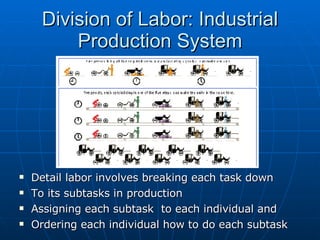
The World Production System The world has become one large system of production Reasons: Improved communication Reasons: Improved transportation technology The production system involves the search for lower labor costs Here how it works:
Division of Labor: Industrial Production System Detail labor involves breaking each task down To its subtasks in production Assigning each subtask  to each individual and Ordering each individual how to do each subtask
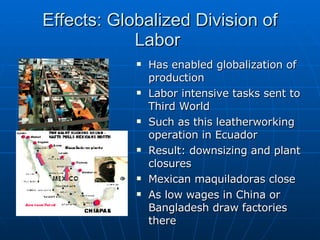
Effects: Globalized Division of Labor  Has enabled globalization of production Labor intensive tasks sent to Third World Such as this leatherworking operation in Ecuador Result: downsizing and plant closures Mexican maquiladoras close  As low wages in China or Bangladesh draw factories there
Peasant Society Importance: Linkage to wider society Definitions based on this linkage Kroeber: Part societies with part cultures. Redfield: Two Aspects Great versus Little Tradition Folk-Urban Continuum Fallers: African societies Lack of a long-standing tradition Drawback: Indigenous African states
Peasant Society: A Structural Definition according to Eric Wolf The funding metaphor Primitive Cultivators and Peasants both must meet a Caloric fund (food, other necessities) Replacement fund (seeds, house repair) Ceremonial fund (life change, solidarity) Peasants Subject to domain of state  Rent fund (taxes, tribute, forced labor)
Indigenous Guatemala: Ethnohistorical Overview Pre-Columbian Era  (ca 1000-1524) Either city states Or parts of a larger state. Colonization by Spain (1524-1600) Colonial and Early Independence (1600-1871) Liberal Era (1871-Present) Reform Hiatus (1944-1954) Civil War and Aftermath (1960-Present)
Pre-Columbian Era Sociopolitical Organization Patrilineal Clans Joint  Land Tenure Warring Kingdoms: Quiche dominated Tributaries to various cycles of states Other Attributes Calendrical System Base 20 system of numbers Writing combining glyph types
Spanish Colonization Conquest completed by 1540, with a few exceptions Colonial Setup Spaniards perennially understaffed Created congregaciones: forced population relocation to town centers Each town deeded communal land Quota system of labor and tribute
Spanish Colonization: Town Government Offices staffed by Indians themselves Enforced the quota system of labor Assessed each household for tribute Administered the allocation of land Handled other daily affairs Structure Caciques became the administrators Alcaldes (mayors) and regidores (council) Police and messengers: the mayores
Spanish Colonization: Religious Governance Priests directed the town’s church Sacristans oversaw church’s daily administration Cofradias assigned care of each saint and its celebration Alter boys handled menial chores Syncretism: Each saint “fronted” for indigenous spirits
Colonial Guatemala/Central America Guatemala was captaincy-general of Central America (including Chiapas) Spain lost interest in Central America Lacked the gold/silver deposits of New Spain and Peru Spain directed staff to these two colonies Central America came to be neglected In due course, Indians gained autonomy by default
Closed Corporate Communities Communities were both closed and corporate Corporate Estate: communal land Body of rights and obligations Rights: usufruct land rights Obligations: community service Focus of service: civil-religious hierarchy
Communities as Corporate: Civil-Religious Hierarchy Civil and religious organizations became fused into a theocracy Hierarchy of offices Lowest: messengers, police Middle level mayordomo of cofradias Upper level: mayors, council, top cofrades  Obligatory service Financial support of office Yearlong service without pay
Communities as Corporate: Civil-Religious Hierarchy Cargo career Youths began as messengers Early to middle age: mayordomos Elders became senior officeholders: councillors. mayors, senior mayordomos Principales (e.g. moletik in Zinacantan) Leveling mechanism Led to reduced stratification Resources directed to community welfare
Communities as Closed: Structural Barriers Community Endogamy Community markers Distinctive dress style Linguistic dialects Product specialization Regional markets Rotating: markets held alternate days Solar: central markets Semimonopoly of crafts ensure demand
Regional Economies of Colonial Central America Hostile symbiosis between Haciendas  Closed corporate communities Conservatives vs. Liberals Conservatives: maintain national self-sufficiency Liberals: Wealth through Economic development External commerce
Liberal Reformas: Roots Economic Strategy Country needs to industrialize Key: Produce exports Guatemala: lucrative export proved to be coffee Origins:  Costa Rica had a booming coffee economy by 1840s In 1860, coffee proved successful
Liberal Reformas: Land Rationale for Land Reforms Needed land “locked” in communal land Incentive lacking for Indians to plant the crop Land Reforms Privatization: only land registered to private individuals was recognized Result: land grabs of communal property Some communities vanished; others restructured
Liberal Reforma: Labor Coffee requires massive labor inputs Tending seedlings Weeding Picking and processing beans Labor Reforms Restoration of labor quota system Debt peonage legalized Fincas de mozos: worker-producing farms Vagrancy laws (1930s)
Liberal Reforma: Impact on Communities Land became a commodity Communal land mostly nonarable Communities became dependent on labor markets Corporate institutions eroded Politics dominated political part of CRH Religious movements entered communities “ True” Catholicism displace folk beliefs Protestantism entered.
Liberal Reforma: Long-term impact Social reforms introduced, reversed  Labor legislation Land redistribution  Civil war of attrition Guerrilla warfare involved Indian in 1980s Communities bombed, mass emigration Peace Accords of 1996 ended war Guatemala has become part of global system of production.
Reactions to Globalization: Latin America Venezuela:  Control of Oil Resources under Chavez Cochabamba, Bolivia:  Privatization of water followed by return to public Bolivia:  Control of gas resources Argentina:  Worker takeover of closed factories Mexico:  Narrow defeat of a socialist coalition; EZLN revolt
Reactions of Globalization: East Asia China:  Controlled foreign investment Japan:  Independent industrialization The Four Tigers:  Independent commerce India:  New Silicon Valleys Question in ReOrient:  Is East Asian hegemony about to re-emerge?
Reactions To Globalization: Fundamentalism Iran:  Islamic Republic as reaction to imperialism Iraq and Afghanistan:  Protracted warfare, with many precedents Other Fundamentalist Movements:  Turkey, Algeria, rest of Middle East
Conclusion Corporate capital dominates the world Third World Countries have become industrial appendages Outsourcing of manufacturing and increasingly high-tech industries Reactions have been multifarious—from co-optation to expulsion

Globalization, Culture Change, The Future

  • 1.
    Cultural Change, Globality,and the Future Imperialism, Acculturation, and the Third World
  • 2.
    Globalization and CulturalChange: Introduction Cultural Change Change always present Present era: change has accelerated Globalization Again, present since the empires Industrial era: Process has accelerated via technology Infiltrated into all parts of Third World cultures
  • 3.
    Leading Trends: GlobalizationEconomic Globalization: Expansion of trade into an international division of labor Core countries Peripheral countries Semiperipheral countries Expansion of a global production system Transportation innovation Communication innovation Labor-intensive processes to Third World More recently: white-collar work
  • 4.
    Leading Trends: GlobalizationImpact Peasantization : Settlement of Nomadic peoples Independent cultivators (e.g. Yanomamo) Proletarianization Alienation of land Rural workers Rural-to-urban migration
  • 5.
    Leading Trends: EarlierPhases of Globalizaton Extermination of existing populations Locations: the Americas, Australia Processes: Diseases, conquest by division Slavery Examples: African slavery by Arabs, then Westerners Contemporary examples: sex slavery in Thailand, forced labor in China
  • 6.
    Leading Trends: AppliedAnthropology Westernization of Technology and Economics Derivative Institutions Politics Religion Positive Aspects of Westernization Health Promotion (though debatable) Elimination of harmful practices such as: Tribal Warfare Clitoridectomy and circumcision Child Marriages
  • 7.
    Leading Trends: AppliedAnthropology Negative Aspects of Westernization: Loss of land Loss of livelihood (India’s cotton): Loss of independence Role of Applied Anthropology Change from subsistence to cash crops Change from indigenous to market-based technology (e.g. fertilizer, demos ) Persuasion; changing attitudes
  • 8.
    Overview Theories ofcultural change Nature of peasant society Case study of the twin processes in Guatemala Guatemala at Conquest Guatemala under Colonial/Conservative Rule Guatemala under Liberal Regimes
  • 9.
    Theories of SocialChange Most theories focus on the local Index variables (Sociologists) Entrepreneuralism (Economists; Psychologists) Diffusionism: (Anthropologists) Macroscopic Approaches Dependency Theory (Frank) World-Systems Analysis (Wallerstein) Recent trends: Asian corporatism?
  • 10.
    States of EconomicGrowth (Rostow) Traditional stage: culture and attitudes are barriers to development Culture change (premodern) stage : acceptance that change is both necessary and beneficial Take-Off Stage: Investment and savings begin to rise Self-Sustained growth: Self-reinforcing investment and savings rates as society undergoes industrialization; spread of education High economic growth (or era of mass consumption): achievement of high standard of living
  • 11.
    Theory of SocialChange: Pattern Variables Modernization is measured by indicators known as pattern variables Traditional vs. modern measures Ascription vs. Achievement Particularism vs. Universalism Drawbacks Traditionalism masks diversity Ignores wider economies Counterexamples in modern society
  • 12.
    Theory of SocialChange:Psychological variables Strategy Foster entrepreneurial attitudes Select society with this attribute Example: McClelland Need for achievement ( n -ach) : a measurable concept;t One indicator: folk tales Turkey: the boy and the grocer Implication: decision as to whom to aid.
  • 13.
    Theory of SocialChange: Diffusionism Strategy Change in key societal characteristics Demonstration projects Marketing strategies Tzintzuntzan: Mexican case study Pottery marketing encouraged--and resisted Image of limited good: absolute scarcity Dyadic contract: distrust of organizations
  • 14.
    World Systems Analysisand Allied Theories Dependency Theory Specialization on single exports Primary sector Fostered by industrial countries World-Systems Analysis Core countries (Industrialized, Diversified) Peripheral: (Monocrop, specialized) Semiperipheral (Intermediate, go-betweens)
  • 15.
    The World ProductionSystem The world has become one large system of production Reasons: Improved communication Reasons: Improved transportation technology The production system involves the search for lower labor costs Here how it works:
  • 16.
    Division of Labor:Industrial Production System Detail labor involves breaking each task down To its subtasks in production Assigning each subtask to each individual and Ordering each individual how to do each subtask
  • 17.
    Effects: Globalized Divisionof Labor Has enabled globalization of production Labor intensive tasks sent to Third World Such as this leatherworking operation in Ecuador Result: downsizing and plant closures Mexican maquiladoras close As low wages in China or Bangladesh draw factories there
  • 18.
    Peasant Society Importance:Linkage to wider society Definitions based on this linkage Kroeber: Part societies with part cultures. Redfield: Two Aspects Great versus Little Tradition Folk-Urban Continuum Fallers: African societies Lack of a long-standing tradition Drawback: Indigenous African states
  • 19.
    Peasant Society: AStructural Definition according to Eric Wolf The funding metaphor Primitive Cultivators and Peasants both must meet a Caloric fund (food, other necessities) Replacement fund (seeds, house repair) Ceremonial fund (life change, solidarity) Peasants Subject to domain of state Rent fund (taxes, tribute, forced labor)
  • 20.
    Indigenous Guatemala: EthnohistoricalOverview Pre-Columbian Era (ca 1000-1524) Either city states Or parts of a larger state. Colonization by Spain (1524-1600) Colonial and Early Independence (1600-1871) Liberal Era (1871-Present) Reform Hiatus (1944-1954) Civil War and Aftermath (1960-Present)
  • 21.
    Pre-Columbian Era SociopoliticalOrganization Patrilineal Clans Joint Land Tenure Warring Kingdoms: Quiche dominated Tributaries to various cycles of states Other Attributes Calendrical System Base 20 system of numbers Writing combining glyph types
  • 22.
    Spanish Colonization Conquestcompleted by 1540, with a few exceptions Colonial Setup Spaniards perennially understaffed Created congregaciones: forced population relocation to town centers Each town deeded communal land Quota system of labor and tribute
  • 23.
    Spanish Colonization: TownGovernment Offices staffed by Indians themselves Enforced the quota system of labor Assessed each household for tribute Administered the allocation of land Handled other daily affairs Structure Caciques became the administrators Alcaldes (mayors) and regidores (council) Police and messengers: the mayores
  • 24.
    Spanish Colonization: ReligiousGovernance Priests directed the town’s church Sacristans oversaw church’s daily administration Cofradias assigned care of each saint and its celebration Alter boys handled menial chores Syncretism: Each saint “fronted” for indigenous spirits
  • 25.
    Colonial Guatemala/Central AmericaGuatemala was captaincy-general of Central America (including Chiapas) Spain lost interest in Central America Lacked the gold/silver deposits of New Spain and Peru Spain directed staff to these two colonies Central America came to be neglected In due course, Indians gained autonomy by default
  • 26.
    Closed Corporate CommunitiesCommunities were both closed and corporate Corporate Estate: communal land Body of rights and obligations Rights: usufruct land rights Obligations: community service Focus of service: civil-religious hierarchy
  • 27.
    Communities as Corporate:Civil-Religious Hierarchy Civil and religious organizations became fused into a theocracy Hierarchy of offices Lowest: messengers, police Middle level mayordomo of cofradias Upper level: mayors, council, top cofrades Obligatory service Financial support of office Yearlong service without pay
  • 28.
    Communities as Corporate:Civil-Religious Hierarchy Cargo career Youths began as messengers Early to middle age: mayordomos Elders became senior officeholders: councillors. mayors, senior mayordomos Principales (e.g. moletik in Zinacantan) Leveling mechanism Led to reduced stratification Resources directed to community welfare
  • 29.
    Communities as Closed:Structural Barriers Community Endogamy Community markers Distinctive dress style Linguistic dialects Product specialization Regional markets Rotating: markets held alternate days Solar: central markets Semimonopoly of crafts ensure demand
  • 30.
    Regional Economies ofColonial Central America Hostile symbiosis between Haciendas Closed corporate communities Conservatives vs. Liberals Conservatives: maintain national self-sufficiency Liberals: Wealth through Economic development External commerce
  • 31.
    Liberal Reformas: RootsEconomic Strategy Country needs to industrialize Key: Produce exports Guatemala: lucrative export proved to be coffee Origins: Costa Rica had a booming coffee economy by 1840s In 1860, coffee proved successful
  • 32.
    Liberal Reformas: LandRationale for Land Reforms Needed land “locked” in communal land Incentive lacking for Indians to plant the crop Land Reforms Privatization: only land registered to private individuals was recognized Result: land grabs of communal property Some communities vanished; others restructured
  • 33.
    Liberal Reforma: LaborCoffee requires massive labor inputs Tending seedlings Weeding Picking and processing beans Labor Reforms Restoration of labor quota system Debt peonage legalized Fincas de mozos: worker-producing farms Vagrancy laws (1930s)
  • 34.
    Liberal Reforma: Impacton Communities Land became a commodity Communal land mostly nonarable Communities became dependent on labor markets Corporate institutions eroded Politics dominated political part of CRH Religious movements entered communities “ True” Catholicism displace folk beliefs Protestantism entered.
  • 35.
    Liberal Reforma: Long-termimpact Social reforms introduced, reversed Labor legislation Land redistribution Civil war of attrition Guerrilla warfare involved Indian in 1980s Communities bombed, mass emigration Peace Accords of 1996 ended war Guatemala has become part of global system of production.
  • 36.
    Reactions to Globalization:Latin America Venezuela: Control of Oil Resources under Chavez Cochabamba, Bolivia: Privatization of water followed by return to public Bolivia: Control of gas resources Argentina: Worker takeover of closed factories Mexico: Narrow defeat of a socialist coalition; EZLN revolt
  • 37.
    Reactions of Globalization:East Asia China: Controlled foreign investment Japan: Independent industrialization The Four Tigers: Independent commerce India: New Silicon Valleys Question in ReOrient: Is East Asian hegemony about to re-emerge?
  • 38.
    Reactions To Globalization:Fundamentalism Iran: Islamic Republic as reaction to imperialism Iraq and Afghanistan: Protracted warfare, with many precedents Other Fundamentalist Movements: Turkey, Algeria, rest of Middle East
  • 39.
    Conclusion Corporate capitaldominates the world Third World Countries have become industrial appendages Outsourcing of manufacturing and increasingly high-tech industries Reactions have been multifarious—from co-optation to expulsion