National Communication Patterns
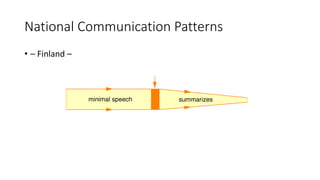
• – Finland –
© 2001, 2009 Richard D Lewis
National Communication Patterns
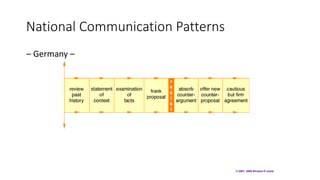
– Germany –
© 2001, 2009 Richard D Lewis
National Communication Patterns
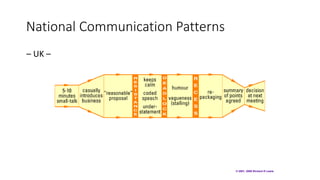
– UK –
National Communication Patterns
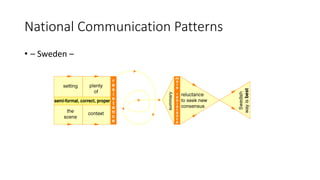
• – Sweden –
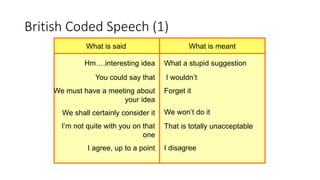
British Coded Speech (1)
What is said What is meant
Hm….interesting idea
You could say that
We must have a meeting about
your idea
We shall certainly consider it
I’m not quite with you on that
one
I agree, up to a point
What a stupid suggestion
I wouldn’t
Forget it
We won’t do it
That is totally unacceptable
I disagree
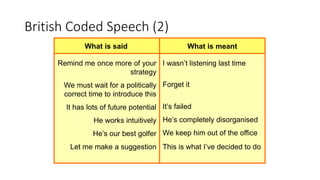
British Coded Speech (2)
What is said What is meant
Remind me once more of your
strategy
We must wait for a politically
correct time to introduce this
It has lots of future potential
He works intuitively
He’s our best golfer
Let me make a suggestion
I wasn’t listening last time
Forget it
It’s failed
He’s completely disorganised
We keep him out of the office
This is what I’ve decided to do
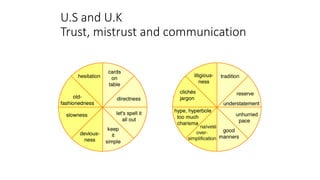
U.S and U.K
Trust, mistrust and communication
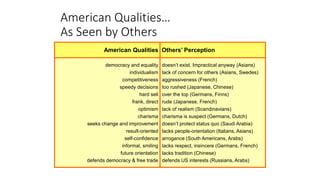
American Qualities…
As Seen by Others
American Qualities Others’ Perception
democracy and equality
individualism
competitiveness
speedy decisions
hard sell
frank, direct
optimism
charisma
seeks change and improvement
result-oriented
self-confidence
informal, smiling
future orientation
defends democracy & free trade
doesn’t exist. Impractical anyway (Asians)
lack of concern for others (Asians, Swedes)
aggressiveness (French)
too rushed (Japanese, Chinese)
over the top (Germans, Finns)
rude (Japanese, French)
lack of realism (Scandinavians)
charisma is suspect (Germans, Dutch)
doesn’t protect status quo (Saudi Arabia)
lacks people-orientation (Italians, Asians)
arrogance (South Americans, Arabs)
lacks respect, insincere (Germans, French)
lacks tradition (Chinese)
defends US interests (Russians, Arabs)
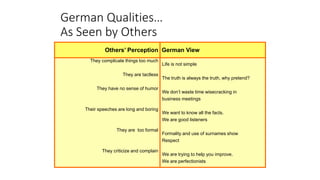
German Qualities…
As Seen by Others
Others’ Perception German View
They complicate things too much
They are tactless
They have no sense of humor
Their speeches are long and boring
They are too formal
They criticize and complain
Life is not simple
The truth is always the truth, why pretend?
We don’t waste time wisecracking in
business meetings
We want to know all the facts.
We are good listeners
Formality and use of surnames show
Respect
We are trying to help you improve.
We are perfectionists
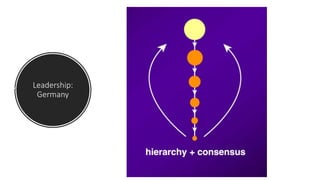
Leadership:
Germany
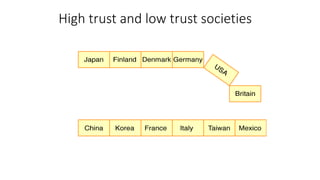
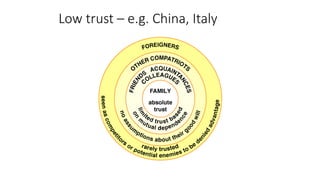
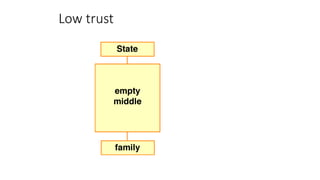
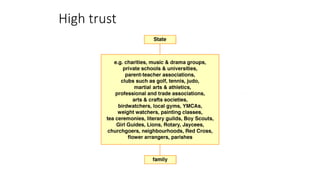
High trust and low trust societies
Low trust – e.g. China, Italy
Low trust
High trust
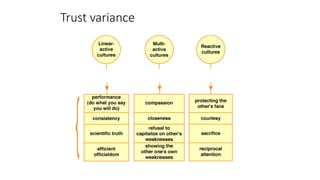
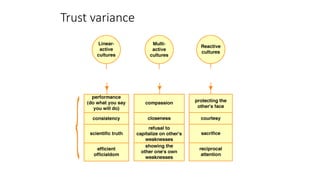
Trust variance
18
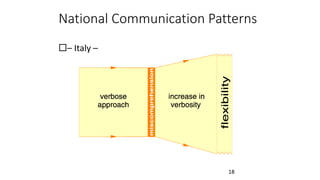
National Communication Patterns
– Italy –
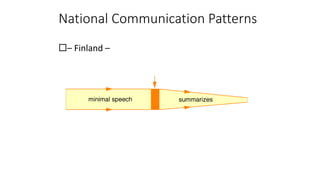
National Communication Patterns
– Finland –
© 2001, 2009 Richard D Lewis
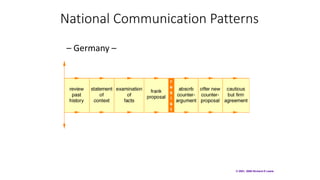
National Communication Patterns
– Germany –
© 2001, 2009 Richard D Lewis
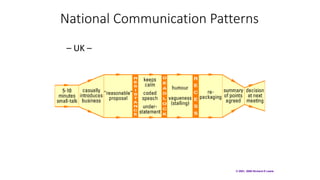
National Communication Patterns
– UK –
Trust variance
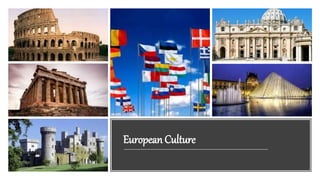
European Culture
Multiculturalism
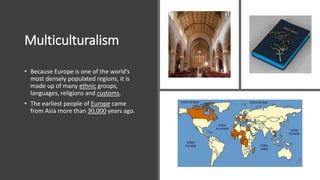
• Because Europe is one of the world’s
most densely populated regions, it is
made up of many ethnic groups,
languages, religions and customs.
• The earliest people of Europe came
from Asia more than 30,000 years ago.
Multiculturalism
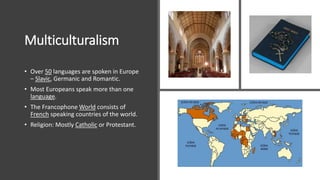
• Over 50 languages are spoken in Europe
– Slavic, Germanic and Romantic.
• Most Europeans speak more than one
language.
• The Francophone World consists of
French speaking countries of the world.
• Religion: Mostly Catholic or Protestant.
The Spread of
European Culture
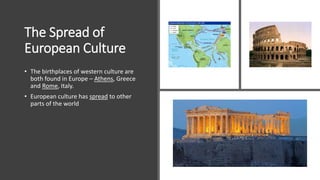
• The birthplaces of western culture are
both found in Europe – Athens, Greece
and Rome, Italy.
• European culture has spread to other
parts of the world
The Spread of European
Culture
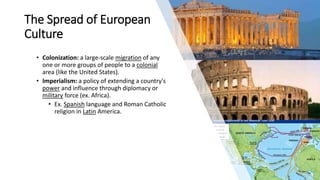
• Colonization: a large-scale migration of any
one or more groups of people to a colonial
area (like the United States).
• Imperialism: a policy of extending a country's
power and influence through diplomacy or
military force (ex. Africa).
• Ex. Spanish language and Roman Catholic
religion in Latin America.
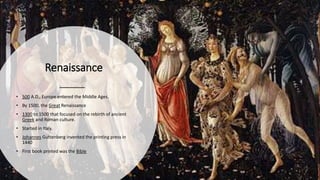
Renaissance
• 500 A.D., Europe entered the Middle Ages.
• By 1500, the Great Renaissance
• 1300 to 1500 that focused on the rebirth of ancient
Greek and Roman culture.
• Started in Italy.
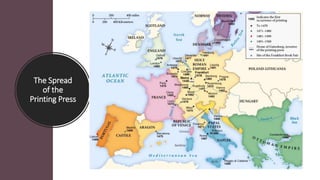
• Johannes Guttenberg invented the printing press in
1440
• First book printed was the Bible
Causes of the
Reformation?
Church corruption
•Avignon Papacy
Marsilius of Padua Defensor Pacis
[Defender of the Peace]
•Attacked papal authority
•The Christian community is the sum of ALL its
parts!
Greed of secular leaders
•1/3 of Europe church land
•Papal need for money indulgences
Printing Press
The Spread
of the
Printing Press
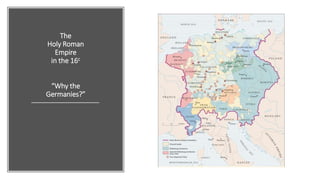
The
Holy Roman
Empire
in the 16c
“Why the
Germanies?”
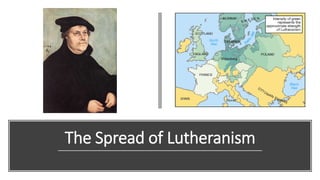
The Spread of Lutheranism
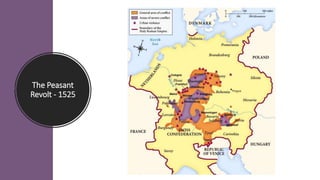
The Peasant
Revolt - 1525
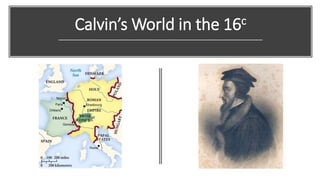
Calvin’s World in the 16c
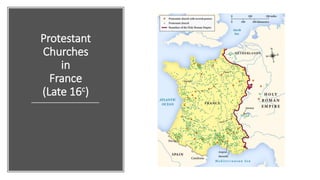
Protestant
Churches
in
France
(Late 16c)
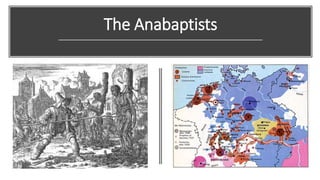
The Anabaptists
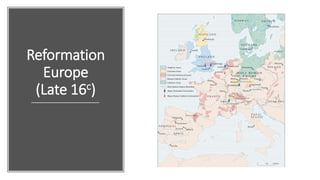
Reformation
Europe
(Late 16c)
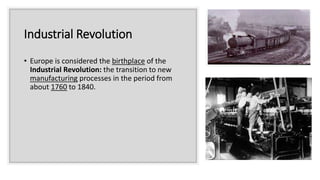
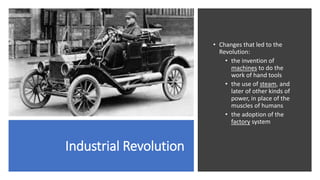
Industrial Revolution
• Europe is considered the birthplace of the
Industrial Revolution: the transition to new
manufacturing processes in the period from
about 1760 to 1840.
Industrial Revolution
• Changes that led to the
Revolution:
• the invention of
machines to do the
work of hand tools
• the use of steam, and
later of other kinds of
power, in place of the
muscles of humans
• the adoption of the
factory system
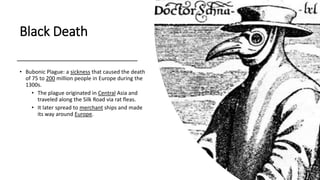
Black Death
• Bubonic Plague: a sickness that caused the death
of 75 to 200 million people in Europe during the
1300s.
• The plague originated in Central Asia and
traveled along the Silk Road via rat fleas.
• It later spread to merchant ships and made
its way around Europe.
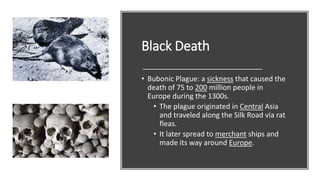
Black Death
• Bubonic Plague: a sickness that caused the
death of 75 to 200 million people in
Europe during the 1300s.
• The plague originated in Central Asia
and traveled along the Silk Road via rat
fleas.
• It later spread to merchant ships and
made its way around Europe.
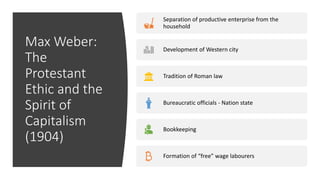
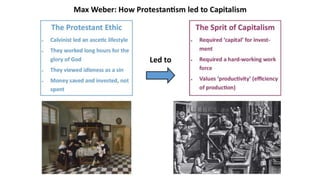
Max Weber:
The
Protestant
Ethic and the
Spirit of
Capitalism
(1904)
Separation of productive enterprise from the
household
Development of Western city
Tradition of Roman law
Bureaucratic officials - Nation state
Bookkeeping
Formation of “free” wage labourers
“A glance at the occupational statistics of any
country of mixed religious composition
brings to light with remarkable frequency a
situation which has several times provoked
discussion in the Catholic press......, namely,
the fact that business leaders and owners of
capital, as well as the higher grades of
skilled labour, and even more the higher
technically and commercially trained
personnel of modern enterprises, are
overwhelmingly Protestant”
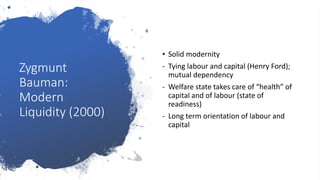
Zygmunt
Bauman:
Modern
Liquidity (2000)
• Solid modernity
- Tying labour and capital (Henry Ford);
mutual dependency
- Welfare state takes care of “health” of
capital and of labour (state of
readiness)
- Long term orientation of labour and
capital
• Liquid modernity:
- Flexibility
- Capital can move freely (not tied to
machines)
- No delay of gratification
- Insecurity (leading to consumerism;
community)
Bauman :
Society under
siege (2002)
• Integration by succession of short term projects
needs little, or no control from the top..... No
other form of social control is more efficient
than the spectre of insecurity hovering over the
heads of the controlled” (p. 35)
Regulation
School Theory
(cf Webster,
2006)
• Fordist-Keynesian era of accumulation
(1945 - 1973)
- Mass production
- Industrial workers
- Full employment
- Mass consumption
- Nation state and national oligopolies
(4-5 companies having 60% market
share
The end of
Fordism:
Globalisation
• Globalisation means the growing
interdependence and interpenetration of
human relations alongside the increasing
integration of the world’s socio-economic life.
• The transnational company (50,000 nowadays)
• 25% of total world production
(Webster, 2006; p. 69, 70)
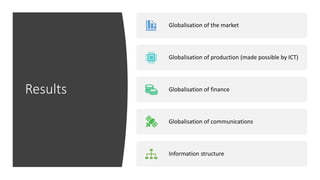
Results
Globalisation of the market
Globalisation of production (made possible by ICT)
Globalisation of finance
Globalisation of communications
Information structure
Post-Fordism
• Downsizing (jobless growth)
• Vertical disintegration (outsourcing)
• Needs information infrastructure
• Flexibility
- flexibility of employees
- flexibility of production
- flexibility of consumption
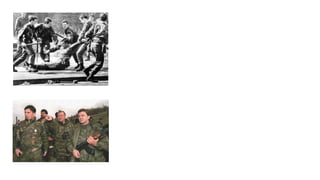
Conflicts & Wars
• Northern Ireland: conflict between the Roman
Catholics and Protestants.
• The former Yugoslavia: conflict between the Serbs,
Croats, Bosnians and Albanians on the Balkan
Peninsula
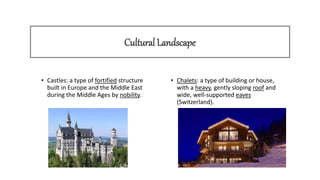
Cultural Landscape
• Castles: a type of fortified structure
built in Europe and the Middle East
during the Middle Ages by nobility.
• Chalets: a type of building or house,
with a heavy, gently sloping roof and
wide, well-supported eaves
(Switzerland).
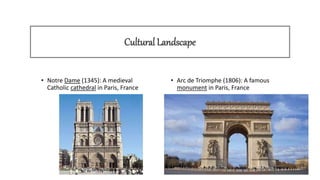
Cultural Landscape
• Notre Dame (1345): A medieval
Catholic cathedral in Paris, France
• Arc de Triomphe (1806): A famous
monument in Paris, France
Cultural Landscape
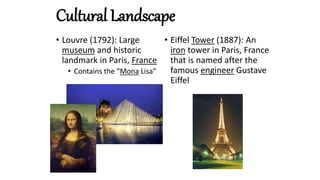
• Louvre (1792): Large
museum and historic
landmark in Paris, France
• Contains the “Mona Lisa”
• Eiffel Tower (1887): An
iron tower in Paris, France
that is named after the
famous engineer Gustave
Eiffel
Cultural Landscape
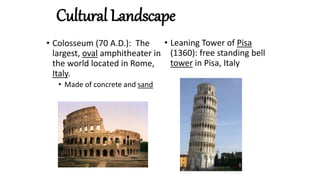
• Colosseum (70 A.D.): The
largest, oval amphitheater in
the world located in Rome,
Italy.
• Made of concrete and sand
• Leaning Tower of Pisa
(1360): free standing bell
tower in Pisa, Italy
Cultural Landscape
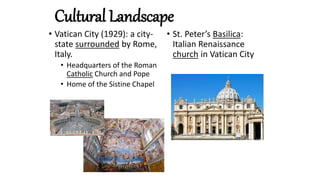
• Vatican City (1929): a city-
state surrounded by Rome,
Italy.
• Headquarters of the Roman
Catholic Church and Pope
• Home of the Sistine Chapel
• St. Peter’s Basilica:
Italian Renaissance
church in Vatican City
Cultural Landscape
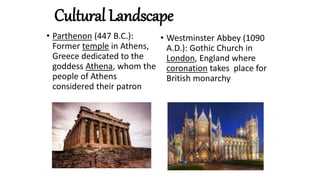
• Parthenon (447 B.C.):
Former temple in Athens,
Greece dedicated to the
goddess Athena, whom the
people of Athens
considered their patron
• Westminster Abbey (1090
A.D.): Gothic Church in
London, England where
coronation takes place for
British monarchy
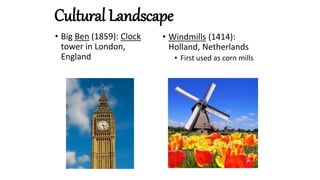
Cultural Landscape
• Big Ben (1859): Clock
tower in London,
England
• Windmills (1414):
Holland, Netherlands
• First used as corn mills

Euro2

  • 2.
  • 3.
    © 2001, 2009Richard D Lewis National Communication Patterns – Germany –
  • 4.
    © 2001, 2009Richard D Lewis National Communication Patterns – UK –
  • 6.
  • 7.
    British Coded Speech(1) What is said What is meant Hm….interesting idea You could say that We must have a meeting about your idea We shall certainly consider it I’m not quite with you on that one I agree, up to a point What a stupid suggestion I wouldn’t Forget it We won’t do it That is totally unacceptable I disagree
  • 8.
    British Coded Speech(2) What is said What is meant Remind me once more of your strategy We must wait for a politically correct time to introduce this It has lots of future potential He works intuitively He’s our best golfer Let me make a suggestion I wasn’t listening last time Forget it It’s failed He’s completely disorganised We keep him out of the office This is what I’ve decided to do
  • 9.
    U.S and U.K Trust,mistrust and communication
  • 10.
    American Qualities… As Seenby Others American Qualities Others’ Perception democracy and equality individualism competitiveness speedy decisions hard sell frank, direct optimism charisma seeks change and improvement result-oriented self-confidence informal, smiling future orientation defends democracy & free trade doesn’t exist. Impractical anyway (Asians) lack of concern for others (Asians, Swedes) aggressiveness (French) too rushed (Japanese, Chinese) over the top (Germans, Finns) rude (Japanese, French) lack of realism (Scandinavians) charisma is suspect (Germans, Dutch) doesn’t protect status quo (Saudi Arabia) lacks people-orientation (Italians, Asians) arrogance (South Americans, Arabs) lacks respect, insincere (Germans, French) lacks tradition (Chinese) defends US interests (Russians, Arabs)
  • 11.
    German Qualities… As Seenby Others Others’ Perception German View They complicate things too much They are tactless They have no sense of humor Their speeches are long and boring They are too formal They criticize and complain Life is not simple The truth is always the truth, why pretend? We don’t waste time wisecracking in business meetings We want to know all the facts. We are good listeners Formality and use of surnames show Respect We are trying to help you improve. We are perfectionists
  • 12.
  • 13.
    High trust andlow trust societies
  • 14.
    Low trust –e.g. China, Italy
  • 15.
  • 16.
  • 17.
  • 18.
  • 19.
  • 20.
    © 2001, 2009Richard D Lewis National Communication Patterns – Germany –
  • 21.
    © 2001, 2009Richard D Lewis National Communication Patterns – UK –
  • 22.
  • 23.
  • 24.
    Multiculturalism • Because Europeis one of the world’s most densely populated regions, it is made up of many ethnic groups, languages, religions and customs. • The earliest people of Europe came from Asia more than 30,000 years ago.
  • 25.
    Multiculturalism • Over 50languages are spoken in Europe – Slavic, Germanic and Romantic. • Most Europeans speak more than one language. • The Francophone World consists of French speaking countries of the world. • Religion: Mostly Catholic or Protestant.
  • 26.
    The Spread of EuropeanCulture • The birthplaces of western culture are both found in Europe – Athens, Greece and Rome, Italy. • European culture has spread to other parts of the world
  • 27.
    The Spread ofEuropean Culture • Colonization: a large-scale migration of any one or more groups of people to a colonial area (like the United States). • Imperialism: a policy of extending a country's power and influence through diplomacy or military force (ex. Africa). • Ex. Spanish language and Roman Catholic religion in Latin America.
  • 28.
    Renaissance • 500 A.D.,Europe entered the Middle Ages. • By 1500, the Great Renaissance • 1300 to 1500 that focused on the rebirth of ancient Greek and Roman culture. • Started in Italy. • Johannes Guttenberg invented the printing press in 1440 • First book printed was the Bible
  • 29.
    Causes of the Reformation? Churchcorruption •Avignon Papacy Marsilius of Padua Defensor Pacis [Defender of the Peace] •Attacked papal authority •The Christian community is the sum of ALL its parts! Greed of secular leaders •1/3 of Europe church land •Papal need for money indulgences Printing Press
  • 30.
  • 31.
    The Holy Roman Empire in the16c “Why the Germanies?”
  • 32.
    The Spread ofLutheranism
  • 33.
  • 34.
  • 35.
  • 36.
  • 37.
  • 38.
    Industrial Revolution • Europeis considered the birthplace of the Industrial Revolution: the transition to new manufacturing processes in the period from about 1760 to 1840.
  • 39.
    Industrial Revolution • Changesthat led to the Revolution: • the invention of machines to do the work of hand tools • the use of steam, and later of other kinds of power, in place of the muscles of humans • the adoption of the factory system
  • 40.
    Black Death • BubonicPlague: a sickness that caused the death of 75 to 200 million people in Europe during the 1300s. • The plague originated in Central Asia and traveled along the Silk Road via rat fleas. • It later spread to merchant ships and made its way around Europe.
  • 41.
    Black Death • BubonicPlague: a sickness that caused the death of 75 to 200 million people in Europe during the 1300s. • The plague originated in Central Asia and traveled along the Silk Road via rat fleas. • It later spread to merchant ships and made its way around Europe.
  • 42.
    Max Weber: The Protestant Ethic andthe Spirit of Capitalism (1904) Separation of productive enterprise from the household Development of Western city Tradition of Roman law Bureaucratic officials - Nation state Bookkeeping Formation of “free” wage labourers
  • 43.
    “A glance atthe occupational statistics of any country of mixed religious composition brings to light with remarkable frequency a situation which has several times provoked discussion in the Catholic press......, namely, the fact that business leaders and owners of capital, as well as the higher grades of skilled labour, and even more the higher technically and commercially trained personnel of modern enterprises, are overwhelmingly Protestant”
  • 45.
    Zygmunt Bauman: Modern Liquidity (2000) • Solidmodernity - Tying labour and capital (Henry Ford); mutual dependency - Welfare state takes care of “health” of capital and of labour (state of readiness) - Long term orientation of labour and capital
  • 46.
    • Liquid modernity: -Flexibility - Capital can move freely (not tied to machines) - No delay of gratification - Insecurity (leading to consumerism; community)
  • 47.
    Bauman : Society under siege(2002) • Integration by succession of short term projects needs little, or no control from the top..... No other form of social control is more efficient than the spectre of insecurity hovering over the heads of the controlled” (p. 35)
  • 48.
    Regulation School Theory (cf Webster, 2006) •Fordist-Keynesian era of accumulation (1945 - 1973) - Mass production - Industrial workers - Full employment - Mass consumption - Nation state and national oligopolies (4-5 companies having 60% market share
  • 49.
    The end of Fordism: Globalisation •Globalisation means the growing interdependence and interpenetration of human relations alongside the increasing integration of the world’s socio-economic life. • The transnational company (50,000 nowadays) • 25% of total world production (Webster, 2006; p. 69, 70)
  • 50.
    Results Globalisation of themarket Globalisation of production (made possible by ICT) Globalisation of finance Globalisation of communications Information structure
  • 51.
    Post-Fordism • Downsizing (joblessgrowth) • Vertical disintegration (outsourcing) • Needs information infrastructure • Flexibility - flexibility of employees - flexibility of production - flexibility of consumption
  • 52.
    Conflicts & Wars •Northern Ireland: conflict between the Roman Catholics and Protestants. • The former Yugoslavia: conflict between the Serbs, Croats, Bosnians and Albanians on the Balkan Peninsula
  • 53.
    Cultural Landscape • Castles:a type of fortified structure built in Europe and the Middle East during the Middle Ages by nobility. • Chalets: a type of building or house, with a heavy, gently sloping roof and wide, well-supported eaves (Switzerland).
  • 54.
    Cultural Landscape • NotreDame (1345): A medieval Catholic cathedral in Paris, France • Arc de Triomphe (1806): A famous monument in Paris, France
  • 55.
    Cultural Landscape • Louvre(1792): Large museum and historic landmark in Paris, France • Contains the “Mona Lisa” • Eiffel Tower (1887): An iron tower in Paris, France that is named after the famous engineer Gustave Eiffel
  • 56.
    Cultural Landscape • Colosseum(70 A.D.): The largest, oval amphitheater in the world located in Rome, Italy. • Made of concrete and sand • Leaning Tower of Pisa (1360): free standing bell tower in Pisa, Italy
  • 57.
    Cultural Landscape • VaticanCity (1929): a city- state surrounded by Rome, Italy. • Headquarters of the Roman Catholic Church and Pope • Home of the Sistine Chapel • St. Peter’s Basilica: Italian Renaissance church in Vatican City
  • 58.
    Cultural Landscape • Parthenon(447 B.C.): Former temple in Athens, Greece dedicated to the goddess Athena, whom the people of Athens considered their patron • Westminster Abbey (1090 A.D.): Gothic Church in London, England where coronation takes place for British monarchy
  • 59.
    Cultural Landscape • BigBen (1859): Clock tower in London, England • Windmills (1414): Holland, Netherlands • First used as corn mills