GLOBAL MEDIA
CULTURES
GLOBALIZATION is characterized as an arrangement of various,
uneven, and some of the time covering verifiable procedures.
These procedure could include financial aspects, governmental
issues, and cultures that advance along with media innovation
to make the conditions under which the globe could be
perceived as “ an envisioned network.”
MEDIA is the plural frame for medium, a method for passing on
something, especially a channel of correspondence . The plural
shape media – just came into general flow in the 1920s then
later ended up broad communications as individuals were
conveying their life through books, radio, and film. Hence media
have become essential to globalization.
Harvard (2007) cited in his study that media have an important impact
on cultural globalization in two mutually interdependent ways .
FIRST- the media provide an extensive transnational transmission of
cultural products .
SECOND- they contribute to the formation of communicative networks
and social structures.
Worldwide media societies create a consistent social trade, in
which social aspects, for example, character, nationality, religion,
behavioral standards and lifestyle are constantly addressed and
tested. These social experiences frequently include the gathering
of societies with an alternate socio- economic base, normally a
transnational and business social industry on one side and a
national , openly managed social industry on the opposite side.
EVOLUTION OF MEDIA
AND GLOBALIZATION
ORAL COMMUNICATION
Speech has been with us for at least 200,000
years. When speech developed into language,
Homo sapiens had developed a medium that
would set them apart from other species and
allow them to cover and conquer the world.
SCRIPT
As the very first writing script allowed human to communicate and
share knowledge and ideas over much larger spaces and across
much longer times. Writing has its own evolution and developed
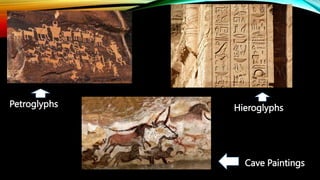
from cave paintings, petroglyphs, and hieroglyphs. Early writing
system began to appear after 3000B.C.E with symbols carved into
clay tablets to keep account for trade. These cuneiform marks later
developed into symbol that represented the syllables of languages
and eventually led to the creation of alphabets , the scripted letters
that represent the smallest sounds of a language. The great
civilizations from EGYPT and GREECE to ROME and CHINA were
made possible through script.
Petroglyphs Hieroglyphs
Cave Paintings
PRINTING
PRESS
All histories of media and globalization acknowledge the consequential role of the
printing press. With the advent of printing press, first made with movable wooden
blocks in China and then with movable metal type by Johannes Gutenberg in Germany,
reading material suddenly was cheaply made and easily circulated. Literacy followed,
and the literacy of common people was to revolutionize every aspect of life.
ELECTRONIC MEDIA
refer to any equipment or tool used in
communication that require electromagnetic energy
– electricity. Examples are telegraph, telephone,
radio, film, and television. The vast reach of these
electronic media continues to open up new avenues
in the economic, political and processes of
globalization.
DIGITAL MEDIA
Digital media are most often electronic media that rely on
digital codes, the long hidden combinations of 0s and 1s that
represent information. Phones and television can now be
considered digital. The computer is the usual representation
of digital media . Access to information around the globe
allows people to adopt and adopt new practices in music,
sports, education, religion, fashion, cuisine, the arts, and other
realms of culture.
CULTURAL
GLOBALIZATION
PROCESSES
The experience of modernity in a worldwide culture-
A chief element in the analysis of the experience of modernity as both a
general form of mentality and a mode of artistic production, is the loosening
of time and space from the bonds of locality and tradition. In the globalized
reality of high modernity, the disassociation of cultural and social activity from
local constraints has drastic consequences: almost all of those institutions
during the 19th and 20th century have confirmed a modern structuring of
cultural and social experience .
Socialization and the development of cultural
character-
The media have continuously transformed into a free organization for socialization and
the improvement of social character. With a quick extending universal correspondence
stream bringing media portrayals of remote societies into neighborhood social
situations, the premises of social utilize have changed and social reflexivity has
expanded at the level of the person.
Mediated communities and activity –
Media and correspondence advances as a rule have encourage the arrangement
of aggregate groups. They have likewise made conceivable informative and
social activity crosswise over time and space. Accompanying to globalization,
the development of groups that are solely settled by methods for media
societies ( for example music fun clubs, internet talk bunches, and so forth) have
been observed.
GLOBALIZATION OF
CULTURE & MEDIA
Media are the primary carriers of cultural through newspapers,
magazines , movies, advertisement , radio, television, internet, and
many other. In many case , these communications are like cultural
laboratory experiments. They sometimes result in startling and stunning
hybrid creations. But in some case they result in ignitable and explosive
mixtures. Pieterse (2004) cited three outcomes with which to consider
the influence of globalization too culture.
-Cultural Differentialism
-Cultural hybridity
-Cultural convergence
Cultural differentialism – suggest that cultures are
different, strong, and resilient . Distinctive cultures will
endure despite globalization and the global reach of
American or Western cultural forms. Cultures are
destined to clash as globalization continually brings
them together.
A:Involves barriers that prevent flows that serve to make cultures more
aline; cultures tend to remain stubbornly different from one another.
B: An example of cultural differentialism is the terrorist attacks on 9/11
and the subsequent wars in Afghanistan and Iraq. To many people,
these events are seen as the product of a clash between Western and
Islamic culture and the eternal differences between them.
C: This is significant because the concept of cultural diffferentialism
emphasizes lasting differences among and between cultures largely
unaffected by globalization or any trans-cultural flows. As seen in the
example, clashing cultures can have a huge impact on both cultures,
countries and the entire world.
Cultural hybridity – Notes that globalization will bring about
an increasing blend or mixtures of cultures. This combination
will result to the creation of new and surprising cultural
forms. This outcomes is common, desirable, and occurs
throughout history, and will occur more so in an era of
globalization.
Cultural hybridization is the blending of elements from different cultures.
I feel that without cultural hybridization, the world we live in would not
be anywhere near as interesting and integrated as it is today. The phrase
“spanglish” is a language that combines the language of spanish and
english. Thus bringing the two cultures closer together. In canada, they
speak english as well as french. In one country, two languages are the
main language; that is an example of cultural hybridization. Some African
countries speak french and mix it in with their native language, creating
something new. Language is just one example of cultural hybridization.
Music is another part of culture that can be mixed with other cultures.
Sometimes, people will take U.S. pop music and create something new
from it in Korea. Artists like Shakira and J.LO will incorporate spanish into
their American songs to bring a little bit of diversity to America.
Cultural convergence – proposes that globalization will bring
about a growing sameness of cultures. A global culture, likely
American culture, will overtake many local cultural imperialism, in
which the cultures of more developed nations invade and take
over the cultures of less developed nations. This result of this
process will be a worldwide, homogenized western culture.
Cultural Imperialism Theory
Cultural imperialism theory
It is possible to define Cultural Imperialism as “the extension of
influence or dominance of one nation’s culture over others, (…)
through the exportation of cultural commodities” (OED, 2008).
However, To wholly understand what Cultural Imperialism is,
one must first define “culture” and “imperialism” separately.
culture is something that is shared, learned or acquired, and
constantly evolving and non-static
Imperialism stems from the word “empire”, and is the extending
of a country’s power and influence through colonisation, use of
military force, or other means (OED, 2014).
Imperialism Examples
1. The Napoleonic Wars
Time Period: 1803-1815
Napoleon sought to expand the French empire by invading other countries. He also tried to install
French allies as rulers of other countries. Napoleon managed to conquer most of Europe, but his
empire collapsed after his defeat at the Battle of Waterloo.
2. Roman Empire
Time Period: 753 BC-476 AD
The Roman Empire was one of the largest and most powerful empires in history. It controlled a
territory that spanned from the Hardian’s Wall relic boundary in Britain to North Africa and from Spain
to the Middle East. The Roman Empire was eventually defeated by internal strife and division as well as
barbarian invasions. The last Roman Emperor, Romulus Augustus, was overthrown in 476 AD.
3. British Empire
Time Period: 1583-1945
The British Empire was one of the largest empires in history and the global hegemony. It controlled a
territory that spanned from North America to Africa and from India to Australia. The British Empire was
eventually dissolved due to nationalism and decolonization movements in the 20th century.
What is cultural imperialism ?
The term cultural imperialism refers most broadly to the exercise
of domination in cultural relationships in which the values,
practices, and meanings of a powerful foreign culture are
imposed upon one or more native cultures.
In 1976, Schiller defined Cultural Imperialism as “the sum of the
processes by which a society is brought into the modern world
system and how its dominating stratum is attracted, pressured,
forced, and sometimes bribed into shaping social institutions to
correspond to the values and structures of the dominating
centre of the system” (1976, pp. 9-10).
Can Cultural Imperialism relate to the World Systems Theory?
It is possible to relate Cultural Imperialism to the World Systems
Theory, in which there is an inter-regional and transnational division
of labour with core, periphery, and semi-periphery countries.
According to Wallerstein, the world economic system is divided into a
hierarchy of three types of countries: core, semiperipheral, and
peripheral.
• Core- Core countries (e.g., U.S., Japan, Germany) are dominant,
capitalist countries characterized by high levels of industrialization
and urbanization.
• Semi- Periphery- Semi-peripheral countries (e.g., South Korea,
Taiwan, Mexico, Brazil, India, Nigeria, South Africa) are less
developed than core nations but more developed than peripheral
nations.
• Periphery- Peripheral countries (e.g., most African countries and
low income countries in South America) are dependent on core
countries for capital and are less industrialized and urbanized.
Cultural Imperialism is also closely related to global communication, which can be
defined as the communication practice occurring across national borders, social,
political, and cultural divides (Thussu, 2010).
what is global communication?
-Global communication is directly affected by the process of globalization, and
helps to increase business opportunities, remove cultural barriers and develop a
global village. Both globalization and global communication have changed the
environmental, cultural, political and economic elements of the world.
In global communication today, Cultural Imperialism manifests itself mainly through
media, especially mainstream and mass media. The media is one of the most
prominent and visible forms of global communication. Although Cultural
Imperialism theory also focuses on governmental and economic systems, it is more
concerned with the assimilation of media, like literature, film, television, Internet,
and music, today. As mentioned earlier, this is one-sided, meaning that the affected
culture’s media is not exported to the influencing culture. Most global media firms
are owned by the same advanced core countries, which dominate the production of
global media (McPhail, 2014).
One could argue that both Cultural Imperialism and global communication are
closely linked to globalisation –Globalisation facilitates global communication and
the spread of cultural perspectives through new media and technological
advancements, and some argue that globalisation is therefore a tool of Cultural
Imperialism (Tomlinson, 2001).
One of the main examples of medial Cultural Imperialism today (20th – 21st century)
is that of the USA. It is considered a core country and, partially, extends its
dominance through media flows.
Consequently, US media and entertainment industries, like Hollywood and Disney,
are able to penetrate the global market and export US-American cultural products
and values. Studios like Warner Brothers and Disney use local production facilities
in Europe, Latin America, and Asia, creating country-specific programming there,
whilst keeping the US-American culture (Thussu, 2010).
Hollywood films have dominated most global media markets since the 1920s and
studies show that around 55%-90% of all films shown in cinemas in Europe are from
the US (Croteau, Hoynes, & Milan, 2011). In contrast, European films only make up
3% of films shown in the US (European Audiovisual Observatory, 2010). The same
study showed that in countries like Malaysia, Colombia, Venezuela, and Indonesia
the percentage of Hollywood films is above 80% (EAO, 2010).
The Axioms of Cultural Imperialism
media play a central role in creating culture. This axiom is linked
to the interchangeable use of various terms to refer to cultural
imperialism. This practice implies that the media have such an
overwhelming role in the process referred to as "cultural
imperialism" that the word "cultural" can be interchanged with
"media" from time to time. Of course, one must be careful in
attributing this massive central significance to the media.
In conclusion, Cultural Imperialism can have both positive and
negative effects on global communication. It can promote generally
positive agendas, like equal rights, and improve the quality of life for
many people where successful. However, it can also prove detrimental
to ‘inferior’ cultures and cultural values when a dominant culture
takes over. It has the possibility of creating one homogenous culture
throughout the world, and distorting foreign cultures. Furthermore, it
can be argued that Cultural Imperialism is prevalent in today’s media
climate, where core countries own the majority of global media and
export their cultural values. Nonetheless, Cultural Imperialism theory
has received criticism for not considering the agency and free will of
the target audience, and ignoring the idea of cultural resistance,
visible in some examples used in this essay. This also proves that
attempting Cultural Imperialism can have very negative effects on
global communication as it weakens the relations between different
heads of state.
Cultural Imperialism implies that it is solely a one-sided cultural
imposition, where the dominant culture, defined as the Western
culture, is imposed on other inferior cultures. However, as
exemplified in this essay, one can see that this is not always the
case and due to globalisation and technological advancements it
is possible for other cultural perspectives and values to be
exported and spread as well. It is important to note that the
Western culture is still dominant in this, but the concept of
globalisation takes into consideration that culture is neither
static nor homogenous.

GLOBAL MEDIA CULTURES.pptx

  • 1.
  • 2.
    GLOBALIZATION is characterizedas an arrangement of various, uneven, and some of the time covering verifiable procedures. These procedure could include financial aspects, governmental issues, and cultures that advance along with media innovation to make the conditions under which the globe could be perceived as “ an envisioned network.”
  • 3.
    MEDIA is theplural frame for medium, a method for passing on something, especially a channel of correspondence . The plural shape media – just came into general flow in the 1920s then later ended up broad communications as individuals were conveying their life through books, radio, and film. Hence media have become essential to globalization.
  • 4.
    Harvard (2007) citedin his study that media have an important impact on cultural globalization in two mutually interdependent ways . FIRST- the media provide an extensive transnational transmission of cultural products . SECOND- they contribute to the formation of communicative networks and social structures.
  • 5.
    Worldwide media societiescreate a consistent social trade, in which social aspects, for example, character, nationality, religion, behavioral standards and lifestyle are constantly addressed and tested. These social experiences frequently include the gathering of societies with an alternate socio- economic base, normally a transnational and business social industry on one side and a national , openly managed social industry on the opposite side.
  • 6.
  • 7.
    ORAL COMMUNICATION Speech hasbeen with us for at least 200,000 years. When speech developed into language, Homo sapiens had developed a medium that would set them apart from other species and allow them to cover and conquer the world.
  • 8.
    SCRIPT As the veryfirst writing script allowed human to communicate and share knowledge and ideas over much larger spaces and across much longer times. Writing has its own evolution and developed from cave paintings, petroglyphs, and hieroglyphs. Early writing system began to appear after 3000B.C.E with symbols carved into clay tablets to keep account for trade. These cuneiform marks later developed into symbol that represented the syllables of languages and eventually led to the creation of alphabets , the scripted letters that represent the smallest sounds of a language. The great civilizations from EGYPT and GREECE to ROME and CHINA were made possible through script.
  • 9.
  • 10.
    PRINTING PRESS All histories ofmedia and globalization acknowledge the consequential role of the printing press. With the advent of printing press, first made with movable wooden blocks in China and then with movable metal type by Johannes Gutenberg in Germany, reading material suddenly was cheaply made and easily circulated. Literacy followed, and the literacy of common people was to revolutionize every aspect of life.
  • 11.
    ELECTRONIC MEDIA refer toany equipment or tool used in communication that require electromagnetic energy – electricity. Examples are telegraph, telephone, radio, film, and television. The vast reach of these electronic media continues to open up new avenues in the economic, political and processes of globalization.
  • 12.
    DIGITAL MEDIA Digital mediaare most often electronic media that rely on digital codes, the long hidden combinations of 0s and 1s that represent information. Phones and television can now be considered digital. The computer is the usual representation of digital media . Access to information around the globe allows people to adopt and adopt new practices in music, sports, education, religion, fashion, cuisine, the arts, and other realms of culture.
  • 13.
  • 14.
    The experience ofmodernity in a worldwide culture- A chief element in the analysis of the experience of modernity as both a general form of mentality and a mode of artistic production, is the loosening of time and space from the bonds of locality and tradition. In the globalized reality of high modernity, the disassociation of cultural and social activity from local constraints has drastic consequences: almost all of those institutions during the 19th and 20th century have confirmed a modern structuring of cultural and social experience .
  • 15.
    Socialization and thedevelopment of cultural character- The media have continuously transformed into a free organization for socialization and the improvement of social character. With a quick extending universal correspondence stream bringing media portrayals of remote societies into neighborhood social situations, the premises of social utilize have changed and social reflexivity has expanded at the level of the person.
  • 16.
    Mediated communities andactivity – Media and correspondence advances as a rule have encourage the arrangement of aggregate groups. They have likewise made conceivable informative and social activity crosswise over time and space. Accompanying to globalization, the development of groups that are solely settled by methods for media societies ( for example music fun clubs, internet talk bunches, and so forth) have been observed.
  • 17.
  • 18.
    Media are theprimary carriers of cultural through newspapers, magazines , movies, advertisement , radio, television, internet, and many other. In many case , these communications are like cultural laboratory experiments. They sometimes result in startling and stunning hybrid creations. But in some case they result in ignitable and explosive mixtures. Pieterse (2004) cited three outcomes with which to consider the influence of globalization too culture.
  • 19.
  • 20.
    Cultural differentialism –suggest that cultures are different, strong, and resilient . Distinctive cultures will endure despite globalization and the global reach of American or Western cultural forms. Cultures are destined to clash as globalization continually brings them together.
  • 21.
    A:Involves barriers thatprevent flows that serve to make cultures more aline; cultures tend to remain stubbornly different from one another. B: An example of cultural differentialism is the terrorist attacks on 9/11 and the subsequent wars in Afghanistan and Iraq. To many people, these events are seen as the product of a clash between Western and Islamic culture and the eternal differences between them. C: This is significant because the concept of cultural diffferentialism emphasizes lasting differences among and between cultures largely unaffected by globalization or any trans-cultural flows. As seen in the example, clashing cultures can have a huge impact on both cultures, countries and the entire world.
  • 22.
    Cultural hybridity –Notes that globalization will bring about an increasing blend or mixtures of cultures. This combination will result to the creation of new and surprising cultural forms. This outcomes is common, desirable, and occurs throughout history, and will occur more so in an era of globalization.
  • 23.
    Cultural hybridization isthe blending of elements from different cultures. I feel that without cultural hybridization, the world we live in would not be anywhere near as interesting and integrated as it is today. The phrase “spanglish” is a language that combines the language of spanish and english. Thus bringing the two cultures closer together. In canada, they speak english as well as french. In one country, two languages are the main language; that is an example of cultural hybridization. Some African countries speak french and mix it in with their native language, creating something new. Language is just one example of cultural hybridization. Music is another part of culture that can be mixed with other cultures. Sometimes, people will take U.S. pop music and create something new from it in Korea. Artists like Shakira and J.LO will incorporate spanish into their American songs to bring a little bit of diversity to America.
  • 24.
    Cultural convergence –proposes that globalization will bring about a growing sameness of cultures. A global culture, likely American culture, will overtake many local cultural imperialism, in which the cultures of more developed nations invade and take over the cultures of less developed nations. This result of this process will be a worldwide, homogenized western culture.
  • 25.
  • 26.
    Cultural imperialism theory Itis possible to define Cultural Imperialism as “the extension of influence or dominance of one nation’s culture over others, (…) through the exportation of cultural commodities” (OED, 2008). However, To wholly understand what Cultural Imperialism is, one must first define “culture” and “imperialism” separately. culture is something that is shared, learned or acquired, and constantly evolving and non-static Imperialism stems from the word “empire”, and is the extending of a country’s power and influence through colonisation, use of military force, or other means (OED, 2014).
  • 27.
    Imperialism Examples 1. TheNapoleonic Wars Time Period: 1803-1815 Napoleon sought to expand the French empire by invading other countries. He also tried to install French allies as rulers of other countries. Napoleon managed to conquer most of Europe, but his empire collapsed after his defeat at the Battle of Waterloo. 2. Roman Empire Time Period: 753 BC-476 AD The Roman Empire was one of the largest and most powerful empires in history. It controlled a territory that spanned from the Hardian’s Wall relic boundary in Britain to North Africa and from Spain to the Middle East. The Roman Empire was eventually defeated by internal strife and division as well as barbarian invasions. The last Roman Emperor, Romulus Augustus, was overthrown in 476 AD. 3. British Empire Time Period: 1583-1945 The British Empire was one of the largest empires in history and the global hegemony. It controlled a territory that spanned from North America to Africa and from India to Australia. The British Empire was eventually dissolved due to nationalism and decolonization movements in the 20th century.
  • 28.
    What is culturalimperialism ? The term cultural imperialism refers most broadly to the exercise of domination in cultural relationships in which the values, practices, and meanings of a powerful foreign culture are imposed upon one or more native cultures. In 1976, Schiller defined Cultural Imperialism as “the sum of the processes by which a society is brought into the modern world system and how its dominating stratum is attracted, pressured, forced, and sometimes bribed into shaping social institutions to correspond to the values and structures of the dominating centre of the system” (1976, pp. 9-10).
  • 29.
    Can Cultural Imperialismrelate to the World Systems Theory? It is possible to relate Cultural Imperialism to the World Systems Theory, in which there is an inter-regional and transnational division of labour with core, periphery, and semi-periphery countries. According to Wallerstein, the world economic system is divided into a hierarchy of three types of countries: core, semiperipheral, and peripheral. • Core- Core countries (e.g., U.S., Japan, Germany) are dominant, capitalist countries characterized by high levels of industrialization and urbanization. • Semi- Periphery- Semi-peripheral countries (e.g., South Korea, Taiwan, Mexico, Brazil, India, Nigeria, South Africa) are less developed than core nations but more developed than peripheral nations. • Periphery- Peripheral countries (e.g., most African countries and low income countries in South America) are dependent on core countries for capital and are less industrialized and urbanized.
  • 30.
    Cultural Imperialism isalso closely related to global communication, which can be defined as the communication practice occurring across national borders, social, political, and cultural divides (Thussu, 2010). what is global communication? -Global communication is directly affected by the process of globalization, and helps to increase business opportunities, remove cultural barriers and develop a global village. Both globalization and global communication have changed the environmental, cultural, political and economic elements of the world. In global communication today, Cultural Imperialism manifests itself mainly through media, especially mainstream and mass media. The media is one of the most prominent and visible forms of global communication. Although Cultural Imperialism theory also focuses on governmental and economic systems, it is more concerned with the assimilation of media, like literature, film, television, Internet, and music, today. As mentioned earlier, this is one-sided, meaning that the affected culture’s media is not exported to the influencing culture. Most global media firms are owned by the same advanced core countries, which dominate the production of global media (McPhail, 2014).
  • 31.
    One could arguethat both Cultural Imperialism and global communication are closely linked to globalisation –Globalisation facilitates global communication and the spread of cultural perspectives through new media and technological advancements, and some argue that globalisation is therefore a tool of Cultural Imperialism (Tomlinson, 2001). One of the main examples of medial Cultural Imperialism today (20th – 21st century) is that of the USA. It is considered a core country and, partially, extends its dominance through media flows. Consequently, US media and entertainment industries, like Hollywood and Disney, are able to penetrate the global market and export US-American cultural products and values. Studios like Warner Brothers and Disney use local production facilities in Europe, Latin America, and Asia, creating country-specific programming there, whilst keeping the US-American culture (Thussu, 2010). Hollywood films have dominated most global media markets since the 1920s and studies show that around 55%-90% of all films shown in cinemas in Europe are from the US (Croteau, Hoynes, & Milan, 2011). In contrast, European films only make up 3% of films shown in the US (European Audiovisual Observatory, 2010). The same study showed that in countries like Malaysia, Colombia, Venezuela, and Indonesia the percentage of Hollywood films is above 80% (EAO, 2010).
  • 32.
    The Axioms ofCultural Imperialism media play a central role in creating culture. This axiom is linked to the interchangeable use of various terms to refer to cultural imperialism. This practice implies that the media have such an overwhelming role in the process referred to as "cultural imperialism" that the word "cultural" can be interchanged with "media" from time to time. Of course, one must be careful in attributing this massive central significance to the media.
  • 33.
    In conclusion, CulturalImperialism can have both positive and negative effects on global communication. It can promote generally positive agendas, like equal rights, and improve the quality of life for many people where successful. However, it can also prove detrimental to ‘inferior’ cultures and cultural values when a dominant culture takes over. It has the possibility of creating one homogenous culture throughout the world, and distorting foreign cultures. Furthermore, it can be argued that Cultural Imperialism is prevalent in today’s media climate, where core countries own the majority of global media and export their cultural values. Nonetheless, Cultural Imperialism theory has received criticism for not considering the agency and free will of the target audience, and ignoring the idea of cultural resistance, visible in some examples used in this essay. This also proves that attempting Cultural Imperialism can have very negative effects on global communication as it weakens the relations between different heads of state.
  • 34.
    Cultural Imperialism impliesthat it is solely a one-sided cultural imposition, where the dominant culture, defined as the Western culture, is imposed on other inferior cultures. However, as exemplified in this essay, one can see that this is not always the case and due to globalisation and technological advancements it is possible for other cultural perspectives and values to be exported and spread as well. It is important to note that the Western culture is still dominant in this, but the concept of globalisation takes into consideration that culture is neither static nor homogenous.