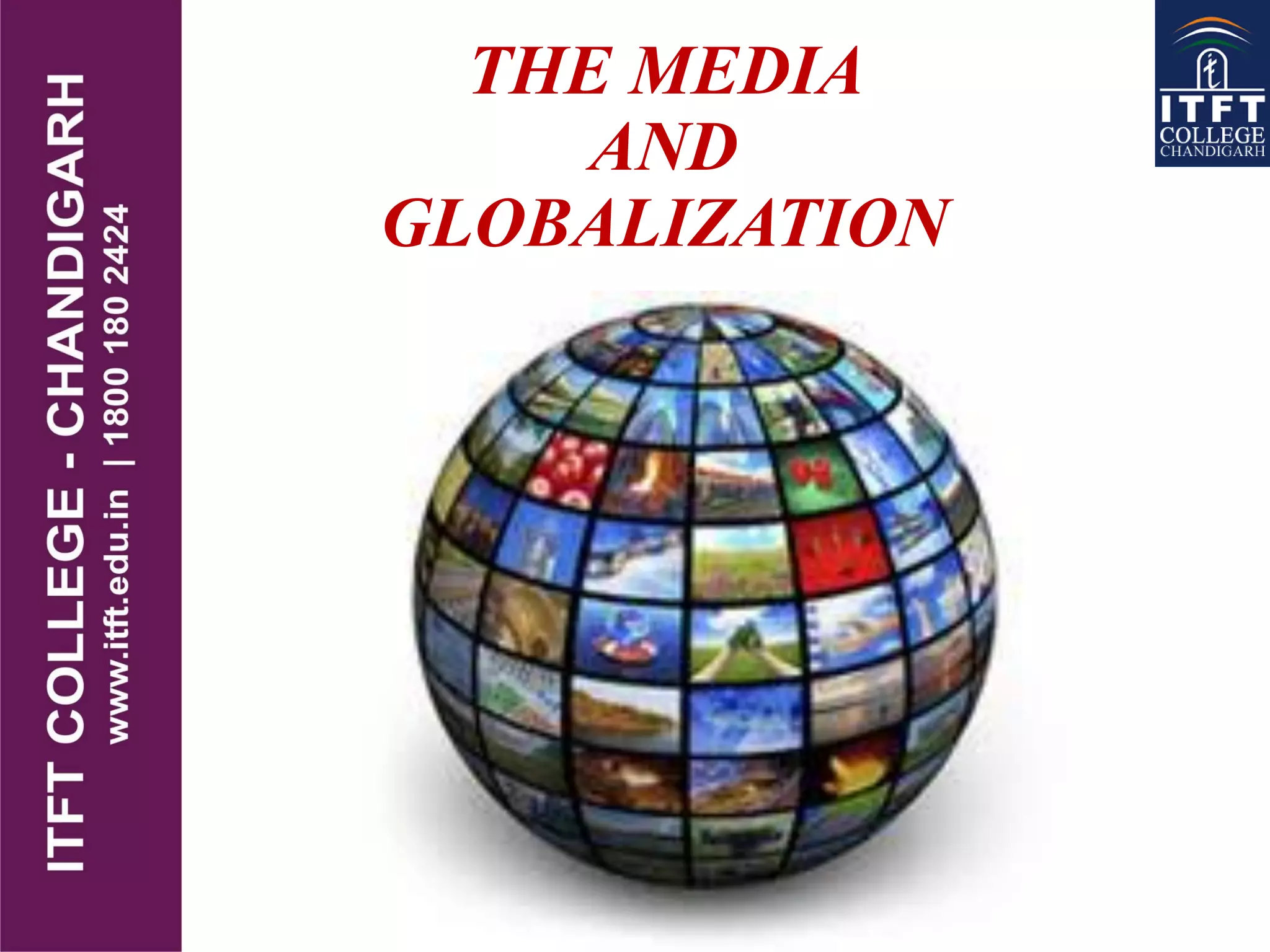
THE MEDIA
AND
GLOBALIZATION
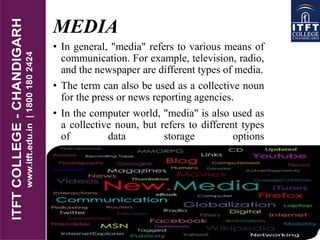
MEDIA
• In general, "media" refers to various means of
communication. For example, television, radio,
and the newspaper are different types of media.
• The term can also be used as a collective noun
for the press or news reporting agencies.
• In the computer world, "media" is also used as
a collective noun, but refers to different types
of data storage options
TYPES OF MEDIA
• Mainly there are two
types of mass media:
1. Print Media –
newspapers,
magazines, journals
2. Electronic Media –
radio, television,
films, new media
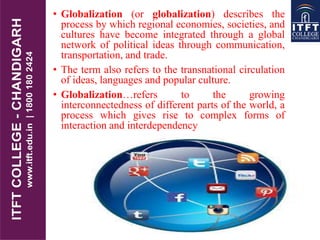
• Globalization (or globalization) describes the
process by which regional economies, societies, and
cultures have become integrated through a global
network of political ideas through communication,
transportation, and trade.
• The term also refers to the transnational circulation
of ideas, languages and popular culture.
• Globalization…refers to the growing
interconnectedness of different parts of the world, a
process which gives rise to complex forms of
interaction and interdependency
DEFINITIONS
 The United Nations ESCWA has
written that globalisation is a widely
used term that can be defined in a no
of ways. When used in an economic
context it refers to the reduction and
removal of barriers between national
borders in order to facilitate flow of
goods, capital, service, labour etc.
 The International Monetary Fund
defines globalisation as the growing
economic interdependence of
countries worldwide through
increasing volume and variety of
cross-border transactions in goods and
services.
 “The elimination of state-enforced
restrictions on exchanges across
borders and the increasingly
integrated and complex global system
of production and exchange that has
emerged as a result” Tom G. Palmer
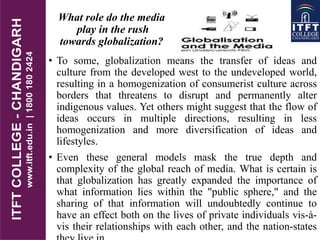
What role do the media
play in the rush
towards globalization?
• To some, globalization means the transfer of ideas and
culture from the developed west to the undeveloped world,
resulting in a homogenization of consumerist culture across
borders that threatens to disrupt and permanently alter
indigenous values. Yet others might suggest that the flow of
ideas occurs in multiple directions, resulting in less
homogenization and more diversification of ideas and
lifestyles.
• Even these general models mask the true depth and
complexity of the global reach of media. What is certain is
that globalization has greatly expanded the importance of
what information lies within the "public sphere," and the
sharing of that information will undoubtedly continue to
have an effect both on the lives of private individuals vis-à-
vis their relationships with each other, and the nation-states
Cont….
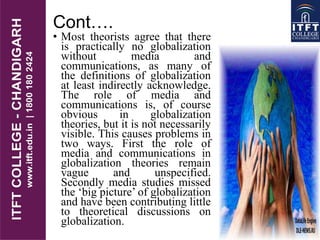
• Most theorists agree that there
is practically no globalization
without media and
communications, as many of
the definitions of globalization
at least indirectly acknowledge.
The role of media and
communications is, of course
obvious in globalization
theories, but it is not necessarily
visible. This causes problems in
two ways. First the role of
media and communications in
globalization theories remain
vague and unspecified.
Secondly media studies missed
the „big picture‟ of globalization
and have been contributing little
to theoretical discussions on
globalization.
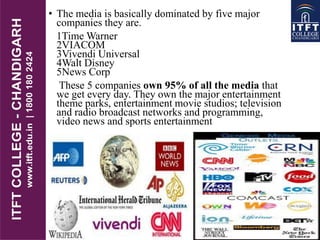
• The media is basically dominated by five major
companies they are.
1Time Warner
2VIACOM
3Vivendi Universal
4Walt Disney
5News Corp
These 5 companies own 95% of all the media that
we get every day. They own the major entertainment
theme parks, entertainment movie studios; television
and radio broadcast networks and programming,
video news and sports entertainment
• How media influence-
For example, after the attacks of 9/11 the
media gave a huge coverage of the event and
exposed Osama guilty for the attack as they
were told by the authorities. This shaped the
public opinion to support the war on terrorism,
the same happened with the war on Iraq. The
problem is that if media received accurate
information then the public opinion supported a
wrong cause, this is the power of public
opinion influence
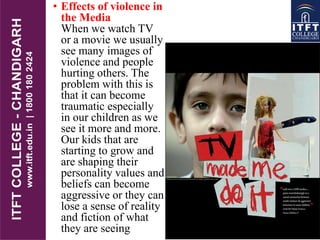
• Effects of violence in
the Media
When we watch TV
or a movie we usually
see many images of
violence and people
hurting others. The
problem with this is
that it can become
traumatic especially
in our children as we
see it more and more.
Our kids that are
starting to grow and
are shaping their
personality values and
beliefs can become
aggressive or they can
lose a sense of reality
and fiction of what
they are seeing
ITFT-MEDIA Media & globalization

ITFT-MEDIA Media & globalization

  • 1.
  • 2.
    MEDIA • In general,"media" refers to various means of communication. For example, television, radio, and the newspaper are different types of media. • The term can also be used as a collective noun for the press or news reporting agencies. • In the computer world, "media" is also used as a collective noun, but refers to different types of data storage options
  • 3.
    TYPES OF MEDIA •Mainly there are two types of mass media: 1. Print Media – newspapers, magazines, journals 2. Electronic Media – radio, television, films, new media
  • 4.
    • Globalization (orglobalization) describes the process by which regional economies, societies, and cultures have become integrated through a global network of political ideas through communication, transportation, and trade. • The term also refers to the transnational circulation of ideas, languages and popular culture. • Globalization…refers to the growing interconnectedness of different parts of the world, a process which gives rise to complex forms of interaction and interdependency
  • 5.
    DEFINITIONS  The UnitedNations ESCWA has written that globalisation is a widely used term that can be defined in a no of ways. When used in an economic context it refers to the reduction and removal of barriers between national borders in order to facilitate flow of goods, capital, service, labour etc.  The International Monetary Fund defines globalisation as the growing economic interdependence of countries worldwide through increasing volume and variety of cross-border transactions in goods and services.  “The elimination of state-enforced restrictions on exchanges across borders and the increasingly integrated and complex global system of production and exchange that has emerged as a result” Tom G. Palmer
  • 6.
    What role dothe media play in the rush towards globalization? • To some, globalization means the transfer of ideas and culture from the developed west to the undeveloped world, resulting in a homogenization of consumerist culture across borders that threatens to disrupt and permanently alter indigenous values. Yet others might suggest that the flow of ideas occurs in multiple directions, resulting in less homogenization and more diversification of ideas and lifestyles. • Even these general models mask the true depth and complexity of the global reach of media. What is certain is that globalization has greatly expanded the importance of what information lies within the "public sphere," and the sharing of that information will undoubtedly continue to have an effect both on the lives of private individuals vis-à- vis their relationships with each other, and the nation-states
  • 7.
    Cont…. • Most theoristsagree that there is practically no globalization without media and communications, as many of the definitions of globalization at least indirectly acknowledge. The role of media and communications is, of course obvious in globalization theories, but it is not necessarily visible. This causes problems in two ways. First the role of media and communications in globalization theories remain vague and unspecified. Secondly media studies missed the „big picture‟ of globalization and have been contributing little to theoretical discussions on globalization.
  • 8.
    • The mediais basically dominated by five major companies they are. 1Time Warner 2VIACOM 3Vivendi Universal 4Walt Disney 5News Corp These 5 companies own 95% of all the media that we get every day. They own the major entertainment theme parks, entertainment movie studios; television and radio broadcast networks and programming, video news and sports entertainment
  • 9.
    • How mediainfluence- For example, after the attacks of 9/11 the media gave a huge coverage of the event and exposed Osama guilty for the attack as they were told by the authorities. This shaped the public opinion to support the war on terrorism, the same happened with the war on Iraq. The problem is that if media received accurate information then the public opinion supported a wrong cause, this is the power of public opinion influence
  • 10.
    • Effects ofviolence in the Media When we watch TV or a movie we usually see many images of violence and people hurting others. The problem with this is that it can become traumatic especially in our children as we see it more and more. Our kids that are starting to grow and are shaping their personality values and beliefs can become aggressive or they can lose a sense of reality and fiction of what they are seeing