WEEDS
WHAT IS A WEED? Any plant growing where it is not wanted
What is a weed? “ A plant whose virtues have not yet been discovered.”   Ralph Waldo Emerson
Detrimental Effect of Weeds Look unattractive In pots in nurseries In garden displays In lawns May make harvesting difficult Stinging nettles Vine like weeds in harvesting machines Allelopathy Toxic exudates from weeds that affect crop plants
Detrimental Effects of Weeds Competition Weeds compete for surface nutrients Compete for bees Compete for water Compete for light Poisonous or painful To people and animals due to chemical or physical defences e.g. thorns Harbour Pests and Diseases Humidity increased Over-wintering sites/alternative food source
Detrimental Effects of Weeds Disrupt and destroy native eco-systems by competing for light, water, nutrients, physical space etc Approximately 8 species of exotic (i.e. non-native) plants naturalise in NZ per year Of those, approximately 10% will become invasive
Worst weeds around Dunedin? In order of weed score rating #1 worst ecological potential = bomarea then old man’s beard hawthorn blackberry gorse sycamore banana passionfruit Followed by… buddleja ivy Darwin’s barberry broom cotoneaster convolvulus Chilean flame creeper
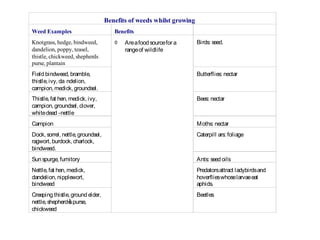
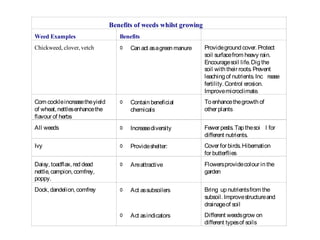
Benefits of Weeds Add interest/colour to landscapes Increase diversity Edible/herbal remedies Act as subsoilers Access nutrients lower down in the soil profile Stabilise hillsides Act as indicators Act as a green manure Contain beneficial chemicals Provide food for predator adults Are a food source for a range of wildlife Provide shelter


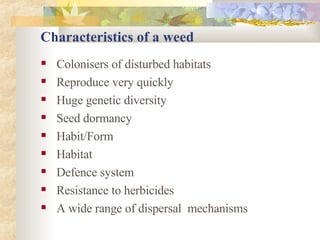
Characteristics of a weed Colonisers of disturbed habitats Reproduce very quickly Huge genetic diversity Seed dormancy Habit/Form Habitat Defence system Resistance to herbicides A wide range of dispersal  mechanisms
Reproduction Methods Rhizome Tubers Root or Shoot Segments Bulbs Seeds Stolons
Weed Lifecycles Annual  Biennial Perennial Ephemeral
Annuals A plant that completes it’s lifecycles in one calendar year or growing season. Seed    Germination    Growth    Flowering/reproduction    Seed set    Death Annual weeds ensure survival by seed production. E.g. fathen, groundsel, cleavers
Biennials Year 1 Grow from seed and develop strong  root systems and cluster of leaves Year 2 Mature, produce seeds and die Biennial weeds ensure survival by seed production E.g. brassicas, shepherd’s purse
Perennial A plant that persists and produces reproductive structures year after year. Reproduces by  Seed  and  Vegetatively. taproots rhizomes creeping stems bulbs/corms E.g. dock, creeping buttercup, couch, oxalis
Ephemeral A plant that completes many lifecycles within one calendar year or growing season.  Ephemeral weeds are very short lived. Seed    Germination    Growth    Flowering/reproduction    Seed set    Death Within weeks Ephemeral weeds ensure survival by seed production.
Implication for weed control Suitable control measures Lifecycle stage Annual/   Mowing, cultivation or contact herbicide. Ephemeral Before flowering. Biennial Cultivation or contact herbicide. Preferably in the first year of growth or in  the second  year before flowering. Perennial Individuals removed, systemic herbicides. Preferably before maturity – in any year  before flowering.
Remember the saying: “ One year’s seeding  means seven year’s weeding!” [1873 Harland & Wilkinson Lancashire Legends 190]
Weeds – adaptations and survival Plant type (life cycle) Plant vigour/Growth rate Weed habit Seed production Seed dispersal Seeding height Physical and chemical defences Root and specialised underground storage systems Herbicide resistance
Weeds – distribution and growth Different environmental conditions favour different patterns of weed distribution and growth. Coastal areas Amenity turf Bush/woodland areas Wetlands Wasteland Garden bed/borders
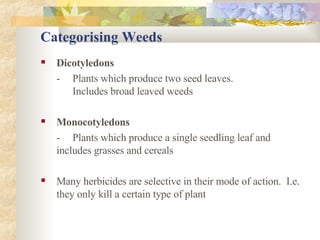
Categorising Weeds Dicotyledons - Plants which produce two seed leaves.  Includes broad leaved weeds Monocotyledons - Plants which produce a single seedling leaf and  includes grasses and cereals Many herbicides are selective in their mode of action.  I.e. they only kill a certain type of plant
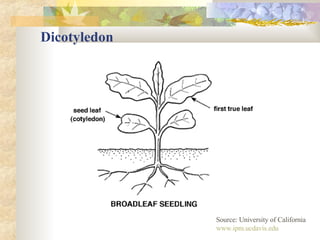
Dicotyledon Source: University of California www.ipm.ucdavis.edu
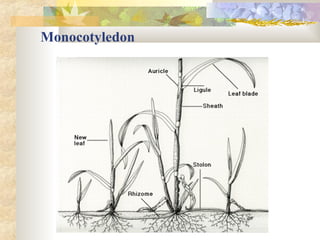
Monocotyledon
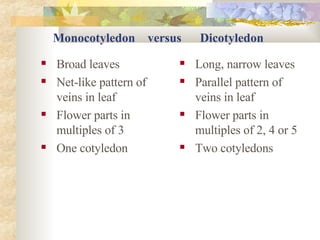
Monocotyledon  versus  Dicotyledon Broad leaves Net-like pattern of veins in leaf Flower parts in multiples of 3 One cotyledon Long, narrow leaves Parallel pattern of veins in leaf Flower parts in multiples of 2, 4 or 5 Two cotyledons
Weed Management Cultural control Biological control Chemical control Legal methods to enforce the 3 methods above Combined together =  Integrated weed management
Cultural Weed Control Prevention Keep surrounding areas weed free Mow before flowering General hygiene - machinery, tools, mulches Don’t buy in with mulch, compost or plants
Cultivation Hand weeding, hoeing, cultivation. Cheap, time consuming. annual/perennial seedlings Heat treatment water or heat/fire annual/perennial seedlings Mulches  (organic and inorganic) Suppresses weed growth by eliminating light No light = No weed Physical control of weeds
Stale Bed Technique Preparing the bed in advance so that the weeds germinate and can be removed before you sow your crop Digging Turn the soil over and bury the weeds upside down - Instant Gratification - Digging when the soil is wet may destroy the soil structure and cause compaction - Some weeds may be slow to decompose and go slimy - don’t replant too soon - Digging will bring weed seeds to the surface - Try digging in the dark!
Mulching Mulches Prevent weeds germinating  - excludes light/unsuitable surface Conserve soil moisture - reduces evaporation Prevents rapid fluctuations in soil temperature Reduces winter heat loss from soil (can prevent them from warming thus increasing frost damage) Prevents soils splashes - reduces soil borne fungal diseases Reduces erosion caused by rain run-off (can prevent water getting into the soil)
Organic Mulches Sawdust Bark chips Peat Hay Straw Leaf mould Spent mushroom compost Fowl manure Stable manure Grass clippings Wood shavings Newspaper
Inorganic Mulches Black polythene Woven plastic fabrics/’Weedmat’ Gravel Scoria Pebbles Rocks
Biological Control of Weeds The use of insects or diseases to control weeds Biological control does not aim to eliminate the weed but to reduce it to a level where it can be effectively controlled by other methods
Biological Control of Weeds Weeds Weeds are mostly introduced (accidentally or deliberately) They often flourish in NZ because: - of the more favourable climate  - insects and disease which naturally control them are not  here Biological control Biological control can be initially slow to show any results.  However once it is established it costs nothing. The insect damages the host plant only, therefore there are minimal environmental side effects.
To control  gorse:  gorse weevil ( Apion ulicis ) and gorse spider mite ( Tetranychus lintearius ) To control  Californian thistle : leaf beetle ( Lema cyanella ) To control  old man’s beard : old man’s beard leaf miner ( Phytomyza vitalbae ) Examples of Biological Agents
Selection of Biological Agents Scientific testing Host specific  MAF permission Quarantine Breeding up Release Assessment
Chemical control of weeds How Herbicides Work Block a Fundamental Growth Process - destroy chlorophyll  - stop cell division - stop respiration Cause stunting, unnatural growth, and dry out the plant (desiccant)
Modes of action Contact Herbicides - foliar applied sprays - enter leaves by diffusion entering the xylem - kills the plant at point of spray contact - use on annuals and young perennials e.g. Universal Weed Killer, Preeglone Systemic or Translocated Herbicides - absorbed either through the roots or leaves - the chemical is then  translocated  or moved about  within  the  plant as it grows e.g. Roundup
Herbicide Selectivity Selective Herbicide - Kills the weeds without harming the desired plants e.g.  Lawn weedkillers  kill broadleaves and leave grasses e.g.  Grasskiller Non-selective herbicides(broad spectrum) - Kills  all  vegetation for total control - Do not use on lawns e.g.  Amitrole, Round-up
What makes a herbicide selective? Herbicide selectivity: Can be a feature of the herbicide - how it is made, active ingredients, different chemical  reaction to different types of plants The way we apply it i.e.  Timing
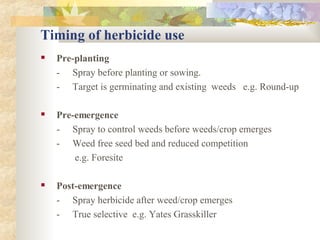
Timing of herbicide use Pre-planting - Spray before planting or sowing. - Target is germinating and existing  weeds  e.g. Round-up Pre-emergence - Spray to control weeds before weeds/crop emerges - Weed free seed bed and reduced competition     e.g. Foresite Post-emergence - Spray herbicide after weed/crop emerges - True selective  e.g. Yates Grasskiller
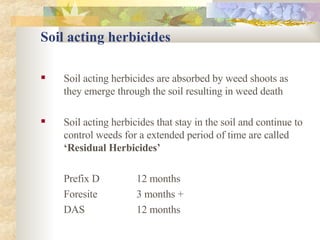
Soil acting herbicides Soil acting herbicides are absorbed by weed shoots as they emerge through the soil resulting in weed death Soil acting herbicides that stay in the soil and continue to control weeds for a extended period of time are called  ‘Residual Herbicides’ Prefix D 12 months Foresite 3 months + DAS 12 months
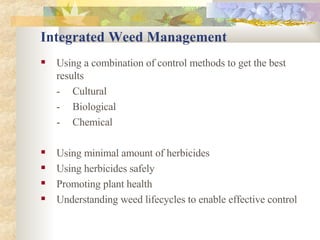
Integrated Weed Management Using a combination of control methods to get the best results - Cultural - Biological - Chemical Using minimal amount of herbicides Using herbicides safely Promoting plant health Understanding weed lifecycles to enable effective control
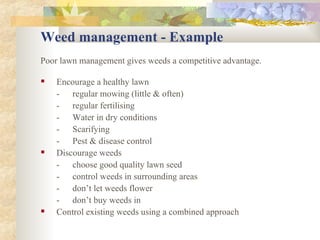
Weed management - Example Poor lawn management gives weeds a competitive advantage. Encourage a healthy lawn - regular mowing (little & often) - regular fertilising - Water in dry conditions - Scarifying - Pest & disease control Discourage weeds - choose good quality lawn seed - control weeds in surrounding areas - don’t let weeds flower - don’t buy weeds in Control existing weeds using a combined approach
Weed Books Weed books on close reserve at the Bill Robertson Library Taylor, R. L. (1981).  Weeds of roadsides and waste ground in New Zealand . Nelson: Taylor Uprichard, E. A. (1985).  A guide to the identification of NZ common weeds in colour . Palmerston North: NZ Weed and Pest Control Society. Taylor, R. L. (1983).  Weeds of crops and gardens in New Zealand .  Nelson: Taylor Parham, B. E. V; Healy, A. J. (1976).  Common weeds in New Zealand . Wellington: D.S.I.R.
References University of California  www.ipm.ucdavis.edu

Weeds 2007

  • 1.
  • 2.
    WHAT IS AWEED? Any plant growing where it is not wanted
  • 3.
    What is aweed? “ A plant whose virtues have not yet been discovered.” Ralph Waldo Emerson
  • 4.
    Detrimental Effect ofWeeds Look unattractive In pots in nurseries In garden displays In lawns May make harvesting difficult Stinging nettles Vine like weeds in harvesting machines Allelopathy Toxic exudates from weeds that affect crop plants
  • 5.
    Detrimental Effects ofWeeds Competition Weeds compete for surface nutrients Compete for bees Compete for water Compete for light Poisonous or painful To people and animals due to chemical or physical defences e.g. thorns Harbour Pests and Diseases Humidity increased Over-wintering sites/alternative food source
  • 6.
    Detrimental Effects ofWeeds Disrupt and destroy native eco-systems by competing for light, water, nutrients, physical space etc Approximately 8 species of exotic (i.e. non-native) plants naturalise in NZ per year Of those, approximately 10% will become invasive
  • 7.
    Worst weeds aroundDunedin? In order of weed score rating #1 worst ecological potential = bomarea then old man’s beard hawthorn blackberry gorse sycamore banana passionfruit Followed by… buddleja ivy Darwin’s barberry broom cotoneaster convolvulus Chilean flame creeper
  • 8.
    Benefits of WeedsAdd interest/colour to landscapes Increase diversity Edible/herbal remedies Act as subsoilers Access nutrients lower down in the soil profile Stabilise hillsides Act as indicators Act as a green manure Contain beneficial chemicals Provide food for predator adults Are a food source for a range of wildlife Provide shelter
  • 9.
  • 10.
  • 11.
  • 12.
  • 13.
    Characteristics of aweed Colonisers of disturbed habitats Reproduce very quickly Huge genetic diversity Seed dormancy Habit/Form Habitat Defence system Resistance to herbicides A wide range of dispersal mechanisms
  • 14.
    Reproduction Methods RhizomeTubers Root or Shoot Segments Bulbs Seeds Stolons
  • 15.
    Weed Lifecycles Annual Biennial Perennial Ephemeral
  • 16.
    Annuals A plantthat completes it’s lifecycles in one calendar year or growing season. Seed  Germination  Growth  Flowering/reproduction  Seed set  Death Annual weeds ensure survival by seed production. E.g. fathen, groundsel, cleavers
  • 17.
    Biennials Year 1Grow from seed and develop strong root systems and cluster of leaves Year 2 Mature, produce seeds and die Biennial weeds ensure survival by seed production E.g. brassicas, shepherd’s purse
  • 18.
    Perennial A plantthat persists and produces reproductive structures year after year. Reproduces by Seed and Vegetatively. taproots rhizomes creeping stems bulbs/corms E.g. dock, creeping buttercup, couch, oxalis
  • 19.
    Ephemeral A plantthat completes many lifecycles within one calendar year or growing season. Ephemeral weeds are very short lived. Seed  Germination  Growth  Flowering/reproduction  Seed set  Death Within weeks Ephemeral weeds ensure survival by seed production.
  • 20.
    Implication for weedcontrol Suitable control measures Lifecycle stage Annual/ Mowing, cultivation or contact herbicide. Ephemeral Before flowering. Biennial Cultivation or contact herbicide. Preferably in the first year of growth or in the second year before flowering. Perennial Individuals removed, systemic herbicides. Preferably before maturity – in any year before flowering.
  • 21.
    Remember the saying:“ One year’s seeding means seven year’s weeding!” [1873 Harland & Wilkinson Lancashire Legends 190]
  • 22.
    Weeds – adaptationsand survival Plant type (life cycle) Plant vigour/Growth rate Weed habit Seed production Seed dispersal Seeding height Physical and chemical defences Root and specialised underground storage systems Herbicide resistance
  • 23.
    Weeds – distributionand growth Different environmental conditions favour different patterns of weed distribution and growth. Coastal areas Amenity turf Bush/woodland areas Wetlands Wasteland Garden bed/borders
  • 24.
    Categorising Weeds Dicotyledons- Plants which produce two seed leaves. Includes broad leaved weeds Monocotyledons - Plants which produce a single seedling leaf and includes grasses and cereals Many herbicides are selective in their mode of action. I.e. they only kill a certain type of plant
  • 25.
    Dicotyledon Source: Universityof California www.ipm.ucdavis.edu
  • 26.
  • 27.
    Monocotyledon versus Dicotyledon Broad leaves Net-like pattern of veins in leaf Flower parts in multiples of 3 One cotyledon Long, narrow leaves Parallel pattern of veins in leaf Flower parts in multiples of 2, 4 or 5 Two cotyledons
  • 28.
    Weed Management Culturalcontrol Biological control Chemical control Legal methods to enforce the 3 methods above Combined together = Integrated weed management
  • 29.
    Cultural Weed ControlPrevention Keep surrounding areas weed free Mow before flowering General hygiene - machinery, tools, mulches Don’t buy in with mulch, compost or plants
  • 30.
    Cultivation Hand weeding,hoeing, cultivation. Cheap, time consuming. annual/perennial seedlings Heat treatment water or heat/fire annual/perennial seedlings Mulches (organic and inorganic) Suppresses weed growth by eliminating light No light = No weed Physical control of weeds
  • 31.
    Stale Bed TechniquePreparing the bed in advance so that the weeds germinate and can be removed before you sow your crop Digging Turn the soil over and bury the weeds upside down - Instant Gratification - Digging when the soil is wet may destroy the soil structure and cause compaction - Some weeds may be slow to decompose and go slimy - don’t replant too soon - Digging will bring weed seeds to the surface - Try digging in the dark!
  • 32.
    Mulching Mulches Preventweeds germinating - excludes light/unsuitable surface Conserve soil moisture - reduces evaporation Prevents rapid fluctuations in soil temperature Reduces winter heat loss from soil (can prevent them from warming thus increasing frost damage) Prevents soils splashes - reduces soil borne fungal diseases Reduces erosion caused by rain run-off (can prevent water getting into the soil)
  • 33.
    Organic Mulches SawdustBark chips Peat Hay Straw Leaf mould Spent mushroom compost Fowl manure Stable manure Grass clippings Wood shavings Newspaper
  • 34.
    Inorganic Mulches Blackpolythene Woven plastic fabrics/’Weedmat’ Gravel Scoria Pebbles Rocks
  • 35.
    Biological Control ofWeeds The use of insects or diseases to control weeds Biological control does not aim to eliminate the weed but to reduce it to a level where it can be effectively controlled by other methods
  • 36.
    Biological Control ofWeeds Weeds Weeds are mostly introduced (accidentally or deliberately) They often flourish in NZ because: - of the more favourable climate - insects and disease which naturally control them are not here Biological control Biological control can be initially slow to show any results. However once it is established it costs nothing. The insect damages the host plant only, therefore there are minimal environmental side effects.
  • 37.
    To control gorse: gorse weevil ( Apion ulicis ) and gorse spider mite ( Tetranychus lintearius ) To control Californian thistle : leaf beetle ( Lema cyanella ) To control old man’s beard : old man’s beard leaf miner ( Phytomyza vitalbae ) Examples of Biological Agents
  • 38.
    Selection of BiologicalAgents Scientific testing Host specific MAF permission Quarantine Breeding up Release Assessment
  • 39.
    Chemical control ofweeds How Herbicides Work Block a Fundamental Growth Process - destroy chlorophyll - stop cell division - stop respiration Cause stunting, unnatural growth, and dry out the plant (desiccant)
  • 40.
    Modes of actionContact Herbicides - foliar applied sprays - enter leaves by diffusion entering the xylem - kills the plant at point of spray contact - use on annuals and young perennials e.g. Universal Weed Killer, Preeglone Systemic or Translocated Herbicides - absorbed either through the roots or leaves - the chemical is then translocated or moved about within the plant as it grows e.g. Roundup
  • 41.
    Herbicide Selectivity SelectiveHerbicide - Kills the weeds without harming the desired plants e.g. Lawn weedkillers kill broadleaves and leave grasses e.g. Grasskiller Non-selective herbicides(broad spectrum) - Kills all vegetation for total control - Do not use on lawns e.g. Amitrole, Round-up
  • 42.
    What makes aherbicide selective? Herbicide selectivity: Can be a feature of the herbicide - how it is made, active ingredients, different chemical reaction to different types of plants The way we apply it i.e. Timing
  • 43.
    Timing of herbicideuse Pre-planting - Spray before planting or sowing. - Target is germinating and existing weeds e.g. Round-up Pre-emergence - Spray to control weeds before weeds/crop emerges - Weed free seed bed and reduced competition e.g. Foresite Post-emergence - Spray herbicide after weed/crop emerges - True selective e.g. Yates Grasskiller
  • 44.
    Soil acting herbicidesSoil acting herbicides are absorbed by weed shoots as they emerge through the soil resulting in weed death Soil acting herbicides that stay in the soil and continue to control weeds for a extended period of time are called ‘Residual Herbicides’ Prefix D 12 months Foresite 3 months + DAS 12 months
  • 45.
    Integrated Weed ManagementUsing a combination of control methods to get the best results - Cultural - Biological - Chemical Using minimal amount of herbicides Using herbicides safely Promoting plant health Understanding weed lifecycles to enable effective control
  • 46.
    Weed management -Example Poor lawn management gives weeds a competitive advantage. Encourage a healthy lawn - regular mowing (little & often) - regular fertilising - Water in dry conditions - Scarifying - Pest & disease control Discourage weeds - choose good quality lawn seed - control weeds in surrounding areas - don’t let weeds flower - don’t buy weeds in Control existing weeds using a combined approach
  • 47.
    Weed Books Weedbooks on close reserve at the Bill Robertson Library Taylor, R. L. (1981). Weeds of roadsides and waste ground in New Zealand . Nelson: Taylor Uprichard, E. A. (1985). A guide to the identification of NZ common weeds in colour . Palmerston North: NZ Weed and Pest Control Society. Taylor, R. L. (1983). Weeds of crops and gardens in New Zealand . Nelson: Taylor Parham, B. E. V; Healy, A. J. (1976). Common weeds in New Zealand . Wellington: D.S.I.R.
  • 48.
    References University ofCalifornia www.ipm.ucdavis.edu