Integrated Pest
Management
(IPM)
Barlet -1956
The term Integrated pest control
(IPC)
Geirer and Clerk - 1961
The term Integrated pest
management (IPM)
What is IPM?
 Smith and Ronalds -1965
 “ IPM defined as the pest population
management system that utilizes all
suitable techniques and methods in
compatible manner to reduce or
maintain the pest population below
EIL.”
History of IPM
 Michelbacher and Bacon – 1952
coined term Integrated control .
 Stern et al. 1959
defined integrated control as applied
pest control .
 Geier 1966
coin the term pest management .
 CEQ – Council On Environmental
Quality
In 1972 gave the term IPM.
 FAO – Food And Agriculture
Organization
In 1967 defined IPM.
 1989 – IPM Task force was
established
 1990 –
IPMWG ( IPM working group)
constituted to implementation
of IPM at international
level.
Reasons for IPM
 Chemical pesticides
can impact the
human health and
ecosystems
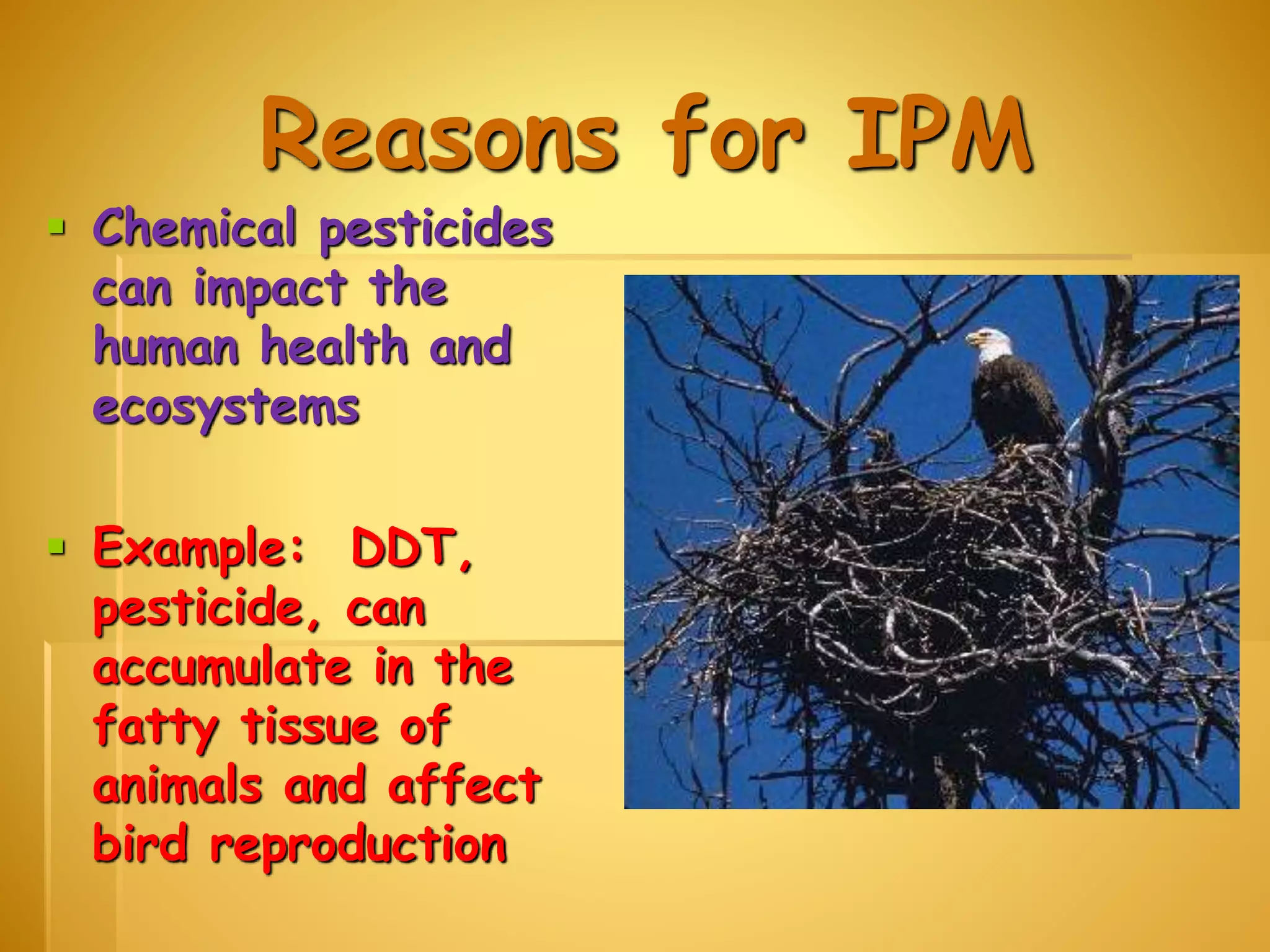
 Example: DDT,
pesticide, can
accumulate in the
fatty tissue of
animals and affect
bird reproduction
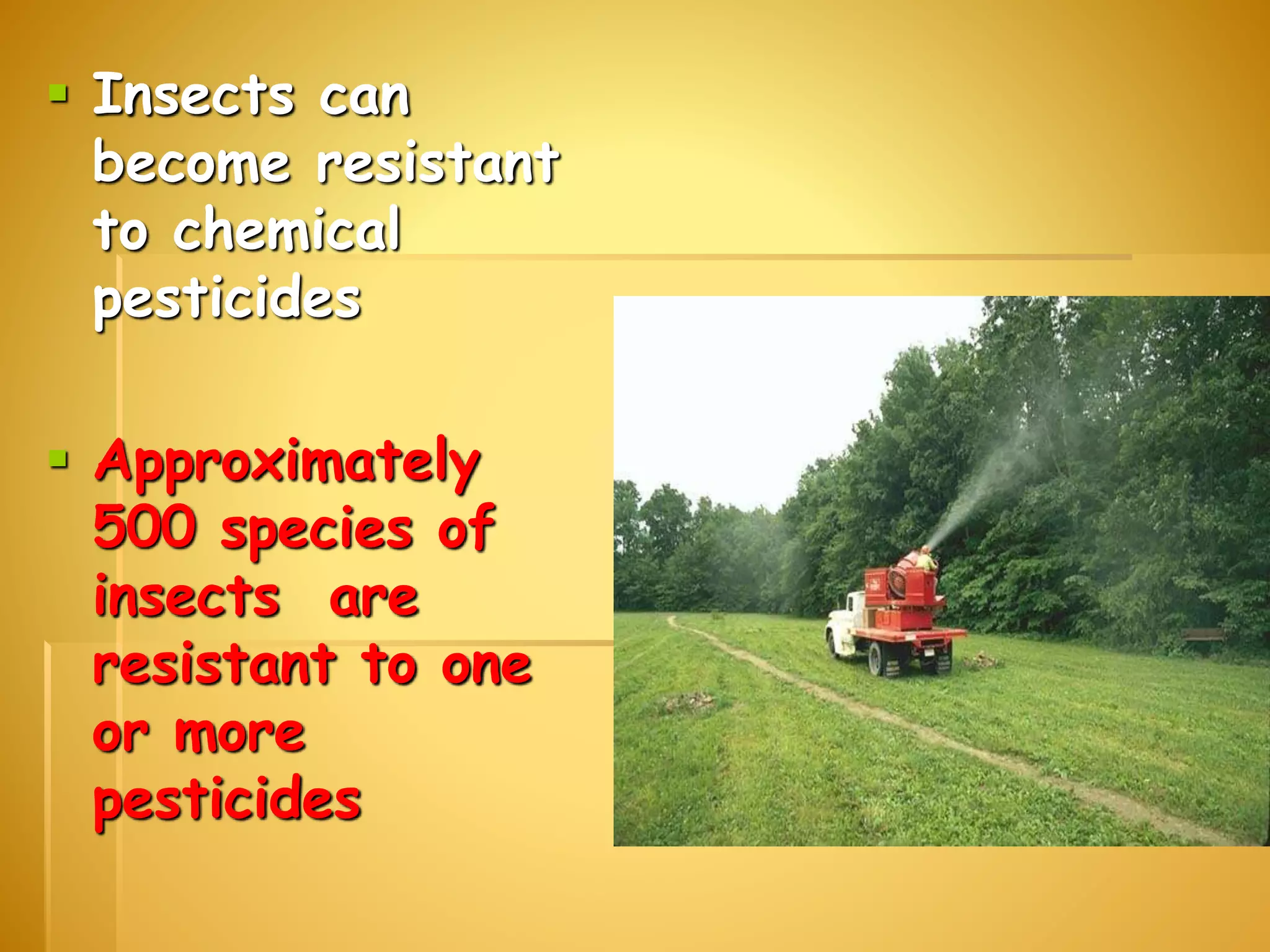
 Insects can
become resistant
to chemical
pesticides
 Approximately
500 species of
insects are
resistant to one
or more
pesticides
 Eg- OP Insecticides and synthetic
pyrethroid resistance in Helicoverpa
armigera .
 Outbreak of secondary pest
eg – white flies emerged as major pest
when spraying insecticides againest
Helicoverpa armigera .
 Resurgence of target pest
Eg- BPH of rice increased when some
OP chemicals are applied.
 The non target organisms like
parasites ,predator ,and
pollinators are killed.
 Indiscriminate use of pesticides
lead to ecological imbalance by
killing predator and parasitoids .
 This may create legal problems
through food contamination and
pollution .
Concept of IPM
1.Understanding the agriculture ecosystem
 Typical agro ecosystem contains 1-4
major crop spp. and 6-10 major pest
spp.
 Agro ecosystem is intensively manipulated
by man for ploughing , inter cultivation
and treatment with pesticides
 Pest population greatly influenced by
these practice.
 Agro ecosystem more susceptible to pest
damage.
2.Planning Of Agro Ecosystem
 Growing of susceptible varieties
should be avoided and related crops
should not be grown.
 eg- 1.Bhendi followed by cotton
increases incidence of spotted
borer
2.Groundnut followed by
soyabean increases incidence of
the leaf miner
3.Cost benefit ratio -
The crop life table to provide solid
information analysis of pest damage as
well as cost benefit ratio in pest
management.
Benefit risk analysis comes when a
chemical pesticide is applied in agro
ecosystem for considering its impact on
society and environment relevant to its
benefit.
4.Tolerance to pest damage
 The pest free crop is neither
necessary in for high yield
 Eg – castor crop can tolerate up
to 25 % defoliation.
 Exception occur in case of plant
disease transmission by vector.
5.Leaving pest residues
Indiscriminate use of
pesticide eliminate natural
enemies .
Pest management is the
important concept to leave a
permanent pest residues below
ETL, so the natural enemies
survive.
6.Timing of treatment.
 Treatment in terms of pesticide
spray should be need based with
minimum number of sprays ,timely
scheduled. Combined with improved
techniques of pest monitoring and
crop development.
 Eg – use of pheromone traps for
monitoring of pest population.
7.Public understanding
and acceptance -
 In order to deal with various
pest problem special effort
should be made for effective
communication to the people for
better understanding and
acceptance of pest management
practice .
Tools of IPM
 Culture method / control.
 Mechanical method
 Physical control
 Legal method
 HPR.
 Chemical method
 Biological method

Integrated pest management (ipm)

  • 1.
  • 2.
    Barlet -1956 The termIntegrated pest control (IPC) Geirer and Clerk - 1961 The term Integrated pest management (IPM)
  • 3.
    What is IPM? Smith and Ronalds -1965  “ IPM defined as the pest population management system that utilizes all suitable techniques and methods in compatible manner to reduce or maintain the pest population below EIL.”
  • 4.
    History of IPM Michelbacher and Bacon – 1952 coined term Integrated control .  Stern et al. 1959 defined integrated control as applied pest control .  Geier 1966 coin the term pest management .
  • 5.
     CEQ –Council On Environmental Quality In 1972 gave the term IPM.  FAO – Food And Agriculture Organization In 1967 defined IPM.  1989 – IPM Task force was established
  • 6.
     1990 – IPMWG( IPM working group) constituted to implementation of IPM at international level.
  • 7.
    Reasons for IPM Chemical pesticides can impact the human health and ecosystems  Example: DDT, pesticide, can accumulate in the fatty tissue of animals and affect bird reproduction
  • 8.
     Insects can becomeresistant to chemical pesticides  Approximately 500 species of insects are resistant to one or more pesticides
  • 9.
     Eg- OPInsecticides and synthetic pyrethroid resistance in Helicoverpa armigera .  Outbreak of secondary pest eg – white flies emerged as major pest when spraying insecticides againest Helicoverpa armigera .  Resurgence of target pest Eg- BPH of rice increased when some OP chemicals are applied.
  • 10.
     The nontarget organisms like parasites ,predator ,and pollinators are killed.  Indiscriminate use of pesticides lead to ecological imbalance by killing predator and parasitoids .  This may create legal problems through food contamination and pollution .
  • 11.
    Concept of IPM 1.Understandingthe agriculture ecosystem  Typical agro ecosystem contains 1-4 major crop spp. and 6-10 major pest spp.  Agro ecosystem is intensively manipulated by man for ploughing , inter cultivation and treatment with pesticides  Pest population greatly influenced by these practice.  Agro ecosystem more susceptible to pest damage.
  • 12.
    2.Planning Of AgroEcosystem  Growing of susceptible varieties should be avoided and related crops should not be grown.  eg- 1.Bhendi followed by cotton increases incidence of spotted borer 2.Groundnut followed by soyabean increases incidence of the leaf miner
  • 13.
    3.Cost benefit ratio- The crop life table to provide solid information analysis of pest damage as well as cost benefit ratio in pest management. Benefit risk analysis comes when a chemical pesticide is applied in agro ecosystem for considering its impact on society and environment relevant to its benefit.
  • 14.
    4.Tolerance to pestdamage  The pest free crop is neither necessary in for high yield  Eg – castor crop can tolerate up to 25 % defoliation.  Exception occur in case of plant disease transmission by vector.
  • 15.
    5.Leaving pest residues Indiscriminateuse of pesticide eliminate natural enemies . Pest management is the important concept to leave a permanent pest residues below ETL, so the natural enemies survive.
  • 16.
    6.Timing of treatment. Treatment in terms of pesticide spray should be need based with minimum number of sprays ,timely scheduled. Combined with improved techniques of pest monitoring and crop development.  Eg – use of pheromone traps for monitoring of pest population.
  • 17.
    7.Public understanding and acceptance-  In order to deal with various pest problem special effort should be made for effective communication to the people for better understanding and acceptance of pest management practice .
  • 18.
    Tools of IPM Culture method / control.  Mechanical method  Physical control  Legal method  HPR.  Chemical method  Biological method