IDENTIFICATION OF WEEDS
Practical - 06
What is weed?
• A weed, by definition, is a plant growing where it isn’t wanted.
• This generally means they are in direct competition with growth of desirable
plant.
Classification of weeds by their life cycle
• Annual Species
• Biennial Species
• Perennial Species
Annual Species
• Annual plants complete their lifecycle in one year (one growing
season)
• These are often rapidly spreading and germinate quickly.
• They germinate, grow, bear flowers and fruits and die off in same
year.
Biennial Species
• Biennial species take two full years to complete their life cycle.
• They germinate grow leaves and stems in first year, in second year they bear
the flowers and fruits.
Perennial Species
• Perennial weeds produce long taproots that make them difficult to eradicate.
• These plants come back year after year from the same root.
Computation of yield losses due to weeds
Percentage reduction in yield-
• Measure of efficacy of a particular treatment when compared with
weed free treatment and is expressed as percentage reduction in
yield.
• Higher in % yield reduction means greater loss due to weeds
Computation of yield losses due to weeds
Percentage reduction in yield =
Where, X is yield from weed free plot and Y is yield from treated plot
Problem-
A weed free plot of Sorghum has given yield of 1500 kg ha-1 whereas atrazine have given yields
of 1400 kg. Calculate the % yield reduction?
X – Y x 100
X
Biology of important weeds
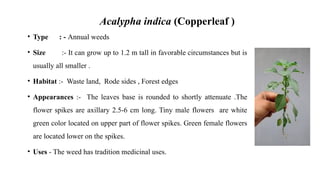
Acalypha indica (Copperleaf )
• Type : - Annual weeds
• Size :- It can grow up to 1.2 m tall in favorable circumstances but is
usually all smaller .
• Habitat :- Waste land, Rode sides , Forest edges
• Appearances :- The leaves base is rounded to shortly attenuate .The
flower spikes are axillary 2.5-6 cm long. Tiny male flowers are white
green color located on upper part of flower spikes. Green female flowers
are located lower on the spikes.
• Uses - The weed has tradition medicinal uses.
• How to control it:
 Hand weeding , mowing
 Use integrated weed management (IWM)
 Use selective herbicide that target broad leaf weeds without harming
crops
Ex- 2-4 D , glyphosate
 Use pre emergent herbicides
Continue……..
Parthenium weeds (Parthenium hysterophorus )
• Type :- Perennial crop
• Habitat :- Semi arid, subtropical , tropical and warmer temperate
region
• Size :- Usually grows 0.5-1.5 m.
• Appearances :- Matures stem is greenish and longitudinally
grooved covered in small stiff hairs. Numerous small flowers
heads are arranged in cluster. Flower heads are white or cream
color and have 5 tingly petals.
• How to control it:
 Chemical control
young and actively growing
eg :- 2-4D , paraquat , glyphosate
seedling and mature plant
eg :- Dicamba
Continue……..
Tick berry (Lantana camara )
• Type :- perennial
• Habitat :- Tropical and sub tropical countries , forest margins
• Size :- Shrub which typically grows to around 2 m tall
• Appearances :- leaves are broadly ovate . Have strong odor , small tubular
shaped flowers which have 4 petals and arrange in cluster, flower in many
different color (red, yellow ,pink, white and orange), fruit is a berry like
drupe which turns from green to dark purple.
• How to control it:
 Mechanical control by slashing plants. Grow the shade tolerates crops -
lantana camera prefers sunny areas
Spreading hog weed ( Boerhavia diffusa )
• Type :- Perennial
• Habitat :- Tropical area
• Size :- Usually grows 5 to 6 cm
• Appearances :- Characterized by cotyledons and its
opposite leaves of different size, Flowers are small,
around 5 mm in diameter. stem purplish or reddish,
thickened at nodes.
• Uses :- used as a fodder for livestock
• How to control it:
 Mulching
 Tillage
 Use Selective herbicides (MCPA and 2-4D )
 Do the crop rotation
Continue……..
Coat buttons (Tridax procumbens)
• Type :- Annual to Perennial
• Habitat :- Tropical and sub tropical area
• Size :- Usually grows 2 feet
• Appearances The plant bears daisy-like yellow-centered
white or yellow flowers with three-toothed ray florets.
The leaves are toothed and generally arrowhead-shaped.
How to control it:-
 Use a mulch or a pre-emergent herbicide in spring to prevent
quick weed.
 These plants have a shallow root system and are easy to pull by
hand or spot-treat with a post-emergent herbicide.
Continue……..
• Type :- Grass-like perennial
• Size :- 2 feet tall, 1 foot wide
• Habitat :- Lawn, landscape, or garden areas in sun or shade
• Appearance :- Nutsedge has slender, grassy leaves,
triangular stems, and small, nutlike tubers on the root
system. When these weeds pop up in lawns, they often grow
faster than turf grass, so they are easy to spot.
Nutsedge (Cyperus rotundus)
How to control it:-
 Remove these plants as soon as you've identified them.
 Do not allow them to develop tubers. Tubers develop about four to six weeks after
the shoot.
 Crop rotation
 Proper irrigation method
 Use selective herbicides that specifically target weed without harming the main crop
Continue……..
Dandelion (Taraxacum officinale)
• Type: Broadleaf perennial
• Size: 12 inches tall, 6-16 inches wide
• Habitat: Lawns and gardens in sun or shade
• Appearance: This common lawn weed
has a long taproot with deeply notched leaves. Yellow
flowers mature into puffballs. Dandelion seeds are like
parachutes that fly away in the wind, helping them
invade new spaces in lawns and garden beds.
• How to control it:-
 Dig up the roots with spade
 Mulching with landscape fabrics
 You can use herbicide to eliminate dandelions
Continue……..
Crabgrass ( Digitaria spp)
• Type:- Grassy annual
• Size:- Up to 18 inches tall and 20 inches wide
• Habitat:- Lawn, landscape, and garden areas in
sun or shade
• Appearance:- Crabgrass is exactly what it
sounds like: A grassy weed. This lawn weed
grows roots anywhere the stem makes soil
contact. Seed heads spread out like four fingers.
• How to control it:
 Control by mulching , hoeing, and hand pulling when the plants
are young and before they set seed.
 Can control this weed with solarization
 Apply pre emergent herbicides. ( Before seeds are germinates)
Continue……..
Purslane (Portulaca oleracea)
• Type:- Broadleaf annual
• Size:- Up to 6 inches tall and 2 feet wide
• Habitat:- Dry, sunny landscape and garden areas
• Appearance:- Identify this weed groundcover by its
fleshy, dark green leaves and small yellow flowers at
the ends of the stems.
• How to control it:
Purslane can be controlled well by hand pulling if you do it when the plant
is young and before it goes to seed.
If it's seeded itself, you can also use post-emergent broadleaf herbicide on
young plants.
 Mulching such as thick 6mm black polythene or paddy straws
Continue……..
Pigweed (Amaranthus spp)
• Type: Broadleaf annual
• Size: 6 feet tall, 2 feet wide
• Habitat : Sunny landscape or garden areas
• Appearance: Pigweeds are tall plants with a
taproot. Identify weeds by their hairy-looking
clusters of green flowers (though some varieties
are grown as annuals).
How to control it:
 Pull out this weed before it flowers.
Also, its seeds require light for germination, so to prevent pigweed seeds
from germinating, cover garden with a 3- to 6-inch layer of winter mulch.
 use pre emergence and post emergence herbicide
Cultural and mechanical control methods.
Continue……..
• Type: Grassy perennial
• Size:- Up to 3 feet tall and several feet wide
• Habitat :- Landscape and garden areas in sun or
shade
• Appearance:- This garden weed has wheat like
flower spikes, which appear above slender clumps of
grassy foliage.
Quackgrass (Elytrigia repens)
• How to control it:
Maintain a dense,
Dig out this fast-growing grass, including the roots, as soon as you see it in
your garden. It's easiest to pull when the soil is moist.
A non-selective herbicide like glyphosate can be used to control a small
infestation in the garden.
Continue……..
Swallen fingergrass (Chloris barbata )
• Type:- Annual
• Size:- Up to 40 cm to 1m tall
• Habitat :- dry cultivated fields and waste places
• Appearance:- leaves are liner with smooth edges,
inflorescence is composed of 4-8cm long , flowers are
wedges shaped and fleshy
• How to control it:
 Mulching - apply the organic matter to suppress weed germination and growth
 Crop rotation
 Shallow tillage can uproot young plant
 Use pre emergent herbicides and post emergent herbicides
 Grazing – livestock can graze on the grass reducing its biomass and seed
production .
Continue……..
Discussion
• Describe the type of weed control method ?
• Example of pre emerge herbicides
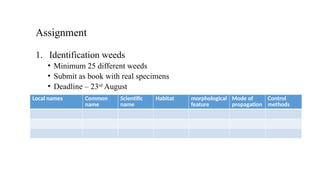
Assignment
1. Identification weeds
• Minimum 25 different weeds
• Submit as book with real specimens
• Deadline – 23rd
August
Local names Common
name
Scientific
name
Habitat morphological
feature
Mode of
propagation
Control
methods

Weed . identification. Technology subject

  • 1.
  • 2.
    What is weed? •A weed, by definition, is a plant growing where it isn’t wanted. • This generally means they are in direct competition with growth of desirable plant. Classification of weeds by their life cycle • Annual Species • Biennial Species • Perennial Species
  • 3.
    Annual Species • Annualplants complete their lifecycle in one year (one growing season) • These are often rapidly spreading and germinate quickly. • They germinate, grow, bear flowers and fruits and die off in same year.
  • 4.
    Biennial Species • Biennialspecies take two full years to complete their life cycle. • They germinate grow leaves and stems in first year, in second year they bear the flowers and fruits. Perennial Species • Perennial weeds produce long taproots that make them difficult to eradicate. • These plants come back year after year from the same root.
  • 5.
    Computation of yieldlosses due to weeds Percentage reduction in yield- • Measure of efficacy of a particular treatment when compared with weed free treatment and is expressed as percentage reduction in yield. • Higher in % yield reduction means greater loss due to weeds
  • 6.
    Computation of yieldlosses due to weeds Percentage reduction in yield = Where, X is yield from weed free plot and Y is yield from treated plot Problem- A weed free plot of Sorghum has given yield of 1500 kg ha-1 whereas atrazine have given yields of 1400 kg. Calculate the % yield reduction? X – Y x 100 X
  • 7.
  • 8.
    Acalypha indica (Copperleaf) • Type : - Annual weeds • Size :- It can grow up to 1.2 m tall in favorable circumstances but is usually all smaller . • Habitat :- Waste land, Rode sides , Forest edges • Appearances :- The leaves base is rounded to shortly attenuate .The flower spikes are axillary 2.5-6 cm long. Tiny male flowers are white green color located on upper part of flower spikes. Green female flowers are located lower on the spikes. • Uses - The weed has tradition medicinal uses.
  • 9.
    • How tocontrol it:  Hand weeding , mowing  Use integrated weed management (IWM)  Use selective herbicide that target broad leaf weeds without harming crops Ex- 2-4 D , glyphosate  Use pre emergent herbicides Continue……..
  • 10.
    Parthenium weeds (Partheniumhysterophorus ) • Type :- Perennial crop • Habitat :- Semi arid, subtropical , tropical and warmer temperate region • Size :- Usually grows 0.5-1.5 m. • Appearances :- Matures stem is greenish and longitudinally grooved covered in small stiff hairs. Numerous small flowers heads are arranged in cluster. Flower heads are white or cream color and have 5 tingly petals.
  • 11.
    • How tocontrol it:  Chemical control young and actively growing eg :- 2-4D , paraquat , glyphosate seedling and mature plant eg :- Dicamba Continue……..
  • 12.
    Tick berry (Lantanacamara ) • Type :- perennial • Habitat :- Tropical and sub tropical countries , forest margins • Size :- Shrub which typically grows to around 2 m tall • Appearances :- leaves are broadly ovate . Have strong odor , small tubular shaped flowers which have 4 petals and arrange in cluster, flower in many different color (red, yellow ,pink, white and orange), fruit is a berry like drupe which turns from green to dark purple. • How to control it:  Mechanical control by slashing plants. Grow the shade tolerates crops - lantana camera prefers sunny areas
  • 13.
    Spreading hog weed( Boerhavia diffusa ) • Type :- Perennial • Habitat :- Tropical area • Size :- Usually grows 5 to 6 cm • Appearances :- Characterized by cotyledons and its opposite leaves of different size, Flowers are small, around 5 mm in diameter. stem purplish or reddish, thickened at nodes. • Uses :- used as a fodder for livestock
  • 14.
    • How tocontrol it:  Mulching  Tillage  Use Selective herbicides (MCPA and 2-4D )  Do the crop rotation Continue……..
  • 15.
    Coat buttons (Tridaxprocumbens) • Type :- Annual to Perennial • Habitat :- Tropical and sub tropical area • Size :- Usually grows 2 feet • Appearances The plant bears daisy-like yellow-centered white or yellow flowers with three-toothed ray florets. The leaves are toothed and generally arrowhead-shaped.
  • 16.
    How to controlit:-  Use a mulch or a pre-emergent herbicide in spring to prevent quick weed.  These plants have a shallow root system and are easy to pull by hand or spot-treat with a post-emergent herbicide. Continue……..
  • 17.
    • Type :-Grass-like perennial • Size :- 2 feet tall, 1 foot wide • Habitat :- Lawn, landscape, or garden areas in sun or shade • Appearance :- Nutsedge has slender, grassy leaves, triangular stems, and small, nutlike tubers on the root system. When these weeds pop up in lawns, they often grow faster than turf grass, so they are easy to spot. Nutsedge (Cyperus rotundus)
  • 18.
    How to controlit:-  Remove these plants as soon as you've identified them.  Do not allow them to develop tubers. Tubers develop about four to six weeks after the shoot.  Crop rotation  Proper irrigation method  Use selective herbicides that specifically target weed without harming the main crop Continue……..
  • 19.
    Dandelion (Taraxacum officinale) •Type: Broadleaf perennial • Size: 12 inches tall, 6-16 inches wide • Habitat: Lawns and gardens in sun or shade • Appearance: This common lawn weed has a long taproot with deeply notched leaves. Yellow flowers mature into puffballs. Dandelion seeds are like parachutes that fly away in the wind, helping them invade new spaces in lawns and garden beds.
  • 20.
    • How tocontrol it:-  Dig up the roots with spade  Mulching with landscape fabrics  You can use herbicide to eliminate dandelions Continue……..
  • 21.
    Crabgrass ( Digitariaspp) • Type:- Grassy annual • Size:- Up to 18 inches tall and 20 inches wide • Habitat:- Lawn, landscape, and garden areas in sun or shade • Appearance:- Crabgrass is exactly what it sounds like: A grassy weed. This lawn weed grows roots anywhere the stem makes soil contact. Seed heads spread out like four fingers.
  • 22.
    • How tocontrol it:  Control by mulching , hoeing, and hand pulling when the plants are young and before they set seed.  Can control this weed with solarization  Apply pre emergent herbicides. ( Before seeds are germinates) Continue……..
  • 23.
    Purslane (Portulaca oleracea) •Type:- Broadleaf annual • Size:- Up to 6 inches tall and 2 feet wide • Habitat:- Dry, sunny landscape and garden areas • Appearance:- Identify this weed groundcover by its fleshy, dark green leaves and small yellow flowers at the ends of the stems.
  • 24.
    • How tocontrol it: Purslane can be controlled well by hand pulling if you do it when the plant is young and before it goes to seed. If it's seeded itself, you can also use post-emergent broadleaf herbicide on young plants.  Mulching such as thick 6mm black polythene or paddy straws Continue……..
  • 25.
    Pigweed (Amaranthus spp) •Type: Broadleaf annual • Size: 6 feet tall, 2 feet wide • Habitat : Sunny landscape or garden areas • Appearance: Pigweeds are tall plants with a taproot. Identify weeds by their hairy-looking clusters of green flowers (though some varieties are grown as annuals).
  • 26.
    How to controlit:  Pull out this weed before it flowers. Also, its seeds require light for germination, so to prevent pigweed seeds from germinating, cover garden with a 3- to 6-inch layer of winter mulch.  use pre emergence and post emergence herbicide Cultural and mechanical control methods. Continue……..
  • 27.
    • Type: Grassyperennial • Size:- Up to 3 feet tall and several feet wide • Habitat :- Landscape and garden areas in sun or shade • Appearance:- This garden weed has wheat like flower spikes, which appear above slender clumps of grassy foliage. Quackgrass (Elytrigia repens)
  • 28.
    • How tocontrol it: Maintain a dense, Dig out this fast-growing grass, including the roots, as soon as you see it in your garden. It's easiest to pull when the soil is moist. A non-selective herbicide like glyphosate can be used to control a small infestation in the garden. Continue……..
  • 29.
    Swallen fingergrass (Chlorisbarbata ) • Type:- Annual • Size:- Up to 40 cm to 1m tall • Habitat :- dry cultivated fields and waste places • Appearance:- leaves are liner with smooth edges, inflorescence is composed of 4-8cm long , flowers are wedges shaped and fleshy
  • 30.
    • How tocontrol it:  Mulching - apply the organic matter to suppress weed germination and growth  Crop rotation  Shallow tillage can uproot young plant  Use pre emergent herbicides and post emergent herbicides  Grazing – livestock can graze on the grass reducing its biomass and seed production . Continue……..
  • 31.
    Discussion • Describe thetype of weed control method ? • Example of pre emerge herbicides
  • 32.
    Assignment 1. Identification weeds •Minimum 25 different weeds • Submit as book with real specimens • Deadline – 23rd August Local names Common name Scientific name Habitat morphological feature Mode of propagation Control methods