What are Weeds?
 A plant out of its place is called a weed.
 A plant that is extremely noxious, useless,
poisonous or unwanted.
 A plant whose negative value outweigh its positive
value.
 Out of 200,000 or more plant species 250 species
are troublesome in agriculture and are called
weeds.
 Approximately 0.1 % of world taxa are weeds.
Losses due to Weeds
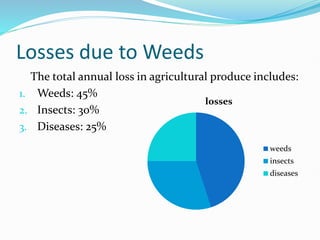
The total annual loss in agricultural produce includes:
1. Weeds: 45%
2. Insects: 30%
3. Diseases: 25%
losses
weeds
insects
diseases
Problems due to Weeds
 Nutrient losses
 Less water available to plants
 Light penetration
 Competition for space
 Susceptibility to insects and diseases
 Increased cost of production
 Low quality crop
 Allelopathic effects
Classification of Weeds
1. Based on morphology:
 Dicots
 Monocots
2. Based on physiology:
 C3
 C4
3. Based on habitat:
 Terrestrial weeds
 Grassland weeds
 Aquatic weeds
Continued..
4. Based on origin:
 Indigenous or native weeds
 Exotic or alien weeds
5. Based on lifecycle:
 Annual weeds
 Biennial weeds
 Perennial weeds
6. Based on association:
 Season bound weeds
 Crop bound weeds
7. Based on nature of stem:
 Woody weeds
 Herbaceous weeds
8. Based on soil pH:
 Acidophile weeds
 Basophile weeds
 Neutrophile weeds
9. Based on host plant:
 Parasitc weeds
 Epiphytic weeds
10. Special classification:
 Poisonous weeds
 Obligate weeds
 Facultative weeds
 Industrial weeds
Weed Management
 Weeds compete with plants for nutrients, moisture,
sunlight and space.
 Reduction in crop yields and production efficiency is direct
effect due to weeds . It varies from 30-35% in rice to 90% in
onion.
 Economic losses caused to crops by weeds are important
from farmers point of view. If weeds do not affect crop
anyway economically, then, they are not harmful and not
important for farmers.
 If by controlling weeds, the increased yield is less then the
cost, then it is irrational to control weeds.
Principles of weed management
1. Prevention
2. Eradication
3. Control
 Mechanical
 Cultural
 Biological
 Chemical
4. Integrated weed management
Preventive methods
 Use of clean and weed free seeds
 Destroy weeds before flowering to avoid spread of weeds
 Clean farm implements and machinery
 Avoid feeding material containing weed seeds to farm
animals
 Avoid adding weeds to manure pits
 Keep irrigation channels and fallow land clean
 Inspect your farm frequently for any strange looking
weed
 Follow quarantine measures
Eradication
 It is complete removal of all live plant parts and
seeds of the weed from an area.
 Because of its difficulty & high cost, eradication is
usually attempted only in smaller areas such as few
ha, a few thousand m2 or less.
 Eradication is often used in high value areas such
as green houses, ornamental plant value areas such
as beds & containers.
Weed Control Methods
1. Mechanical control:
 Hand Pulling or Hand Weeding: Removal of weeds either
manually or by using tools like khurpi or sickle.
 Tillage: Includes ploughing, disking, harrowing and leveling which
causes exposure of seeds to sunlight, which can be destroyed
effectively later.
 Flooding : Flood kills weeds by excluding oxygen from their
environment.
 Burning : Using flame to destroy weeds before sowing or using a
shield after sowing of crop.
2. Cultural control:
 Mulching: Principle is exclusion of sunlight from environment.
Polythene Sheets, natural materials like paddy husk, ground nut
shells, saw dust etc. are used as mulching material.
 Field preparation: The field has to be kept weed free.
 Summer tillage: The practice of summer tillage or offseason
tillage is one of the effective cultural methods to check the growth of
perennial weed population in crop cultivation.
 Crop Rotation : Crop rotation is effective in controlling of crop
associated and crop bound weeds such as Avena fatua in wheat.
 Smothering: Smoother crops germinates very quickly and develop
large canopy, capable of efficient photosynthesis within short period
Eg; Cowpea, lucern, berseem.
 Solarisation: In this method the soil temperature is further increased
by 5 to 10 degrees by covering a pre-soaking fallow field with
transparent plastic sheet to kill vegetative propagation.
 Intercropping: Short duration crops like pulses are sown between
the fallow area in the main crop that allows no place for weeds to grow.
 Biological Control:
 The use of living organism (Bio-agents) such as
insects, herbivorous fish, snails and even
competitive plants to limit weed infestation is
called biological control of weeds.
 The bio-agent which is specific to particular host
weed can be used for control of the weed.
 Eg. Cyperus rotundus can be controlled in crop
fields with moth “Bactra verutana”
 Chemical Control:
 Herbicides are chemicals capable of killing or inhibiting
the growth of plants.
 Herbicides are primarly grouped into inorganic (Arsenic
acid, sulphuric acid, sodium chlorate) and organic
herbicides (diesel xylene type of aromatic oils).
 Eg. 2,4-D, Atrazine, Paraquat.
 Herbicides are also classified as pre emergence
(pendimethylene) and post emergence( atrazine).
 Integrated weed management:
 Integrated weed management (IWM) is a weed
management program based on a combination of
preventive, cultural, mechanical, and chemical
practices.
 A single weed control measure is not feasible due to
the number of different weed species and their highly
diverse life cycles and survival strategies.
 In addition, controlling weeds with one or two
methods provides the weeds a chance to adapt to those
practices.
 In essence, the development of an IWM program is based
on a few general principles that can be used at any farm:
1. Use agronomic practices that limit the introduction and
spread of weeds (preventing weed problems before they
start).
2. Help the crop compete with weeds (help ‘choke out’
weeds).
3. Use practices that keep weeds ‘off balance’ (do not allow
weeds to adapt).
Dispersal of Weeds
 “Weeds are good travelers”
 Dispersal of mature seeds and live vegetative parts of weeds
is nature’s way of providing non-competitive sites to new
individuals.
 Common weed dispersal agents are:
 Wind
 Water
 Animals
 Human
Characteristics of Weeds
1. Prolific seed production:
 Produces larger number of seeds compare to crops.
 Seed production varies from 40 to 1,96,000 number of
seeds/plant.
 Most of the weed seeds are small in size and contribute
enormously to the seed reserves.
2. Vegetative reproduction:
 The vegetative reproduction is another way by which the
weeds are able to spread and include tubers, rhizomes,
bulbs, stems etc.
3. Seed dormancy:
 It is an efficient survival mechanism of weeds.
 It is defined as a state in which a viable seed fails to
germinate even under favorable conditions for plant
growth.
 This mechanism helps weed seeds to remain viable for a
long period of time .
4. Longevity and viability of seeds:
 Weed seeds do not lose their viability for years even under
adverse conditions.
 Lotus seed collected from the bottom of the Manchurian
lake bed have viability even after 1000 years.
 Whereas, wild mustard and Chenopodium remain viable
for 30 and 20 years, respectively.
5. Weed seed dispersal :
 Weed dispersal has no geographical boundaries.
 Common agents of weed dispersal are wind, water, animals,
birds, organic manures, agriculture implements and
human beings.
6. Wider adaptability:
 They have ability to thrive under adverse conditions due to
morphological and physiological conditions Eg.
Trianthema (carpet weed), Sorghum halepense and
Saccharum spontaneum can survive in different
environmental conditions.
7. Modified structure in order to compete with crop
plants:
 They are provided with hooks, stiff hairs, thorns and spines
E.g, Xanthium, Tribulus, and Achyranthus spp.
8. Other characteristic features like :
 They flower earlier and mature ahead of the crop they
infest.
 Rapid establishment and growth of weed seedlings
 Tolerance to shading effects by the crops at the time of
establishment
 Quick response to available soil moisture and nutrients.
 Most of the weeds possess C4 type of photosynthesis,
which is an added advantage during moisture stress.
 They possess extensive root system, which go deeper as well
as of creeping type.
Advantages derived from weeds
1. Weeds Add Organic Matter and Nutrients to the Soil:
 Many weeds have luxuriant leafy growth and when buried in
the soil as green manure add considerable amount of organic
matter and plant nutrients.
 Weeds add about 5 to 15 tonnes of green matter per hectare
depending upon weed species and their growth.
2. Weeds Check Wind and Water Erosion:
 Weeds growing on desert lands, waste lands and sloppy
fields lower wind and water erosion and also help for
protection of the environment.
 Chenopodium album - used as mulch to reduce
evaporation losses.
3. Used as Fodder for Animals:
 Some weeds have good palatable taste.
 Hariyali grass (Cynodon dactylon) and Cenchrus ciliaris
serve as food for animals.
4. Used as Leafy Vegetables:
 Cholai (Amaranthus viridis)
 Lehli (Convolvulus arvensis)
 Kulfa (Portulaca olearcea )
5. Medicinal Value:
 Leucas aspera used in snake bite.
 Calotropis procera : Gastric troubles
 Argemone mexicana : Skin disorders
 Striga orobanchioides : control diabetes
6. Economic Importance:
 Saccharum spontaneum used for breeding sugarcane
varieties for including hardiness.
 Nutsedge (Cyperus rotundus) for making essence sticks
(agarbatis).
7. Reclamation of Alkaline Soils:
 The application of powder of the weed Argemone mexicana
@ 2.5 tonnes/ha is useful for reclamation of alkaline soils.
8. Ornamental purposes:
 Lantana camara and Cactus – Used as ornamental and
hedge plants.
 Portulaca spp – For beautiful flowers.
 Parthenium used in bouquets.
01_Weeds_Agricultural_Perspective.pptx

01_Weeds_Agricultural_Perspective.pptx

  • 2.
    What are Weeds? A plant out of its place is called a weed.  A plant that is extremely noxious, useless, poisonous or unwanted.  A plant whose negative value outweigh its positive value.  Out of 200,000 or more plant species 250 species are troublesome in agriculture and are called weeds.  Approximately 0.1 % of world taxa are weeds.
  • 3.
    Losses due toWeeds The total annual loss in agricultural produce includes: 1. Weeds: 45% 2. Insects: 30% 3. Diseases: 25% losses weeds insects diseases
  • 4.
    Problems due toWeeds  Nutrient losses  Less water available to plants  Light penetration  Competition for space  Susceptibility to insects and diseases  Increased cost of production  Low quality crop  Allelopathic effects
  • 5.
    Classification of Weeds 1.Based on morphology:  Dicots  Monocots 2. Based on physiology:  C3  C4 3. Based on habitat:  Terrestrial weeds  Grassland weeds  Aquatic weeds
  • 6.
    Continued.. 4. Based onorigin:  Indigenous or native weeds  Exotic or alien weeds 5. Based on lifecycle:  Annual weeds  Biennial weeds  Perennial weeds 6. Based on association:  Season bound weeds  Crop bound weeds
  • 7.
    7. Based onnature of stem:  Woody weeds  Herbaceous weeds 8. Based on soil pH:  Acidophile weeds  Basophile weeds  Neutrophile weeds
  • 8.
    9. Based onhost plant:  Parasitc weeds  Epiphytic weeds 10. Special classification:  Poisonous weeds  Obligate weeds  Facultative weeds  Industrial weeds
  • 9.
    Weed Management  Weedscompete with plants for nutrients, moisture, sunlight and space.  Reduction in crop yields and production efficiency is direct effect due to weeds . It varies from 30-35% in rice to 90% in onion.  Economic losses caused to crops by weeds are important from farmers point of view. If weeds do not affect crop anyway economically, then, they are not harmful and not important for farmers.  If by controlling weeds, the increased yield is less then the cost, then it is irrational to control weeds.
  • 10.
    Principles of weedmanagement 1. Prevention 2. Eradication 3. Control  Mechanical  Cultural  Biological  Chemical 4. Integrated weed management
  • 11.
    Preventive methods  Useof clean and weed free seeds  Destroy weeds before flowering to avoid spread of weeds  Clean farm implements and machinery  Avoid feeding material containing weed seeds to farm animals  Avoid adding weeds to manure pits  Keep irrigation channels and fallow land clean  Inspect your farm frequently for any strange looking weed  Follow quarantine measures
  • 12.
    Eradication  It iscomplete removal of all live plant parts and seeds of the weed from an area.  Because of its difficulty & high cost, eradication is usually attempted only in smaller areas such as few ha, a few thousand m2 or less.  Eradication is often used in high value areas such as green houses, ornamental plant value areas such as beds & containers.
  • 13.
    Weed Control Methods 1.Mechanical control:  Hand Pulling or Hand Weeding: Removal of weeds either manually or by using tools like khurpi or sickle.  Tillage: Includes ploughing, disking, harrowing and leveling which causes exposure of seeds to sunlight, which can be destroyed effectively later.  Flooding : Flood kills weeds by excluding oxygen from their environment.  Burning : Using flame to destroy weeds before sowing or using a shield after sowing of crop.
  • 14.
    2. Cultural control: Mulching: Principle is exclusion of sunlight from environment. Polythene Sheets, natural materials like paddy husk, ground nut shells, saw dust etc. are used as mulching material.  Field preparation: The field has to be kept weed free.  Summer tillage: The practice of summer tillage or offseason tillage is one of the effective cultural methods to check the growth of perennial weed population in crop cultivation.  Crop Rotation : Crop rotation is effective in controlling of crop associated and crop bound weeds such as Avena fatua in wheat.
  • 15.
     Smothering: Smoothercrops germinates very quickly and develop large canopy, capable of efficient photosynthesis within short period Eg; Cowpea, lucern, berseem.  Solarisation: In this method the soil temperature is further increased by 5 to 10 degrees by covering a pre-soaking fallow field with transparent plastic sheet to kill vegetative propagation.  Intercropping: Short duration crops like pulses are sown between the fallow area in the main crop that allows no place for weeds to grow.
  • 16.
     Biological Control: The use of living organism (Bio-agents) such as insects, herbivorous fish, snails and even competitive plants to limit weed infestation is called biological control of weeds.  The bio-agent which is specific to particular host weed can be used for control of the weed.  Eg. Cyperus rotundus can be controlled in crop fields with moth “Bactra verutana”
  • 17.
     Chemical Control: Herbicides are chemicals capable of killing or inhibiting the growth of plants.  Herbicides are primarly grouped into inorganic (Arsenic acid, sulphuric acid, sodium chlorate) and organic herbicides (diesel xylene type of aromatic oils).  Eg. 2,4-D, Atrazine, Paraquat.  Herbicides are also classified as pre emergence (pendimethylene) and post emergence( atrazine).
  • 18.
     Integrated weedmanagement:  Integrated weed management (IWM) is a weed management program based on a combination of preventive, cultural, mechanical, and chemical practices.  A single weed control measure is not feasible due to the number of different weed species and their highly diverse life cycles and survival strategies.  In addition, controlling weeds with one or two methods provides the weeds a chance to adapt to those practices.
  • 19.
     In essence,the development of an IWM program is based on a few general principles that can be used at any farm: 1. Use agronomic practices that limit the introduction and spread of weeds (preventing weed problems before they start). 2. Help the crop compete with weeds (help ‘choke out’ weeds). 3. Use practices that keep weeds ‘off balance’ (do not allow weeds to adapt).
  • 20.
    Dispersal of Weeds “Weeds are good travelers”  Dispersal of mature seeds and live vegetative parts of weeds is nature’s way of providing non-competitive sites to new individuals.  Common weed dispersal agents are:  Wind  Water  Animals  Human
  • 21.
    Characteristics of Weeds 1.Prolific seed production:  Produces larger number of seeds compare to crops.  Seed production varies from 40 to 1,96,000 number of seeds/plant.  Most of the weed seeds are small in size and contribute enormously to the seed reserves. 2. Vegetative reproduction:  The vegetative reproduction is another way by which the weeds are able to spread and include tubers, rhizomes, bulbs, stems etc.
  • 22.
    3. Seed dormancy: It is an efficient survival mechanism of weeds.  It is defined as a state in which a viable seed fails to germinate even under favorable conditions for plant growth.  This mechanism helps weed seeds to remain viable for a long period of time . 4. Longevity and viability of seeds:  Weed seeds do not lose their viability for years even under adverse conditions.
  • 23.
     Lotus seedcollected from the bottom of the Manchurian lake bed have viability even after 1000 years.  Whereas, wild mustard and Chenopodium remain viable for 30 and 20 years, respectively. 5. Weed seed dispersal :  Weed dispersal has no geographical boundaries.  Common agents of weed dispersal are wind, water, animals, birds, organic manures, agriculture implements and human beings.
  • 24.
    6. Wider adaptability: They have ability to thrive under adverse conditions due to morphological and physiological conditions Eg. Trianthema (carpet weed), Sorghum halepense and Saccharum spontaneum can survive in different environmental conditions. 7. Modified structure in order to compete with crop plants:  They are provided with hooks, stiff hairs, thorns and spines E.g, Xanthium, Tribulus, and Achyranthus spp.
  • 25.
    8. Other characteristicfeatures like :  They flower earlier and mature ahead of the crop they infest.  Rapid establishment and growth of weed seedlings  Tolerance to shading effects by the crops at the time of establishment  Quick response to available soil moisture and nutrients.  Most of the weeds possess C4 type of photosynthesis, which is an added advantage during moisture stress.  They possess extensive root system, which go deeper as well as of creeping type.
  • 26.
    Advantages derived fromweeds 1. Weeds Add Organic Matter and Nutrients to the Soil:  Many weeds have luxuriant leafy growth and when buried in the soil as green manure add considerable amount of organic matter and plant nutrients.  Weeds add about 5 to 15 tonnes of green matter per hectare depending upon weed species and their growth. 2. Weeds Check Wind and Water Erosion:  Weeds growing on desert lands, waste lands and sloppy fields lower wind and water erosion and also help for protection of the environment.  Chenopodium album - used as mulch to reduce evaporation losses.
  • 27.
    3. Used asFodder for Animals:  Some weeds have good palatable taste.  Hariyali grass (Cynodon dactylon) and Cenchrus ciliaris serve as food for animals. 4. Used as Leafy Vegetables:  Cholai (Amaranthus viridis)  Lehli (Convolvulus arvensis)  Kulfa (Portulaca olearcea )
  • 28.
    5. Medicinal Value: Leucas aspera used in snake bite.  Calotropis procera : Gastric troubles  Argemone mexicana : Skin disorders  Striga orobanchioides : control diabetes 6. Economic Importance:  Saccharum spontaneum used for breeding sugarcane varieties for including hardiness.  Nutsedge (Cyperus rotundus) for making essence sticks (agarbatis).
  • 29.
    7. Reclamation ofAlkaline Soils:  The application of powder of the weed Argemone mexicana @ 2.5 tonnes/ha is useful for reclamation of alkaline soils. 8. Ornamental purposes:  Lantana camara and Cactus – Used as ornamental and hedge plants.  Portulaca spp – For beautiful flowers.  Parthenium used in bouquets.