INTRODUCTION
Fabrication of restorations of Fixed
Prosthodontics require indirect
techniques , in which the
fabrication of the restoration is done
outside the mouth. For this ,an
accurate duplication of prepared teeth
and maintenance of their relationship
to one another is important.
DEFINITION
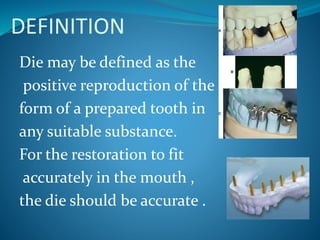
Die may be defined as the
positive reproduction of the
form of a prepared tooth in
any suitable substance.
For the restoration to fit
accurately in the mouth ,
the die should be accurate .
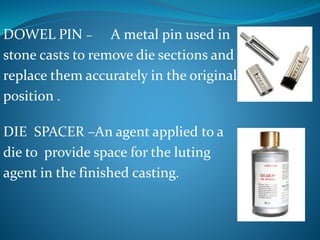
DOWEL PIN – A metal pin used in
stone casts to remove die sections and
replace them accurately in the original
position .
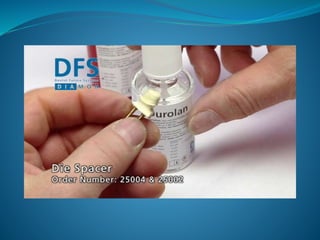
DIE SPACER –An agent applied to a
die to provide space for the luting
agent in the finished casting.
IDEAL REQUIREMENTS
- Dimensional accuracy .
- High abrasion resistance .
- Ability to produce fine details .
- Compatibility with all impression
materials .
- Toughness to resist breakage.
- Colour contrast with wax ,porcelain ,
- Ease of manipulation and rapid
fabrication .
- Non injurious to touch and inhalation
- Economical .
CLASSIFICATION
I .ACCORDING TO THE TYPE OF
MATERIAL :
a) Gypsum Products :
Type IV Dental Stone .
Type V Dental stone ,high strength , high expansion
Type V Dental stone with ligho sulphonates .
b) Metal and metal coated dies :
Electroformed dies .
Metal sprayed dies .
Silver amalgam dies .
c) Resin or polymer dies :
Metal or inorganic filled resins .
Epoxy resins .
d) Cements :
Silicophosphates .
Polyacrylic acid bonded cement .
e) Refractory Materials :
Divestments .
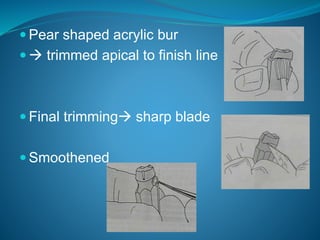
Investments (for RPD frameworks ) .
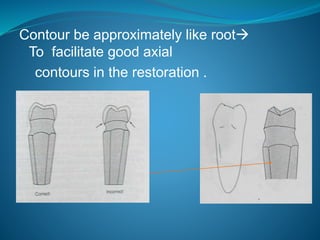
f) Flexible die materials .
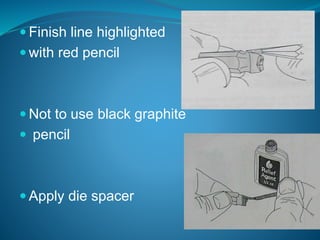
II . Based on the design :
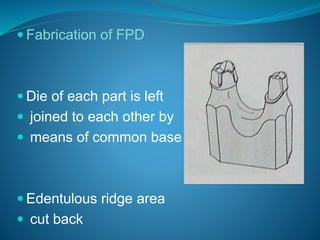
a) Working cast with seperate
die system .
b) Working cast with
removable die system .
c)Accutrac system .
GYPSUM DIE MATERIALS
- Most commonly used .
-
- A D A specification No : 25 .
- Type IV & V are used .
Advantages
Easy to use .
Relatively inexpensive .
Easy manipulation .
Good working time .
Minimum shrinkage .
Compatible with all impression
materials .
Good colour contrast .
Disadvantages
Mechanical properties not ideal .
Brittle .
Less abrasion resistant .
Modifications
To overcome the abrasion
resistance
a) Add colloidal silica .
b) Impregnate the surface with a low
viscosity
resin such as cyanoacrylate .
RESIN ROCK * (WHIP MIX ) .
ELECTROPLATED DIES
It is the deposition of a coat of a metal .
Pure silver or copper is used .
ELECTROFORMING :
It is process by which a thin coating of metal
is deposited on the impression , after which
a gypsum cast is poured into the impression
.
PLATING CAN BE DONE :
 Individual tooth preparation .
 Full arch impression .
 Compound impression .( copper plated .)
 Polysulfide . (silver plated .)
 Silicone impression .
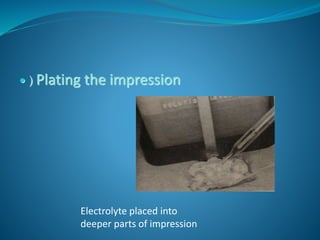
 ) Plating the impression
Electrolyte placed into
deeper parts of impression
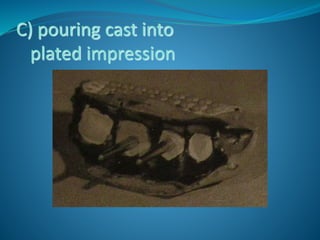
C) pouring cast into
plated impression
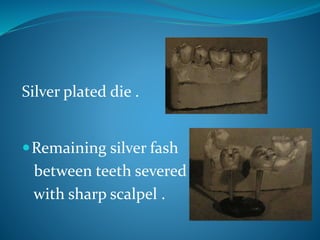
Silver plated die .
Remaining silver fash
between teeth severed
with sharp scalpel .
ADVANTAGES :
Dimensional accuracy .
Hard & abrasion resistant .
Economical .
Does not absorb oil or water .
Imparts smooth surface to wax
pattern .
Prevents cuspal wear
DISADVANTAGES
 Difficult to trim .
 Silver bath – health hazard .
 Colour contrast not good .
 Not compatible with all impression materials .
 Adaptation of wax not as good as stone
RESINS
They are used to overcome low
strength and abrasion resistance of
stone .
Epoxy resins are commonly used .
Polyurethane may also be used .
The are most effective with rubber
based impression materials .
(Silicones & Polyether )
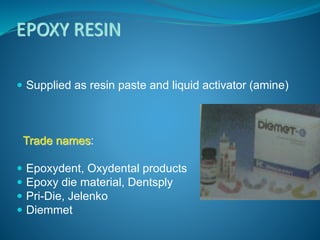
EPOXY RESIN
 Supplied as resin paste and liquid activator (amine)
Trade names:
 Epoxydent, Oxydental products
 Epoxy die material, Dentsply
 Pri-Die, Jelenko
 Diemmet
ADVANTAGES
 Tougher .
 Dimensionally stable .
 More abrasion resistant .
 Detail production better .
 Can be used at room temp .
DISADVANTAGES
 Shrinkage during polymerisation .
 Viscous ,does not flow readily .
 Setting may take upto 24 hrs .
 Expensive .
 Tight fitting prostheses .
 Not compatible with hydrocolloid & Polysulfide .
FLEXIBLE DIE MATERIALS
They are similar to heavy bodied silicone or
polyether impression materials .
Advantages over gypsum :
More rapid setting .
Ease of removal of interim restoration .
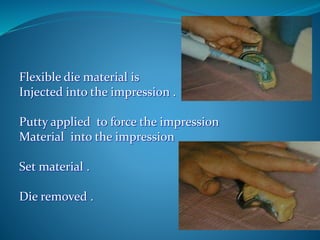
Flexible die material is
Injected into the impression .
Putty applied to force the impression
Material into the impression
Set material .
Die removed .
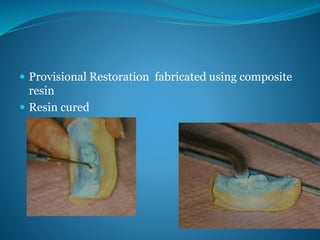
 Provisional Restoration fabricated using composite
resin
 Resin cured
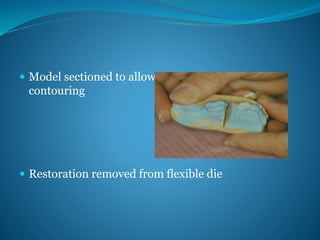
 Model sectioned to allow proximal access for
contouring
 Restoration removed from flexible die
Advantage:
 Less time required
 Overcomes problems associated with making interim
restoration on arches that have significant undercuts
Disadvantage:
 Expensive
 Separator surface details poor
ALTERNATIVE DIE MATERIALS
A ) Silicophosphate cements :
Similar to filling & cementing
material .
Adv : Harder than die stone .
Disadv : Shrinkage on setting .
Loss of water on standing .
SILVER AMALGAM
Similar to restorative material .
Advantages :
Harder dies .
Reproduces fine details and sharp
margins
DISADVANTAGES
-Can be packed only to a rigid impression .
Takes long time to reach maximum
hardness .
High thermal conductivity .
Separating agent needed.
POLYMERS & FILLED
POLYMERS
Self cured acrylic resins , Polymeric
materials with fillers .
ADV :
More abrasion resistant .
Not as brittle as die stone .
DISADV :
Shrinkage on polymerisation .
MEATAL SPRAYED DIES
A Bismuth – Tin alloy (MP -138*c) can be
sprayed directly on to an impression to
form a metal shell which can be filled
with dental stone .
ADV :
Can be obtained rapidly from
elastomeric impression material .
DISADV :
Care should be taken to ptrevent
abrasion if the alloy is soft .
Advantage:
 Less time consuming than electroplating
Disadvantage:
 Alloy is soft low abrasion resistance
 Complex equipments required
 Inhalation of spray dangerous
 Compatible with elastomeric impressions only.
CERAMIC DIE MATERIALS
Two types of materials are available .
1) .One without using the platinum foil
matrix for porcelain restorations .
2) . A ceramic material ,supplied as a
powder & liquid
DIE SPACER Provides space for the
luting agent
Olden days: etching or milling to
get space
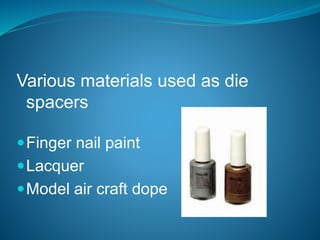
Various materials used as die
spacers
Finger nail paint
Lacquer
Model air craft dope
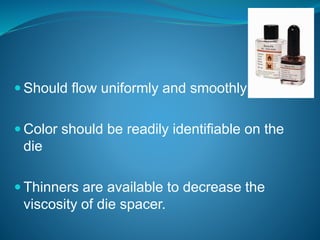
 Should flow uniformly and smoothly
 Color should be readily identifiable on the
die
 Thinners are available to decrease the
viscosity of die spacer.
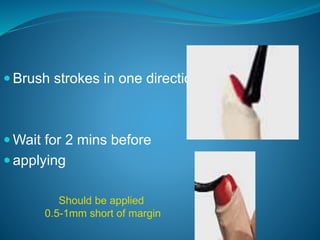
 Brush strokes in one direction
 Wait for 2 mins before
 applying
Should be applied
0.5-1mm short of margin
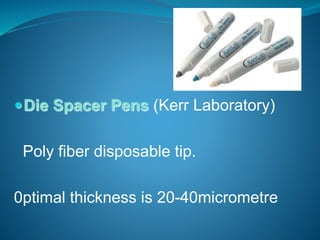
Die Spacer Pens (Kerr Laboratory)
Poly fiber disposable tip.
0ptimal thickness is 20-40micrometre
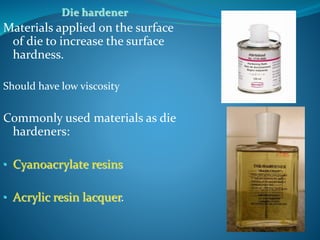
Die hardener
Materials applied on the surface
of die to increase the surface
hardness.
Should have low viscosity
Commonly used materials as die
hardeners:
• Cyanoacrylate resins
• Acrylic resin lacquer.

 Applied to finish line area of the die to
prevent abrasion by waxing instruments
during the fabrication of wax pattern
 Applied with brush or PKT instrument no 1.
Quickly blown off and dried from above the
margin toward the cervical area.
or
Blot with tissue
Optimal thickness : 2-3 micrometre .
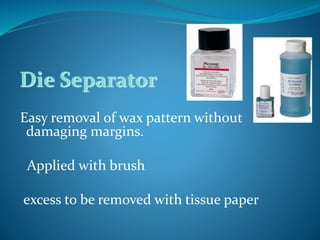
Die Separator
Easy removal of wax pattern without
damaging margins.
Applied with brush
excess to be removed with tissue paper
DIE SYSTEMS
Working cast with separate die
Working cast with removable die
Dowel pin system .
Di – Lock Tray system .
Pindex system .
Accutrac system .
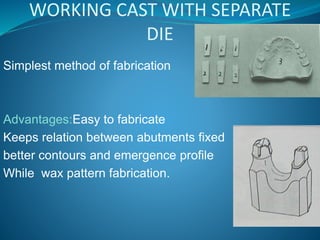
WORKING CAST WITH SEPARATE
DIE
Simplest method of fabrication
Advantages:Easy to fabricate
Keeps relation between abutments fixed
better contours and emergence profile
While wax pattern fabrication.
Disadvantages
 Wax pattern must be transferred from die
to cast  destroy internal adaptation of
wax
 Some times difficult to seat wax pattern on
the cast
- Different impressions
- Second pour –impression damaged
- Different thickness of spacers
Procedure
Both working cast and sectional die can be
obtained by:
Pouring impression twice
Making two impressions
Preparation of
separate die
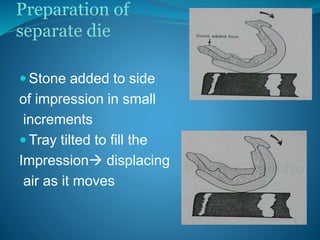
 Stone added to side
of impression in small
increments
 Tray tilted to fill the
Impression displacing
air as it moves
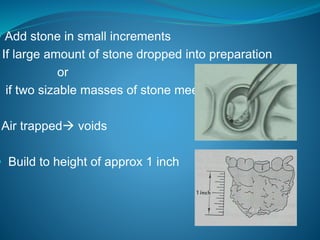
 Add stone in small increments
If large amount of stone dropped into preparation
or
if two sizable masses of stone meet
Air trapped voids
 Build to height of approx 1 inch
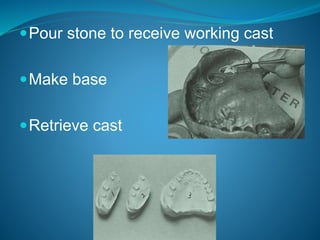
Pour stone to receive working cast
Make base
Retrieve cast
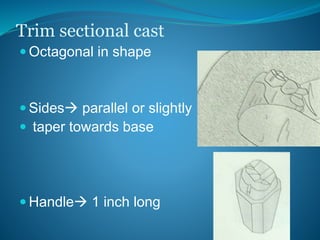
Trim sectional cast
 Octagonal in shape
 Sides parallel or slightly
 taper towards base
 Handle 1 inch long
 Pear shaped acrylic bur
  trimmed apical to finish line
 Final trimming sharp blade
 Smoothened
Contour be approximately like root
To facilitate good axial
contours in the restoration .
 Finish line highlighted
 with red pencil
 Not to use black graphite
 pencil
 Apply die spacer
 Fabrication of FPD
 Die of each part is left
 joined to each other by
 means of common base
 Edentulous ridge area
 cut back
Advantage:
 Convenient to use
 Various drawback of separate die are overcome
Disadvantage:
 Risk of introducing error in the pattern if die does not
seat accurately in the working cast
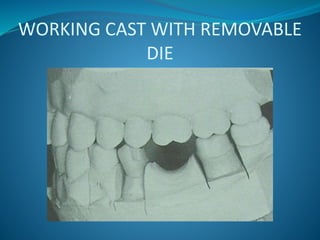
WORKING CAST WITH REMOVABLE
DIE
Requirements:
1) dies must return to their exact
original position
2) dies must remain stable even when
inverted
3) cast containing dies must be easy to
mount on an articulator
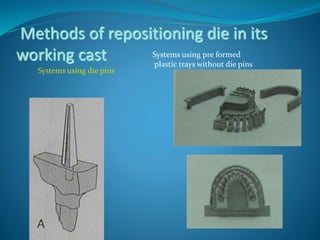
Methods of repositioning die in its
working cast
Systems using die pins
Systems using pre formed
plastic trays without die pins
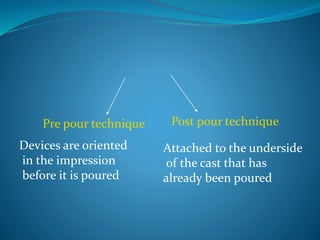
Pre pour technique Post pour technique
Devices are oriented
in the impression
before it is poured
Attached to the underside
of the cast that has
already been poured
Conventional dowel pin systems
Dowel pin (GPT 7): a metal pin used
in
stone casts to remove die sections
and
replace them accurately in the
original position
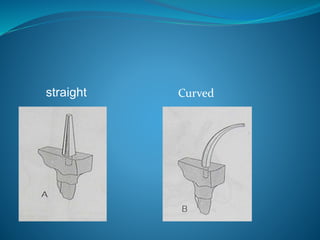
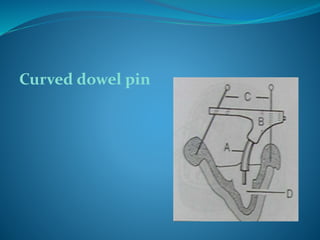
Curved
straight
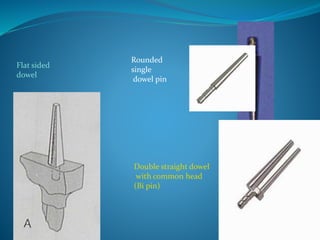
Flat sided
dowel
Rounded
single
dowel pin
Double straight dowel
with common head
(Bi pin)
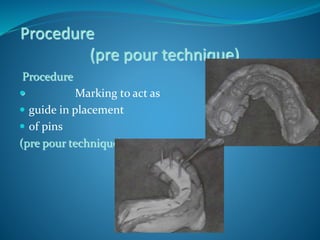
Procedure
(pre pour technique)
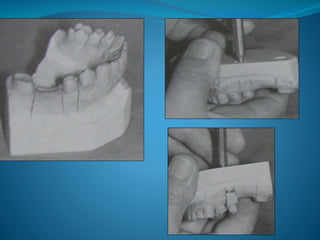
Procedure
 Marking to act as
 guide in placement
 of pins
(pre pour technique)
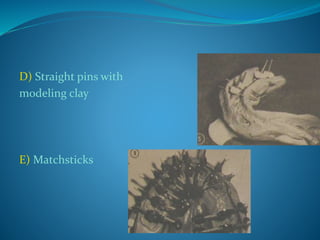
D) Straight pins with
modeling clay
E) Matchsticks
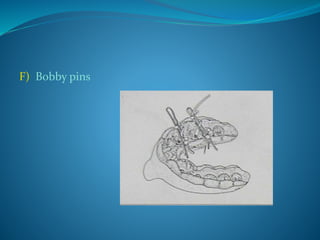
F) Bobby pins
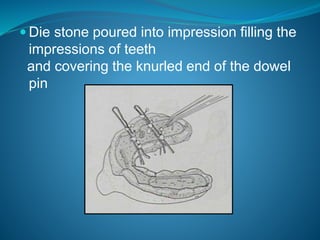
 Die stone poured into impression filling the
impressions of teeth
and covering the knurled end of the dowel
pin
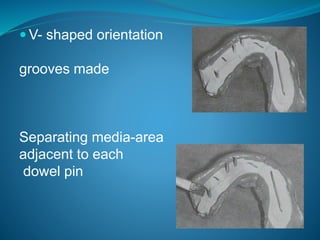
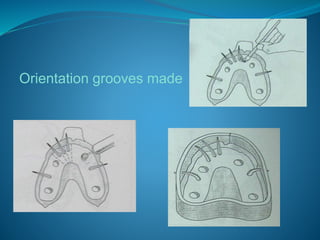
 V- shaped orientation
grooves made
Separating media-area
adjacent to each
dowel pin
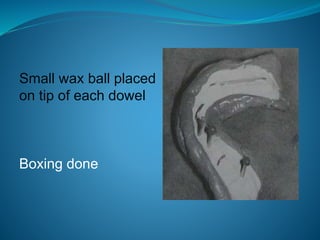
Small wax ball placed
on tip of each dowel
Boxing done
Curved dowel pin
Orientation grooves made
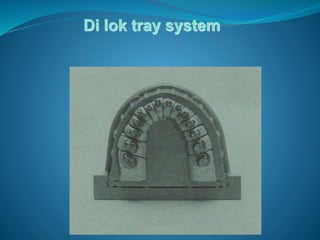
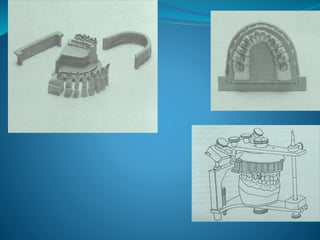
Di lok tray system
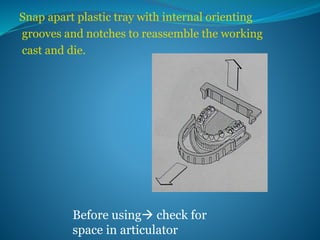
Snap apart plastic tray with internal orienting
grooves and notches to reassemble the working
cast and die.
Before using check for
space in articulator
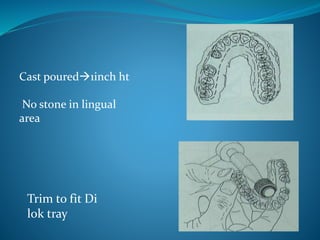
Cast poured1inch ht
No stone in lingual
area
Trim to fit Di
lok tray
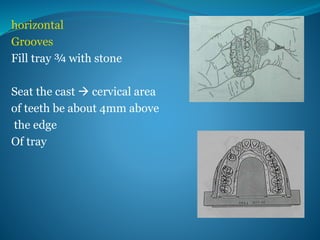
horizontal
Grooves
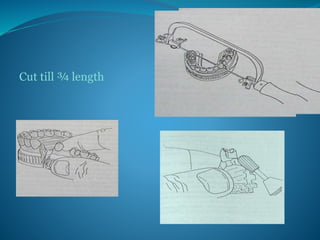
Fill tray ¾ with stone
Seat the cast  cervical area
of teeth be about 4mm above
the edge
Of tray
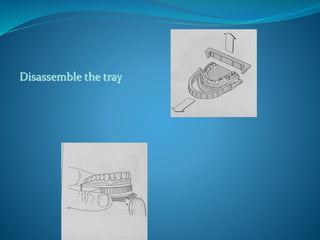
Disassemble the tray
Cut till ¾ length
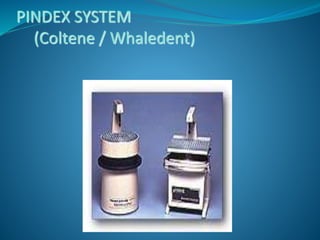
PINDEX SYSTEM
(Coltene / Whaledent)
Similar to post pour dowel pin technique .
Showed the least horizontal movement .
Adv :
Allows accurate placement of the die pins .
Excellent if instrument is well maintained .
Disadv :
Special equipment is needed .
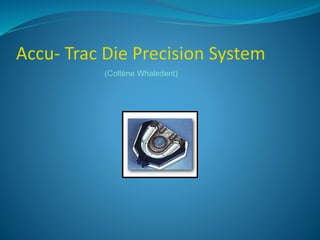
Accu- Trac Die Precision System
(Coltène Whaledent)
Used in fabrication of porcelain
laminate veneers
Removable die system that is
modification of a plastic tray with
internal grooves and notches
The technique of obtaining die is
similar to Di-lok system
Other systems include
DVA Model system and Zeiser model
system
These systems use a precision drill and
special base plates that are aligned and
drilled to provide die removal
Advantage: allows for expansion of
stone , which is relieved by saw cuts
CONCLUSION
A good impression and accurate die
are
the first steps towards the fabrication
of
an accurate restoration. Proper
selection of the die material and its
manipulation are paramount to achieve
accuracy in the die.
Removable die systems are preferable, as
they can be used with all impression
materials , as no second pour is required.
Proper sectioning of the cast and their
reassembly depends on the system used.
Choice of the die material and system
depends on the operator, as none fulfills all
the requirements. The advantage and
disadvantage of each must be weighed.
References
 Herbet T Shillingburg- Fundamentals of Fixed
Prosthodontics- 3rd edition
 Notes on Dental Materials, E. C Combe- 6th edition
 Contemporary Fixed Prosthodontics IIIrd Edition by
Rosenthal, Land & Fujimoto.
 Kenneth J,. Anusavice- PhilipsScience of Dental materials-
10th edition
 Robert G Craig- Restorative dental Materials- 11th Edition
 William J. o brien- Dental matereials and their selection-
3rd edition

Die materials and die systems

  • 2.
    INTRODUCTION Fabrication of restorationsof Fixed Prosthodontics require indirect techniques , in which the fabrication of the restoration is done outside the mouth. For this ,an accurate duplication of prepared teeth and maintenance of their relationship to one another is important.
  • 3.
    DEFINITION Die may bedefined as the positive reproduction of the form of a prepared tooth in any suitable substance. For the restoration to fit accurately in the mouth , the die should be accurate .
  • 4.
    DOWEL PIN –A metal pin used in stone casts to remove die sections and replace them accurately in the original position . DIE SPACER –An agent applied to a die to provide space for the luting agent in the finished casting.
  • 6.
    IDEAL REQUIREMENTS - Dimensionalaccuracy . - High abrasion resistance . - Ability to produce fine details . - Compatibility with all impression materials . - Toughness to resist breakage.
  • 7.
    - Colour contrastwith wax ,porcelain , - Ease of manipulation and rapid fabrication . - Non injurious to touch and inhalation - Economical .
  • 8.
    CLASSIFICATION I .ACCORDING TOTHE TYPE OF MATERIAL : a) Gypsum Products : Type IV Dental Stone . Type V Dental stone ,high strength , high expansion Type V Dental stone with ligho sulphonates .
  • 9.
    b) Metal andmetal coated dies : Electroformed dies . Metal sprayed dies . Silver amalgam dies . c) Resin or polymer dies : Metal or inorganic filled resins . Epoxy resins .
  • 10.
    d) Cements : Silicophosphates. Polyacrylic acid bonded cement . e) Refractory Materials : Divestments . Investments (for RPD frameworks ) . f) Flexible die materials .
  • 11.
    II . Basedon the design : a) Working cast with seperate die system . b) Working cast with removable die system . c)Accutrac system .
  • 12.
    GYPSUM DIE MATERIALS -Most commonly used . - - A D A specification No : 25 . - Type IV & V are used .
  • 13.
    Advantages Easy to use. Relatively inexpensive . Easy manipulation . Good working time . Minimum shrinkage . Compatible with all impression materials . Good colour contrast .
  • 14.
    Disadvantages Mechanical properties notideal . Brittle . Less abrasion resistant .
  • 15.
    Modifications To overcome theabrasion resistance a) Add colloidal silica . b) Impregnate the surface with a low viscosity resin such as cyanoacrylate . RESIN ROCK * (WHIP MIX ) .
  • 16.
    ELECTROPLATED DIES It isthe deposition of a coat of a metal . Pure silver or copper is used . ELECTROFORMING : It is process by which a thin coating of metal is deposited on the impression , after which a gypsum cast is poured into the impression .
  • 17.
    PLATING CAN BEDONE :  Individual tooth preparation .  Full arch impression .  Compound impression .( copper plated .)  Polysulfide . (silver plated .)  Silicone impression .
  • 18.
     ) Platingthe impression Electrolyte placed into deeper parts of impression
  • 19.
    C) pouring castinto plated impression
  • 20.
    Silver plated die. Remaining silver fash between teeth severed with sharp scalpel .
  • 21.
    ADVANTAGES : Dimensional accuracy. Hard & abrasion resistant . Economical . Does not absorb oil or water . Imparts smooth surface to wax pattern . Prevents cuspal wear
  • 22.
    DISADVANTAGES  Difficult totrim .  Silver bath – health hazard .  Colour contrast not good .  Not compatible with all impression materials .  Adaptation of wax not as good as stone
  • 23.
    RESINS They are usedto overcome low strength and abrasion resistance of stone . Epoxy resins are commonly used . Polyurethane may also be used . The are most effective with rubber based impression materials . (Silicones & Polyether )
  • 24.
    EPOXY RESIN  Suppliedas resin paste and liquid activator (amine) Trade names:  Epoxydent, Oxydental products  Epoxy die material, Dentsply  Pri-Die, Jelenko  Diemmet
  • 25.
    ADVANTAGES  Tougher . Dimensionally stable .  More abrasion resistant .  Detail production better .  Can be used at room temp .
  • 26.
    DISADVANTAGES  Shrinkage duringpolymerisation .  Viscous ,does not flow readily .  Setting may take upto 24 hrs .  Expensive .  Tight fitting prostheses .  Not compatible with hydrocolloid & Polysulfide .
  • 27.
    FLEXIBLE DIE MATERIALS Theyare similar to heavy bodied silicone or polyether impression materials . Advantages over gypsum : More rapid setting . Ease of removal of interim restoration .
  • 28.
    Flexible die materialis Injected into the impression . Putty applied to force the impression Material into the impression Set material . Die removed .
  • 29.
     Provisional Restorationfabricated using composite resin  Resin cured
  • 30.
     Model sectionedto allow proximal access for contouring  Restoration removed from flexible die
  • 31.
    Advantage:  Less timerequired  Overcomes problems associated with making interim restoration on arches that have significant undercuts Disadvantage:  Expensive  Separator surface details poor
  • 32.
    ALTERNATIVE DIE MATERIALS A) Silicophosphate cements : Similar to filling & cementing material . Adv : Harder than die stone . Disadv : Shrinkage on setting . Loss of water on standing .
  • 33.
    SILVER AMALGAM Similar torestorative material . Advantages : Harder dies . Reproduces fine details and sharp margins
  • 34.
    DISADVANTAGES -Can be packedonly to a rigid impression . Takes long time to reach maximum hardness . High thermal conductivity . Separating agent needed.
  • 35.
    POLYMERS & FILLED POLYMERS Selfcured acrylic resins , Polymeric materials with fillers . ADV : More abrasion resistant . Not as brittle as die stone . DISADV : Shrinkage on polymerisation .
  • 36.
    MEATAL SPRAYED DIES ABismuth – Tin alloy (MP -138*c) can be sprayed directly on to an impression to form a metal shell which can be filled with dental stone . ADV : Can be obtained rapidly from elastomeric impression material . DISADV : Care should be taken to ptrevent abrasion if the alloy is soft .
  • 37.
    Advantage:  Less timeconsuming than electroplating Disadvantage:  Alloy is soft low abrasion resistance  Complex equipments required  Inhalation of spray dangerous  Compatible with elastomeric impressions only.
  • 38.
    CERAMIC DIE MATERIALS Twotypes of materials are available . 1) .One without using the platinum foil matrix for porcelain restorations . 2) . A ceramic material ,supplied as a powder & liquid
  • 39.
    DIE SPACER Providesspace for the luting agent Olden days: etching or milling to get space
  • 40.
    Various materials usedas die spacers Finger nail paint Lacquer Model air craft dope
  • 41.
     Should flowuniformly and smoothly  Color should be readily identifiable on the die  Thinners are available to decrease the viscosity of die spacer.
  • 42.
     Brush strokesin one direction  Wait for 2 mins before  applying Should be applied 0.5-1mm short of margin
  • 43.
    Die Spacer Pens(Kerr Laboratory) Poly fiber disposable tip. 0ptimal thickness is 20-40micrometre
  • 44.
    Die hardener Materials appliedon the surface of die to increase the surface hardness. Should have low viscosity Commonly used materials as die hardeners: • Cyanoacrylate resins • Acrylic resin lacquer.
  • 45.
      Applied tofinish line area of the die to prevent abrasion by waxing instruments during the fabrication of wax pattern  Applied with brush or PKT instrument no 1. Quickly blown off and dried from above the margin toward the cervical area. or Blot with tissue Optimal thickness : 2-3 micrometre .
  • 46.
    Die Separator Easy removalof wax pattern without damaging margins. Applied with brush excess to be removed with tissue paper
  • 47.
    DIE SYSTEMS Working castwith separate die Working cast with removable die Dowel pin system . Di – Lock Tray system . Pindex system . Accutrac system .
  • 48.
    WORKING CAST WITHSEPARATE DIE Simplest method of fabrication Advantages:Easy to fabricate Keeps relation between abutments fixed better contours and emergence profile While wax pattern fabrication.
  • 49.
    Disadvantages  Wax patternmust be transferred from die to cast  destroy internal adaptation of wax  Some times difficult to seat wax pattern on the cast - Different impressions - Second pour –impression damaged - Different thickness of spacers
  • 50.
    Procedure Both working castand sectional die can be obtained by: Pouring impression twice Making two impressions
  • 51.
    Preparation of separate die Stone added to side of impression in small increments  Tray tilted to fill the Impression displacing air as it moves
  • 52.
     Add stonein small increments If large amount of stone dropped into preparation or if two sizable masses of stone meet Air trapped voids  Build to height of approx 1 inch
  • 53.
    Pour stone toreceive working cast Make base Retrieve cast
  • 54.
    Trim sectional cast Octagonal in shape  Sides parallel or slightly  taper towards base  Handle 1 inch long
  • 55.
     Pear shapedacrylic bur   trimmed apical to finish line  Final trimming sharp blade  Smoothened
  • 56.
    Contour be approximatelylike root To facilitate good axial contours in the restoration .
  • 57.
     Finish linehighlighted  with red pencil  Not to use black graphite  pencil  Apply die spacer
  • 58.
     Fabrication ofFPD  Die of each part is left  joined to each other by  means of common base  Edentulous ridge area  cut back
  • 59.
    Advantage:  Convenient touse  Various drawback of separate die are overcome Disadvantage:  Risk of introducing error in the pattern if die does not seat accurately in the working cast
  • 60.
    WORKING CAST WITHREMOVABLE DIE
  • 61.
    Requirements: 1) dies mustreturn to their exact original position 2) dies must remain stable even when inverted 3) cast containing dies must be easy to mount on an articulator
  • 62.
    Methods of repositioningdie in its working cast Systems using die pins Systems using pre formed plastic trays without die pins
  • 63.
    Pre pour techniquePost pour technique Devices are oriented in the impression before it is poured Attached to the underside of the cast that has already been poured
  • 64.
    Conventional dowel pinsystems Dowel pin (GPT 7): a metal pin used in stone casts to remove die sections and replace them accurately in the original position
  • 65.
  • 66.
    Flat sided dowel Rounded single dowel pin Doublestraight dowel with common head (Bi pin)
  • 67.
    Procedure (pre pour technique) Procedure Marking to act as  guide in placement  of pins (pre pour technique)
  • 68.
    D) Straight pinswith modeling clay E) Matchsticks
  • 69.
  • 70.
     Die stonepoured into impression filling the impressions of teeth and covering the knurled end of the dowel pin
  • 71.
     V- shapedorientation grooves made Separating media-area adjacent to each dowel pin
  • 72.
    Small wax ballplaced on tip of each dowel Boxing done
  • 76.
  • 77.
  • 78.
  • 79.
    Snap apart plastictray with internal orienting grooves and notches to reassemble the working cast and die. Before using check for space in articulator
  • 80.
    Cast poured1inch ht Nostone in lingual area Trim to fit Di lok tray
  • 81.
    horizontal Grooves Fill tray ¾with stone Seat the cast  cervical area of teeth be about 4mm above the edge Of tray
  • 82.
  • 83.
  • 85.
  • 86.
    Similar to postpour dowel pin technique . Showed the least horizontal movement . Adv : Allows accurate placement of the die pins . Excellent if instrument is well maintained . Disadv : Special equipment is needed .
  • 87.
    Accu- Trac DiePrecision System (Coltène Whaledent)
  • 88.
    Used in fabricationof porcelain laminate veneers Removable die system that is modification of a plastic tray with internal grooves and notches The technique of obtaining die is similar to Di-lok system
  • 89.
    Other systems include DVAModel system and Zeiser model system These systems use a precision drill and special base plates that are aligned and drilled to provide die removal Advantage: allows for expansion of stone , which is relieved by saw cuts
  • 90.
    CONCLUSION A good impressionand accurate die are the first steps towards the fabrication of an accurate restoration. Proper selection of the die material and its manipulation are paramount to achieve accuracy in the die.
  • 91.
    Removable die systemsare preferable, as they can be used with all impression materials , as no second pour is required. Proper sectioning of the cast and their reassembly depends on the system used. Choice of the die material and system depends on the operator, as none fulfills all the requirements. The advantage and disadvantage of each must be weighed.
  • 92.
    References  Herbet TShillingburg- Fundamentals of Fixed Prosthodontics- 3rd edition  Notes on Dental Materials, E. C Combe- 6th edition  Contemporary Fixed Prosthodontics IIIrd Edition by Rosenthal, Land & Fujimoto.  Kenneth J,. Anusavice- PhilipsScience of Dental materials- 10th edition  Robert G Craig- Restorative dental Materials- 11th Edition  William J. o brien- Dental matereials and their selection- 3rd edition