LAMINATE VENEERS (PART-I)
DR SHRIMANT RAMAN
DEPARTMENT OF PROSTHODONTICS
INTRODUCTION
• The dental profession is faced with specific esthetic
demands and a rapid evolution of new but unproven
techniques
• Although the direct bonding of porcelain veneers is
relatively new, reports of success warrant its inclusion
as a restorative treatment.
• Laminate veneers have evolved over the last several
decades to become one of aesthetic dentistry’s most
popular restorations.
• It is a conservative alternative to full coverage for
improving the appearance of an anterior tooth
DEFINITION
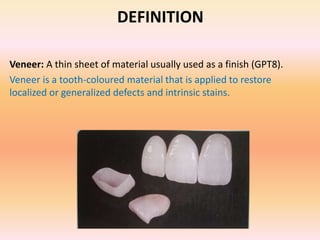
Veneer: A thin sheet of material usually used as a finish (GPT8).
Veneer is a tooth-coloured material that is applied to restore
localized or generalized defects and intrinsic stains.
Laminating: Constructing a veneer and bonding it to
etched tooth structure.
Porcelain laminate veneer: A thin bonded ceramic
restoration that restores the facial surface and part of
the proximal surfaces of teeth requiring aesthetic
restoration (GPT).
HISTORY
• Impossible to see the fine facial features, and close up sequence
were rare
• Hollywood film makers experienced a dental dilemma.
• Thus, it became necessary for movie stars to have glamorous smiles
• Thus, necessity led to invention.
• In 1930s Dr Charles Pincus create the ‘Hollywood smile’ for
American actors.
• He used denture adhesive to hold the veneer in place.
• In the 1970s, preformed plastic laminates were bonded to the
teeth using composite resin, but bonding to the plastic was poor
along with colour instability.
The evolution of the modern ceramic laminate was
assisted by the following discoveries:
1. Etching of enamel by Buonocore (1955)
2. Bowen’s BIS-GMA resins (1960s)
3. Ceramic etching and bonding by Rochette (1973).
INDICATIONS
• Diastema
• Extreme discolouration
• Enamel defects
• Tooth fracture
• Malpositioned teeth and abnormalities of shape
• Abraded and eroded facial surfaces
• Attrition
CONTRAINDICATIONS
• Endodontically treated teeth
• Parafunctional habits like bruxism
• Insufficient coronal tooth structure
• Actively erupting teeth
• Severe periodontal involvement and crowding
Advantages Disadvantages
• Minimally invasive – conservative
• Excellent colour and light transmission
– good aesthetics
• High colour stability
• Good tissue response
• Excellent durability – good strength,
wear resistance and no fluid
absorption
• Speed and simplicity
• Tooth preparation, however minimal, is
required
• Cementation is time-consuming and
technique sensitive
• Fragile – may fracture if improperly
handled during try-in or cementation
• Proper selection of underlying cement
is critical for success
• Difficult to repair
• Cost
Materials used as veneers in dentistry:
• Chair side composite
• Processed composite
• Porcelain
• Pressed ceramics
Types :
• Partial veneer – Localized defects
• Full veneer – Generalized defects
Techniques :
• Direct – composite, same day, time- consuming
• Indirect – 2 appointments, better esthetics, best for multiple
teeth, long life for porcelain
SHADE SELECTION
• This should be done at the beginning, during the consultation
or treatment planning appointment.
• It has to be done when the teeth have not been dried out for
any period of time.
• It is done under a colour corrected light or outside in
daylight.
• It is best for a ceramist to make an individualized shade guide
and not by conventional vita shade guide
TOOTH PREPARATION
TYPES
TYPE I - contact lens type:
Does not cover the incisal
edge
Type II – classic or
conventional type: Most
commonly used; covers the
incisal edge and terminates
lingually
Type III – wrap-around or
three-fourth type
ARMAMENTARIUM
• A diamond depth cutter with three 2 mm diameter wheels
mounted on a 1.0 mm diameter noncutting shaft. Produces a
depth cut of 0.5 mm.
• A diamond depth cutter with a wheel diameter of 1.6 mm
produces a depth cut of 0.3 mm.
• Round bur (No. 1)
• Round-end tapering diamond (medium and
fine grit)
• Finishing diamond and burs
• Airotor handpiece
PROCEDURE
1) Labial reduction : 1. Depth cuts
2. Reducing remaining enamel
DEPTH CUT ALONG GINGIVAL MARGINS
WITH A NO. 1 ROUND BUR
DEPTH CUT EXTENDED PROXIMALLY AND
INCISALLY
DEPTH CUTS USING ONLY ROUND BUR
DEPTH CUT ALONG CENTRE OF TOOTH
TWO DEPTH CUTS PLACED MESIODISTALLY
DIRECTION OF INSTRUMENT TO REDUCE REMAINING ENAMEL
DEPTH CUTS DIAMOND DEPTH CUTTER
DEPTH CUTS WITH DEPTH CUTTER DIAMOND
DIRECTION OF INSTRUMENT TO REDUCE
REMAINING ENAMEL
2) Proximal reduction :
• Depth can often be as great as 0.8–1 mm, since the enamel layer
is thick towards proximal surface
PROXIMAL REDUCTION SHORT OF BREAKING CONTACT
Reasons to preserve contact area :
• It is an anatomical feature that is extremely difficult to reproduce
• It prevents displacement of the tooth between the preparation
and placement appointment if no provisional restorations are
planned.
• Post-insertion oral care is easier.
• Simplifies try-in – no need to adjust the contact.
• Simplifies bonding and finishing.
3) Sulcular extension
• Routinely the margins are placed supra gingivally.
• When discoloration is excessive, the margins are extended sub gingivally.
• A rounded 0.3 mm chamfer serves as an ideal margin for ceramic laminate veneer
SUPRAGINGIVAL MARGIN
PLACEMENT.
Advantages of supragingival margin :
• Increased areas of enamel in the preparation.
• Simplified moisture control.
• Visual confirmation of marginal fit.
• Margins are accessible for finishing and polishing.
• Access to margins for routine maintenance and dental hygiene
procedure.
Advantages of chamfer finish line :
• Conservative, distinct.
• Provides increased bulk of porcelain giving adequate strength, avoids
over contouring.
• Good marginal seal.
• Accuracy of fit – veneer is easily inserted at try-in and final placement.
For type I preparations, the tooth reduction ends here.
For type II preparations, incisal and lingual reductions are
necessary.
4) Incisal reduction
INCISAL DEPTH CUTS INCISAL REDUCTION
Indications for incisal coverage :
• The incisal thickness is too thin to support the veneer.
• A lengthening of the incisal edge of 1–2 mm is desired.
• Facio-incisal margin is visible and unaesthetic.
• Incisal enamel is structurally compromised.
• The incisal edge is subject to functional stress.
5) Lingual reduction
LINGUAL REDUCTION
SOFT TISSUE MANAGEMENT
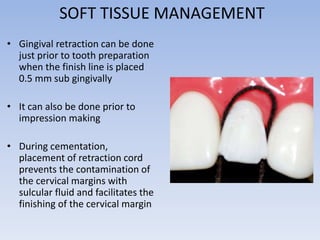
• Gingival retraction can be done
just prior to tooth preparation
when the finish line is placed
0.5 mm sub gingivally
• It can also be done prior to
impression making
• During cementation,
placement of retraction cord
prevents the contamination of
the cervical margins with
sulcular fluid and facilitates the
finishing of the cervical margin
Impression procedure
Light body syringed around the
preparation.
Putty mixed and loaded onto stock
tray.
Tray placed over the syringed light
body
Single impression made using double
mix
Cementation
Initial veneer inspection
The veneer is placed on the cast
and assessed for the following:
• Imperfections
• Individual fit
• Collective fit (for multiple
veneers)
• Veneer colour
Preparation of site
The prepared teeth are isolated, provisional
removed and cleaned with pumice
Prepared teeth cleaned with pumice
Try-in
The veneers are then tried-in the patient’s mouth. They are checked
for:
• Individual fit
• Collective fit
• Colour
 Water-soluble glycerin, transparent silicones and colour keyed try-
in pastes can be used to attach the laminate to the tooth during
try-in.
Bonding
Bonding involves the following procedures:
• Preparation of veneer
• Preparation of tooth
• Luting
Preparation of veneer
• Cleaning of the veneer with a solvent such as acetone
• Etched with 10%–15% hydrofluoric acid for 30 s to 1 min
 Some clinicians tend to get the veneer etched by the laboratory;
this is not recommended as the etched surface may get
contaminated during handling and try-in procedures.
Fitting surface filled with
ceramic etchant
• A normal composite bonding agent is finally applied to the fitting
surface at the same time when the tooth surface is also bonded.
It is not light cured.
Application of Silane coupling agent
Preparation of tooth
The prepared teeth are pumiced again to remove
any try-in paste or cement.
Isolation with soft metal bands Etching with phosphoric acid
Application of bonding agent on tooth
LUTING
• The cement of choice for luting ceramic
laminate veneers is resin cement
Cement mixed Cement applied on fitting surface
and spread evenly
Initially light cured for 5 s
Final curing for 45–60 s
Excess removed
FINISHING
Margins finished with fine grit
diamonds
Finishing strips are used for
proximal surfaces
Discs are used for final
finishing
MAINTENANCE
• For 72–96 h following insertion, patients should avoid highly
coloured foods, tea or coffee, hard food and extreme
temperatures.
• Routine scaling should be done at least every 4 months,
ultrasonic scalers may be avoided.
• Abrasive and highly fluoridated tooth paste should be avoided.
• Excessive biting forces and nail biting and pencil chewing habits
should be avoided.
• Soft acrylic mouth guard can be used during contact sports.
CAUSES OF FAILURE OF CERAMIC LAMINATE
VENEERS
LAMINATES VENEERS.pptx

LAMINATES VENEERS.pptx

  • 1.
    LAMINATE VENEERS (PART-I) DRSHRIMANT RAMAN DEPARTMENT OF PROSTHODONTICS
  • 2.
    INTRODUCTION • The dentalprofession is faced with specific esthetic demands and a rapid evolution of new but unproven techniques • Although the direct bonding of porcelain veneers is relatively new, reports of success warrant its inclusion as a restorative treatment.
  • 3.
    • Laminate veneershave evolved over the last several decades to become one of aesthetic dentistry’s most popular restorations. • It is a conservative alternative to full coverage for improving the appearance of an anterior tooth
  • 4.
    DEFINITION Veneer: A thinsheet of material usually used as a finish (GPT8). Veneer is a tooth-coloured material that is applied to restore localized or generalized defects and intrinsic stains.
  • 5.
    Laminating: Constructing aveneer and bonding it to etched tooth structure. Porcelain laminate veneer: A thin bonded ceramic restoration that restores the facial surface and part of the proximal surfaces of teeth requiring aesthetic restoration (GPT).
  • 6.
    HISTORY • Impossible tosee the fine facial features, and close up sequence were rare • Hollywood film makers experienced a dental dilemma. • Thus, it became necessary for movie stars to have glamorous smiles • Thus, necessity led to invention.
  • 7.
    • In 1930sDr Charles Pincus create the ‘Hollywood smile’ for American actors. • He used denture adhesive to hold the veneer in place. • In the 1970s, preformed plastic laminates were bonded to the teeth using composite resin, but bonding to the plastic was poor along with colour instability.
  • 8.
    The evolution ofthe modern ceramic laminate was assisted by the following discoveries: 1. Etching of enamel by Buonocore (1955) 2. Bowen’s BIS-GMA resins (1960s) 3. Ceramic etching and bonding by Rochette (1973).
  • 9.
    INDICATIONS • Diastema • Extremediscolouration • Enamel defects • Tooth fracture • Malpositioned teeth and abnormalities of shape • Abraded and eroded facial surfaces • Attrition
  • 10.
    CONTRAINDICATIONS • Endodontically treatedteeth • Parafunctional habits like bruxism • Insufficient coronal tooth structure • Actively erupting teeth • Severe periodontal involvement and crowding
  • 11.
    Advantages Disadvantages • Minimallyinvasive – conservative • Excellent colour and light transmission – good aesthetics • High colour stability • Good tissue response • Excellent durability – good strength, wear resistance and no fluid absorption • Speed and simplicity • Tooth preparation, however minimal, is required • Cementation is time-consuming and technique sensitive • Fragile – may fracture if improperly handled during try-in or cementation • Proper selection of underlying cement is critical for success • Difficult to repair • Cost
  • 12.
    Materials used asveneers in dentistry: • Chair side composite • Processed composite • Porcelain • Pressed ceramics
  • 13.
    Types : • Partialveneer – Localized defects • Full veneer – Generalized defects Techniques : • Direct – composite, same day, time- consuming • Indirect – 2 appointments, better esthetics, best for multiple teeth, long life for porcelain
  • 14.
    SHADE SELECTION • Thisshould be done at the beginning, during the consultation or treatment planning appointment. • It has to be done when the teeth have not been dried out for any period of time. • It is done under a colour corrected light or outside in daylight. • It is best for a ceramist to make an individualized shade guide and not by conventional vita shade guide
  • 15.
    TOOTH PREPARATION TYPES TYPE I- contact lens type: Does not cover the incisal edge Type II – classic or conventional type: Most commonly used; covers the incisal edge and terminates lingually Type III – wrap-around or three-fourth type
  • 16.
    ARMAMENTARIUM • A diamonddepth cutter with three 2 mm diameter wheels mounted on a 1.0 mm diameter noncutting shaft. Produces a depth cut of 0.5 mm. • A diamond depth cutter with a wheel diameter of 1.6 mm produces a depth cut of 0.3 mm.
  • 17.
    • Round bur(No. 1) • Round-end tapering diamond (medium and fine grit) • Finishing diamond and burs • Airotor handpiece
  • 18.
    PROCEDURE 1) Labial reduction: 1. Depth cuts 2. Reducing remaining enamel DEPTH CUT ALONG GINGIVAL MARGINS WITH A NO. 1 ROUND BUR DEPTH CUT EXTENDED PROXIMALLY AND INCISALLY DEPTH CUTS USING ONLY ROUND BUR
  • 19.
    DEPTH CUT ALONGCENTRE OF TOOTH
  • 20.
    TWO DEPTH CUTSPLACED MESIODISTALLY
  • 21.
    DIRECTION OF INSTRUMENTTO REDUCE REMAINING ENAMEL
  • 22.
    DEPTH CUTS DIAMONDDEPTH CUTTER DEPTH CUTS WITH DEPTH CUTTER DIAMOND
  • 23.
    DIRECTION OF INSTRUMENTTO REDUCE REMAINING ENAMEL
  • 24.
    2) Proximal reduction: • Depth can often be as great as 0.8–1 mm, since the enamel layer is thick towards proximal surface PROXIMAL REDUCTION SHORT OF BREAKING CONTACT
  • 25.
    Reasons to preservecontact area : • It is an anatomical feature that is extremely difficult to reproduce • It prevents displacement of the tooth between the preparation and placement appointment if no provisional restorations are planned. • Post-insertion oral care is easier. • Simplifies try-in – no need to adjust the contact. • Simplifies bonding and finishing.
  • 26.
    3) Sulcular extension •Routinely the margins are placed supra gingivally. • When discoloration is excessive, the margins are extended sub gingivally. • A rounded 0.3 mm chamfer serves as an ideal margin for ceramic laminate veneer SUPRAGINGIVAL MARGIN PLACEMENT.
  • 27.
    Advantages of supragingivalmargin : • Increased areas of enamel in the preparation. • Simplified moisture control. • Visual confirmation of marginal fit. • Margins are accessible for finishing and polishing. • Access to margins for routine maintenance and dental hygiene procedure.
  • 28.
    Advantages of chamferfinish line : • Conservative, distinct. • Provides increased bulk of porcelain giving adequate strength, avoids over contouring. • Good marginal seal. • Accuracy of fit – veneer is easily inserted at try-in and final placement. For type I preparations, the tooth reduction ends here. For type II preparations, incisal and lingual reductions are necessary.
  • 29.
    4) Incisal reduction INCISALDEPTH CUTS INCISAL REDUCTION
  • 30.
    Indications for incisalcoverage : • The incisal thickness is too thin to support the veneer. • A lengthening of the incisal edge of 1–2 mm is desired. • Facio-incisal margin is visible and unaesthetic. • Incisal enamel is structurally compromised. • The incisal edge is subject to functional stress.
  • 31.
  • 32.
    SOFT TISSUE MANAGEMENT •Gingival retraction can be done just prior to tooth preparation when the finish line is placed 0.5 mm sub gingivally • It can also be done prior to impression making • During cementation, placement of retraction cord prevents the contamination of the cervical margins with sulcular fluid and facilitates the finishing of the cervical margin
  • 33.
    Impression procedure Light bodysyringed around the preparation. Putty mixed and loaded onto stock tray.
  • 34.
    Tray placed overthe syringed light body Single impression made using double mix
  • 35.
    Cementation Initial veneer inspection Theveneer is placed on the cast and assessed for the following: • Imperfections • Individual fit • Collective fit (for multiple veneers) • Veneer colour
  • 36.
    Preparation of site Theprepared teeth are isolated, provisional removed and cleaned with pumice Prepared teeth cleaned with pumice
  • 37.
    Try-in The veneers arethen tried-in the patient’s mouth. They are checked for: • Individual fit • Collective fit • Colour  Water-soluble glycerin, transparent silicones and colour keyed try- in pastes can be used to attach the laminate to the tooth during try-in.
  • 38.
    Bonding Bonding involves thefollowing procedures: • Preparation of veneer • Preparation of tooth • Luting
  • 39.
    Preparation of veneer •Cleaning of the veneer with a solvent such as acetone • Etched with 10%–15% hydrofluoric acid for 30 s to 1 min  Some clinicians tend to get the veneer etched by the laboratory; this is not recommended as the etched surface may get contaminated during handling and try-in procedures. Fitting surface filled with ceramic etchant
  • 40.
    • A normalcomposite bonding agent is finally applied to the fitting surface at the same time when the tooth surface is also bonded. It is not light cured. Application of Silane coupling agent
  • 41.
    Preparation of tooth Theprepared teeth are pumiced again to remove any try-in paste or cement. Isolation with soft metal bands Etching with phosphoric acid
  • 42.
    Application of bondingagent on tooth
  • 43.
    LUTING • The cementof choice for luting ceramic laminate veneers is resin cement Cement mixed Cement applied on fitting surface and spread evenly
  • 44.
    Initially light curedfor 5 s Final curing for 45–60 s Excess removed
  • 45.
    FINISHING Margins finished withfine grit diamonds Finishing strips are used for proximal surfaces Discs are used for final finishing
  • 46.
    MAINTENANCE • For 72–96h following insertion, patients should avoid highly coloured foods, tea or coffee, hard food and extreme temperatures. • Routine scaling should be done at least every 4 months, ultrasonic scalers may be avoided. • Abrasive and highly fluoridated tooth paste should be avoided. • Excessive biting forces and nail biting and pencil chewing habits should be avoided. • Soft acrylic mouth guard can be used during contact sports.
  • 47.
    CAUSES OF FAILUREOF CERAMIC LAMINATE VENEERS

Editor's Notes

  • #5 It is the prosthetic treatment that consists of replacing the visible portion of the dental enamel with a ceramic substitute, intimately bonded to the tooth surface, yielding optical, mechanical and biological properties closely resembling those of the natural enamel
  • #7 With the earliest motion pictures were produced, the films were so jumpy it was In the late 1920s, the talkies arrived. Combined with improved filming and projecting techniques, which made minor details more visible,
  • #8 first used thin resin facings and then air fired porcelain facings to
  • #16 thickness of tooth, need for increasing tooth length and occlusion determine whether type I or II is used.
  • #41 The silane creates a chemical bond between composite cement and ceramic
  • #43 Composite bonding agent is applied on the tooth surface and is not light-cured now