DIAGNOSIS IN
ENDODONTICS
-By
Dr.Manjiri Honap
Department of Conservative
Dentistry and Endodontics
Learning Objectives
Diagnosis
Diagnostic method
Medical history
Dental history
Subjective symptoms
Clinical observations
Clinical tests
Diagnosis
‘The art and science of detecting deviations
from health and the cause and nature there
of’
Glossary of Endodontic terms. 7th ed. Chicago: American
Association of Endodontists;2003
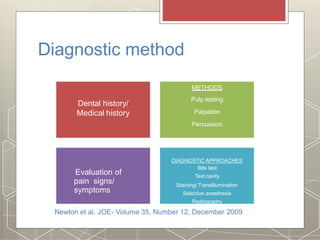
Diagnostic method
Dental history/
Medical history
METHODS
Pulp testing
Palpation
Percussion
Evaluation of
pain signs/
symptoms
DIAGNOSTIC APPROACHES
Bite test
Test cavity
Staining/ Transillumination
Selective anesthesia
Radiography
Newton et al. JOE- Volume 35, Number 12, December 2009
Dental history
Chief complaint & its history
When was it lastrestored?
Pulp capping/ Pulpotomy/large
restoration in the same
Sharp blow/accident
Swelling/ gumboil
Drainage
Subjective symptoms
Is the pain stillpresent?
What type? (Sharp/dull)
Throbbing?
Intermittent/Continuous?
Aggravated by: cold, heat,pressure,
mastication, lying down, sweet, sour?
How long does itlast?
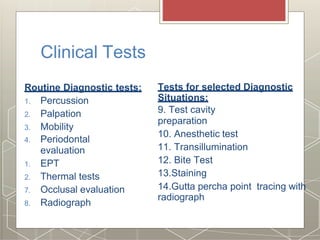
Clinical Tests
Routine Diagnostic tests:
1. Percussion
2. Palpation
3. Mobility
4. Periodontal
evaluation
1. EPT
2. Thermal tests
7. Occlusal evaluation
8. Radiograph
Tests for selected Diagnostic
Situations:
9. Test cavity
preparation
10. Anesthetic test
11. Transillumination
12. Bite Test
13.Staining
14.Gutta percha point tracing with
radiograph
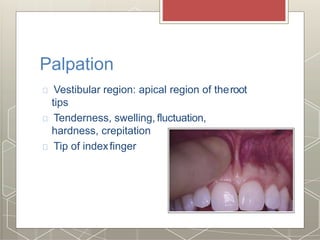
Palpation
Vestibular region: apical region of theroot
tips
Tenderness, swelling, fluctuation,
hardness, crepitation
Tip of indexfinger
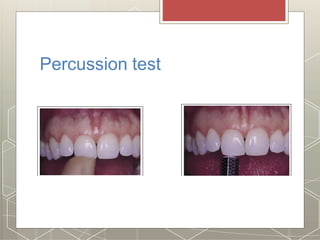
Percussion test
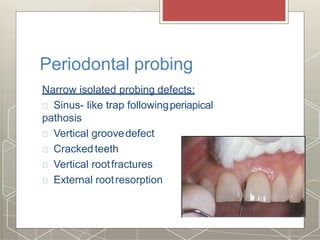
Periodontal probing
Narrow isolated probing defects:
Sinus- like trap followingperiapical
pathosis
Vertical groovedefect
Crackedteeth
Vertical rootfractures
External rootresorption
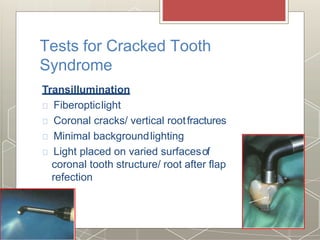
Tests for Cracked Tooth
Syndrome
Transillumination
Fiberopticlight
Coronal cracks/ vertical rootfractures
Minimal backgroundlighting
Light placed on varied surfacesof
coronal tooth structure/ root after flap
refection
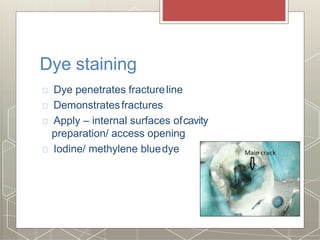
Dye staining
Dye penetrates fractureline
Demonstratesfractures
Apply – internal surfaces ofcavity
preparation/ access opening
Iodine/ methylene bluedye
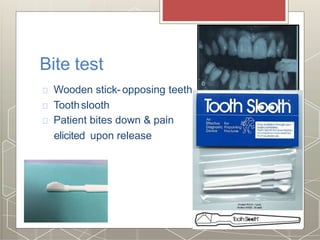
Bite test
Wooden stick-opposing teeth
Toothslooth
Patient bites down & pain
elicited upon release
Pulp tests
*Ideal technique: non invasive, painless,
standardized, reproducible, reliable,
inexpensive, easily completed & objective
*Chambers. 1982
Pulp sensibility tests
Thermal tests
Electric pulp tests
Test cavity
Pulp vitality tests
Laser doppler flowmetry
Pulse oximetry
Clinically Normal pulp
• I m m e d i a c y, i n t e n s i t y, &
d u r a t i o n o f r e s p o n s e
• Mild to moderate - transient responseto
cold & electrical stimuli
• Response subsides in few secondson
removal of stimulus
• Do not usually respond to heattests
Reversible pulpitis
Thermal stimuli (cold)- sharppain
Subsides as soon as the stimulusis
removed/ in few seconds
Irreversible pulpitis
Thermal changes (cold): sharp pain ,dull
prolonged ache- last upto an hour or so
Pulp necrosis
Significant relation between lackof response
& pulp necrosis
No response with EPTs & thermaltests
Thermal tests
Often inappropriately referred toas
‘Vitality tests’
More reliable thanEPT
Inexpensive & easy-to- useequipment
Patient’s painreproduced
Thermal tests- Rationale
Sensory response: not bytemperature
changes in receptors
Hydrodynamic movement offluid:
dentinal tubules- A fibers
Cold- faster A fibers: sharp localized
pain
Heat- slower C fibers: dull long lastingpain
Jafarzadeh & Abbott. IEJ, 43, 738-762, 2010
Thermal tests
• Initial cold sensitivity
• Heat sensitivity- continued pulp deterioration
• Disappearance of cold sensitivity
• Cold stimuli might relieve heat induced pain
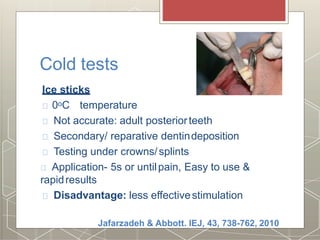
Cold tests
Ice sticks
0oC temperature
Not accurate: adult posteriorteeth
Secondary/ reparative dentindeposition
Testing under crowns/splints
Application- 5s or untilpain, Easy to use &
rapidresults
Disadvantage: less effectivestimulation
Jafarzadeh & Abbott. IEJ, 43, 738-762, 2010
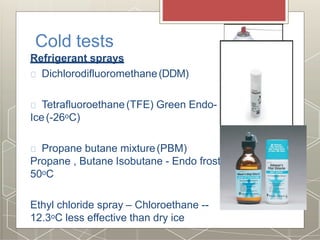
Cold tests
Refrigerant sprays
Dichlorodifluoromethane(DDM)
Tetrafluoroethane(TFE) Green Endo-
Ice(-26oC)
Propane butane mixture(PBM)
Propane , Butane Isobutane - Endo frost-
50oC
Ethyl chloride spray – Chloroethane --
12.3oC less effective than dry ice
Cold tests
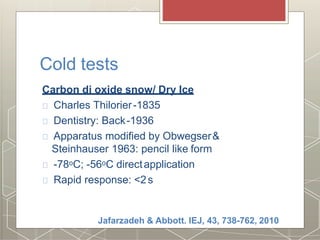
Carbon di oxide snow/ Dry Ice
Charles Thilorier-1835
Dentistry: Back-1936
Apparatus modified by Obwegser&
Steinhauser 1963: pencil like form
-78oC; -56oC directapplication
Rapid response: <2s
Jafarzadeh & Abbott. IEJ, 43, 738-762, 2010
Cold tests
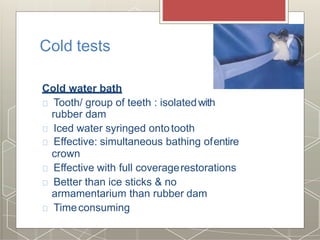
Cold water bath
Tooth/ group of teeth : isolatedwith
rubber dam
Iced water syringed ontotooth
Effective: simultaneous bathing ofentire
crown
Effective with full coveragerestorations
Better than ice sticks & no
armamentarium than rubber dam
Timeconsuming
Heat tests
Heat: fluidexpansion- A fibers
Inflamed pulp: C-fibers; lastingresponse
Acutely inflamed/ partially necroticpulp
Low diagnostic accuracy- not usedas
single method
Heat tests
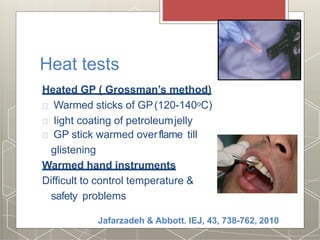
Heated GP ( Grossman’s method)
Warmed sticks of GP(120-140oC)
Iight coating of petroleumjelly
GP stick warmed overflame till
glistening
Warmed hand instruments
Difficult to control temperature &
safety problems
Jafarzadeh & Abbott. IEJ, 43, 738-762, 2010
Heat tests
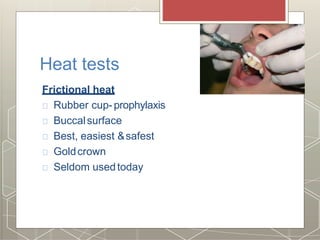
Frictional heat
Rubber cup-prophylaxis
Buccalsurface
Best, easiest &safest
Goldcrown
Seldom usedtoday
Heat tests
Hot water bath
Similar to cold waterbath
Temperature graduallyincreased
Begin with most posterior andproceed
until positive response
Greater thermalchange
PFMcrowns
Time consuming & patientcooperation
Heat tests
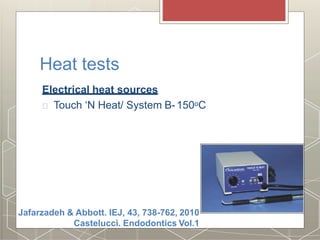
Electrical heat sources
Touch ‘N Heat/ System B-150oC
Jafarzadeh & Abbott. IEJ, 43, 738-762, 2010
Castelucci. Endodontics Vol.1
Heat tests
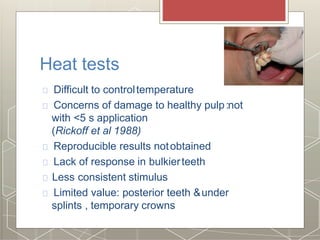
Difficult to controltemperature
Concerns of damage to healthy pulp:not
with <5 s application
(Rickoff et al 1988)
Reproducible results notobtained
Lack of response in bulkierteeth
Less consistent stimulus
Limited value: posterior teeth &under
splints , temporary crowns
Value of diagnostic tests
Heat: relatively high sensitivity;but least
accurate being the least specific
Cold test: more accurate thanEPT
Remember..
Inform patient of the nature oftests
Handsignals
Stimulus removed after 5-6s
Refractory period after coldtest
Incisal- anterior & incisal aspect of
mesiobuccal cusp: posterior (Trope &
Debelian 2005)
Ideally be tested on allsurfaces
Several adjacent, contralateral &
opposing teeth tested
Pulp sensibility tests
Preferred sequence:
Opposin
g teeth
Presumably
healthy teeth-
same
quadrant
Most
suspiciou
s tooth
• Disease free contralateral control tooth
• Opposing tooth
• Presumably healthy teeth in same quadrant
• Most suspicious teeth
False responses
False negative results: Normal pulps that do
not respond to tests
Calcification: no response to cold;may
respond to high value of current in EPT
Premedication
Recenttrauma
Immatureapex
RCT teeth: not expected torespond
Jafarzadeh & Abbott. IEJ, 43, 738-762, 2010
False responses
Extensiverestorations
Pulp protectingbases
High painthreshold
Activation of fixed orthodonticappliances
Psychoticdisorders
Defective EPT device/discharged
batteries/ poor electrical contact
False responses
False positive results: Necrotic pulps
responding to tests
Conduction of current to adjacent gingival &
periodontal tissues (avoided with reasonable
current strength & proper techniques)
Moist gangrene, partially necrotictissue,
infected pulp
Breakdown products of localized necrosis
False responses
Calcified tooth structure conductingto
tissue apical to an area of necrosis
Current conducted to adjacent teeth
through metallic restorations (avoided by
rubber dam / celluloid strips between teeth)
Inflamed pulp tissue in one canal of a
multirooted teeth with other canals &
chamber necrotic
Anxious/ youngpatient
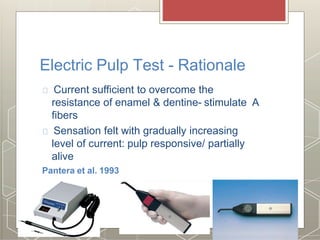
Electric Pulp Test - Rationale
Current sufficient to overcome the
resistance of enamel & dentine- stimulate A
fibers
Sensation felt with gradually increasing
level of current: pulp responsive/ partially
alive
Pantera et al. 1993
EPT- Rationale
A fibers: brief sharp sensation/ tingling
*No blood flow- pulp becomes anoxic&A
fibers cease to function
*Pitt Ford & Patel
2004
Limitations
1. Subjective; measure only nerve supply
2.Thermal tests: not effective in substantial
secondary dentin formation
3.Unreliability of tests: Immature apices,
traumatic injuries, more subjectivity in the
young
4.No correlation with the histologic status
(Contrasting results: Hill, 1986)
5.Extensive restorations, pulp recession,
pulp calcification
Jafarzadeh & Abbott. IEJ, 43, 738-762, 2010
Variations in reading/ False
response
Failure to complete
the circuit
Equipment
problems
Probeplacement
Interfacemedia
Patient related factors
Tooth characteristics
Restored teeth
Dentition
Supporting tissues
Apex maturation
Repeated trials
False positive response
Necrotic pulp responds totesting.
Stimulation of adjacentteeth/
attachment apparatus
The response of vital tissue inmultirooted
tooth with pulp necrosis in one or more
canals
Patient interpretation:subjectivity
William T. Johnson. Colour Atlas of
Endodontics
False negative response
Vital pulp that does not respondto
stimulation
Inadequate contact
Toothcalcification
Immature apex
Traumaticinjury
Subjective nature of thetests
Elderly patients – regressive neuralchanges
Analgesics forpain
Traumaticinjury
Test cavity
Non localized, acute diffuseradiating
pain
Cavity prepared in the tooth:without
anesthesia
Unreliable; response even in necroticpulp
Response unreliable: anxiety
Invasive &irreversible
- Not justified in modernpractice
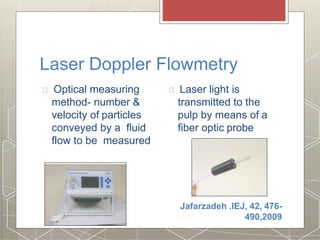
Laser Doppler Flowmetry
Jafarzadeh .IEJ, 42, 476-
490,2009
Optical measuring
method- number &
velocity of particles
conveyed by a fluid
flow to be measured
Laser light is
transmitted to the
pulp by means of a
fiber optic probe
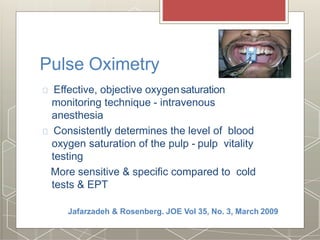
Pulse Oximetry
Effective, objective oxygensaturation
monitoring technique - intravenous
anesthesia
Consistently determines the level of blood
oxygen saturation of the pulp - pulp vitality
testing
More sensitive & specific compared to cold
tests & EPT
Jafarzadeh & Rosenberg. JOE Vol 35, No. 3, March 2009
Ultraviolet light/Fiberoptic
Fluorescent Spectrometry
Fluorescence
Vital teeth fluoresce normally; necrotic&RCT
teeth do not –Foreman
Lighting in the operatory fullysuppressed
Fluorescence from the pulp -substantially lower than
the healthy and decayed dentin fluorescence.
Healthy and decayed dentinpatterns
differentiated
Tyagi et al.Saudi Endodontic Journal • May-Aug 2012 • Vol 2 • Issue 2
Anesthetic test
L/A: painfularea
Block/ infiltration/intraosseous
Vague location ofpain
Non odontogenic pain:Myocardial
infarction
Ultrasound
Compliment conventionalradiography
High resolution, 3D images-inner
macrostructure of the tooth
Detects cracks in a simulated humantooth
Detect vertical root fractures – in both
vital&nonvital teeth
Tyagi et al.Saudi Endodontic Journal • May-Aug 2012 • Vol 2 • Issue 2
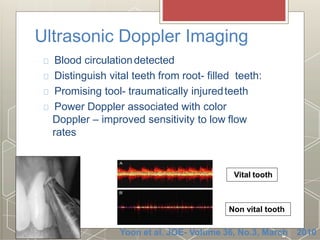
Ultrasonic Doppler Imaging
Blood circulationdetected
Distinguish vital teeth from root- filled teeth:
Promising tool- traumatically injuredteeth
Power Doppler associated with color
Doppler – improved sensitivity to low flow
rates
Non vital tooth
Yoon et al. JOE- Volume 36, No.3, March 2010
Vital tooth
RADIOGRAPHY-Little value : assess
pulp status
Presence &extent
of carious lesions
Vital pulptherapy
Calcifications
Resorptions
Periradicular
radiolucencies
Tracingfistulous
tracts
Thickness ofPDL
Periodontal
disease
Root & pulpspace
anatomy
PreviousRCT
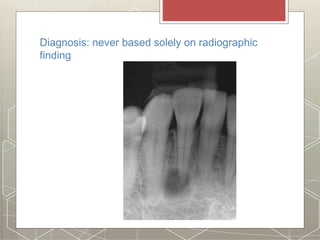
Diagnosis: never based solely on radiographic
finding
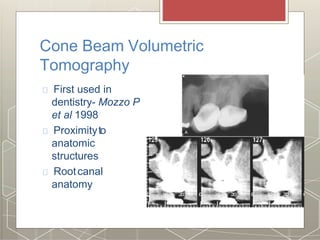
Cone Beam Volumetric
Tomography
First used in
dentistry- Mozzo P
et al 1998
Proximityto
anatomic
structures
Rootcanal
anatomy
DIAGNOSIS IN ENDODONTICS .pptx

DIAGNOSIS IN ENDODONTICS .pptx

  • 1.
    DIAGNOSIS IN ENDODONTICS -By Dr.Manjiri Honap Departmentof Conservative Dentistry and Endodontics
  • 2.
    Learning Objectives Diagnosis Diagnostic method Medicalhistory Dental history Subjective symptoms Clinical observations Clinical tests
  • 3.
    Diagnosis ‘The art andscience of detecting deviations from health and the cause and nature there of’ Glossary of Endodontic terms. 7th ed. Chicago: American Association of Endodontists;2003
  • 4.
    Diagnostic method Dental history/ Medicalhistory METHODS Pulp testing Palpation Percussion Evaluation of pain signs/ symptoms DIAGNOSTIC APPROACHES Bite test Test cavity Staining/ Transillumination Selective anesthesia Radiography Newton et al. JOE- Volume 35, Number 12, December 2009
  • 5.
    Dental history Chief complaint& its history When was it lastrestored? Pulp capping/ Pulpotomy/large restoration in the same Sharp blow/accident Swelling/ gumboil Drainage
  • 6.
    Subjective symptoms Is thepain stillpresent? What type? (Sharp/dull) Throbbing? Intermittent/Continuous? Aggravated by: cold, heat,pressure, mastication, lying down, sweet, sour? How long does itlast?
  • 7.
    Clinical Tests Routine Diagnostictests: 1. Percussion 2. Palpation 3. Mobility 4. Periodontal evaluation 1. EPT 2. Thermal tests 7. Occlusal evaluation 8. Radiograph Tests for selected Diagnostic Situations: 9. Test cavity preparation 10. Anesthetic test 11. Transillumination 12. Bite Test 13.Staining 14.Gutta percha point tracing with radiograph
  • 8.
    Palpation Vestibular region: apicalregion of theroot tips Tenderness, swelling, fluctuation, hardness, crepitation Tip of indexfinger
  • 9.
  • 10.
    Periodontal probing Narrow isolatedprobing defects: Sinus- like trap followingperiapical pathosis Vertical groovedefect Crackedteeth Vertical rootfractures External rootresorption
  • 11.
    Tests for CrackedTooth Syndrome Transillumination Fiberopticlight Coronal cracks/ vertical rootfractures Minimal backgroundlighting Light placed on varied surfacesof coronal tooth structure/ root after flap refection
  • 12.
    Dye staining Dye penetratesfractureline Demonstratesfractures Apply – internal surfaces ofcavity preparation/ access opening Iodine/ methylene bluedye
  • 13.
    Bite test Wooden stick-opposingteeth Toothslooth Patient bites down & pain elicited upon release
  • 14.
    Pulp tests *Ideal technique:non invasive, painless, standardized, reproducible, reliable, inexpensive, easily completed & objective *Chambers. 1982 Pulp sensibility tests Thermal tests Electric pulp tests Test cavity Pulp vitality tests Laser doppler flowmetry Pulse oximetry
  • 15.
    Clinically Normal pulp •I m m e d i a c y, i n t e n s i t y, & d u r a t i o n o f r e s p o n s e • Mild to moderate - transient responseto cold & electrical stimuli • Response subsides in few secondson removal of stimulus • Do not usually respond to heattests
  • 16.
    Reversible pulpitis Thermal stimuli(cold)- sharppain Subsides as soon as the stimulusis removed/ in few seconds
  • 17.
    Irreversible pulpitis Thermal changes(cold): sharp pain ,dull prolonged ache- last upto an hour or so
  • 18.
    Pulp necrosis Significant relationbetween lackof response & pulp necrosis No response with EPTs & thermaltests
  • 19.
    Thermal tests Often inappropriatelyreferred toas ‘Vitality tests’ More reliable thanEPT Inexpensive & easy-to- useequipment Patient’s painreproduced
  • 20.
    Thermal tests- Rationale Sensoryresponse: not bytemperature changes in receptors Hydrodynamic movement offluid: dentinal tubules- A fibers Cold- faster A fibers: sharp localized pain Heat- slower C fibers: dull long lastingpain Jafarzadeh & Abbott. IEJ, 43, 738-762, 2010
  • 21.
    Thermal tests • Initialcold sensitivity • Heat sensitivity- continued pulp deterioration • Disappearance of cold sensitivity • Cold stimuli might relieve heat induced pain
  • 22.
    Cold tests Ice sticks 0oCtemperature Not accurate: adult posteriorteeth Secondary/ reparative dentindeposition Testing under crowns/splints Application- 5s or untilpain, Easy to use & rapidresults Disadvantage: less effectivestimulation Jafarzadeh & Abbott. IEJ, 43, 738-762, 2010
  • 23.
    Cold tests Refrigerant sprays Dichlorodifluoromethane(DDM) Tetrafluoroethane(TFE)Green Endo- Ice(-26oC) Propane butane mixture(PBM) Propane , Butane Isobutane - Endo frost- 50oC Ethyl chloride spray – Chloroethane -- 12.3oC less effective than dry ice
  • 24.
    Cold tests Carbon dioxide snow/ Dry Ice Charles Thilorier-1835 Dentistry: Back-1936 Apparatus modified by Obwegser& Steinhauser 1963: pencil like form -78oC; -56oC directapplication Rapid response: <2s Jafarzadeh & Abbott. IEJ, 43, 738-762, 2010
  • 25.
    Cold tests Cold waterbath Tooth/ group of teeth : isolatedwith rubber dam Iced water syringed ontotooth Effective: simultaneous bathing ofentire crown Effective with full coveragerestorations Better than ice sticks & no armamentarium than rubber dam Timeconsuming
  • 26.
    Heat tests Heat: fluidexpansion-A fibers Inflamed pulp: C-fibers; lastingresponse Acutely inflamed/ partially necroticpulp Low diagnostic accuracy- not usedas single method
  • 27.
    Heat tests Heated GP( Grossman’s method) Warmed sticks of GP(120-140oC) Iight coating of petroleumjelly GP stick warmed overflame till glistening Warmed hand instruments Difficult to control temperature & safety problems Jafarzadeh & Abbott. IEJ, 43, 738-762, 2010
  • 28.
    Heat tests Frictional heat Rubbercup-prophylaxis Buccalsurface Best, easiest &safest Goldcrown Seldom usedtoday
  • 29.
    Heat tests Hot waterbath Similar to cold waterbath Temperature graduallyincreased Begin with most posterior andproceed until positive response Greater thermalchange PFMcrowns Time consuming & patientcooperation
  • 30.
    Heat tests Electrical heatsources Touch ‘N Heat/ System B-150oC Jafarzadeh & Abbott. IEJ, 43, 738-762, 2010 Castelucci. Endodontics Vol.1
  • 31.
    Heat tests Difficult tocontroltemperature Concerns of damage to healthy pulp:not with <5 s application (Rickoff et al 1988) Reproducible results notobtained Lack of response in bulkierteeth Less consistent stimulus Limited value: posterior teeth &under splints , temporary crowns
  • 32.
    Value of diagnostictests Heat: relatively high sensitivity;but least accurate being the least specific Cold test: more accurate thanEPT
  • 33.
    Remember.. Inform patient ofthe nature oftests Handsignals Stimulus removed after 5-6s Refractory period after coldtest
  • 34.
    Incisal- anterior &incisal aspect of mesiobuccal cusp: posterior (Trope & Debelian 2005) Ideally be tested on allsurfaces Several adjacent, contralateral & opposing teeth tested
  • 35.
    Pulp sensibility tests Preferredsequence: Opposin g teeth Presumably healthy teeth- same quadrant Most suspiciou s tooth • Disease free contralateral control tooth • Opposing tooth • Presumably healthy teeth in same quadrant • Most suspicious teeth
  • 36.
    False responses False negativeresults: Normal pulps that do not respond to tests Calcification: no response to cold;may respond to high value of current in EPT Premedication Recenttrauma Immatureapex RCT teeth: not expected torespond Jafarzadeh & Abbott. IEJ, 43, 738-762, 2010
  • 37.
    False responses Extensiverestorations Pulp protectingbases Highpainthreshold Activation of fixed orthodonticappliances Psychoticdisorders Defective EPT device/discharged batteries/ poor electrical contact
  • 38.
    False responses False positiveresults: Necrotic pulps responding to tests Conduction of current to adjacent gingival & periodontal tissues (avoided with reasonable current strength & proper techniques) Moist gangrene, partially necrotictissue, infected pulp Breakdown products of localized necrosis
  • 39.
    False responses Calcified toothstructure conductingto tissue apical to an area of necrosis Current conducted to adjacent teeth through metallic restorations (avoided by rubber dam / celluloid strips between teeth) Inflamed pulp tissue in one canal of a multirooted teeth with other canals & chamber necrotic Anxious/ youngpatient
  • 40.
    Electric Pulp Test- Rationale Current sufficient to overcome the resistance of enamel & dentine- stimulate A fibers Sensation felt with gradually increasing level of current: pulp responsive/ partially alive Pantera et al. 1993
  • 41.
    EPT- Rationale A fibers:brief sharp sensation/ tingling *No blood flow- pulp becomes anoxic&A fibers cease to function *Pitt Ford & Patel 2004
  • 42.
    Limitations 1. Subjective; measureonly nerve supply 2.Thermal tests: not effective in substantial secondary dentin formation 3.Unreliability of tests: Immature apices, traumatic injuries, more subjectivity in the young 4.No correlation with the histologic status (Contrasting results: Hill, 1986) 5.Extensive restorations, pulp recession, pulp calcification Jafarzadeh & Abbott. IEJ, 43, 738-762, 2010
  • 43.
    Variations in reading/False response Failure to complete the circuit Equipment problems Probeplacement Interfacemedia Patient related factors Tooth characteristics Restored teeth Dentition Supporting tissues Apex maturation Repeated trials
  • 44.
    False positive response Necroticpulp responds totesting. Stimulation of adjacentteeth/ attachment apparatus The response of vital tissue inmultirooted tooth with pulp necrosis in one or more canals Patient interpretation:subjectivity William T. Johnson. Colour Atlas of Endodontics
  • 45.
    False negative response Vitalpulp that does not respondto stimulation Inadequate contact Toothcalcification Immature apex Traumaticinjury Subjective nature of thetests Elderly patients – regressive neuralchanges Analgesics forpain Traumaticinjury
  • 46.
    Test cavity Non localized,acute diffuseradiating pain Cavity prepared in the tooth:without anesthesia Unreliable; response even in necroticpulp Response unreliable: anxiety Invasive &irreversible - Not justified in modernpractice
  • 47.
    Laser Doppler Flowmetry Jafarzadeh.IEJ, 42, 476- 490,2009 Optical measuring method- number & velocity of particles conveyed by a fluid flow to be measured Laser light is transmitted to the pulp by means of a fiber optic probe
  • 48.
    Pulse Oximetry Effective, objectiveoxygensaturation monitoring technique - intravenous anesthesia Consistently determines the level of blood oxygen saturation of the pulp - pulp vitality testing More sensitive & specific compared to cold tests & EPT Jafarzadeh & Rosenberg. JOE Vol 35, No. 3, March 2009
  • 49.
    Ultraviolet light/Fiberoptic Fluorescent Spectrometry Fluorescence Vitalteeth fluoresce normally; necrotic&RCT teeth do not –Foreman Lighting in the operatory fullysuppressed Fluorescence from the pulp -substantially lower than the healthy and decayed dentin fluorescence. Healthy and decayed dentinpatterns differentiated Tyagi et al.Saudi Endodontic Journal • May-Aug 2012 • Vol 2 • Issue 2
  • 50.
    Anesthetic test L/A: painfularea Block/infiltration/intraosseous Vague location ofpain Non odontogenic pain:Myocardial infarction
  • 51.
    Ultrasound Compliment conventionalradiography High resolution,3D images-inner macrostructure of the tooth Detects cracks in a simulated humantooth Detect vertical root fractures – in both vital&nonvital teeth Tyagi et al.Saudi Endodontic Journal • May-Aug 2012 • Vol 2 • Issue 2
  • 52.
    Ultrasonic Doppler Imaging Bloodcirculationdetected Distinguish vital teeth from root- filled teeth: Promising tool- traumatically injuredteeth Power Doppler associated with color Doppler – improved sensitivity to low flow rates Non vital tooth Yoon et al. JOE- Volume 36, No.3, March 2010 Vital tooth
  • 53.
    RADIOGRAPHY-Little value :assess pulp status Presence &extent of carious lesions Vital pulptherapy Calcifications Resorptions Periradicular radiolucencies Tracingfistulous tracts Thickness ofPDL Periodontal disease Root & pulpspace anatomy PreviousRCT
  • 54.
    Diagnosis: never basedsolely on radiographic finding
  • 55.
    Cone Beam Volumetric Tomography Firstused in dentistry- Mozzo P et al 1998 Proximityto anatomic structures Rootcanal anatomy

Editor's Notes

  • #10 Firm digital pressure/ handle of instrument like mouth mirror: tap in a vertical direction  Patient bite on Tooth Slooth/ Cotton swab
  • #11 Endodontic & periodontic lesions mimic each other concurrently  Record probing depths: periodontal health & prognosis  Entire circumference probed
  • #15 Pulp nerve fibers respond – external stimulus  Thermal/ Electrical / Direct dentine stimulation  Do not indicate the health status & does not quantify the degree of disease
  • #18  EPT: not of value
  • #24 Convenient and esiest to use Applied to middle third of the facial surface
  • #47 Young teeth: immature roots- invasive nature questioned   No further information than thermal & EPT  Not justified in modern practice