



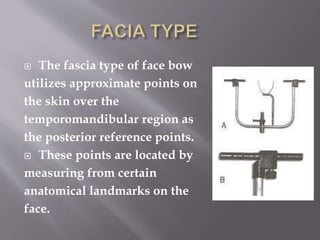

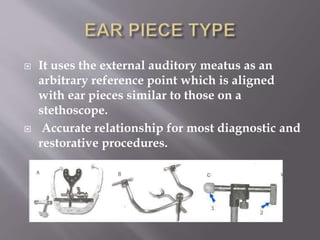


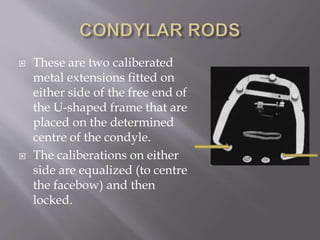

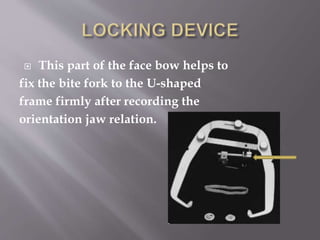

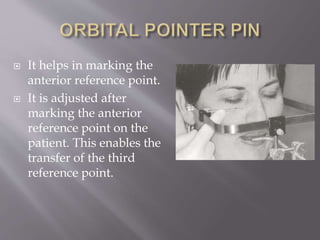


This document discusses different types of facebows used to transfer the spatial relationship of the maxilla to an articulator. It describes arbitrary, kinematic/hinge, and fascia type facebows. The kinematic facebow locates the true hinge axis most accurately within 5 mm. Arbitrary facebows use approximate reference points which can introduce errors. The document also outlines the parts of a facebow including the U-shaped frame, condylar rods, bite fork, locking device, and orbital pointer pin. It emphasizes the importance of using a facebow to accurately capture the patient's hinge axis for producing biologically acceptable restorations.


