


PARALLEL
ECONOM
Y
Parallel economy
emphasizes
confrontation between
objectives of
legitimate and
illegitimate.
Variously referred as
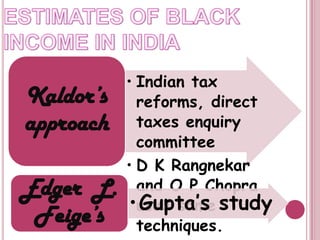
• Indian tax
reforms, direct
taxes enquiry
committee
• D K Rangnekar
and O P Chopra
used same
techniques.
Kaldor’s
approach
•Gupta’s study
Edger L.
Feige’s
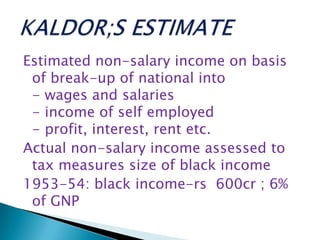
Estimated non-salary income on basis
of break-up of national into
- wages and salaries
- income of self employed
- profit, interest, rent etc.
Actual non-salary income assessed to
tax measures size of black income
1953-54: black income-rs 600cr ; 6%
of GNP
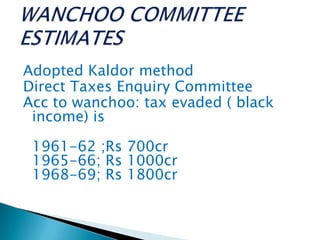
Adopted Kaldor method
Direct Taxes Enquiry Committee
Acc to wanchoo: tax evaded ( black
income) is
1961-62 ;Rs 700cr
1965-66; Rs 1000cr
1968-69; Rs 1800cr
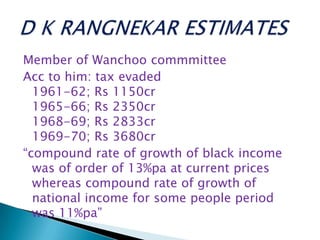
Member of Wanchoo commmittee
Acc to him: tax evaded
1961-62; Rs 1150cr
1965-66; Rs 2350cr
1968-69; Rs 2833cr
1969-70; Rs 3680cr
“compound rate of growth of black income
was of order of 13%pa at current prices
whereas compound rate of growth of
national income for some people period
was 11%pa”
 Used modified methodology recommended by
DTEC
underlying assumptions:
 One non- salary incomes is evaded
 Tax other than income tax r evaded
 Efficiency of tax administration remains
unchanged
 Ratio of non0- salary income above exemption
limit to total non- salary income has remained
same
 Unaccounted income generated in agriculture
sector has not taken into account
 Aggregate of income which are taxable but
not reported to tax authorities
1975-76: Rs9958 to Rs11870cr (15 to 18%
of GNP)
1983-84: Rs31584 to Rs36784cr (18 to 21%
of GNP)
Study confines itself into six areas:
1. Factor income received openly or covertly
in production of goods or services
2. Black income generated in relation to
capital receipts on sale of assets
3. Fixed capital formation in public
sector
4. Black income generated in relation to
private corporate sector
5.Black income generated in relation to
export
6. Black income generated through
over-invoicing of imports by private
sector and sales of import licenses .
• 1980-81: Rs50977cr (
41.7% of GNP)
• 1983-84: Rs 82208cr
(45.8% of GNP)
• 1987-88: Rs 149297cr
(51.7% of GNP)
Estimate
of black
income
for 3
particular
years:
YEAR GNP KALDOR WONCHO
O
CHOPRA NIPFP SURAJ B
GUPTA
53-54 9993 6000(6)
60-61 14946 916(6.1)
61-62 15879 700(4.4) 716(4.5)
65-66 23948 2350(4.2) 1439(6.4)
68-69 33024 2833(8.6) 1318(4)
72-73 47750 1795(3.8)
75-76 9958-
11870
80-81 122226 20362-
23678
50977
(41.7)
83-84 185991 31584-
36784
85208
(45.8)
87088 294408 149297
(50.7)
Main findings of various studies:
i. Black money growing in both absolute
and relative terms
ii. Black income less thn10% of GNP in
1975-76 …. Begin to grow and rose to
51% in 1987-88
iii. Rate of growth of black income is
faster than growth of GNP
iv. Higher rates of taxation motivates
businessman and industrialists for tax
evasion
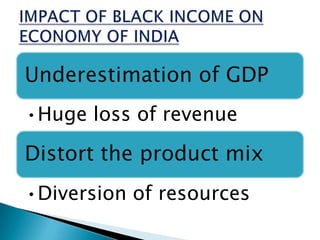
Underestimation of GDP
•Huge loss of revenue
Distort the product mix
•Diversion of resources
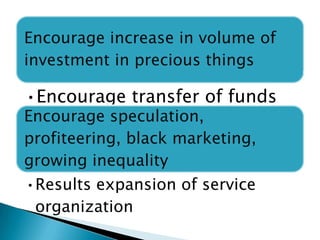
Encourage increase in volume of
investment in precious things
•Encourage transfer of funds
Encourage speculation,
profiteering, black marketing,
growing inequality
•Results expansion of service
organization
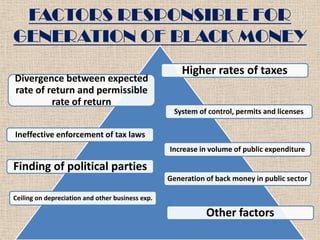
FACTORS RESPONSIBLE FOR
GENERATION OF BLACK MONEY
Higher rates of taxes
Divergence between expected
rate of return and permissible
rate of return
System of control, permits and licenses
Ineffective enforcement of tax laws
Increase in volume of public expenditure
Finding of political parties
Generation of back money in public sector
Ceiling on depreciation and other business exp.
Other factors
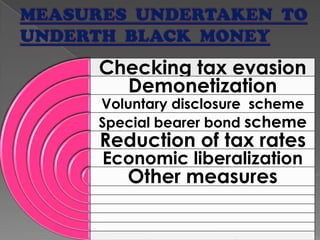
Checking tax evasion
Demonetization
Voluntary disclosure scheme
Special bearer bond scheme
Reduction of tax rates
Economic liberalization
Other measures

Parallel economy (economicz)

  • 1.
  • 2.
    Parallel economy emphasizes confrontation between objectivesof legitimate and illegitimate. Variously referred as
  • 4.
    • Indian tax reforms,direct taxes enquiry committee • D K Rangnekar and O P Chopra used same techniques. Kaldor’s approach •Gupta’s study Edger L. Feige’s
  • 5.
    Estimated non-salary incomeon basis of break-up of national into - wages and salaries - income of self employed - profit, interest, rent etc. Actual non-salary income assessed to tax measures size of black income 1953-54: black income-rs 600cr ; 6% of GNP
  • 6.
    Adopted Kaldor method DirectTaxes Enquiry Committee Acc to wanchoo: tax evaded ( black income) is 1961-62 ;Rs 700cr 1965-66; Rs 1000cr 1968-69; Rs 1800cr
  • 7.
    Member of Wanchoocommmittee Acc to him: tax evaded 1961-62; Rs 1150cr 1965-66; Rs 2350cr 1968-69; Rs 2833cr 1969-70; Rs 3680cr “compound rate of growth of black income was of order of 13%pa at current prices whereas compound rate of growth of national income for some people period was 11%pa”
  • 8.
     Used modifiedmethodology recommended by DTEC underlying assumptions:  One non- salary incomes is evaded  Tax other than income tax r evaded  Efficiency of tax administration remains unchanged  Ratio of non0- salary income above exemption limit to total non- salary income has remained same  Unaccounted income generated in agriculture sector has not taken into account
  • 9.
     Aggregate ofincome which are taxable but not reported to tax authorities 1975-76: Rs9958 to Rs11870cr (15 to 18% of GNP) 1983-84: Rs31584 to Rs36784cr (18 to 21% of GNP) Study confines itself into six areas: 1. Factor income received openly or covertly in production of goods or services
  • 10.
    2. Black incomegenerated in relation to capital receipts on sale of assets 3. Fixed capital formation in public sector 4. Black income generated in relation to private corporate sector 5.Black income generated in relation to export 6. Black income generated through over-invoicing of imports by private sector and sales of import licenses .
  • 11.
    • 1980-81: Rs50977cr( 41.7% of GNP) • 1983-84: Rs 82208cr (45.8% of GNP) • 1987-88: Rs 149297cr (51.7% of GNP) Estimate of black income for 3 particular years:
  • 12.
    YEAR GNP KALDORWONCHO O CHOPRA NIPFP SURAJ B GUPTA 53-54 9993 6000(6) 60-61 14946 916(6.1) 61-62 15879 700(4.4) 716(4.5) 65-66 23948 2350(4.2) 1439(6.4) 68-69 33024 2833(8.6) 1318(4) 72-73 47750 1795(3.8) 75-76 9958- 11870 80-81 122226 20362- 23678 50977 (41.7) 83-84 185991 31584- 36784 85208 (45.8) 87088 294408 149297 (50.7)
  • 13.
    Main findings ofvarious studies: i. Black money growing in both absolute and relative terms ii. Black income less thn10% of GNP in 1975-76 …. Begin to grow and rose to 51% in 1987-88 iii. Rate of growth of black income is faster than growth of GNP iv. Higher rates of taxation motivates businessman and industrialists for tax evasion
  • 14.
    Underestimation of GDP •Hugeloss of revenue Distort the product mix •Diversion of resources
  • 15.
    Encourage increase involume of investment in precious things •Encourage transfer of funds Encourage speculation, profiteering, black marketing, growing inequality •Results expansion of service organization
  • 16.
    FACTORS RESPONSIBLE FOR GENERATIONOF BLACK MONEY Higher rates of taxes Divergence between expected rate of return and permissible rate of return System of control, permits and licenses Ineffective enforcement of tax laws Increase in volume of public expenditure Finding of political parties Generation of back money in public sector Ceiling on depreciation and other business exp. Other factors
  • 17.
    Checking tax evasion Demonetization Voluntarydisclosure scheme Special bearer bond scheme Reduction of tax rates Economic liberalization Other measures