“Developing a web based monitoring
      and evaluation system”

       Crop Goat Project in Tanzania


                                  PGI and RMG
Pamela Pali, Harrison Rware, Carlos Quiros, Titus Karanja, Joseph Gatheru Mugo, Nicholas
                                   Ndiwa, Jane Poole
                                                                                     1
                                  4th October 2012
Integrating Dairy Goats and Root
Crop Production for increasing Food,
  Nutrition and Income Security of
  Smallholder Farmers in Tanzania
        Canadian International Food
          Security Research Fund
Background
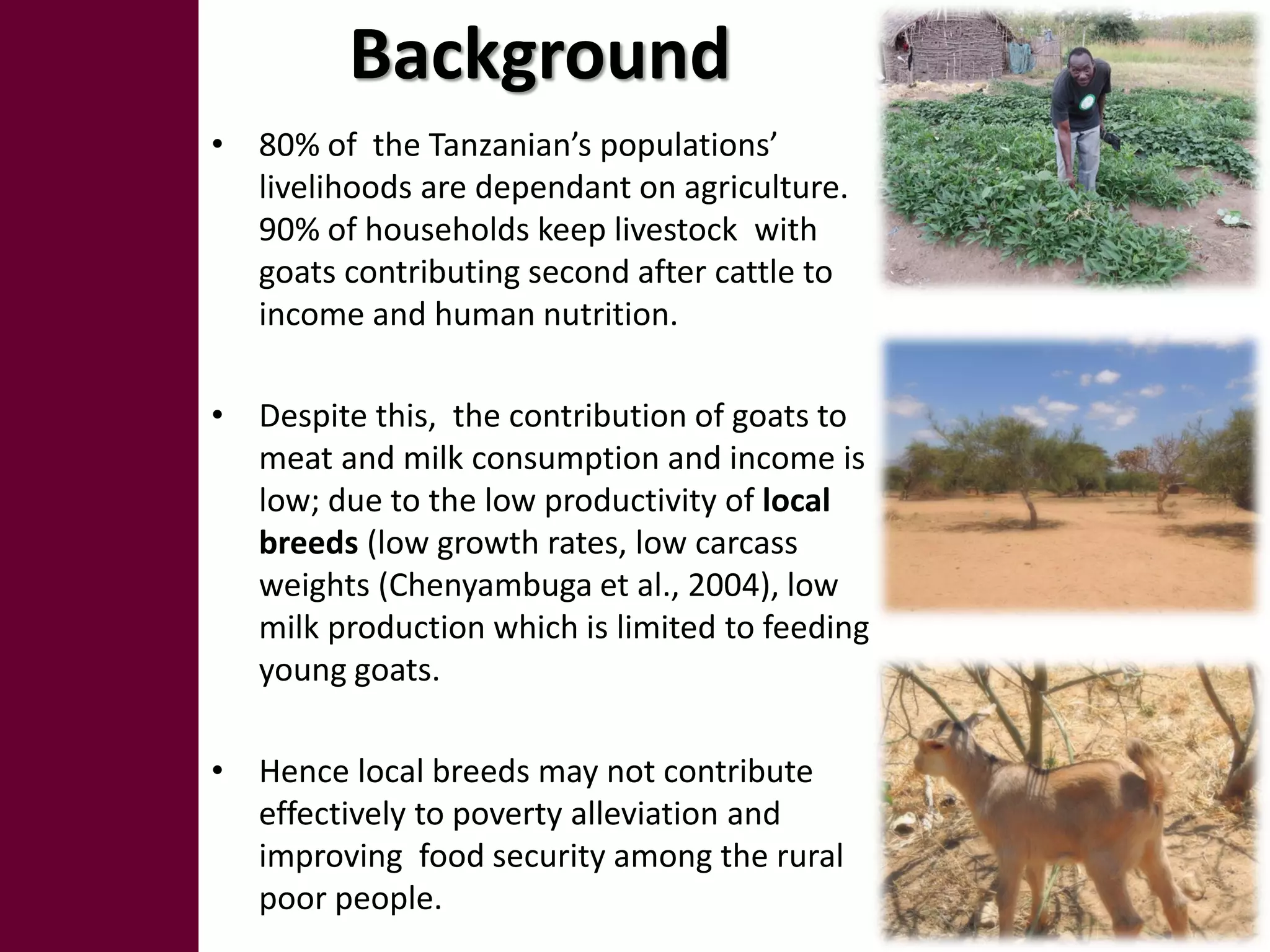
• 80% of the Tanzanian’s populations’
  livelihoods are dependant on agriculture.
  90% of households keep livestock with
  goats contributing second after cattle to
  income and human nutrition.

• Despite this, the contribution of goats to
  meat and milk consumption and income is
  low; due to the low productivity of local
  breeds (low growth rates, low carcass
  weights (Chenyambuga et al., 2004), low
  milk production which is limited to feeding
  young goats.

• Hence local breeds may not contribute
  effectively to poverty alleviation and
  improving food security among the rural
  poor people.
Background
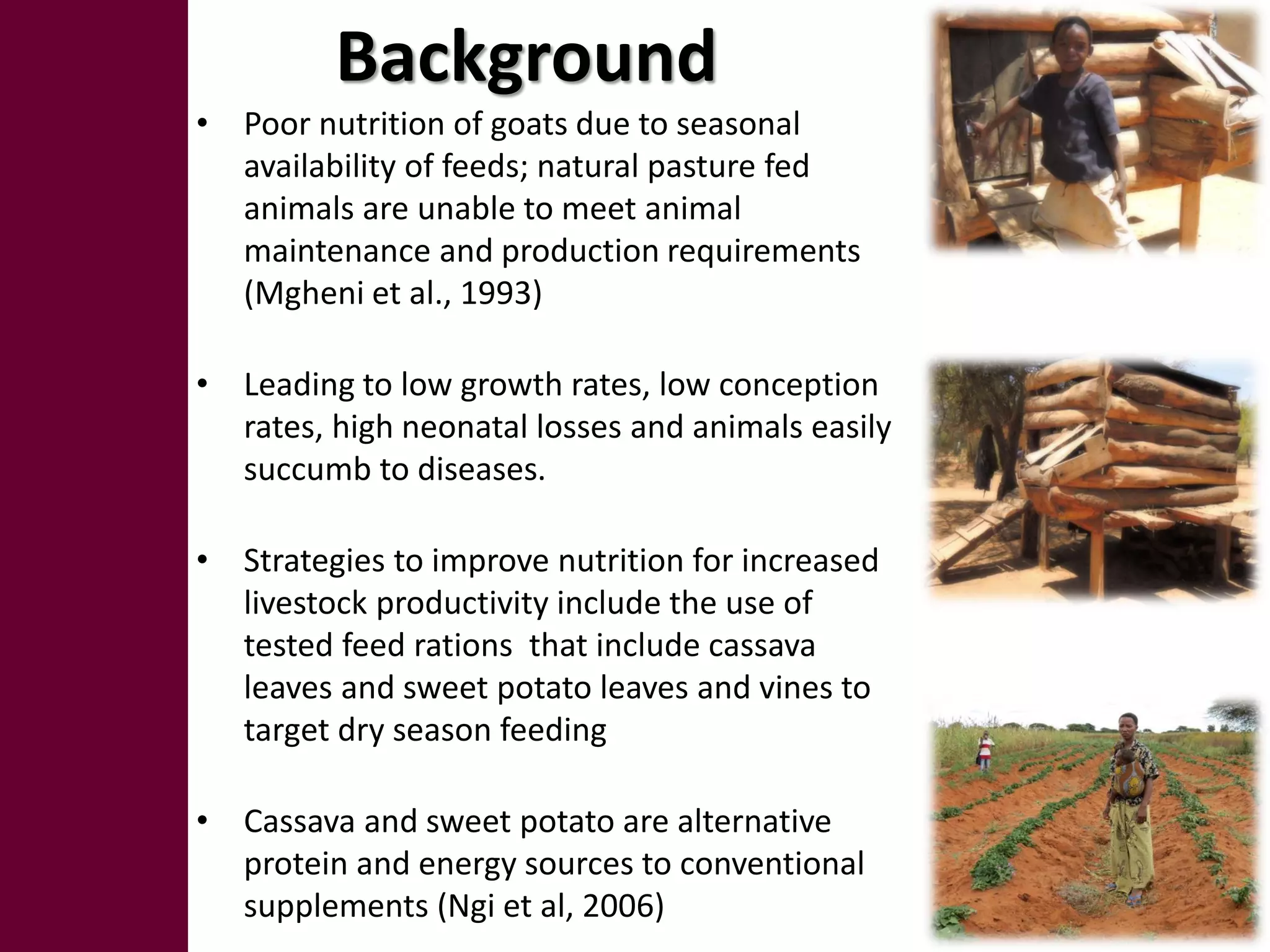
• Poor nutrition of goats due to seasonal
  availability of feeds; natural pasture fed
  animals are unable to meet animal
  maintenance and production requirements
  (Mgheni et al., 1993)

• Leading to low growth rates, low conception
  rates, high neonatal losses and animals easily
  succumb to diseases.

• Strategies to improve nutrition for increased
  livestock productivity include the use of
  tested feed rations that include cassava
  leaves and sweet potato leaves and vines to
  target dry season feeding

• Cassava and sweet potato are alternative
  protein and energy sources to conventional
  supplements (Ngi et al, 2006)
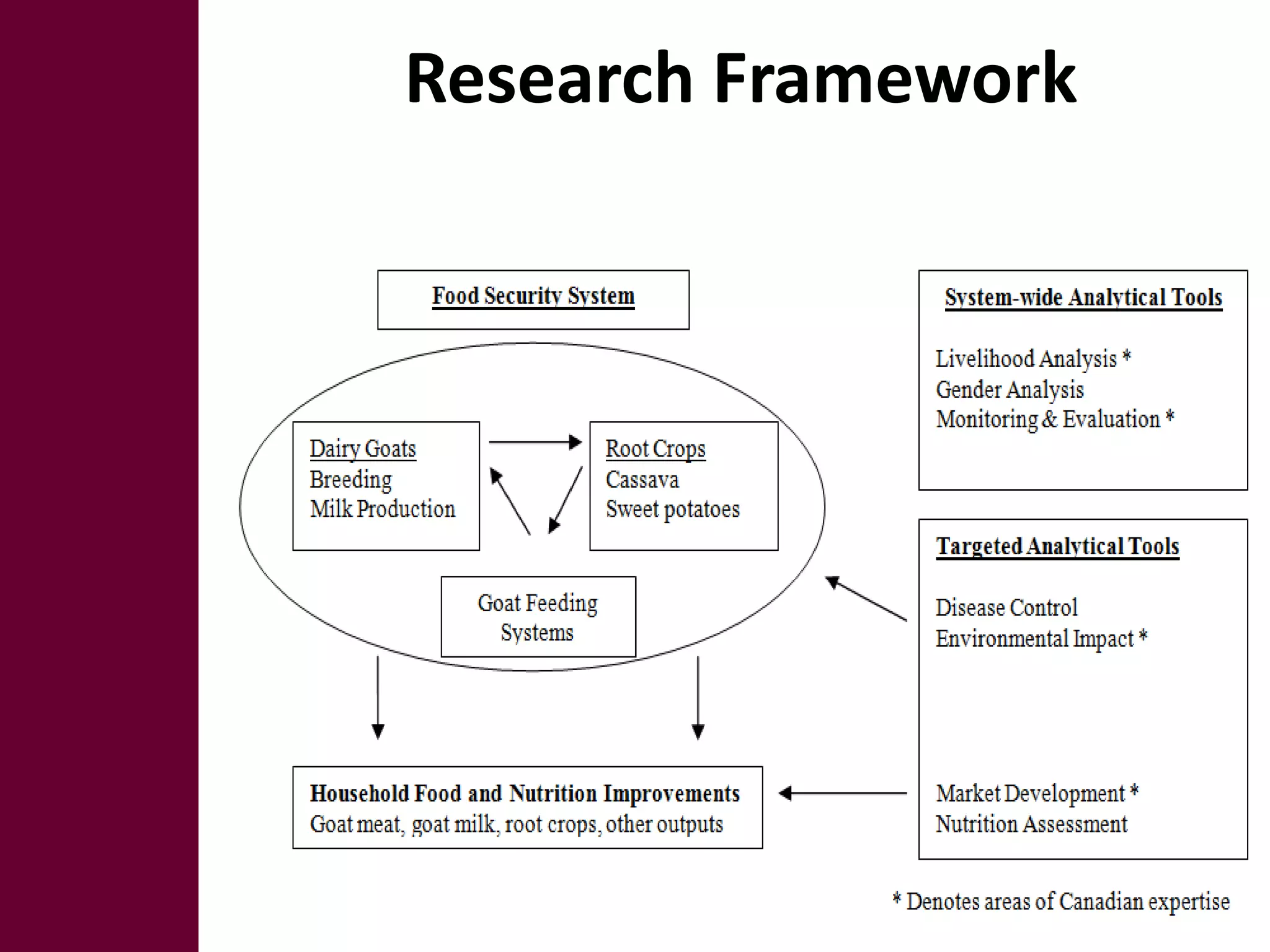
Objectives

• To improve the milk production potential of indigenous goats through
  crossbreeding, improved management and control of major diseases

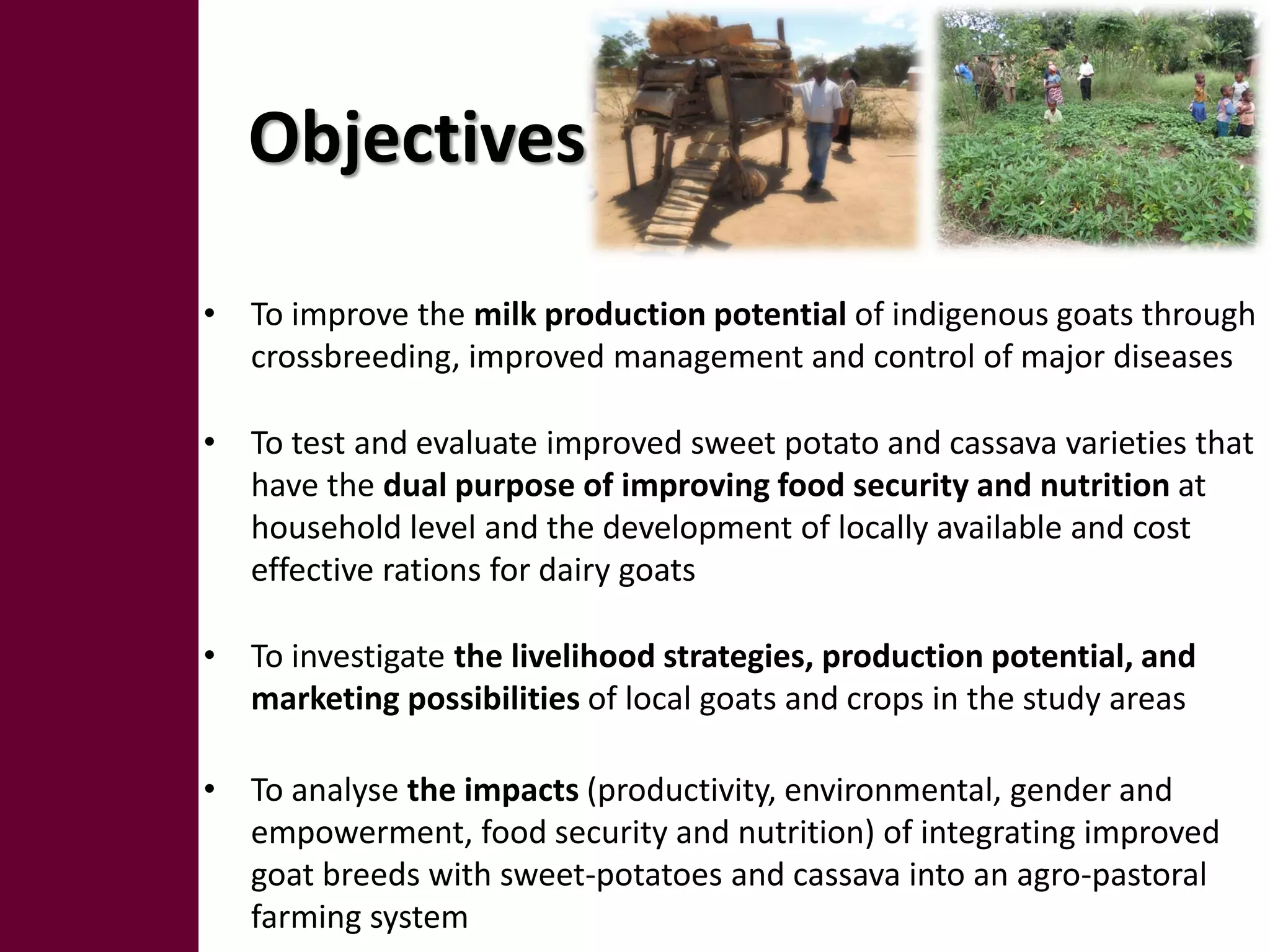
• To test and evaluate improved sweet potato and cassava varieties that
  have the dual purpose of improving food security and nutrition at
  household level and the development of locally available and cost
  effective rations for dairy goats

• To investigate the livelihood strategies, production potential, and
  marketing possibilities of local goats and crops in the study areas

• To analyse the impacts (productivity, environmental, gender and
  empowerment, food security and nutrition) of integrating improved
  goat breeds with sweet-potatoes and cassava into an agro-pastoral
  farming system
Research Framework
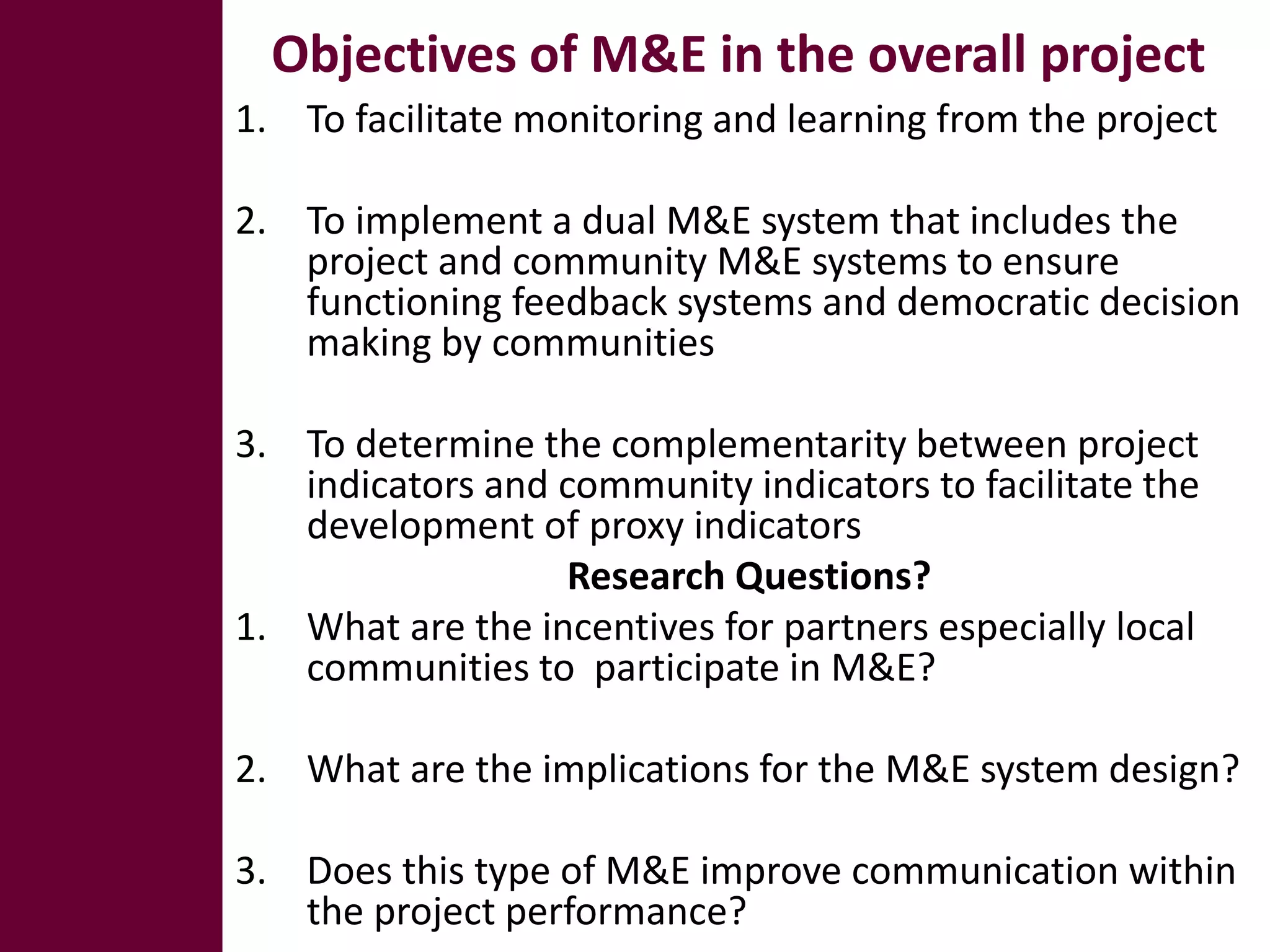
Objectives of M&E in the overall project
1. To facilitate monitoring and learning from the project

2. To implement a dual M&E system that includes the
   project and community M&E systems to ensure
   functioning feedback systems and democratic decision
   making by communities

3. To determine the complementarity between project
   indicators and community indicators to facilitate the
   development of proxy indicators
                  Research Questions?
1. What are the incentives for partners especially local
   communities to participate in M&E?

2. What are the implications for the M&E system design?

3. Does this type of M&E improve communication within
   the project performance?
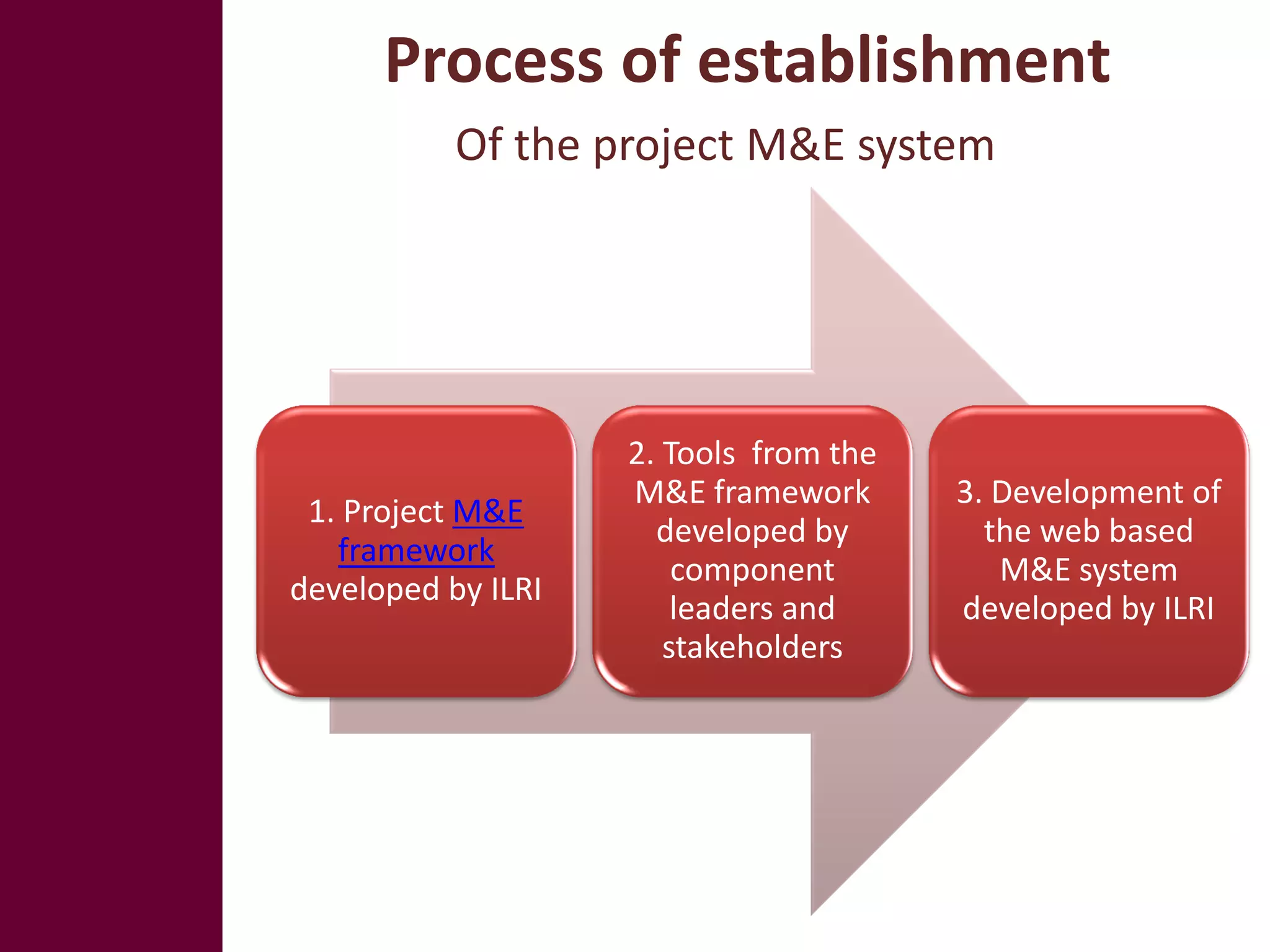
Process of establishment
           Of the project M&E system


                    2. Tools from the
                    M&E framework       3. Development of
 1. Project M&E
                      developed by        the web based
   framework
                        component          M&E system
developed by ILRI
                        leaders and     developed by ILRI
                       stakeholders
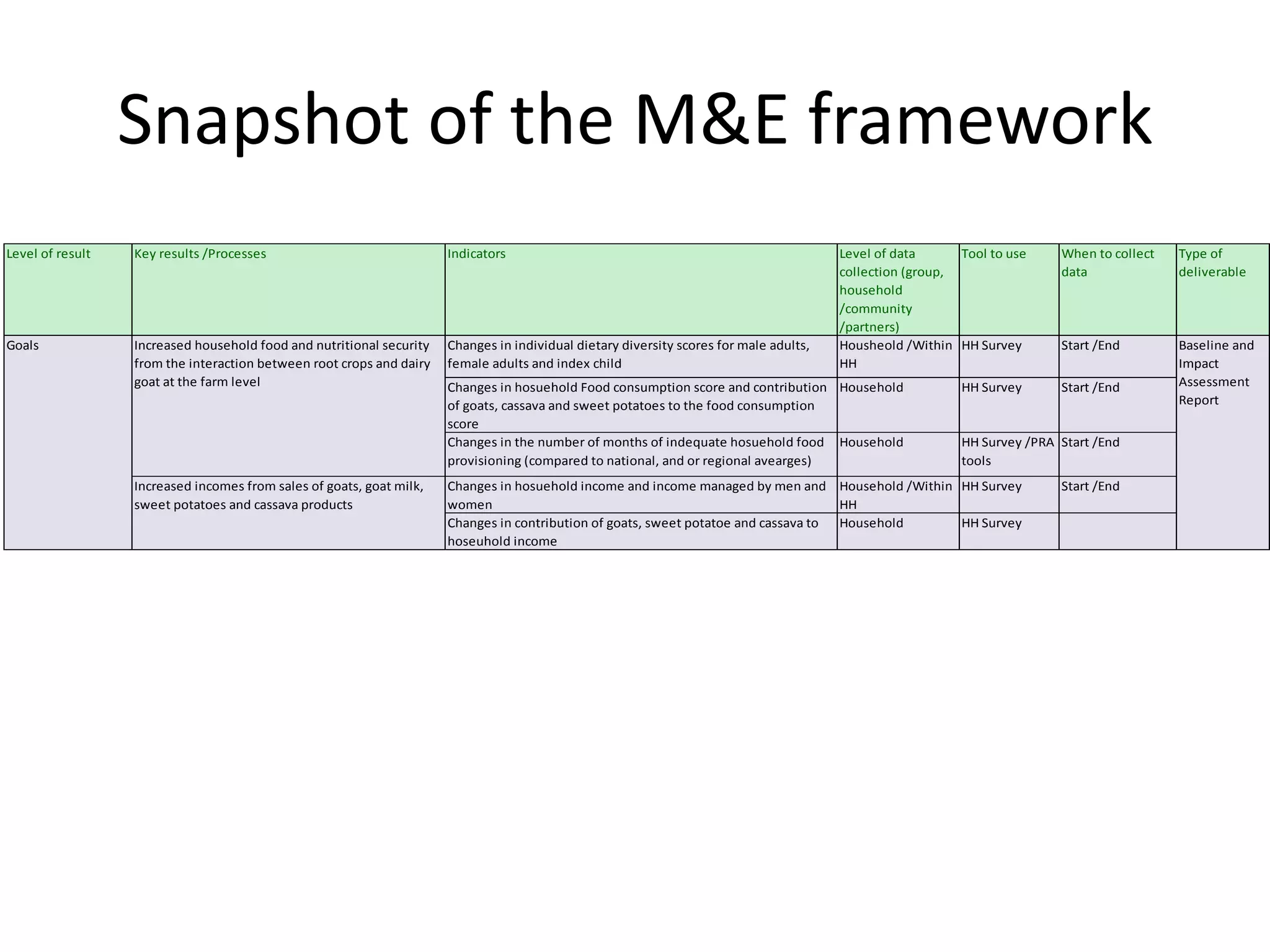
Snapshot of the M&E framework
Level of result   Key results /Processes                              Indicators                                                        Level of data      Tool to use    When to collect   Type of
                                                                                                                                        collection (group,                data              deliverable
                                                                                                                                        household
                                                                                                                                        /community
                                                                                                                                        /partners)
Goals             Increased household food and nutritional security   Changes in individual dietary diversity scores for male adults,   Housheold /Within HH Survey       Start /End        Baseline and
                  from the interaction between root crops and dairy   female adults and index child                                     HH                                                  Impact
                  goat at the farm level                              Changes in hosuehold Food consumption score and contribution Household               HH Survey      Start /End        Assessment
                                                                      of goats, cassava and sweet potatoes to the food consumption                                                          Report
                                                                      score
                                                                      Changes in the number of months of indequate hosuehold food Household                HH Survey /PRA Start /End
                                                                      provisioning (compared to national, and or regional avearges)                        tools
                  Increased incomes from sales of goats, goat milk,   Changes in hosuehold income and income managed by men and Household /Within HH Survey               Start /End
                  sweet potatoes and cassava products                 women                                                          HH
                                                                      Changes in contribution of goats, sweet potatoe and cassava to Household    HH Survey
                                                                      hoseuhold income
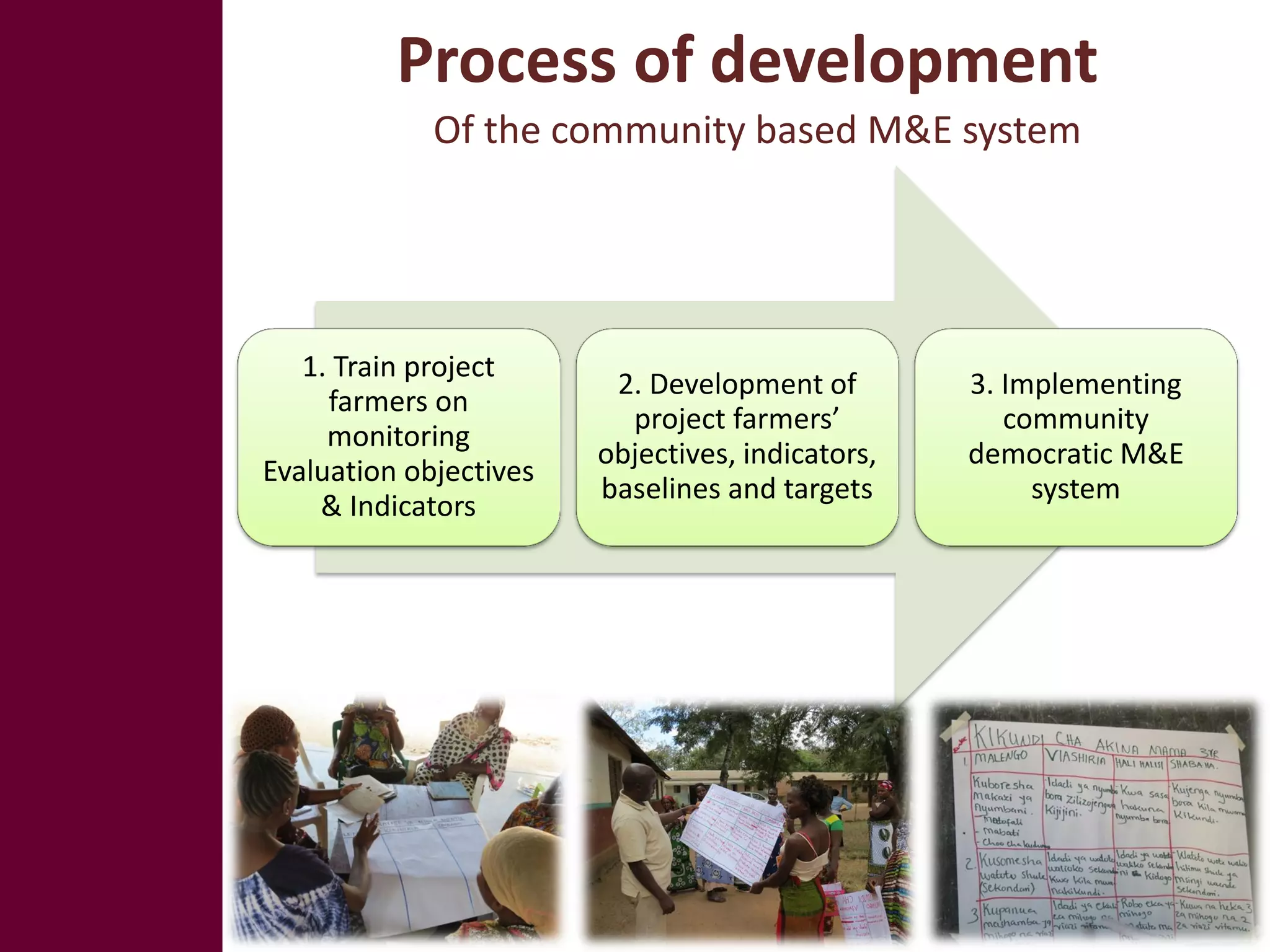
Process of development
             Of the community based M&E system


   1. Train project
                         2. Development of        3. Implementing
     farmers on
                          project farmers’           community
     monitoring
                        objectives, indicators,   democratic M&E
Evaluation objectives
                        baselines and targets          system
    & Indicators
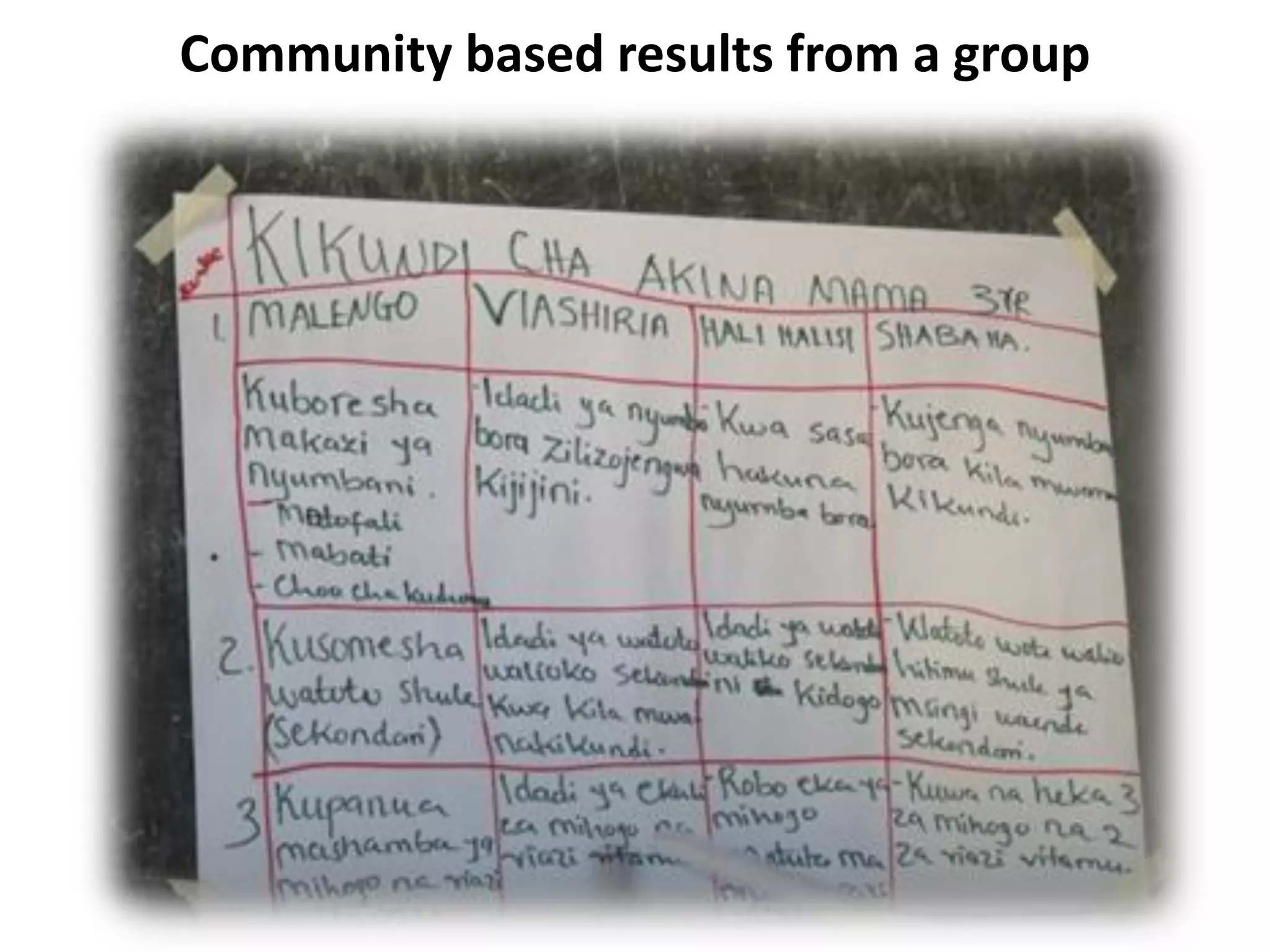
Community based results from a group
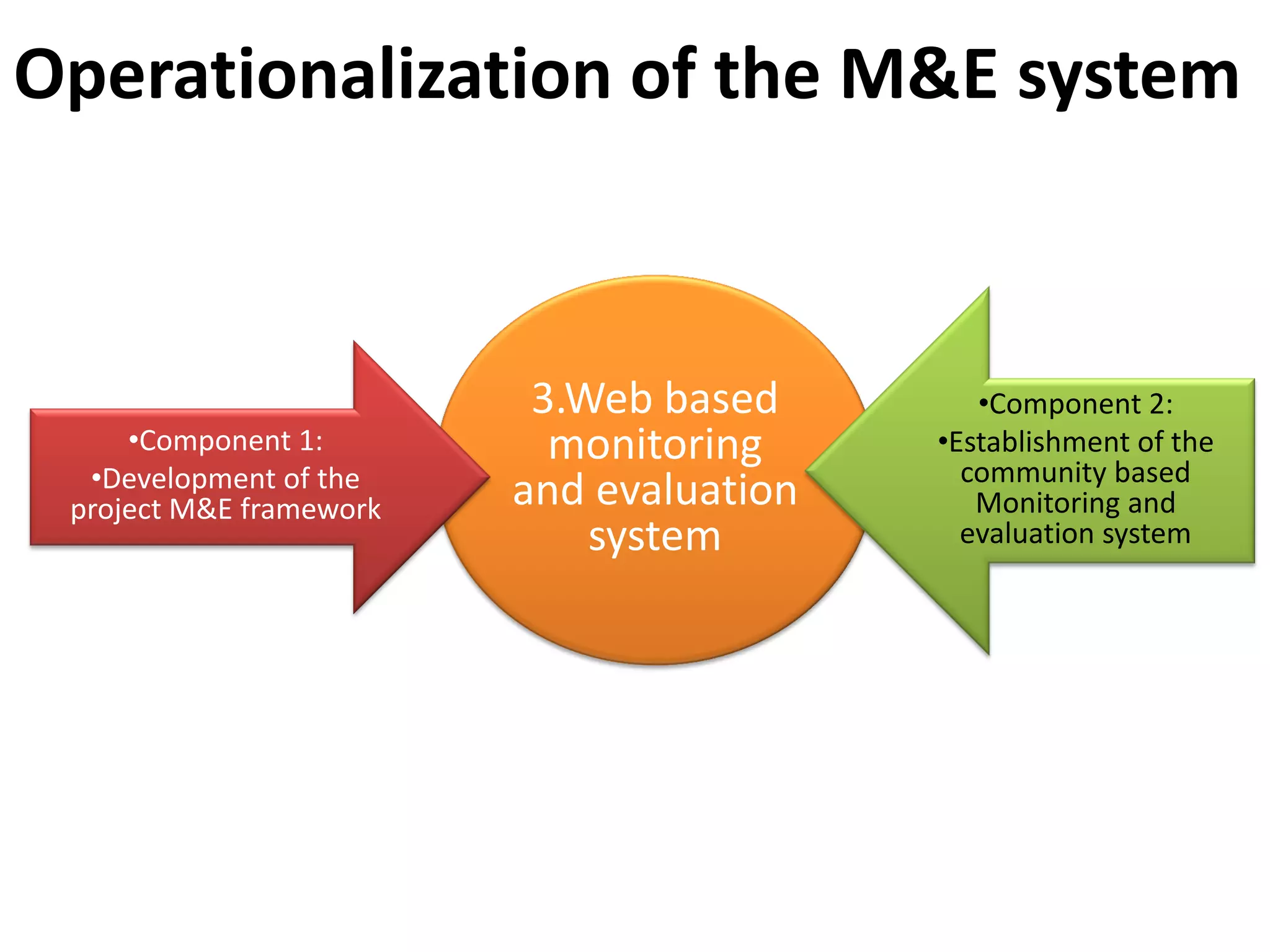
Operationalization of the M&E system


                          3.Web based        •Component 2:
     •Component 1:         monitoring     •Establishment of the
  •Development of the                       community based
 project M&E framework   and evaluation      Monitoring and
                             system         evaluation system
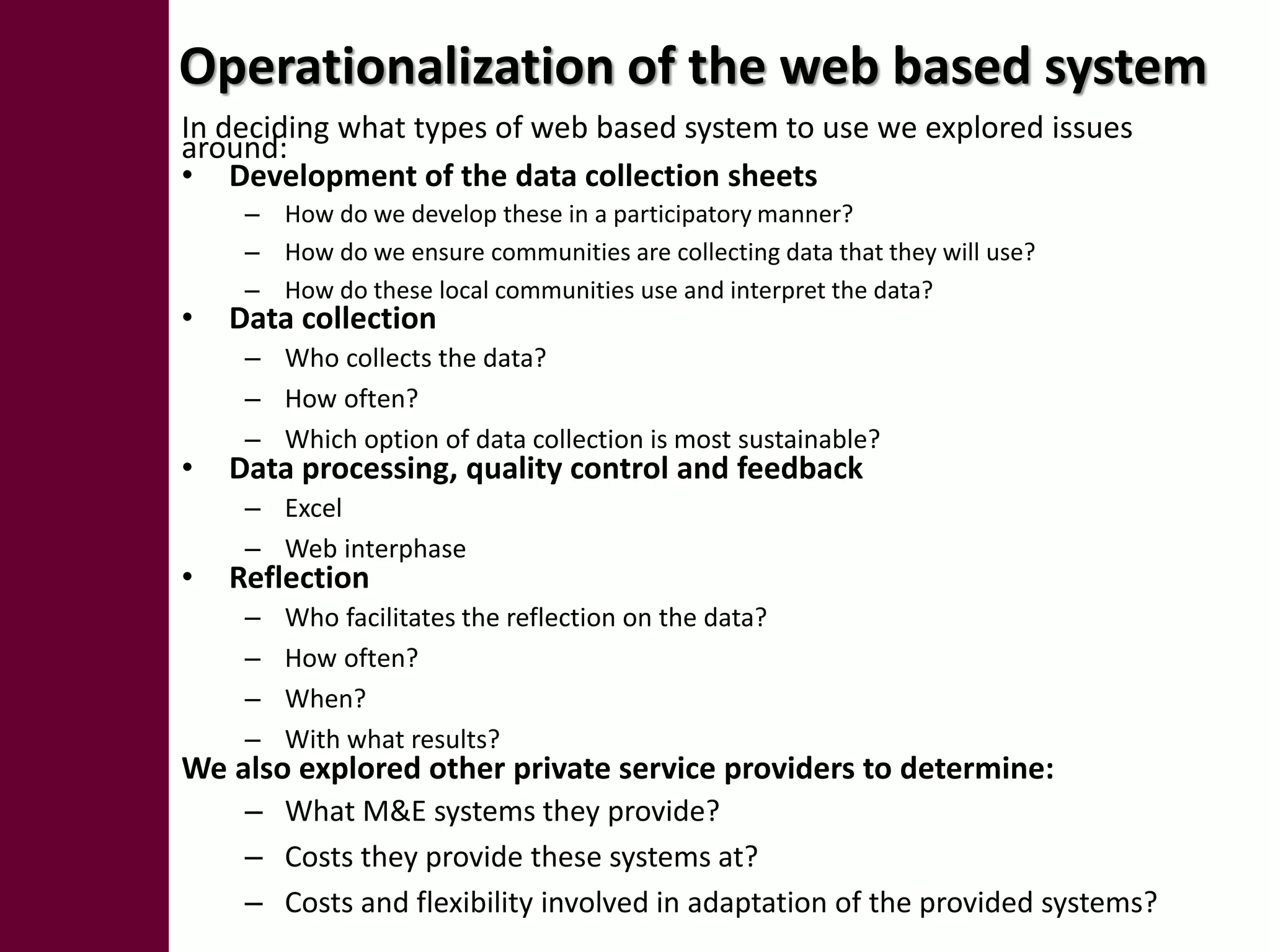
Operationalization of the web based system
In deciding what types of web based system to use we explored issues
around:
• Development of the data collection sheets
     – How do we develop these in a participatory manner?
     – How do we ensure communities are collecting data that they will use?
     – How do these local communities use and interpret the data?
•   Data collection
     – Who collects the data?
     – How often?
     – Which option of data collection is most sustainable?
•   Data processing, quality control and feedback
     – Excel
     – Web interphase
•   Reflection
     –   Who facilitates the reflection on the data?
     –   How often?
     –   When?
     –   With what results?
We also explored other private service providers to determine:
     – What M&E systems they provide?
     – Costs they provide these systems at?
     – Costs and flexibility involved in adaptation of the provided systems?
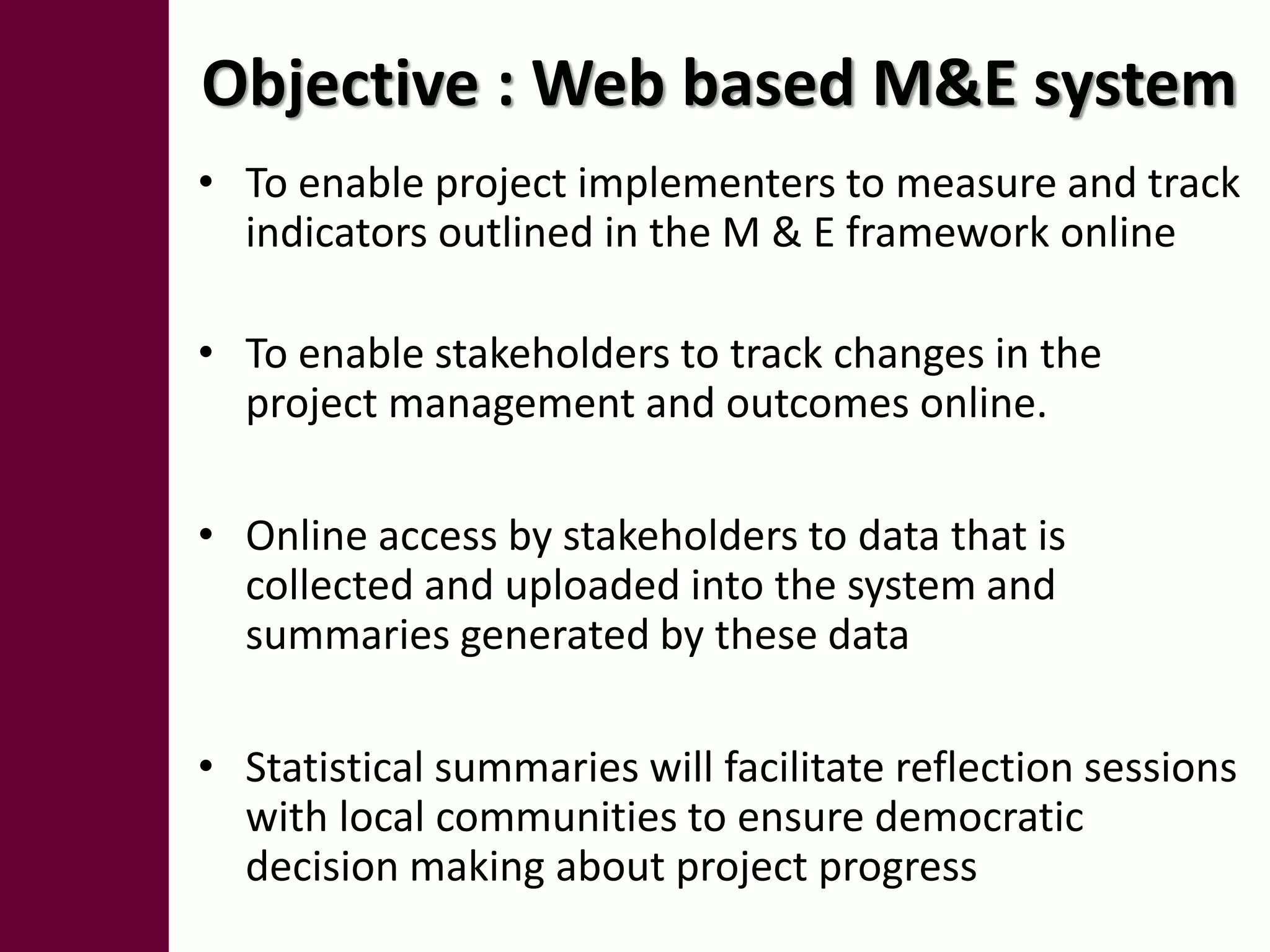
Objective : Web based M&E system
• To enable project implementers to measure and track
  indicators outlined in the M & E framework online

• To enable stakeholders to track changes in the
  project management and outcomes online.

• Online access by stakeholders to data that is
  collected and uploaded into the system and
  summaries generated by these data

• Statistical summaries will facilitate reflection sessions
  with local communities to ensure democratic
  decision making about project progress
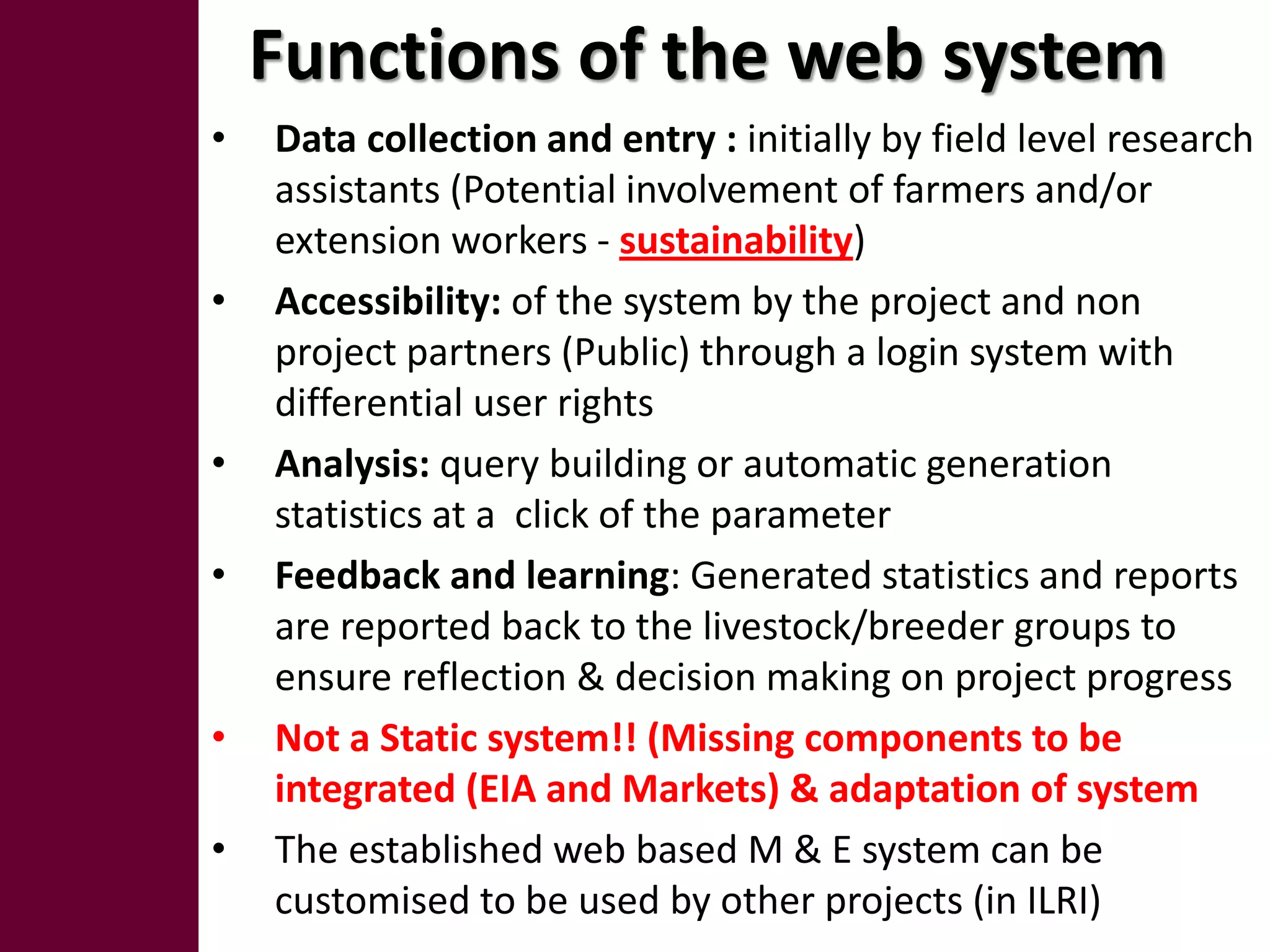
Functions of the web system
•   Data collection and entry : initially by field level research
    assistants (Potential involvement of farmers and/or
    extension workers - sustainability)
•   Accessibility: of the system by the project and non
    project partners (Public) through a login system with
    differential user rights
•   Analysis: query building or automatic generation
    statistics at a click of the parameter
•   Feedback and learning: Generated statistics and reports
    are reported back to the livestock/breeder groups to
    ensure reflection & decision making on project progress
•   Not a Static system!! (Missing components to be
    integrated (EIA and Markets) & adaptation of system
•   The established web based M & E system can be
    customised to be used by other projects (in ILRI)
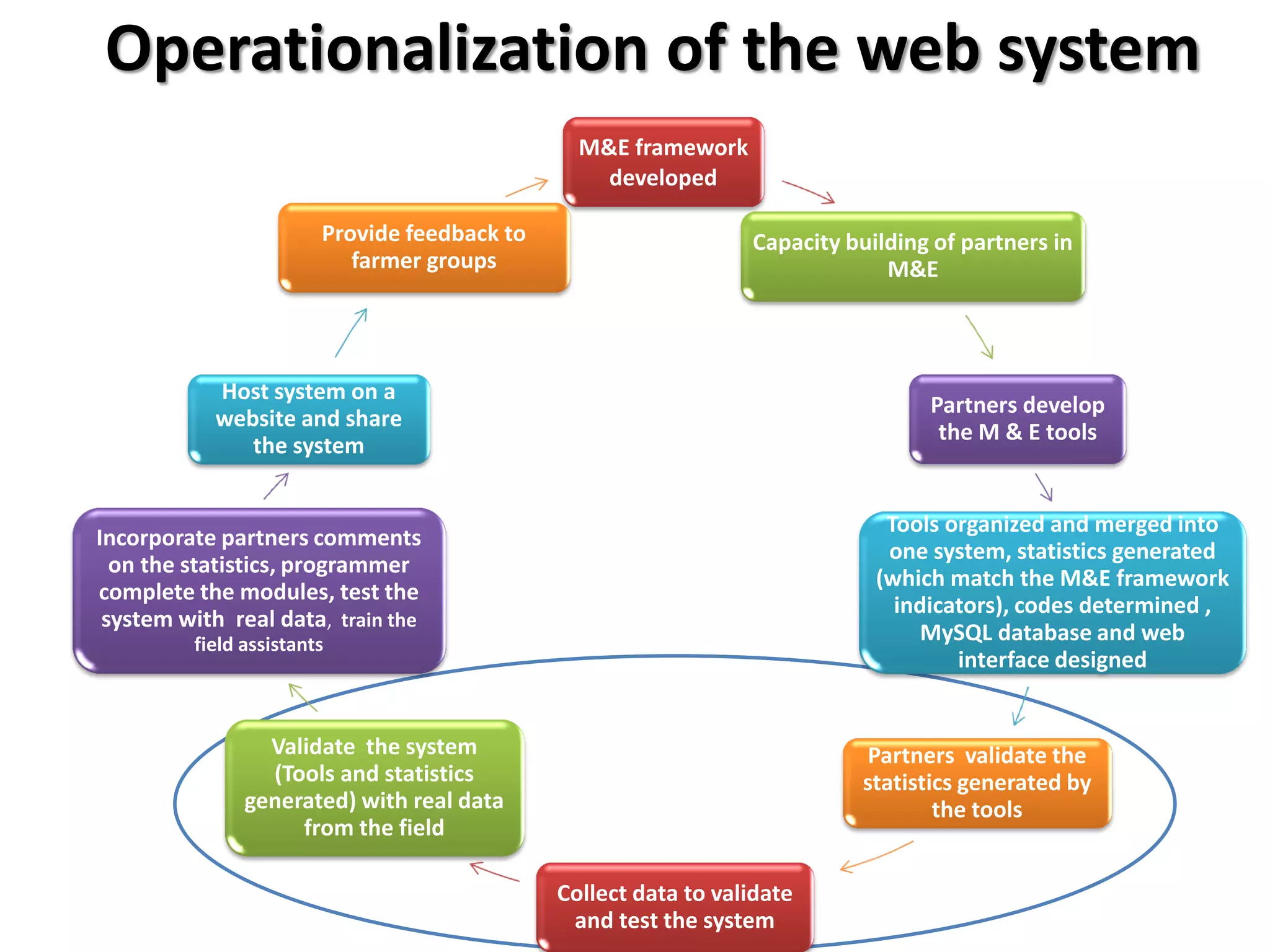
Operationalization of the web system
                                                M&E framework
                                                  developed

                        Provide feedback to                      Capacity building of partners in
                           farmer groups                                      M&E


            Host system on a
                                                                                  Partners develop
            website and share
                                                                                   the M & E tools
               the system


                                                                              Tools organized and merged into
Incorporate partners comments
                                                                              one system, statistics generated
  on the statistics, programmer
                                                                             (which match the M&E framework
complete the modules, test the
                                                                               indicators), codes determined ,
 system with real data, train the
         field assistants
                                                                                 MySQL database and web
                                                                                     interface designed


                 Validate the system                                         Partners validate the
                 (Tools and statistics                                      statistics generated by
               generated) with real data                                            the tools
                    from the field

                                              Collect data to validate
                                               and test the system
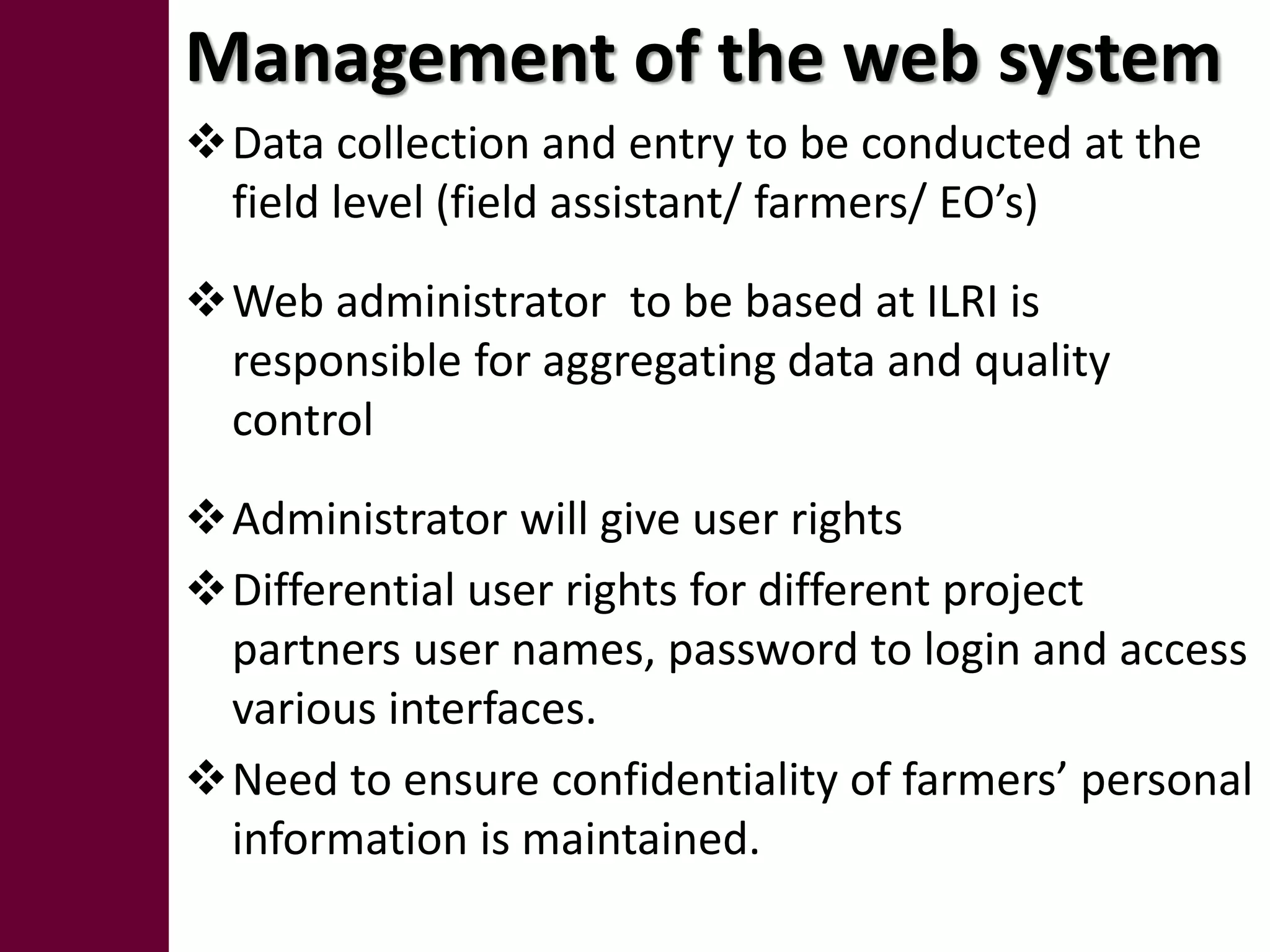
Management of the web system
Data collection and entry to be conducted at the
 field level (field assistant/ farmers/ EO’s)

Web administrator to be based at ILRI is
 responsible for aggregating data and quality
 control

Administrator will give user rights
Differential user rights for different project
 partners user names, password to login and access
 various interfaces.
Need to ensure confidentiality of farmers’ personal
 information is maintained.
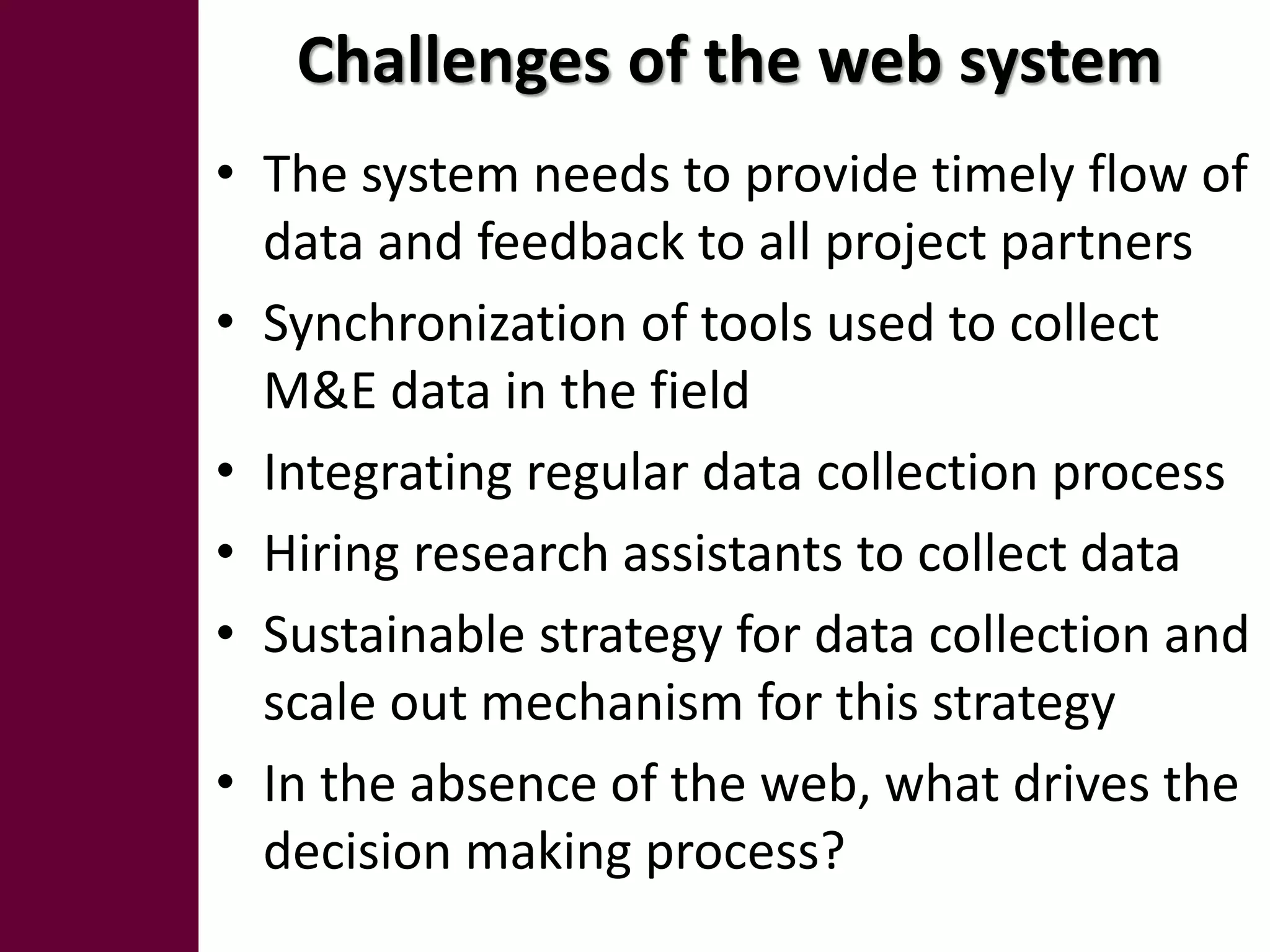
Challenges of the web system
• The system needs to provide timely flow of
  data and feedback to all project partners
• Synchronization of tools used to collect
  M&E data in the field
• Integrating regular data collection process
• Hiring research assistants to collect data
• Sustainable strategy for data collection and
  scale out mechanism for this strategy
• In the absence of the web, what drives the
  decision making process?
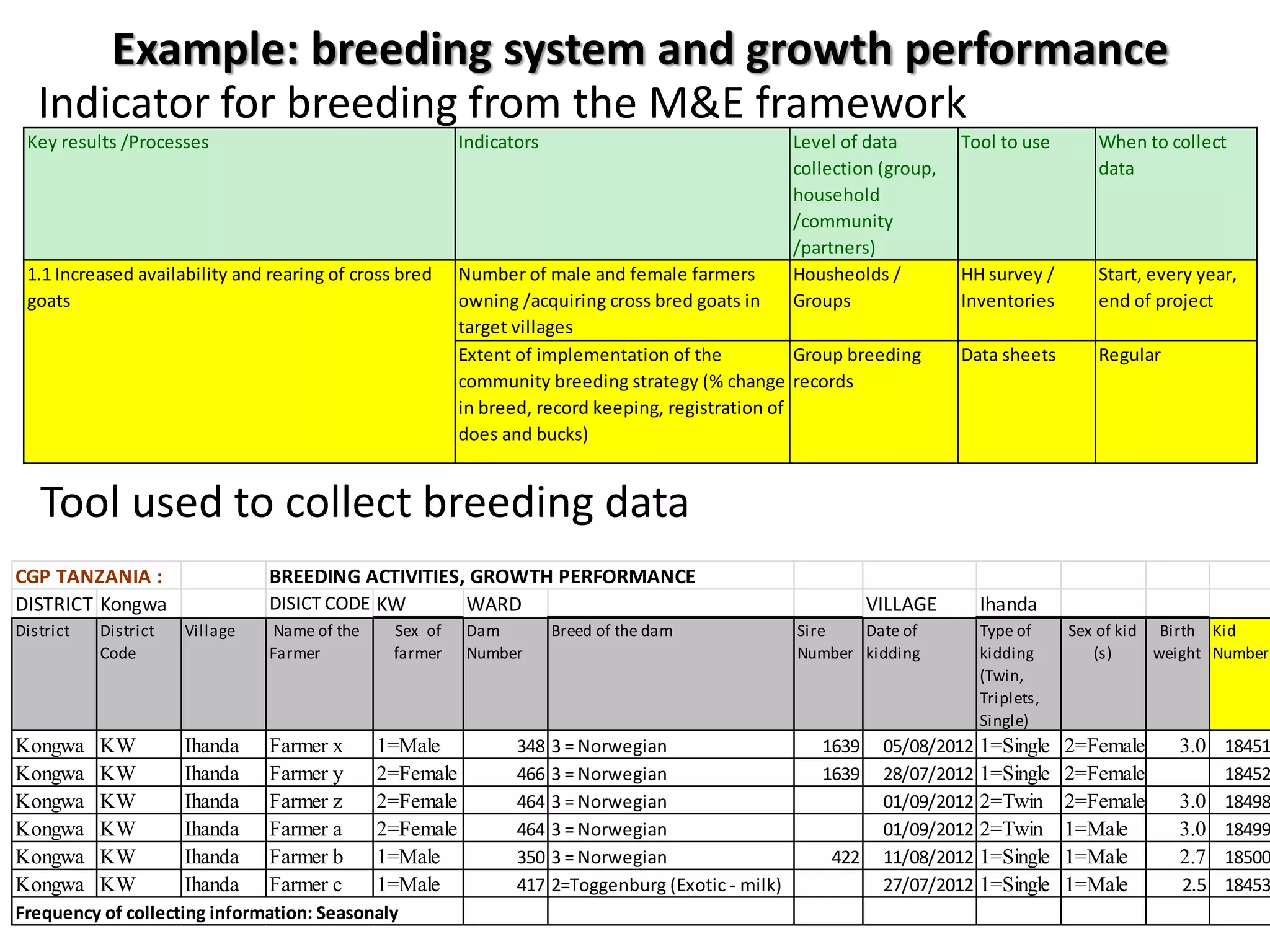
Example: breeding system and growth performance
   Indicator for breeding from the M&E framework
 Key results /Processes                                  Indicators                                Level of data        Tool to use      When to collect
                                                                                                   collection (group,                    data
                                                                                                   household
                                                                                                   /community
                                                                                                   /partners)
 1.1 Increased availability and rearing of cross bred    Number of male and female farmers         Housheolds /         HH survey /      Start, every year,
 goats                                                   owning /acquiring cross bred goats in     Groups               Inventories      end of project
                                                         target villages
                                                         Extent of implementation of the           Group breeding       Data sheets      Regular
                                                         community breeding strategy (% change records
                                                         in breed, record keeping, registration of
                                                         does and bucks)


   Tool used to collect breeding data
CGP TANZANIA :                  BREEDING ACTIVITIES, GROWTH PERFORMANCE
DISTRICT Kongwa                 DISICT CODE KW      WARD                                                     VILLAGE      Ihanda
District   District   Village   Name of the     Sex of    Dam         Breed of the dam             Sire   Date of         Type of     Sex of kid Birth Kid
           Code                 Farmer          farmer    Number                                   Number kidding         kidding        (s)     weight Number
                                                                                                                          (Twin,
                                                                                                                          Triplets,
                                                                                                                          Single)
Kongwa     KW         Ihanda    Farmer x      1=Male            348 3 = Norwegian                     1639    05/08/2012 1=Single     2=Female     3.0 18451
Kongwa     KW         Ihanda    Farmer y      2=Female          466 3 = Norwegian                     1639    28/07/2012 1=Single     2=Female           18452
Kongwa     KW         Ihanda    Farmer z      2=Female          464 3 = Norwegian                             01/09/2012 2=Twin       2=Female     3.0   18498
Kongwa     KW         Ihanda    Farmer a      2=Female          464 3 = Norwegian                             01/09/2012 2=Twin       1=Male       3.0   18499
Kongwa     KW         Ihanda    Farmer b      1=Male            350 3 = Norwegian                      422    11/08/2012 1=Single     1=Male       2.7   18500
Kongwa     KW         Ihanda    Farmer c      1=Male            417 2=Toggenburg (Exotic ‐ milk)              27/07/2012 1=Single     1=Male       2.5   18453
Frequency of collecting information: Seasonaly
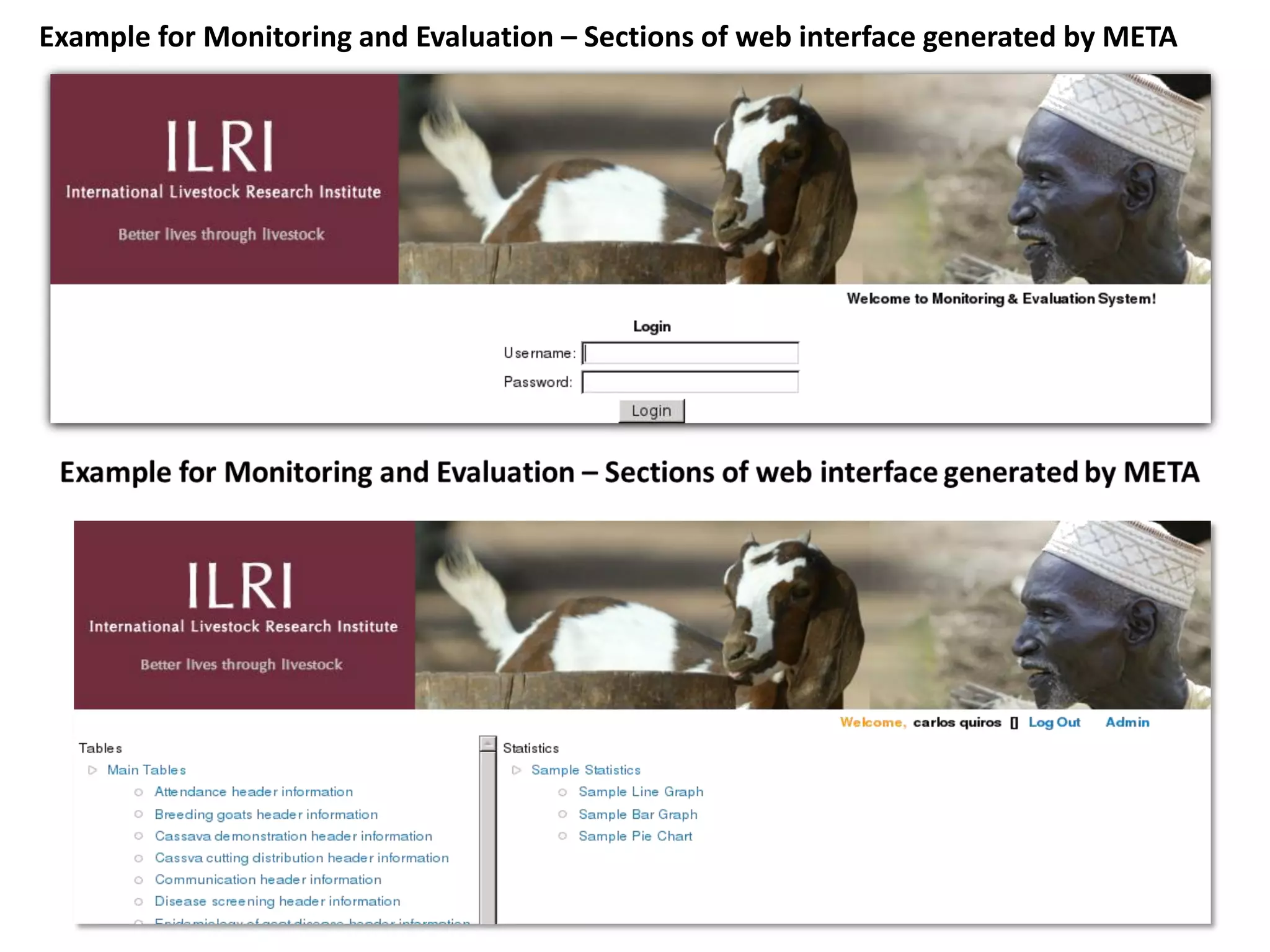
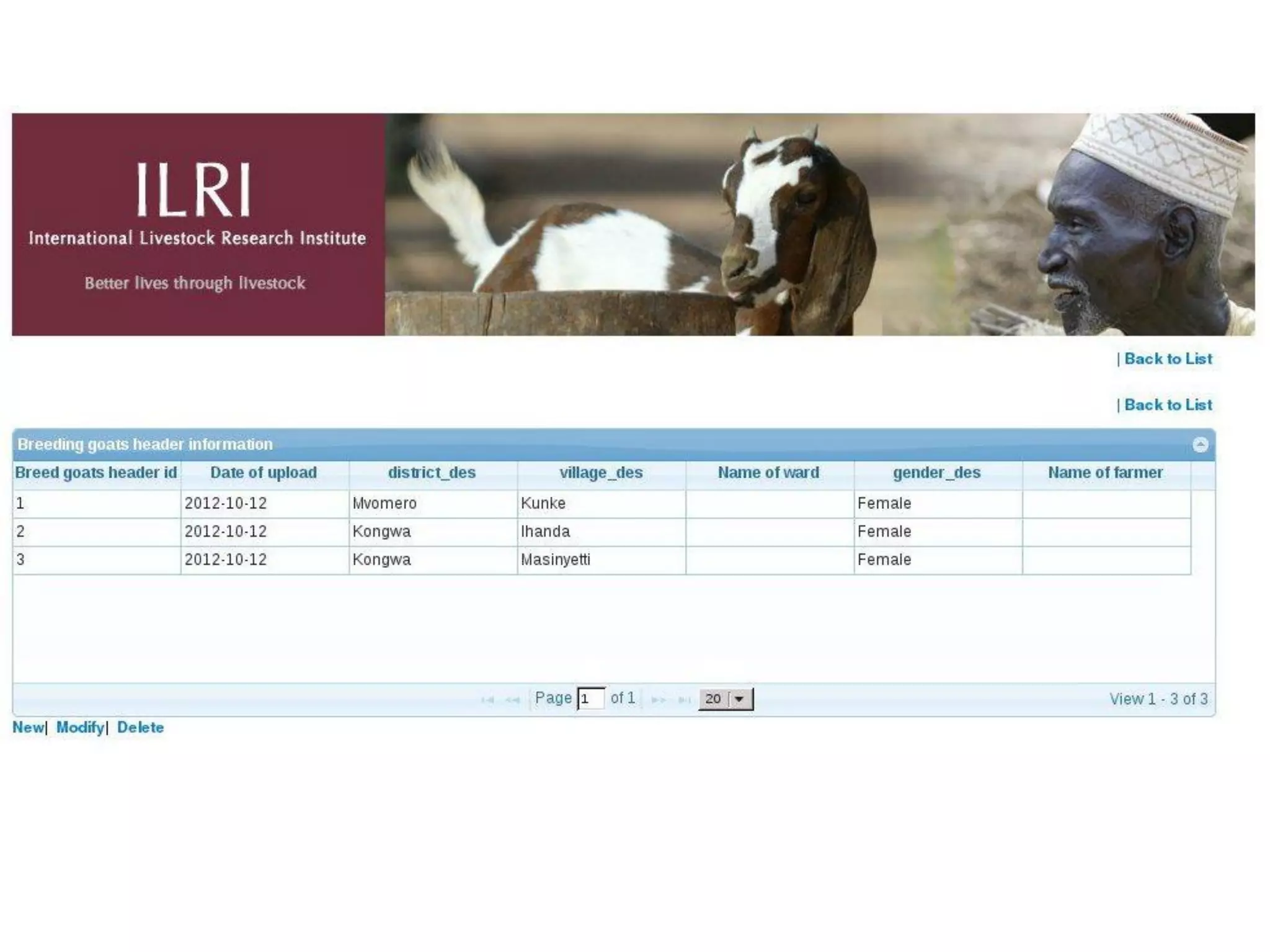
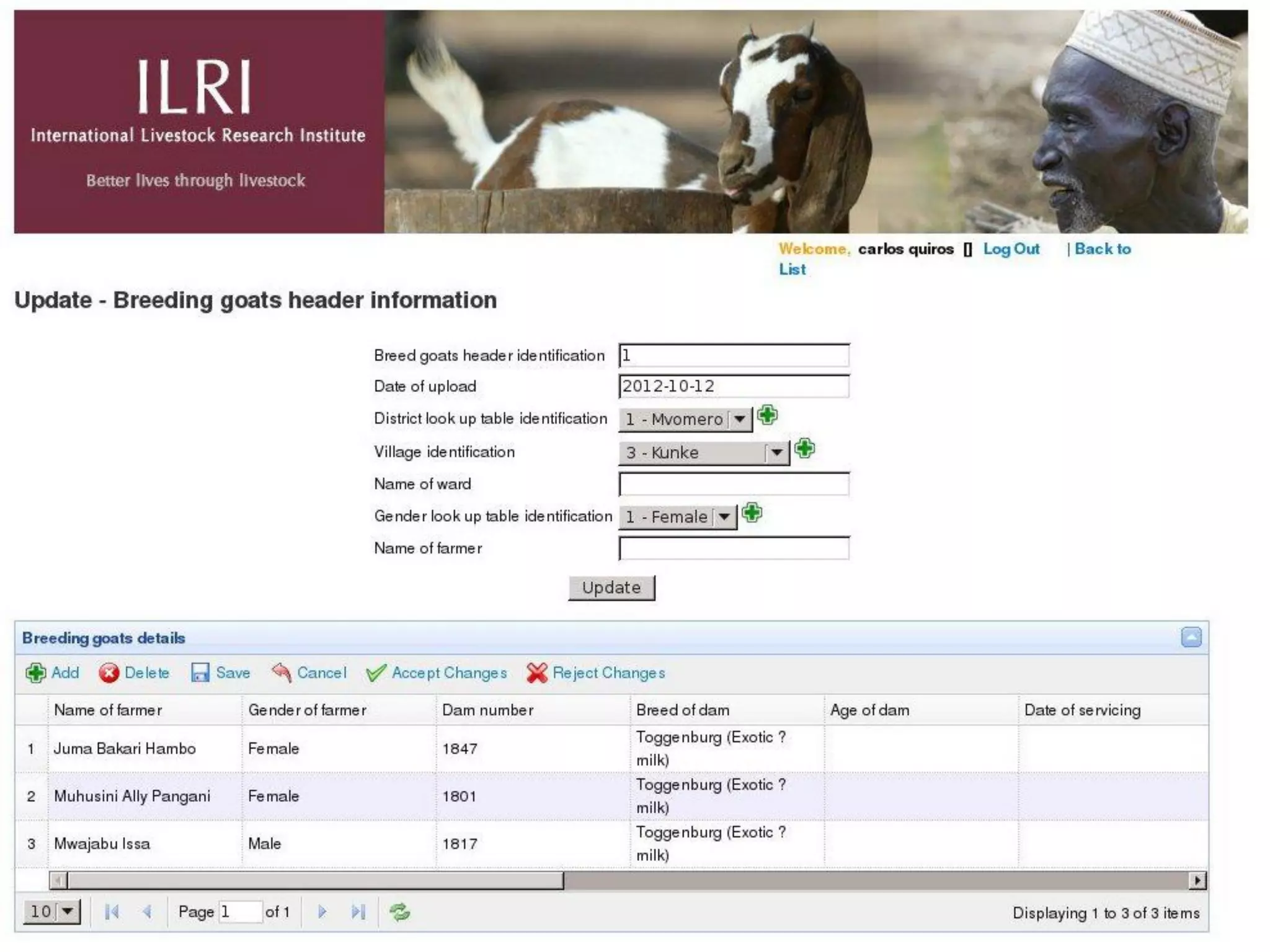
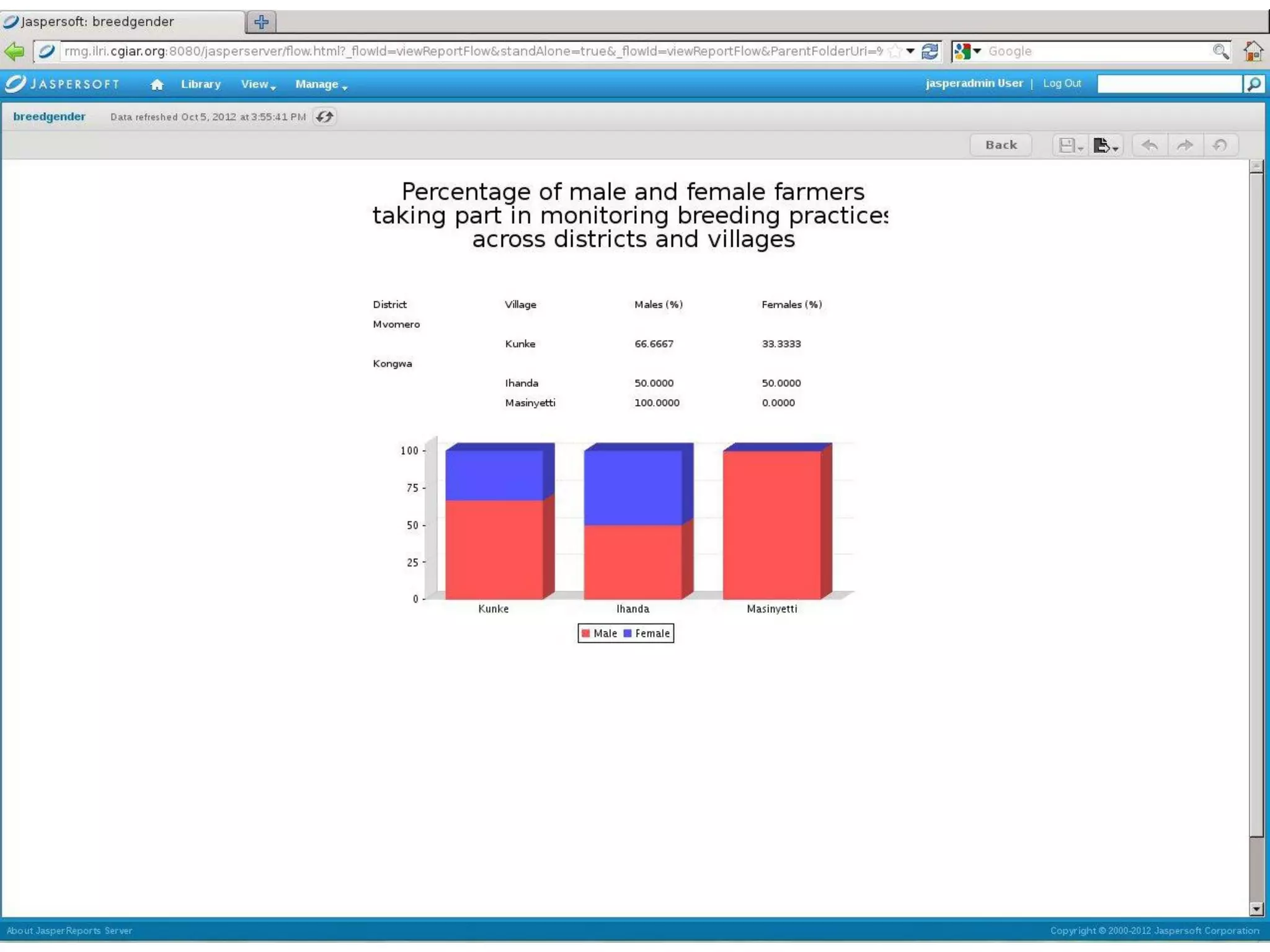
Example for Monitoring and Evaluation – Sections of web interface generated by META
Questions from the presentation (1)
                                Documented by Edna Mutua - PGI
•   Q: Are you increasing workload for field staff? R: Either way, data collection has to be
    done. It is possible to use devices connected to the internet to enter data directly.

•   Q:Are there risks of losing collected data? R: This has not been experienced this far.

•   Q: Is it possible to use farmers for data collection? R: It is an option. Other options
    include using extension workers that have to be paid and using research assistants.
    Research assistants are most preferred because they have the ability to collect quality
    data. It may be difficult to use farmers for now due to challenges in use and access of the
    internet.

•   Q: Is it possible to enter data offline? R: It is, one can enter the data in excel then later
    send it to ILRI for uploading. The excel format also acts as the backup for online data.

•   Q: What is the sustainability strategy for data collection? R:The project will hire field
    officers to do data collections. Farmers will be engaged in keeping their own breeding
    records. The field officers will then put this information together and upload it.
Questions from the presentation (2)
•   Q: What is the incentive for farmers to engage in data collection? R: This is a
    challenge. The team intends to disaggregate the kind of data that farmers can be
    requested to collect and what can be done by other project staff. Farmers can be
    involved in collecting data that gives them feedback on how their production is faring as
    this information is of great interest to them.

•   Q: Are there plans for up-scaling? R: Not yet.
•   Q: Has a cost benefit analysis been done on project? R: The costs can be identified. The
    project is sustainable because it uses locally available resources. It does not seek to
    introduce what the community has never done before. The community keeps goats,
    grows cassava and sweep potato. The project is working on encouraging farmers to
    cross breed their goats to improve productivity and use dried cassava and sweet potato
    vines as part of animal feeds in dry seasons. Initially, 107 farmers were given exotic
    goats for cross breeding and were expected to give the kids to other farmers that did
    not receive the exotic breeds so that the technology can diffuse in the community in
    sustainable fashion.
•   Q: Can the data collected in this system be used for conducting impact assessments?
    R: Yes, because the M&E system covers the project in between the baseline and end line
    stages.
•   Q: Is this M&E system compatible with PDAs? R: With understanding of how the PDA
    works the M&E team can develop a compatible application for PDAs.
Developing a web-based monitoring and evaluation system: Crop Goat Project in Tanzania

  • 1.
    “Developing a webbased monitoring and evaluation system” Crop Goat Project in Tanzania PGI and RMG Pamela Pali, Harrison Rware, Carlos Quiros, Titus Karanja, Joseph Gatheru Mugo, Nicholas Ndiwa, Jane Poole 1 4th October 2012
  • 2.
    Integrating Dairy Goatsand Root Crop Production for increasing Food, Nutrition and Income Security of Smallholder Farmers in Tanzania Canadian International Food Security Research Fund
  • 3.
    Background • 80% ofthe Tanzanian’s populations’ livelihoods are dependant on agriculture. 90% of households keep livestock with goats contributing second after cattle to income and human nutrition. • Despite this, the contribution of goats to meat and milk consumption and income is low; due to the low productivity of local breeds (low growth rates, low carcass weights (Chenyambuga et al., 2004), low milk production which is limited to feeding young goats. • Hence local breeds may not contribute effectively to poverty alleviation and improving food security among the rural poor people.
  • 4.
    Background • Poor nutritionof goats due to seasonal availability of feeds; natural pasture fed animals are unable to meet animal maintenance and production requirements (Mgheni et al., 1993) • Leading to low growth rates, low conception rates, high neonatal losses and animals easily succumb to diseases. • Strategies to improve nutrition for increased livestock productivity include the use of tested feed rations that include cassava leaves and sweet potato leaves and vines to target dry season feeding • Cassava and sweet potato are alternative protein and energy sources to conventional supplements (Ngi et al, 2006)
  • 5.
    Objectives • To improvethe milk production potential of indigenous goats through crossbreeding, improved management and control of major diseases • To test and evaluate improved sweet potato and cassava varieties that have the dual purpose of improving food security and nutrition at household level and the development of locally available and cost effective rations for dairy goats • To investigate the livelihood strategies, production potential, and marketing possibilities of local goats and crops in the study areas • To analyse the impacts (productivity, environmental, gender and empowerment, food security and nutrition) of integrating improved goat breeds with sweet-potatoes and cassava into an agro-pastoral farming system
  • 6.
  • 7.
    Objectives of M&Ein the overall project 1. To facilitate monitoring and learning from the project 2. To implement a dual M&E system that includes the project and community M&E systems to ensure functioning feedback systems and democratic decision making by communities 3. To determine the complementarity between project indicators and community indicators to facilitate the development of proxy indicators Research Questions? 1. What are the incentives for partners especially local communities to participate in M&E? 2. What are the implications for the M&E system design? 3. Does this type of M&E improve communication within the project performance?
  • 8.
    Process of establishment Of the project M&E system 2. Tools from the M&E framework 3. Development of 1. Project M&E developed by the web based framework component M&E system developed by ILRI leaders and developed by ILRI stakeholders
  • 9.
    Snapshot of theM&E framework Level of result Key results /Processes Indicators Level of data Tool to use When to collect Type of collection (group, data deliverable household /community /partners) Goals Increased household food and nutritional security Changes in individual dietary diversity scores for male adults, Housheold /Within HH Survey Start /End Baseline and from the interaction between root crops and dairy female adults and index child HH Impact goat at the farm level Changes in hosuehold Food consumption score and contribution Household HH Survey Start /End Assessment of goats, cassava and sweet potatoes to the food consumption Report score Changes in the number of months of indequate hosuehold food Household HH Survey /PRA Start /End provisioning (compared to national, and or regional avearges) tools Increased incomes from sales of goats, goat milk, Changes in hosuehold income and income managed by men and Household /Within HH Survey Start /End sweet potatoes and cassava products women HH Changes in contribution of goats, sweet potatoe and cassava to Household HH Survey hoseuhold income
  • 10.
    Process of development Of the community based M&E system 1. Train project 2. Development of 3. Implementing farmers on project farmers’ community monitoring objectives, indicators, democratic M&E Evaluation objectives baselines and targets system & Indicators
  • 11.
  • 12.
    Operationalization of theM&E system 3.Web based •Component 2: •Component 1: monitoring •Establishment of the •Development of the community based project M&E framework and evaluation Monitoring and system evaluation system
  • 13.
    Operationalization of theweb based system In deciding what types of web based system to use we explored issues around: • Development of the data collection sheets – How do we develop these in a participatory manner? – How do we ensure communities are collecting data that they will use? – How do these local communities use and interpret the data? • Data collection – Who collects the data? – How often? – Which option of data collection is most sustainable? • Data processing, quality control and feedback – Excel – Web interphase • Reflection – Who facilitates the reflection on the data? – How often? – When? – With what results? We also explored other private service providers to determine: – What M&E systems they provide? – Costs they provide these systems at? – Costs and flexibility involved in adaptation of the provided systems?
  • 14.
    Objective : Webbased M&E system • To enable project implementers to measure and track indicators outlined in the M & E framework online • To enable stakeholders to track changes in the project management and outcomes online. • Online access by stakeholders to data that is collected and uploaded into the system and summaries generated by these data • Statistical summaries will facilitate reflection sessions with local communities to ensure democratic decision making about project progress
  • 15.
    Functions of theweb system • Data collection and entry : initially by field level research assistants (Potential involvement of farmers and/or extension workers - sustainability) • Accessibility: of the system by the project and non project partners (Public) through a login system with differential user rights • Analysis: query building or automatic generation statistics at a click of the parameter • Feedback and learning: Generated statistics and reports are reported back to the livestock/breeder groups to ensure reflection & decision making on project progress • Not a Static system!! (Missing components to be integrated (EIA and Markets) & adaptation of system • The established web based M & E system can be customised to be used by other projects (in ILRI)
  • 16.
    Operationalization of theweb system M&E framework developed Provide feedback to Capacity building of partners in farmer groups M&E Host system on a Partners develop website and share the M & E tools the system Tools organized and merged into Incorporate partners comments one system, statistics generated on the statistics, programmer (which match the M&E framework complete the modules, test the indicators), codes determined , system with real data, train the field assistants MySQL database and web interface designed Validate the system Partners validate the (Tools and statistics statistics generated by generated) with real data the tools from the field Collect data to validate and test the system
  • 17.
    Management of theweb system Data collection and entry to be conducted at the field level (field assistant/ farmers/ EO’s) Web administrator to be based at ILRI is responsible for aggregating data and quality control Administrator will give user rights Differential user rights for different project partners user names, password to login and access various interfaces. Need to ensure confidentiality of farmers’ personal information is maintained.
  • 18.
    Challenges of theweb system • The system needs to provide timely flow of data and feedback to all project partners • Synchronization of tools used to collect M&E data in the field • Integrating regular data collection process • Hiring research assistants to collect data • Sustainable strategy for data collection and scale out mechanism for this strategy • In the absence of the web, what drives the decision making process?
  • 19.
    Example: breeding systemand growth performance Indicator for breeding from the M&E framework Key results /Processes Indicators Level of data Tool to use When to collect collection (group, data household /community /partners) 1.1 Increased availability and rearing of cross bred Number of male and female farmers Housheolds / HH survey / Start, every year, goats owning /acquiring cross bred goats in Groups Inventories end of project target villages Extent of implementation of the Group breeding Data sheets Regular community breeding strategy (% change records in breed, record keeping, registration of does and bucks) Tool used to collect breeding data CGP TANZANIA : BREEDING ACTIVITIES, GROWTH PERFORMANCE DISTRICT Kongwa DISICT CODE KW WARD VILLAGE Ihanda District District Village Name of the Sex of Dam Breed of the dam Sire Date of Type of Sex of kid Birth Kid Code Farmer farmer Number Number kidding kidding (s) weight Number (Twin, Triplets, Single) Kongwa KW Ihanda Farmer x 1=Male 348 3 = Norwegian 1639 05/08/2012 1=Single 2=Female 3.0 18451 Kongwa KW Ihanda Farmer y 2=Female 466 3 = Norwegian 1639 28/07/2012 1=Single 2=Female 18452 Kongwa KW Ihanda Farmer z 2=Female 464 3 = Norwegian 01/09/2012 2=Twin 2=Female 3.0 18498 Kongwa KW Ihanda Farmer a 2=Female 464 3 = Norwegian 01/09/2012 2=Twin 1=Male 3.0 18499 Kongwa KW Ihanda Farmer b 1=Male 350 3 = Norwegian 422 11/08/2012 1=Single 1=Male 2.7 18500 Kongwa KW Ihanda Farmer c 1=Male 417 2=Toggenburg (Exotic ‐ milk) 27/07/2012 1=Single 1=Male 2.5 18453 Frequency of collecting information: Seasonaly
  • 20.
    Example for Monitoringand Evaluation – Sections of web interface generated by META
  • 24.
    Questions from thepresentation (1) Documented by Edna Mutua - PGI • Q: Are you increasing workload for field staff? R: Either way, data collection has to be done. It is possible to use devices connected to the internet to enter data directly. • Q:Are there risks of losing collected data? R: This has not been experienced this far. • Q: Is it possible to use farmers for data collection? R: It is an option. Other options include using extension workers that have to be paid and using research assistants. Research assistants are most preferred because they have the ability to collect quality data. It may be difficult to use farmers for now due to challenges in use and access of the internet. • Q: Is it possible to enter data offline? R: It is, one can enter the data in excel then later send it to ILRI for uploading. The excel format also acts as the backup for online data. • Q: What is the sustainability strategy for data collection? R:The project will hire field officers to do data collections. Farmers will be engaged in keeping their own breeding records. The field officers will then put this information together and upload it.
  • 25.
    Questions from thepresentation (2) • Q: What is the incentive for farmers to engage in data collection? R: This is a challenge. The team intends to disaggregate the kind of data that farmers can be requested to collect and what can be done by other project staff. Farmers can be involved in collecting data that gives them feedback on how their production is faring as this information is of great interest to them. • Q: Are there plans for up-scaling? R: Not yet. • Q: Has a cost benefit analysis been done on project? R: The costs can be identified. The project is sustainable because it uses locally available resources. It does not seek to introduce what the community has never done before. The community keeps goats, grows cassava and sweep potato. The project is working on encouraging farmers to cross breed their goats to improve productivity and use dried cassava and sweet potato vines as part of animal feeds in dry seasons. Initially, 107 farmers were given exotic goats for cross breeding and were expected to give the kids to other farmers that did not receive the exotic breeds so that the technology can diffuse in the community in sustainable fashion. • Q: Can the data collected in this system be used for conducting impact assessments? R: Yes, because the M&E system covers the project in between the baseline and end line stages. • Q: Is this M&E system compatible with PDAs? R: With understanding of how the PDA works the M&E team can develop a compatible application for PDAs.