Creating gendered
monitoring, evaluation and learning
indicators for the Livestock and Fish
research program
Michael M. Kidoido, Froukje Kruijssen and Alessandra Galie
Livestock and Fish Gender Working Group
Workshop and Planning Meeting
Addis Ababa, Ethiopia, 14-18 October 2013
Background to L&F Monitoring Evaluation and
Learning (MEL)strategy
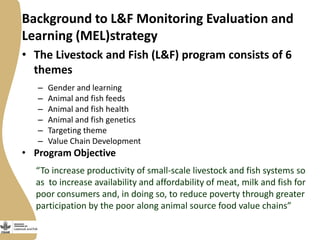
• The Livestock and Fish (L&F) program consists of 6
themes
–
–
–
–
–
–

Gender and learning
Animal and fish feeds
Animal and fish health
Animal and fish genetics
Targeting theme
Value Chain Development

• Program Objective
“To increase productivity of small‐scale livestock and fish systems so
as to increase availability and affordability of meat, milk and fish for
poor consumers and, in doing so, to reduce poverty through greater
participation by the poor along animal source food value chains”
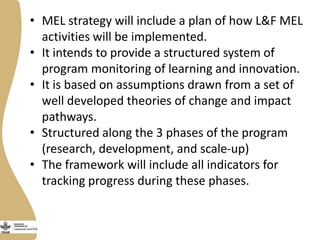
• MEL strategy will include a plan of how L&F MEL
activities will be implemented.
• It intends to provide a structured system of
program monitoring of learning and innovation.
• It is based on assumptions drawn from a set of
well developed theories of change and impact
pathways.
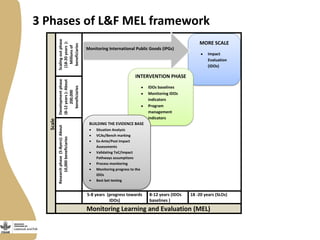
• Structured along the 3 phases of the program
(research, development, and scale-up)
• The framework will include all indicators for
tracking progress during these phases.
Research phase (5-8yers): About
10,000 beneficiaries

Scale

Development phase
(8-12 years ): About
200,000
beneficiaries

Scaling out phase
(18-20 years ):
Millions of
beneficiaries

3 Phases of L&F MEL framework
MORE SCALE
Monitoring International Public Goods (IPGs)
Impact
Evaluation
(IDOs)

INTERVENTION PHASE
IDOs baselines
Monitoring IDOs
indicators
Program
management
indicators
BUILDING THE EVIDENCE BASE
Situation Analysis
VCAs/Bench marking
Ex-Ante/Post Impact
Assessments
Validating ToC/Impact
Pathways assumptions
Process monitoring
Monitoring progress to the
IDOs
Best bet testing

5-8 years (progress towards
IDOs)

8-12 years (IDOs
baselines )

18 -20 years (SLOs)

Monitoring Learning and Evaluation (MEL)
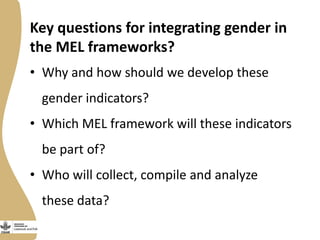
Key questions for integrating gender in
the MEL frameworks?
• Why and how should we develop these
gender indicators?
• Which MEL framework will these indicators
be part of?
• Who will collect, compile and analyze

these data?
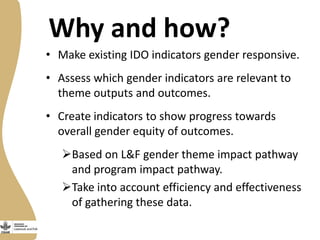
Why and how?
• Make existing IDO indicators gender responsive.
• Assess which gender indicators are relevant to
theme outputs and outcomes.
• Create indicators to show progress towards
overall gender equity of outcomes.
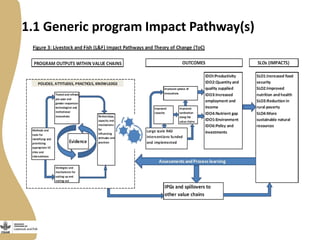
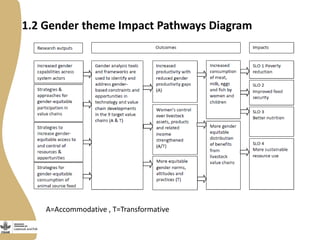
Based on L&F gender theme impact pathway
and program impact pathway.
Take into account efficiency and effectiveness
of gathering these data.
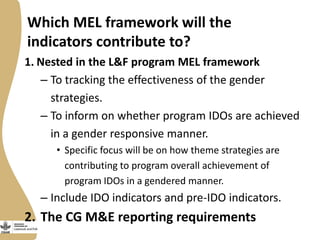
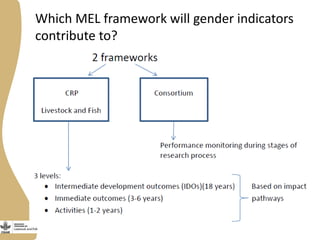
Which MEL framework will the
indicators contribute to?
1. Nested in the L&F program MEL framework
– To tracking the effectiveness of the gender
strategies.
– To inform on whether program IDOs are achieved
in a gender responsive manner.
• Specific focus will be on how theme strategies are
contributing to program overall achievement of
program IDOs in a gendered manner.

– Include IDO indicators and pre-IDO indicators.

2. The CG M&E reporting requirements
Which MEL framework will gender indicators
contribute to?
1.1 Generic program Impact Pathway(s)
1.2 Gender theme Impact Pathways Diagram

A=Accommodative , T=Transformative
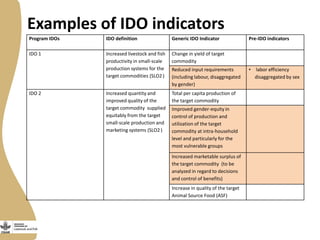
Examples of IDO indicators
Program IDOs

IDO definition

Generic IDO Indicator

IDO 1

Increased livestock and fish
productivity in small-scale
production systems for the
target commodities (SLO2 )

Change in yield of target
commodity

Increased quantity and
improved quality of the
target commodity supplied
equitably from the target
small-scale production and
marketing systems (SLO2 )

Total per capita production of
the target commodity

IDO 2

Reduced input requirements
(including labour, disaggregated
by gender)

Improved gender-equity in
control of production and
utilization of the target
commodity at intra-household
level and particularly for the
most vulnerable groups
Increased marketable surplus of
the target commodity (to be
analyzed in regard to decisions
and control of benefits)
Increase in quality of the target
Animal Source Food (ASF)

Pre-IDO indicators

• labor efficiency
disaggregated by sex
IDO 3

IDO 4

IDO 5

IDO 6

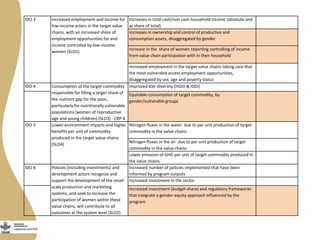
Increased employment and income for
low-income actors in the target value
chains, with an increased share of
employment opportunities for and
income controlled by low-income
women (SLO1)

Increases in total cash/non cash household income (absolute and
as share of total)
Increases in ownership and control of productive and
consumption assets, disaggregated by gender
Increase in the share of women reporting controlling of income
from value chain participation with in their household

Increased employment in the target value chains taking care that
the most vulnerable access employment opportunities,
disaggregated by sex, age and poverty status
Consumption of the target commodity Improved diet diversity (HDDI & IDDI)
responsible for filling a larger share of Equitable consumption of target commodity, by
the nutrient gap for the poor,
gender/vulnerable groups
particularly for nutritionally vulnerable
populations (women of reproductive
age and young children) (SLO3) - CRP 4
Lower environment impacts and higher Nitrogen fluxes in the water due to per unit production of target
benefits per unit of commodity
commodity in the value chains
produced in the target value chains
Nitrogen fluxes in the air due to per unit production of target
(SLO4)
commodity in the value chains
Lower emission of GHG per unit of target commodity produced in
the value chains
Policies (including investments) and
Increased number of policies implemented that have been
development actors recognize and
informed by program outputs
support the development of the small- Increased investment in the sector
scale production and marketing
Increased investment (budget share) and regulatory frameworks
systems, and seek to increase the
that integrate a gender-equity approach influenced by the
participation of women within these
program
value chains, will contribute to all
outcomes at the system level (SLO2)
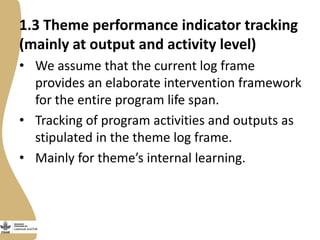
1.3 Theme performance indicator tracking
(mainly at output and activity level)
• We assume that the current log frame
provides an elaborate intervention framework
for the entire program life span.
• Tracking of program activities and outputs as
stipulated in the theme log frame.
• Mainly for theme’s internal learning.
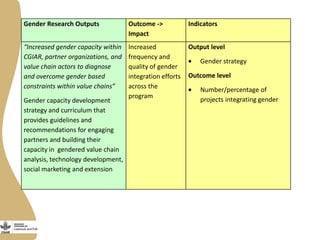
Gender Research Outputs

Outcome ->
Impact

Indicators

“Increased gender capacity within
CGIAR, partner organizations, and
value chain actors to diagnose
and overcome gender based
constraints within value chains”

Increased
frequency and
quality of gender
integration efforts
across the
program

Output level

Gender capacity development
strategy and curriculum that
provides guidelines and
recommendations for engaging
partners and building their
capacity in gendered value chain
analysis, technology development,
social marketing and extension

Gender strategy
Outcome level
Number/percentage of
projects integrating gender
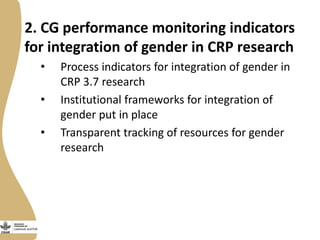
2. CG performance monitoring indicators
for integration of gender in CRP research
•
•
•

Process indicators for integration of gender in
CRP 3.7 research
Institutional frameworks for integration of
gender put in place
Transparent tracking of resources for gender
research
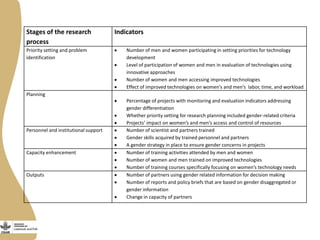
Stages of the research
process
Priority setting and problem
identification

Indicators
Number of men and women participating in setting priorities for technology
development
Level of participation of women and men in evaluation of technologies using
innovative approaches
Number of women and men accessing improved technologies
Effect of improved technologies on women’s and men’s labor, time, and workload

Planning

Personnel and institutional support

Capacity enhancement

Outputs

Percentage of projects with monitoring and evaluation indicators addressing
gender differentiation
Whether priority setting for research planning included gender-related criteria
Projects’ impact on women’s and men’s access and control of resources
Number of scientist and partners trained
Gender skills acquired by trained personnel and partners
A gender strategy in place to ensure gender concerns in projects
Number of training activities attended by men and women
Number of women and men trained on improved technologies
Number of training courses specifically focusing on women’s technology needs
Number of partners using gender related information for decision making
Number of reports and policy briefs that are based on gender disaggregated or
gender information
Change in capacity of partners
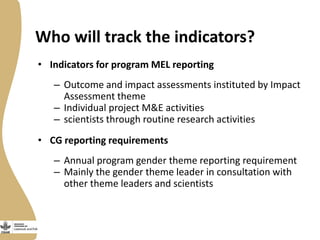
Who will track the indicators?
• Indicators for program MEL reporting

– Outcome and impact assessments instituted by Impact
Assessment theme
– Individual project M&E activities
– scientists through routine research activities
• CG reporting requirements
– Annual program gender theme reporting requirement
– Mainly the gender theme leader in consultation with
other theme leaders and scientists
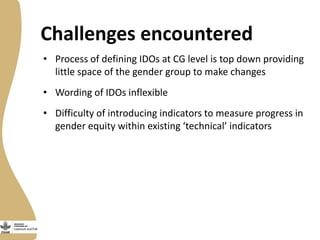
Challenges encountered
• Process of defining IDOs at CG level is top down providing
little space of the gender group to make changes
• Wording of IDOs inflexible
• Difficulty of introducing indicators to measure progress in
gender equity within existing ‘technical’ indicators
CGIAR Research Program on Livestock and Fish
livestockfish.cgiar.org

CGIAR is a global partnership that unites organizations engaged in research for a food secure future. The CGIAR
Research Program on Livestock and Fish aims to increase the productivity of small-scale livestock and fish systems
in sustainable ways, making meat, milk and fish more available and affordable across the developing world.

Creating gendered monitoring, evaluation and learning indicators for the Livestock and Fish research program

  • 1.
    Creating gendered monitoring, evaluationand learning indicators for the Livestock and Fish research program Michael M. Kidoido, Froukje Kruijssen and Alessandra Galie Livestock and Fish Gender Working Group Workshop and Planning Meeting Addis Ababa, Ethiopia, 14-18 October 2013
  • 2.
    Background to L&FMonitoring Evaluation and Learning (MEL)strategy • The Livestock and Fish (L&F) program consists of 6 themes – – – – – – Gender and learning Animal and fish feeds Animal and fish health Animal and fish genetics Targeting theme Value Chain Development • Program Objective “To increase productivity of small‐scale livestock and fish systems so as to increase availability and affordability of meat, milk and fish for poor consumers and, in doing so, to reduce poverty through greater participation by the poor along animal source food value chains”
  • 3.
    • MEL strategywill include a plan of how L&F MEL activities will be implemented. • It intends to provide a structured system of program monitoring of learning and innovation. • It is based on assumptions drawn from a set of well developed theories of change and impact pathways. • Structured along the 3 phases of the program (research, development, and scale-up) • The framework will include all indicators for tracking progress during these phases.
  • 4.
    Research phase (5-8yers):About 10,000 beneficiaries Scale Development phase (8-12 years ): About 200,000 beneficiaries Scaling out phase (18-20 years ): Millions of beneficiaries 3 Phases of L&F MEL framework MORE SCALE Monitoring International Public Goods (IPGs) Impact Evaluation (IDOs) INTERVENTION PHASE IDOs baselines Monitoring IDOs indicators Program management indicators BUILDING THE EVIDENCE BASE Situation Analysis VCAs/Bench marking Ex-Ante/Post Impact Assessments Validating ToC/Impact Pathways assumptions Process monitoring Monitoring progress to the IDOs Best bet testing 5-8 years (progress towards IDOs) 8-12 years (IDOs baselines ) 18 -20 years (SLOs) Monitoring Learning and Evaluation (MEL)
  • 5.
    Key questions forintegrating gender in the MEL frameworks? • Why and how should we develop these gender indicators? • Which MEL framework will these indicators be part of? • Who will collect, compile and analyze these data?
  • 6.
    Why and how? •Make existing IDO indicators gender responsive. • Assess which gender indicators are relevant to theme outputs and outcomes. • Create indicators to show progress towards overall gender equity of outcomes. Based on L&F gender theme impact pathway and program impact pathway. Take into account efficiency and effectiveness of gathering these data.
  • 7.
    Which MEL frameworkwill the indicators contribute to? 1. Nested in the L&F program MEL framework – To tracking the effectiveness of the gender strategies. – To inform on whether program IDOs are achieved in a gender responsive manner. • Specific focus will be on how theme strategies are contributing to program overall achievement of program IDOs in a gendered manner. – Include IDO indicators and pre-IDO indicators. 2. The CG M&E reporting requirements
  • 8.
    Which MEL frameworkwill gender indicators contribute to?
  • 9.
    1.1 Generic programImpact Pathway(s)
  • 10.
    1.2 Gender themeImpact Pathways Diagram A=Accommodative , T=Transformative
  • 11.
    Examples of IDOindicators Program IDOs IDO definition Generic IDO Indicator IDO 1 Increased livestock and fish productivity in small-scale production systems for the target commodities (SLO2 ) Change in yield of target commodity Increased quantity and improved quality of the target commodity supplied equitably from the target small-scale production and marketing systems (SLO2 ) Total per capita production of the target commodity IDO 2 Reduced input requirements (including labour, disaggregated by gender) Improved gender-equity in control of production and utilization of the target commodity at intra-household level and particularly for the most vulnerable groups Increased marketable surplus of the target commodity (to be analyzed in regard to decisions and control of benefits) Increase in quality of the target Animal Source Food (ASF) Pre-IDO indicators • labor efficiency disaggregated by sex
  • 12.
    IDO 3 IDO 4 IDO5 IDO 6 Increased employment and income for low-income actors in the target value chains, with an increased share of employment opportunities for and income controlled by low-income women (SLO1) Increases in total cash/non cash household income (absolute and as share of total) Increases in ownership and control of productive and consumption assets, disaggregated by gender Increase in the share of women reporting controlling of income from value chain participation with in their household Increased employment in the target value chains taking care that the most vulnerable access employment opportunities, disaggregated by sex, age and poverty status Consumption of the target commodity Improved diet diversity (HDDI & IDDI) responsible for filling a larger share of Equitable consumption of target commodity, by the nutrient gap for the poor, gender/vulnerable groups particularly for nutritionally vulnerable populations (women of reproductive age and young children) (SLO3) - CRP 4 Lower environment impacts and higher Nitrogen fluxes in the water due to per unit production of target benefits per unit of commodity commodity in the value chains produced in the target value chains Nitrogen fluxes in the air due to per unit production of target (SLO4) commodity in the value chains Lower emission of GHG per unit of target commodity produced in the value chains Policies (including investments) and Increased number of policies implemented that have been development actors recognize and informed by program outputs support the development of the small- Increased investment in the sector scale production and marketing Increased investment (budget share) and regulatory frameworks systems, and seek to increase the that integrate a gender-equity approach influenced by the participation of women within these program value chains, will contribute to all outcomes at the system level (SLO2)
  • 13.
    1.3 Theme performanceindicator tracking (mainly at output and activity level) • We assume that the current log frame provides an elaborate intervention framework for the entire program life span. • Tracking of program activities and outputs as stipulated in the theme log frame. • Mainly for theme’s internal learning.
  • 14.
    Gender Research Outputs Outcome-> Impact Indicators “Increased gender capacity within CGIAR, partner organizations, and value chain actors to diagnose and overcome gender based constraints within value chains” Increased frequency and quality of gender integration efforts across the program Output level Gender capacity development strategy and curriculum that provides guidelines and recommendations for engaging partners and building their capacity in gendered value chain analysis, technology development, social marketing and extension Gender strategy Outcome level Number/percentage of projects integrating gender
  • 15.
    2. CG performancemonitoring indicators for integration of gender in CRP research • • • Process indicators for integration of gender in CRP 3.7 research Institutional frameworks for integration of gender put in place Transparent tracking of resources for gender research
  • 16.
    Stages of theresearch process Priority setting and problem identification Indicators Number of men and women participating in setting priorities for technology development Level of participation of women and men in evaluation of technologies using innovative approaches Number of women and men accessing improved technologies Effect of improved technologies on women’s and men’s labor, time, and workload Planning Personnel and institutional support Capacity enhancement Outputs Percentage of projects with monitoring and evaluation indicators addressing gender differentiation Whether priority setting for research planning included gender-related criteria Projects’ impact on women’s and men’s access and control of resources Number of scientist and partners trained Gender skills acquired by trained personnel and partners A gender strategy in place to ensure gender concerns in projects Number of training activities attended by men and women Number of women and men trained on improved technologies Number of training courses specifically focusing on women’s technology needs Number of partners using gender related information for decision making Number of reports and policy briefs that are based on gender disaggregated or gender information Change in capacity of partners
  • 17.
    Who will trackthe indicators? • Indicators for program MEL reporting – Outcome and impact assessments instituted by Impact Assessment theme – Individual project M&E activities – scientists through routine research activities • CG reporting requirements – Annual program gender theme reporting requirement – Mainly the gender theme leader in consultation with other theme leaders and scientists
  • 18.
    Challenges encountered • Processof defining IDOs at CG level is top down providing little space of the gender group to make changes • Wording of IDOs inflexible • Difficulty of introducing indicators to measure progress in gender equity within existing ‘technical’ indicators
  • 19.
    CGIAR Research Programon Livestock and Fish livestockfish.cgiar.org CGIAR is a global partnership that unites organizations engaged in research for a food secure future. The CGIAR Research Program on Livestock and Fish aims to increase the productivity of small-scale livestock and fish systems in sustainable ways, making meat, milk and fish more available and affordable across the developing world.

Editor's Notes

  • #4 Page title minimum of 30 points and maximumof two linesMain point 6 point smaller than slide titleBullet points 4 point less than main pointFont type is CalibriIt is advised in one slide maximum 6 bulletsWe recommend you use images on slidesYou can change partner logos on front pageYou have to duplicate this slide for more inside pages