Livestock management in Ghana 2019/2020
Augustine Ayantunde1, Sadat Salifu2, and Franklin Avornyo2
1International Livestock Research Institute (ILRI), 2Council for Scientific and Industrial
Research - Savanna Agricultural Research Institute (CSIR-SARI)
Africa RISING Ghana Country Planning Meeting
24 - 25 June 2020
Tamale, Ghana & Virtual
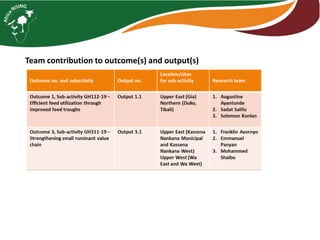
Team contribution to outcome(s) and output(s)
Key research findings
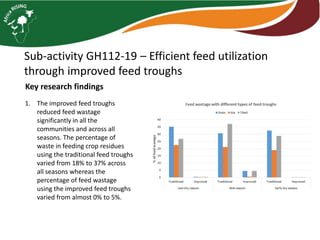
1. The improved feed troughs
reduced feed wastage
significantly in all the
communities and across all
seasons. The percentage of
waste in feeding crop residues
using the traditional feed troughs
varied from 18% to 37% across
all seasons whereas the
percentage of feed wastage
using the improved feed troughs
varied from almost 0% to 5%.
Sub-activity GH112-19 – Efficient feed utilization
through improved feed troughs
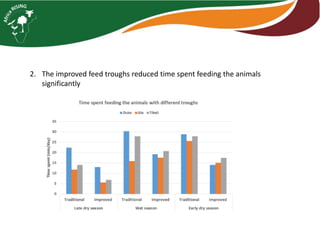
2. The improved feed troughs reduced time spent feeding the animals
significantly
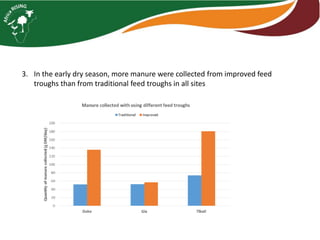
3. In the early dry season, more manure were collected from improved feed
troughs than from traditional feed troughs in all sites
4. Male adults were largely responsible for feeding the animals in the three study communities
across all seasons though female adults and boys were also involved.
5. Time spent feeding and percentage wastage were similar for both types of improved feed
troughs which implies that feed troughs constructed with local materials are as good as
those constructed with commercial materials despite the fact that the former were
considerably cheaper (about Ghc 234) than the commercial ones (about Ghc 1,149).
6. The participating farmers confirm the benefits of the improved feed troughs which are
consistent with our results.
7. Modifications made by farmers to the improved feed troughs included addition of watering
trough, a wooden barrier to prevent smaller animals from jumping into feeding
compartment to contaminate feed, fencing around trough to keep away stray animals, and
addition of feed storage area above feeding compartment.
Team deliverables
• Comprehensive technical report on the use of improved feed troughs compared to the
traditional troughs (submitted).
• Database on evaluation of use of the improved feed troughs in 3 intervention communities
(to be submitted for uploading to Dataverse).
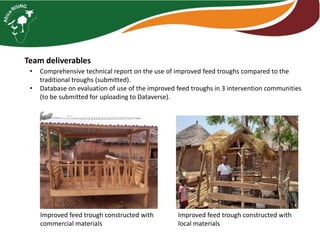
Improved feed trough constructed with
commercial materials
Improved feed trough constructed with
local materials
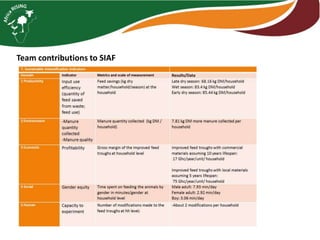
Team contributions to SIAF
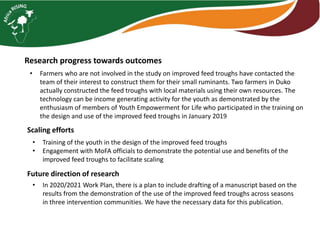
Research progress towards outcomes
• Farmers who are not involved in the study on improved feed troughs have contacted the
team of their interest to construct them for their small ruminants. Two farmers in Duko
actually constructed the feed troughs with local materials using their own resources. The
technology can be income generating activity for the youth as demonstrated by the
enthusiasm of members of Youth Empowerment for Life who participated in the training on
the design and use of the improved feed troughs in January 2019
Scaling efforts
• Training of the youth in the design of the improved feed troughs
• Engagement with MoFA officials to demonstrate the potential use and benefits of the
improved feed troughs to facilitate scaling
Future direction of research
• In 2020/2021 Work Plan, there is a plan to include drafting of a manuscript based on the
results from the demonstration of the use of the improved feed troughs across seasons
in three intervention communities. We have the necessary data for this publication.
Sub-activity GH311-19 – Strengthening small ruminant
value chain
Project outcome
• Outcome 3: Farmers and other value chain actors have greater and equitable
access to production assets and markets (input and output) through enabling
institutions and policies.
Project output
• Output 3.1: Improved policies and institutional arrangements to increase
participation of farm families, especially women and youth in the output and input
markets and decision-making are developed.
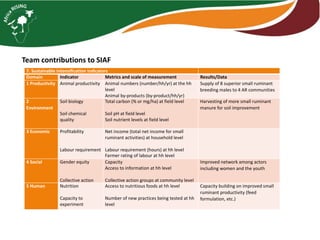
Team contributions to SIAF
7. Sustainable intensification indicators
Domain Indicator Metrics and scale of measurement Results/Data
1 Productivity Animal productivity Animal numbers (number/hh/yr) at the hh
level
Animal by-products (by-product/hh/yr)
Supply of 8 superior small ruminant
breeding males to 4 AR communities
2
Environment
Soil biology
Soil chemical
quality
Total carbon (% or mg/ha) at field level
Soil pH at field level
Soil nutrient levels at field level
Harvesting of more small ruminant
manure for soil improvement
3 Economic Profitability
Labour requirement
Net income (total net income for small
ruminant activities) at household level
Labour requirement (hours) at hh level
Farmer rating of labour at hh level
4 Social Gender equity
Collective action
Capacity
Access to information at hh level
Collective action groups at community level
Improved network among actors
including women and the youth
5 Human Nutrition
Capacity to
experiment
Access to nutritious foods at hh level
Number of new practices being tested at hh
level
Capacity building on improved small
ruminant productivity (feed
formulation, etc.)
Key research findings
1. In Burkina Faso, the small ruminant actors (producers, traders and processors)
are better organized from the community level up to the national level.
2. Burkina Faso Animal Production Directorate has a Director of Value Chain
Development.
3. AR project farmers can specialize in the supply of crossbreeds and in future
Sahelian animals for the upscale market in Ghana.
Research gaps
1. Identifying clear policy guidelines to govern the operation of the small ruminant
value chain.
2. Which institution should be responsible and how should it provide leadership in
the development of the small ruminant value chain.
3. Potential partners of the small ruminant value chain.
Team deliverables
• Two functional Innovational Platforms
• Baseline survey report
• IP workshop reports
• Technical report
What are the plans around team consolidation of data
• Possible publication of findings as a case study
Scaling efforts
• Training of cross-section of actors
• Operation of innovation platforms
• Engagement of MoFA/DoA at district, municipal and regional level, and some potential
benefits for the project farmers include construction of small ruminant model houses,
improving access to animal healthcare, increasing stock size, breed quality and facilitating
the formation of producer organizations.
Future direction of research
• Address the organization of small ruminant producers in AR communities
• Make MoFA play a key role in the entire small ruminant value chain
• Form relevant partnerships to enhance the functioning of the small ruminant value chain
• Conduct an evaluation on the effect of interventions undertaken
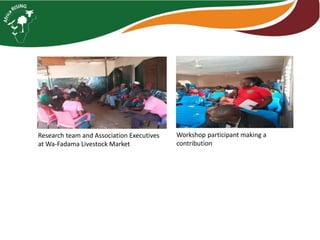
Workshop participant making a
contribution
Research team and Association Executives
at Wa-Fadama Livestock Market
Africa Research in Sustainable Intensification for the Next Generation
africa-rising.net
This presentation is licensed for use under the Creative Commons Attribution 4.0 International Licence.
Thank You

Livestock management in Ghana 2019/2020

  • 1.
    Livestock management inGhana 2019/2020 Augustine Ayantunde1, Sadat Salifu2, and Franklin Avornyo2 1International Livestock Research Institute (ILRI), 2Council for Scientific and Industrial Research - Savanna Agricultural Research Institute (CSIR-SARI) Africa RISING Ghana Country Planning Meeting 24 - 25 June 2020 Tamale, Ghana & Virtual
  • 2.
    Team contribution tooutcome(s) and output(s)
  • 3.
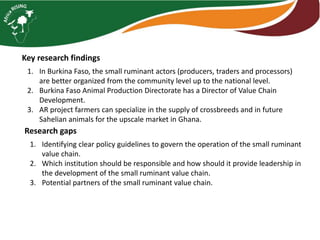
    Key research findings 1.The improved feed troughs reduced feed wastage significantly in all the communities and across all seasons. The percentage of waste in feeding crop residues using the traditional feed troughs varied from 18% to 37% across all seasons whereas the percentage of feed wastage using the improved feed troughs varied from almost 0% to 5%. Sub-activity GH112-19 – Efficient feed utilization through improved feed troughs
  • 4.
    2. The improvedfeed troughs reduced time spent feeding the animals significantly
  • 5.
    3. In theearly dry season, more manure were collected from improved feed troughs than from traditional feed troughs in all sites
  • 6.
    4. Male adultswere largely responsible for feeding the animals in the three study communities across all seasons though female adults and boys were also involved. 5. Time spent feeding and percentage wastage were similar for both types of improved feed troughs which implies that feed troughs constructed with local materials are as good as those constructed with commercial materials despite the fact that the former were considerably cheaper (about Ghc 234) than the commercial ones (about Ghc 1,149). 6. The participating farmers confirm the benefits of the improved feed troughs which are consistent with our results. 7. Modifications made by farmers to the improved feed troughs included addition of watering trough, a wooden barrier to prevent smaller animals from jumping into feeding compartment to contaminate feed, fencing around trough to keep away stray animals, and addition of feed storage area above feeding compartment.
  • 7.
    Team deliverables • Comprehensivetechnical report on the use of improved feed troughs compared to the traditional troughs (submitted). • Database on evaluation of use of the improved feed troughs in 3 intervention communities (to be submitted for uploading to Dataverse). Improved feed trough constructed with commercial materials Improved feed trough constructed with local materials
  • 8.
  • 9.
    Research progress towardsoutcomes • Farmers who are not involved in the study on improved feed troughs have contacted the team of their interest to construct them for their small ruminants. Two farmers in Duko actually constructed the feed troughs with local materials using their own resources. The technology can be income generating activity for the youth as demonstrated by the enthusiasm of members of Youth Empowerment for Life who participated in the training on the design and use of the improved feed troughs in January 2019 Scaling efforts • Training of the youth in the design of the improved feed troughs • Engagement with MoFA officials to demonstrate the potential use and benefits of the improved feed troughs to facilitate scaling Future direction of research • In 2020/2021 Work Plan, there is a plan to include drafting of a manuscript based on the results from the demonstration of the use of the improved feed troughs across seasons in three intervention communities. We have the necessary data for this publication.
  • 10.
    Sub-activity GH311-19 –Strengthening small ruminant value chain Project outcome • Outcome 3: Farmers and other value chain actors have greater and equitable access to production assets and markets (input and output) through enabling institutions and policies. Project output • Output 3.1: Improved policies and institutional arrangements to increase participation of farm families, especially women and youth in the output and input markets and decision-making are developed.
  • 11.
    Team contributions toSIAF 7. Sustainable intensification indicators Domain Indicator Metrics and scale of measurement Results/Data 1 Productivity Animal productivity Animal numbers (number/hh/yr) at the hh level Animal by-products (by-product/hh/yr) Supply of 8 superior small ruminant breeding males to 4 AR communities 2 Environment Soil biology Soil chemical quality Total carbon (% or mg/ha) at field level Soil pH at field level Soil nutrient levels at field level Harvesting of more small ruminant manure for soil improvement 3 Economic Profitability Labour requirement Net income (total net income for small ruminant activities) at household level Labour requirement (hours) at hh level Farmer rating of labour at hh level 4 Social Gender equity Collective action Capacity Access to information at hh level Collective action groups at community level Improved network among actors including women and the youth 5 Human Nutrition Capacity to experiment Access to nutritious foods at hh level Number of new practices being tested at hh level Capacity building on improved small ruminant productivity (feed formulation, etc.)
  • 12.
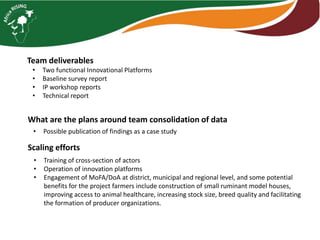
    Key research findings 1.In Burkina Faso, the small ruminant actors (producers, traders and processors) are better organized from the community level up to the national level. 2. Burkina Faso Animal Production Directorate has a Director of Value Chain Development. 3. AR project farmers can specialize in the supply of crossbreeds and in future Sahelian animals for the upscale market in Ghana. Research gaps 1. Identifying clear policy guidelines to govern the operation of the small ruminant value chain. 2. Which institution should be responsible and how should it provide leadership in the development of the small ruminant value chain. 3. Potential partners of the small ruminant value chain.
  • 13.
    Team deliverables • Twofunctional Innovational Platforms • Baseline survey report • IP workshop reports • Technical report What are the plans around team consolidation of data • Possible publication of findings as a case study Scaling efforts • Training of cross-section of actors • Operation of innovation platforms • Engagement of MoFA/DoA at district, municipal and regional level, and some potential benefits for the project farmers include construction of small ruminant model houses, improving access to animal healthcare, increasing stock size, breed quality and facilitating the formation of producer organizations.
  • 14.
    Future direction ofresearch • Address the organization of small ruminant producers in AR communities • Make MoFA play a key role in the entire small ruminant value chain • Form relevant partnerships to enhance the functioning of the small ruminant value chain • Conduct an evaluation on the effect of interventions undertaken
  • 15.
    Workshop participant makinga contribution Research team and Association Executives at Wa-Fadama Livestock Market
  • 16.
    Africa Research inSustainable Intensification for the Next Generation africa-rising.net This presentation is licensed for use under the Creative Commons Attribution 4.0 International Licence. Thank You