ECOSYSTEMS
Social studies
An ecosystem consist of all the organisms living on a place, as
well as the physical environment they live in.
Organisms in an ecosystem interrelate with each other.
Ecosystems come in all shapes and sizes.
They can be as small as a terrarium in your room or as big as
an ocean.
PHYSICAL ENVIRONMENT
• The physical environment is made up of the non-living
components in an ecosystem.
• It includes non-living things, such as rocks, water and air,
and factors that affect living things, such as temperature,
humidity and light.
• Our planet has many different ecosystems, found in two
types of physical environments:
• Terrestrial environments: these are found on land
and as surrounded by air.
• Aquatic environments: these can be freshwater
environments, such as rivers and lakes, or
saltwater environments, such as seas and oceans.
LIVING THINGS
• The living things in an ecosystem are all the
animals, plants and other living things, such as
algae, fungi and bacteria.
• Every ecosystem has a particular fauna and flora.
• Fauna refers to all the animals in an ecosystem
• flora includes all its plants.
NUTRITION IN
ECOSYSTEMS
All living things need food to survive.
Depending on how living things obtain their
food, they can be:
• PRODUCERS: make their own food, like plants or algae.
• CONSUMERS: obtein their food from other living things, as
animals. There are different types:
• Primary Consumers feed on producers, so they are hervivores, as
rabbit.
• Secondary Consumers feed on primary consumers, they are
carnivores, as foxes.
• Tertiary consumers feed on secondary consumers, so they are
cornivores, as eagles.
• DESPOMPONSERS: they descompose dead animals and plant
materials into minerals, as bacteria or mushrooms.
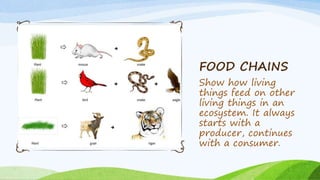
FOOD CHAINS
Show how living
things feed on other
living things in an
ecosystem. It always
starts with a
producer, continues
with a consumer.
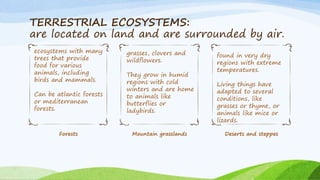
TERRESTRIAL ECOSYSTEMS
TERRESTRIAL ECOSYSTEMS:
are located on land and are surrounded by air.
Forests Mountain grasslands Deserts and steppes
ecosystems with many
trees that provide
food for various
animals, including
birds and mammals.
Can be atlantic forests
or mediterranean
forests.
grasses, clovers and
wildflowers.
They grow in humid
regions with cold
winters and are home
to animals like
butterflies or
ladybirds.
found in very dry
regions with extreme
temperatures.
Living things have
adapted to several
conditions, like
grasses or thyme, or
animals like mice or
lizards.
AQUATIC ECOSYSTEMS
AQUATIC ECOSYSTEMS:
are located in water environment. Depending on the salinity,
the amount of salt dissolved in water, there are two types:
marine ecosystems:
• high salinity. Water is in
constant movement due to
waves and currents.
• Sandy beaches
• Rocky shores
• Open sea
freshwater ecosystems:
• Very low salinity.
• Rivers, where the water is
always moving, so living things
need to adapt to the flow, is
home to otters and trout.
• Lagoons, where wahter doesn’t
move, are home of plants as
reeds, and animals as frogs or
water snakes.

Ecosystems

  • 1.
  • 2.
    An ecosystem consistof all the organisms living on a place, as well as the physical environment they live in. Organisms in an ecosystem interrelate with each other. Ecosystems come in all shapes and sizes. They can be as small as a terrarium in your room or as big as an ocean.
  • 3.
    PHYSICAL ENVIRONMENT • Thephysical environment is made up of the non-living components in an ecosystem. • It includes non-living things, such as rocks, water and air, and factors that affect living things, such as temperature, humidity and light.
  • 4.
    • Our planethas many different ecosystems, found in two types of physical environments: • Terrestrial environments: these are found on land and as surrounded by air. • Aquatic environments: these can be freshwater environments, such as rivers and lakes, or saltwater environments, such as seas and oceans.
  • 5.
    LIVING THINGS • Theliving things in an ecosystem are all the animals, plants and other living things, such as algae, fungi and bacteria. • Every ecosystem has a particular fauna and flora. • Fauna refers to all the animals in an ecosystem • flora includes all its plants.
  • 6.
    NUTRITION IN ECOSYSTEMS All livingthings need food to survive. Depending on how living things obtain their food, they can be:
  • 7.
    • PRODUCERS: maketheir own food, like plants or algae. • CONSUMERS: obtein their food from other living things, as animals. There are different types: • Primary Consumers feed on producers, so they are hervivores, as rabbit. • Secondary Consumers feed on primary consumers, they are carnivores, as foxes. • Tertiary consumers feed on secondary consumers, so they are cornivores, as eagles. • DESPOMPONSERS: they descompose dead animals and plant materials into minerals, as bacteria or mushrooms.
  • 8.
    FOOD CHAINS Show howliving things feed on other living things in an ecosystem. It always starts with a producer, continues with a consumer.
  • 9.
  • 10.
    TERRESTRIAL ECOSYSTEMS: are locatedon land and are surrounded by air. Forests Mountain grasslands Deserts and steppes ecosystems with many trees that provide food for various animals, including birds and mammals. Can be atlantic forests or mediterranean forests. grasses, clovers and wildflowers. They grow in humid regions with cold winters and are home to animals like butterflies or ladybirds. found in very dry regions with extreme temperatures. Living things have adapted to several conditions, like grasses or thyme, or animals like mice or lizards.
  • 11.
  • 12.
    AQUATIC ECOSYSTEMS: are locatedin water environment. Depending on the salinity, the amount of salt dissolved in water, there are two types: marine ecosystems: • high salinity. Water is in constant movement due to waves and currents. • Sandy beaches • Rocky shores • Open sea freshwater ecosystems: • Very low salinity. • Rivers, where the water is always moving, so living things need to adapt to the flow, is home to otters and trout. • Lagoons, where wahter doesn’t move, are home of plants as reeds, and animals as frogs or water snakes.