International Research Journal of Engineering and Technology (IRJET) e-ISSN: 2395 -0056
Volume: 04 Issue: 06 | June -2017 www.irjet.net p-ISSN: 2395-0072
© 2017, IRJET | Impact Factor value: 5.181 | ISO 9001:2008 Certified Journal | Page 1250
Wearable Technology Orientation Using Big Data Analytics for Improving
Quality of Human Life
Ch.Srilakshmi
Asst Professor,Department of Information Technology
R.M.D Engineering College, Kavaraipettai, Chennai, Tamil Nadu
----------------------------------------------------------------------------***--------------------------------------------------------------------------
Abstract: Wearable devices and the data generated by them
give a unique opportunity to understand the user behavior
and predict future needs due to its personal nature. In coming
years this data will grow exponentially due to huge popularity
of wearable devices. Analysis will become a challenge with the
personal data explosion and also to maintain a updated
knowledge base. This calls for big data analysis model for
wearable devices. Big data analysis model which will update
the knowledge base and give users a personalized
recommendation based on the analysis of the data. Big data
analysis offers personalized adaptive technique for data
handling and transformation from wearable devices. Big Data
MapReduce data technologies ensure that data can be used
for long term analysis for different applications in the future.
Keyword: MapReduce, Wearables, personalized knowledge
Base
I. Introduction
In today’s world a lot of data is generated by the wearable
devices which is not leveraged and processed properly. This
data is highly unique due to the personal nature of the
wearable device. There is an exponential growth in wearable
devices and they collect a lot of data which cannot be
processed using conventional techniques. The target data are
all the devices revolving around the user which can vary from
the Digital bracelet, watch, to glasses, to wearable clothing.
The data gathered from the wearable devices have yet to be
properly explored or analyzed to enable the user to make
decisions relevant to it.
A) Wearable Tech is the Next Big (Data)
Wearable technology is any device which a) is small
enough to be worn on the body, such as a watch and b) can
wirelessly connect with the Internet, a satellite, another
mobile device, or some other connectivity point. Common
wearable tech examples include Google Glass and Apple
Watch. The recent developed devices related to the Human
interaction like Google Glass, Pebble, Fitbit One, heart beat
monitor, smart phone, smart shirt etc, show the importance
and opens new ways of research and application for IT.
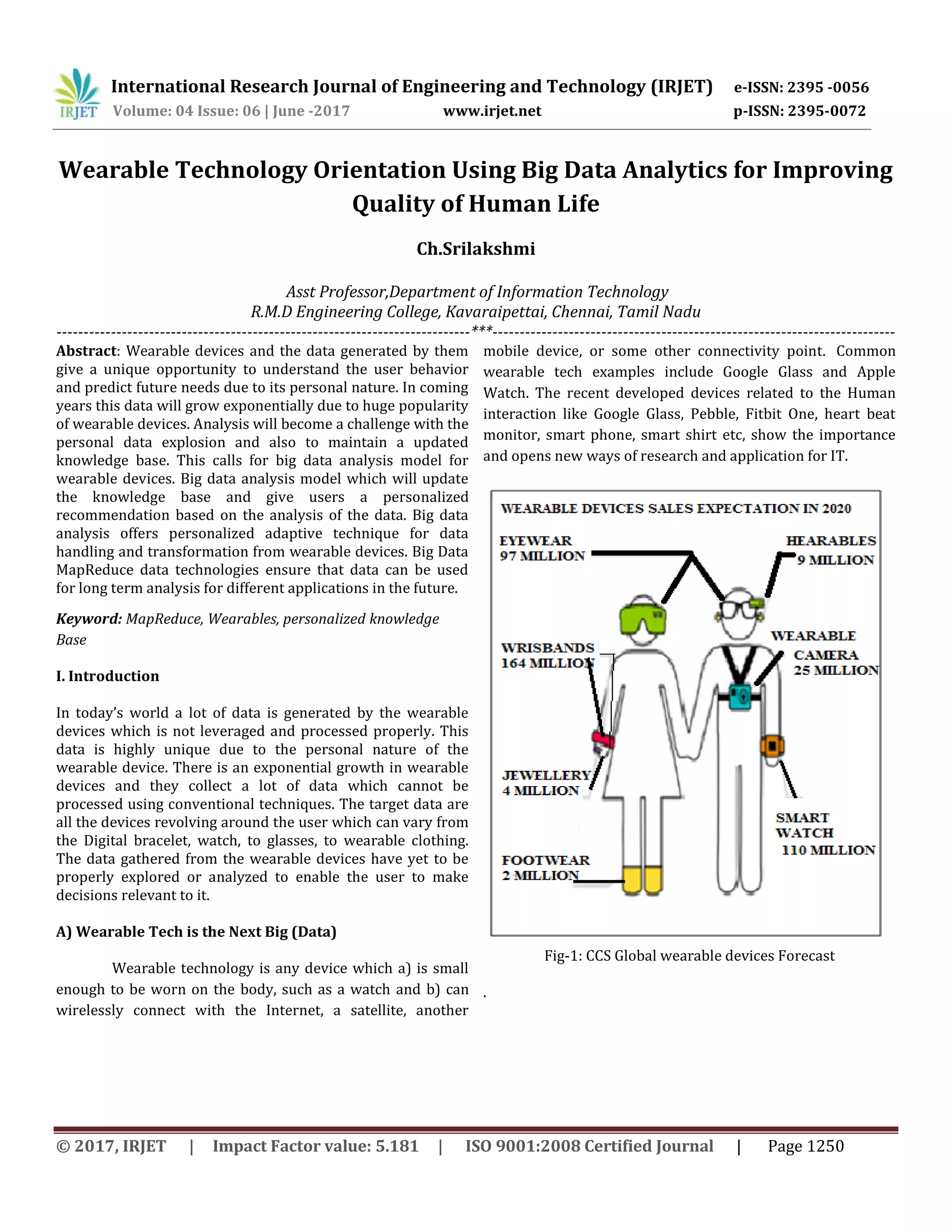
Fig-1: CCS Global wearable devices Forecast
.
International Research Journal of Engineering and Technology (IRJET) e-ISSN: 2395 -0056
Volume: 04 Issue: 06 | June -2017 www.irjet.net p-ISSN: 2395-0072
© 2017, IRJET | Impact Factor value: 5.181 | ISO 9001:2008 Certified Journal | Page 1251
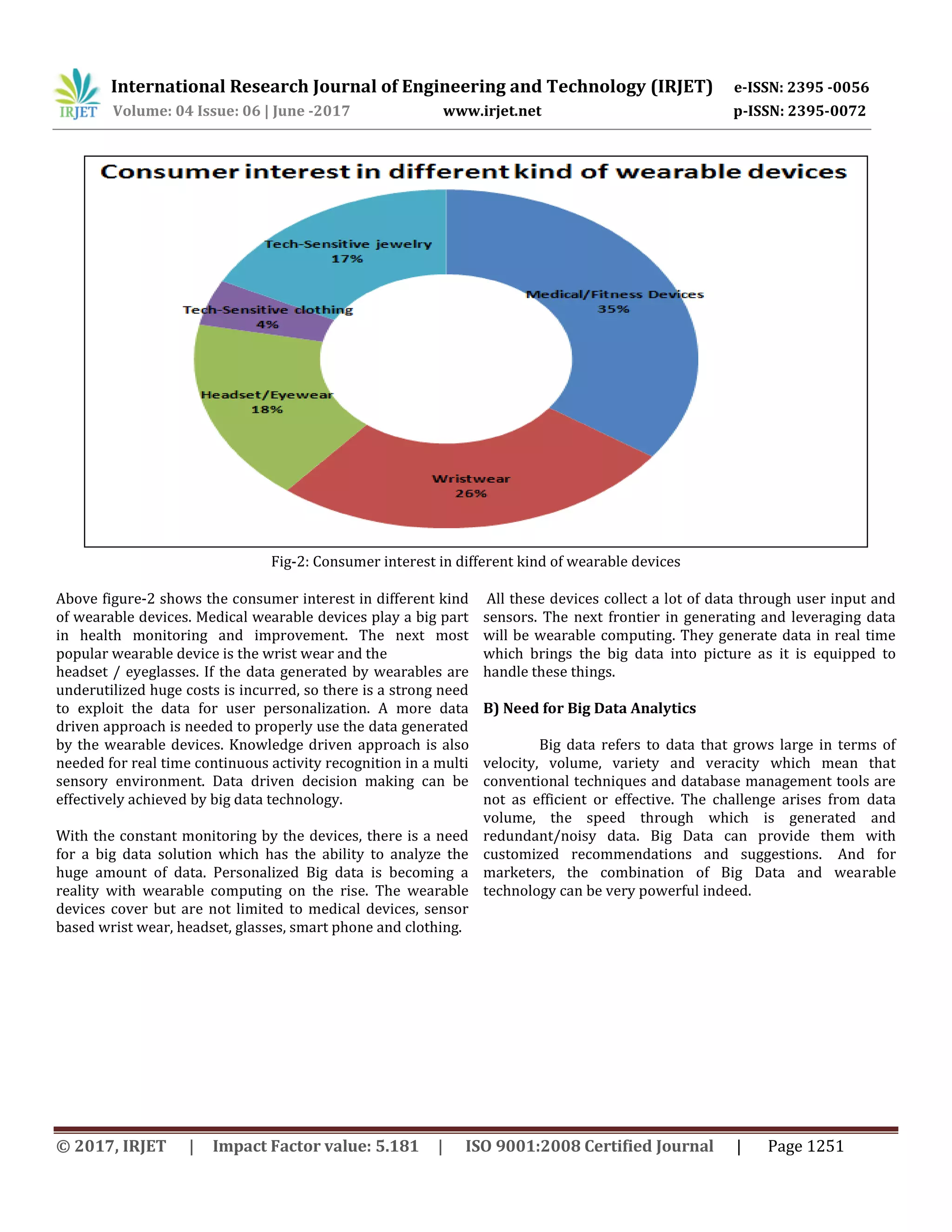
Fig-2: Consumer interest in different kind of wearable devices
Above figure-2 shows the consumer interest in different kind
of wearable devices. Medical wearable devices play a big part
in health monitoring and improvement. The next most
popular wearable device is the wrist wear and the
headset / eyeglasses. If the data generated by wearables are
underutilized huge costs is incurred, so there is a strong need
to exploit the data for user personalization. A more data
driven approach is needed to properly use the data generated
by the wearable devices. Knowledge driven approach is also
needed for real time continuous activity recognition in a multi
sensory environment. Data driven decision making can be
effectively achieved by big data technology.
With the constant monitoring by the devices, there is a need
for a big data solution which has the ability to analyze the
huge amount of data. Personalized Big data is becoming a
reality with wearable computing on the rise. The wearable
devices cover but are not limited to medical devices, sensor
based wrist wear, headset, glasses, smart phone and clothing.
All these devices collect a lot of data through user input and
sensors. The next frontier in generating and leveraging data
will be wearable computing. They generate data in real time
which brings the big data into picture as it is equipped to
handle these things.
B) Need for Big Data Analytics
Big data refers to data that grows large in terms of
velocity, volume, variety and veracity which mean that
conventional techniques and database management tools are
not as efficient or effective. The challenge arises from data
volume, the speed through which is generated and
redundant/noisy data. Big Data can provide them with
customized recommendations and suggestions. And for
marketers, the combination of Big Data and wearable
technology can be very powerful indeed.
International Research Journal of Engineering and Technology (IRJET) e-ISSN: 2395 -0056
Volume: 04 Issue: 06 | June -2017 www.irjet.net p-ISSN: 2395-0072
© 2017, IRJET | Impact Factor value: 5.181 | ISO 9001:2008 Certified Journal | Page 1252
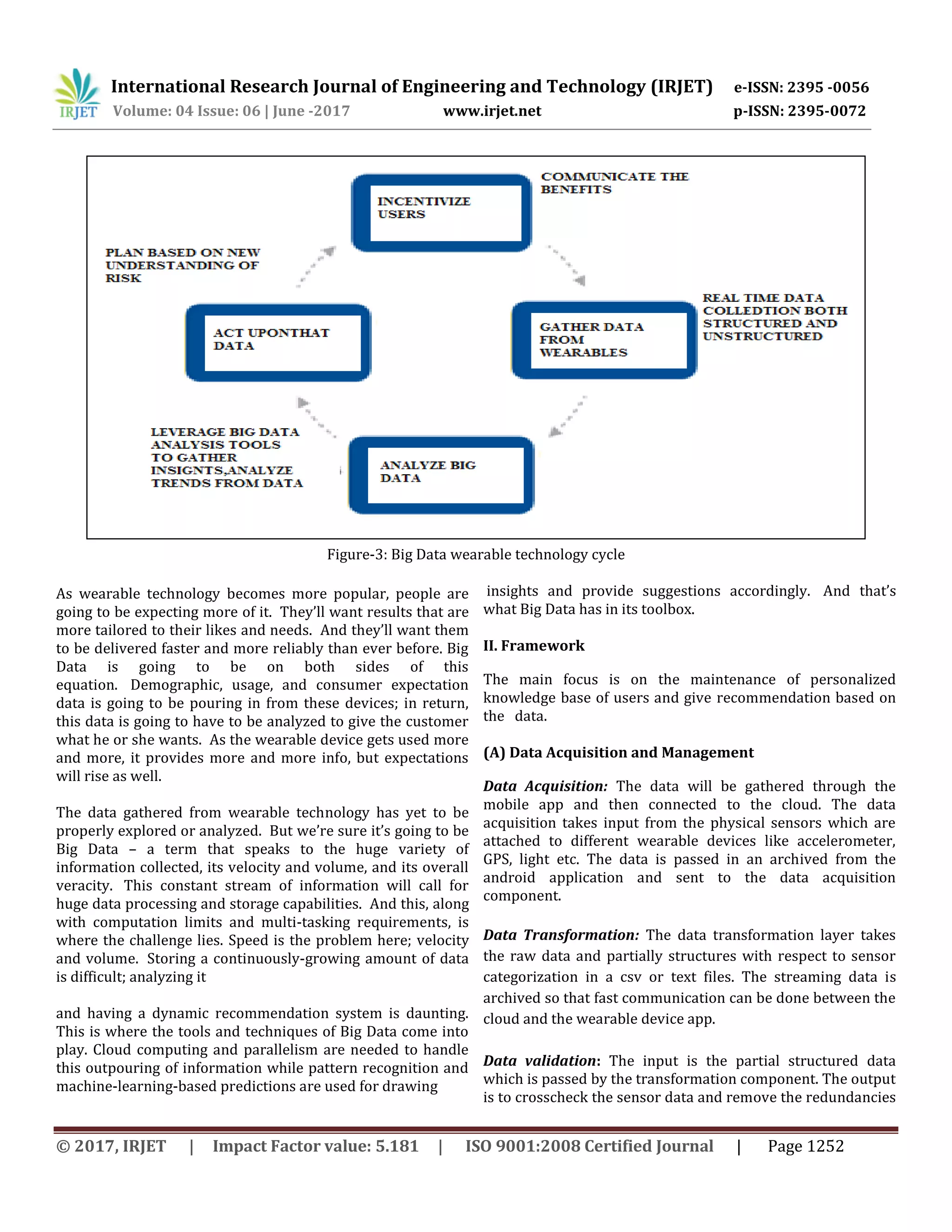
Figure-3: Big Data wearable technology cycle
As wearable technology becomes more popular, people are
going to be expecting more of it. They’ll want results that are
more tailored to their likes and needs. And they’ll want them
to be delivered faster and more reliably than ever before. Big
Data is going to be on both sides of this
equation. Demographic, usage, and consumer expectation
data is going to be pouring in from these devices; in return,
this data is going to have to be analyzed to give the customer
what he or she wants. As the wearable device gets used more
and more, it provides more and more info, but expectations
will rise as well.
The data gathered from wearable technology has yet to be
properly explored or analyzed. But we’re sure it’s going to be
Big Data – a term that speaks to the huge variety of
information collected, its velocity and volume, and its overall
veracity. This constant stream of information will call for
huge data processing and storage capabilities. And this, along
with computation limits and multi-tasking requirements, is
where the challenge lies. Speed is the problem here; velocity
and volume. Storing a continuously-growing amount of data
is difficult; analyzing it
and having a dynamic recommendation system is daunting.
This is where the tools and techniques of Big Data come into
play. Cloud computing and parallelism are needed to handle
this outpouring of information while pattern recognition and
machine-learning-based predictions are used for drawing
insights and provide suggestions accordingly. And that’s
what Big Data has in its toolbox.
II. Framework
The main focus is on the maintenance of personalized
knowledge base of users and give recommendation based on
the data.
(A) Data Acquisition and Management
Data Acquisition: The data will be gathered through the
mobile app and then connected to the cloud. The data
acquisition takes input from the physical sensors which are
attached to different wearable devices like accelerometer,
GPS, light etc. The data is passed in an archived from the
android application and sent to the data acquisition
component.
Data Transformation: The data transformation layer takes
the raw data and partially structures with respect to sensor
categorization in a csv or text files. The streaming data is
archived so that fast communication can be done between the
cloud and the wearable device app.
Data validation: The input is the partial structured data
which is passed by the transformation component. The output
is to crosscheck the sensor data and remove the redundancies
International Research Journal of Engineering and Technology (IRJET) e-ISSN: 2395 -0056
Volume: 04 Issue: 06 | June -2017 www.irjet.net p-ISSN: 2395-0072
© 2017, IRJET | Impact Factor value: 5.181 | ISO 9001:2008 Certified Journal | Page 1253
from it. It is then stored in the Hadoop Distributed File
System.
(B) Personalized Adaptive Analysis
Data Abstraction: The data abstraction selects user
attributes from the configuration file which is processed
further. The input of the data is partially structured data that
is stored in the HDFS. The data abstraction selects user
attributes from the configuration file which is to be processed
further. The configuration file is populated by the user
through the information utilizing API
Data Cleansing: The data cleansing module check the user
attributes their values and structure the schema to store in
the personalized intermediate database. APIs. Querying the
HDFS and bringing the relevant data takes a lot of time so an
intermediate database is introduced.
MapReduce Analysis: Hadoop is a cloud computing platform
and an open source implementation of MapReduce
programming model. In a MapReduce job there are three
phases i.e. map, copy and reduce. The structured schema is
passed on the analysis component as well as the raw logs
stored in HDFS. The output is values of the user attributes and
produce training data for the decision making. The
MapReduce analysis is an intermediate step to populate the
personalized knowledge base. The SQL like queries are used
for retrieving the data from the HDFS through Apache PIG.
Knowledge driven Decision making: This module populate
personalized knowledge base through trained parameters
which will assist user in decision making. The MapReduce
analysis with give the training data help knowledge driven
decision making. The output is personalized knowledge base
through trained parameters. Two machine learning
techniques used for this framework are naive Bayesian and
decision trees.
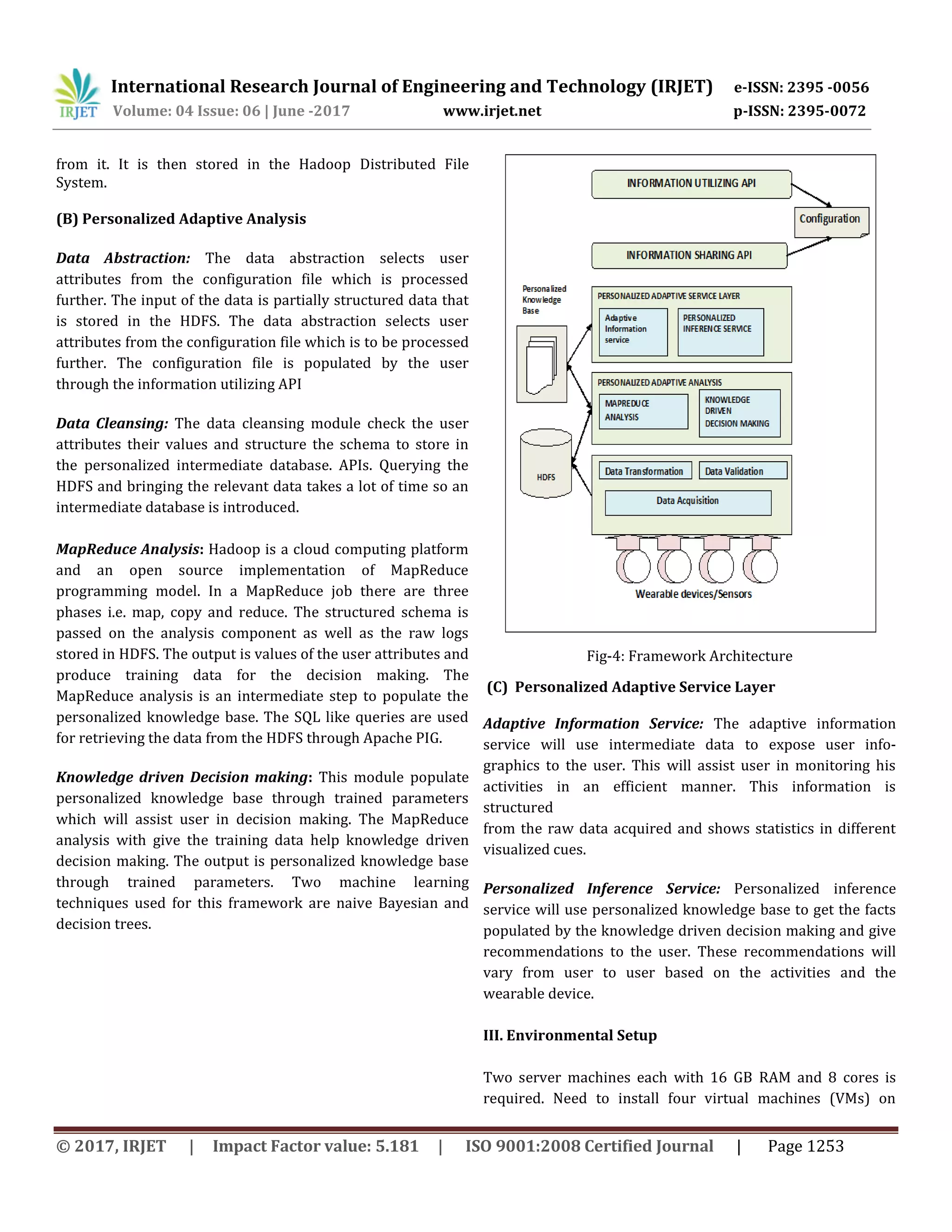
Fig-4: Framework Architecture
(C) Personalized Adaptive Service Layer
Adaptive Information Service: The adaptive information
service will use intermediate data to expose user info-
graphics to the user. This will assist user in monitoring his
activities in an efficient manner. This information is
structured
from the raw data acquired and shows statistics in different
visualized cues.
Personalized Inference Service: Personalized inference
service will use personalized knowledge base to get the facts
populated by the knowledge driven decision making and give
recommendations to the user. These recommendations will
vary from user to user based on the activities and the
wearable device.
III. Environmental Setup
Two server machines each with 16 GB RAM and 8 cores is
required. Need to install four virtual machines (VMs) on
International Research Journal of Engineering and Technology (IRJET) e-ISSN: 2395 -0056
Volume: 04 Issue: 06 | June -2017 www.irjet.net p-ISSN: 2395-0072
© 2017, IRJET | Impact Factor value: 5.181 | ISO 9001:2008 Certified Journal | Page 1254
server 2 and 1 VMs on server two. Use an android application
in the wearable device which archives the data and pass the
data through a web service. This data is stored in Hadoop
Distributed File System. Access the data through Apache Pig
scripts. The MapReduce programs are written in java and run
on 8 VM hadoop cluster. Populate the intermediate database
through the scripts and the adaptive knowledge base through
MapReduce programs. There are two types of MapReduce
implementation. One is for the analysis and one is the
machine learning implementation in which decision making
module is trained and tested.
IV. Conclusion
Wearable data provides a unique opportunity because the
user and the devices have a more intimate connection due to
which we can get more relevant and contextual information.
The data in the next few years is going to balloon and it is
going to be a challenge to analyze and keep an updated
knowledge base. Personalized Big Data is the next wave and
associating different data sources will be main key to
personalization. All of the devices are going to collect a lot of
data and represent a lot of data in real-time which is an
interesting use case for analytics. One of the Key technologies
is MapReduce and its open source solution Hadoop. We have
proposed a framework to give a real time solution to this
problem and at the same time update the knowledge base in a
smooth and efficient manner.
References
1. Lorincz, K., Malan, D.J., Fulford-Jones, T.R., Nawoj, A., Clavel,
A., Shnayder, V.,Mainland, G., Welsh, M., Moulton, S.: Sensor
networks for emergency response: challenges and
opportunities. Pervasive Computing, IEEE 3(2004) 16–23.
2. Dean, J., Ghemawat, S.: Mapreduce: simplified data
processing on large clusters.
Communications of the ACM 51(2008) 107–113.
3. Chawla, N.V., Davis, D.A.: Bringing big data to personalized
healthcare: A patient centered framework. Journal of general
internal medicine 28(2013) 660–665.
4. Chen, L., Nugent, C.D., Wang, H.: A knowledge-driven
approach to activity recognition in smart homes. Knowledge
and Data Engineering, IEEE Transactions on 24 (2012) 961–
974.
5. Provost, F., Fawcett, T.: Data science and its relationship to
big data and data-driven decision making. Big Data (2016)
51–59.
6. D. Y. Chen. The Evolution and Trend of Wearable Computer
(1). Journal of Chongqing University (Natural Science Edition),
2000, 23(3): 119-124.

Wearable Technology Orientation using Big Data Analytics for Improving Quality of Human Life

  • 1.
    International Research Journalof Engineering and Technology (IRJET) e-ISSN: 2395 -0056 Volume: 04 Issue: 06 | June -2017 www.irjet.net p-ISSN: 2395-0072 © 2017, IRJET | Impact Factor value: 5.181 | ISO 9001:2008 Certified Journal | Page 1250 Wearable Technology Orientation Using Big Data Analytics for Improving Quality of Human Life Ch.Srilakshmi Asst Professor,Department of Information Technology R.M.D Engineering College, Kavaraipettai, Chennai, Tamil Nadu ----------------------------------------------------------------------------***-------------------------------------------------------------------------- Abstract: Wearable devices and the data generated by them give a unique opportunity to understand the user behavior and predict future needs due to its personal nature. In coming years this data will grow exponentially due to huge popularity of wearable devices. Analysis will become a challenge with the personal data explosion and also to maintain a updated knowledge base. This calls for big data analysis model for wearable devices. Big data analysis model which will update the knowledge base and give users a personalized recommendation based on the analysis of the data. Big data analysis offers personalized adaptive technique for data handling and transformation from wearable devices. Big Data MapReduce data technologies ensure that data can be used for long term analysis for different applications in the future. Keyword: MapReduce, Wearables, personalized knowledge Base I. Introduction In today’s world a lot of data is generated by the wearable devices which is not leveraged and processed properly. This data is highly unique due to the personal nature of the wearable device. There is an exponential growth in wearable devices and they collect a lot of data which cannot be processed using conventional techniques. The target data are all the devices revolving around the user which can vary from the Digital bracelet, watch, to glasses, to wearable clothing. The data gathered from the wearable devices have yet to be properly explored or analyzed to enable the user to make decisions relevant to it. A) Wearable Tech is the Next Big (Data) Wearable technology is any device which a) is small enough to be worn on the body, such as a watch and b) can wirelessly connect with the Internet, a satellite, another mobile device, or some other connectivity point. Common wearable tech examples include Google Glass and Apple Watch. The recent developed devices related to the Human interaction like Google Glass, Pebble, Fitbit One, heart beat monitor, smart phone, smart shirt etc, show the importance and opens new ways of research and application for IT. Fig-1: CCS Global wearable devices Forecast .
  • 2.
    International Research Journalof Engineering and Technology (IRJET) e-ISSN: 2395 -0056 Volume: 04 Issue: 06 | June -2017 www.irjet.net p-ISSN: 2395-0072 © 2017, IRJET | Impact Factor value: 5.181 | ISO 9001:2008 Certified Journal | Page 1251 Fig-2: Consumer interest in different kind of wearable devices Above figure-2 shows the consumer interest in different kind of wearable devices. Medical wearable devices play a big part in health monitoring and improvement. The next most popular wearable device is the wrist wear and the headset / eyeglasses. If the data generated by wearables are underutilized huge costs is incurred, so there is a strong need to exploit the data for user personalization. A more data driven approach is needed to properly use the data generated by the wearable devices. Knowledge driven approach is also needed for real time continuous activity recognition in a multi sensory environment. Data driven decision making can be effectively achieved by big data technology. With the constant monitoring by the devices, there is a need for a big data solution which has the ability to analyze the huge amount of data. Personalized Big data is becoming a reality with wearable computing on the rise. The wearable devices cover but are not limited to medical devices, sensor based wrist wear, headset, glasses, smart phone and clothing. All these devices collect a lot of data through user input and sensors. The next frontier in generating and leveraging data will be wearable computing. They generate data in real time which brings the big data into picture as it is equipped to handle these things. B) Need for Big Data Analytics Big data refers to data that grows large in terms of velocity, volume, variety and veracity which mean that conventional techniques and database management tools are not as efficient or effective. The challenge arises from data volume, the speed through which is generated and redundant/noisy data. Big Data can provide them with customized recommendations and suggestions. And for marketers, the combination of Big Data and wearable technology can be very powerful indeed.
  • 3.
    International Research Journalof Engineering and Technology (IRJET) e-ISSN: 2395 -0056 Volume: 04 Issue: 06 | June -2017 www.irjet.net p-ISSN: 2395-0072 © 2017, IRJET | Impact Factor value: 5.181 | ISO 9001:2008 Certified Journal | Page 1252 Figure-3: Big Data wearable technology cycle As wearable technology becomes more popular, people are going to be expecting more of it. They’ll want results that are more tailored to their likes and needs. And they’ll want them to be delivered faster and more reliably than ever before. Big Data is going to be on both sides of this equation. Demographic, usage, and consumer expectation data is going to be pouring in from these devices; in return, this data is going to have to be analyzed to give the customer what he or she wants. As the wearable device gets used more and more, it provides more and more info, but expectations will rise as well. The data gathered from wearable technology has yet to be properly explored or analyzed. But we’re sure it’s going to be Big Data – a term that speaks to the huge variety of information collected, its velocity and volume, and its overall veracity. This constant stream of information will call for huge data processing and storage capabilities. And this, along with computation limits and multi-tasking requirements, is where the challenge lies. Speed is the problem here; velocity and volume. Storing a continuously-growing amount of data is difficult; analyzing it and having a dynamic recommendation system is daunting. This is where the tools and techniques of Big Data come into play. Cloud computing and parallelism are needed to handle this outpouring of information while pattern recognition and machine-learning-based predictions are used for drawing insights and provide suggestions accordingly. And that’s what Big Data has in its toolbox. II. Framework The main focus is on the maintenance of personalized knowledge base of users and give recommendation based on the data. (A) Data Acquisition and Management Data Acquisition: The data will be gathered through the mobile app and then connected to the cloud. The data acquisition takes input from the physical sensors which are attached to different wearable devices like accelerometer, GPS, light etc. The data is passed in an archived from the android application and sent to the data acquisition component. Data Transformation: The data transformation layer takes the raw data and partially structures with respect to sensor categorization in a csv or text files. The streaming data is archived so that fast communication can be done between the cloud and the wearable device app. Data validation: The input is the partial structured data which is passed by the transformation component. The output is to crosscheck the sensor data and remove the redundancies
  • 4.
    International Research Journalof Engineering and Technology (IRJET) e-ISSN: 2395 -0056 Volume: 04 Issue: 06 | June -2017 www.irjet.net p-ISSN: 2395-0072 © 2017, IRJET | Impact Factor value: 5.181 | ISO 9001:2008 Certified Journal | Page 1253 from it. It is then stored in the Hadoop Distributed File System. (B) Personalized Adaptive Analysis Data Abstraction: The data abstraction selects user attributes from the configuration file which is processed further. The input of the data is partially structured data that is stored in the HDFS. The data abstraction selects user attributes from the configuration file which is to be processed further. The configuration file is populated by the user through the information utilizing API Data Cleansing: The data cleansing module check the user attributes their values and structure the schema to store in the personalized intermediate database. APIs. Querying the HDFS and bringing the relevant data takes a lot of time so an intermediate database is introduced. MapReduce Analysis: Hadoop is a cloud computing platform and an open source implementation of MapReduce programming model. In a MapReduce job there are three phases i.e. map, copy and reduce. The structured schema is passed on the analysis component as well as the raw logs stored in HDFS. The output is values of the user attributes and produce training data for the decision making. The MapReduce analysis is an intermediate step to populate the personalized knowledge base. The SQL like queries are used for retrieving the data from the HDFS through Apache PIG. Knowledge driven Decision making: This module populate personalized knowledge base through trained parameters which will assist user in decision making. The MapReduce analysis with give the training data help knowledge driven decision making. The output is personalized knowledge base through trained parameters. Two machine learning techniques used for this framework are naive Bayesian and decision trees. Fig-4: Framework Architecture (C) Personalized Adaptive Service Layer Adaptive Information Service: The adaptive information service will use intermediate data to expose user info- graphics to the user. This will assist user in monitoring his activities in an efficient manner. This information is structured from the raw data acquired and shows statistics in different visualized cues. Personalized Inference Service: Personalized inference service will use personalized knowledge base to get the facts populated by the knowledge driven decision making and give recommendations to the user. These recommendations will vary from user to user based on the activities and the wearable device. III. Environmental Setup Two server machines each with 16 GB RAM and 8 cores is required. Need to install four virtual machines (VMs) on
  • 5.
    International Research Journalof Engineering and Technology (IRJET) e-ISSN: 2395 -0056 Volume: 04 Issue: 06 | June -2017 www.irjet.net p-ISSN: 2395-0072 © 2017, IRJET | Impact Factor value: 5.181 | ISO 9001:2008 Certified Journal | Page 1254 server 2 and 1 VMs on server two. Use an android application in the wearable device which archives the data and pass the data through a web service. This data is stored in Hadoop Distributed File System. Access the data through Apache Pig scripts. The MapReduce programs are written in java and run on 8 VM hadoop cluster. Populate the intermediate database through the scripts and the adaptive knowledge base through MapReduce programs. There are two types of MapReduce implementation. One is for the analysis and one is the machine learning implementation in which decision making module is trained and tested. IV. Conclusion Wearable data provides a unique opportunity because the user and the devices have a more intimate connection due to which we can get more relevant and contextual information. The data in the next few years is going to balloon and it is going to be a challenge to analyze and keep an updated knowledge base. Personalized Big Data is the next wave and associating different data sources will be main key to personalization. All of the devices are going to collect a lot of data and represent a lot of data in real-time which is an interesting use case for analytics. One of the Key technologies is MapReduce and its open source solution Hadoop. We have proposed a framework to give a real time solution to this problem and at the same time update the knowledge base in a smooth and efficient manner. References 1. Lorincz, K., Malan, D.J., Fulford-Jones, T.R., Nawoj, A., Clavel, A., Shnayder, V.,Mainland, G., Welsh, M., Moulton, S.: Sensor networks for emergency response: challenges and opportunities. Pervasive Computing, IEEE 3(2004) 16–23. 2. Dean, J., Ghemawat, S.: Mapreduce: simplified data processing on large clusters. Communications of the ACM 51(2008) 107–113. 3. Chawla, N.V., Davis, D.A.: Bringing big data to personalized healthcare: A patient centered framework. Journal of general internal medicine 28(2013) 660–665. 4. Chen, L., Nugent, C.D., Wang, H.: A knowledge-driven approach to activity recognition in smart homes. Knowledge and Data Engineering, IEEE Transactions on 24 (2012) 961– 974. 5. Provost, F., Fawcett, T.: Data science and its relationship to big data and data-driven decision making. Big Data (2016) 51–59. 6. D. Y. Chen. The Evolution and Trend of Wearable Computer (1). Journal of Chongqing University (Natural Science Edition), 2000, 23(3): 119-124.