International Research Journal of Engineering and Technology (IRJET) e-ISSN: 2395 -0056
Volume: 04 Issue: 1 | Jan -2017 www.irjet.net p-ISSN: 2395-0072
© 2017, IRJET | Impact Factor value: 5.181 | ISO 9001:2008 Certified Journal | Page 595
Future of Big Data
Ms. Priya Chaudhari1, Ms. Binita Patel2
1Final year Student B.E., Department of Computer engineering, SVIT Vasad, Gujarat, India
2Final year Student B.E., Department of Computer engineering, SVIT Vasad, Gujarat, India
---------------------------------------------------------------------***---------------------------------------------------------------------
Abstract – As quoted by CNBC – “Data is the new oil”. Big
data has become a business issue or at least an issue that
business people are aware of. Due to the advancement of new
technologies, devices, social media, the amount of data
produced is growing rapidly every year. For instance, The
Large Hadron Collider, when operational last year, generated
1GB of data per second. The amount of data produced by
mankind from the beginning of time till 2003 was 5 billion
gigabytes. The same amount was created in every two days in
2011, and in every ten minutes in 2013. This rate is still
growing enormously. Big data is a collection of large datasets
that requires advanced tools, techniques and frameworks
rather traditional computing techniques. Big data is evolving
rampantly at science symposiums, playing a most vital role
across industries and business firms. As a result the data are
mined for deeper insights and improve business functions,
sales, customers review and satisfaction, privacy and security.
Key Words: Big Data, Hadoop, Cyber security, Machine
learning, IoT, Cloud, Spark
1. INTRODUCTION
Almost everyone has agreed that a big data has taken the
business world by a storm, but what’s next? Will data
continue to grow? What technologieswill developaround it?
Big data has provided firms and institutions with better
sources for analysis, marketing, business decisions, as well
increasing the ability to see those pressure points and
correct issues before customers are even aware of them.
Although, with more data points being collected from
customers, and employees, more and more firms are facing
the challenge of how data can be retrieved and analyzed
faster and more efficiently. The concept of big data fabric
helps firms to address these problems in a way to store,
analyze and stream data that will be efficient to retrieve
actionable information and leverage the value of the data
that we get from customers. Data will continue to grow,
considering that the number of hand handled devices and
Internet-connected devices will grow exponentially.
1.1 Challenges
 Store, handle, analyze
 Increasing volume
 Security
 Integrating collections of data to yield actionable
information
 Employing advanced tools to manage and retrieve
data efficiently
 Staffing shortages
 Forecasting trends
2. Trends and Predictions of Big Data
It's clear that the big data market will grow but
how organizations will be using thisbigdata isnotthatclear.
Along with current technologies new technologies will be
surfaced to improve the big data market. Below are some
trends that are likely to shape the big data market in future:
1. Open source
2. Machine Learning
3. Edge Analytics & Computing
4. Predictive Analytics
5. Cloud Computing
6. Intelligent Security
7. Job trends
2.1. Open Source
Open source applications like Apache Hadoop, Spark, R
programming, Map reduce and more are dominating the big
data space. Hadoop has quickly become synonymous of big
data, but it is difficult to master hadoop, therefore lots of
projects have failed; but now there is Spark, and Hadoophas
come quite a long way. Hadoop is becoming affordable
general purpose solution. But spark, a new framework is
almost 100 times faster than hadoop. Whereas, R is a
programming language and software environment for
statistical analysis, graphical representation and reporting.
Fig-1: Open sources of Big Data
International Research Journal of Engineering and Technology (IRJET) e-ISSN: 2395 -0056
Volume: 04 Issue: 1 | Jan -2017 www.irjet.net p-ISSN: 2395-0072
© 2017, IRJET | Impact Factor value: 5.181 | ISO 9001:2008 Certified Journal | Page 596
2.2. Machine learning
Machine learning is basically a branch of Artificial
Intelligence which helps computers to analyze stored big
data and comes to a conclusion without being programmed
explicitly. According to world’s prominent IT research
companies like Gartner and Ovum predictions has been
made that machine learning will be an essential partfordata
preparations and predictive analysis for profitablebusiness.
Classification of machine learning:
 Supervised- task driven
 Unsupervised- data driven
 Reinforcement- algorithm that learns to react to an
environment
Fig-2: Machine Learning
2.3. Edge Analytics & Computing
Edge Computing is data processing at the edge of network
whereas Edge Analytics is data analysis at the edge of the
network. The Internet of Things (IoT) is supposed to have
considerable impact on big data. This IoT big data of
companies is dealt with the help of latest technology called
edge computing. It improves performance by reducing the
data flowing over the networks and also saves cloud
computing cost. In situation where data is routed
inefficiently or delays occur, Edge Analytics can be used to
solve these issues. Also, rather than using polarized systems
in which raw data is sent to data warehouse where it is
cleaned and analyzed, systems which can perform these
tasks at the edge of system are more productive. Bringing
analytics to data is a principle that makes edge analytics an
enticing topic. For instance, a massive scale CCTV security
system, with thousands of camerascoveringa largearea.Itis
better if the images captured by the cameras at the moment
could be analyzed themselves and data which is useless can
be marked as low priority or discarded, so that it can avoid
generating expense as well as compliance burdens.
2.4. Predictive Analytics
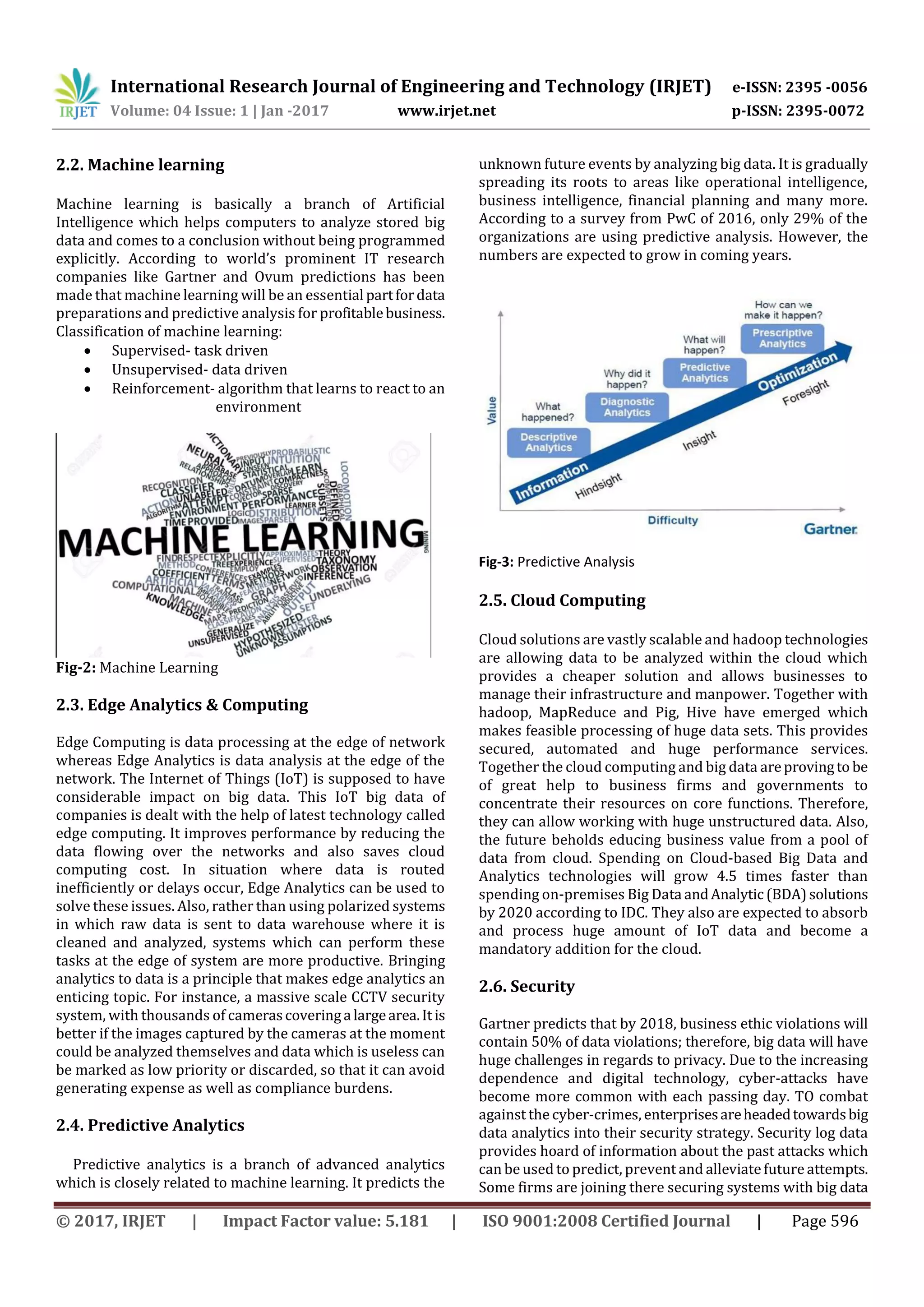
Predictive analytics is a branch of advanced analytics
which is closely related to machine learning. It predicts the
unknown future events by analyzing big data. It is gradually
spreading its roots to areas like operational intelligence,
business intelligence, financial planning and many more.
According to a survey from PwC of 2016, only 29% of the
organizations are using predictive analysis. However, the
numbers are expected to grow in coming years.
Fig-3: Predictive Analysis
2.5. Cloud Computing
Cloud solutions are vastly scalable and hadoop technologies
are allowing data to be analyzed within the cloud which
provides a cheaper solution and allows businesses to
manage their infrastructure and manpower. Together with
hadoop, MapReduce and Pig, Hive have emerged which
makes feasible processing of huge data sets. This provides
secured, automated and huge performance services.
Together the cloud computing and big data areprovingto be
of great help to business firms and governments to
concentrate their resources on core functions. Therefore,
they can allow working with huge unstructured data. Also,
the future beholds educing business value from a pool of
data from cloud. Spending on Cloud-based Big Data and
Analytics technologies will grow 4.5 times faster than
spending on-premises Big Data andAnalytic (BDA)solutions
by 2020 according to IDC. They also are expected to absorb
and process huge amount of IoT data and become a
mandatory addition for the cloud.
2.6. Security
Gartner predicts that by 2018, business ethic violations will
contain 50% of data violations; therefore, big data will have
huge challenges in regards to privacy. Due to the increasing
dependence and digital technology, cyber-attacks have
become more common with each passing day. TO combat
against the cyber-crimes, enterprisesareheadedtowardsbig
data analytics into their security strategy. Security log data
provides hoard of information about the past attacks which
can be used to predict, prevent and alleviatefutureattempts.
Some firms are joining there securing systems with big data
International Research Journal of Engineering and Technology (IRJET) e-ISSN: 2395 -0056
Volume: 04 Issue: 1 | Jan -2017 www.irjet.net p-ISSN: 2395-0072
© 2017, IRJET | Impact Factor value: 5.181 | ISO 9001:2008 Certified Journal | Page 597
platforms like hadoop whereas others are dependent on
vendor products that include big data analytic properties. As
reported Cybersecurity Ventures,cybersecurityexpenditure
will exceed $1 trillion from 2017 to 2021.
Fig-4: Intelligent Security
2.7. Job Trends
Due to increased demands there is need to bridge the talent
gap in data analytics. Therefore, academic institutions are
compiling degree programs in data science, boot camp style
schools are providing training in marketable skills.
According to an industry estimate data scientist will receive
twice the remuneration received by a programmer. Also
companies are more likely to appoint chief data officers
(CDO).
Fig-5 Predicted Salaries
3. CONCLUSION
Gartner predicts that by 2020bigdata andInternet ofThings
will be used to reinvent, digitize and eliminate 80% of
business processes. Therefore, the impact that big data will
have on various businesses cannot be overlooked. To truly
uncover the power of big data, organizations must identify
how to use their data to build reporting and analytics for
their operations. Studying all the latest leading big market
analysis and research, it can be assumed that 15% of IT
organizations will move to cloud based service platforms
and service market is anticipated to rise about35%by2021.
Summarizing, Peter Sondergaard, Senior Vice President of
Gartner Research famously stated, ― ”Information is the oil
of the 21st century and analytics is the combustionengine”..
REFERENCES
[1] Huawei Noah's Ark Lab, Hong Kong Science Park, Shatin,
Hong Kong "Mining big data: current status and forecast
To the future" ACM SIGKDD Explorations Newsletter
Volume 14 Issue 2, December 2012.
[2] “BIG DATA MINING” VIT University, Vellore
Yash Gupta, Mustafa Bohra, Mastan Patel, Jeet Kumar
IRJET publications Volume: 03 Issue: 11 | Nov -2016
[3] Lizhe Gregor, vonLaszewski,AndrewYoungeXi,HeMarcel
KunzeJie, TaoCheng Fu “Cloud Computing: a Perspective
Study” Article First Online: 03 June 2010
DOI: 10.1007/s00354-008-0081-5
[4] Ken Birman, Gregory Chockler, Robbert van Renesse
“Toward a cloud computing research agenda” Newsletter
ACM SIGACT News archive Volume 40 Issue 2, June 2009
[5] Amir Gandomi, Murtaza Haider “Beyond the hype: Big
data concepts, methods, and analytics”
Volume 35, Issue 2, April 2015, Pages 137–144
[6] Stephen Kaisler, Frank Armour, J. Alberto Espinosa,
William Money “Big Data: Issues and Challenges Moving
Forward”
[7] Data Mining: Practical Machine Learning Tools and
Techniques, Second Edition By Ian H. Witten, Eibe Frank
[8] Varian, Hal R. “Big Data: New Tricks for Econometrics”
The Journal of Economic Perspectives, Volume 28,
Number 2, Spring 2014, pp. 3-27(25) in American
Economic Association

Future of Big Data

  • 1.
    International Research Journalof Engineering and Technology (IRJET) e-ISSN: 2395 -0056 Volume: 04 Issue: 1 | Jan -2017 www.irjet.net p-ISSN: 2395-0072 © 2017, IRJET | Impact Factor value: 5.181 | ISO 9001:2008 Certified Journal | Page 595 Future of Big Data Ms. Priya Chaudhari1, Ms. Binita Patel2 1Final year Student B.E., Department of Computer engineering, SVIT Vasad, Gujarat, India 2Final year Student B.E., Department of Computer engineering, SVIT Vasad, Gujarat, India ---------------------------------------------------------------------***--------------------------------------------------------------------- Abstract – As quoted by CNBC – “Data is the new oil”. Big data has become a business issue or at least an issue that business people are aware of. Due to the advancement of new technologies, devices, social media, the amount of data produced is growing rapidly every year. For instance, The Large Hadron Collider, when operational last year, generated 1GB of data per second. The amount of data produced by mankind from the beginning of time till 2003 was 5 billion gigabytes. The same amount was created in every two days in 2011, and in every ten minutes in 2013. This rate is still growing enormously. Big data is a collection of large datasets that requires advanced tools, techniques and frameworks rather traditional computing techniques. Big data is evolving rampantly at science symposiums, playing a most vital role across industries and business firms. As a result the data are mined for deeper insights and improve business functions, sales, customers review and satisfaction, privacy and security. Key Words: Big Data, Hadoop, Cyber security, Machine learning, IoT, Cloud, Spark 1. INTRODUCTION Almost everyone has agreed that a big data has taken the business world by a storm, but what’s next? Will data continue to grow? What technologieswill developaround it? Big data has provided firms and institutions with better sources for analysis, marketing, business decisions, as well increasing the ability to see those pressure points and correct issues before customers are even aware of them. Although, with more data points being collected from customers, and employees, more and more firms are facing the challenge of how data can be retrieved and analyzed faster and more efficiently. The concept of big data fabric helps firms to address these problems in a way to store, analyze and stream data that will be efficient to retrieve actionable information and leverage the value of the data that we get from customers. Data will continue to grow, considering that the number of hand handled devices and Internet-connected devices will grow exponentially. 1.1 Challenges  Store, handle, analyze  Increasing volume  Security  Integrating collections of data to yield actionable information  Employing advanced tools to manage and retrieve data efficiently  Staffing shortages  Forecasting trends 2. Trends and Predictions of Big Data It's clear that the big data market will grow but how organizations will be using thisbigdata isnotthatclear. Along with current technologies new technologies will be surfaced to improve the big data market. Below are some trends that are likely to shape the big data market in future: 1. Open source 2. Machine Learning 3. Edge Analytics & Computing 4. Predictive Analytics 5. Cloud Computing 6. Intelligent Security 7. Job trends 2.1. Open Source Open source applications like Apache Hadoop, Spark, R programming, Map reduce and more are dominating the big data space. Hadoop has quickly become synonymous of big data, but it is difficult to master hadoop, therefore lots of projects have failed; but now there is Spark, and Hadoophas come quite a long way. Hadoop is becoming affordable general purpose solution. But spark, a new framework is almost 100 times faster than hadoop. Whereas, R is a programming language and software environment for statistical analysis, graphical representation and reporting. Fig-1: Open sources of Big Data
  • 2.
    International Research Journalof Engineering and Technology (IRJET) e-ISSN: 2395 -0056 Volume: 04 Issue: 1 | Jan -2017 www.irjet.net p-ISSN: 2395-0072 © 2017, IRJET | Impact Factor value: 5.181 | ISO 9001:2008 Certified Journal | Page 596 2.2. Machine learning Machine learning is basically a branch of Artificial Intelligence which helps computers to analyze stored big data and comes to a conclusion without being programmed explicitly. According to world’s prominent IT research companies like Gartner and Ovum predictions has been made that machine learning will be an essential partfordata preparations and predictive analysis for profitablebusiness. Classification of machine learning:  Supervised- task driven  Unsupervised- data driven  Reinforcement- algorithm that learns to react to an environment Fig-2: Machine Learning 2.3. Edge Analytics & Computing Edge Computing is data processing at the edge of network whereas Edge Analytics is data analysis at the edge of the network. The Internet of Things (IoT) is supposed to have considerable impact on big data. This IoT big data of companies is dealt with the help of latest technology called edge computing. It improves performance by reducing the data flowing over the networks and also saves cloud computing cost. In situation where data is routed inefficiently or delays occur, Edge Analytics can be used to solve these issues. Also, rather than using polarized systems in which raw data is sent to data warehouse where it is cleaned and analyzed, systems which can perform these tasks at the edge of system are more productive. Bringing analytics to data is a principle that makes edge analytics an enticing topic. For instance, a massive scale CCTV security system, with thousands of camerascoveringa largearea.Itis better if the images captured by the cameras at the moment could be analyzed themselves and data which is useless can be marked as low priority or discarded, so that it can avoid generating expense as well as compliance burdens. 2.4. Predictive Analytics Predictive analytics is a branch of advanced analytics which is closely related to machine learning. It predicts the unknown future events by analyzing big data. It is gradually spreading its roots to areas like operational intelligence, business intelligence, financial planning and many more. According to a survey from PwC of 2016, only 29% of the organizations are using predictive analysis. However, the numbers are expected to grow in coming years. Fig-3: Predictive Analysis 2.5. Cloud Computing Cloud solutions are vastly scalable and hadoop technologies are allowing data to be analyzed within the cloud which provides a cheaper solution and allows businesses to manage their infrastructure and manpower. Together with hadoop, MapReduce and Pig, Hive have emerged which makes feasible processing of huge data sets. This provides secured, automated and huge performance services. Together the cloud computing and big data areprovingto be of great help to business firms and governments to concentrate their resources on core functions. Therefore, they can allow working with huge unstructured data. Also, the future beholds educing business value from a pool of data from cloud. Spending on Cloud-based Big Data and Analytics technologies will grow 4.5 times faster than spending on-premises Big Data andAnalytic (BDA)solutions by 2020 according to IDC. They also are expected to absorb and process huge amount of IoT data and become a mandatory addition for the cloud. 2.6. Security Gartner predicts that by 2018, business ethic violations will contain 50% of data violations; therefore, big data will have huge challenges in regards to privacy. Due to the increasing dependence and digital technology, cyber-attacks have become more common with each passing day. TO combat against the cyber-crimes, enterprisesareheadedtowardsbig data analytics into their security strategy. Security log data provides hoard of information about the past attacks which can be used to predict, prevent and alleviatefutureattempts. Some firms are joining there securing systems with big data
  • 3.
    International Research Journalof Engineering and Technology (IRJET) e-ISSN: 2395 -0056 Volume: 04 Issue: 1 | Jan -2017 www.irjet.net p-ISSN: 2395-0072 © 2017, IRJET | Impact Factor value: 5.181 | ISO 9001:2008 Certified Journal | Page 597 platforms like hadoop whereas others are dependent on vendor products that include big data analytic properties. As reported Cybersecurity Ventures,cybersecurityexpenditure will exceed $1 trillion from 2017 to 2021. Fig-4: Intelligent Security 2.7. Job Trends Due to increased demands there is need to bridge the talent gap in data analytics. Therefore, academic institutions are compiling degree programs in data science, boot camp style schools are providing training in marketable skills. According to an industry estimate data scientist will receive twice the remuneration received by a programmer. Also companies are more likely to appoint chief data officers (CDO). Fig-5 Predicted Salaries 3. CONCLUSION Gartner predicts that by 2020bigdata andInternet ofThings will be used to reinvent, digitize and eliminate 80% of business processes. Therefore, the impact that big data will have on various businesses cannot be overlooked. To truly uncover the power of big data, organizations must identify how to use their data to build reporting and analytics for their operations. Studying all the latest leading big market analysis and research, it can be assumed that 15% of IT organizations will move to cloud based service platforms and service market is anticipated to rise about35%by2021. Summarizing, Peter Sondergaard, Senior Vice President of Gartner Research famously stated, ― ”Information is the oil of the 21st century and analytics is the combustionengine”.. REFERENCES [1] Huawei Noah's Ark Lab, Hong Kong Science Park, Shatin, Hong Kong "Mining big data: current status and forecast To the future" ACM SIGKDD Explorations Newsletter Volume 14 Issue 2, December 2012. [2] “BIG DATA MINING” VIT University, Vellore Yash Gupta, Mustafa Bohra, Mastan Patel, Jeet Kumar IRJET publications Volume: 03 Issue: 11 | Nov -2016 [3] Lizhe Gregor, vonLaszewski,AndrewYoungeXi,HeMarcel KunzeJie, TaoCheng Fu “Cloud Computing: a Perspective Study” Article First Online: 03 June 2010 DOI: 10.1007/s00354-008-0081-5 [4] Ken Birman, Gregory Chockler, Robbert van Renesse “Toward a cloud computing research agenda” Newsletter ACM SIGACT News archive Volume 40 Issue 2, June 2009 [5] Amir Gandomi, Murtaza Haider “Beyond the hype: Big data concepts, methods, and analytics” Volume 35, Issue 2, April 2015, Pages 137–144 [6] Stephen Kaisler, Frank Armour, J. Alberto Espinosa, William Money “Big Data: Issues and Challenges Moving Forward” [7] Data Mining: Practical Machine Learning Tools and Techniques, Second Edition By Ian H. Witten, Eibe Frank [8] Varian, Hal R. “Big Data: New Tricks for Econometrics” The Journal of Economic Perspectives, Volume 28, Number 2, Spring 2014, pp. 3-27(25) in American Economic Association