1
Developing	
  an	
  Sustainable	
  IT	
  Capability:	
  Lessons	
  
From	
  Intel's	
  Journey	
  
Edward	
  Curry 	
   	
  Digital	
  Enterprise	
  Research	
  Ins7tute	
  (DERI)	
  
Bill	
  Guyon 	
   	
   	
  Intel	
  Coropora7on	
  
Charles	
  Sheridan 	
   	
  Intel	
  Labs	
  Europe	
  
Brian	
  Donnellan 	
   	
  Innova7on	
  Value	
  Ins7tute	
  (IVI)	


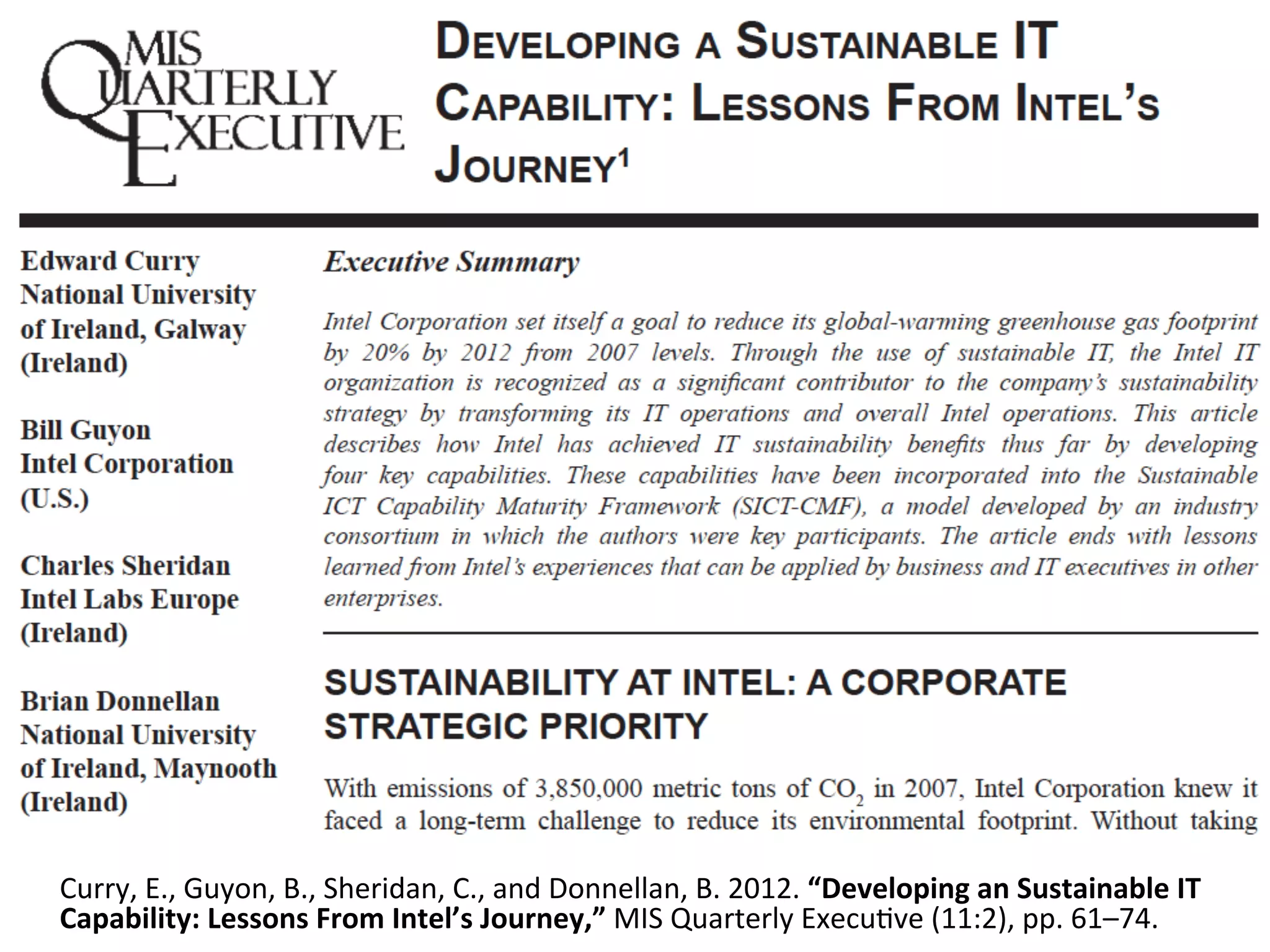
Curry,	
  E.,	
  Guyon,	
  B.,	
  Sheridan,	
  C.,	
  and	
  Donnellan,	
  B.	
  2012.	
  “Developing	
  an	
  Sustainable	
  IT	
  
Capability:	
  Lessons	
  From	
  Intel’s	
  Journey,”	
  MIS	
  Quarterly	
  Execu7ve	
  (11:2),	
  pp.	
  61–74.	
  
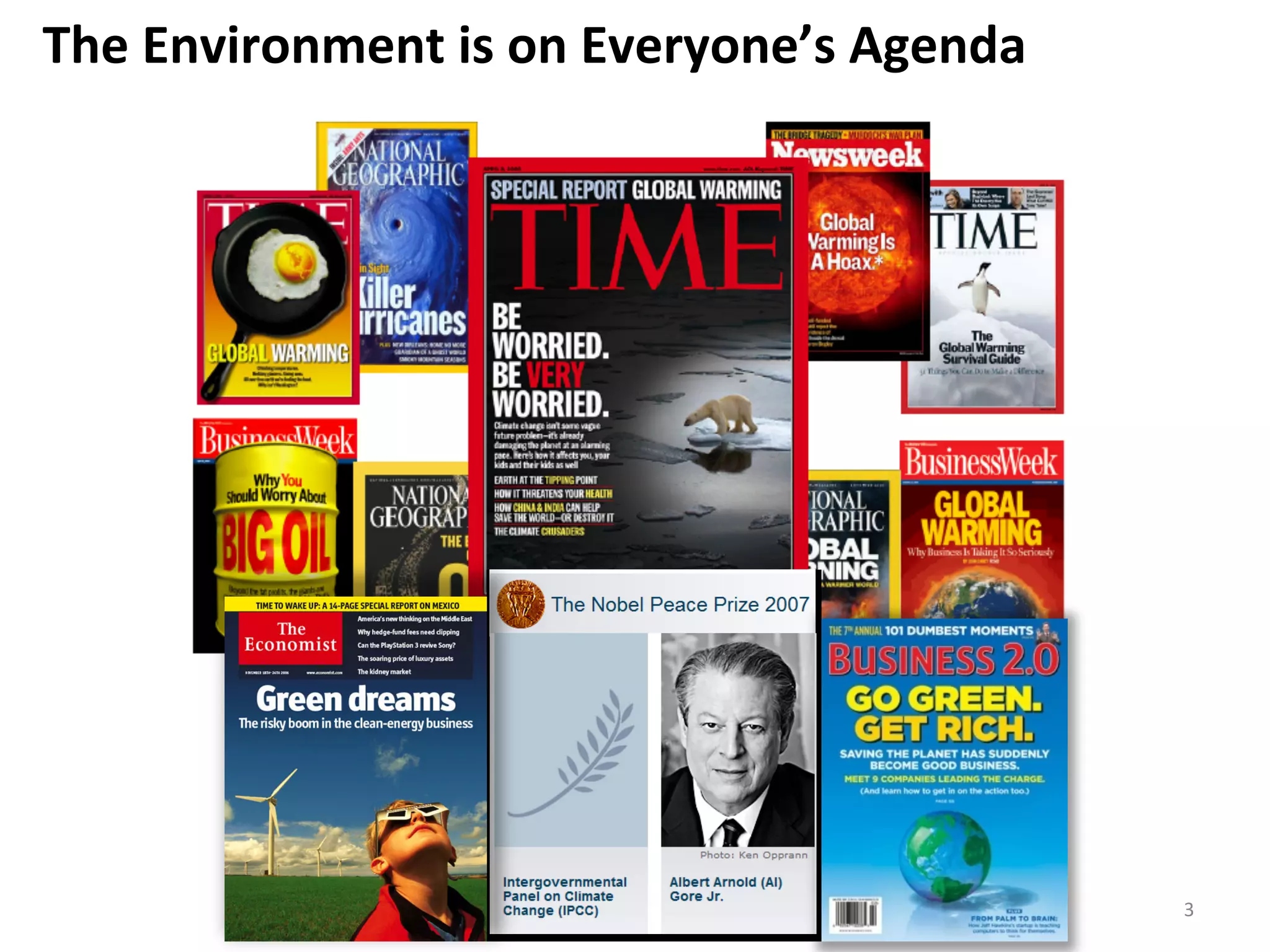
3	
  	
  
The	
  Environment	
  is	
  on	
  Everyone’s	
  Agenda	
  
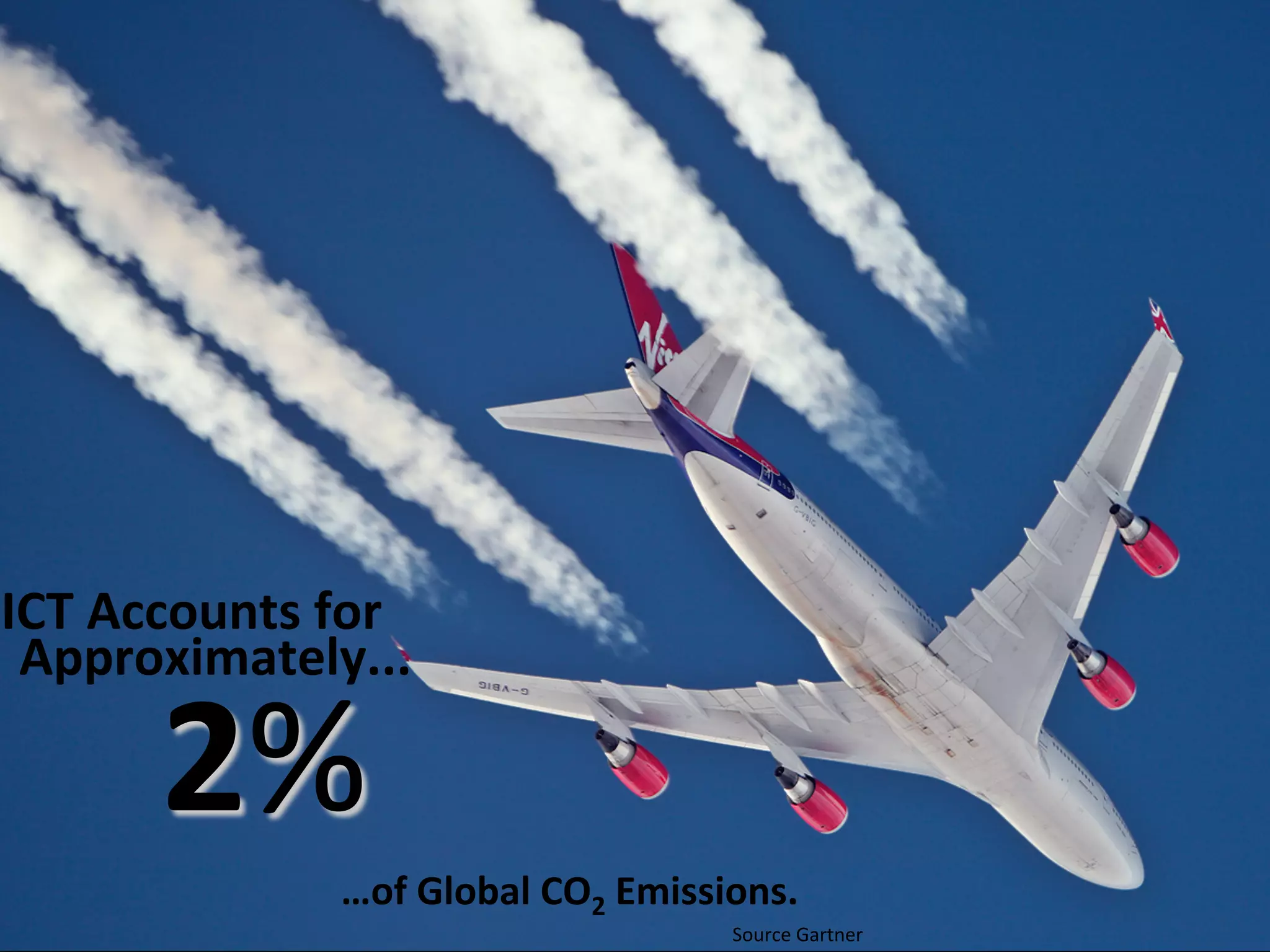
4	
  	
  
ICT’s	
  Mass	
  ProducGon	
  Carbon	
  Cost	
  
2%	
  
ICT	
  Accounts	
  for	
  
Approximately...	
  
…of	
  Global	
  CO2	
  Emissions.	
  
Source	
  Gartner	
  
McKinsey	
  2020	
  Report	
  
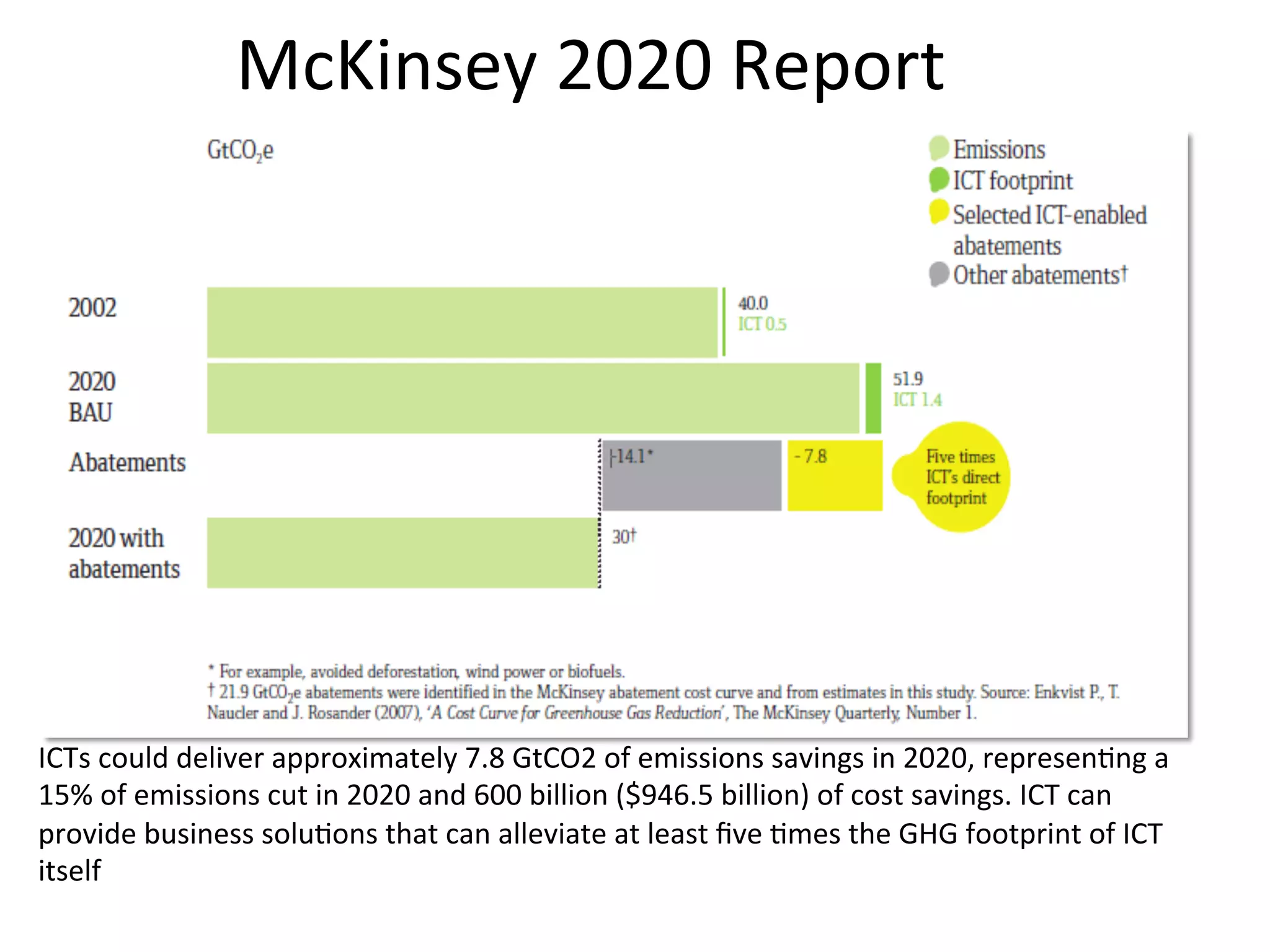
ICTs	
  could	
  deliver	
  approximately	
  7.8	
  GtCO2	
  of	
  emissions	
  savings	
  in	
  2020,	
  represen7ng	
  a	
  
15%	
  of	
  emissions	
  cut	
  in	
  2020	
  and	
  600	
  billion	
  ($946.5	
  billion)	
  of	
  cost	
  savings.	
  ICT	
  can	
  
provide	
  business	
  solu7ons	
  that	
  can	
  alleviate	
  at	
  least	
  five	
  7mes	
  the	
  GHG	
  footprint	
  of	
  ICT	
  
itself	
  
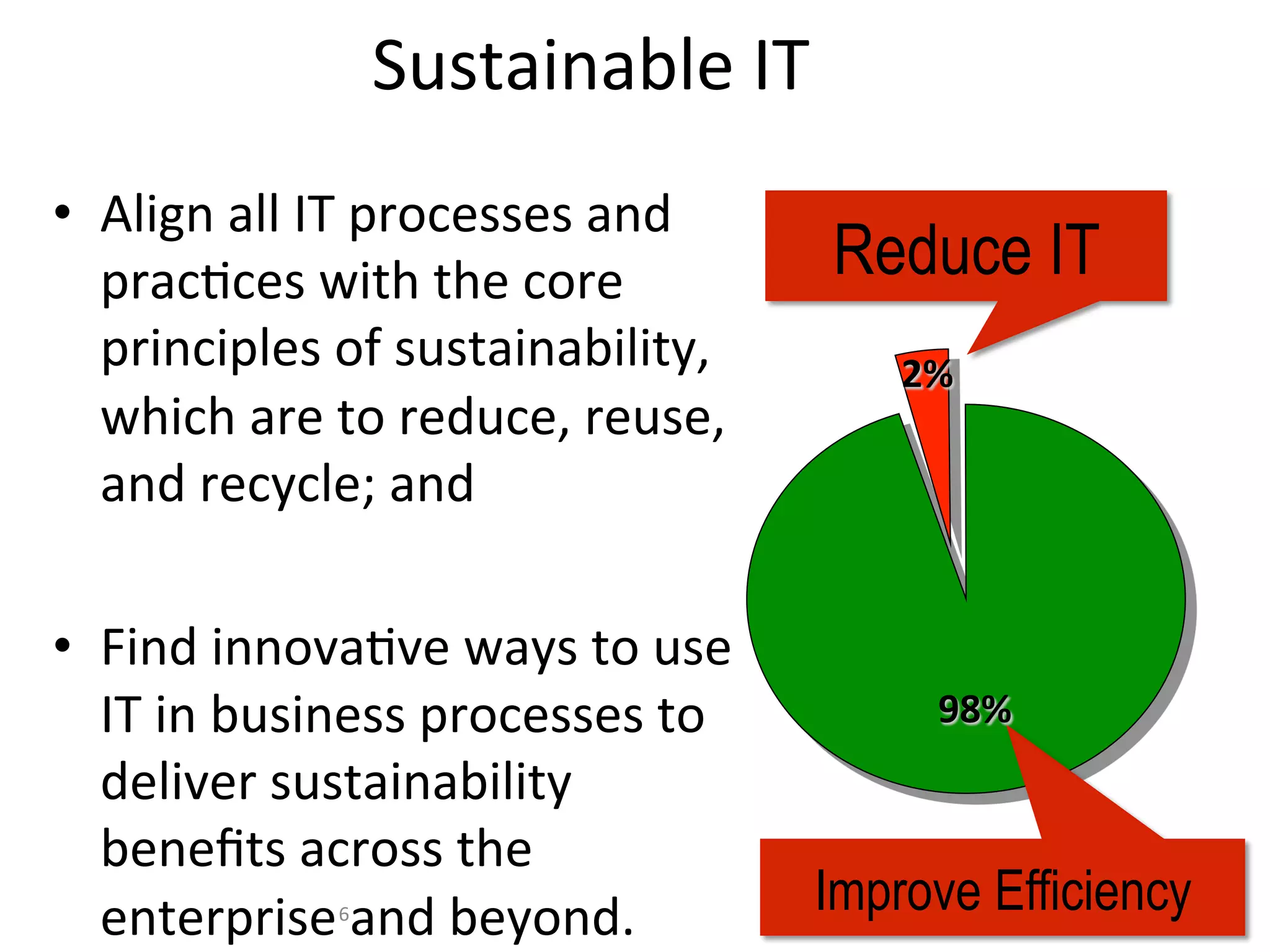
•  Align	
  all	
  IT	
  processes	
  and	
  
prac7ces	
  with	
  the	
  core	
  
principles	
  of	
  sustainability,	
  
which	
  are	
  to	
  reduce,	
  reuse,	
  
and	
  recycle;	
  and	
  
•  Find	
  innova7ve	
  ways	
  to	
  use	
  
IT	
  in	
  business	
  processes	
  to	
  
deliver	
  sustainability	
  
benefits	
  across	
  the	
  
enterprise	
  and	
  beyond.	
  6	
  	
  
2%	
  
Reduce IT
Improve Efficiency
Sustainable	
  IT	
  
98%	
  
Sustainability	
  1.0	
  Case	
  Study	
  	
  
Intel	
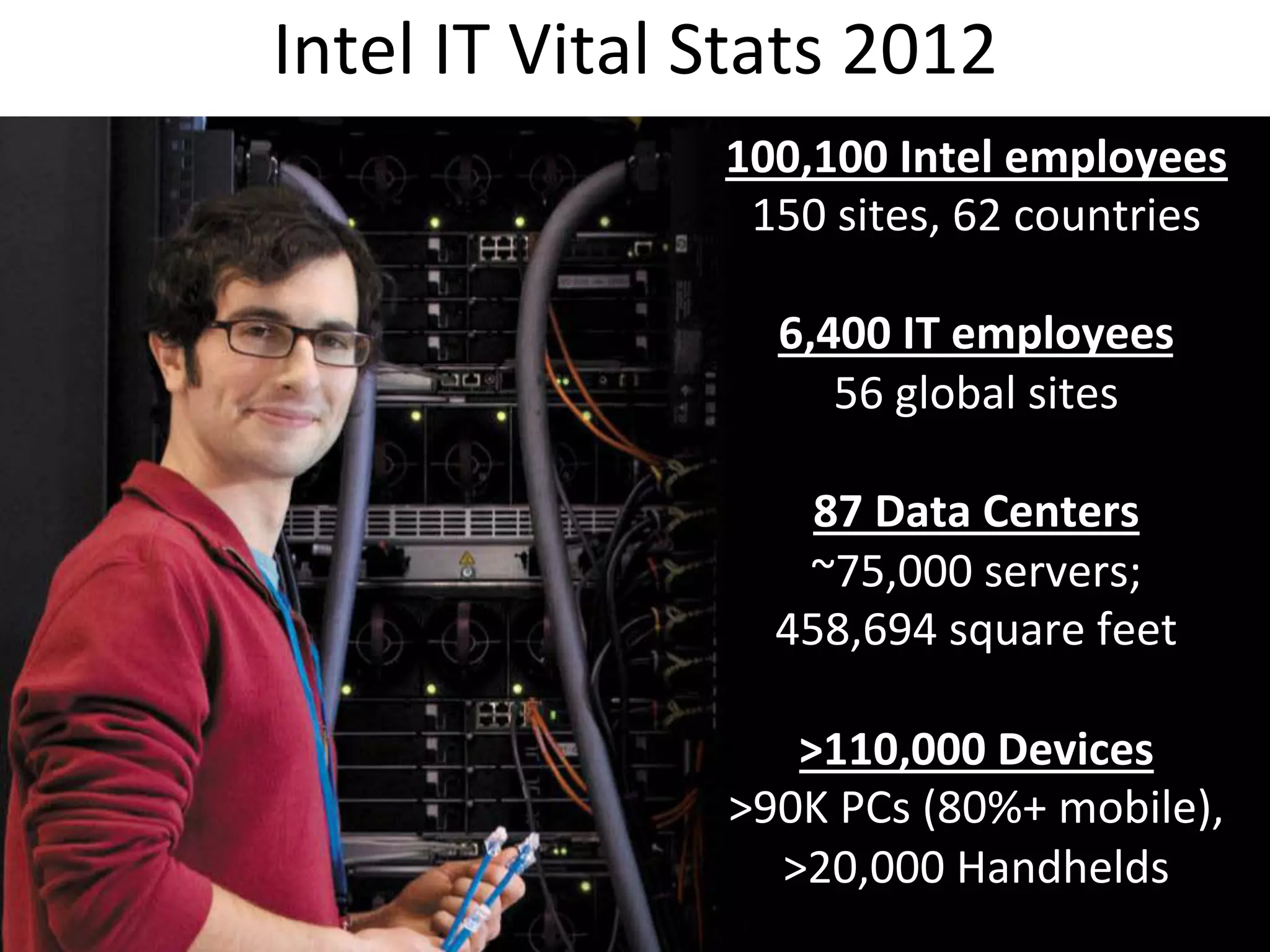
  IT	
  Vital	
  Stats	
  2012	
  
100,100	
  Intel	
  employees	
  
150	
  sites,	
  62	
  countries	


6,400	
  IT	
  employees	
  
56	
  global	
  sites	


87	
  Data	
  Centers	
  
~75,000	
  servers;	
  	
  
458,694	
  square	
  feet	


>110,000	
  Devices	
  
>90K	
  PCs	
  (80%+	
  mobile),	
  
>20,000	
  Handhelds	
  
Sustainability	
  @	
  	
  
Sustainability	
  @	
  Intel	
  
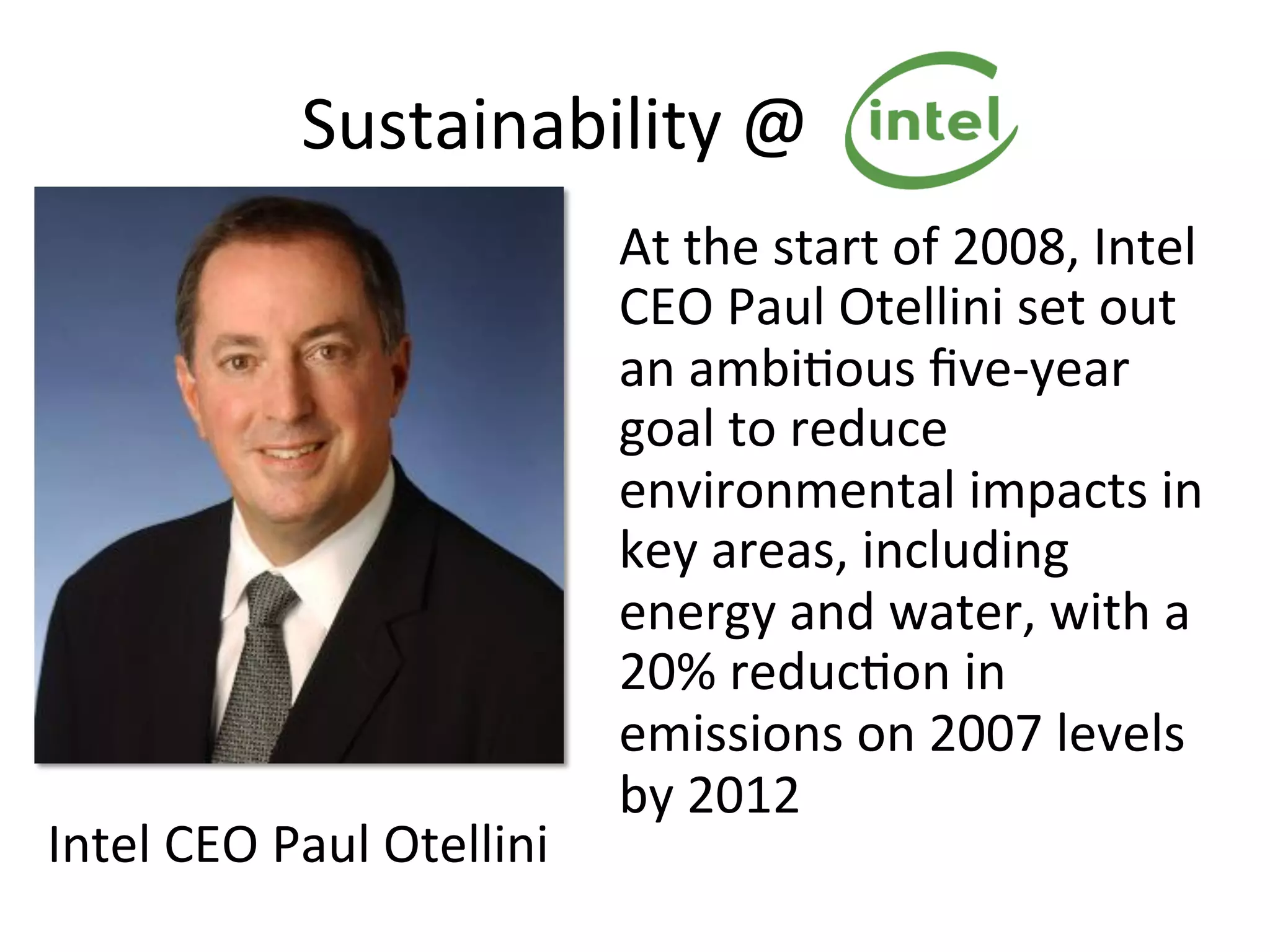
At	
  the	
  start	
  of	
  2008,	
  Intel	
  
CEO	
  Paul	
  Otellini	
  set	
  out	
  
an	
  ambi7ous	
  five-­‐year	
  
goal	
  to	
  reduce	
  
environmental	
  impacts	
  in	
  
key	
  areas,	
  including	
  
energy	
  and	
  water,	
  with	
  a	
  
20%	
  reduc7on	
  in	
  
emissions	
  on	
  2007	
  levels	
  
by	
  2012	
  
Intel	
  CEO	
  Paul	
  Otellini	
  	
  
IT	
  Sustainability	
  @	
  Intel	
  
CIO	
  saw	
  opportunity	
  for	
  
Intel	
  IT	
  to	
  play	
  a	
  key	
  role	
  in	
  
enabling	
  the	
  company	
  to	
  
achieve	
  its	
  corporate	
  
sustainability	
  goals	


Commiged	
  Intel	
  IT	
  to	
  
helping	
  the	
  business	
  deliver	
  
its	
  objec7ves	
  through	
  use	
  of	
  
sustainable	
  IT	
  
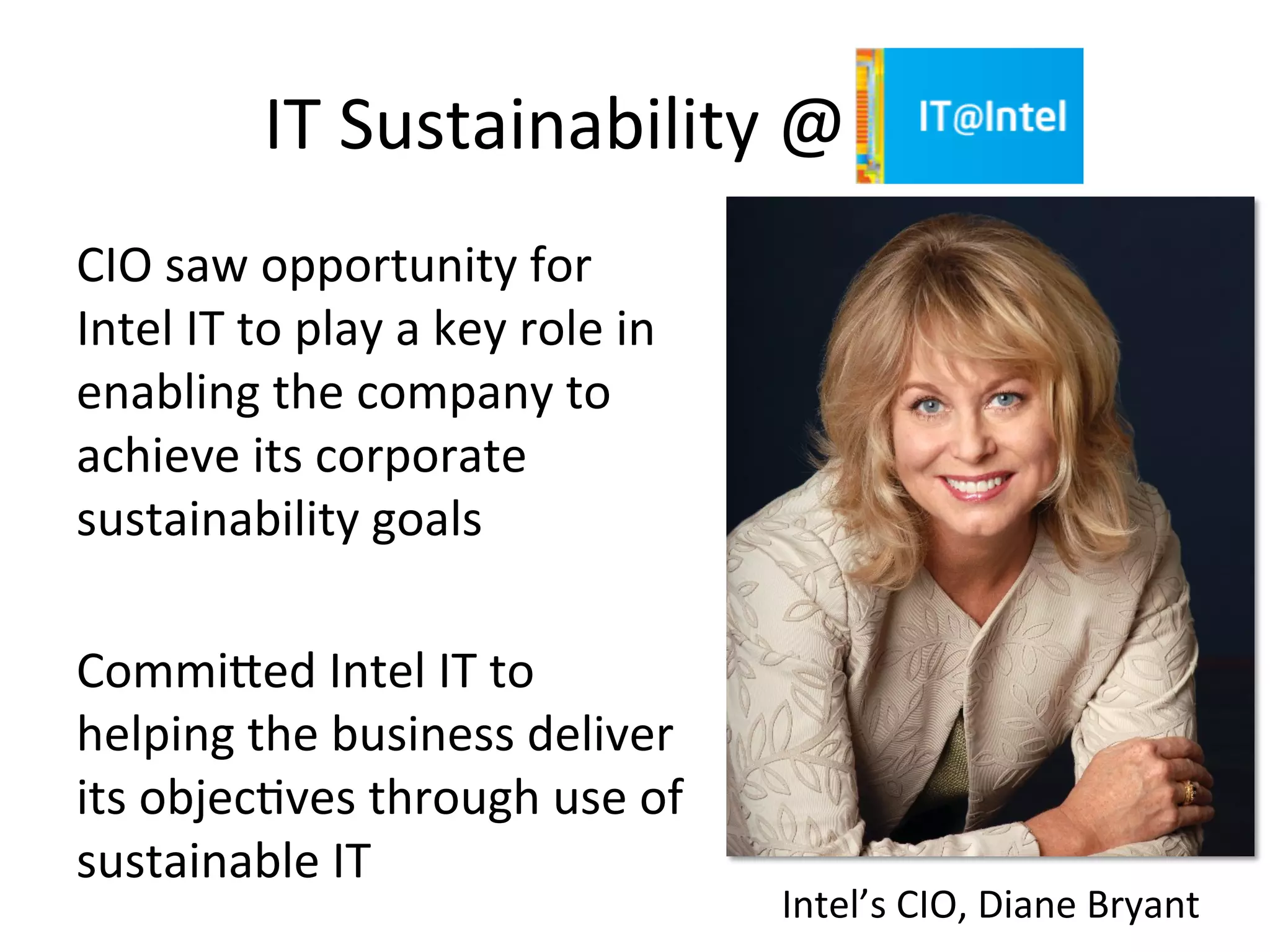
Intel’s	
  CIO,	
  Diane	
  Bryant	
  
Developing	
  an	
  IT	
  Sustainability	
  
Capability	
  
•  Aligning	
  IT	
  and	
  Corporate	
  Goals	
  
•  3	
  Phase	
  Sustainable	
  IT	
  Roadmap	
  
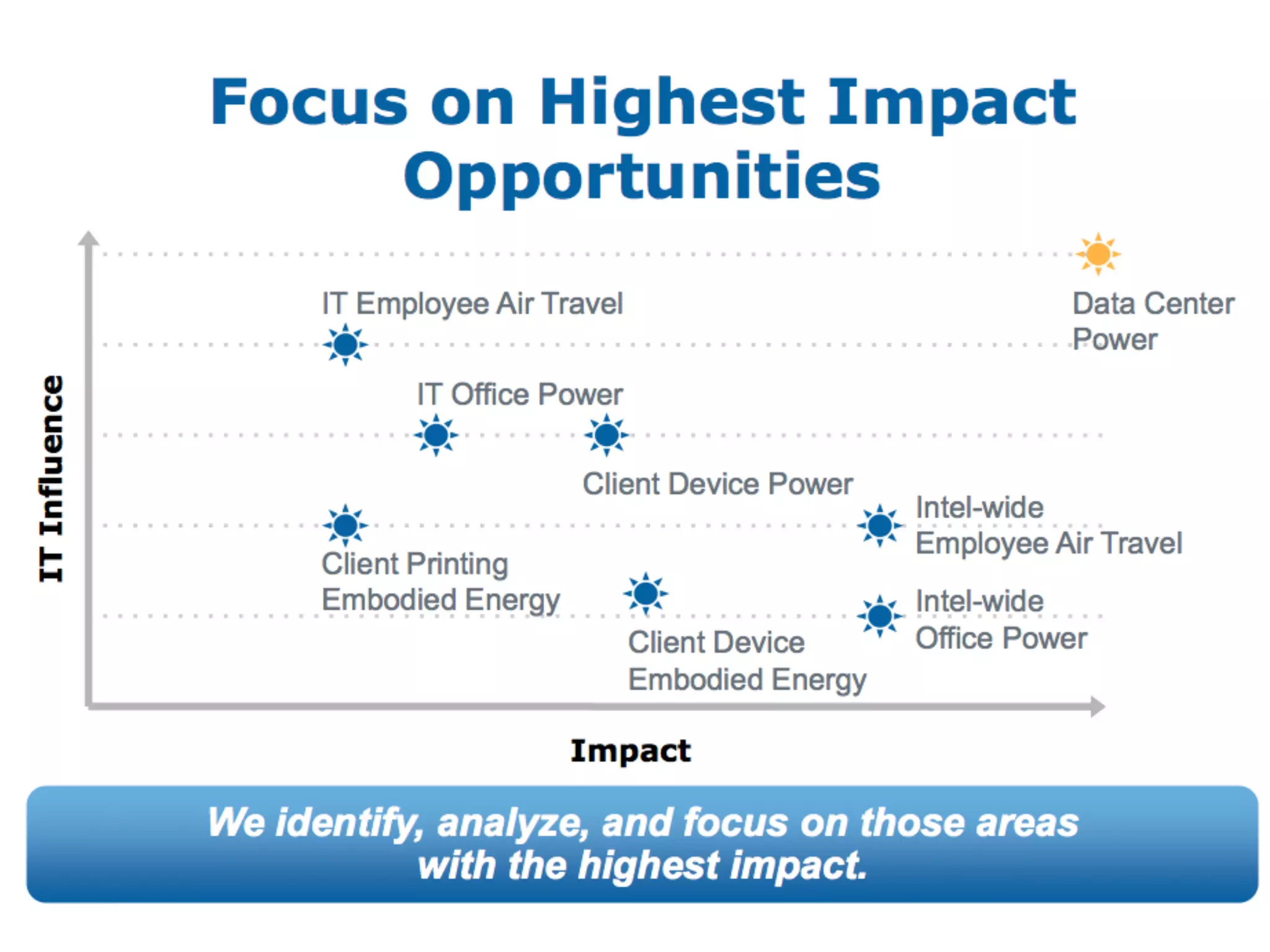
•  Understanding	
  The	
  IT	
  Footprint	
  
•  Iden7fying	
  High-­‐Impact	
  Opportuni7es	
  
•  Develop	
  a	
  Sustainable	
  Culture	
  
•  Use	
  Employee	
  Incen7ve	
  Programs	
  to	
  Drive	
  
Innova7on	
  
•  Build	
  the	
  Business	
  Case	
  for	
  Sustainability	
  
Employee
Bonus
Employee-led
Activities
Small Office IT
Footprint
LED
Light Fixtures
Telepresence
Rooms
Solar
Panels
“LEED Gold”
building design
High efficiency
Data Centers
Energy
Management Software
Sustainable
IT @ Intel IT
Reduced
Business Travel
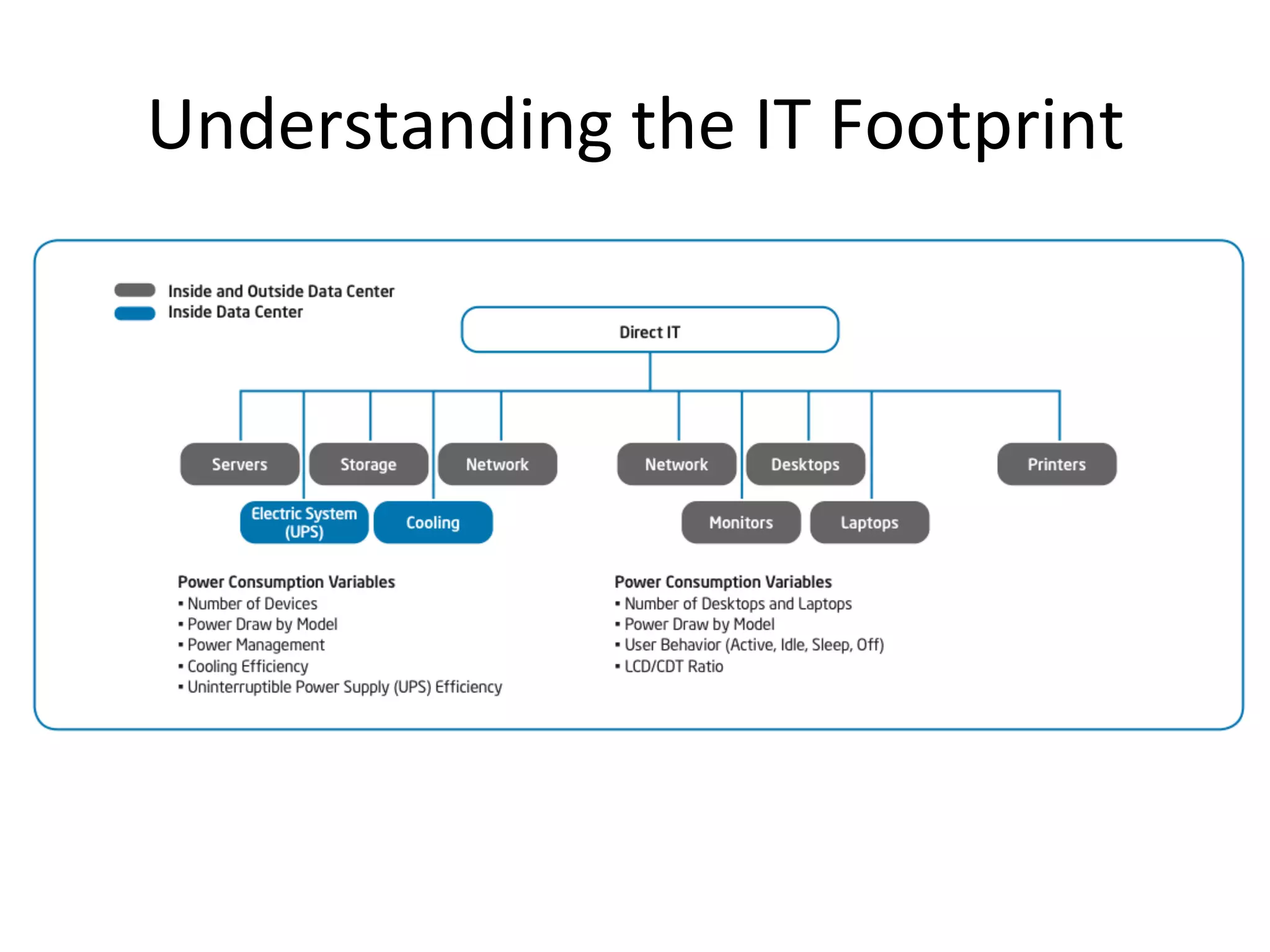
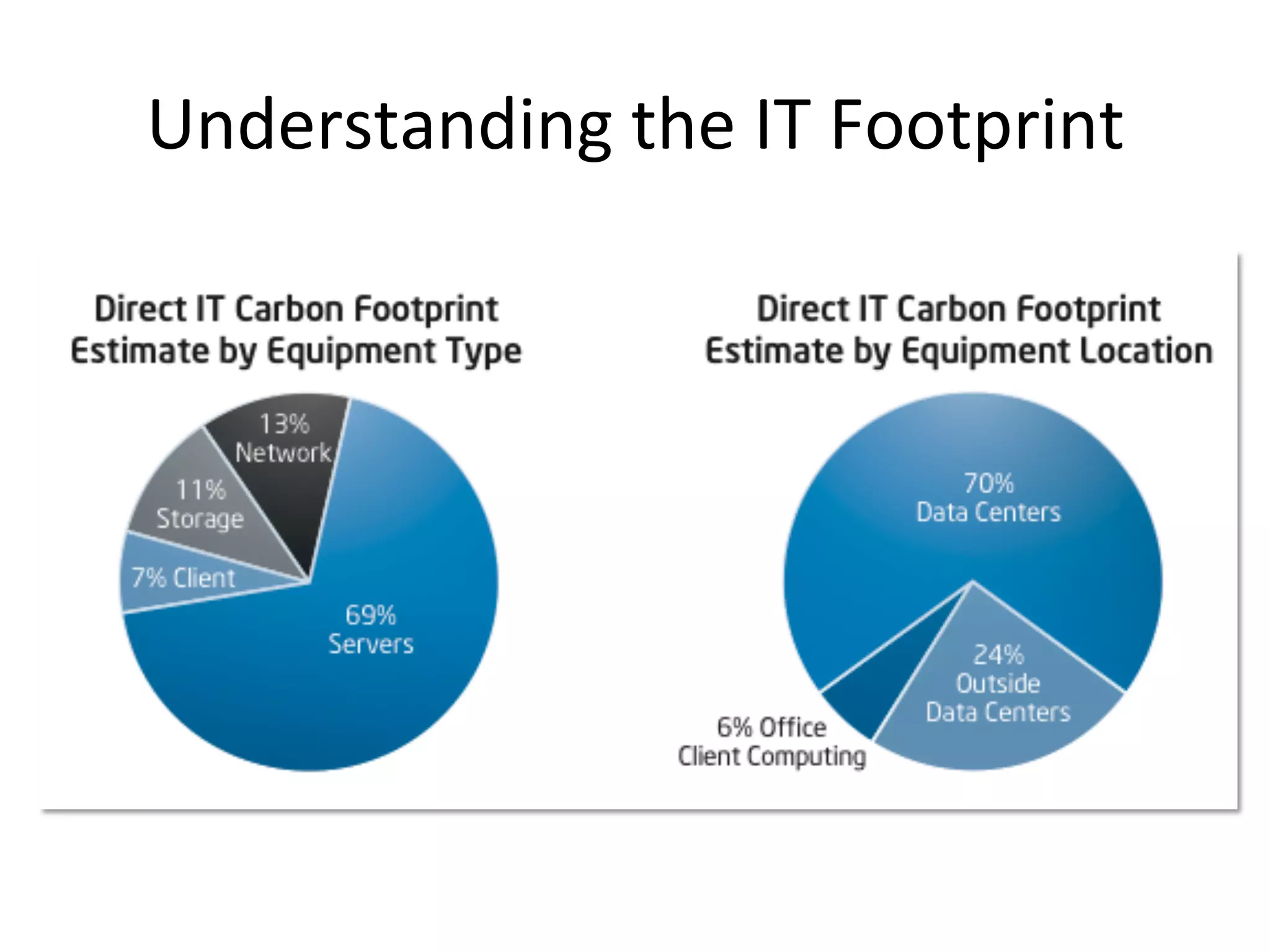
Understanding	
  the	
  IT	
  Footprint	
  
Understanding	
  the	
  IT	
  Footprint	
  
Data	
  Centres:	
  An	
  Inefficient	
  Truth	
  
*	
  Source:	
  EPA	
  Report	
  to	
  Congress	
  on	
  Server	
  and	
  Data	
  Center	
  Energy	
  Efficiency,	
  August	
  2007	
  
32%	
  
Processor	
  	
  
Drives5%
Peripheral Slots 20%
PSU 15%45%	
  
IT	
  Load	
  
55%	
  
Power,	
  Cooling	
  
&	
  LighGng	
  
Data	
  Center	
   Server	
   Processor	
  
100	
  Wa]s	
  
Supplied	
  
14	
  Wa]s	
  supplied	
  
to	
  CPU	
  
11.2	
  Wa]s	
  used	
  for	
  
computaGon	
  
45	
  Wa]s	
  supplied	
  
to	
  IT	
  equipment	
  
Up	
  to	
  88.8%	
  of	
  the	
  power	
  consumed	
  by	
  a	
  
data	
  centre	
  is	
  used	
  before	
  computa8on	
  
17	
  	
  
80%	
  
UGlised	
  
20%
Idle
Server	
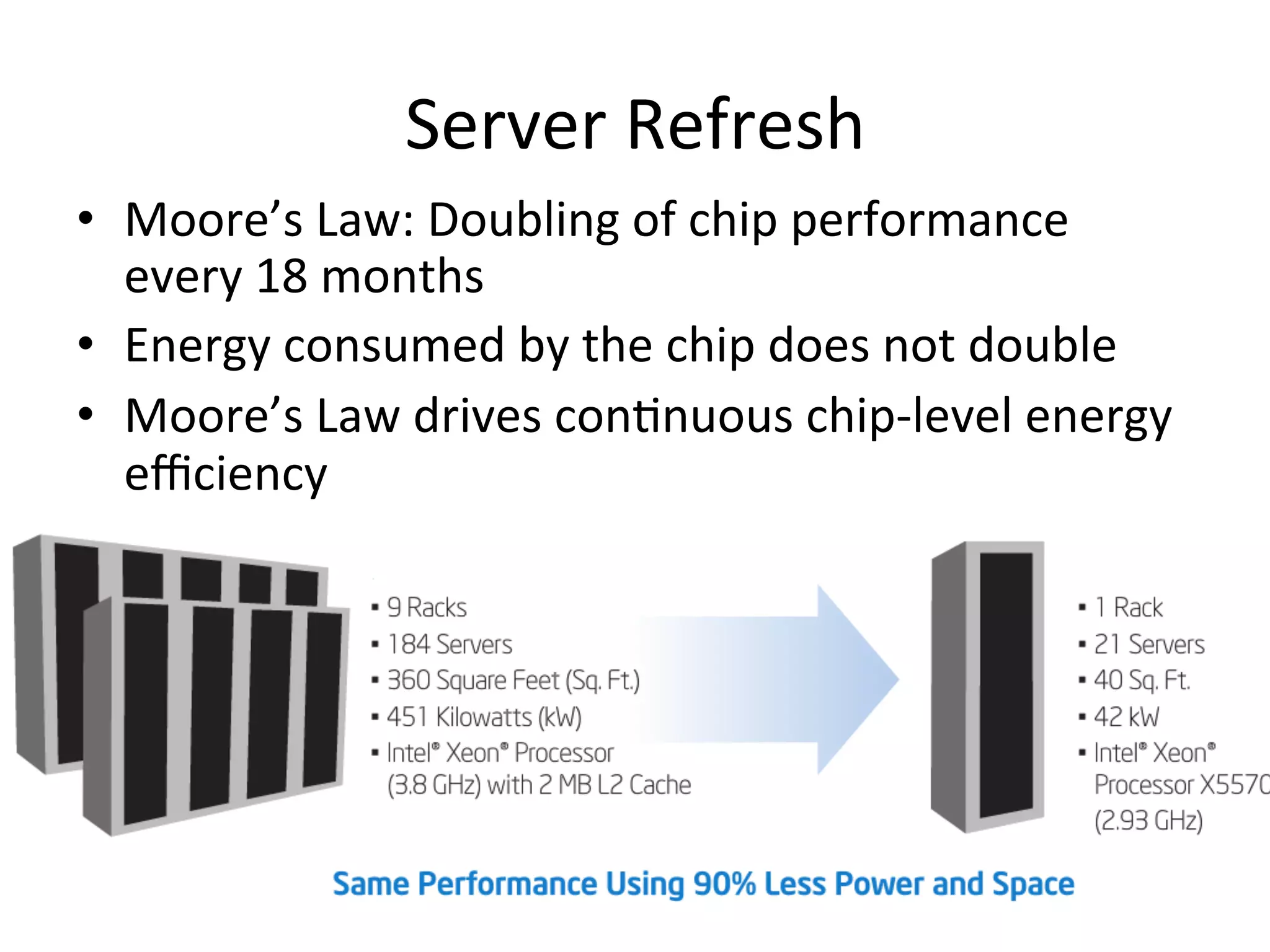
  Refresh	
  
•  Moore’s	
  Law:	
  Doubling	
  of	
  chip	
  performance	
  
every	
  18	
  months	
  
•  Energy	
  consumed	
  by	
  the	
  chip	
  does	
  not	
  double	
  
•  Moore’s	
  Law	
  drives	
  con7nuous	
  chip-­‐level	
  energy	
  
efficiency	
  	
  
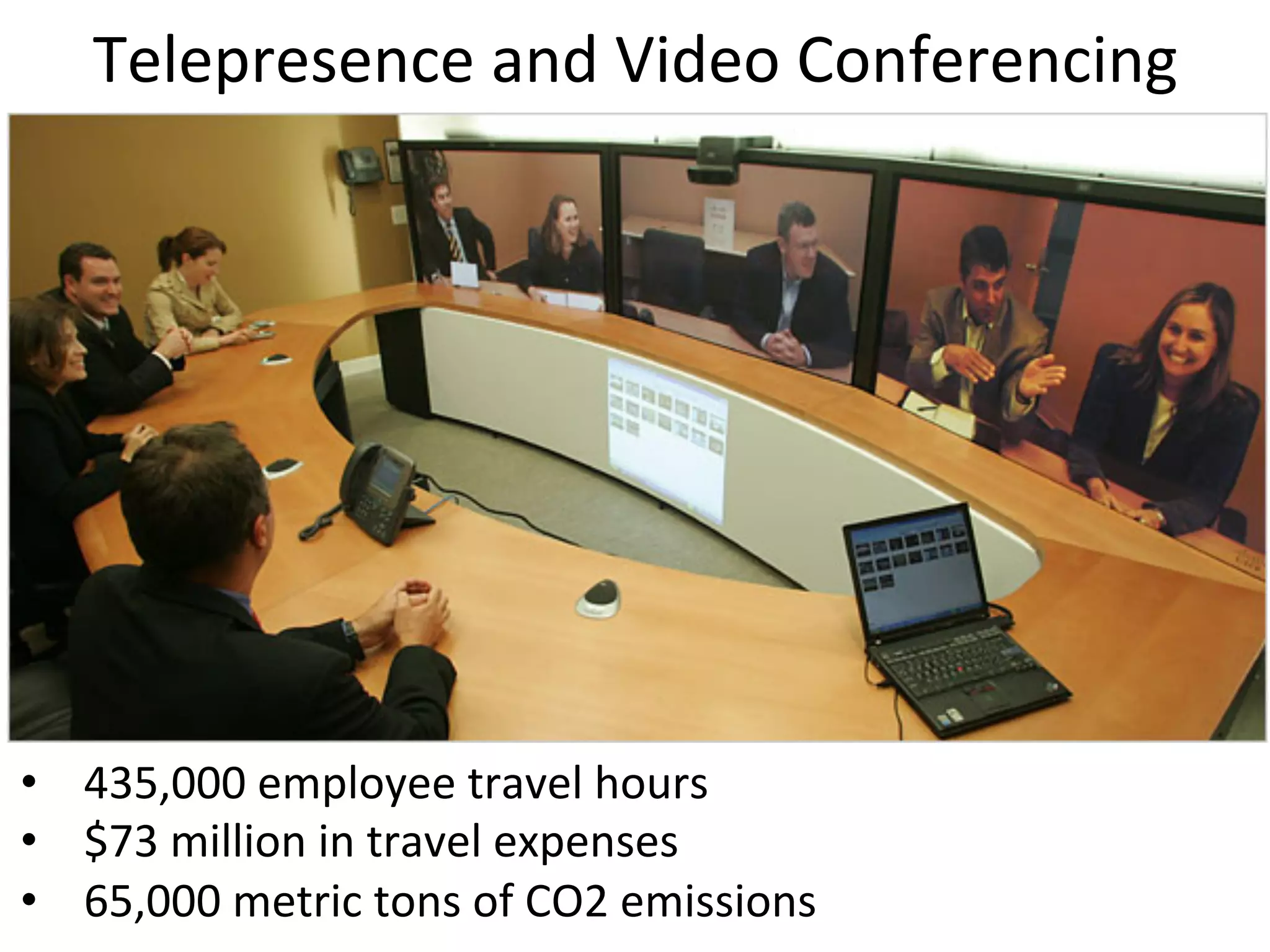
Telepresence	
  and	
  Video	
  Conferencing	
  
•  435,000	
  employee	
  travel	
  hours	
  
•  $73	
  million	
  in	
  travel	
  expenses	
  
•  65,000	
  metric	
  tons	
  of	
  CO2	
  emissions	
  
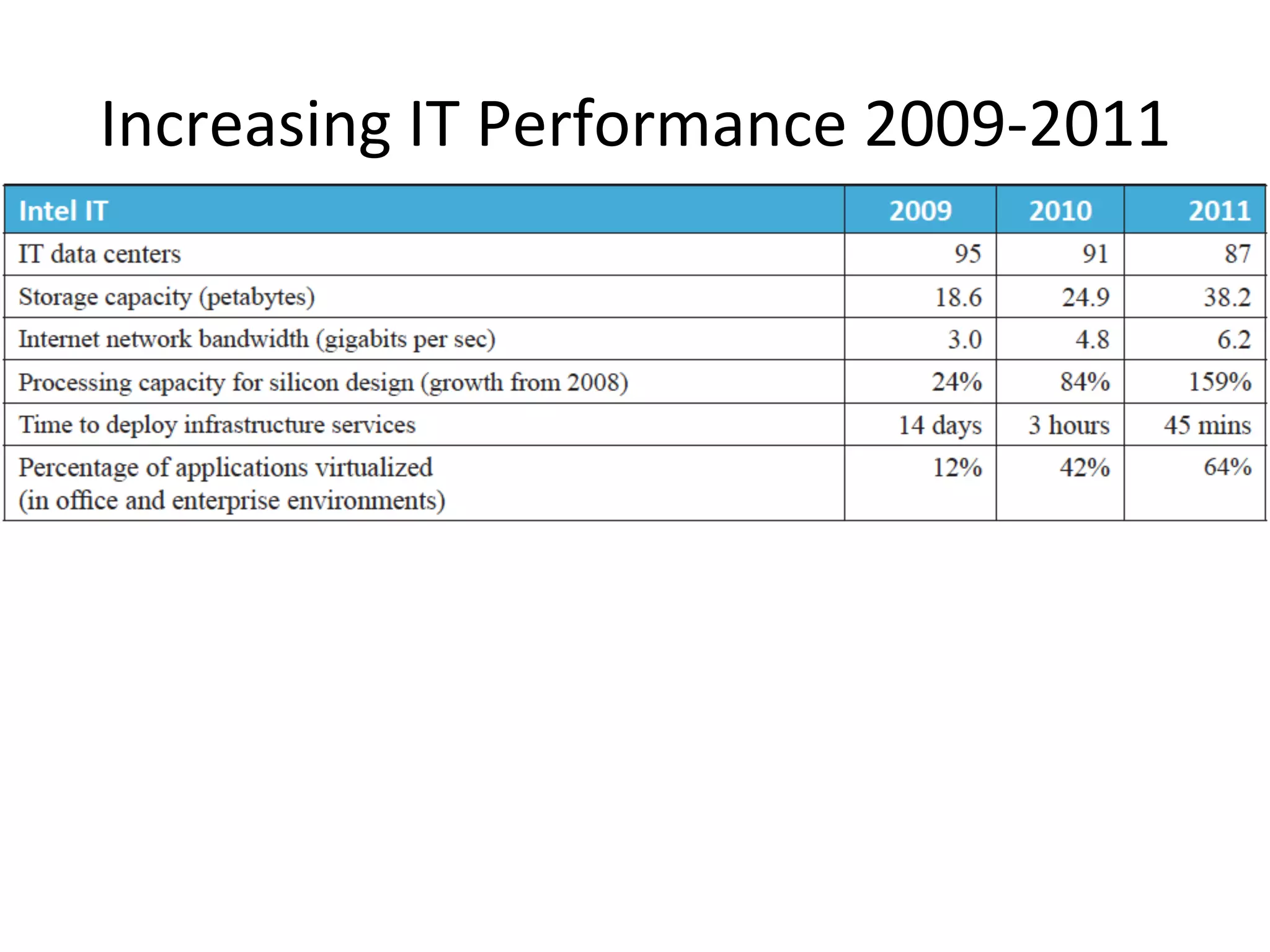
Increasing	
  IT	
  Performance	
  2009-­‐2011	
  
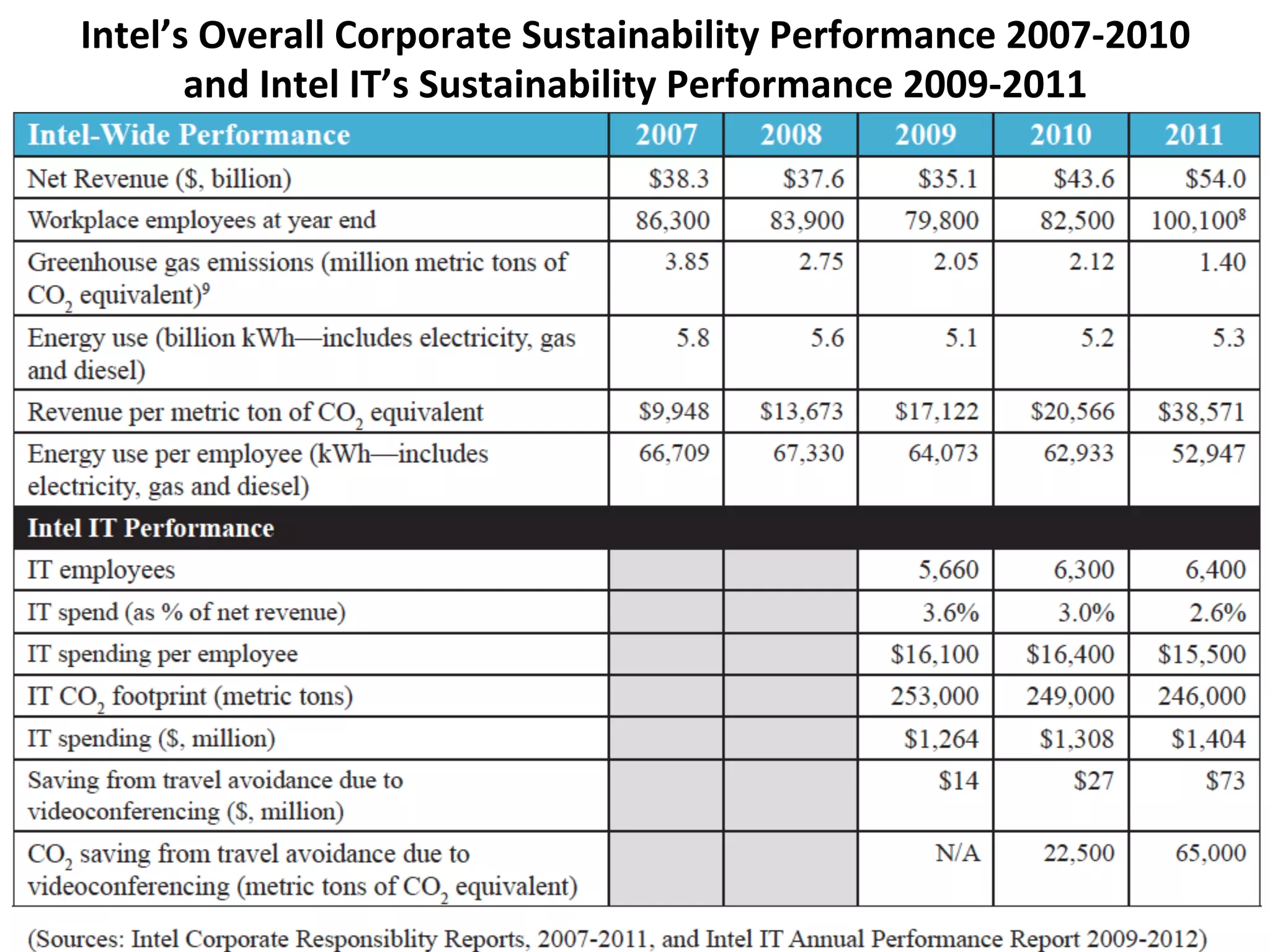
Intel’s	
  Overall	
  Corporate	
  Sustainability	
  Performance	
  2007-­‐2010	
  
and	
  Intel	
  IT’s	
  Sustainability	
  Performance	
  2009-­‐2011	


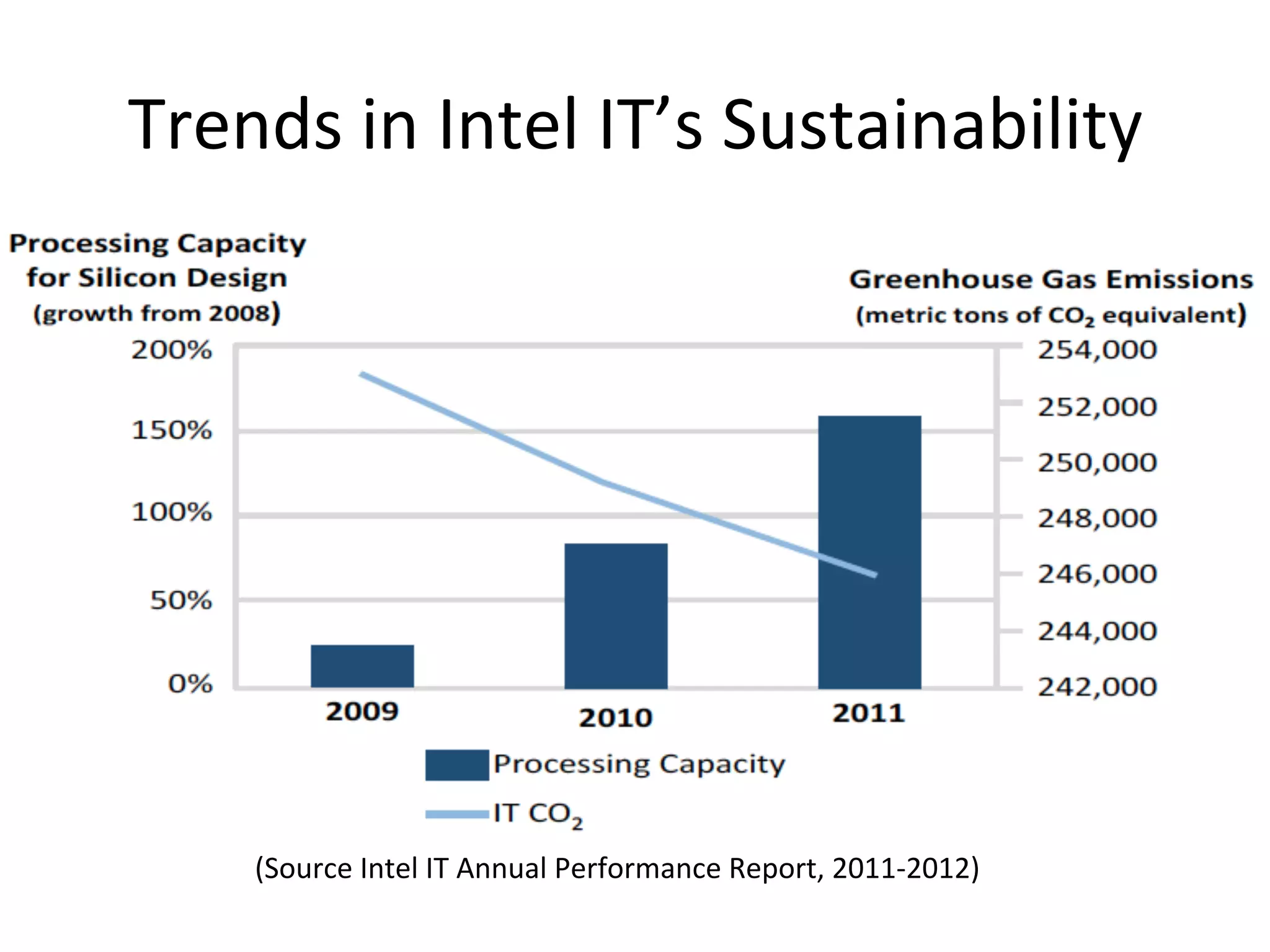
Trends	
  in	
  Intel	
  IT’s	
  Sustainability	


(Source	
  Intel	
  IT	
  Annual	
  Performance	
  Report,	
  2011-­‐2012)	


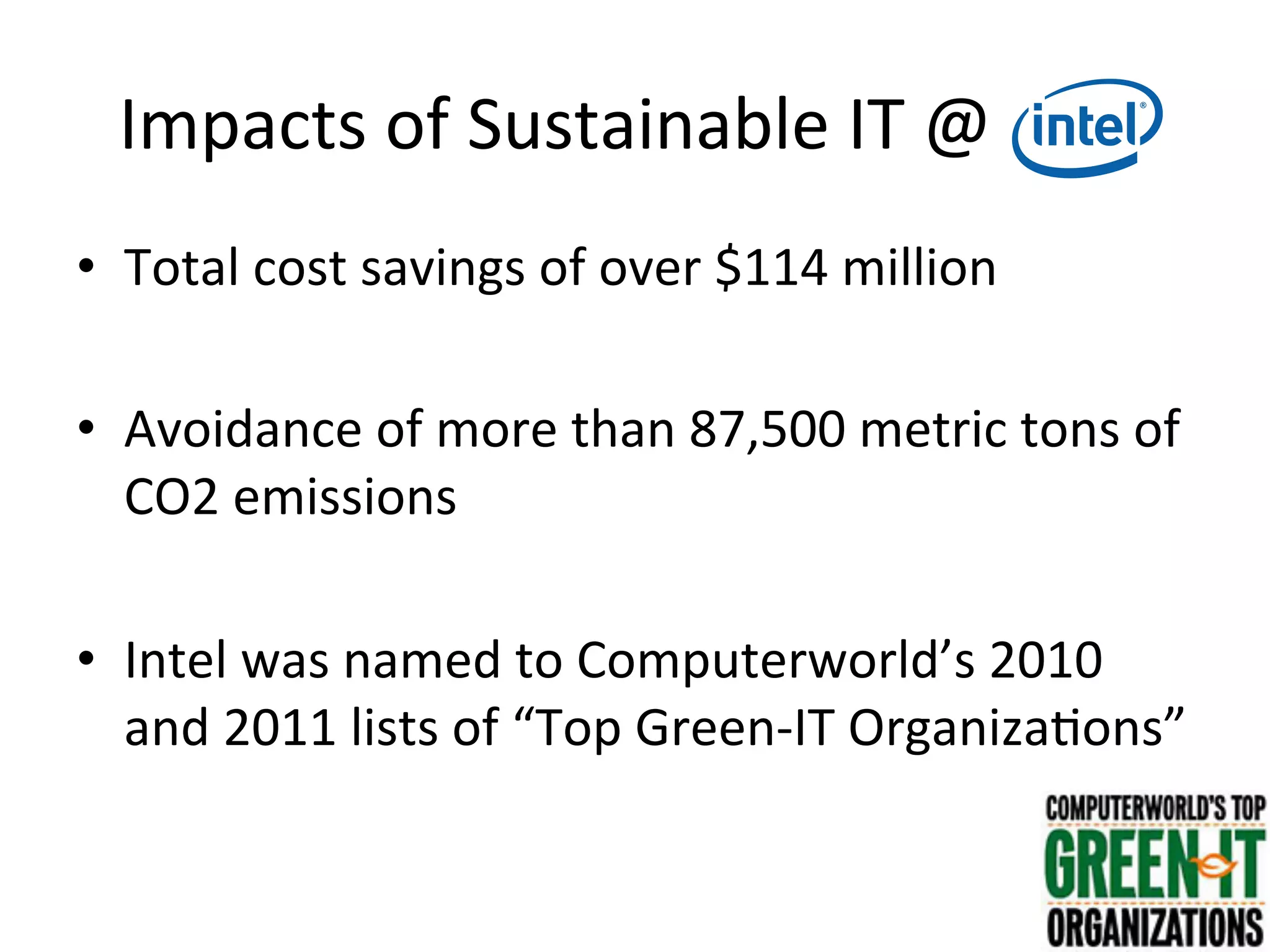
Impacts	
  of	
  Sustainable	
  IT	
  @	
  Intel	
  
•  Total	
  cost	
  savings	
  of	
  over	
  $114	
  million	
  
•  Avoidance	
  of	
  more	
  than	
  87,500	
  metric	
  tons	
  of	
  
CO2	
  emissions	
  
•  Intel	
  was	
  named	
  to	
  Computerworld’s	
  2010	
  
and	
  2011	
  lists	
  of	
  “Top	
  Green-­‐IT	
  Organiza7ons”	
  
24
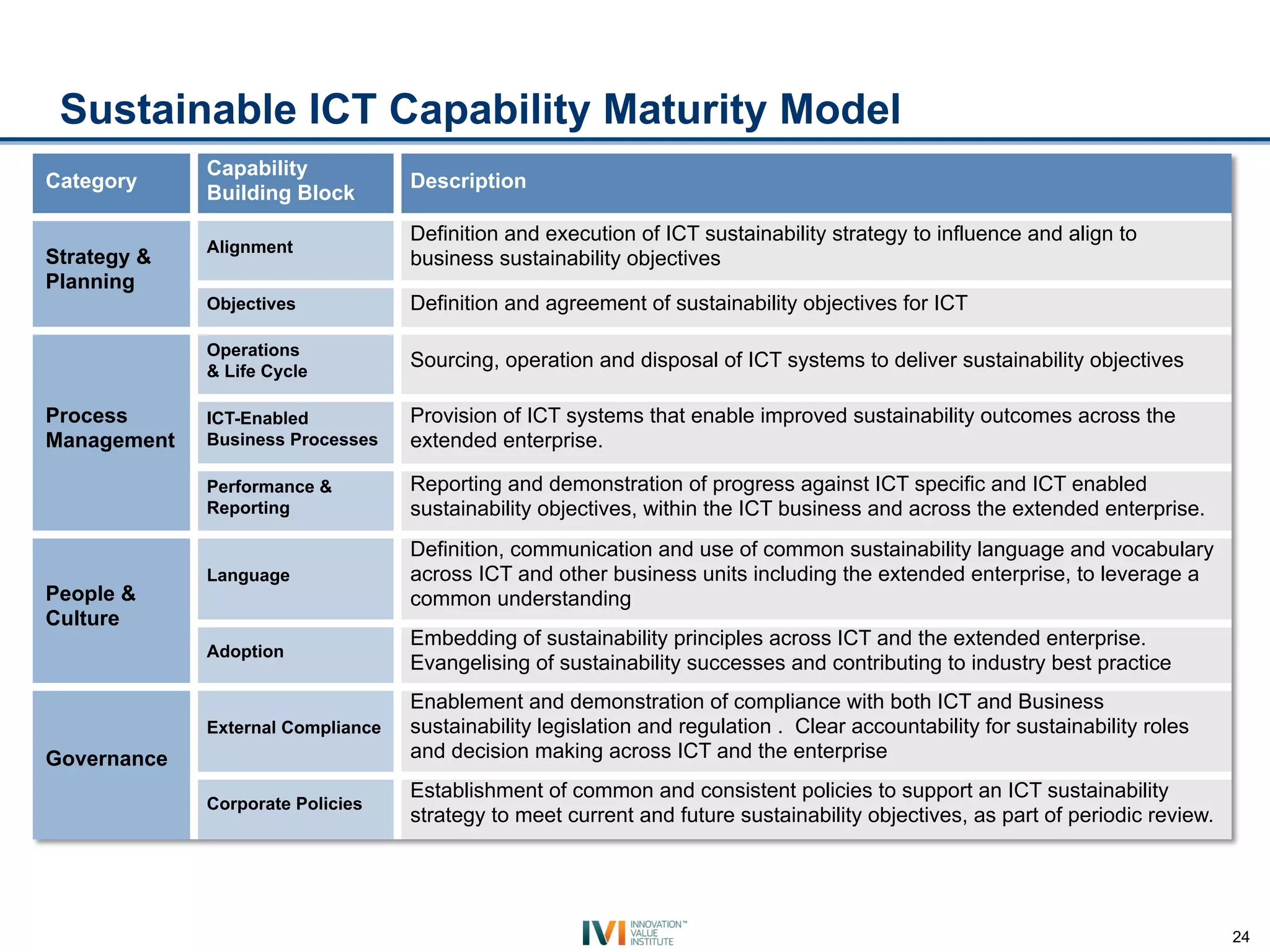
Sustainable ICT Capability Maturity Model
Category
Capability
Building Block
Description
Strategy &
Planning
Alignment
Definition and execution of ICT sustainability strategy to influence and align to
business sustainability objectives
Objectives Definition and agreement of sustainability objectives for ICT
Process
Management
Operations
& Life Cycle
Sourcing, operation and disposal of ICT systems to deliver sustainability objectives
ICT-Enabled
Business Processes
Provision of ICT systems that enable improved sustainability outcomes across the
extended enterprise.
Performance &
Reporting
Reporting and demonstration of progress against ICT specific and ICT enabled
sustainability objectives, within the ICT business and across the extended enterprise.
People &
Culture
Language
Definition, communication and use of common sustainability language and vocabulary
across ICT and other business units including the extended enterprise, to leverage a
common understanding
Adoption
Embedding of sustainability principles across ICT and the extended enterprise.
Evangelising of sustainability successes and contributing to industry best practice
Governance
External Compliance
Enablement and demonstration of compliance with both ICT and Business
sustainability legislation and regulation . Clear accountability for sustainability roles
and decision making across ICT and the enterprise
Corporate Policies
Establishment of common and consistent policies to support an ICT sustainability
strategy to meet current and future sustainability objectives, as part of periodic review.
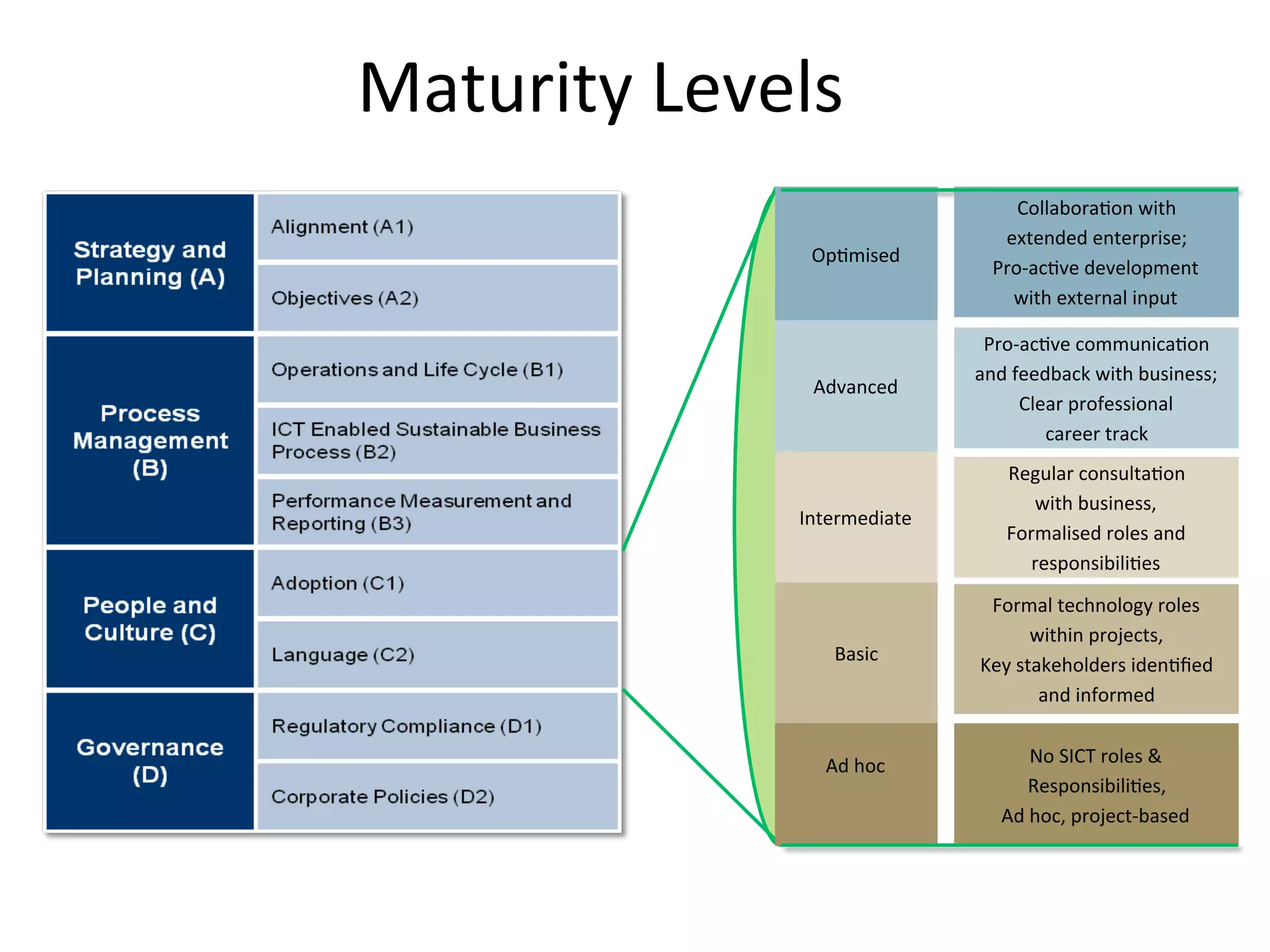
Maturity	
  Levels	
  
Ad	
  hoc	


Basic	
  
Intermediate	
  
Advanced	
  
Op7mised	
  
No	
  SICT	
  roles	
  &	
  	
  
Responsibili7es,	
  	
  
Ad	
  hoc,	
  project-­‐based	
  
Formal	
  technology	
  roles	
  	
  
within	
  projects,	
  	
  
Key	
  stakeholders	
  iden7fied	
  	
  
and	
  informed	
  
Regular	
  consulta7on	
  	
  
with	
  business,	
  	
  
Formalised	
  roles	
  and	
  	
  
responsibili7es	
  
Pro-­‐ac7ve	
  communica7on	
  
and	
  feedback	
  with	
  business;	
  
Clear	
  professional	
  	
  
career	
  track	
  
Collabora7on	
  with	
  	
  
extended	
  enterprise;	
  	
  
Pro-­‐ac7ve	
  development	
  	
  
with	
  external	
  input	
  
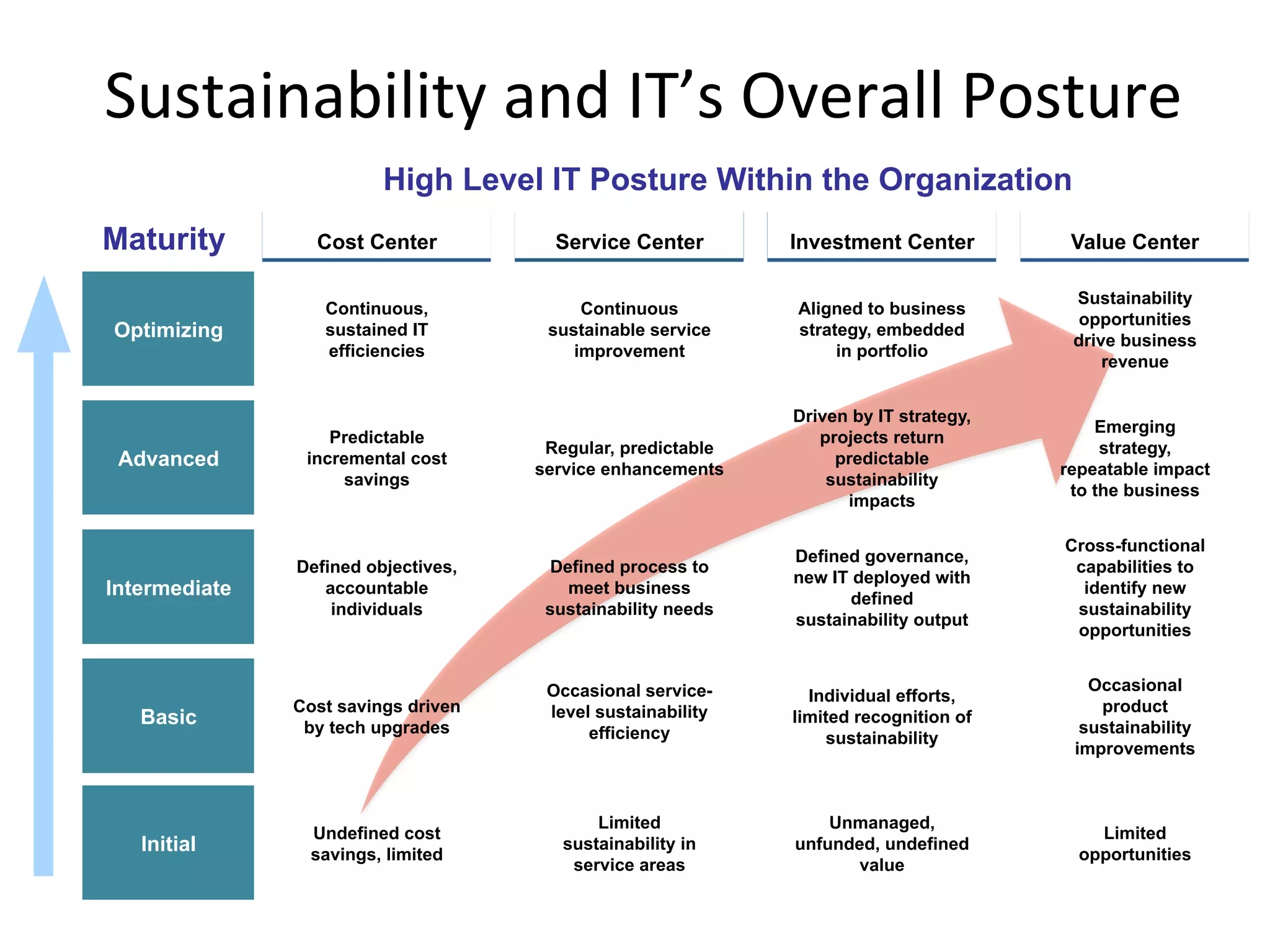
High Level IT Posture Within the Organization
Optimizing
Initial
Advanced
Basic
Intermediate
	
  Sustainability	
  and	
  IT’s	
  Overall	
  Posture	
  
Continuous,
sustained IT
efficiencies
Predictable
incremental cost
savings
Cost savings driven
by tech upgrades
Defined objectives,
accountable
individuals
Cost Center
Continuous
sustainable service
improvement
Limited
sustainability in
service areas
Regular, predictable
service enhancements
Defined process to
meet business
sustainability needs
Service Center
Aligned to business
strategy, embedded
in portfolio
Unmanaged,
unfunded, undefined
value
Individual efforts,
limited recognition of
sustainability
Investment Center
Limited
opportunities
Occasional
product
sustainability
improvements
Cross-functional
capabilities to
identify new
sustainability
opportunities
Value Center
Undefined cost
savings, limited
Occasional service-
level sustainability
efficiency
Driven by IT strategy,
projects return
predictable
sustainability
impacts
Defined governance,
new IT deployed with
defined
sustainability output
Sustainability
opportunities
drive business
revenue
Emerging
strategy,
repeatable impact
to the business
Maturity
Key	
  Lessons	
  
•  Sustainable	
  IT	
  is	
  different	
  to	
  Green	
  IT	


•  Align	
  Business	
  and	
  IT	
  Sustainability	
  Objec7ves	
  	
  
•  Build	
  the	
  Business	
  Case	
  for	
  Sustainability	


•  Use	
  Incen7ves	
  to	
  Drive	
  Change	
  Across	
  the	
  
Organiza7on	
  	
  
Further	
  Reading	
  Material	


•  Curry,	
  E.,	
  Guyon,	
  B.,	
  Sheridan,	
  C.,	
  and	
  Donnellan,	
  B.	
  2012.	
  “Developing	
  an	
  
Sustainable	
  IT	
  Capability:	
  Lessons	
  From	
  Intel’s	
  Journey,”	
  MIS	
  Quarterly	
  
Execu7ve	
  (11:2),	
  pp.	
  61–74.	
  
–  hgp://www.edwardcurry.org/publica7ons/MISQE_SustainableIT_Intel_2012.pdf	
  
•  Donnellan,	
  B.,	
  Sheridan,	
  C.,	
  and	
  Curry,	
  E.	
  2011.	
  “A	
  Capability	
  Maturity	
  
Framework	
  for	
  Sustainable	
  InformaGon	
  and	
  CommunicaGon	
  
Technology,”	
  IEEE	
  IT	
  Professional	
  (13:1),	
  pp.	
  33–40.	
  
–  hgp://www.edwardcurry.org/publica7ons/donnellan_ITPro_SICT_2011.pdf	


•  Curry,	
  E.,	
  Guyon,	
  B.,	
  Sheridan,	
  C.,	
  and	
  Donnellan,	
  B.	
  2012.	
  “Sustainable	
  IT:	
  
Challenges,	
  Postures,	
  and	
  Outcomes,”	
  IEEE	
  Computer	
  (45:11),	
  pp.	
  79–81.	
  
–  hgp://www.edwardcurry.org/publica7ons/Curry_SustainableIT_Computer2012.pdf	
  
Teaching	
  Case	
  
•  Curry,	
  E.,	
  and	
  Donnellan,	
  B.	
  2012.	
  “Sustainable	
  IT	
  at	
  Intel:	
  A	
  
Teaching	
  Case,”	
  In	
  Interna7onal	
  Conference	
  on	
  Informa7on	
  
Systems	
  2012	
  
–  hgp://www.edwardcurry.org/publica7ons/Curry_Intel_Teaching_Case_ICIS.pdf	
  
•  Courses	
  and	
  Level	
  
–  Suitable	
  for	
  use	
  in	
  upper-­‐division	
  business	
  undergraduate,	
  graduate,	
  
or	
  execu7ve	
  MBA	
  educa7on	
  course	
  in	
  IT	
  sustainability,	
  IT	
  strategy,	
  or	
  
IT	
  management	
  
•  Teaching	
  Objec7ves:	
  
–  To	
  provide	
  conceptual	
  underpinnings	
  of	
  Sustainable	
  compu7ng	
  
–  To	
  trace	
  the	
  evolu7on	
  of	
  the	
  Sustainable	
  IT	
  strategy	
  at	
  Intel	
  
–  To	
  evaluate	
  the	
  Sustainable	
  IT	
  strategy	
  as	
  deployed	
  by	
  Intel	
  
–  To	
  iden7fy	
  possible	
  improvements	
  
–  To	
  iden7fy	
  next	
  steps	
  and	
  define	
  associated	
  business	
  case	
  

Developing an Sustainable IT Capability: Lessons From Intel's Journey

  • 1.
    1 Developing  an  Sustainable  IT  Capability:  Lessons   From  Intel's  Journey   Edward  Curry    Digital  Enterprise  Research  Ins7tute  (DERI)   Bill  Guyon      Intel  Coropora7on   Charles  Sheridan    Intel  Labs  Europe   Brian  Donnellan    Innova7on  Value  Ins7tute  (IVI)      
  • 2.
    Curry,  E.,  Guyon,  B.,  Sheridan,  C.,  and  Donnellan,  B.  2012.  “Developing  an  Sustainable  IT   Capability:  Lessons  From  Intel’s  Journey,”  MIS  Quarterly  Execu7ve  (11:2),  pp.  61–74.  
  • 3.
    3     The  Environment  is  on  Everyone’s  Agenda  
  • 4.
    4     ICT’s  Mass  ProducGon  Carbon  Cost   2%   ICT  Accounts  for   Approximately...   …of  Global  CO2  Emissions.   Source  Gartner  
  • 5.
    McKinsey  2020  Report   ICTs  could  deliver  approximately  7.8  GtCO2  of  emissions  savings  in  2020,  represen7ng  a   15%  of  emissions  cut  in  2020  and  600  billion  ($946.5  billion)  of  cost  savings.  ICT  can   provide  business  solu7ons  that  can  alleviate  at  least  five  7mes  the  GHG  footprint  of  ICT   itself  
  • 6.
    •  Align  all  IT  processes  and   prac7ces  with  the  core   principles  of  sustainability,   which  are  to  reduce,  reuse,   and  recycle;  and   •  Find  innova7ve  ways  to  use   IT  in  business  processes  to   deliver  sustainability   benefits  across  the   enterprise  and  beyond.  6     2%   Reduce IT Improve Efficiency Sustainable  IT   98%  
  • 7.
  • 8.
    Intel  IT  Vital  Stats  2012   100,100  Intel  employees   150  sites,  62  countries     6,400  IT  employees   56  global  sites     87  Data  Centers   ~75,000  servers;     458,694  square  feet     >110,000  Devices   >90K  PCs  (80%+  mobile),   >20,000  Handhelds  
  • 9.
  • 10.
    Sustainability  @  Intel   At  the  start  of  2008,  Intel   CEO  Paul  Otellini  set  out   an  ambi7ous  five-­‐year   goal  to  reduce   environmental  impacts  in   key  areas,  including   energy  and  water,  with  a   20%  reduc7on  in   emissions  on  2007  levels   by  2012   Intel  CEO  Paul  Otellini    
  • 11.
    IT  Sustainability  @  Intel   CIO  saw  opportunity  for   Intel  IT  to  play  a  key  role  in   enabling  the  company  to   achieve  its  corporate   sustainability  goals     Commiged  Intel  IT  to   helping  the  business  deliver   its  objec7ves  through  use  of   sustainable  IT   Intel’s  CIO,  Diane  Bryant  
  • 12.
    Developing  an  IT  Sustainability   Capability   •  Aligning  IT  and  Corporate  Goals   •  3  Phase  Sustainable  IT  Roadmap   •  Understanding  The  IT  Footprint   •  Iden7fying  High-­‐Impact  Opportuni7es   •  Develop  a  Sustainable  Culture   •  Use  Employee  Incen7ve  Programs  to  Drive   Innova7on   •  Build  the  Business  Case  for  Sustainability  
  • 13.
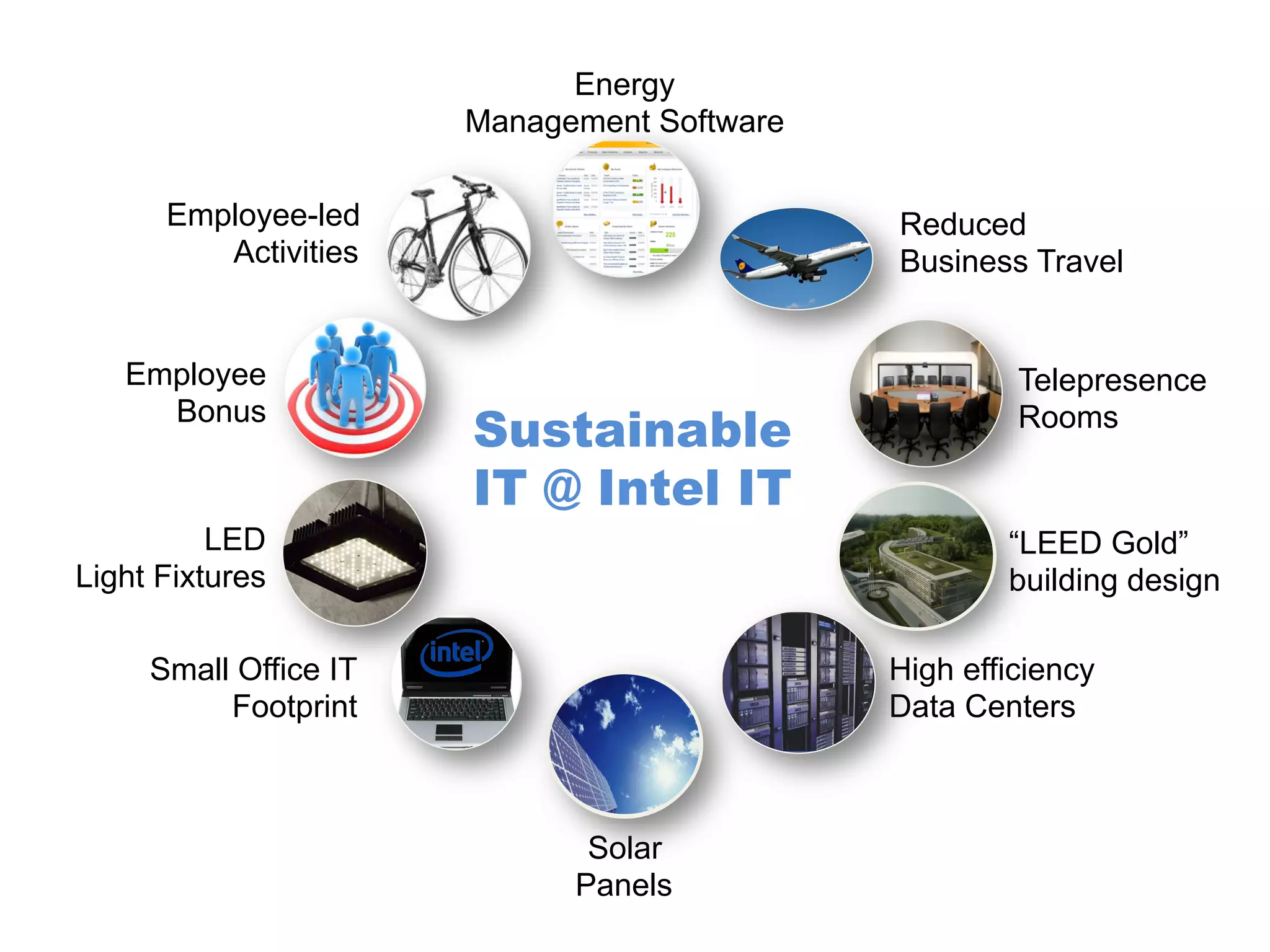
    Employee Bonus Employee-led Activities Small Office IT Footprint LED LightFixtures Telepresence Rooms Solar Panels “LEED Gold” building design High efficiency Data Centers Energy Management Software Sustainable IT @ Intel IT Reduced Business Travel
  • 14.
  • 15.
  • 17.
    Data  Centres:  An  Inefficient  Truth   *  Source:  EPA  Report  to  Congress  on  Server  and  Data  Center  Energy  Efficiency,  August  2007   32%   Processor     Drives5% Peripheral Slots 20% PSU 15%45%   IT  Load   55%   Power,  Cooling   &  LighGng   Data  Center   Server   Processor   100  Wa]s   Supplied   14  Wa]s  supplied   to  CPU   11.2  Wa]s  used  for   computaGon   45  Wa]s  supplied   to  IT  equipment   Up  to  88.8%  of  the  power  consumed  by  a   data  centre  is  used  before  computa8on   17     80%   UGlised   20% Idle
  • 18.
    Server  Refresh   • Moore’s  Law:  Doubling  of  chip  performance   every  18  months   •  Energy  consumed  by  the  chip  does  not  double   •  Moore’s  Law  drives  con7nuous  chip-­‐level  energy   efficiency    
  • 19.
    Telepresence  and  Video  Conferencing   •  435,000  employee  travel  hours   •  $73  million  in  travel  expenses   •  65,000  metric  tons  of  CO2  emissions  
  • 20.
    Increasing  IT  Performance  2009-­‐2011  
  • 21.
    Intel’s  Overall  Corporate  Sustainability  Performance  2007-­‐2010   and  Intel  IT’s  Sustainability  Performance  2009-­‐2011        
  • 22.
    Trends  in  Intel  IT’s  Sustainability       (Source  Intel  IT  Annual  Performance  Report,  2011-­‐2012)      
  • 23.
    Impacts  of  Sustainable  IT  @  Intel   •  Total  cost  savings  of  over  $114  million   •  Avoidance  of  more  than  87,500  metric  tons  of   CO2  emissions   •  Intel  was  named  to  Computerworld’s  2010   and  2011  lists  of  “Top  Green-­‐IT  Organiza7ons”  
  • 24.
    24 Sustainable ICT CapabilityMaturity Model Category Capability Building Block Description Strategy & Planning Alignment Definition and execution of ICT sustainability strategy to influence and align to business sustainability objectives Objectives Definition and agreement of sustainability objectives for ICT Process Management Operations & Life Cycle Sourcing, operation and disposal of ICT systems to deliver sustainability objectives ICT-Enabled Business Processes Provision of ICT systems that enable improved sustainability outcomes across the extended enterprise. Performance & Reporting Reporting and demonstration of progress against ICT specific and ICT enabled sustainability objectives, within the ICT business and across the extended enterprise. People & Culture Language Definition, communication and use of common sustainability language and vocabulary across ICT and other business units including the extended enterprise, to leverage a common understanding Adoption Embedding of sustainability principles across ICT and the extended enterprise. Evangelising of sustainability successes and contributing to industry best practice Governance External Compliance Enablement and demonstration of compliance with both ICT and Business sustainability legislation and regulation . Clear accountability for sustainability roles and decision making across ICT and the enterprise Corporate Policies Establishment of common and consistent policies to support an ICT sustainability strategy to meet current and future sustainability objectives, as part of periodic review.
  • 25.
    Maturity  Levels   Ad  hoc     Basic   Intermediate   Advanced   Op7mised   No  SICT  roles  &     Responsibili7es,     Ad  hoc,  project-­‐based   Formal  technology  roles     within  projects,     Key  stakeholders  iden7fied     and  informed   Regular  consulta7on     with  business,     Formalised  roles  and     responsibili7es   Pro-­‐ac7ve  communica7on   and  feedback  with  business;   Clear  professional     career  track   Collabora7on  with     extended  enterprise;     Pro-­‐ac7ve  development     with  external  input  
  • 26.
    High Level ITPosture Within the Organization Optimizing Initial Advanced Basic Intermediate  Sustainability  and  IT’s  Overall  Posture   Continuous, sustained IT efficiencies Predictable incremental cost savings Cost savings driven by tech upgrades Defined objectives, accountable individuals Cost Center Continuous sustainable service improvement Limited sustainability in service areas Regular, predictable service enhancements Defined process to meet business sustainability needs Service Center Aligned to business strategy, embedded in portfolio Unmanaged, unfunded, undefined value Individual efforts, limited recognition of sustainability Investment Center Limited opportunities Occasional product sustainability improvements Cross-functional capabilities to identify new sustainability opportunities Value Center Undefined cost savings, limited Occasional service- level sustainability efficiency Driven by IT strategy, projects return predictable sustainability impacts Defined governance, new IT deployed with defined sustainability output Sustainability opportunities drive business revenue Emerging strategy, repeatable impact to the business Maturity
  • 27.
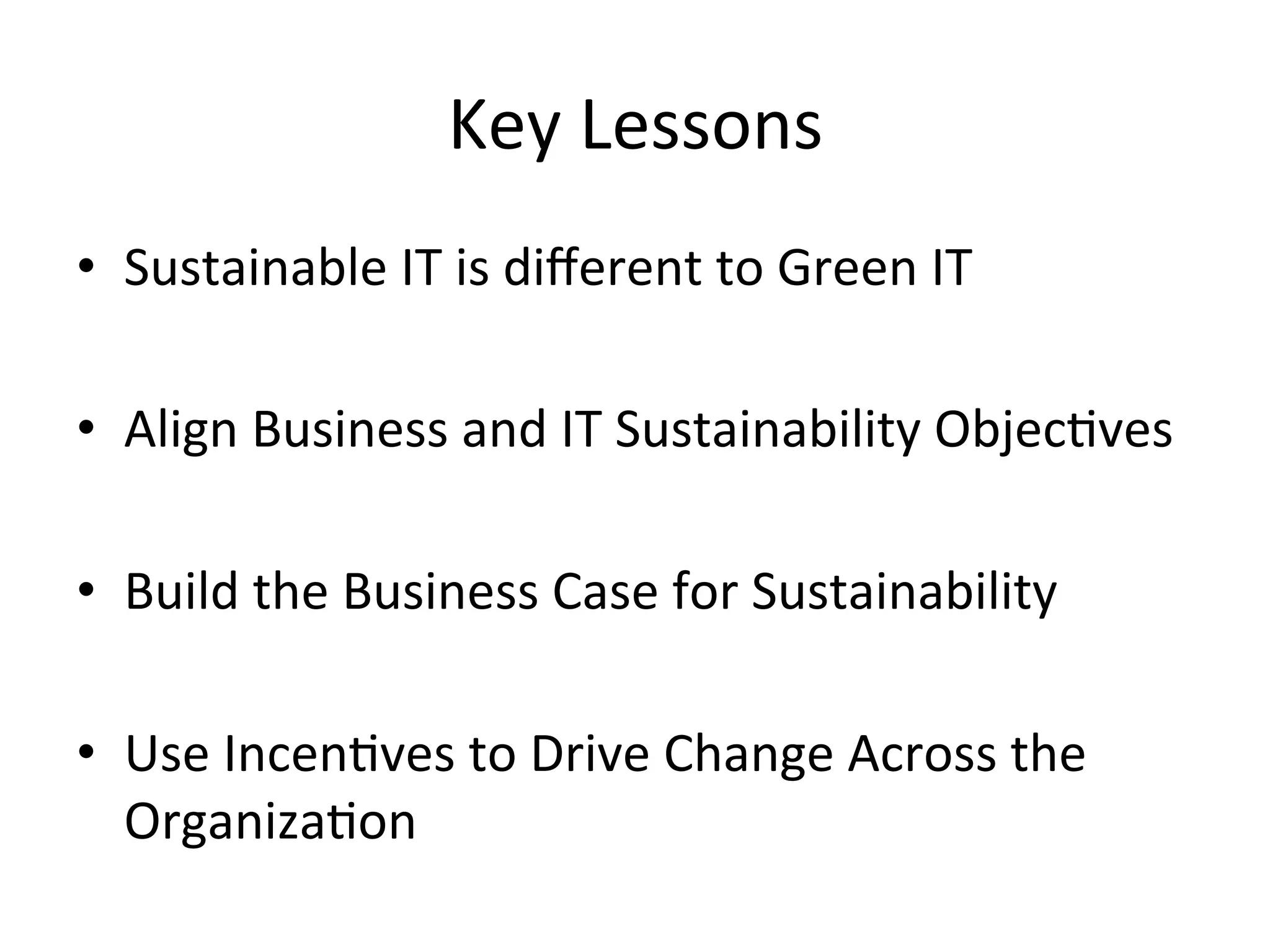
    Key  Lessons   • Sustainable  IT  is  different  to  Green  IT     •  Align  Business  and  IT  Sustainability  Objec7ves     •  Build  the  Business  Case  for  Sustainability     •  Use  Incen7ves  to  Drive  Change  Across  the   Organiza7on    
  • 28.
    Further  Reading  Material     •  Curry,  E.,  Guyon,  B.,  Sheridan,  C.,  and  Donnellan,  B.  2012.  “Developing  an   Sustainable  IT  Capability:  Lessons  From  Intel’s  Journey,”  MIS  Quarterly   Execu7ve  (11:2),  pp.  61–74.   –  hgp://www.edwardcurry.org/publica7ons/MISQE_SustainableIT_Intel_2012.pdf   •  Donnellan,  B.,  Sheridan,  C.,  and  Curry,  E.  2011.  “A  Capability  Maturity   Framework  for  Sustainable  InformaGon  and  CommunicaGon   Technology,”  IEEE  IT  Professional  (13:1),  pp.  33–40.   –  hgp://www.edwardcurry.org/publica7ons/donnellan_ITPro_SICT_2011.pdf     •  Curry,  E.,  Guyon,  B.,  Sheridan,  C.,  and  Donnellan,  B.  2012.  “Sustainable  IT:   Challenges,  Postures,  and  Outcomes,”  IEEE  Computer  (45:11),  pp.  79–81.   –  hgp://www.edwardcurry.org/publica7ons/Curry_SustainableIT_Computer2012.pdf  
  • 29.
    Teaching  Case   • Curry,  E.,  and  Donnellan,  B.  2012.  “Sustainable  IT  at  Intel:  A   Teaching  Case,”  In  Interna7onal  Conference  on  Informa7on   Systems  2012   –  hgp://www.edwardcurry.org/publica7ons/Curry_Intel_Teaching_Case_ICIS.pdf   •  Courses  and  Level   –  Suitable  for  use  in  upper-­‐division  business  undergraduate,  graduate,   or  execu7ve  MBA  educa7on  course  in  IT  sustainability,  IT  strategy,  or   IT  management   •  Teaching  Objec7ves:   –  To  provide  conceptual  underpinnings  of  Sustainable  compu7ng   –  To  trace  the  evolu7on  of  the  Sustainable  IT  strategy  at  Intel   –  To  evaluate  the  Sustainable  IT  strategy  as  deployed  by  Intel   –  To  iden7fy  possible  improvements   –  To  iden7fy  next  steps  and  define  associated  business  case