JSS ACADEMY OF TECHNICAL EDUCATION
JSS Campus, Dr. Vishnuvardhan Road, Bangalore – 560060
DEPARTMENT OF ELECTRONICS AND COMMUNICATION ENGINEERING
TECHNICAL SEMINAR
2023-2024
Digital Twin Technology
Name: K S Spoorthi Usn:1JS20EC036
under the guidance of
Dr.Saroja S Bhusare Dr.H S Aravind
Associate Professor Associate Professor
Outline
 Indroduction
 Historical Background
 Literature Review
 Characteritics
 Tehnologies
 Architecture
 Applications
 Advantages and Limitations
 Conclusion
Indroduction
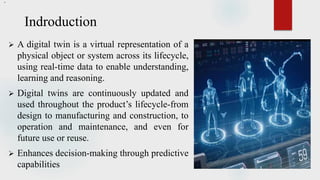
 A digital twin is a virtual representation of a
physical object or system across its lifecycle,
using real-time data to enable understanding,
learning and reasoning.
 Digital twins are continuously updated and
used throughout the product’s lifecycle-from
design to manufacturing and construction, to
operation and maintenance, and even for
future use or reuse.
 Enhances decision-making through predictive
capabilities
.
Historical Background
 The concept of Digital Twin was First voiced by
David Gelernter in 1991 and was called ‘Mirror
Worlds’.
 NASA was one of the first organizations that
used complex simulations of spacecrafts.
 The rise of the Internet of Things (IoT) and
connected sensors in the 2010s revolutionized
digital twin technology.
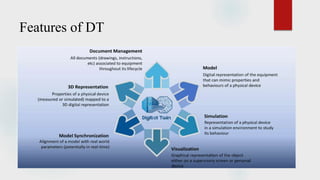
Features of DT
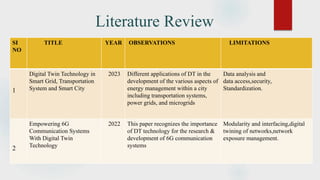
Literature Review
SI
NO
TITLE YEAR OBSERVATIONS LIMITATIONS
1
Digital Twin Technology in
Smart Grid, Transportation
System and Smart City
2023 Different applications of DT in the
development of the various aspects of
energy management within a city
including transportation systems,
power grids, and microgrids
Data analysis and
data access,security,
Standardization.
2
Empowering 6G
Communication Systems
With Digital Twin
Technology
2022 This paper recognizes the importance
of DT technology for the research &
development of 6G communication
systems
Modularity and interfacing,digital
twining of networks,network
exposure management.
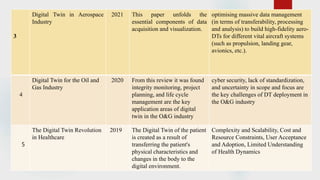
3
Digital Twin in Aerospace
Industry
2021 This paper unfolds the
essential components of data
acquisition and visualization.
optimising massive data management
(in terms of transferability, processing
and analysis) to build high-fidelity aero-
DTs for different vital aircraft systems
(such as propulsion, landing gear,
avionics, etc.).
4
Digital Twin for the Oil and
Gas Industry
2020 From this review it was found
integrity monitoring, project
planning, and life cycle
management are the key
application areas of digital
twin in the O&G industry
cyber security, lack of standardization,
and uncertainty in scope and focus are
the key challenges of DT deployment in
the O&G industry
5
The Digital Twin Revolution
in Healthcare
2019 The Digital Twin of the patient
is created as a result of
transferring the patient's
physical characteristics and
changes in the body to the
digital environment.
Complexity and Scalability, Cost and
Resource Constraints, User Acceptance
and Adoption, Limited Understanding
of Health Dynamics
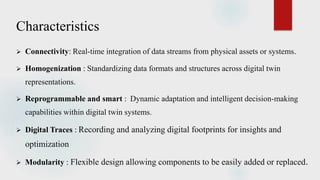
Characteristics
 Connectivity: Real-time integration of data streams from physical assets or systems.
 Homogenization : Standardizing data formats and structures across digital twin
representations.
 Reprogrammable and smart : Dynamic adaptation and intelligent decision-making
capabilities within digital twin systems.
 Digital Traces : Recording and analyzing digital footprints for insights and
optimization
 Modularity : Flexible design allowing components to be easily added or replaced.
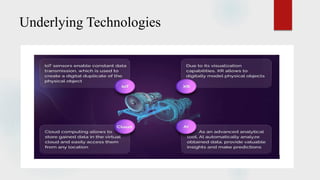
Underlying Technologies
Internet of Things(IOT)
IoT is based on the collection of data acquired
from real-world objects with the help of sensors.
These data are then used to create a digital
duplicate of the physical object that can be
analyzed, manipulated, and optimized.
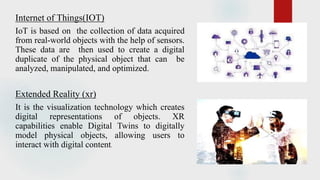
Extended Reality (xr)
It is the visualization technology which creates
digital representations of objects. XR
capabilities enable Digital Twins to digitally
model physical objects, allowing users to
interact with digital content.
Cloud computing
Technology is used for efficient storing and
accessing data over the Internet. As applications of
Digital Twins operate with large volumes of data,
cloud computing allows to store all data in the
virtual cloud and easily access required
information from any location.
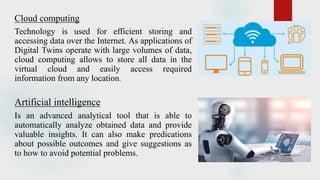
Artificial intelligence
Is an advanced analytical tool that is able to
automatically analyze obtained data and provide
valuable insights. It can also make predications
about possible outcomes and give suggestions as
to how to avoid potential problems.
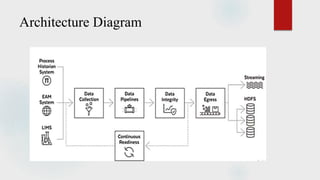
Architecture Diagram
Architecture
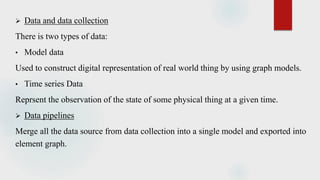
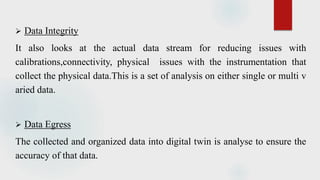
The different stages in the architecture of Digital Twin service involves :
 Data and Data Collection
 Data Pipelines
 Data Integrity
 Data Egress
 Data and data collection
There is two types of data:
• Model data
Used to construct digital representation of real world thing by using graph models.
• Time series Data
Reprsent the observation of the state of some physical thing at a given time.
 Data pipelines
Merge all the data source from data collection into a single model and exported into
element graph.
 Data Integrity
It also looks at the actual data stream for reducing issues with
calibrations,connectivity, physical issues with the instrumentation that
collect the physical data.This is a set of analysis on either single or multi v
aried data.
 Data Egress
The collected and organized data into digital twin is analyse to ensure the
accuracy of that data.
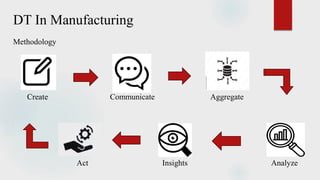
DT In Manufacturing
Methodology
Create Communicate Aggregate
Act Insights Analyze
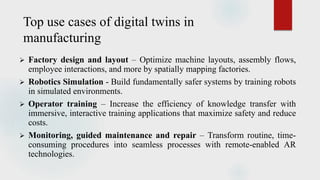
Top use cases of digital twins in
manufacturing
 Factory design and layout – Optimize machine layouts, assembly flows,
employee interactions, and more by spatially mapping factories.
 Robotics Simulation - Build fundamentally safer systems by training robots
in simulated environments.
 Operator training – Increase the efficiency of knowledge transfer with
immersive, interactive training applications that maximize safety and reduce
costs.
 Monitoring, guided maintenance and repair – Transform routine, time-
consuming procedures into seamless processes with remote-enabled AR
technologies.
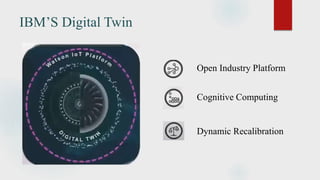
IBM’S Digital Twin
Open Industry Platform
Cognitive Computing
Dynamic Recalibration
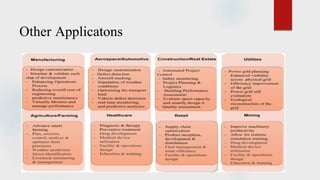
Other Applicatons
Advantages
 Comparison of digital vs physical product
 Performance monitoring
 Improved productivity
 Increased reliability
 Performance tuning
 Customer support
Limitations
 Compatibility challenges
 Inconsistencies
 Handling data
 Security
Challenges
 Complexity of Integration
 Data Quality and Quantity
 Interoperability
 Security and Privacy Concerns
 Scalability
Conclusion
Combined with the latest machine learning and artificial intelligence
tools which helping companies across many industries reduce
operational costs,increase productivity,improve performance,and change
the way predictive maintenance is done.For product manufactures in
particular,digital twin technology is crucial to achieving more efficient
production lines and faster time-to-market.
Future scope
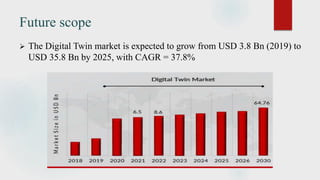
 The Digital Twin market is expected to grow from USD 3.8 Bn (2019) to
USD 35.8 Bn by 2025, with CAGR = 37.8%
References
https://ieeexplore.ieee.org/document/10351572/
https://ieeexplore.ieee.org/document/9540135/
https://ieeexplore.ieee.org/document/9899718/
https://ieeexplore.ieee.org/document/10099646/
https://vciba.springeropen.com/articles/10.1186/s42492-023-00137-4
THANK YOU…

Digital twin technology - seminar presentation

  • 1.
    JSS ACADEMY OFTECHNICAL EDUCATION JSS Campus, Dr. Vishnuvardhan Road, Bangalore – 560060 DEPARTMENT OF ELECTRONICS AND COMMUNICATION ENGINEERING TECHNICAL SEMINAR 2023-2024 Digital Twin Technology Name: K S Spoorthi Usn:1JS20EC036 under the guidance of Dr.Saroja S Bhusare Dr.H S Aravind Associate Professor Associate Professor
  • 2.
    Outline  Indroduction  HistoricalBackground  Literature Review  Characteritics  Tehnologies  Architecture  Applications  Advantages and Limitations  Conclusion
  • 3.
    Indroduction  A digitaltwin is a virtual representation of a physical object or system across its lifecycle, using real-time data to enable understanding, learning and reasoning.  Digital twins are continuously updated and used throughout the product’s lifecycle-from design to manufacturing and construction, to operation and maintenance, and even for future use or reuse.  Enhances decision-making through predictive capabilities .
  • 4.
    Historical Background  Theconcept of Digital Twin was First voiced by David Gelernter in 1991 and was called ‘Mirror Worlds’.  NASA was one of the first organizations that used complex simulations of spacecrafts.  The rise of the Internet of Things (IoT) and connected sensors in the 2010s revolutionized digital twin technology.
  • 5.
  • 6.
    Literature Review SI NO TITLE YEAROBSERVATIONS LIMITATIONS 1 Digital Twin Technology in Smart Grid, Transportation System and Smart City 2023 Different applications of DT in the development of the various aspects of energy management within a city including transportation systems, power grids, and microgrids Data analysis and data access,security, Standardization. 2 Empowering 6G Communication Systems With Digital Twin Technology 2022 This paper recognizes the importance of DT technology for the research & development of 6G communication systems Modularity and interfacing,digital twining of networks,network exposure management.
  • 7.
    3 Digital Twin inAerospace Industry 2021 This paper unfolds the essential components of data acquisition and visualization. optimising massive data management (in terms of transferability, processing and analysis) to build high-fidelity aero- DTs for different vital aircraft systems (such as propulsion, landing gear, avionics, etc.). 4 Digital Twin for the Oil and Gas Industry 2020 From this review it was found integrity monitoring, project planning, and life cycle management are the key application areas of digital twin in the O&G industry cyber security, lack of standardization, and uncertainty in scope and focus are the key challenges of DT deployment in the O&G industry 5 The Digital Twin Revolution in Healthcare 2019 The Digital Twin of the patient is created as a result of transferring the patient's physical characteristics and changes in the body to the digital environment. Complexity and Scalability, Cost and Resource Constraints, User Acceptance and Adoption, Limited Understanding of Health Dynamics
  • 8.
    Characteristics  Connectivity: Real-timeintegration of data streams from physical assets or systems.  Homogenization : Standardizing data formats and structures across digital twin representations.  Reprogrammable and smart : Dynamic adaptation and intelligent decision-making capabilities within digital twin systems.  Digital Traces : Recording and analyzing digital footprints for insights and optimization  Modularity : Flexible design allowing components to be easily added or replaced.
  • 9.
  • 10.
    Internet of Things(IOT) IoTis based on the collection of data acquired from real-world objects with the help of sensors. These data are then used to create a digital duplicate of the physical object that can be analyzed, manipulated, and optimized. Extended Reality (xr) It is the visualization technology which creates digital representations of objects. XR capabilities enable Digital Twins to digitally model physical objects, allowing users to interact with digital content.
  • 11.
    Cloud computing Technology isused for efficient storing and accessing data over the Internet. As applications of Digital Twins operate with large volumes of data, cloud computing allows to store all data in the virtual cloud and easily access required information from any location. Artificial intelligence Is an advanced analytical tool that is able to automatically analyze obtained data and provide valuable insights. It can also make predications about possible outcomes and give suggestions as to how to avoid potential problems.
  • 12.
  • 13.
    Architecture The different stagesin the architecture of Digital Twin service involves :  Data and Data Collection  Data Pipelines  Data Integrity  Data Egress
  • 14.
     Data anddata collection There is two types of data: • Model data Used to construct digital representation of real world thing by using graph models. • Time series Data Reprsent the observation of the state of some physical thing at a given time.  Data pipelines Merge all the data source from data collection into a single model and exported into element graph.
  • 15.
     Data Integrity Italso looks at the actual data stream for reducing issues with calibrations,connectivity, physical issues with the instrumentation that collect the physical data.This is a set of analysis on either single or multi v aried data.  Data Egress The collected and organized data into digital twin is analyse to ensure the accuracy of that data.
  • 16.
    DT In Manufacturing Methodology CreateCommunicate Aggregate Act Insights Analyze
  • 17.
    Top use casesof digital twins in manufacturing  Factory design and layout – Optimize machine layouts, assembly flows, employee interactions, and more by spatially mapping factories.  Robotics Simulation - Build fundamentally safer systems by training robots in simulated environments.  Operator training – Increase the efficiency of knowledge transfer with immersive, interactive training applications that maximize safety and reduce costs.  Monitoring, guided maintenance and repair – Transform routine, time- consuming procedures into seamless processes with remote-enabled AR technologies.
  • 18.
    IBM’S Digital Twin OpenIndustry Platform Cognitive Computing Dynamic Recalibration
  • 19.
  • 20.
    Advantages  Comparison ofdigital vs physical product  Performance monitoring  Improved productivity  Increased reliability  Performance tuning  Customer support
  • 21.
    Limitations  Compatibility challenges Inconsistencies  Handling data  Security
  • 22.
    Challenges  Complexity ofIntegration  Data Quality and Quantity  Interoperability  Security and Privacy Concerns  Scalability
  • 23.
    Conclusion Combined with thelatest machine learning and artificial intelligence tools which helping companies across many industries reduce operational costs,increase productivity,improve performance,and change the way predictive maintenance is done.For product manufactures in particular,digital twin technology is crucial to achieving more efficient production lines and faster time-to-market.
  • 24.
    Future scope  TheDigital Twin market is expected to grow from USD 3.8 Bn (2019) to USD 35.8 Bn by 2025, with CAGR = 37.8%
  • 25.
  • 26.