• Different types of waves carry signals to
televisions and radios.
• Sound and light waves move all around you
and enable you to hear and see.
What are waves?
Waves
1
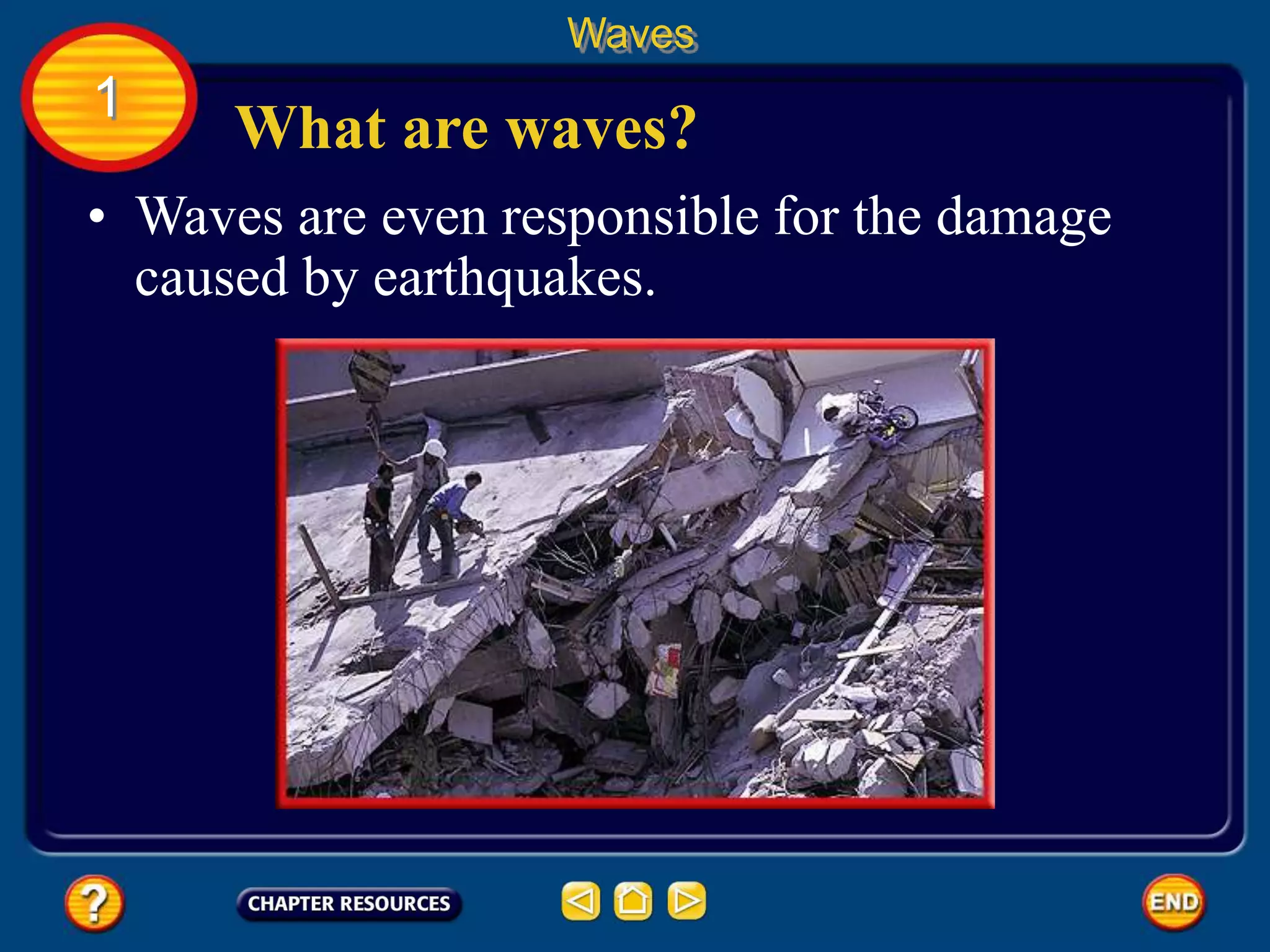
• Waves are even responsible for the damage
caused by earthquakes.
What are waves?
Waves
1
• A wave is a disturbance that moves through
matter or space.
• Waves carry energy from one place to
another.
• In water waves, the energy is transferred by
water molecules.
Waves Carry Energy, not Matter
Waves
1
• When waves travel through solids, liquids,
and gases, matter is not carried along with
the waves.
• Waves usually are produced by something moving back and
forth, or vibrating.
2 Types of Waves
Waves
1
• It is the energy of the vibrating object that waves carry
outward.
• Some waves, known as mechanical waves, can travel only
through matter. (ex: water waves, earthquake/seismic
waves, sound waves, and the waves that travel down a rope
or spring)
• Waves called electromagnetic waves can travel either
through matter or through empty space.
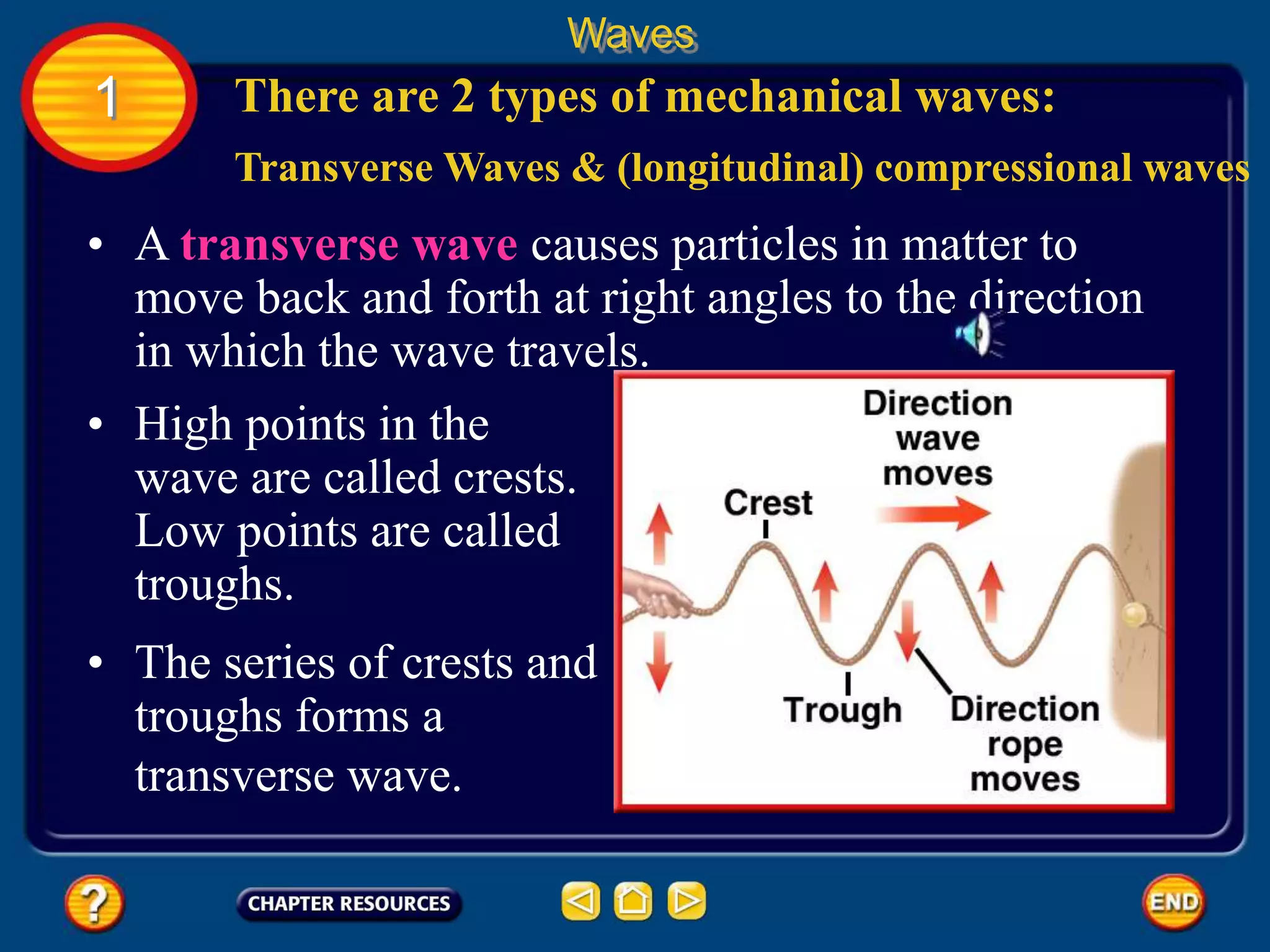
• A transverse wave causes particles in matter to
move back and forth at right angles to the direction
in which the wave travels.
There are 2 types of mechanical waves:
Transverse Waves & (longitudinal) compressional waves
Waves
1
• High points in the
wave are called crests.
Low points are called
troughs.
• The series of crests and
troughs forms a
transverse wave.
• Another type of mechanical wave is a
compressional wave.
Compressional Waves
Waves
1
• A compressional wave causes particles in
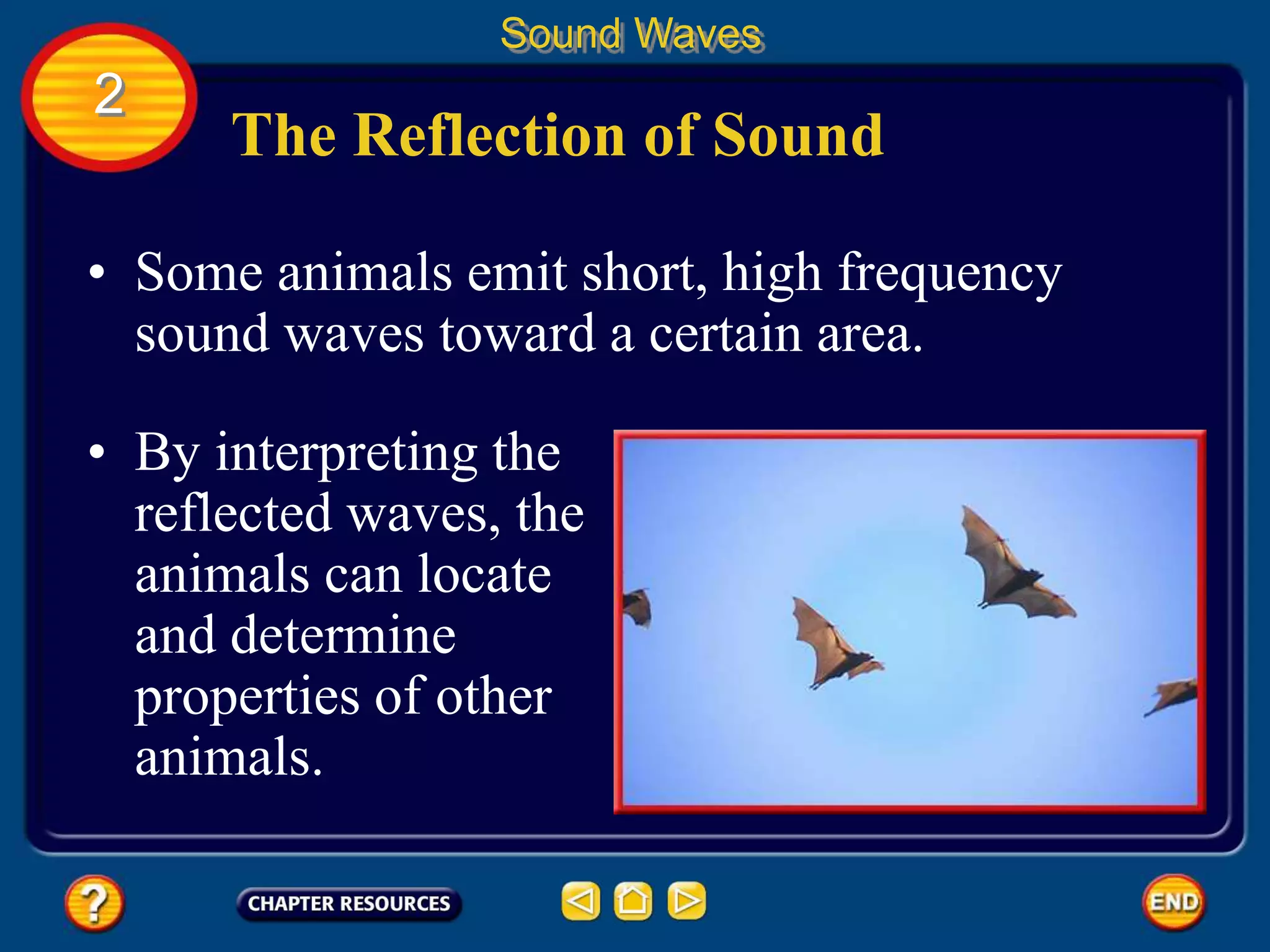
matter to move back and forth along the
same direction in which the wave travels.
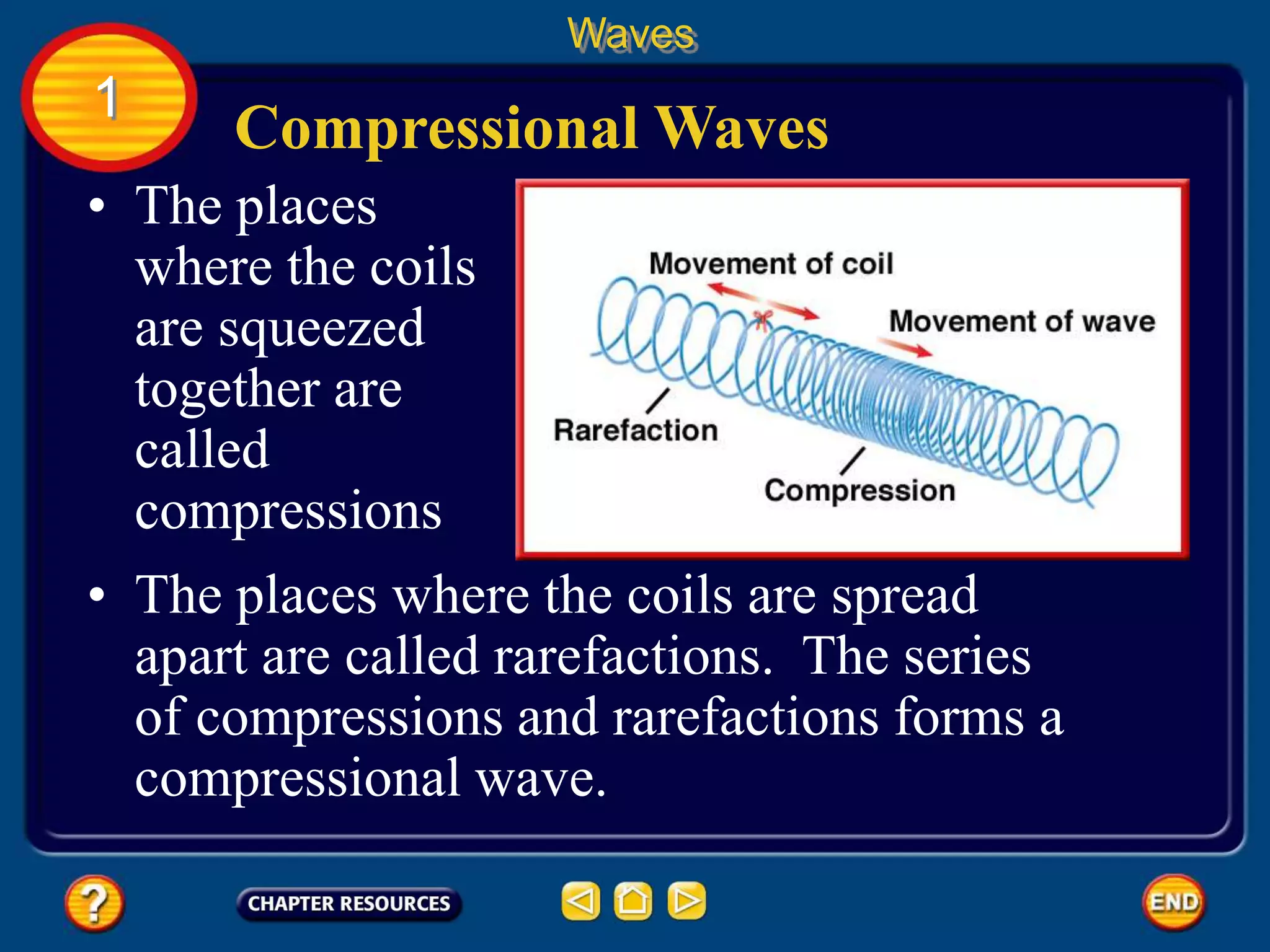
• The places
where the coils
are squeezed
together are
called
compressions
Compressional Waves
Waves
1
• The places where the coils are spread
apart are called rarefactions. The series
of compressions and rarefactions forms a
compressional wave.
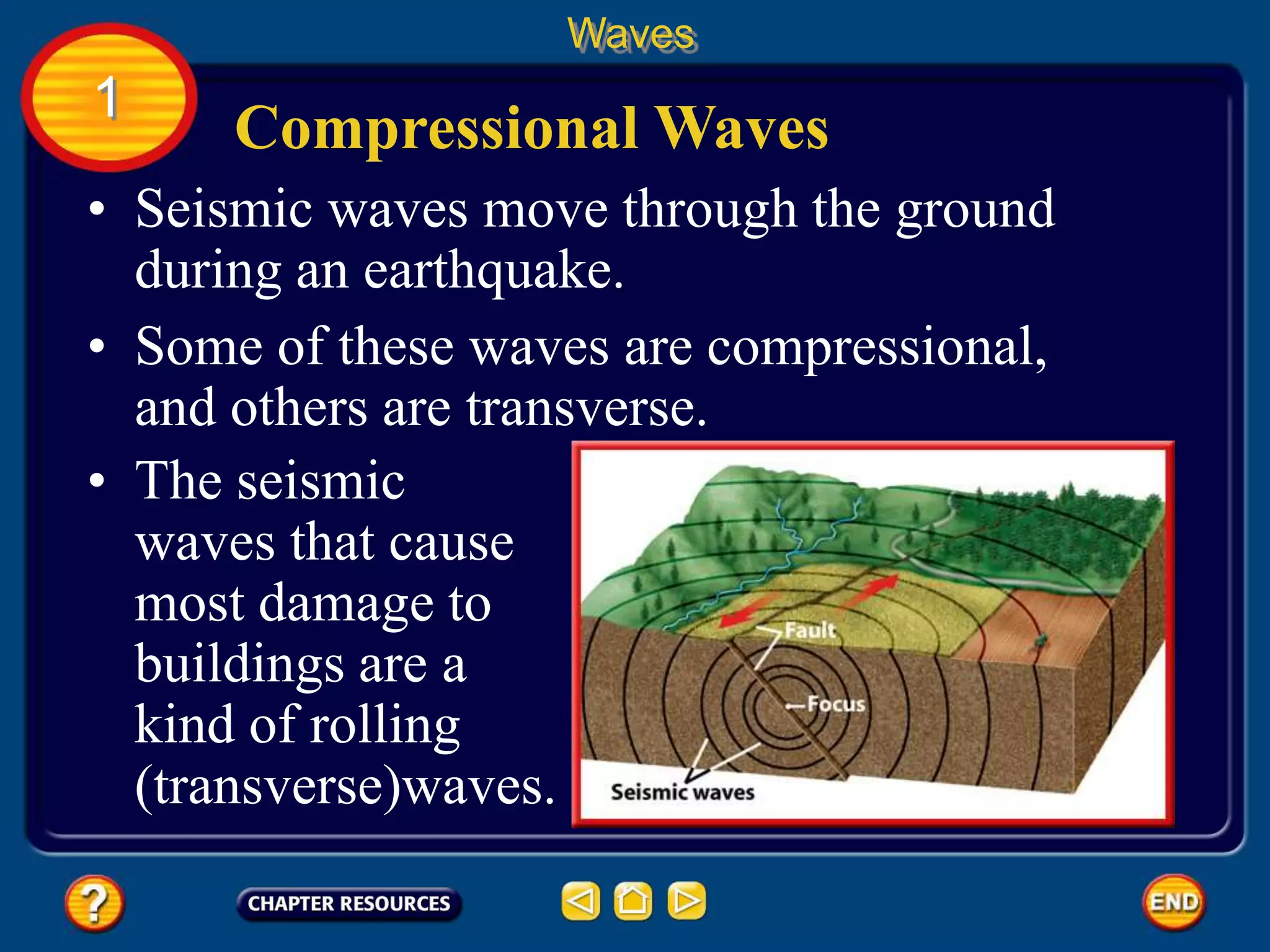
• Seismic waves move through the ground
during an earthquake.
Compressional Waves
Waves
1
• Some of these waves are compressional,
and others are transverse.
• The seismic
waves that cause
most damage to
buildings are a
kind of rolling
(transverse)waves.
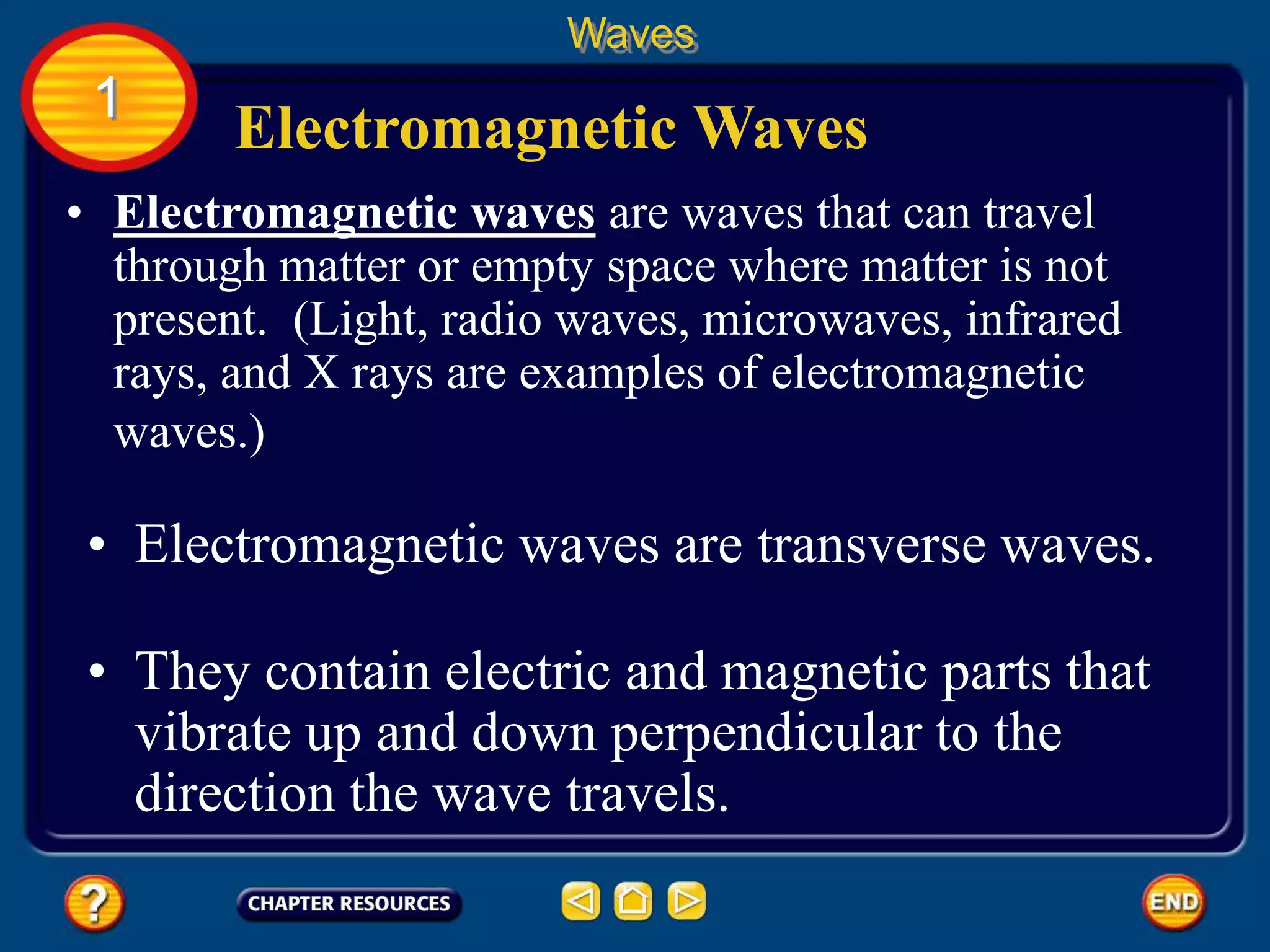
• Electromagnetic waves are waves that can travel
through matter or empty space where matter is not
present. (Light, radio waves, microwaves, infrared
rays, and X rays are examples of electromagnetic
waves.)
Electromagnetic Waves
Waves
1
• Electromagnetic waves are transverse waves.
• They contain electric and magnetic parts that
vibrate up and down perpendicular to the
direction the wave travels.
Review
• A ___________ wave is a shaped wave is
a shaped wave known for crests and
troughs. A transverse wave can be a
___________ wave which travels through
matter ONLY or an _____________ wave
which can travel through matter OR empty
space (a vacuum).
• The properties that waves have depend on
the vibrations that produce the waves.
Properties of Waves
Waves
1
• For example, if you move a pencil slowly
up and down in a bowl of water, the waves
produced by the pencil’s motion will be
small and spread apart.
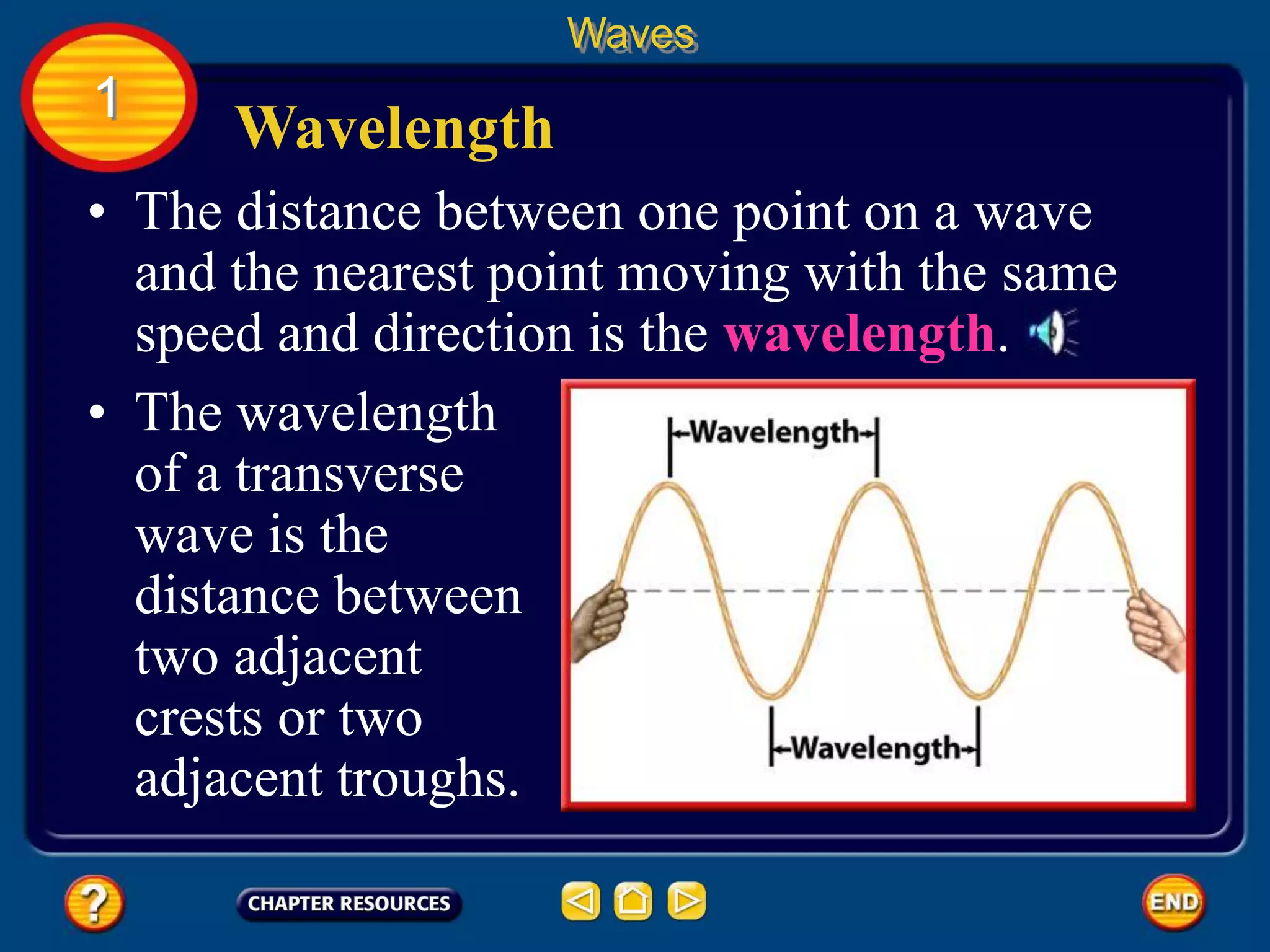
• The distance between one point on a wave
and the nearest point moving with the same
speed and direction is the wavelength.
Wavelength
Waves
1
• The wavelength
of a transverse
wave is the
distance between
two adjacent
crests or two
adjacent troughs.
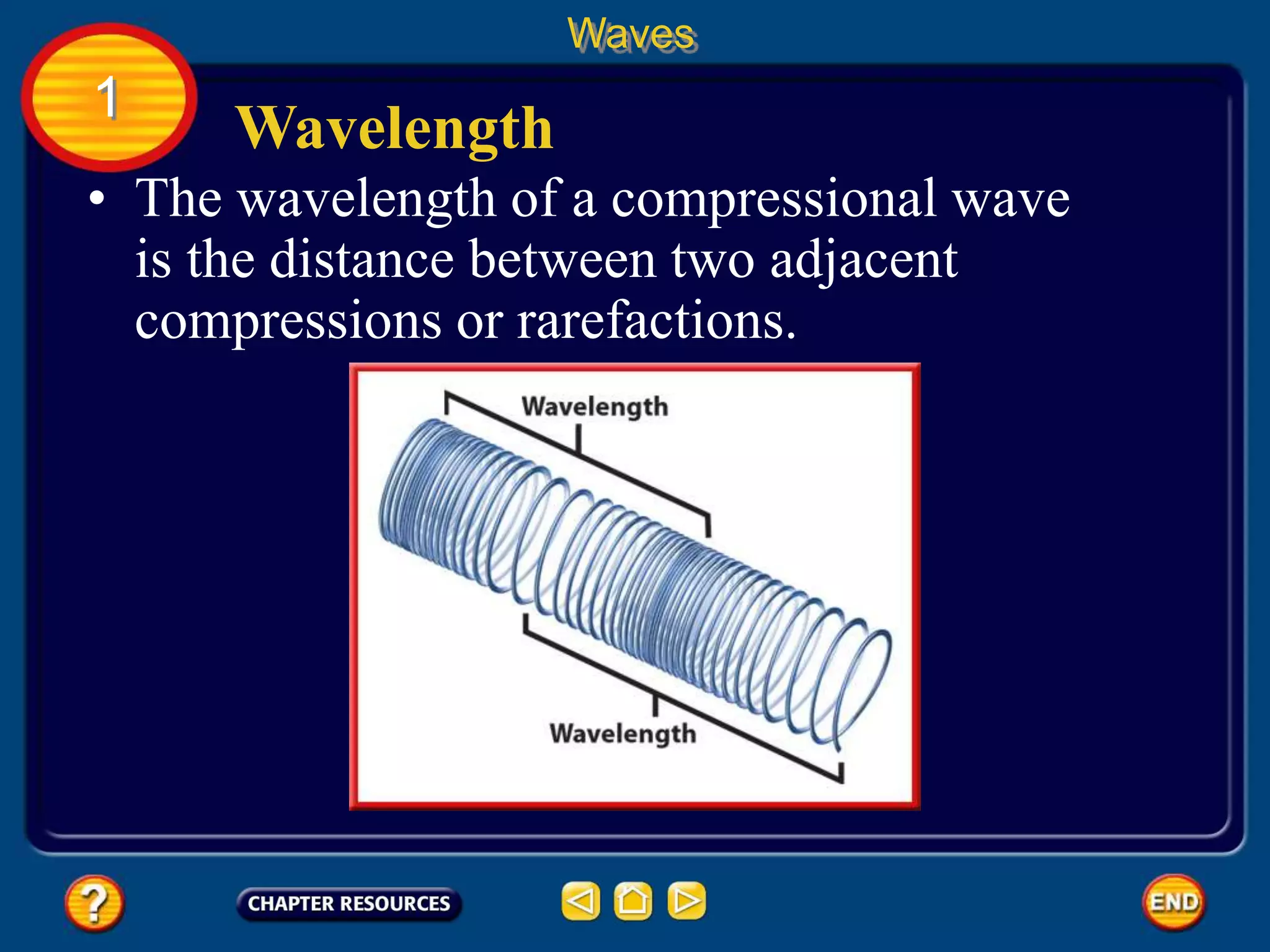
• The wavelength of a compressional wave
is the distance between two adjacent
compressions or rarefactions.
Wavelength
Waves
1
• The frequency of a wave is the number
of wavelengths that pass by a point each
second (or certain amount of time).
Frequency
Waves
1
If you were watching a transverse wave on a rope, the frequency
of the wave would be the number of crests or troughs that pass you
each second.
-The closer the waves are together, the
greater the energy carried by the waves.
• The amplitude (largeness or height) of a wave is a
measure of the distance between a line through the
middle of a wave and a crest or trough.
Amplitude of a Transverse Wave
Waves
1
• As the distance between crests and troughs
increases, the amplitude (largeness or height) of a
transverse wave increases.
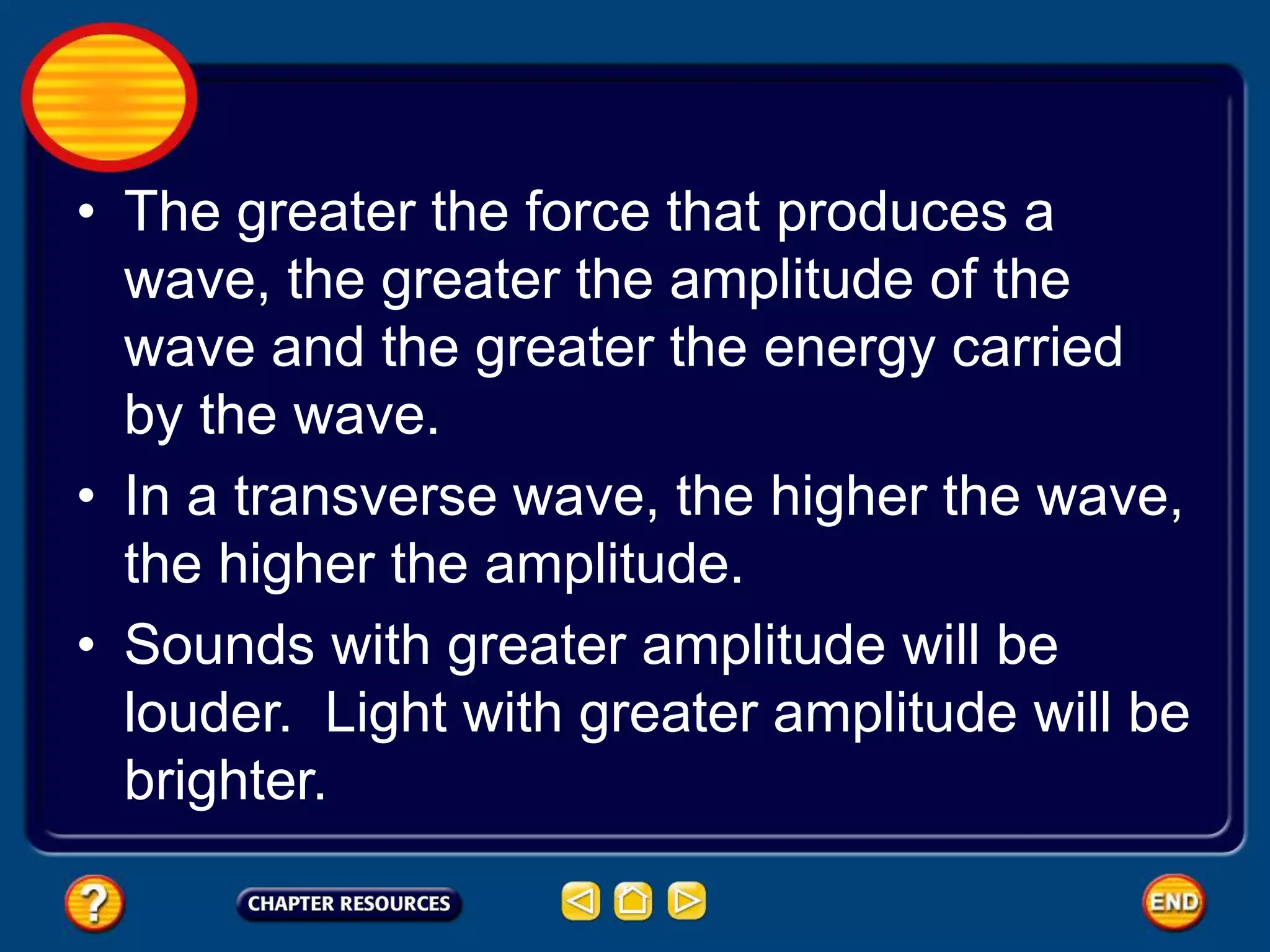
• The greater the force that produces a
wave, the greater the amplitude of the
wave and the greater the energy carried
by the wave.
• In a transverse wave, the higher the wave,
the higher the amplitude.
• Sounds with greater amplitude will be
louder. Light with greater amplitude will be
brighter.
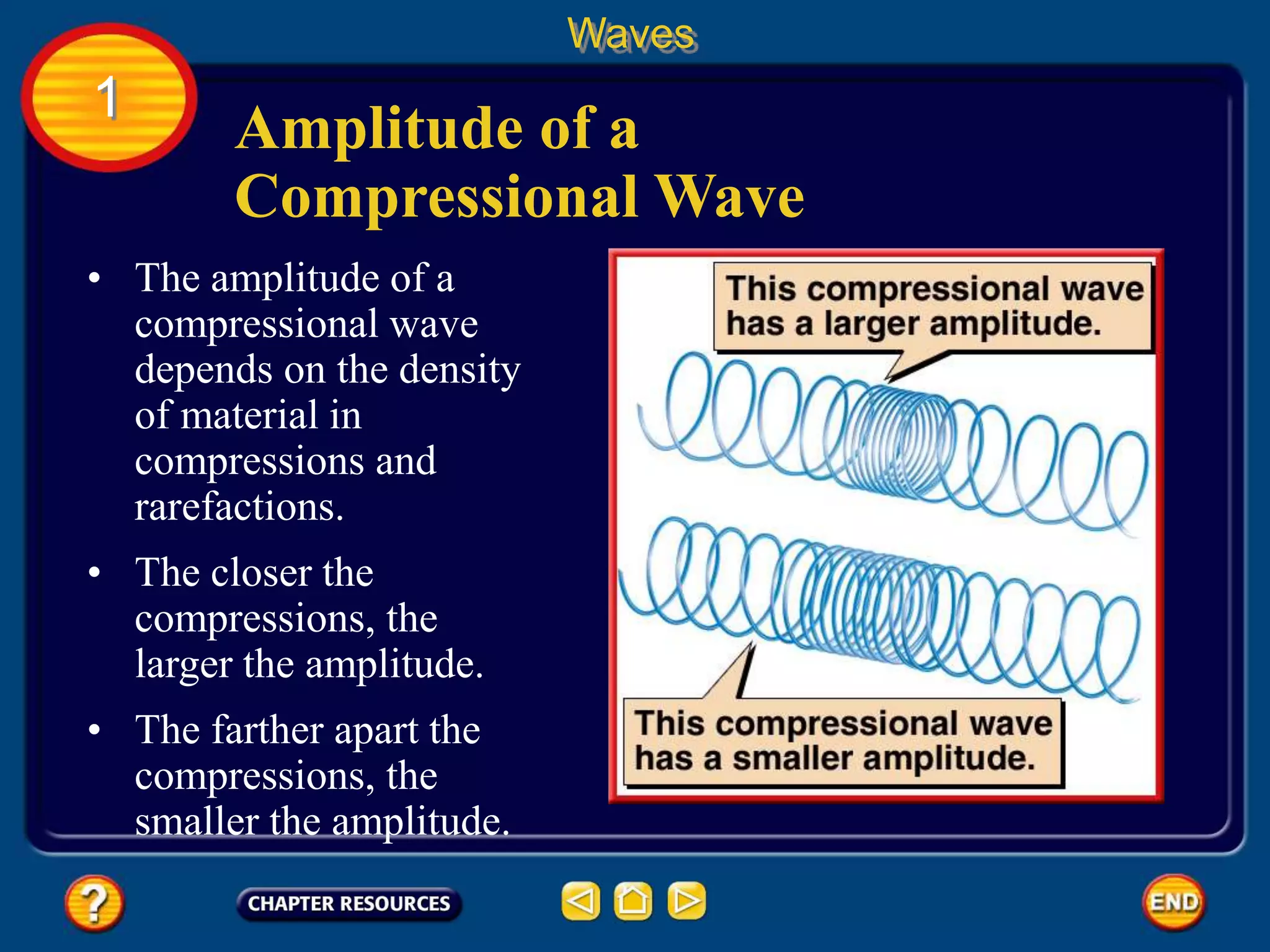
• The amplitude of a
compressional wave
depends on the density
of material in
compressions and
rarefactions.
• The closer the
compressions, the
larger the amplitude.
• The farther apart the
compressions, the
smaller the amplitude.
Amplitude of a
Compressional Wave
Waves
1
• The vibrations that produce a wave transfer
energy to the wave.
Amplitude and Energy
Waves
1
• The more energy a wave carries, the larger
its amplitude.
• Seismic waves are produced by vibrations in
Earth’s crust that cause earthquakes.
• The more energy these waves have, the larger
their amplitudes and the more damage they
cause as they travel along Earth’s surface.
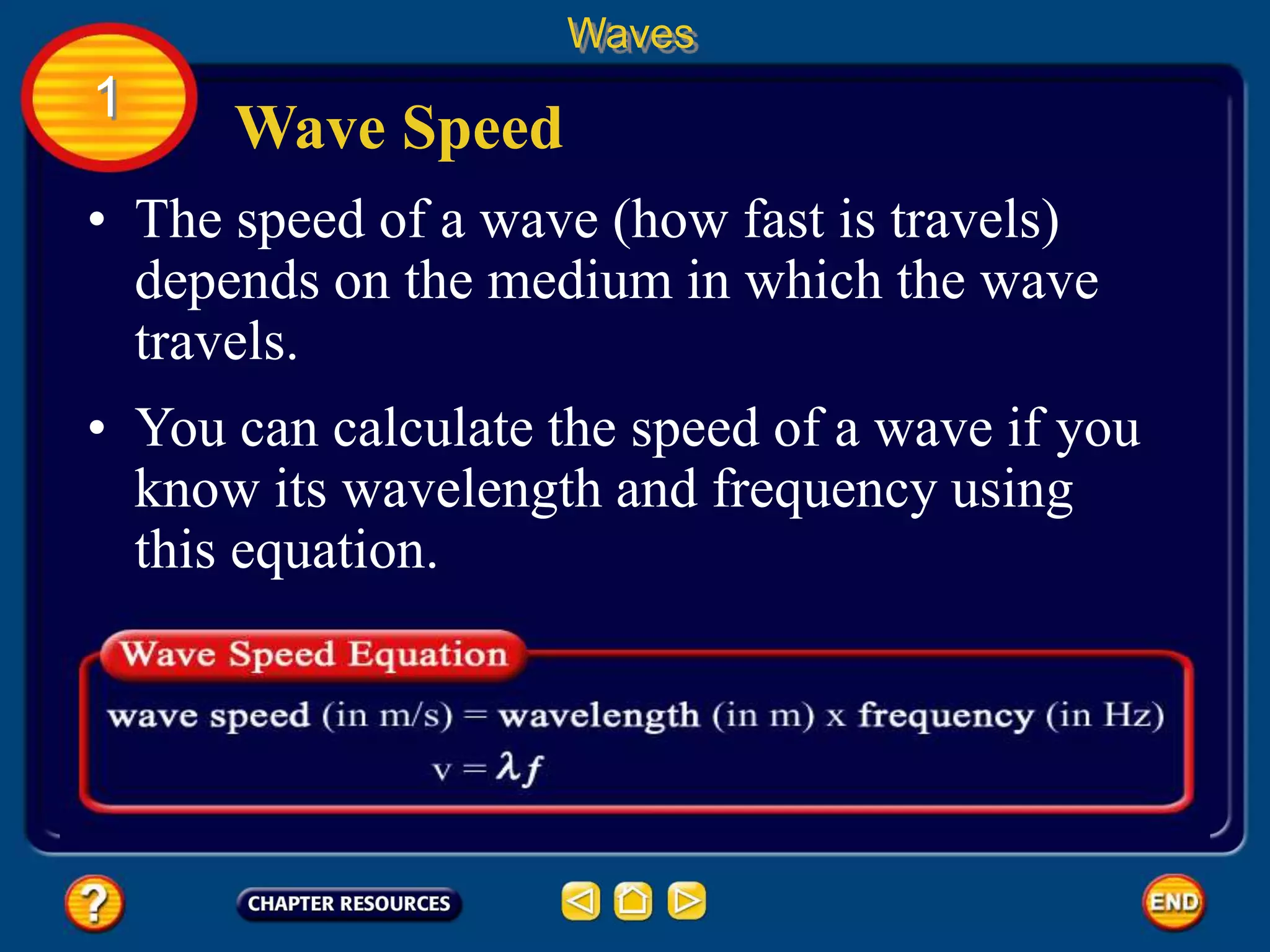
• The speed of a wave (how fast is travels)
depends on the medium in which the wave
travels.
Wave Speed
Waves
1
• You can calculate the speed of a wave if you
know its wavelength and frequency using
this equation.
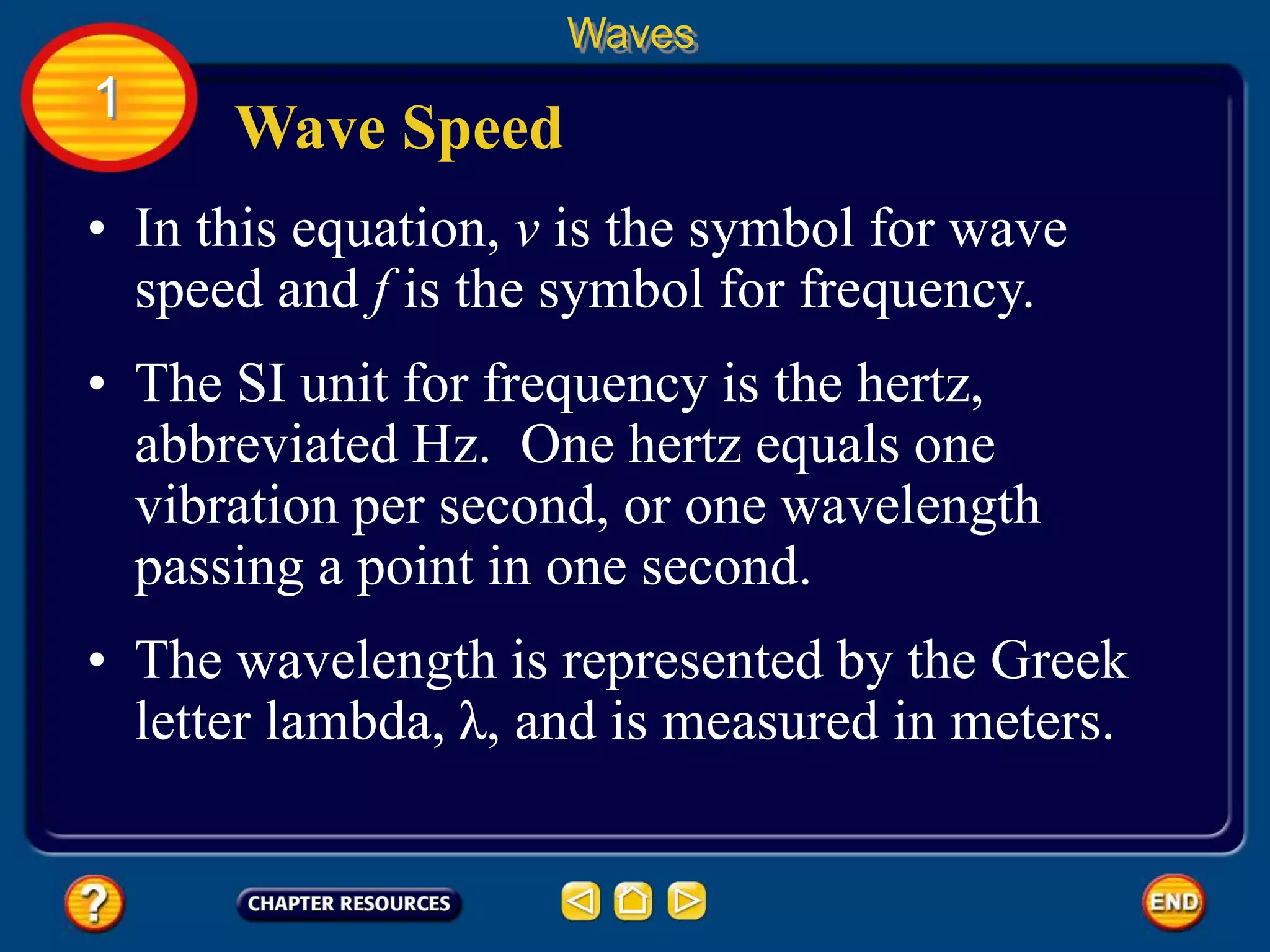
• In this equation, v is the symbol for wave
speed and f is the symbol for frequency.
Wave Speed
Waves
1
• The SI unit for frequency is the hertz,
abbreviated Hz. One hertz equals one
vibration per second, or one wavelength
passing a point in one second.
• The wavelength is represented by the Greek
letter lambda, λ, and is measured in meters.
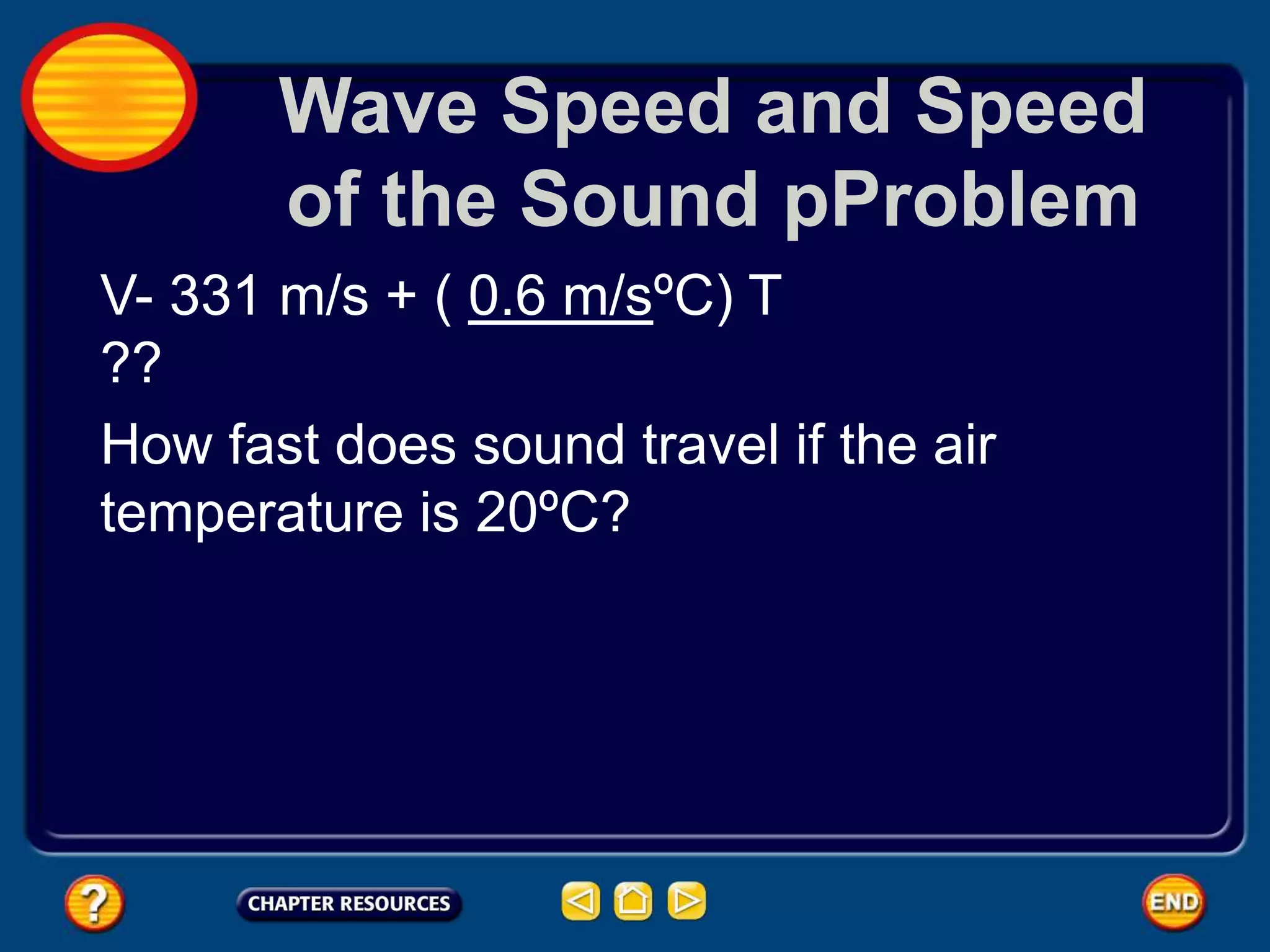
Wave Speed and Speed
of the Sound pProblem
V- 331 m/s + ( 0.6 m/sºC) T
??
How fast does sound travel if the air
temperature is 20ºC?
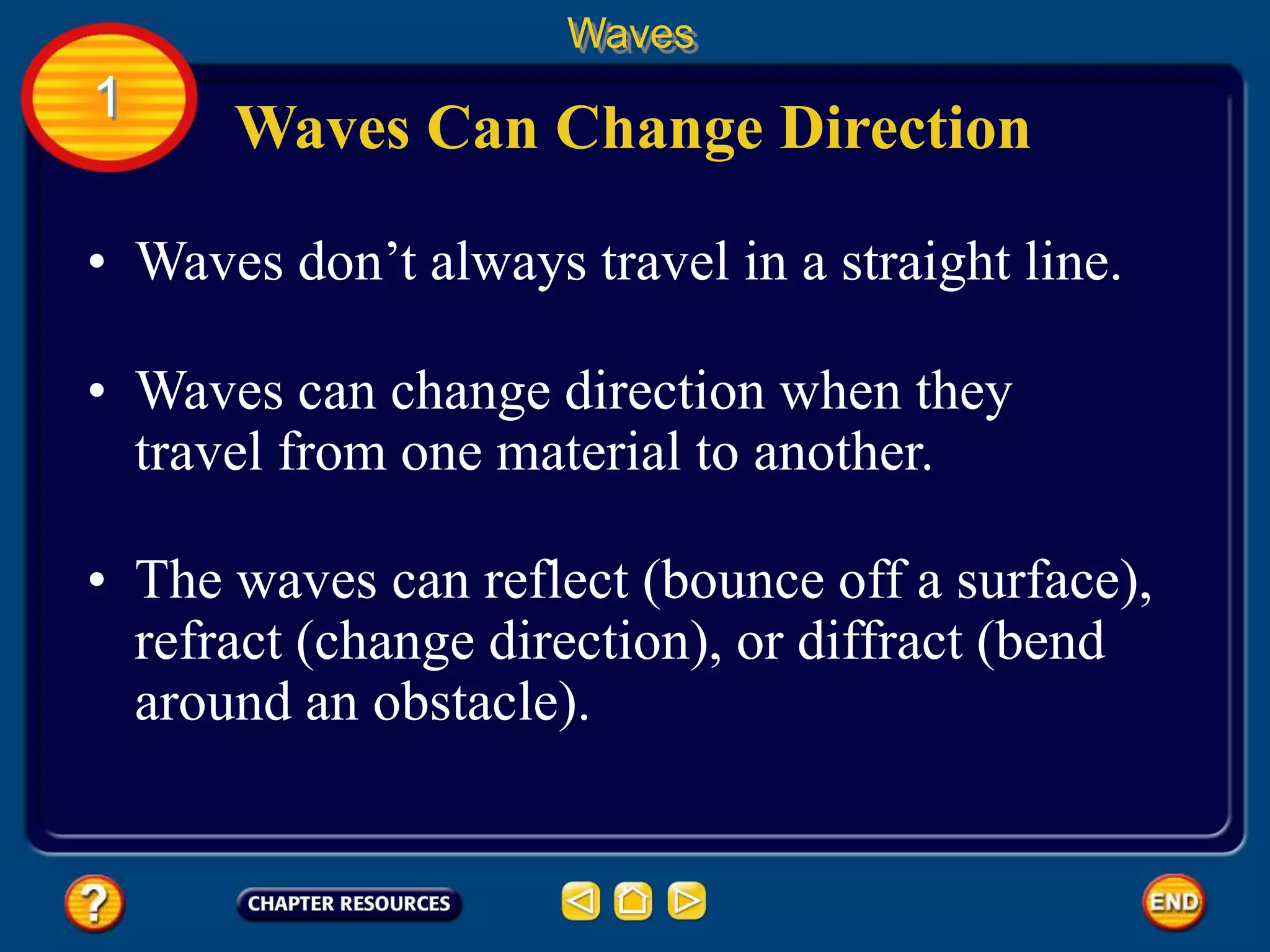
• Waves don’t always travel in a straight line.
Waves Can Change Direction
Waves
1
• Waves can change direction when they
travel from one material to another.
• The waves can reflect (bounce off a surface),
refract (change direction), or diffract (bend
around an obstacle).
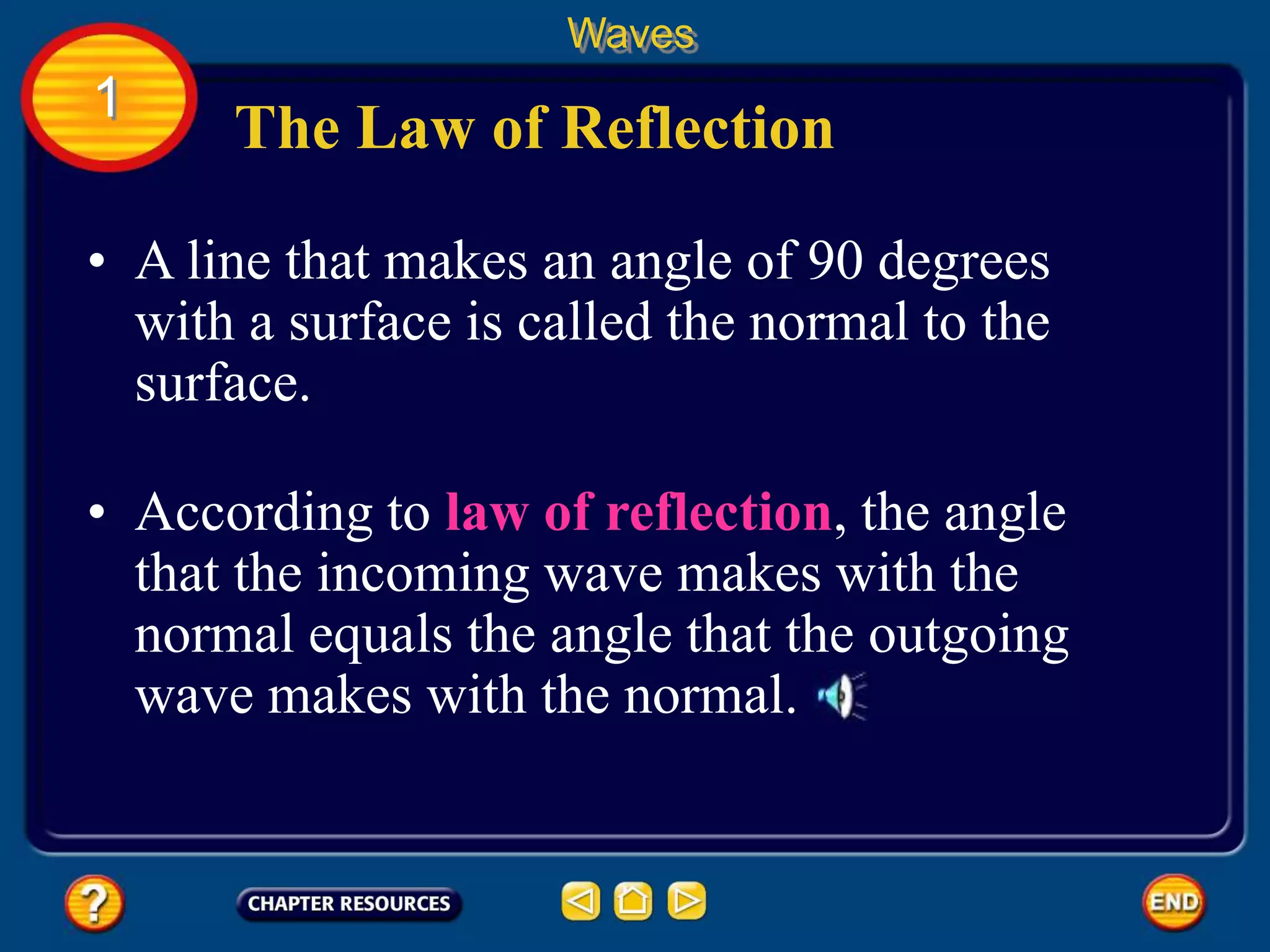
• A line that makes an angle of 90 degrees
with a surface is called the normal to the
surface.
The Law of Reflection
Waves
1
• According to law of reflection, the angle
that the incoming wave makes with the
normal equals the angle that the outgoing
wave makes with the normal.
Reflection
• Reflection is the bouncing back of a wave
when it meets a surface or boundary that
does not absorb the entire wave’s energy.
All waves can be reflected.
• Examples: light reflected off a mirror,
echoes (voice, bats, dolphins)
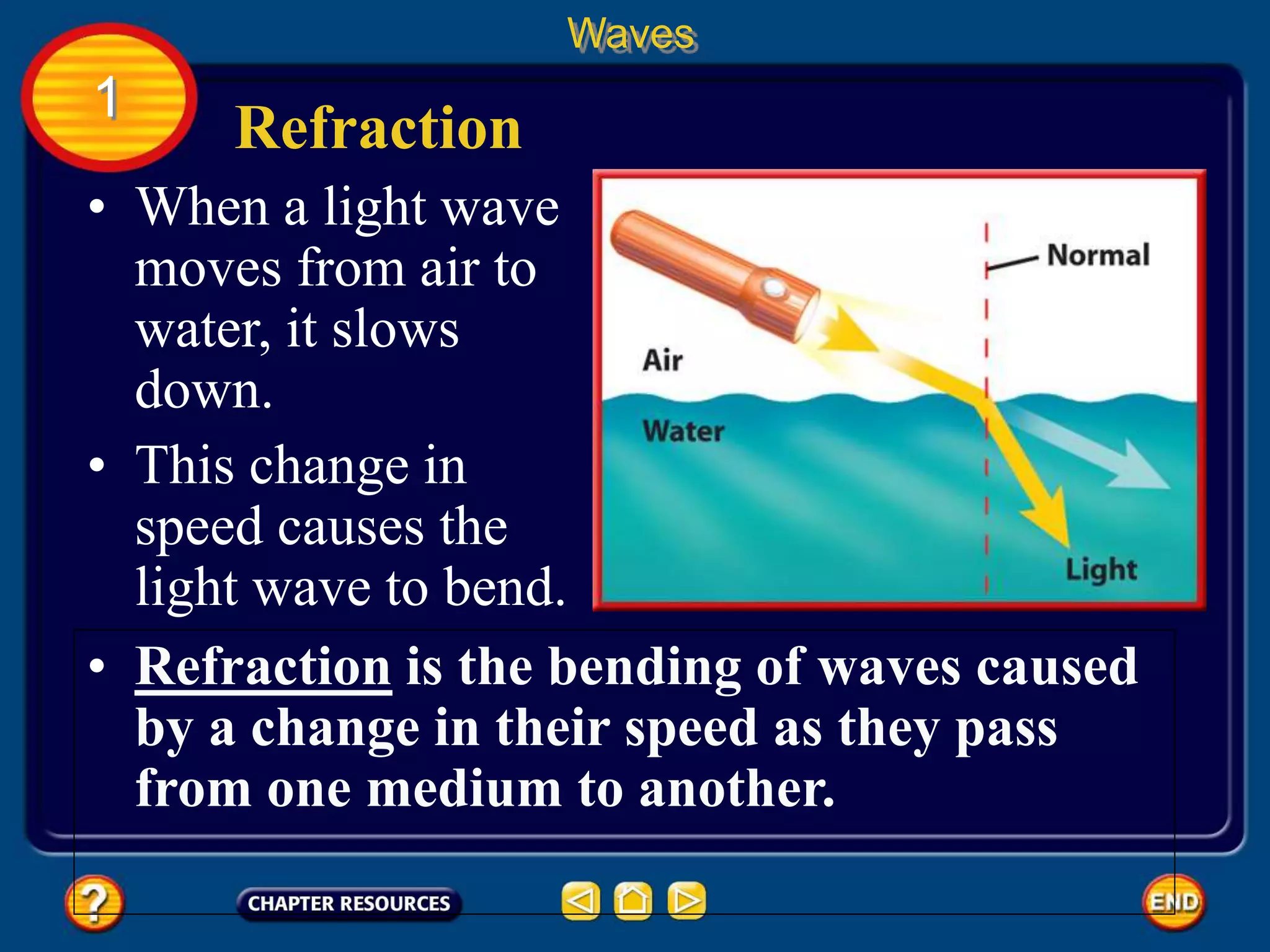
• When a light wave
moves from air to
water, it slows
down.
Refraction
Waves
1
• This change in
speed causes the
light wave to bend.
• Refraction is the bending of waves caused
by a change in their speed as they pass
from one medium to another.
Refraction
• As waves pass at an angle from one
medium to another, they may speed up
or slow down.
• The greater the change in speed of the
waves, the more the waves will bend.
• Refraction of light going from air
through a convex lens, for example,
can make images appear larger as the
light waves bend.
• Waves can change direction by diffraction,
which is the bending of waves around an
object.
Refraction
Waves
1
• Prisms or diffraction gratings separate
white light into its different components or
color by bending the light at different
angles depending on the frequencies of the
light passing through the prism or
diffraction grating. Different colors of
light have different frequencies.
• The wavelengths of sound waves are
similar to the size of objects around you,
but the wavelengths of light waves are
much shorter.
Diffraction of Sound and Light
Waves
1
• As a result, you can hear people talking
in a room with an open door even though
you can’t see them.
Transmission
• Transmission of waves occurs when
waves pass through a given point or
medium (matter).
• Example: Light waves are transmitted
through transparent materials that
allow most light that strikes them to
pass through.
Transmission
• Only a small amount of light is
absorbed when waves are transmitted.
Most of the wave passes through the
medium (matter).
Transmission
• Opaque materials allow no light waves
to be transmitted through them.
• Translucent materials transmit some
light, but cause it to be scattered so no
clear image is seen.
Absorption
• Absorption of certain frequencies of light
occurs when the energy is not transferred
through, or reflected by the given medium.
• Objects or substances that absorb any
wavelength of electromagnetic radiation
become warmer and convert the
absorbed energy to infrared radiation.
1
Section Check
Question 1
Waves carry _______, not _______.
Waves carry energy, not matter. Think of what
happens when you shake one end of a rope; a
wave travels along the rope, but the rope itself
doesn’t move forward.
Answer
1
Section Check
Question 1
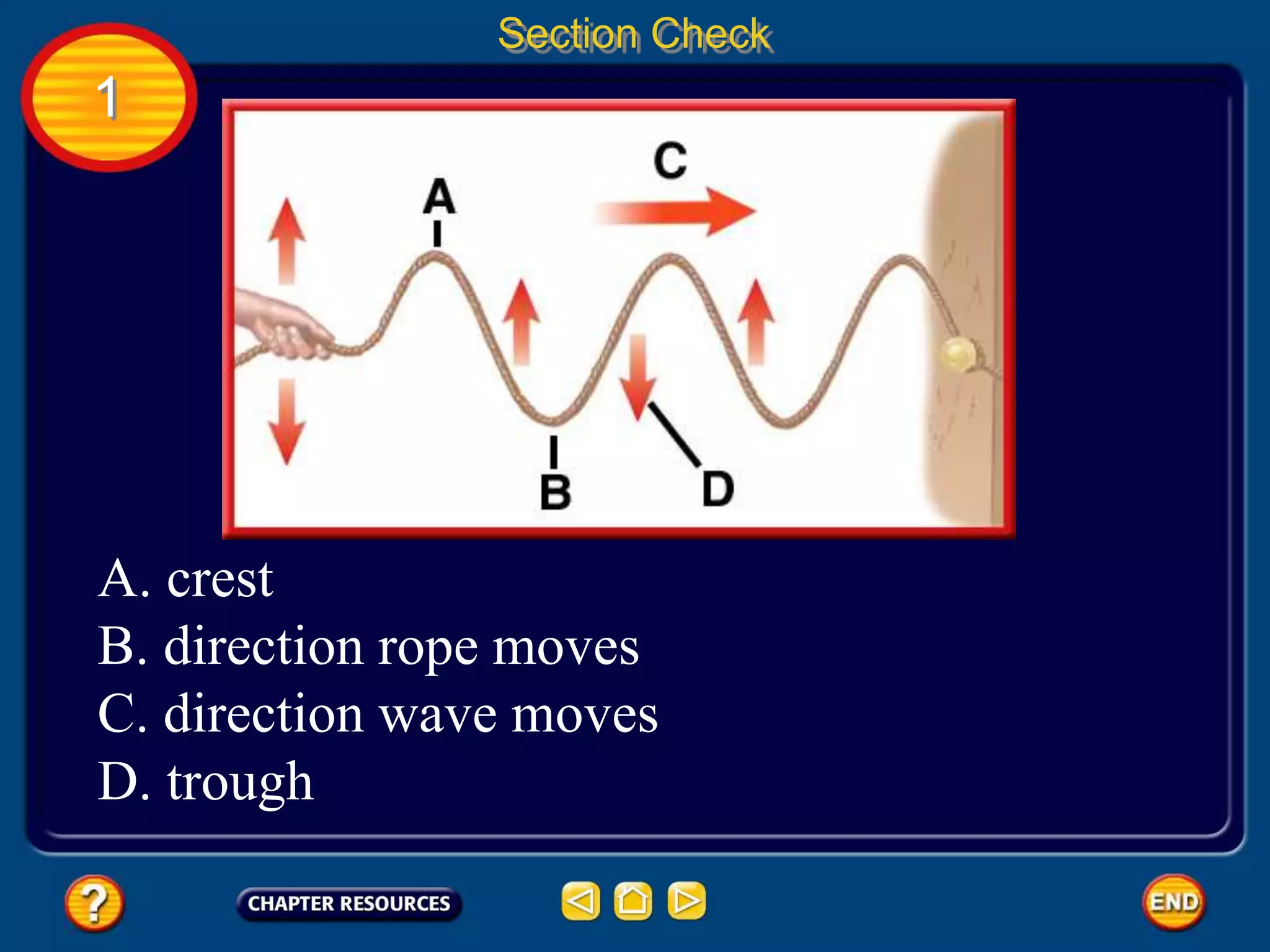
What is shown at point B in this illustration?
1
Section Check
A. crest
B. direction rope moves
C. direction wave moves
D. trough
1
Section Check
Answer
The answer is D. Low points on a wave are
called troughs.
1
Section Check
Question 3
The number of wavelengths that pass by each
second is the wave’s _______.
A. diffraction
B. frequency
C. rarefaction
D. wavelength
1
Section Check
Answer
The answer is B. If you were watching a
transverse wave on a rope, the frequency of the
wave would be the number of crests or troughs
that pass you each second.
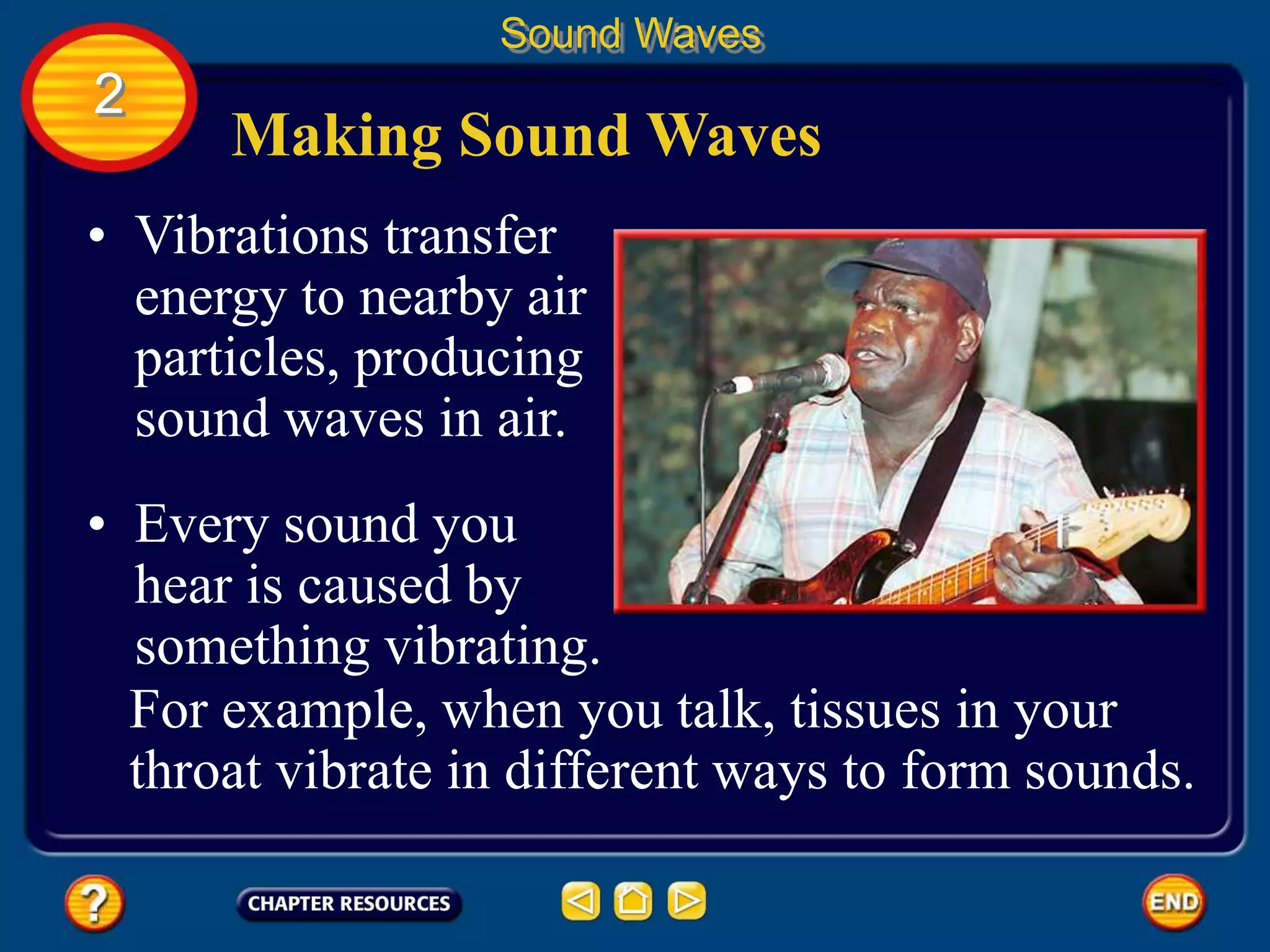
Making Sound Waves
• Vibrations transfer
energy to nearby air
particles, producing
sound waves in air.
Sound Waves
2
• Every sound you
hear is caused by
something vibrating.
For example, when you talk, tissues in your
throat vibrate in different ways to form sounds.
Sound Waves are
Compressional Waves
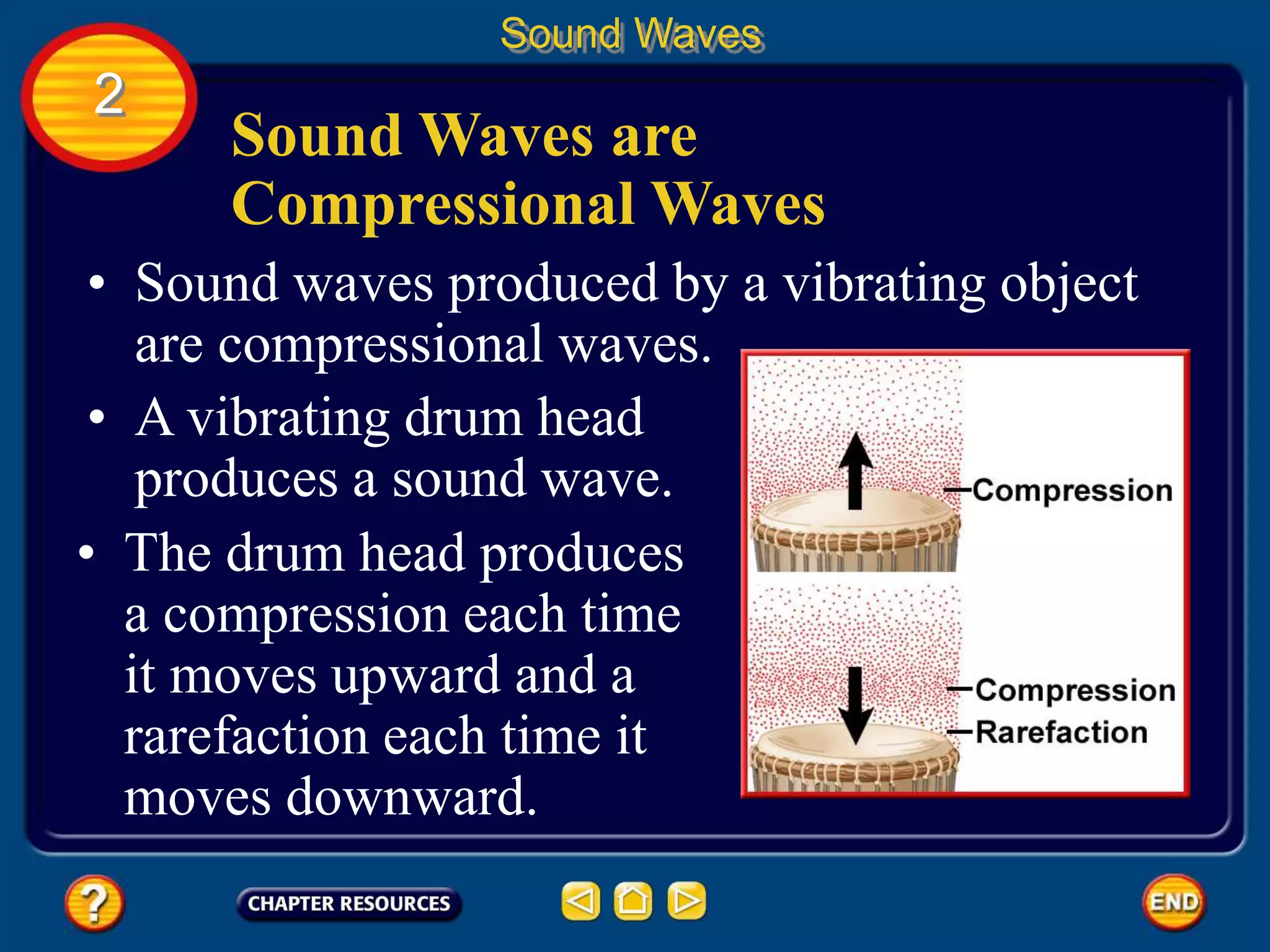
• Sound waves produced by a vibrating object
are compressional waves.
• A vibrating drum head
produces a sound wave.
Sound Waves
2
• The drum head produces
a compression each time
it moves upward and a
rarefaction each time it
moves downward.
Sound Waves are
Compressional Waves
• Sound waves can only travel through matter.
• The energy carried by a sound wave is
transferred by the collisions between the
particles in the material the wave is
traveling in.
Sound Waves
2
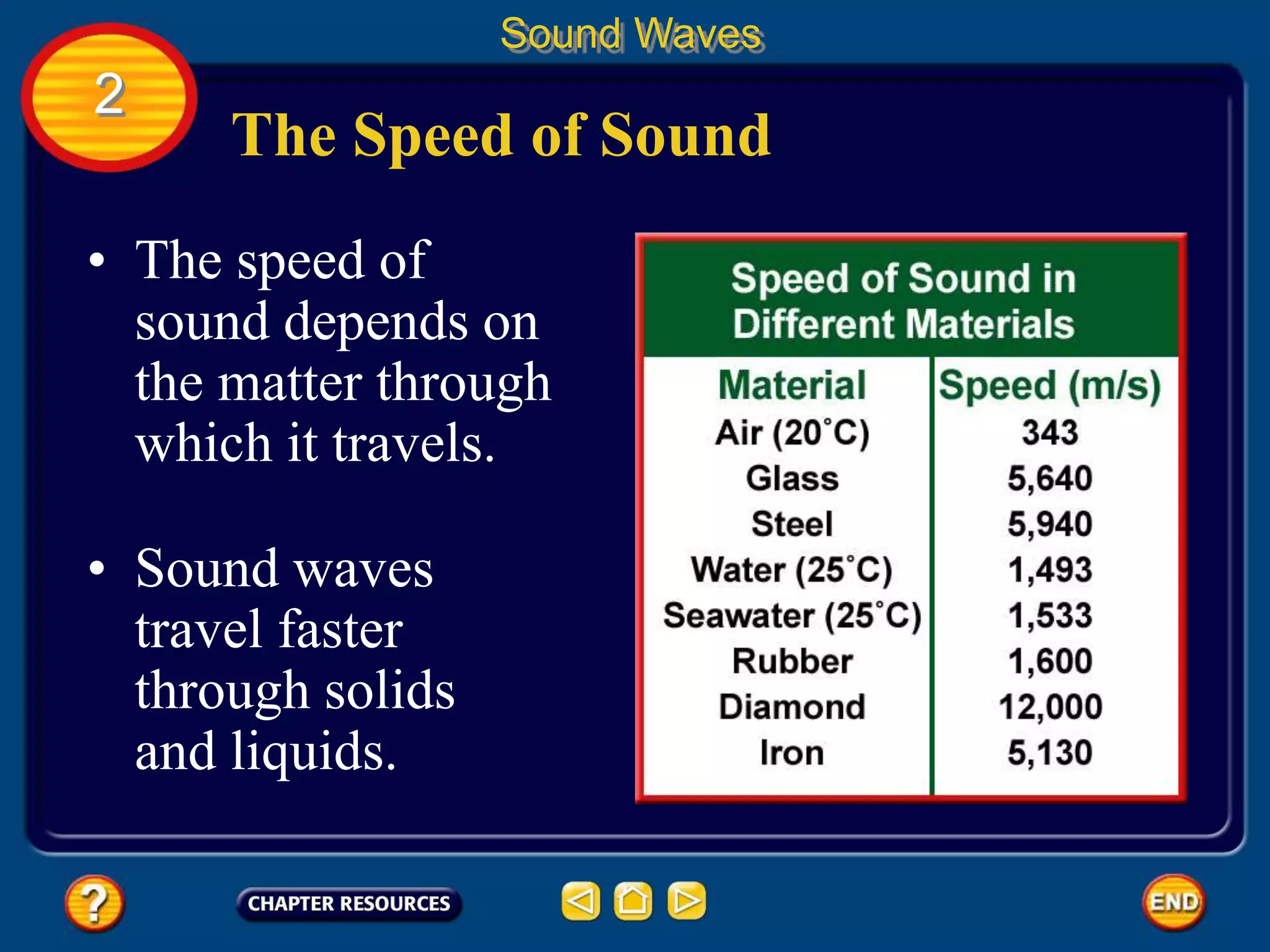
The Speed of Sound
• The speed of
sound depends on
the matter through
which it travels.
• Sound waves
travel faster
through solids
and liquids.
Sound Waves
2
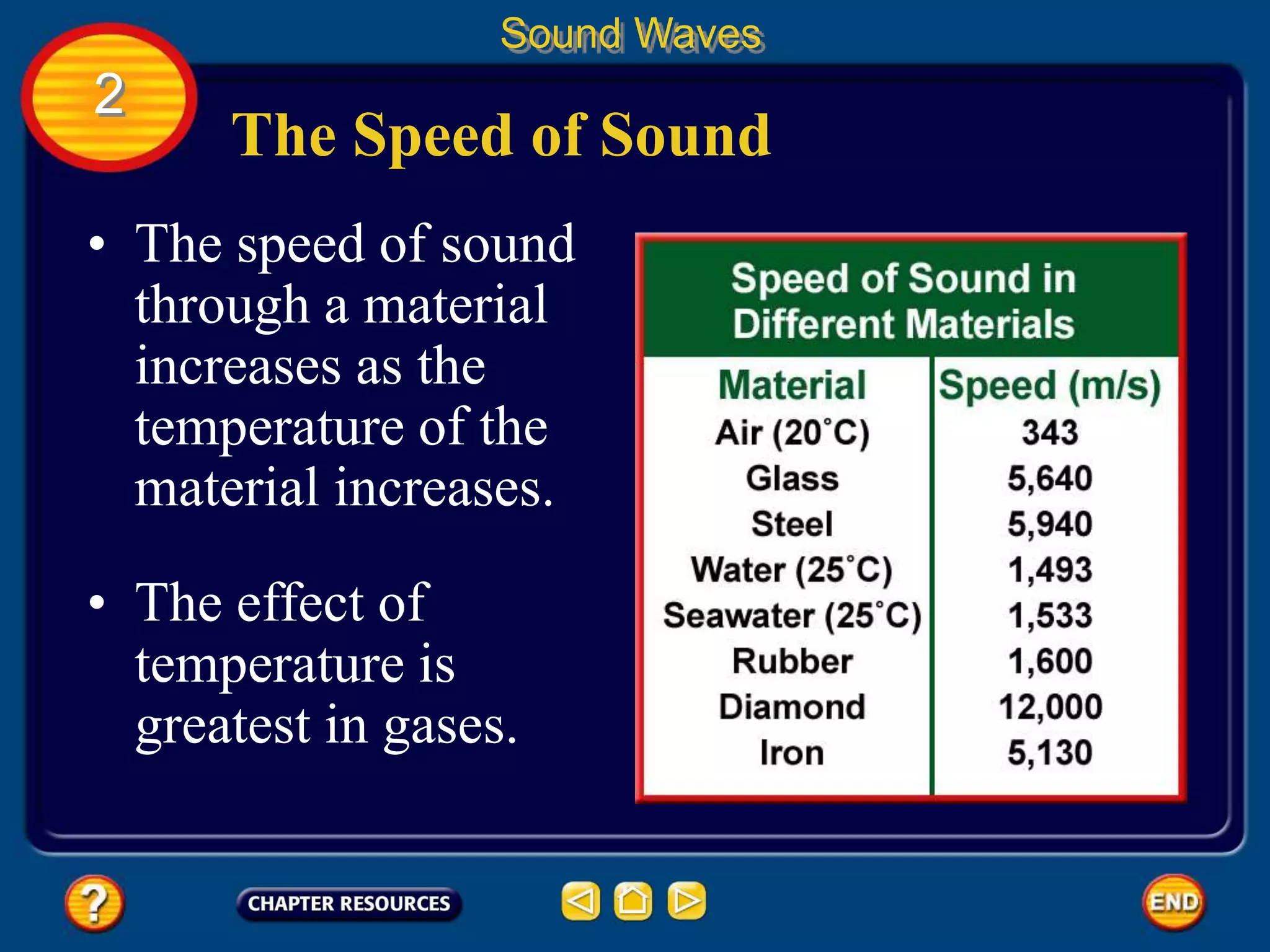
The Speed of Sound
Sound Waves
2
• The speed of sound
through a material
increases as the
temperature of the
material increases.
• The effect of
temperature is
greatest in gases.
The Loudness of Sound
• What makes a sound loud or soft?
• The difference is the amount of energy.
Sound Waves
2
• Loud sounds have more energy than
soft sounds.
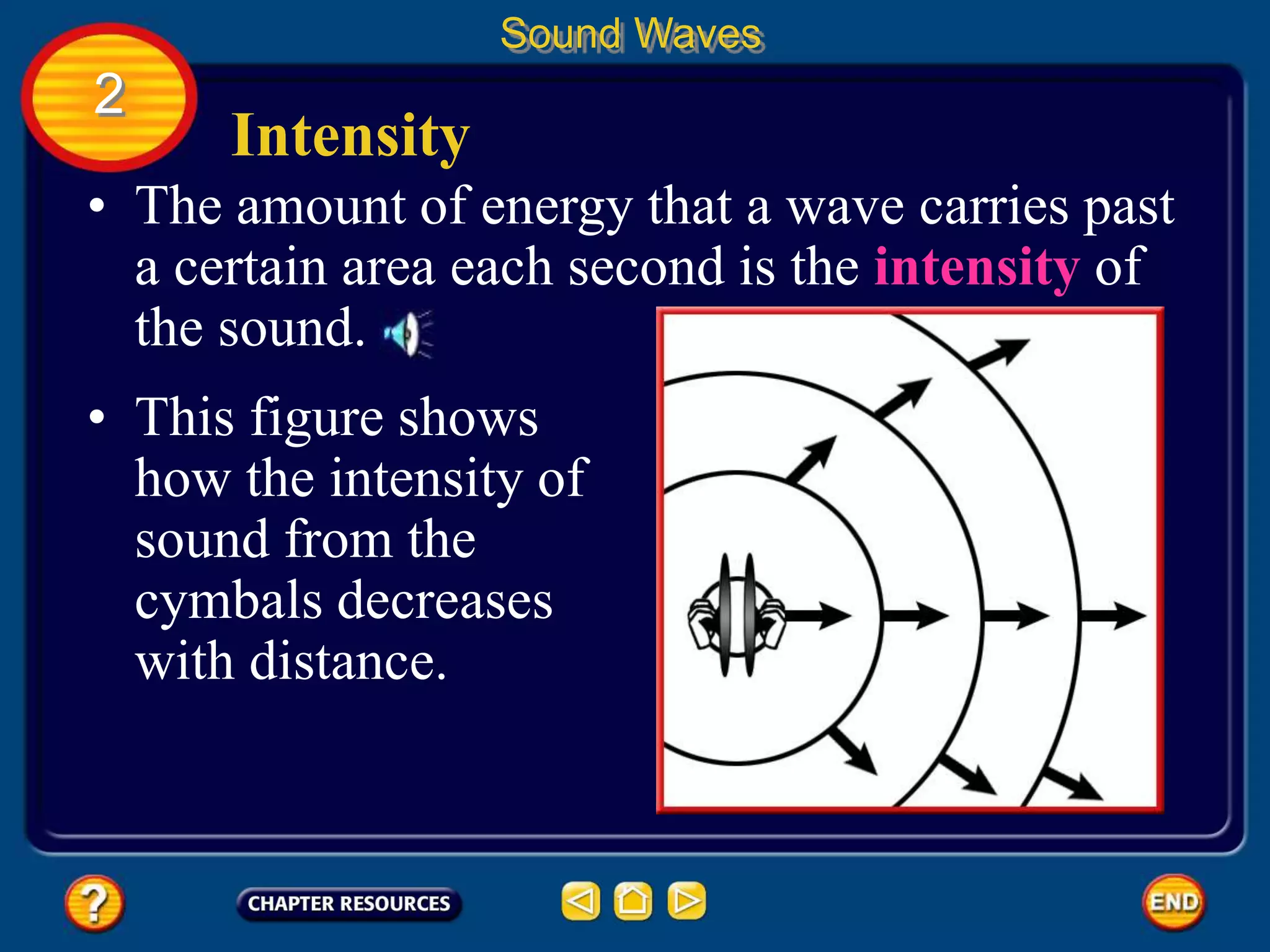
Intensity
• The amount of energy that a wave carries past
a certain area each second is the intensity of
the sound.
Sound Waves
2
• This figure shows
how the intensity of
sound from the
cymbals decreases
with distance.
Intensity
• The intensity of sound waves is related to
the amplitude.
Sound Waves
2
• Sound with a greater amplitude also has a
greater intensity.
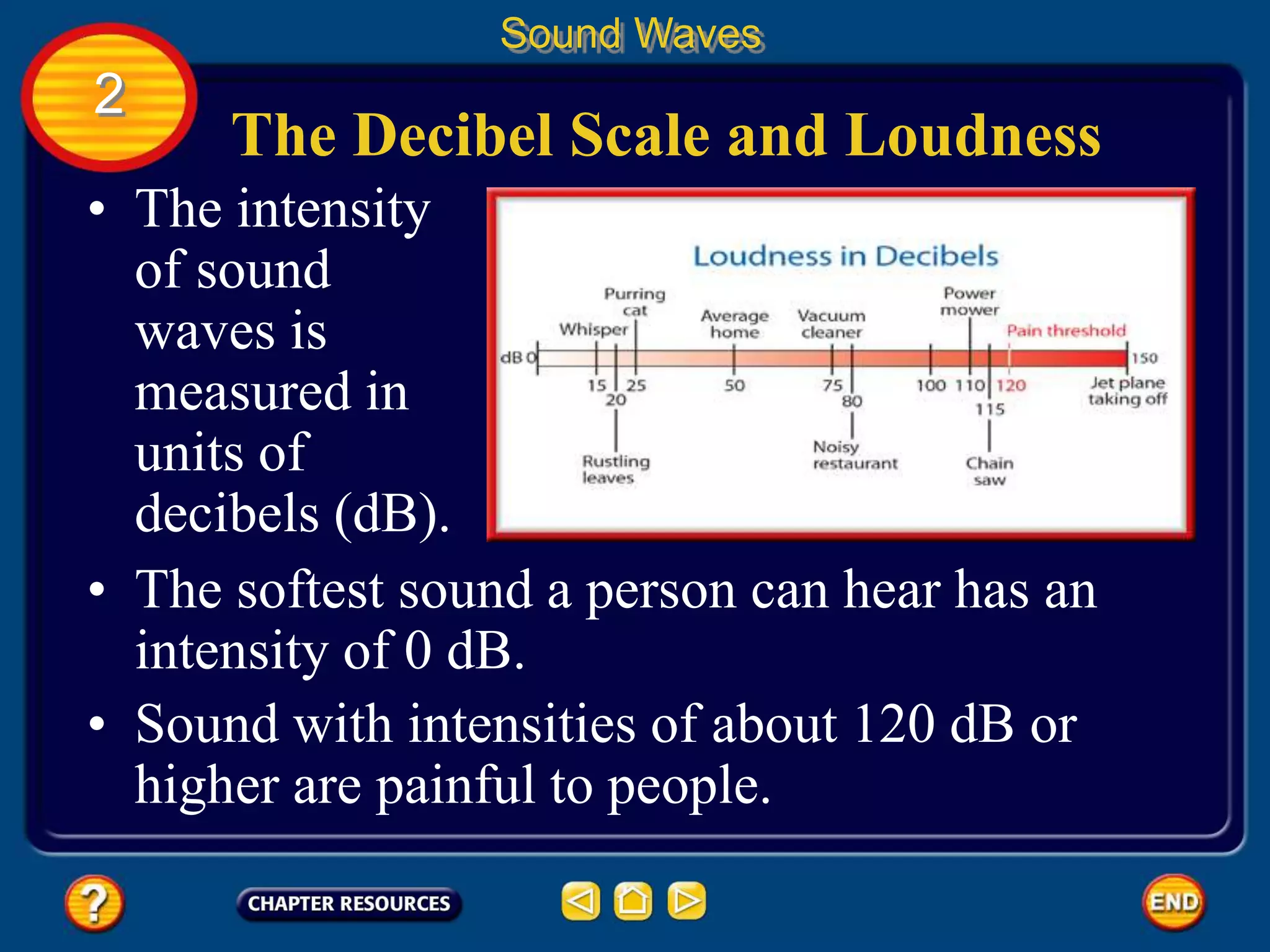
The Decibel Scale and Loudness
• The intensity
of sound
waves is
measured in
units of
decibels (dB).
Sound Waves
2
• The softest sound a person can hear has an
intensity of 0 dB.
• Sound with intensities of about 120 dB or
higher are painful to people.
The Decibel Scale and Loudness
• Loudness is the human perception of the
intensity of sound waves.
Sound Waves
2
• Each increase of 10 dB in intensity
multiplies the energy of the sound waves
ten times.
• Most people perceive this as a doubling
of the loudness of the sound.
Frequency and Pitch
• The frequency of sound waves is determined
by the frequency of the vibrations that
produce the sound.
Sound Waves
2
• People are usually able to hear sounds with
frequencies between about 20 Hz and
20,000 Hz.
• Pitch is the human perception of the
frequency sound.
• Sounds with low frequencies have low pitch
and sounds with high frequencies have high
pitch.
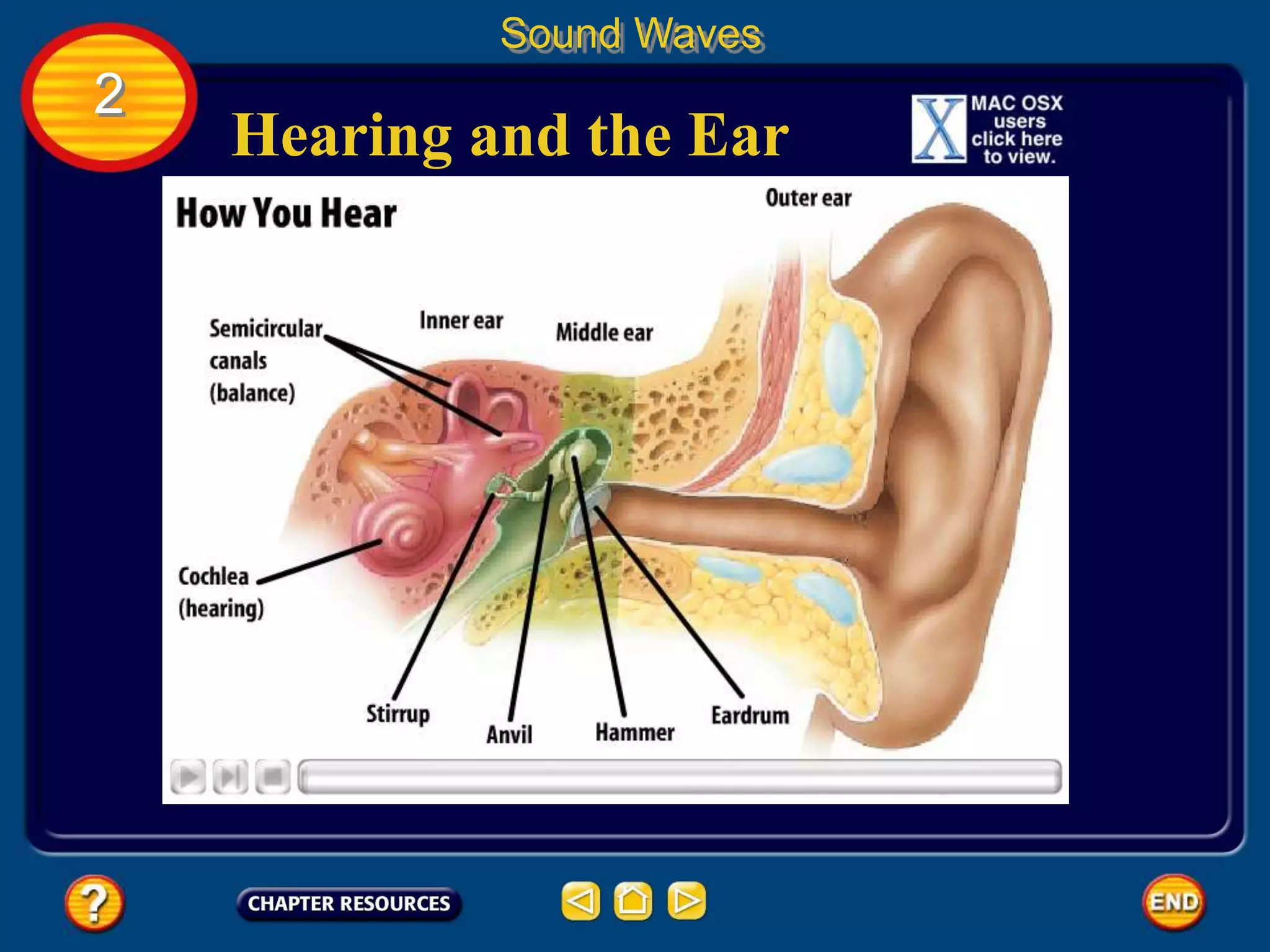
Hearing and the Ear
• The ear is a complex organ that can detect a
wide range of sounds.
Sound Waves
2
• The ear can be divided into three parts—the
outer ear, the middle ear, and the inner ear.
Hearing and the Ear
Sound Waves
2
The Reflection of Sound
• Echoes are sounds that reflect off surfaces.
Sound Waves
2
• Repeated echoes are called reverberation.
The Reflection of Sound
• The reflection of sound can be used to locate
or identify objects.
Sound Waves
2
• Echolocation is the process of locating objects
by bounding sounds off them.
The Reflection of Sound
Sound Waves
2
• By interpreting the
reflected waves, the
animals can locate
and determine
properties of other
animals.
• Some animals emit short, high frequency
sound waves toward a certain area.
Section Check
FIRST QUIZ
2
Section Check
Test I
Multiple Choice
Instructions. Choose the letter of the correct
answer. Write your answer on the space
provided before the number.
2
Section Check
Question 1
Every sound you hear is caused by something
that is _______.
A. compressing
B. loud
C. moving
D. vibrating
2
Section Check
Question 2
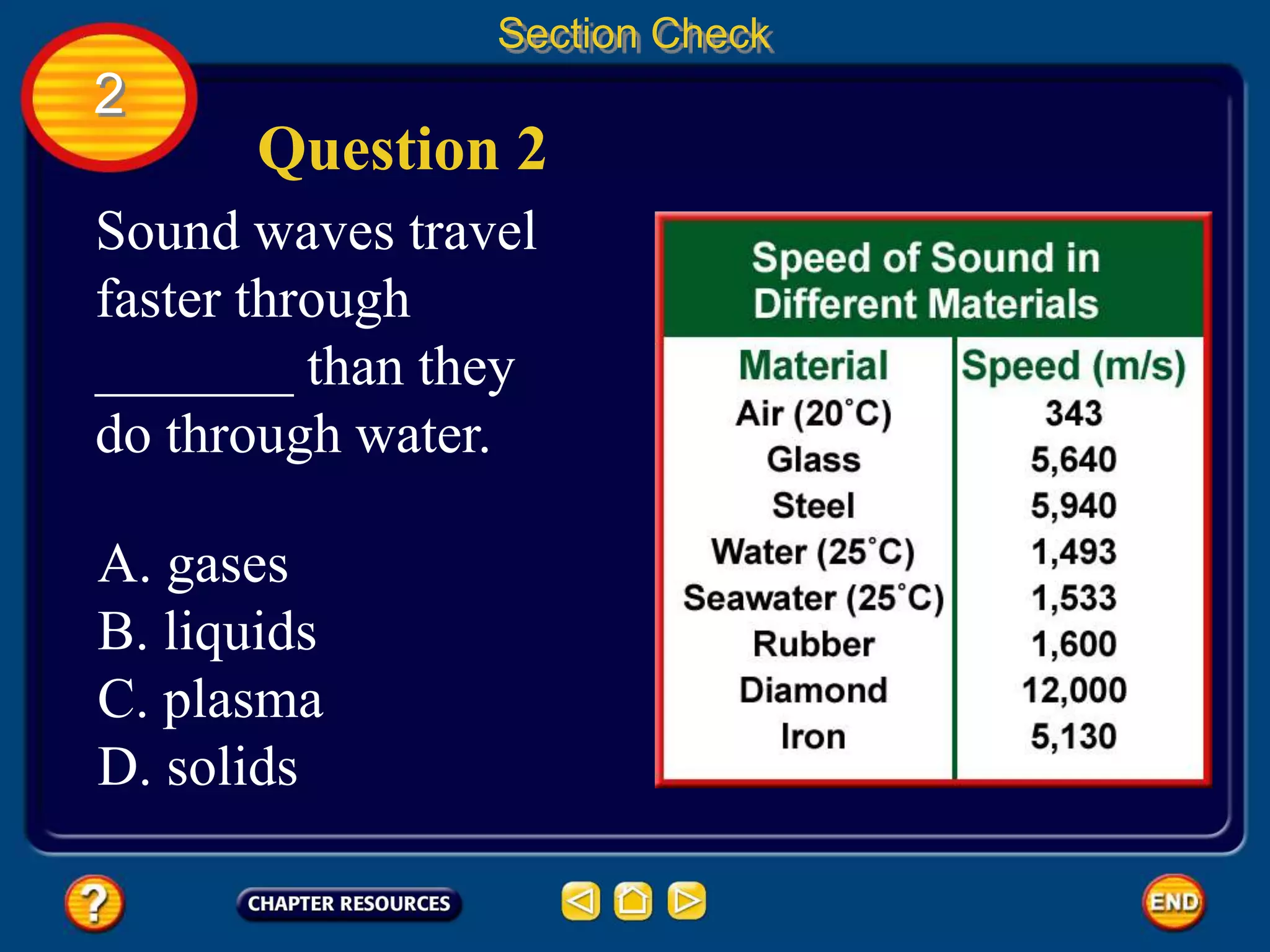
Sound waves travel
faster through
_______ than they
do through water.
A. gases
B. liquids
C. plasma
D. solids
2
Section Check
Question 3
High point in the wave is called.
A. Wavelength
B. Trough
C. Frequency
D. Crest
1
Section Check
Question 4
Waves carry _______, not _______.
A. Energy, matter
B. Matter, Energy
C. Sounds, Light
D. Sounds, Vacuum
Section Check
3
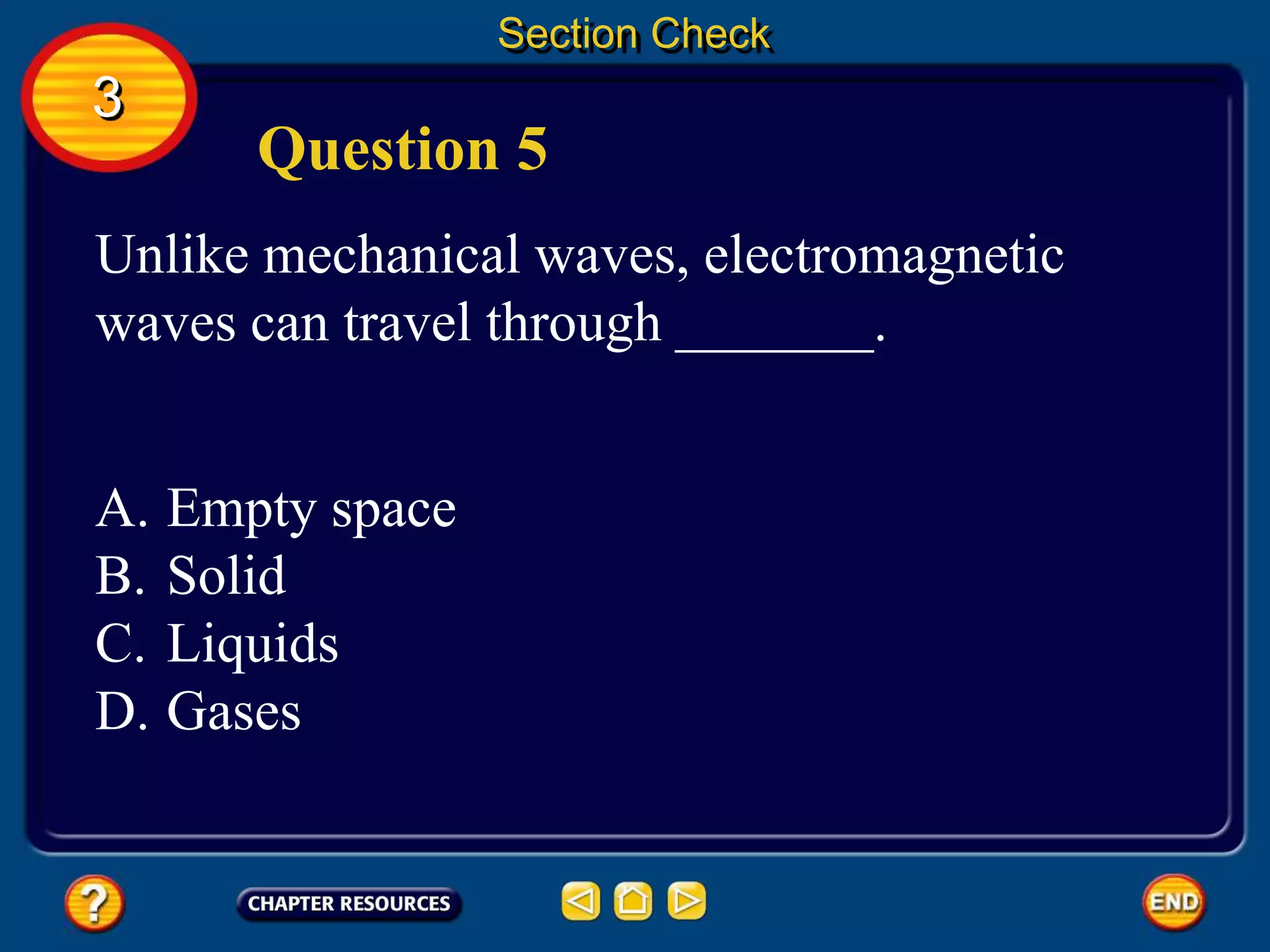
Question 5
Unlike mechanical waves, electromagnetic
waves can travel through _______.
A. Empty space
B. Solid
C. Liquids
D. Gases
1
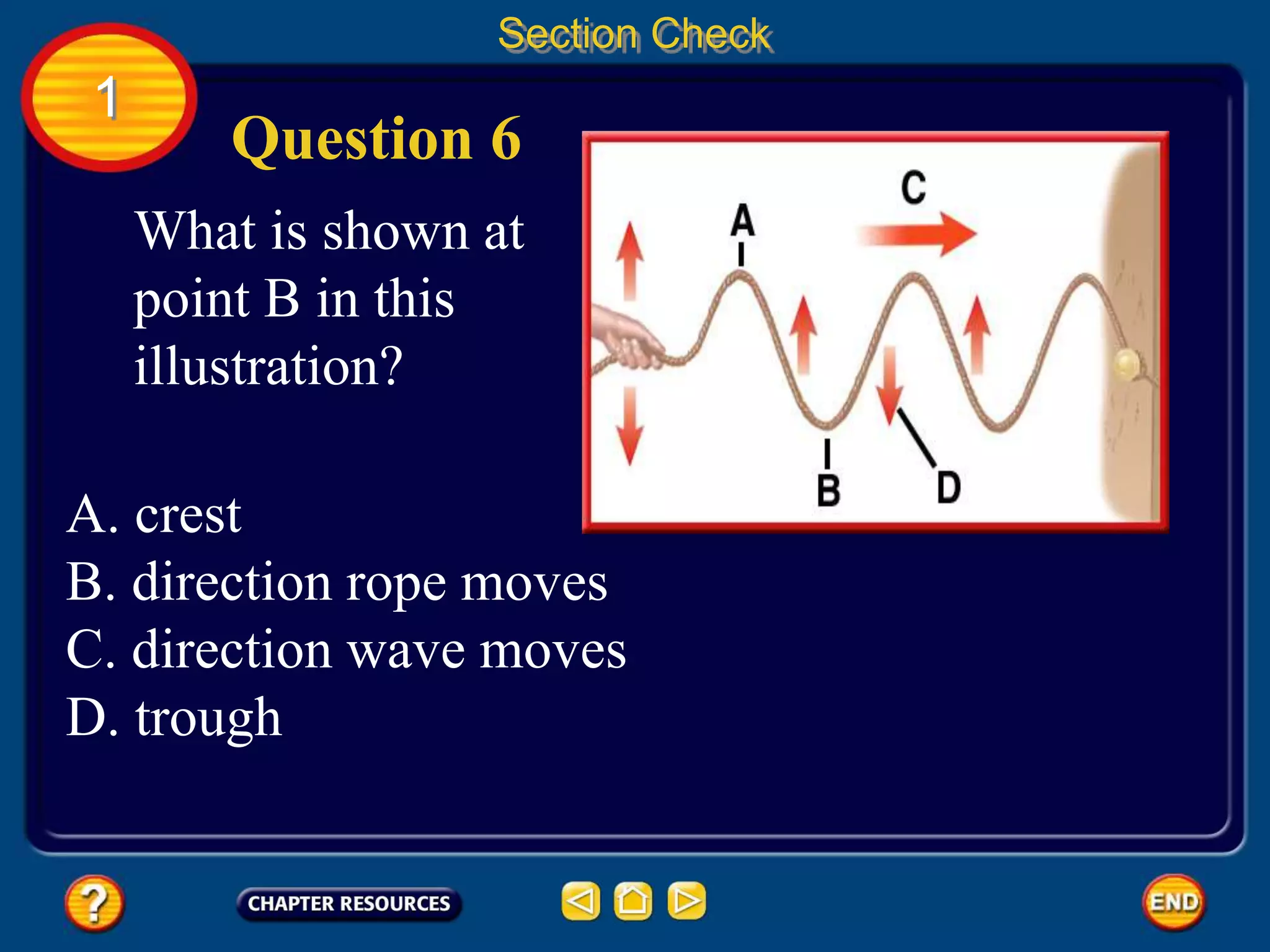
Section Check
A. crest
B. direction rope moves
C. direction wave moves
D. trough
Question 6
What is shown at
point B in this
illustration?
1
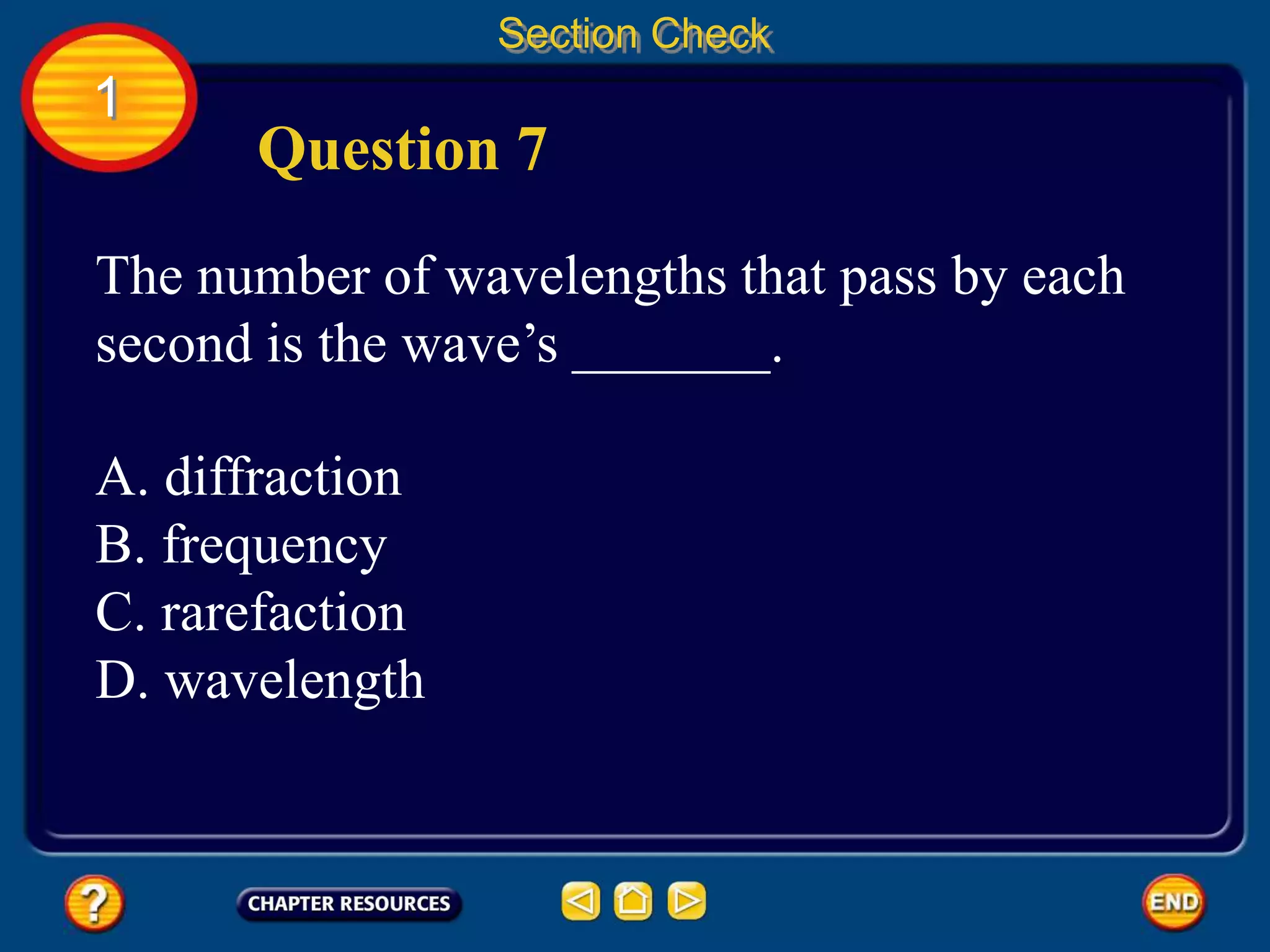
Section Check
Question 7
The number of wavelengths that pass by each
second is the wave’s _______.
A. diffraction
B. frequency
C. rarefaction
D. wavelength
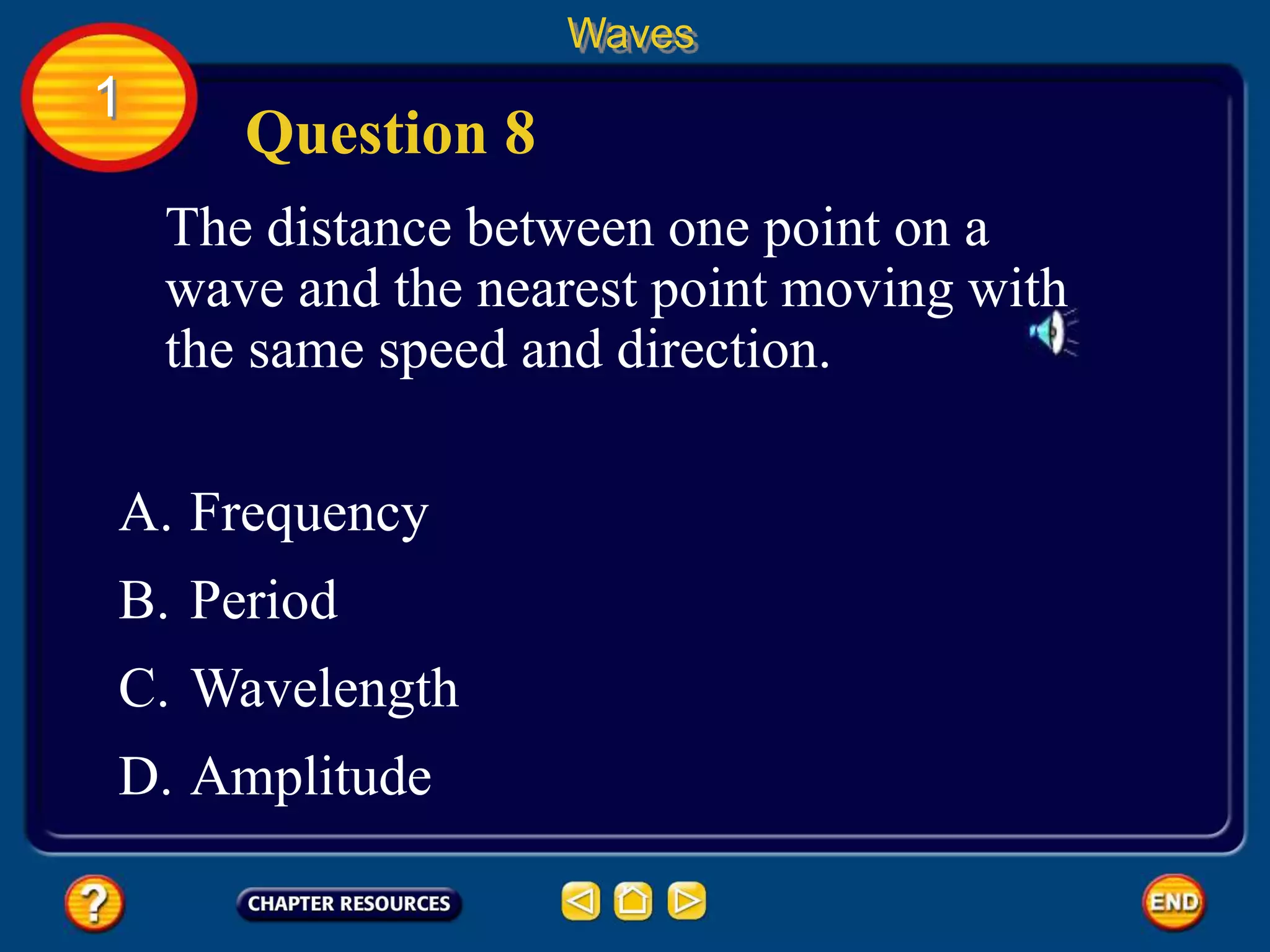
The distance between one point on a
wave and the nearest point moving with
the same speed and direction.
Waves
1
A. Frequency
B. Period
C. Wavelength
D. Amplitude
Question 8
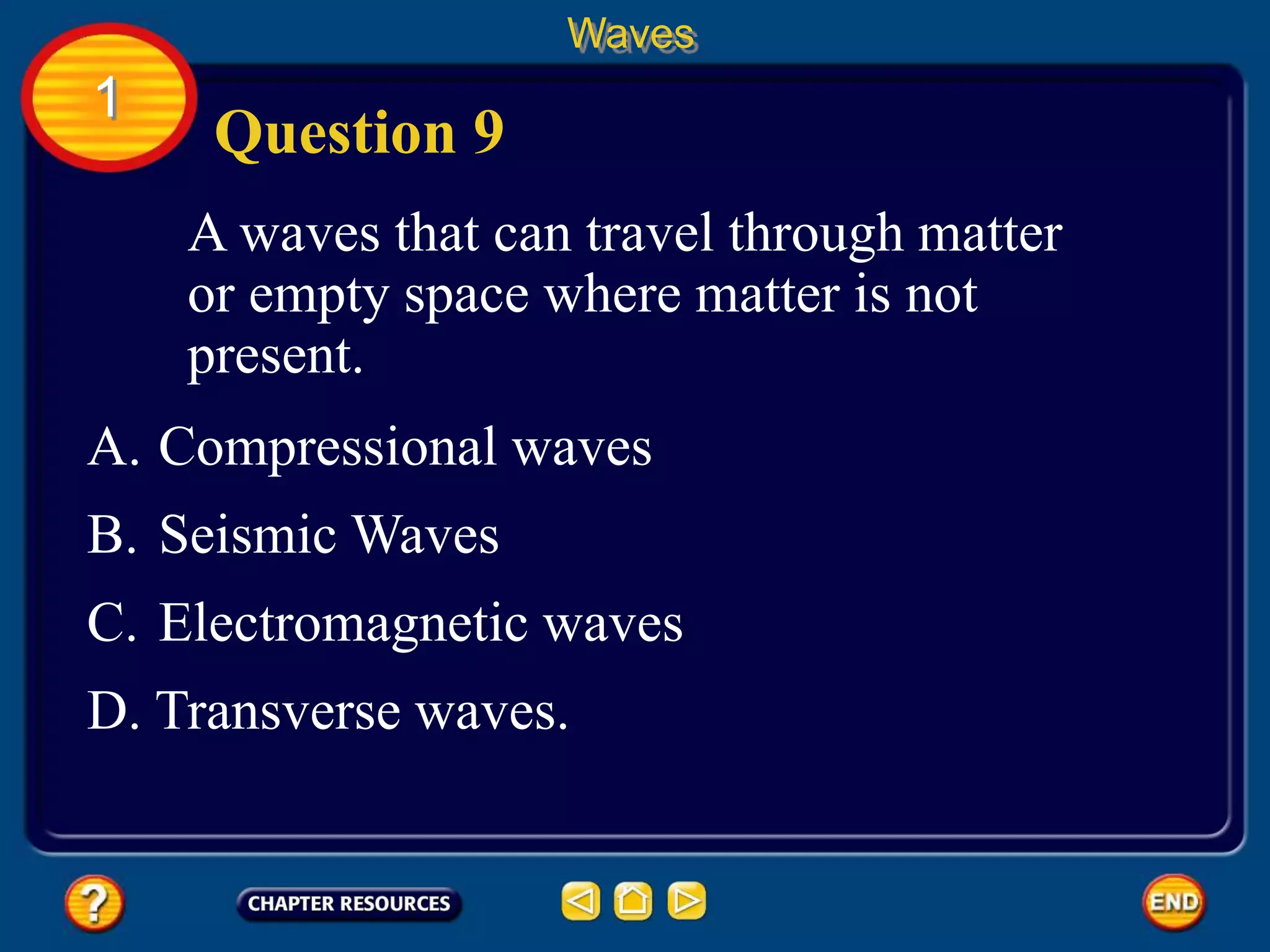
A waves that can travel through matter
or empty space where matter is not
present.
Waves
1
A. Compressional waves
B. Seismic Waves
C. Electromagnetic waves
D. Transverse waves.
Question 9
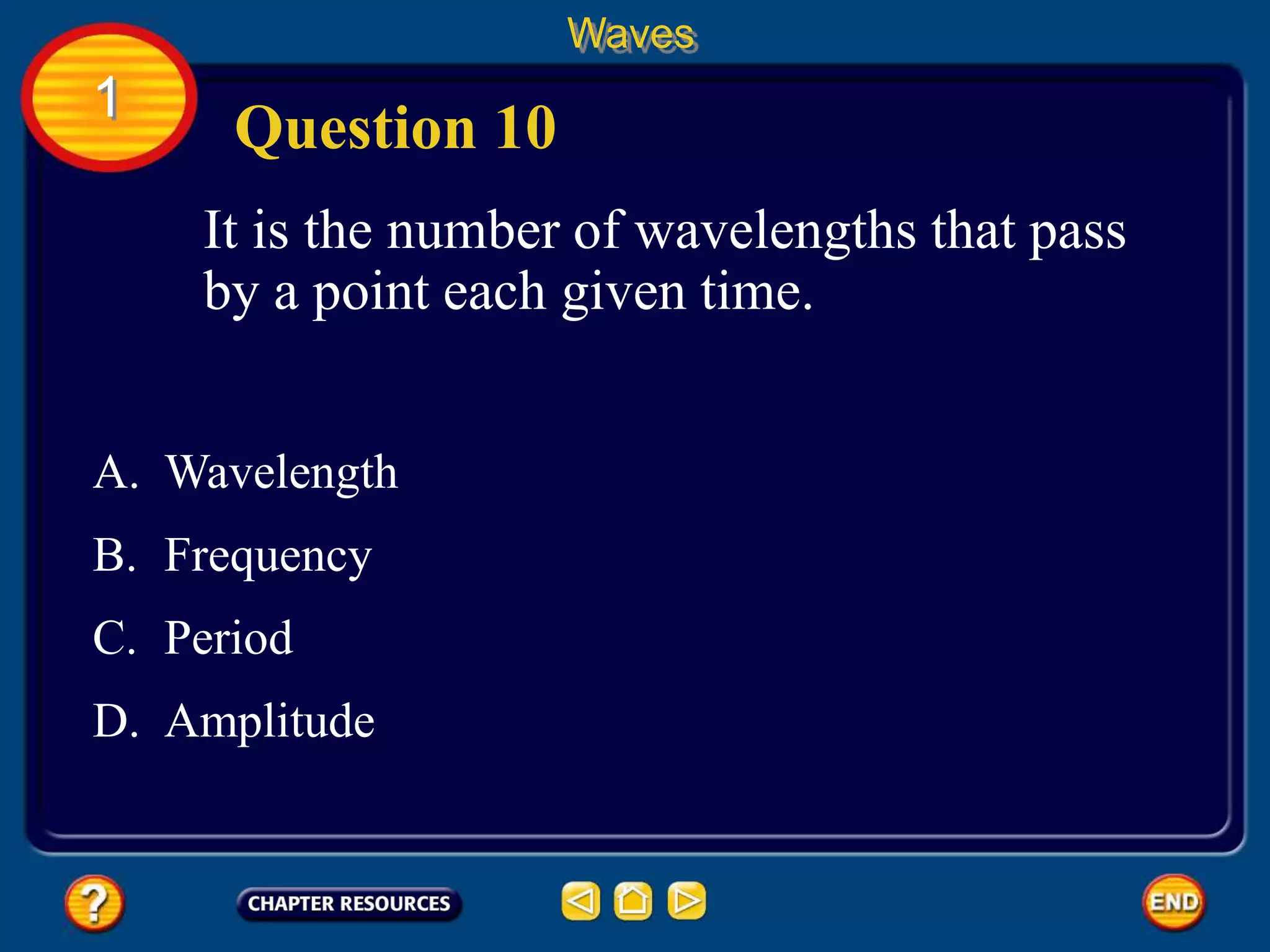
It is the number of wavelengths that pass
by a point each given time.
Question 10
Waves
1
A. Wavelength
B. Frequency
C. Period
D. Amplitude
Instructions: Enumerate the following.
Write your answer on your paper.
Test II
Enumeration
1
Waves
1
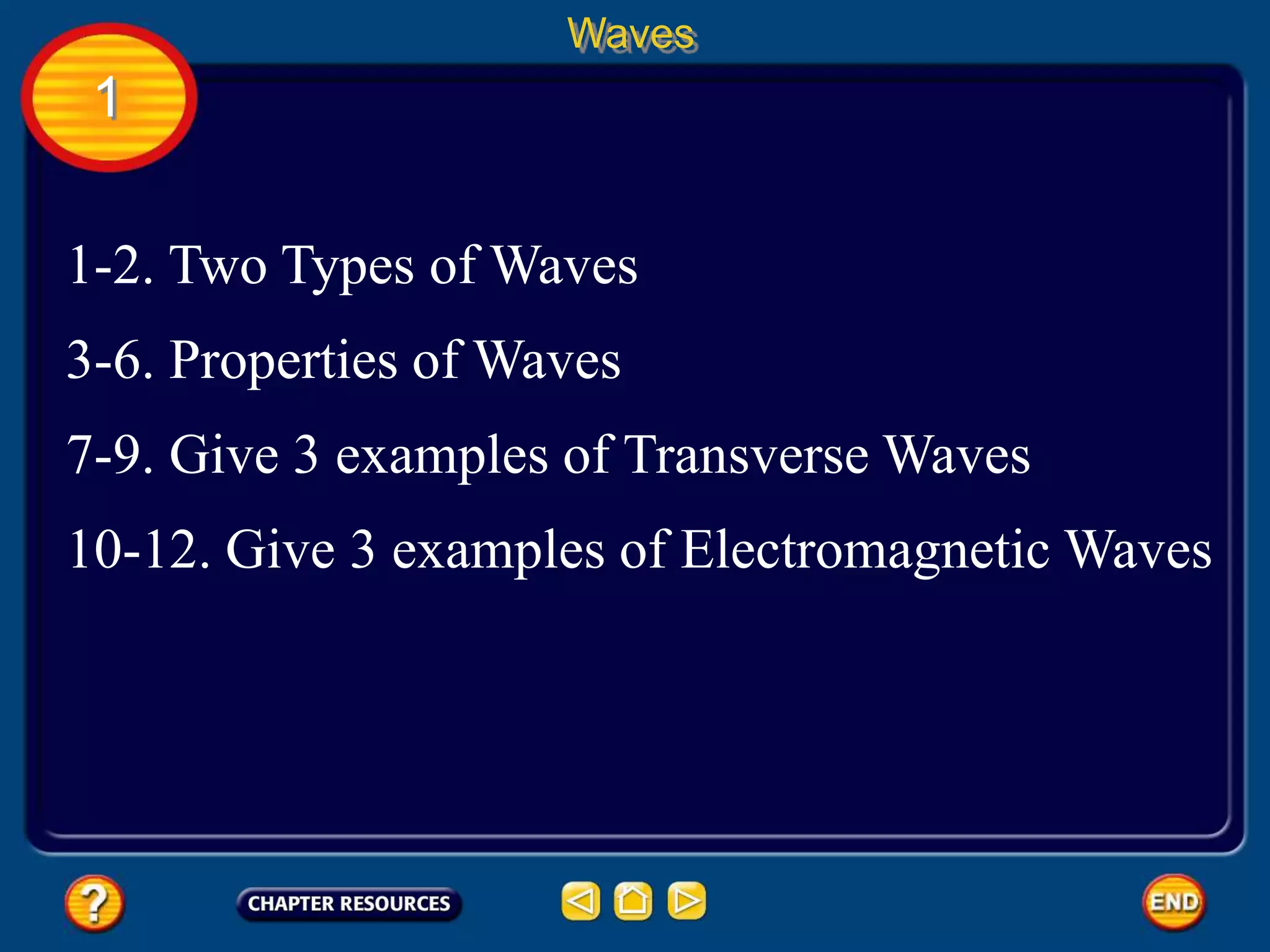
1-2. Two Types of Waves
3-6. Properties of Waves
7-9. Give 3 examples of Transverse Waves
10-12. Give 3 examples of Electromagnetic Waves
Waves
1
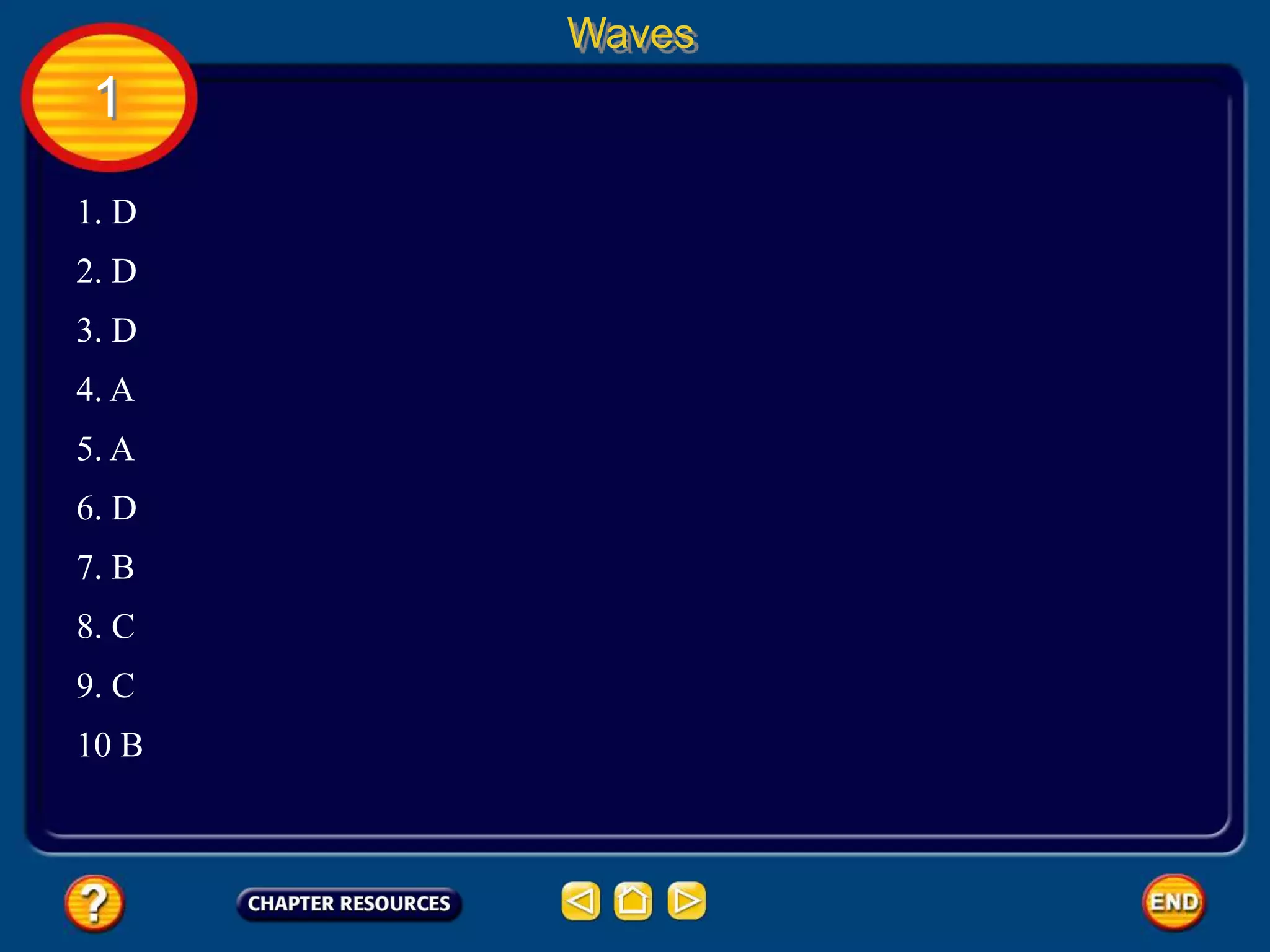
1. D
2. D
3. D
4. A
5. A
6. D
7. B
8. C
9. C
10 B
2
Section Check
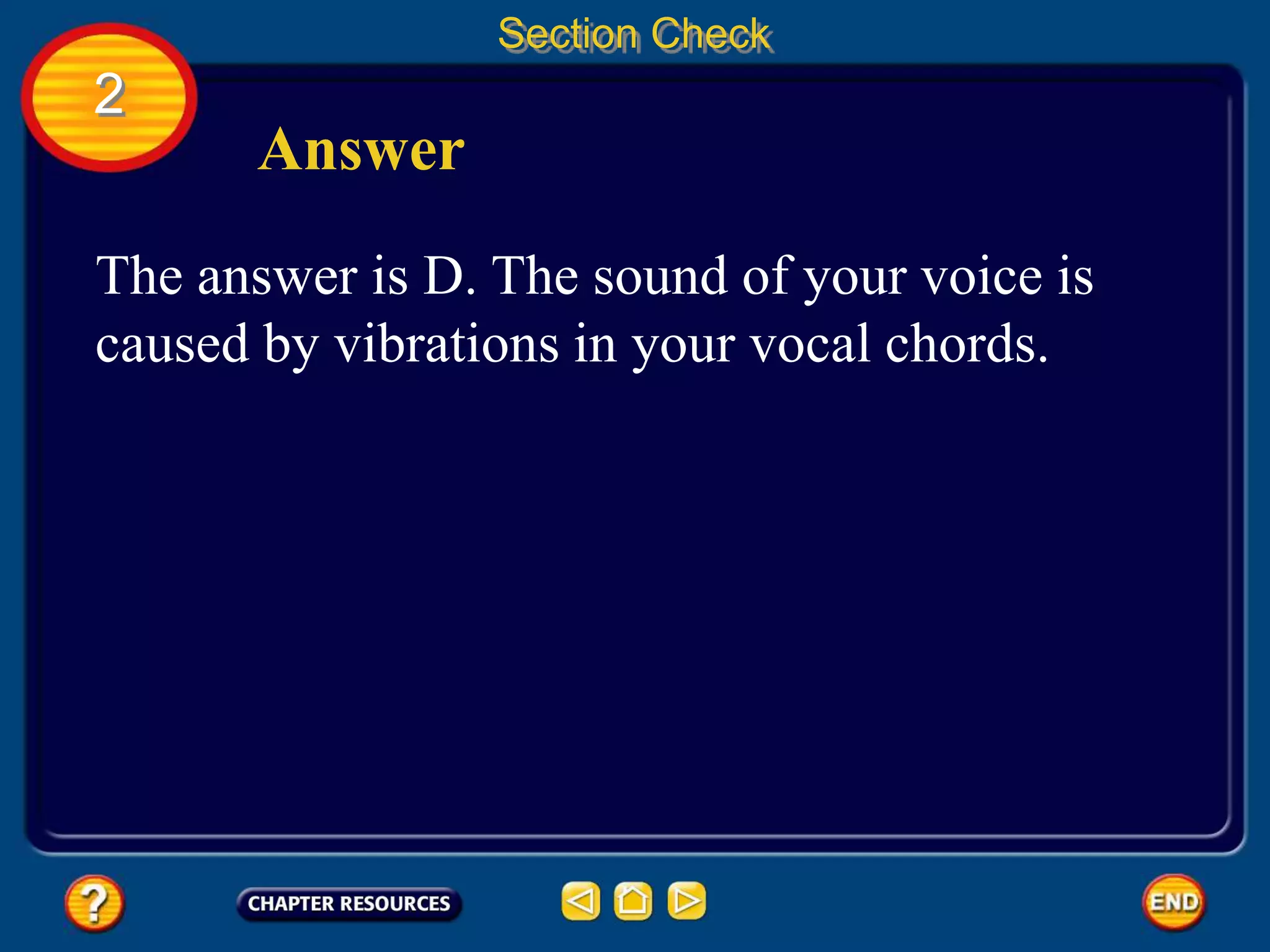
Answer
The answer is D. The sound of your voice is
caused by vibrations in your vocal chords.
2
Section Check
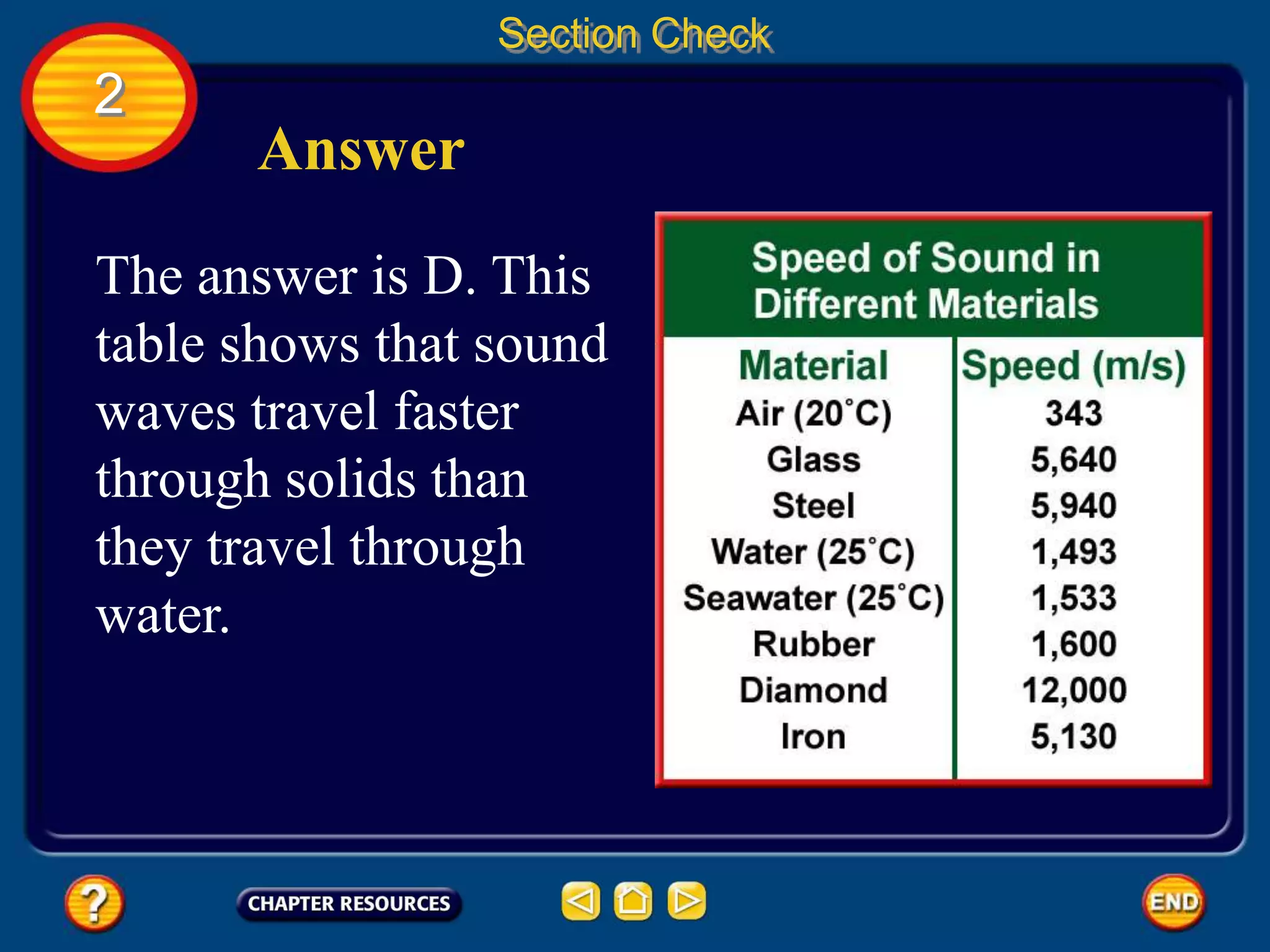
Answer
The answer is D. This
table shows that sound
waves travel faster
through solids than
they travel through
water.
2
Section Check
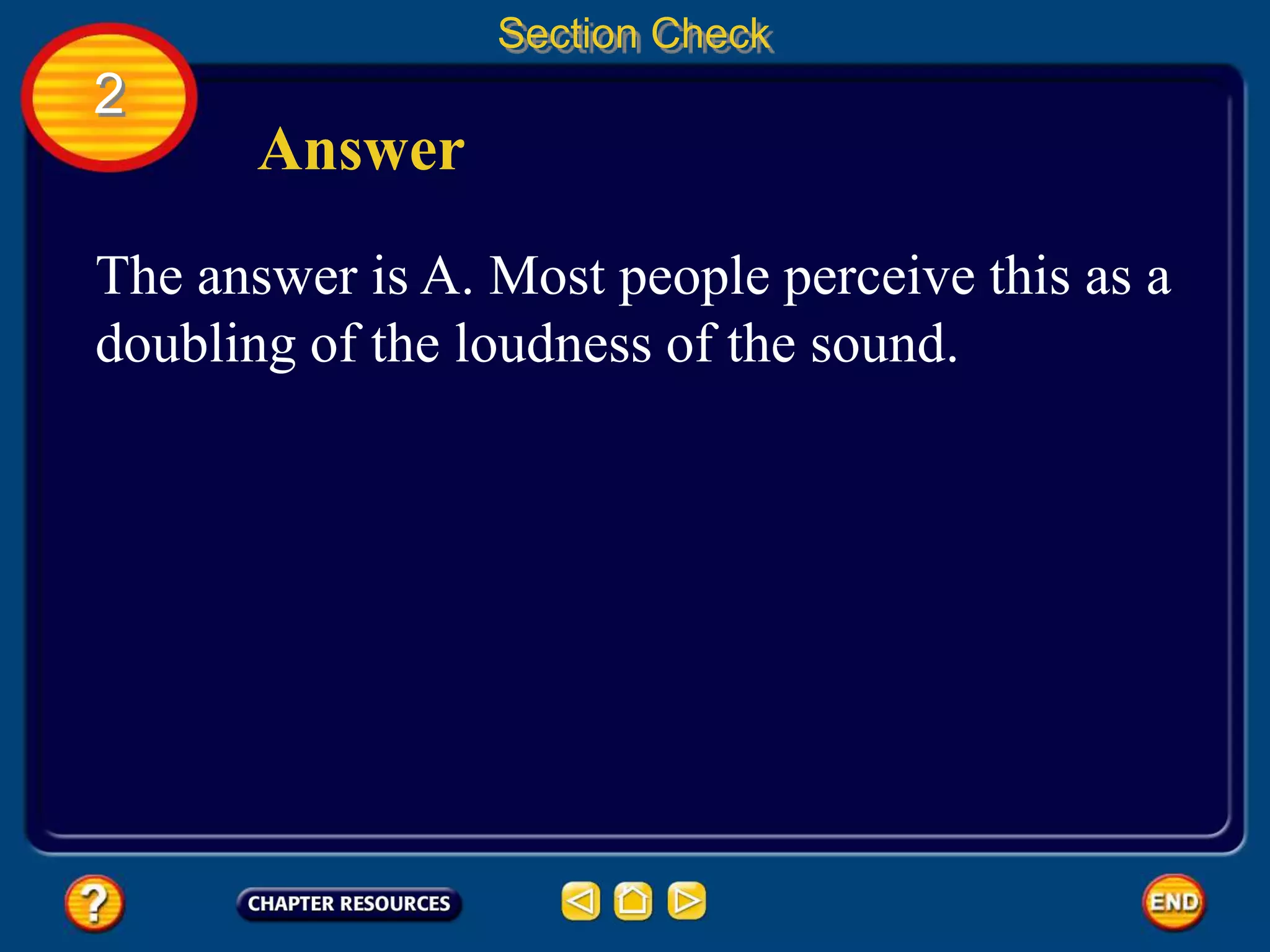
Answer
The answer is A. Most people perceive this as a
doubling of the loudness of the sound.
Waves in Empty Space
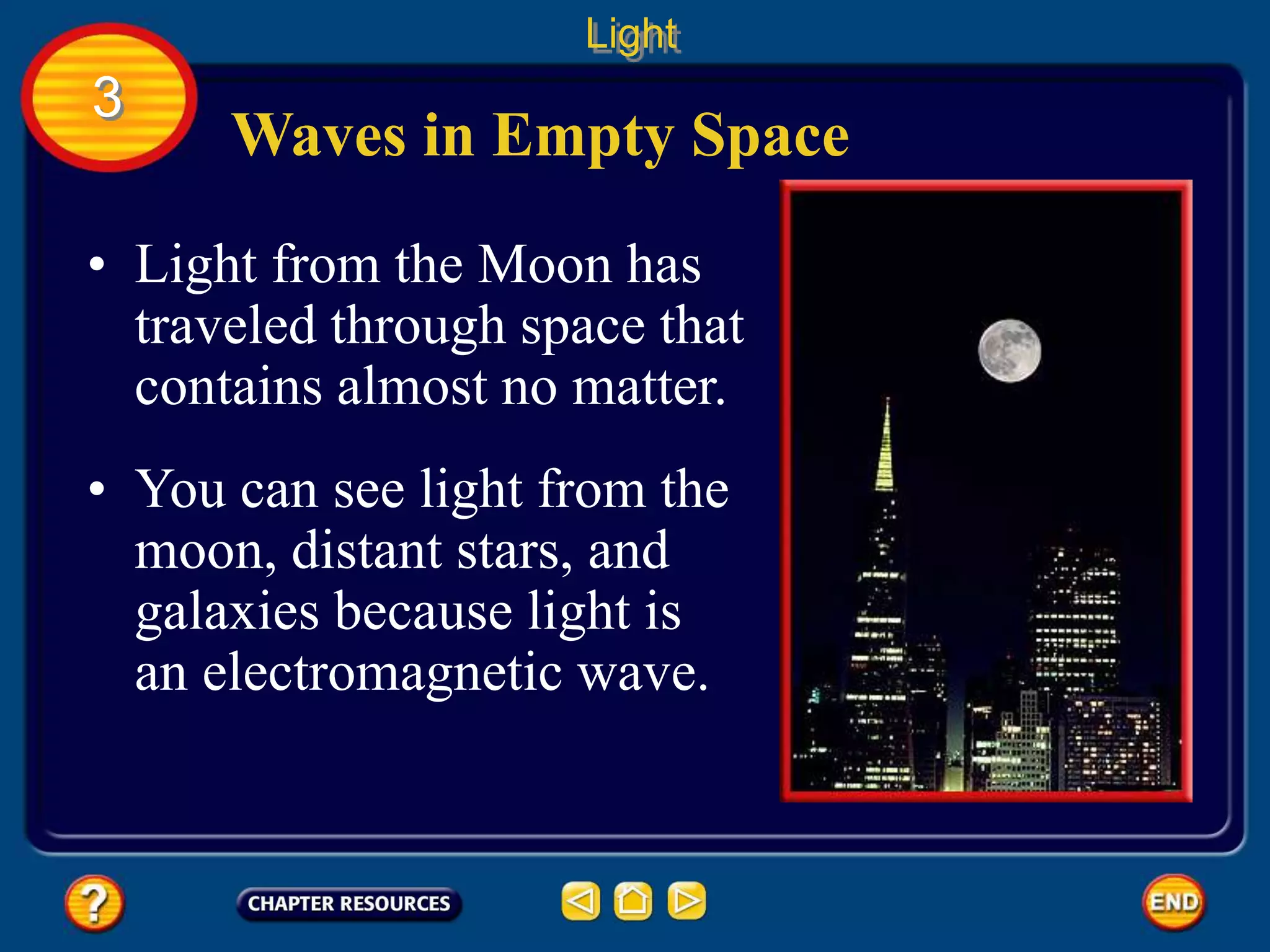
• Light from the Moon has
traveled through space that
contains almost no matter.
• You can see light from the
moon, distant stars, and
galaxies because light is
an electromagnetic wave.
Light
3
Waves in Empty Space
Light
3
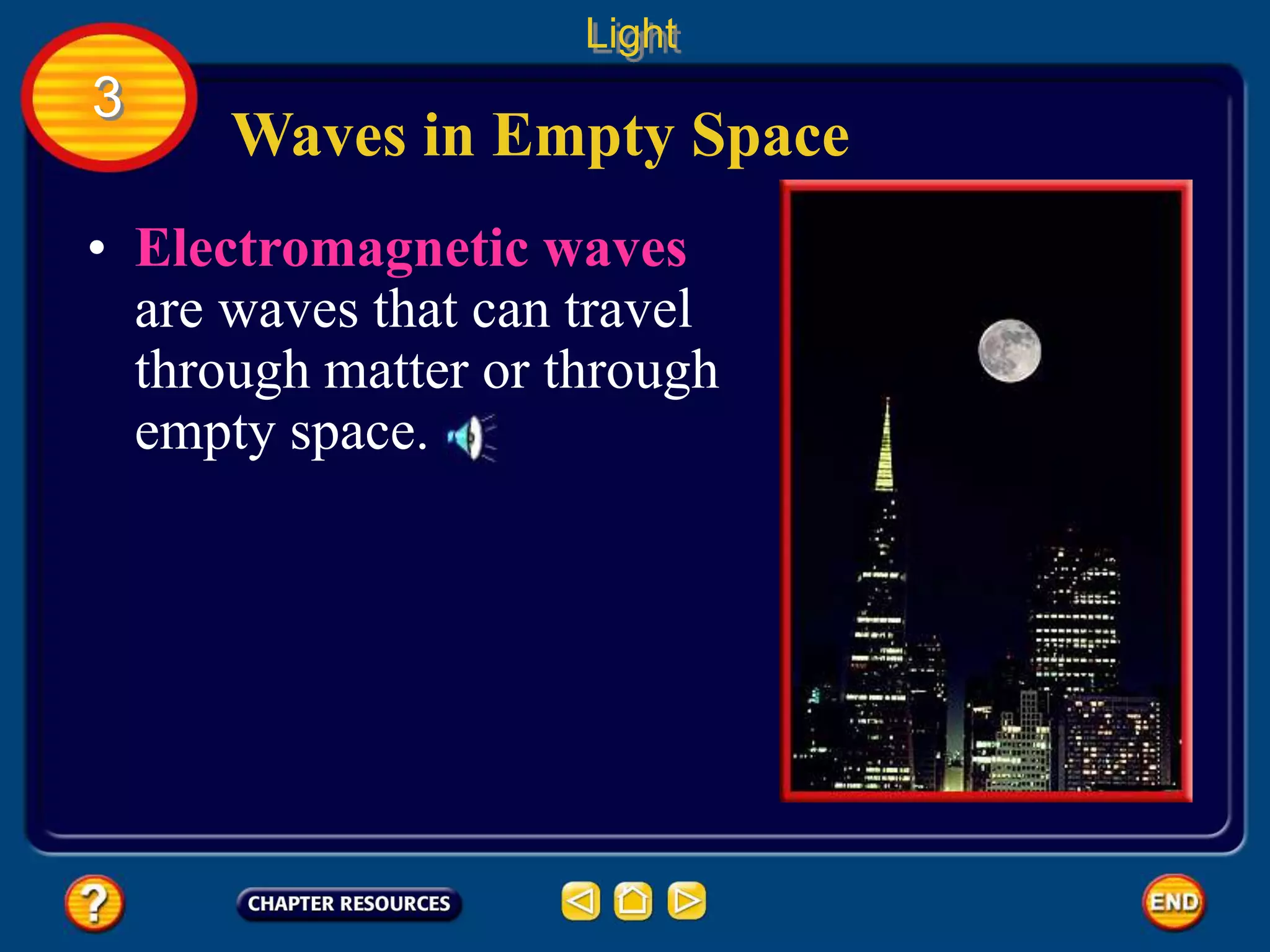
• Electromagnetic waves
are waves that can travel
through matter or through
empty space.
The Speed of Light
• In empty space, light travels at a speed of
about 300,000 km/s.
• Light travels so fast that light emitted from
the Sun travels 150 million km to Earth in
only about eight and a half minutes.
Light
3
The Speed of Light
• When light travels in matter, it interacts
with the atoms and molecules in the
material and slows down.
• As a result, light travels fastest in empty
space, and travels slowest in solids.
Light
3
Wavelength and
Frequency of Light
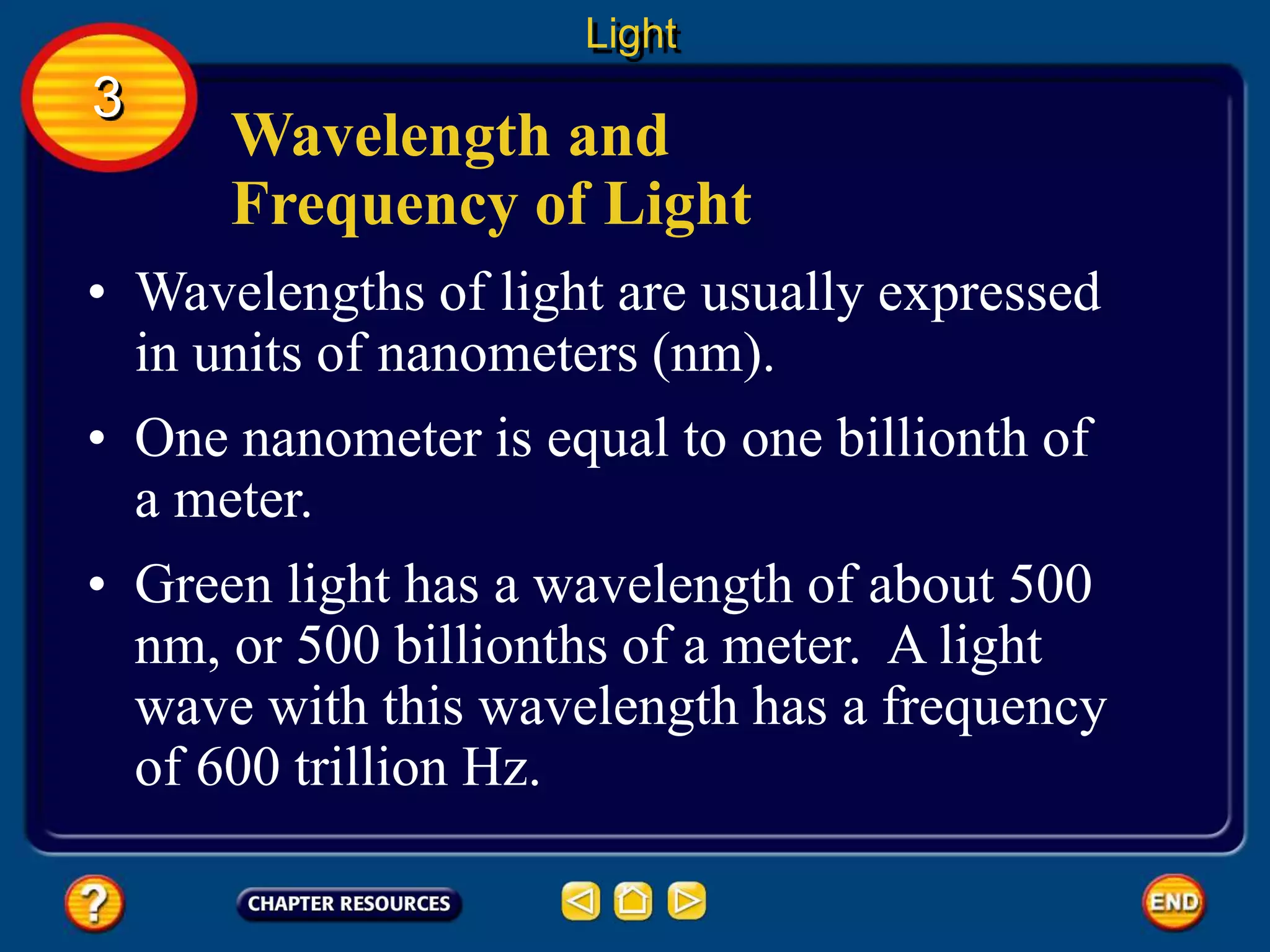
• Wavelengths of light are usually expressed
in units of nanometers (nm).
• One nanometer is equal to one billionth of
a meter.
Light
3
• Green light has a wavelength of about 500
nm, or 500 billionths of a meter. A light
wave with this wavelength has a frequency
of 600 trillion Hz.
Properties of Light Waves
• Light waves, and all electromagnetic waves,
are transverse waves.
• An electromagnetic wave traveling through
matter can cause matter to move at right
angles to the direction the wave is moving.
Light
3
Properties of Light Waves
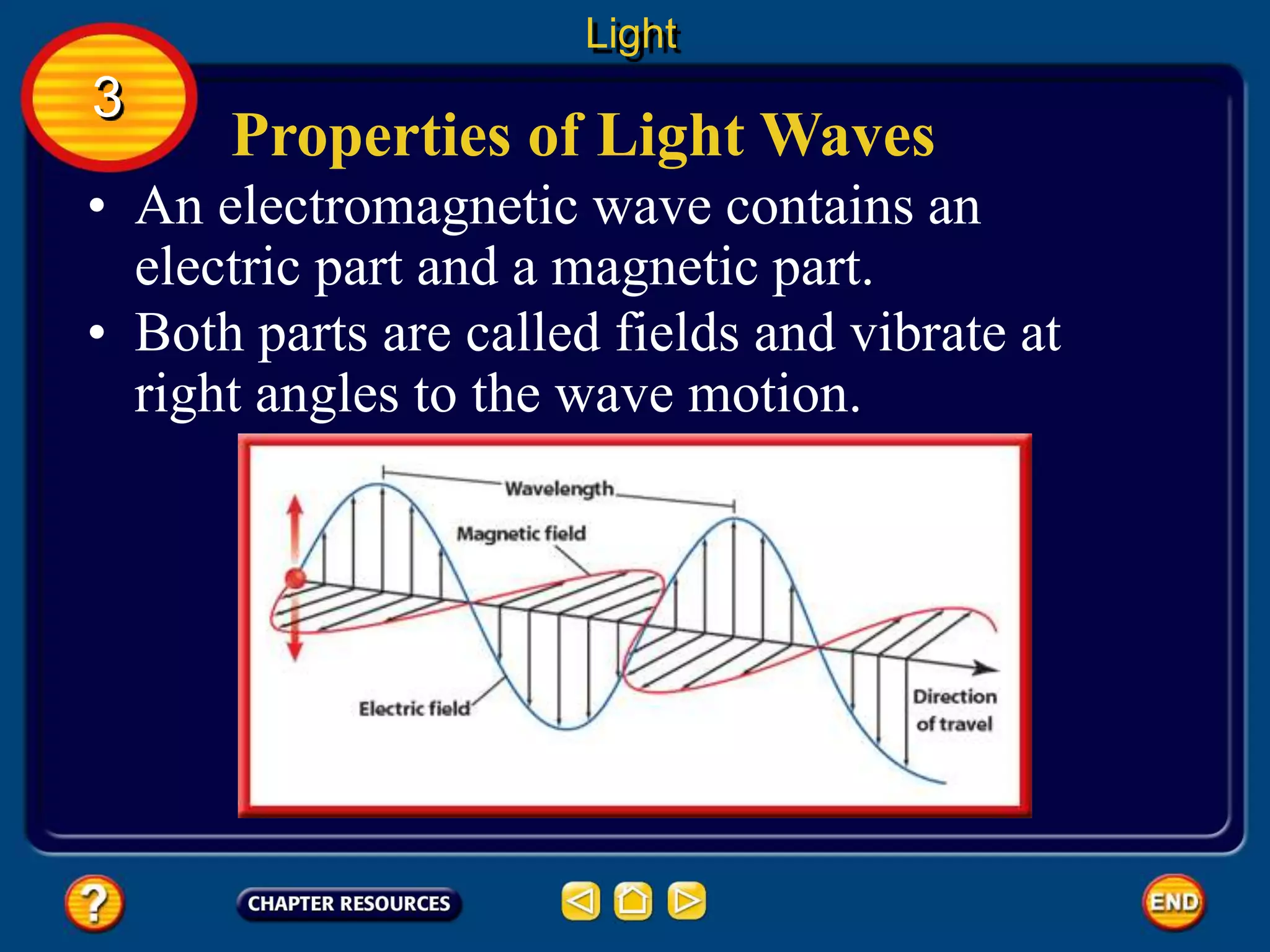
• An electromagnetic wave contains an
electric part and a magnetic part.
• Both parts are called fields and vibrate at
right angles to the wave motion.
Light
3
Properties of Light Waves
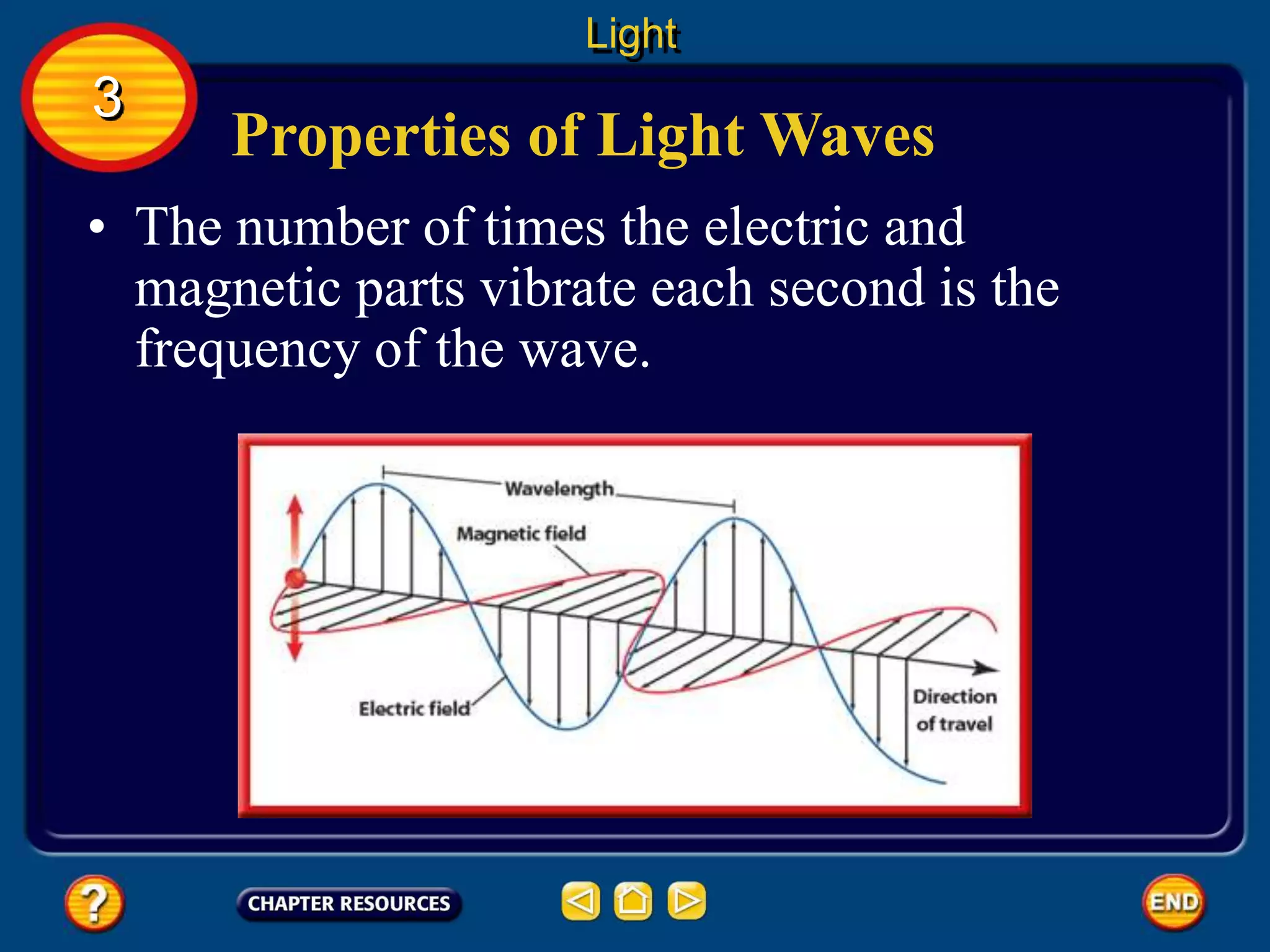
• The number of times the electric and
magnetic parts vibrate each second is the
frequency of the wave.
Light
3
Properties of Light Waves
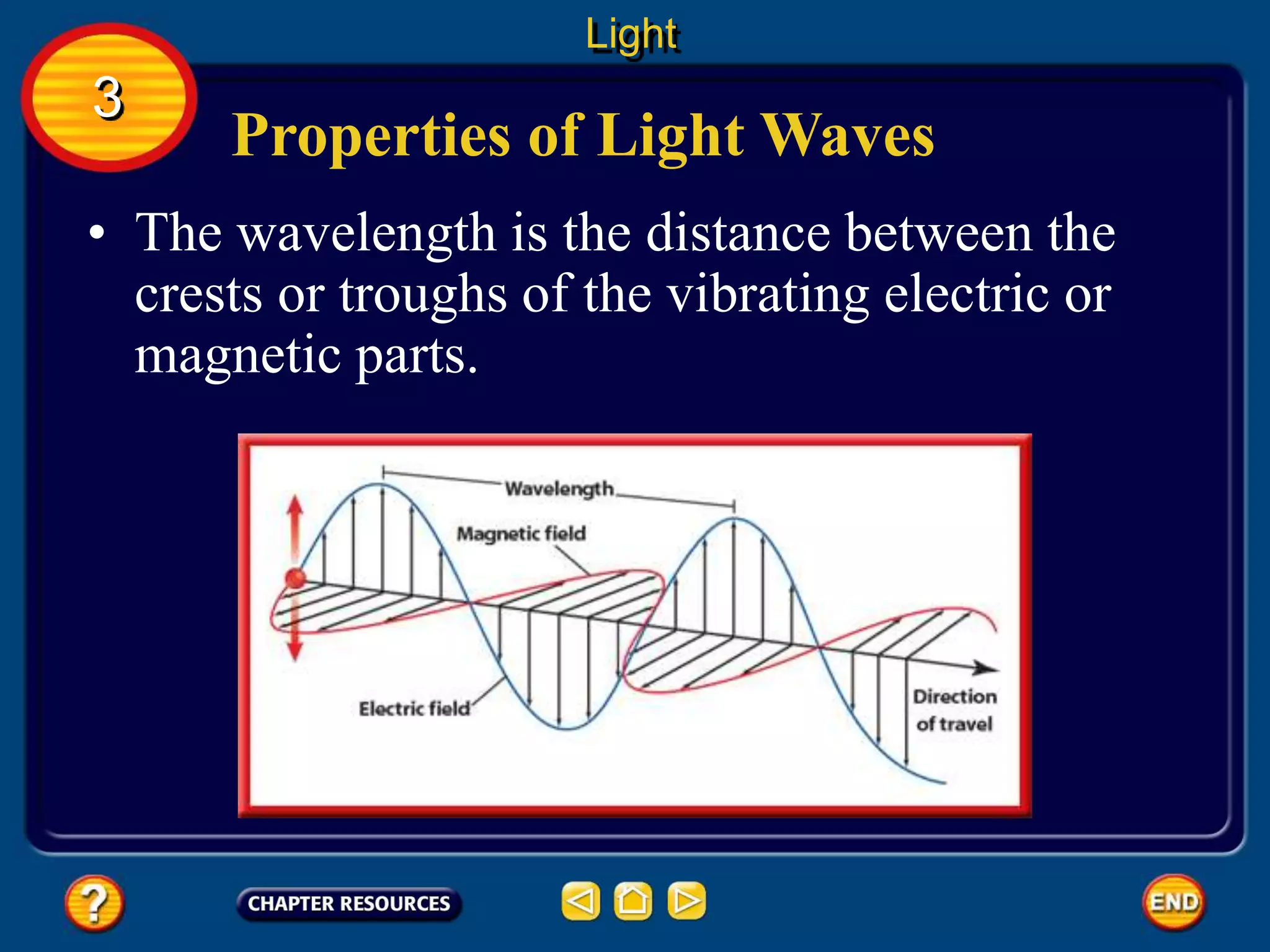
• The wavelength is the distance between the
crests or troughs of the vibrating electric or
magnetic parts.
Light
3
Intensity of Light Waves
• The intensity of waves is a measure of the
amount of energy that the waves carry.
• For light waves, the intensity determines
the brightness of the light.
Light
3
• A dim light has lower intensity because the
waves carry less energy.
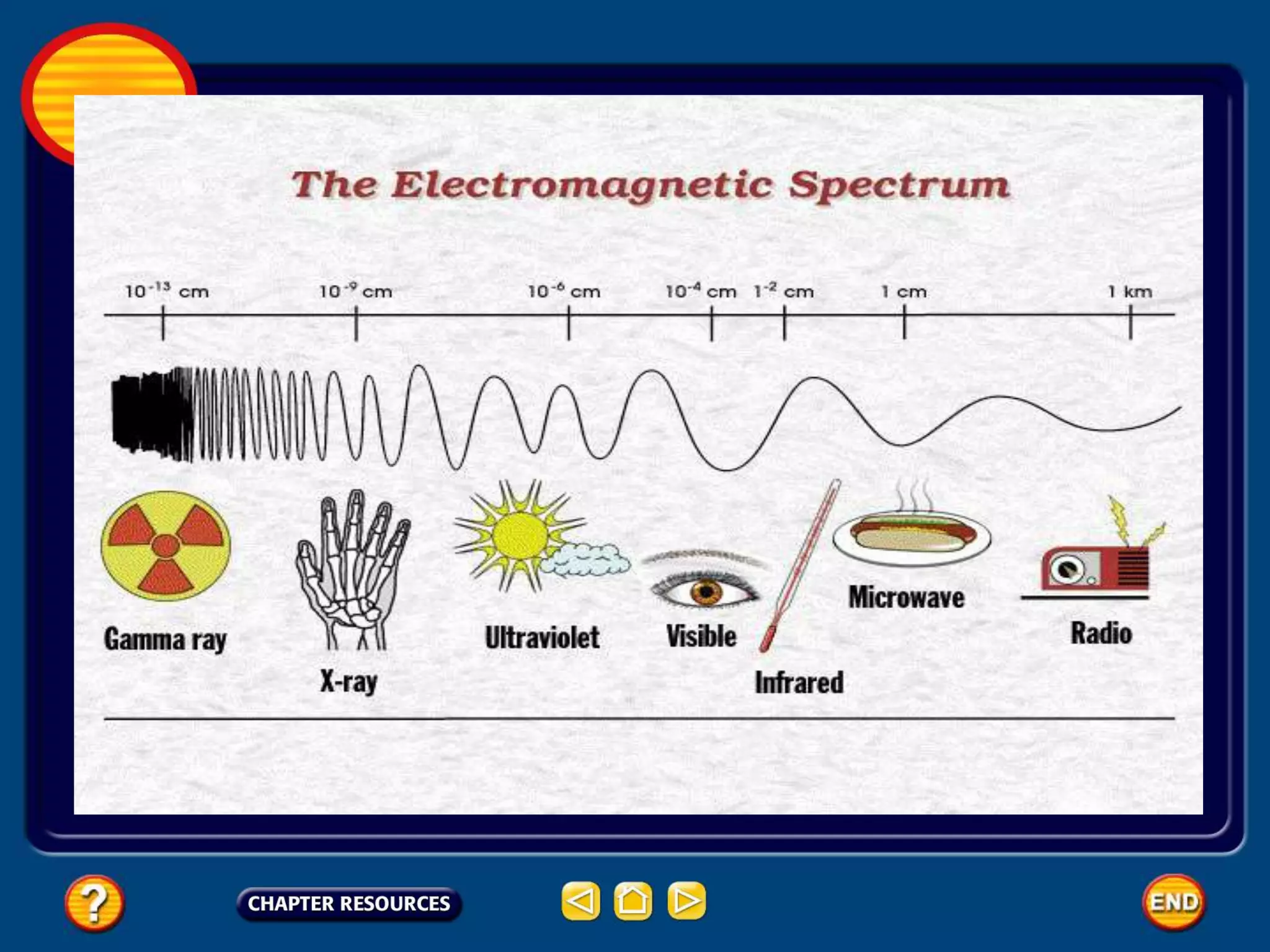
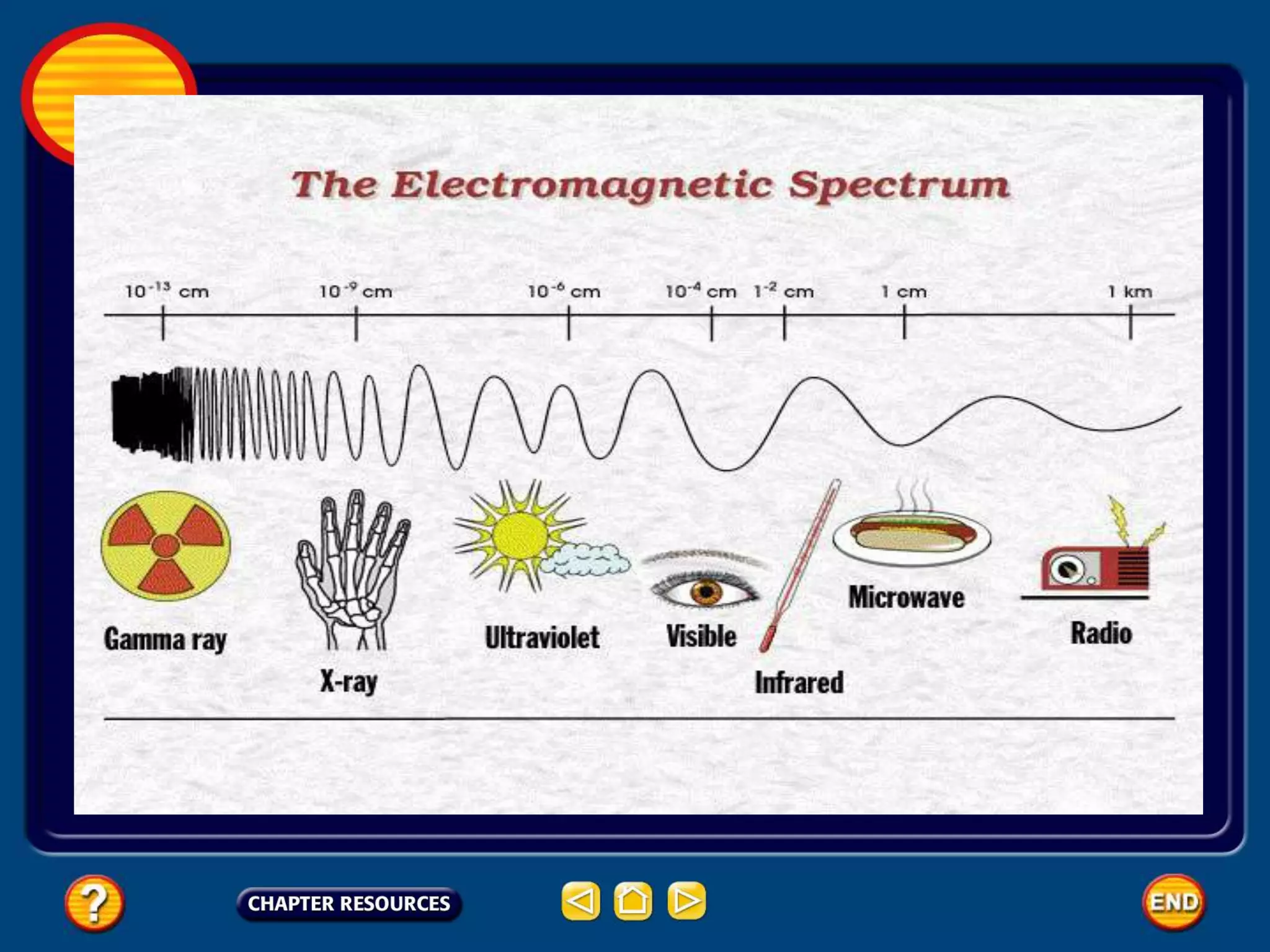
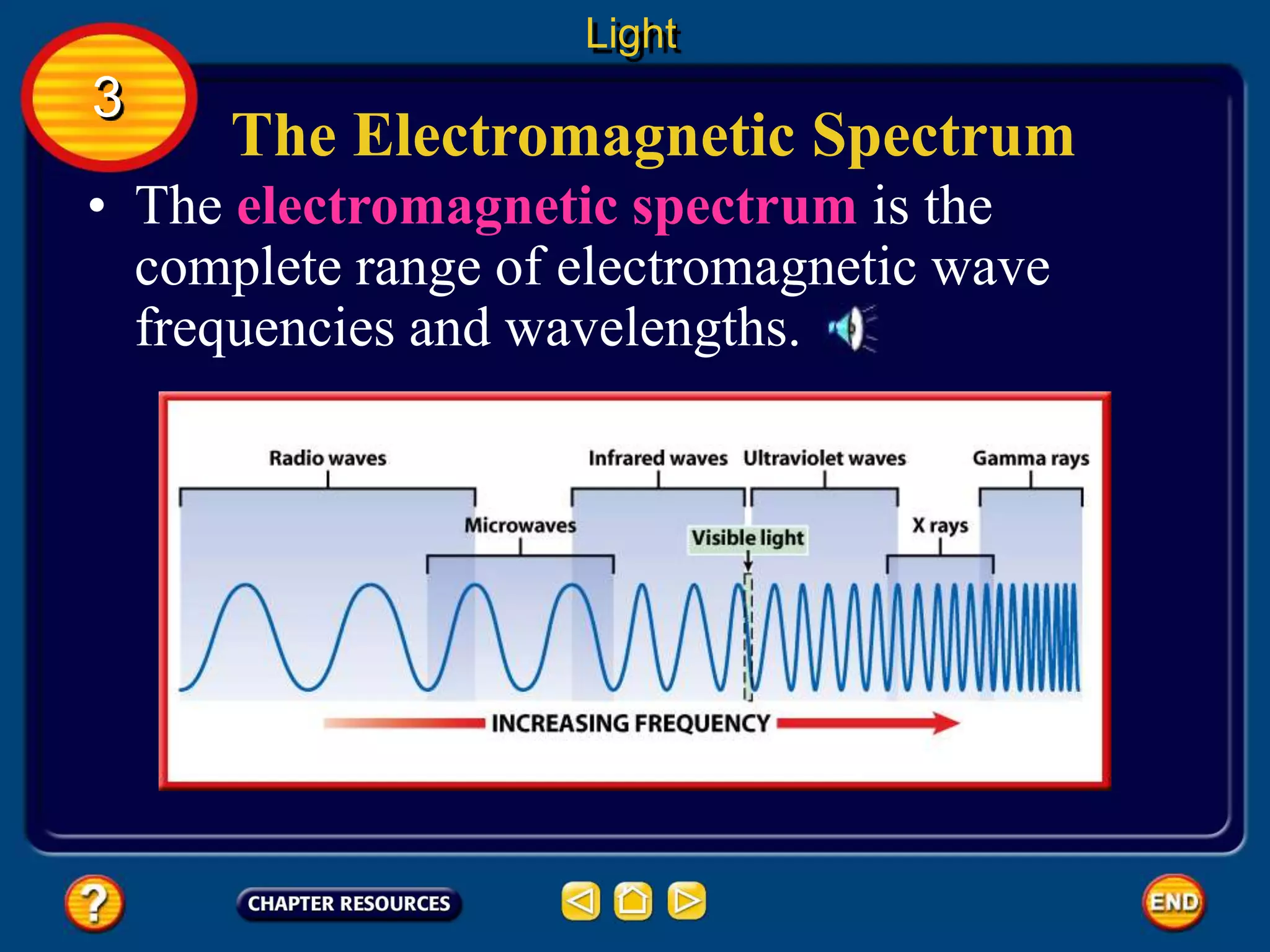
The Electromagnetic Spectrum
• The electromagnetic spectrum is the
complete range of electromagnetic wave
frequencies and wavelengths.
Light
3
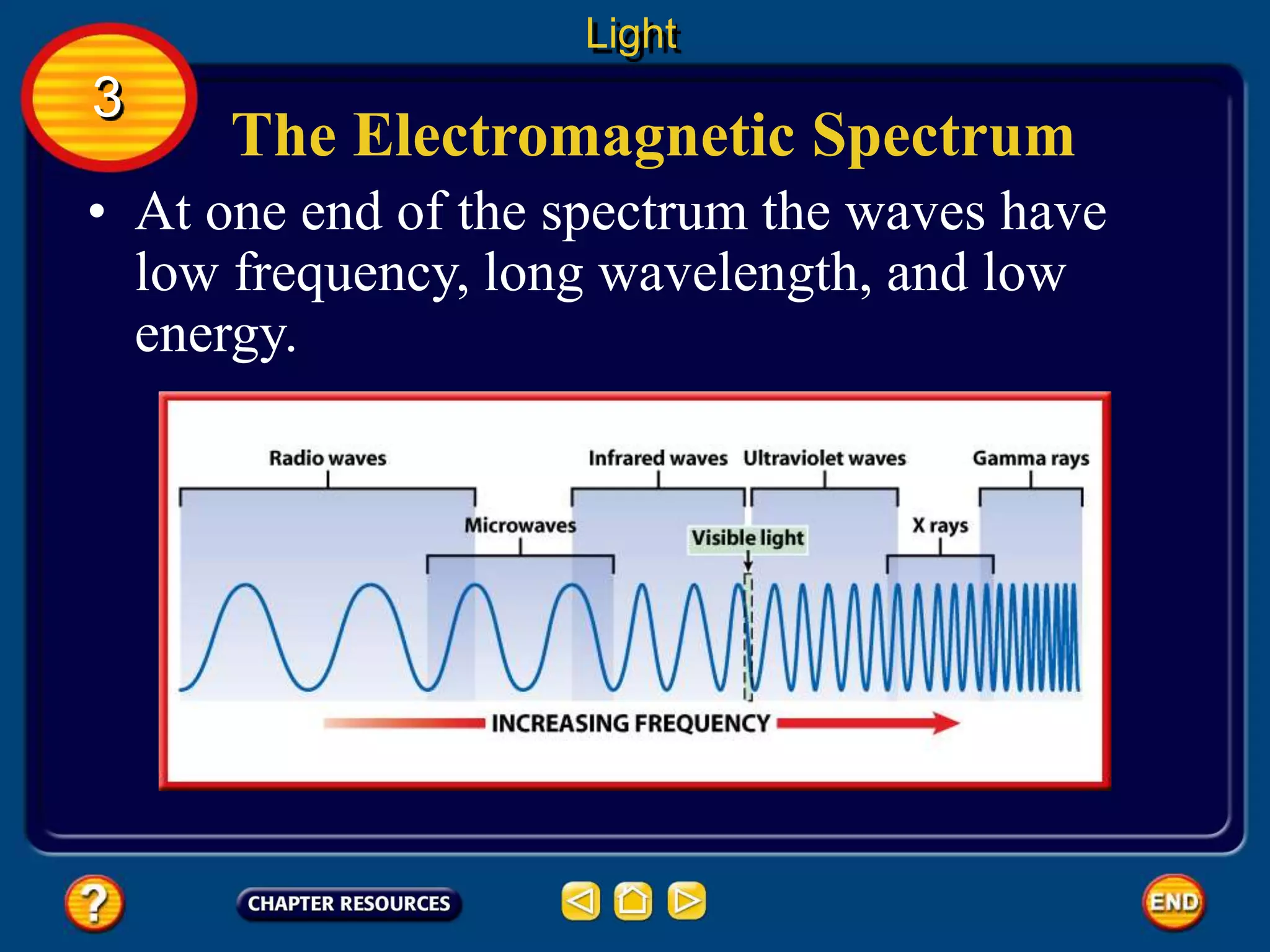
The Electromagnetic Spectrum
• At one end of the spectrum the waves have
low frequency, long wavelength, and low
energy.
Light
3
The Electromagnetic Spectrum
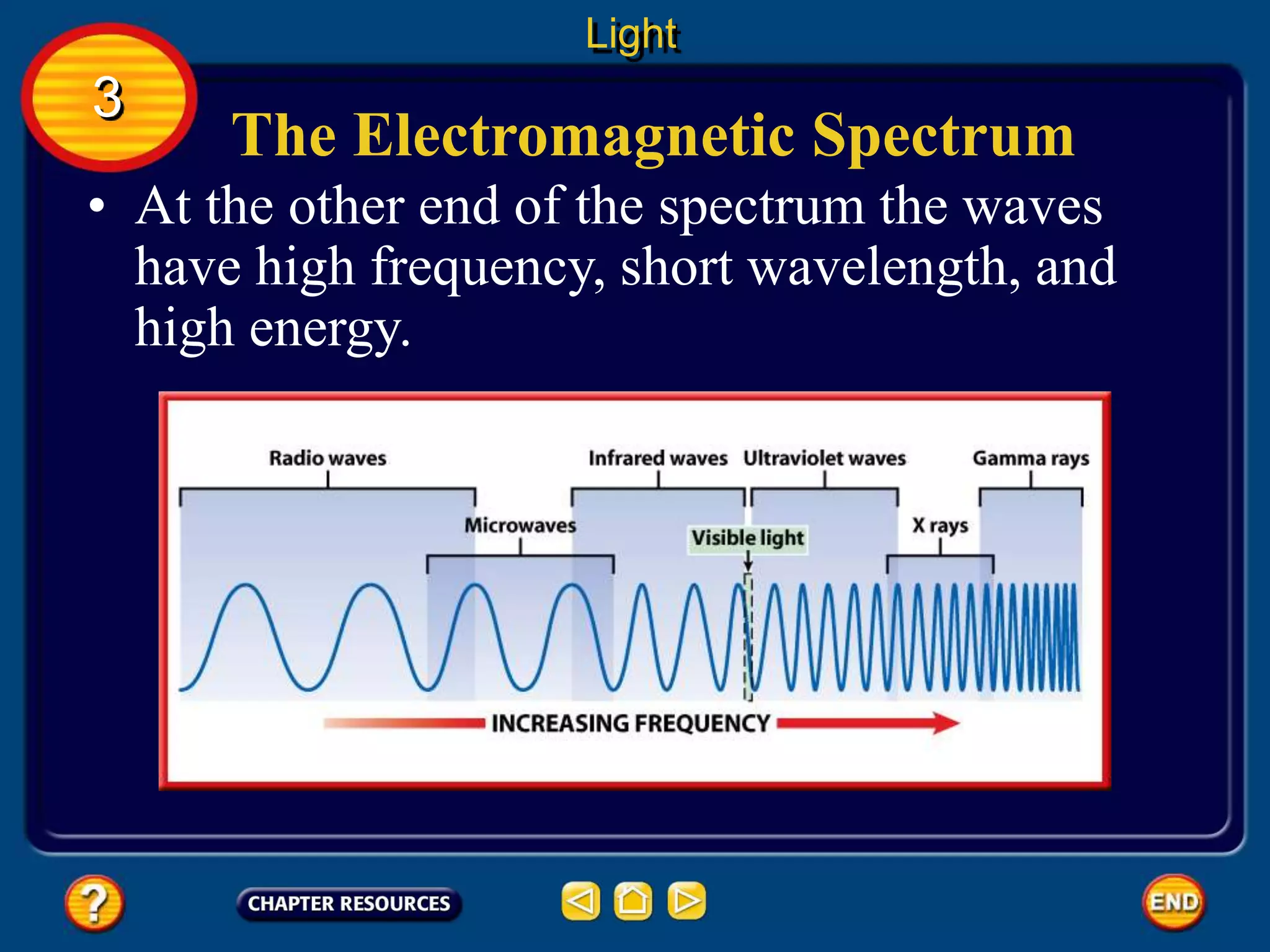
Light
3
• At the other end of the spectrum the waves
have high frequency, short wavelength, and
high energy.
Radio Waves and Microwaves
• The wavelengths of radio waves are greater
than about 0.3 meters.
• Some are even thousands of meters long.
Light
3
• The shortest radio waves are called
microwaves.
• These waves have a wavelength between
about 0.3 meters and 0.001 meters.
Infrared Waves
• Infrared waves have wavelengths between
0.001 meters and 700 billionths of a meter.
• All warm bodies emit infrared waves.
Light
3
• Law enforcement officials and military
personnel sometimes use special night
goggles that are sensitive to infrared waves.
These goggles can be used to help locate
people in the dark.
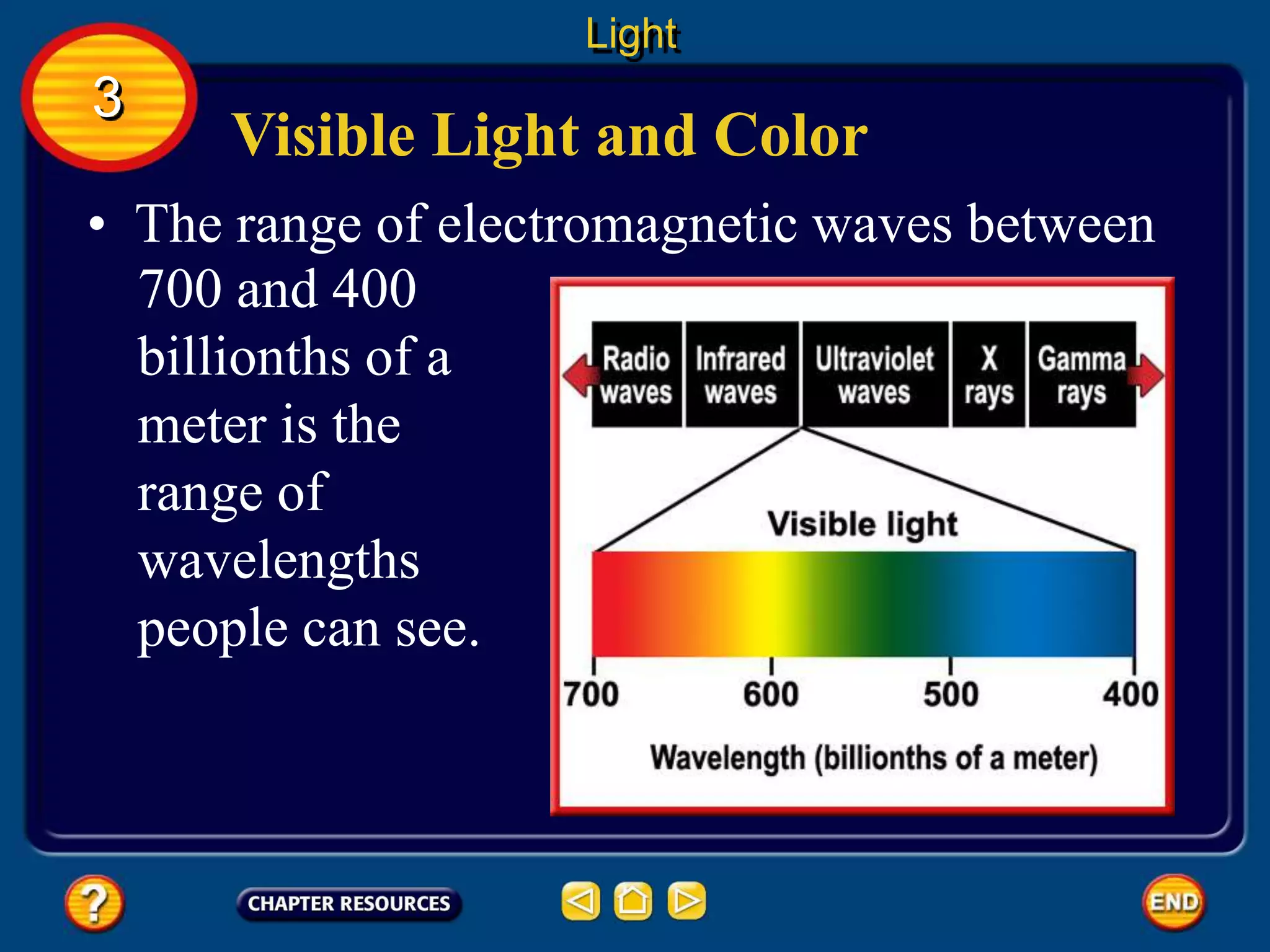
Visible Light and Color
Light
3
• The range of electromagnetic waves between
700 and 400
billionths of a
meter is the
range of
wavelengths
people can see.
Ultraviolet Waves
• Electromagnetic waves with wavelengths
between about 400 billionths and 10
billionths of a meter are ultraviolet waves.
Light
3
• Ultraviolet waves carry more energy than
visible light waves.
• Sunlight that reaches Earth’s surface contains
a small fraction of ultraviolet waves.
X Rays and Gamma Rays
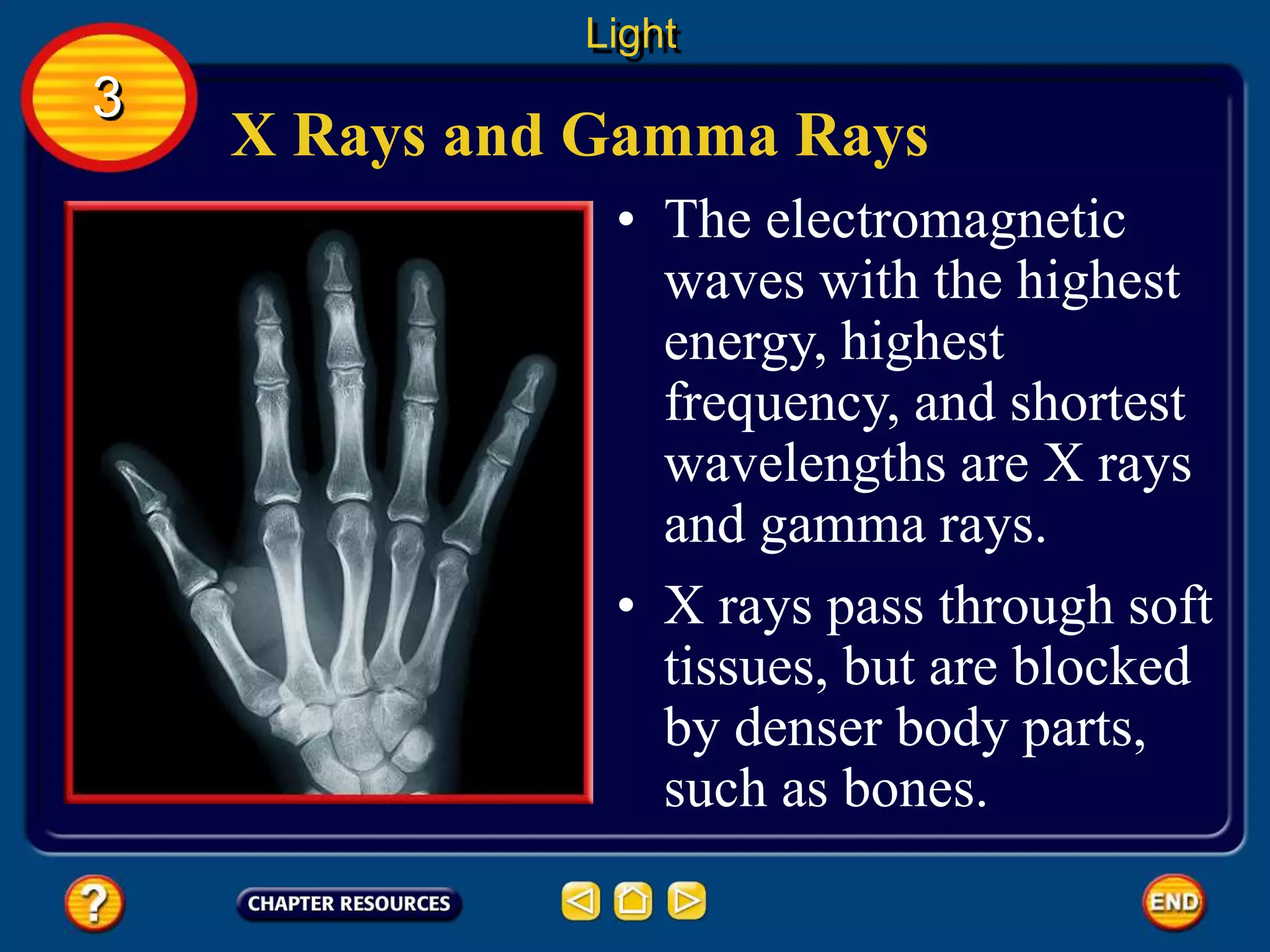
• The electromagnetic
waves with the highest
energy, highest
frequency, and shortest
wavelengths are X rays
and gamma rays.
Light
3
• X rays pass through soft
tissues, but are blocked
by denser body parts,
such as bones.
X Rays and Gamma Rays
• Gamma rays are even more energetic
than X rays.
Light
3
• One use of gamma rays is in the food
industry to kill bacteria that might
increase the rate of spoilage of food.
Electromagnetic Waves
from the Sun
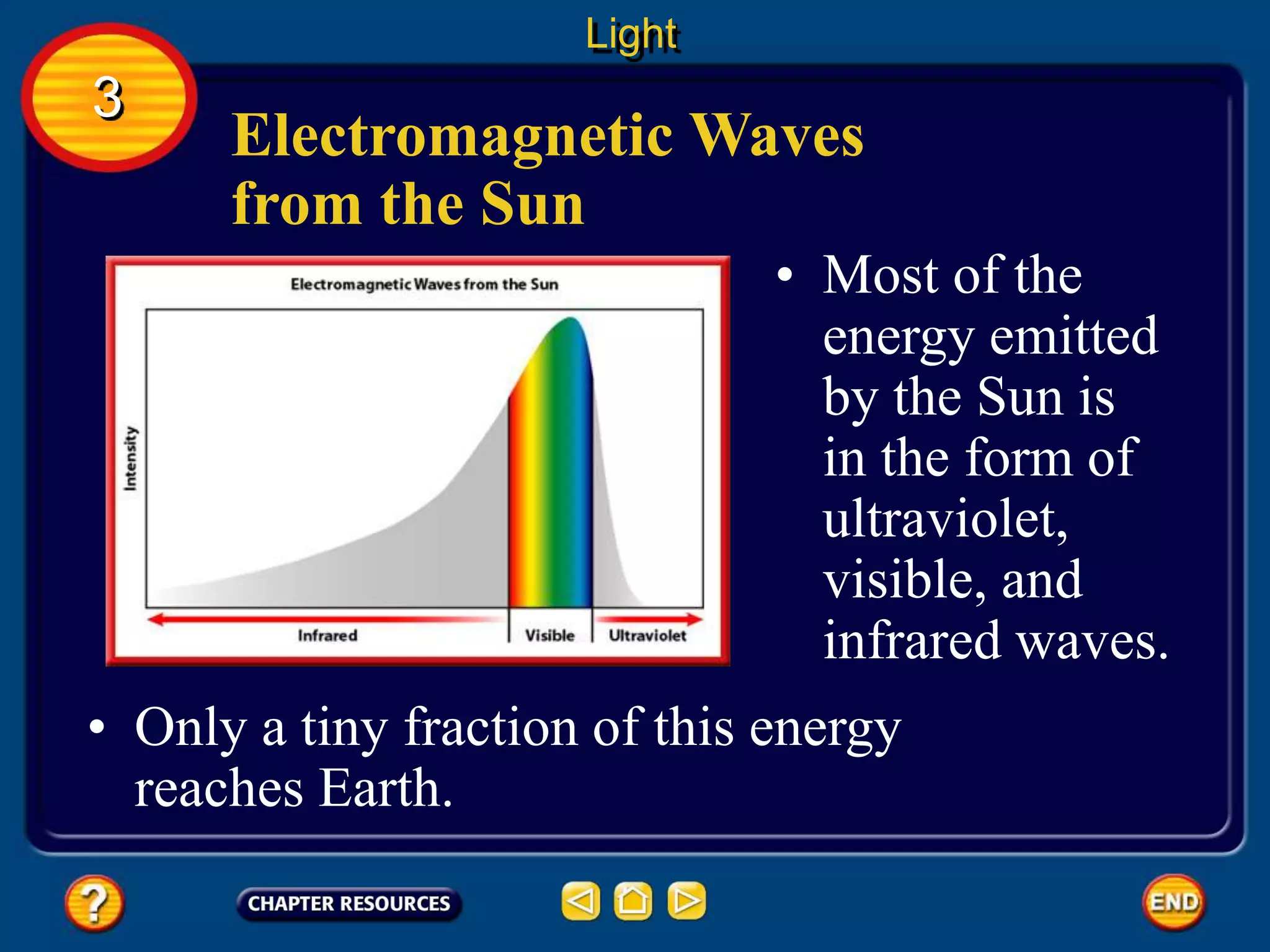
• Most of the
energy emitted
by the Sun is
in the form of
ultraviolet,
visible, and
infrared waves.
Light
3
• Only a tiny fraction of this energy
reaches Earth.
Electromagnetic Waves
from the Sun
Light
3
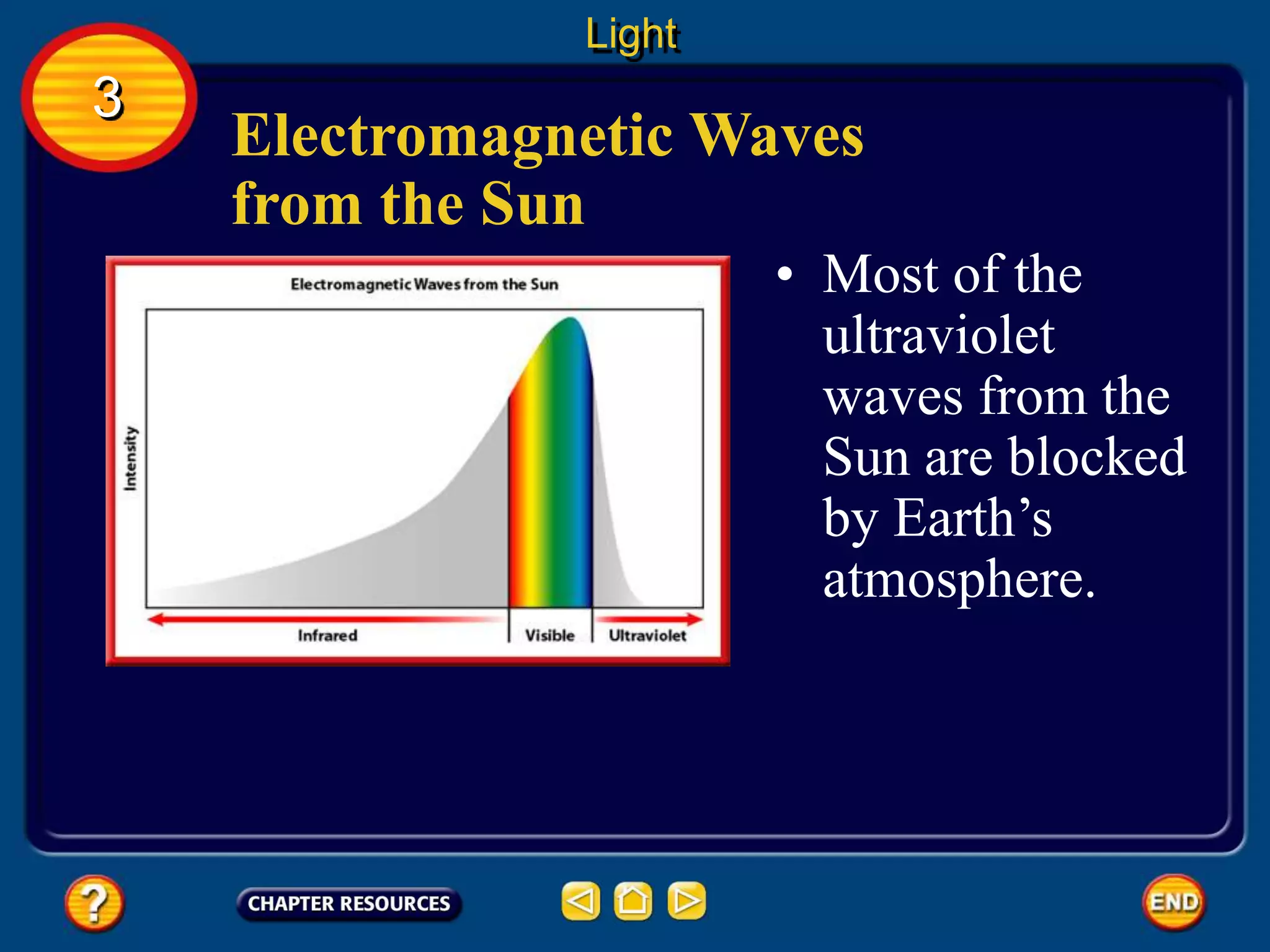
• Most of the
ultraviolet
waves from the
Sun are blocked
by Earth’s
atmosphere.
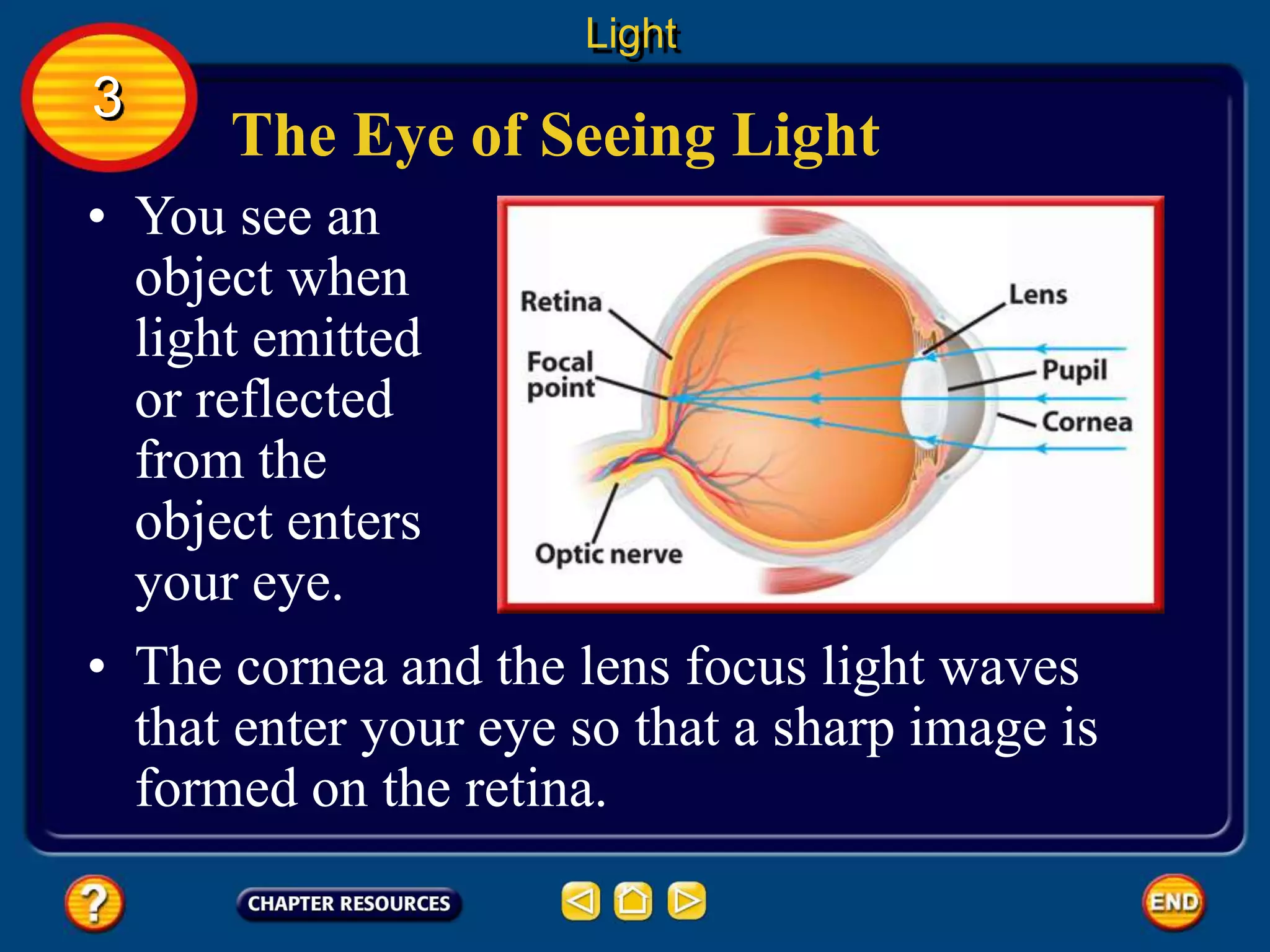
The Eye of Seeing Light
• You see an
object when
light emitted
or reflected
from the
object enters
your eye.
Light
3
• The cornea and the lens focus light waves
that enter your eye so that a sharp image is
formed on the retina.
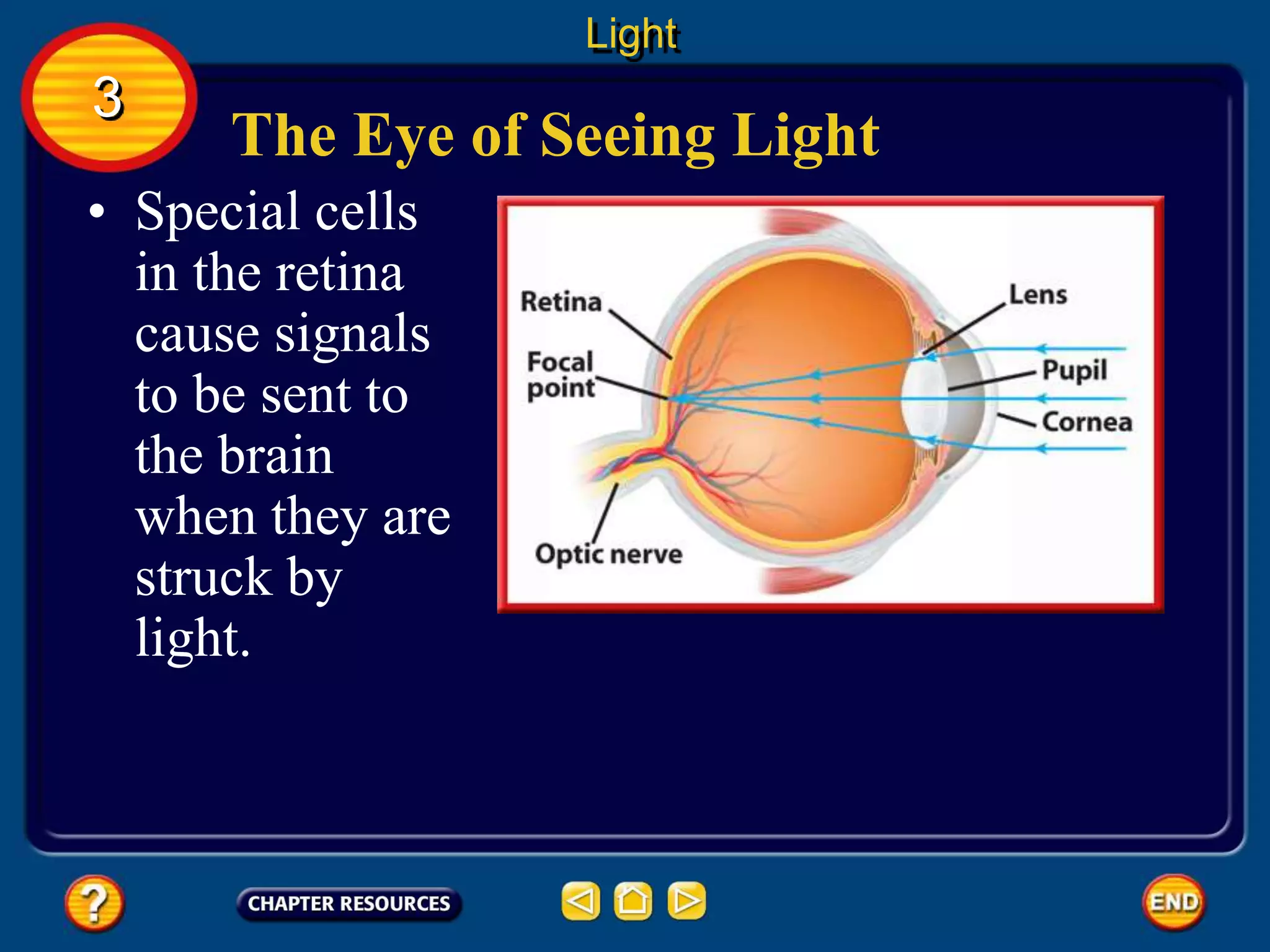
The Eye of Seeing Light
• Special cells
in the retina
cause signals
to be sent to
the brain
when they are
struck by
light.
Light
3
The Eye of Seeing Light
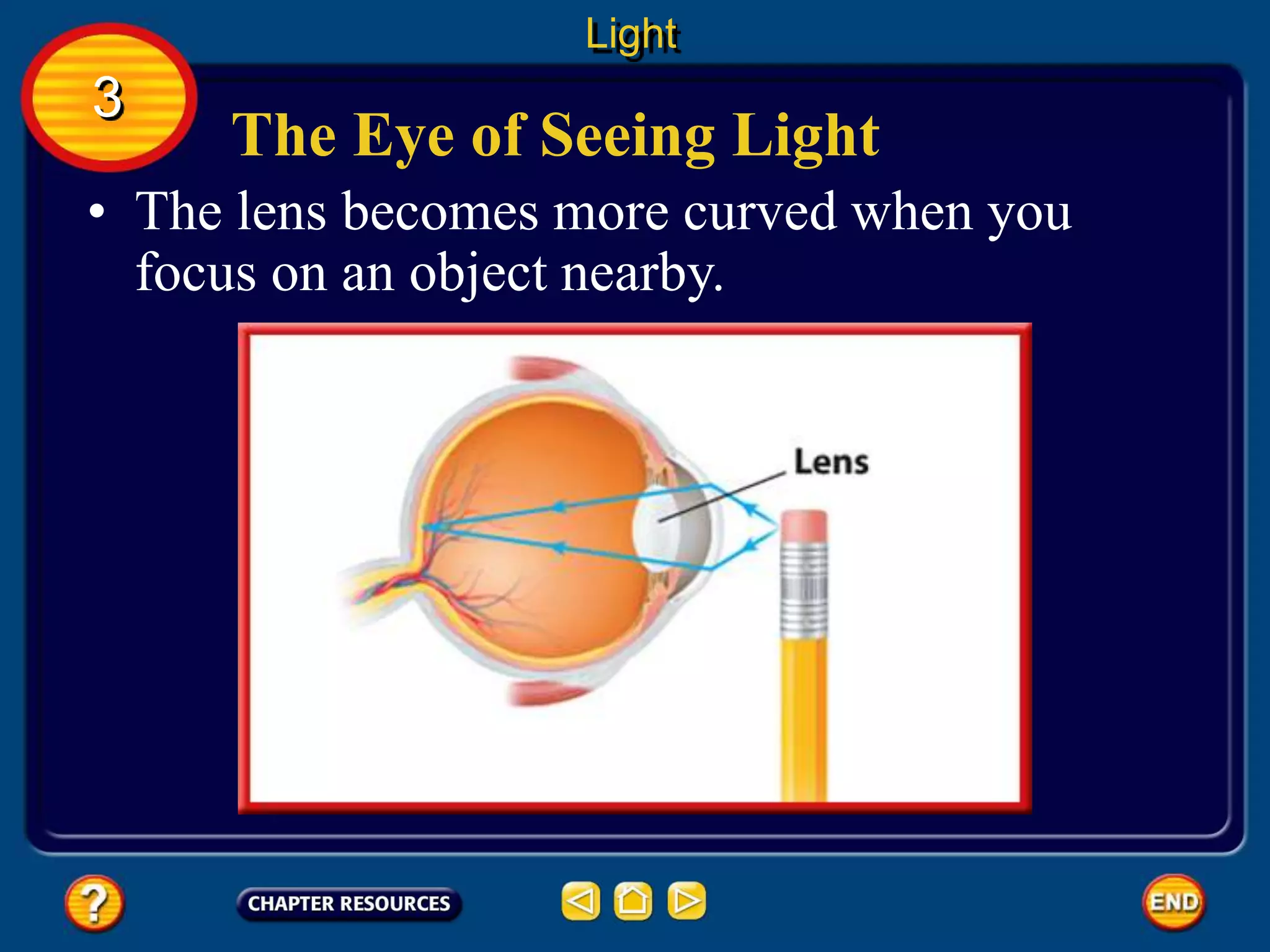
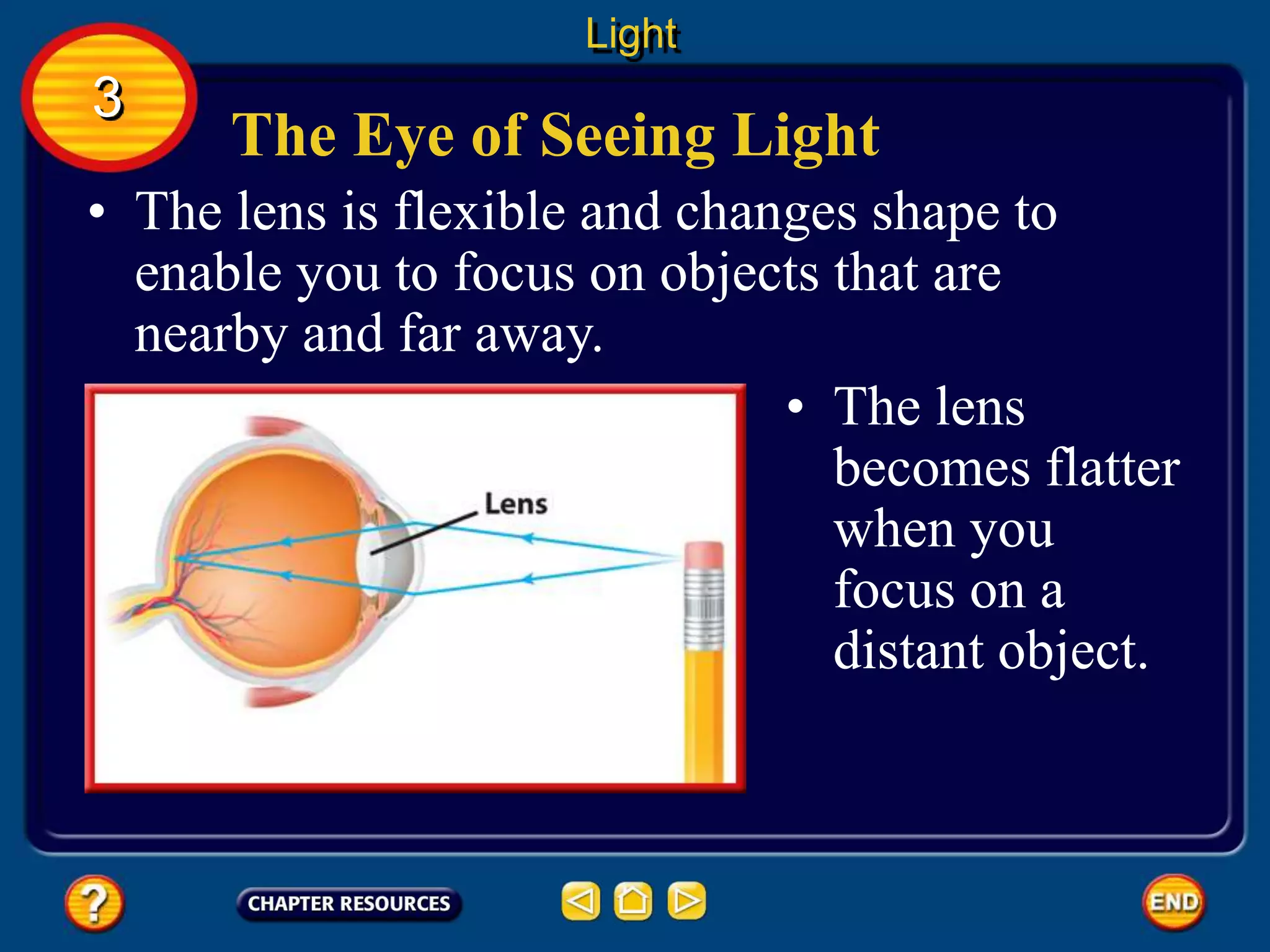
• The lens is flexible and changes shape to
enable you to focus on objects that are
nearby and far away.
Light
3
• The lens
becomes flatter
when you
focus on a
distant object.
The Eye of Seeing Light
• The lens becomes more curved when you
focus on an object nearby.
Light
3
Why do objects have color?
• When light waves strike an object, some of
the light waves are reflected.
Light
3
• The wavelengths of the light waves that are
reflected determine the object’s color.
• For example, a red rose reflects light waves
that have wavelengths in the red part of the
visible spectrum.
Rod and Cone Cells
• The retina contains over a hundred million
light-sensitive cells called rods and cones.
Light
3
• Rod cells are sensitive to dim light, and
cone cells enable you to see colors.
Section Check
3
Question 1
Unlike mechanical waves, electromagnetic
waves can travel through _______.
Electromagnetic waves can travel through
empty space.
Answer
Section Check
3
Question 2
No material thing, including spaceships, can
move faster than _______.
The answer is the speed of light. Light speed is
the upper limit on travel through space.
Answer
Section Check
3
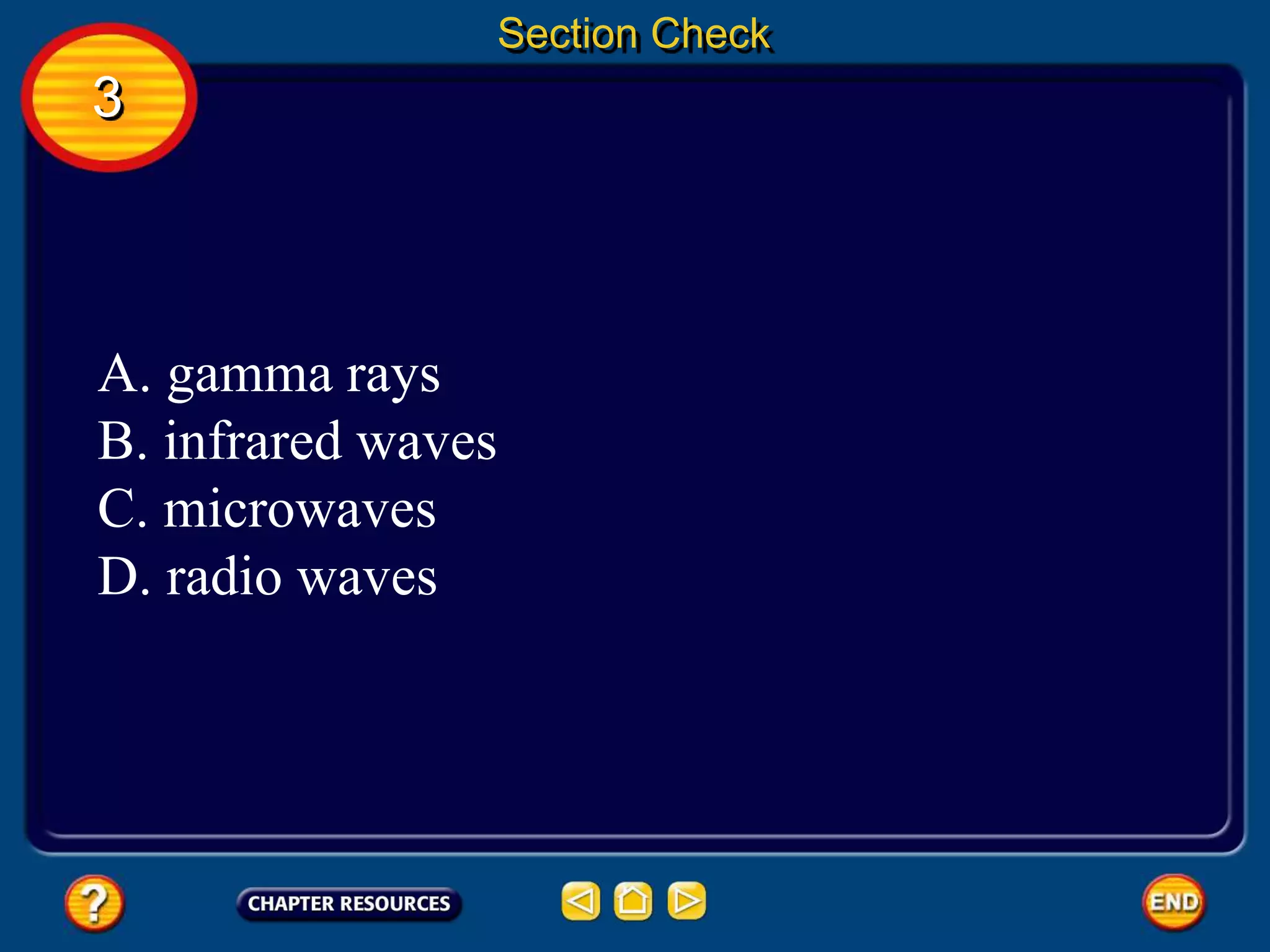
Question 3
Which contains a higher frequency?
Section Check
3
A. gamma rays
B. infrared waves
C. microwaves
D. radio waves
Section Check
3
Answer
The answer is A. As wavelength decreases,
frequency increases.
To advance to the next item or next page click on any
of the following keys: mouse, space bar, enter, down or
forward arrow.
Click on this icon to return to the table of contents
Click on this icon to return to the previous slide
Click on this icon to move to the next slide
Click on this icon to open the resources file.
Help
Click on this icon to go to the end of the presentation.
End of Chapter Summary File

Waves PowerPoint [Autosaved] [Autosaved].ppt

  • 2.
    • Different typesof waves carry signals to televisions and radios. • Sound and light waves move all around you and enable you to hear and see. What are waves? Waves 1
  • 3.
    • Waves areeven responsible for the damage caused by earthquakes. What are waves? Waves 1
  • 4.
    • A waveis a disturbance that moves through matter or space. • Waves carry energy from one place to another. • In water waves, the energy is transferred by water molecules. Waves Carry Energy, not Matter Waves 1 • When waves travel through solids, liquids, and gases, matter is not carried along with the waves.
  • 5.
    • Waves usuallyare produced by something moving back and forth, or vibrating. 2 Types of Waves Waves 1 • It is the energy of the vibrating object that waves carry outward. • Some waves, known as mechanical waves, can travel only through matter. (ex: water waves, earthquake/seismic waves, sound waves, and the waves that travel down a rope or spring) • Waves called electromagnetic waves can travel either through matter or through empty space.
  • 6.
    • A transversewave causes particles in matter to move back and forth at right angles to the direction in which the wave travels. There are 2 types of mechanical waves: Transverse Waves & (longitudinal) compressional waves Waves 1 • High points in the wave are called crests. Low points are called troughs. • The series of crests and troughs forms a transverse wave.
  • 7.
    • Another typeof mechanical wave is a compressional wave. Compressional Waves Waves 1 • A compressional wave causes particles in matter to move back and forth along the same direction in which the wave travels.
  • 8.
    • The places wherethe coils are squeezed together are called compressions Compressional Waves Waves 1 • The places where the coils are spread apart are called rarefactions. The series of compressions and rarefactions forms a compressional wave.
  • 9.
    • Seismic wavesmove through the ground during an earthquake. Compressional Waves Waves 1 • Some of these waves are compressional, and others are transverse. • The seismic waves that cause most damage to buildings are a kind of rolling (transverse)waves.
  • 10.
    • Electromagnetic wavesare waves that can travel through matter or empty space where matter is not present. (Light, radio waves, microwaves, infrared rays, and X rays are examples of electromagnetic waves.) Electromagnetic Waves Waves 1 • Electromagnetic waves are transverse waves. • They contain electric and magnetic parts that vibrate up and down perpendicular to the direction the wave travels.
  • 12.
    Review • A ___________wave is a shaped wave is a shaped wave known for crests and troughs. A transverse wave can be a ___________ wave which travels through matter ONLY or an _____________ wave which can travel through matter OR empty space (a vacuum).
  • 13.
    • The propertiesthat waves have depend on the vibrations that produce the waves. Properties of Waves Waves 1 • For example, if you move a pencil slowly up and down in a bowl of water, the waves produced by the pencil’s motion will be small and spread apart.
  • 14.
    • The distancebetween one point on a wave and the nearest point moving with the same speed and direction is the wavelength. Wavelength Waves 1 • The wavelength of a transverse wave is the distance between two adjacent crests or two adjacent troughs.
  • 15.
    • The wavelengthof a compressional wave is the distance between two adjacent compressions or rarefactions. Wavelength Waves 1
  • 16.
    • The frequencyof a wave is the number of wavelengths that pass by a point each second (or certain amount of time). Frequency Waves 1 If you were watching a transverse wave on a rope, the frequency of the wave would be the number of crests or troughs that pass you each second. -The closer the waves are together, the greater the energy carried by the waves.
  • 18.
    • The amplitude(largeness or height) of a wave is a measure of the distance between a line through the middle of a wave and a crest or trough. Amplitude of a Transverse Wave Waves 1 • As the distance between crests and troughs increases, the amplitude (largeness or height) of a transverse wave increases.
  • 19.
    • The greaterthe force that produces a wave, the greater the amplitude of the wave and the greater the energy carried by the wave. • In a transverse wave, the higher the wave, the higher the amplitude. • Sounds with greater amplitude will be louder. Light with greater amplitude will be brighter.
  • 20.
    • The amplitudeof a compressional wave depends on the density of material in compressions and rarefactions. • The closer the compressions, the larger the amplitude. • The farther apart the compressions, the smaller the amplitude. Amplitude of a Compressional Wave Waves 1
  • 21.
    • The vibrationsthat produce a wave transfer energy to the wave. Amplitude and Energy Waves 1 • The more energy a wave carries, the larger its amplitude. • Seismic waves are produced by vibrations in Earth’s crust that cause earthquakes. • The more energy these waves have, the larger their amplitudes and the more damage they cause as they travel along Earth’s surface.
  • 22.
    • The speedof a wave (how fast is travels) depends on the medium in which the wave travels. Wave Speed Waves 1 • You can calculate the speed of a wave if you know its wavelength and frequency using this equation.
  • 23.
    • In thisequation, v is the symbol for wave speed and f is the symbol for frequency. Wave Speed Waves 1 • The SI unit for frequency is the hertz, abbreviated Hz. One hertz equals one vibration per second, or one wavelength passing a point in one second. • The wavelength is represented by the Greek letter lambda, λ, and is measured in meters.
  • 24.
    Wave Speed andSpeed of the Sound pProblem V- 331 m/s + ( 0.6 m/sºC) T ?? How fast does sound travel if the air temperature is 20ºC?
  • 25.
    • Waves don’talways travel in a straight line. Waves Can Change Direction Waves 1 • Waves can change direction when they travel from one material to another. • The waves can reflect (bounce off a surface), refract (change direction), or diffract (bend around an obstacle).
  • 26.
    • A linethat makes an angle of 90 degrees with a surface is called the normal to the surface. The Law of Reflection Waves 1 • According to law of reflection, the angle that the incoming wave makes with the normal equals the angle that the outgoing wave makes with the normal.
  • 27.
    Reflection • Reflection isthe bouncing back of a wave when it meets a surface or boundary that does not absorb the entire wave’s energy. All waves can be reflected. • Examples: light reflected off a mirror, echoes (voice, bats, dolphins)
  • 28.
    • When alight wave moves from air to water, it slows down. Refraction Waves 1 • This change in speed causes the light wave to bend. • Refraction is the bending of waves caused by a change in their speed as they pass from one medium to another.
  • 29.
    Refraction • As wavespass at an angle from one medium to another, they may speed up or slow down. • The greater the change in speed of the waves, the more the waves will bend. • Refraction of light going from air through a convex lens, for example, can make images appear larger as the light waves bend.
  • 30.
    • Waves canchange direction by diffraction, which is the bending of waves around an object. Refraction Waves 1 • Prisms or diffraction gratings separate white light into its different components or color by bending the light at different angles depending on the frequencies of the light passing through the prism or diffraction grating. Different colors of light have different frequencies.
  • 31.
    • The wavelengthsof sound waves are similar to the size of objects around you, but the wavelengths of light waves are much shorter. Diffraction of Sound and Light Waves 1 • As a result, you can hear people talking in a room with an open door even though you can’t see them.
  • 32.
    Transmission • Transmission ofwaves occurs when waves pass through a given point or medium (matter). • Example: Light waves are transmitted through transparent materials that allow most light that strikes them to pass through.
  • 33.
    Transmission • Only asmall amount of light is absorbed when waves are transmitted. Most of the wave passes through the medium (matter).
  • 34.
    Transmission • Opaque materialsallow no light waves to be transmitted through them. • Translucent materials transmit some light, but cause it to be scattered so no clear image is seen.
  • 35.
    Absorption • Absorption ofcertain frequencies of light occurs when the energy is not transferred through, or reflected by the given medium. • Objects or substances that absorb any wavelength of electromagnetic radiation become warmer and convert the absorbed energy to infrared radiation.
  • 36.
    1 Section Check Question 1 Wavescarry _______, not _______. Waves carry energy, not matter. Think of what happens when you shake one end of a rope; a wave travels along the rope, but the rope itself doesn’t move forward. Answer
  • 37.
    1 Section Check Question 1 Whatis shown at point B in this illustration?
  • 38.
    1 Section Check A. crest B.direction rope moves C. direction wave moves D. trough
  • 39.
    1 Section Check Answer The answeris D. Low points on a wave are called troughs.
  • 40.
    1 Section Check Question 3 Thenumber of wavelengths that pass by each second is the wave’s _______. A. diffraction B. frequency C. rarefaction D. wavelength
  • 41.
    1 Section Check Answer The answeris B. If you were watching a transverse wave on a rope, the frequency of the wave would be the number of crests or troughs that pass you each second.
  • 42.
    Making Sound Waves •Vibrations transfer energy to nearby air particles, producing sound waves in air. Sound Waves 2 • Every sound you hear is caused by something vibrating. For example, when you talk, tissues in your throat vibrate in different ways to form sounds.
  • 43.
    Sound Waves are CompressionalWaves • Sound waves produced by a vibrating object are compressional waves. • A vibrating drum head produces a sound wave. Sound Waves 2 • The drum head produces a compression each time it moves upward and a rarefaction each time it moves downward.
  • 44.
    Sound Waves are CompressionalWaves • Sound waves can only travel through matter. • The energy carried by a sound wave is transferred by the collisions between the particles in the material the wave is traveling in. Sound Waves 2
  • 45.
    The Speed ofSound • The speed of sound depends on the matter through which it travels. • Sound waves travel faster through solids and liquids. Sound Waves 2
  • 46.
    The Speed ofSound Sound Waves 2 • The speed of sound through a material increases as the temperature of the material increases. • The effect of temperature is greatest in gases.
  • 47.
    The Loudness ofSound • What makes a sound loud or soft? • The difference is the amount of energy. Sound Waves 2 • Loud sounds have more energy than soft sounds.
  • 48.
    Intensity • The amountof energy that a wave carries past a certain area each second is the intensity of the sound. Sound Waves 2 • This figure shows how the intensity of sound from the cymbals decreases with distance.
  • 49.
    Intensity • The intensityof sound waves is related to the amplitude. Sound Waves 2 • Sound with a greater amplitude also has a greater intensity.
  • 50.
    The Decibel Scaleand Loudness • The intensity of sound waves is measured in units of decibels (dB). Sound Waves 2 • The softest sound a person can hear has an intensity of 0 dB. • Sound with intensities of about 120 dB or higher are painful to people.
  • 51.
    The Decibel Scaleand Loudness • Loudness is the human perception of the intensity of sound waves. Sound Waves 2 • Each increase of 10 dB in intensity multiplies the energy of the sound waves ten times. • Most people perceive this as a doubling of the loudness of the sound.
  • 52.
    Frequency and Pitch •The frequency of sound waves is determined by the frequency of the vibrations that produce the sound. Sound Waves 2 • People are usually able to hear sounds with frequencies between about 20 Hz and 20,000 Hz. • Pitch is the human perception of the frequency sound. • Sounds with low frequencies have low pitch and sounds with high frequencies have high pitch.
  • 53.
    Hearing and theEar • The ear is a complex organ that can detect a wide range of sounds. Sound Waves 2 • The ear can be divided into three parts—the outer ear, the middle ear, and the inner ear.
  • 54.
    Hearing and theEar Sound Waves 2
  • 55.
    The Reflection ofSound • Echoes are sounds that reflect off surfaces. Sound Waves 2 • Repeated echoes are called reverberation.
  • 56.
    The Reflection ofSound • The reflection of sound can be used to locate or identify objects. Sound Waves 2 • Echolocation is the process of locating objects by bounding sounds off them.
  • 57.
    The Reflection ofSound Sound Waves 2 • By interpreting the reflected waves, the animals can locate and determine properties of other animals. • Some animals emit short, high frequency sound waves toward a certain area.
  • 58.
  • 59.
    2 Section Check Test I MultipleChoice Instructions. Choose the letter of the correct answer. Write your answer on the space provided before the number.
  • 60.
    2 Section Check Question 1 Everysound you hear is caused by something that is _______. A. compressing B. loud C. moving D. vibrating
  • 61.
    2 Section Check Question 2 Soundwaves travel faster through _______ than they do through water. A. gases B. liquids C. plasma D. solids
  • 62.
    2 Section Check Question 3 Highpoint in the wave is called. A. Wavelength B. Trough C. Frequency D. Crest
  • 63.
    1 Section Check Question 4 Wavescarry _______, not _______. A. Energy, matter B. Matter, Energy C. Sounds, Light D. Sounds, Vacuum
  • 64.
    Section Check 3 Question 5 Unlikemechanical waves, electromagnetic waves can travel through _______. A. Empty space B. Solid C. Liquids D. Gases
  • 65.
    1 Section Check A. crest B.direction rope moves C. direction wave moves D. trough Question 6 What is shown at point B in this illustration?
  • 66.
    1 Section Check Question 7 Thenumber of wavelengths that pass by each second is the wave’s _______. A. diffraction B. frequency C. rarefaction D. wavelength
  • 67.
    The distance betweenone point on a wave and the nearest point moving with the same speed and direction. Waves 1 A. Frequency B. Period C. Wavelength D. Amplitude Question 8
  • 68.
    A waves thatcan travel through matter or empty space where matter is not present. Waves 1 A. Compressional waves B. Seismic Waves C. Electromagnetic waves D. Transverse waves. Question 9
  • 69.
    It is thenumber of wavelengths that pass by a point each given time. Question 10 Waves 1 A. Wavelength B. Frequency C. Period D. Amplitude
  • 70.
    Instructions: Enumerate thefollowing. Write your answer on your paper. Test II Enumeration 1
  • 71.
    Waves 1 1-2. Two Typesof Waves 3-6. Properties of Waves 7-9. Give 3 examples of Transverse Waves 10-12. Give 3 examples of Electromagnetic Waves
  • 72.
    Waves 1 1. D 2. D 3.D 4. A 5. A 6. D 7. B 8. C 9. C 10 B
  • 73.
    2 Section Check Answer The answeris D. The sound of your voice is caused by vibrations in your vocal chords.
  • 74.
    2 Section Check Answer The answeris D. This table shows that sound waves travel faster through solids than they travel through water.
  • 75.
    2 Section Check Answer The answeris A. Most people perceive this as a doubling of the loudness of the sound.
  • 76.
    Waves in EmptySpace • Light from the Moon has traveled through space that contains almost no matter. • You can see light from the moon, distant stars, and galaxies because light is an electromagnetic wave. Light 3
  • 77.
    Waves in EmptySpace Light 3 • Electromagnetic waves are waves that can travel through matter or through empty space.
  • 78.
    The Speed ofLight • In empty space, light travels at a speed of about 300,000 km/s. • Light travels so fast that light emitted from the Sun travels 150 million km to Earth in only about eight and a half minutes. Light 3
  • 79.
    The Speed ofLight • When light travels in matter, it interacts with the atoms and molecules in the material and slows down. • As a result, light travels fastest in empty space, and travels slowest in solids. Light 3
  • 80.
    Wavelength and Frequency ofLight • Wavelengths of light are usually expressed in units of nanometers (nm). • One nanometer is equal to one billionth of a meter. Light 3 • Green light has a wavelength of about 500 nm, or 500 billionths of a meter. A light wave with this wavelength has a frequency of 600 trillion Hz.
  • 81.
    Properties of LightWaves • Light waves, and all electromagnetic waves, are transverse waves. • An electromagnetic wave traveling through matter can cause matter to move at right angles to the direction the wave is moving. Light 3
  • 82.
    Properties of LightWaves • An electromagnetic wave contains an electric part and a magnetic part. • Both parts are called fields and vibrate at right angles to the wave motion. Light 3
  • 83.
    Properties of LightWaves • The number of times the electric and magnetic parts vibrate each second is the frequency of the wave. Light 3
  • 84.
    Properties of LightWaves • The wavelength is the distance between the crests or troughs of the vibrating electric or magnetic parts. Light 3
  • 85.
    Intensity of LightWaves • The intensity of waves is a measure of the amount of energy that the waves carry. • For light waves, the intensity determines the brightness of the light. Light 3 • A dim light has lower intensity because the waves carry less energy.
  • 86.
    The Electromagnetic Spectrum •The electromagnetic spectrum is the complete range of electromagnetic wave frequencies and wavelengths. Light 3
  • 87.
    The Electromagnetic Spectrum •At one end of the spectrum the waves have low frequency, long wavelength, and low energy. Light 3
  • 88.
    The Electromagnetic Spectrum Light 3 •At the other end of the spectrum the waves have high frequency, short wavelength, and high energy.
  • 89.
    Radio Waves andMicrowaves • The wavelengths of radio waves are greater than about 0.3 meters. • Some are even thousands of meters long. Light 3 • The shortest radio waves are called microwaves. • These waves have a wavelength between about 0.3 meters and 0.001 meters.
  • 90.
    Infrared Waves • Infraredwaves have wavelengths between 0.001 meters and 700 billionths of a meter. • All warm bodies emit infrared waves. Light 3 • Law enforcement officials and military personnel sometimes use special night goggles that are sensitive to infrared waves. These goggles can be used to help locate people in the dark.
  • 91.
    Visible Light andColor Light 3 • The range of electromagnetic waves between 700 and 400 billionths of a meter is the range of wavelengths people can see.
  • 92.
    Ultraviolet Waves • Electromagneticwaves with wavelengths between about 400 billionths and 10 billionths of a meter are ultraviolet waves. Light 3 • Ultraviolet waves carry more energy than visible light waves. • Sunlight that reaches Earth’s surface contains a small fraction of ultraviolet waves.
  • 93.
    X Rays andGamma Rays • The electromagnetic waves with the highest energy, highest frequency, and shortest wavelengths are X rays and gamma rays. Light 3 • X rays pass through soft tissues, but are blocked by denser body parts, such as bones.
  • 94.
    X Rays andGamma Rays • Gamma rays are even more energetic than X rays. Light 3 • One use of gamma rays is in the food industry to kill bacteria that might increase the rate of spoilage of food.
  • 95.
    Electromagnetic Waves from theSun • Most of the energy emitted by the Sun is in the form of ultraviolet, visible, and infrared waves. Light 3 • Only a tiny fraction of this energy reaches Earth.
  • 96.
    Electromagnetic Waves from theSun Light 3 • Most of the ultraviolet waves from the Sun are blocked by Earth’s atmosphere.
  • 97.
    The Eye ofSeeing Light • You see an object when light emitted or reflected from the object enters your eye. Light 3 • The cornea and the lens focus light waves that enter your eye so that a sharp image is formed on the retina.
  • 98.
    The Eye ofSeeing Light • Special cells in the retina cause signals to be sent to the brain when they are struck by light. Light 3
  • 99.
    The Eye ofSeeing Light • The lens is flexible and changes shape to enable you to focus on objects that are nearby and far away. Light 3 • The lens becomes flatter when you focus on a distant object.
  • 100.
    The Eye ofSeeing Light • The lens becomes more curved when you focus on an object nearby. Light 3
  • 101.
    Why do objectshave color? • When light waves strike an object, some of the light waves are reflected. Light 3 • The wavelengths of the light waves that are reflected determine the object’s color. • For example, a red rose reflects light waves that have wavelengths in the red part of the visible spectrum.
  • 102.
    Rod and ConeCells • The retina contains over a hundred million light-sensitive cells called rods and cones. Light 3 • Rod cells are sensitive to dim light, and cone cells enable you to see colors.
  • 103.
    Section Check 3 Question 1 Unlikemechanical waves, electromagnetic waves can travel through _______. Electromagnetic waves can travel through empty space. Answer
  • 104.
    Section Check 3 Question 2 Nomaterial thing, including spaceships, can move faster than _______. The answer is the speed of light. Light speed is the upper limit on travel through space. Answer
  • 105.
    Section Check 3 Question 3 Whichcontains a higher frequency?
  • 106.
    Section Check 3 A. gammarays B. infrared waves C. microwaves D. radio waves
  • 107.
    Section Check 3 Answer The answeris A. As wavelength decreases, frequency increases.
  • 108.
    To advance tothe next item or next page click on any of the following keys: mouse, space bar, enter, down or forward arrow. Click on this icon to return to the table of contents Click on this icon to return to the previous slide Click on this icon to move to the next slide Click on this icon to open the resources file. Help Click on this icon to go to the end of the presentation.
  • 109.
    End of ChapterSummary File