{Why} Does
Social Media
Have to Change
Everything?
Amy E. Hays
Emerging Technologies Program Specialist
                                                                     1
Texas A&M AgriLife Extension
Institute of Renewable Natural Resources/Water Resources Institute
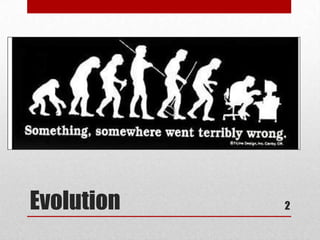
Evolution   2
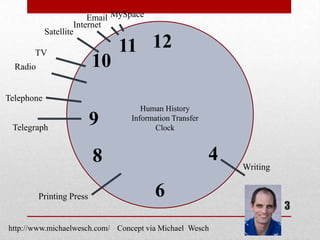
Email MySpace
                     Internet
            Satellite

       TV                       11 12
  Radio                    10
Telephone
                                     Human History

 Telegraph
                           9      Information Transfer
                                        Clock


                           8                             4   Writing


          Printing Press                 6
                                                                       3
http://www.michaelwesch.com/ Concept via Michael Wesch
Struggle

• How do I keep up?
• How do I keep my work/business up?


                                       4
5
Why does social media
have an impact
information discovery?

                         6
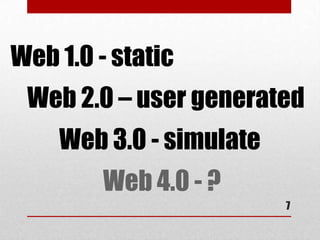
Web 1.0 - static
 Web 2.0 – user generated
    Web 3.0 - simulate
         Web 4.0 - ?
                         7
http://archive.org/web/web.php

                             8
IT’S ABOUT HOW SOCIAL
NETWORKING IMPACTS
INFORMATION SHARING
                        9
Go [there] to
find everything
about [THIS]
                  11
Come [HERE ]
information needs
to find me
                    12
Evidence

• More email subscribers?
• More people at meetings?
• Budgets increasing for publications?
• Magazine adds/articles cheaper?
                                         13
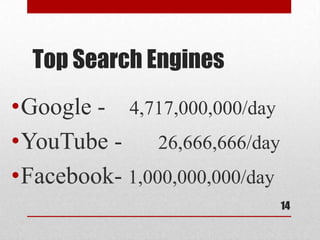
Top Search Engines
•Google - 4,717,000,000/day
•YouTube - 26,666,666/day
•Facebook- 1,000,000,000/day
                               14
MAJOR SHIFT - 2011
Search Engine Optimization
                             15
How Information Will Find
People in the Future
• How many people access that information
  (statistics on page views, site visits, ect…)
• Was this site socially shared???
• Was the page recommended, or rated by
  a user?
• How timely is the information?
• Did any of my friends visit this site?
                                                  17
Organizational Challenge

Are
TV, email, newsletters, radio,
magazines searchable?
                                 18
“That’s
Marketing's
Job”
              19
Why I’m online
                 • Want to make
                   connections to
                   friends and family

                 • Want to find new
                   friends

                 • Share experiences
                   and get feedback

                 • Keep up with news
                   and information
Why WE are online
• Want to be an
  influencer

• Seek support and
  opinion

• Share experiences
  and get feedback

• Keep up with news
  and information
Biggest challenges
 facing Watershed
 [coordinators/educators]
• Nobody really understands what a watershed is?
• How do you keep a watershed healthy?
• Difficult to bring parties with a stake in watersheds
  together
• Future sustainability of watersheds is critical to almost all
  facets of business, human health, and natural resource
  sustainability
                                                               23
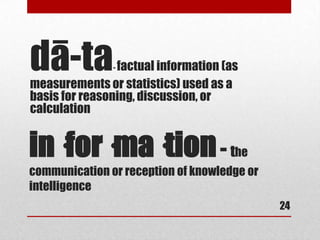
dā-ta          -factual information (as
measurements or statistics) used as a
basis for reasoning, discussion, or
calculation


in·for·ma·tion - t                    he
communication or reception of knowledge or
intelligence
                                             24
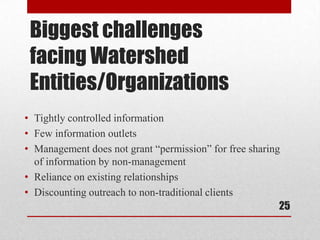
Biggest challenges
 facing Watershed
 Entities/Organizations
• Tightly controlled information
• Few information outlets
• Management does not grant “permission” for free sharing
  of information by non-management
• Reliance on existing relationships
• Discounting outreach to non-traditional clients
                                                         25
STRATEGIES TO DO NOW
                       26
Tip #1 – You don’t
have to be involved in
a social network to
reap the benefits of
social media
                         27
Website Check-up

• Is your website social media
  ready?

                                 28
Website Best Practices
• Do you have pictures with your articles?
  • When people share your news, information, articles social
    networks like Facebook, Pinterest, Google+ pull the text AND
    attempt to pull a picture.
  • Humans are 82% dominantly visual
• Do you practice good web writing skills?
  • Writing for the web is NOT like writing for print.
  • Learn characteristics of good web writing
• PDF’s are NOT searchable through search engines, make sure
  to have GOOD summary paragraphs that go with PDF listings.

                                                                   29
Tip #2 – Think Mobile


                        30
31
Mobile Now – Mobile First?
• There are now more than 1 billion smartphones in use worldwide: 1.038
  billion in total.
• It took us 16 years to pass 1 billion but it's estimated to take only three
  years for the next billion smartphone users to come on board.
• 3.2 billion people, or 46% of the world's total population of 7
  billion, have at least one active mobile (cellular, not just smarpthone)
  device.
• The global "addressable" population is 4.7 billion.
• Of the remaining 2.3 billion, 1.5 billion live in pockets with poor or no
  network coverage, though this should fall to 1.1 billion by 2017. The
  other 800m include some elderly, disabled and cash-strapped
  unemployed, as well as the very young or incarcerated. (source)
Source: Luke Wroblewski - http://www.lukew.com.
                                                                           32
Tip #3 – Pick a
strategy first, not a
tool


                        33
34
Be Specific in Goals
• Do you want more people to sign up for
  meetings, events, newsletters?
• Want more people at events?
• Want to drive people to your website?
• Have more fans/followers?
• Enhance your website with feeds?
                                           35
Sean Carton ClickZ – A Social Media Strategy Checklist
1.    What are we trying to accomplish?

2.    Why social media?

3.    What kind of social media will help us best achieve our goals?

4.    Are we prepared to let go of control of our brand, at least a little?

5.    What will we do to encourage participation?

6.    Who will maintain our social media presence?

7.    Do we have the resources to keep this up, or will this be a short campaign?

8.    How does engaging users via social media integrate into our overall
      marketing/communications strategy?

9.    How do we measure success? What constitutes failure?

10.   What will we do less of if we're spending resources on social media?


                                                               http://www.clickz.com/3634939 (Dec. 21, 2009)
Tip #4 – DUNBAR


                  37
How Do You Make the Top 150?
• A relationship means two way conversation
  • Ask questions
  • Provide leads to new resources
  • Highlight friends/partners information
• Provide context to links, comments
  • Don’t just show a link, give dialog as to WHY your clients would
    be interested
  • Show a little personality
• Engage, engage, engage – all relationships must be cultivated

                                                                  38
Tip #5 – Listen/Follow
other good examples
FIRST.


                         39
Two Excellent Examples:


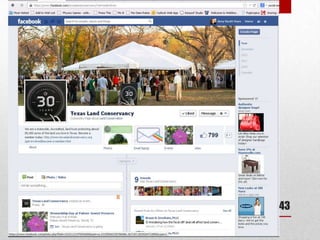
• Texas Land Conservancy
• Trinity Waters – trinitywaters.org


                                       40
41
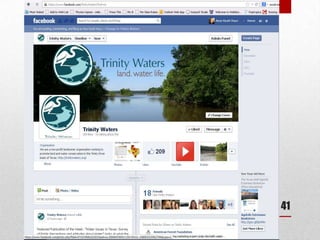
Trinity Waters –
Facebook, Twitter, Scoop.it
• Post information about conservation, watershed
  management, wildlife, conservation, ect…
    •   Publications
    •   News releases
    •   Popular articles
    •   Partners
•   Consistent
•   Post photo’s they take
•   Advertise events (theirs and others)
•   Ask questions, quizzes                         42
43
Texas Land Conservancy–
Facebook, Twitter, Pinterest
• Highlight properties
    •   Beautiful photos
    •   News releases
    •   Popular articles
    •   Partners
•   Conversational
•   High advocacy
•   Advertise events (theirs and others)
•   Utilize Pinterest for educational outreach, advocacy   44
Tip #6 – Let others
help


                      45
Avoid “one man” mentality
• Teach employee’s how to use social tools to “spread” the news
  • Hold trainings on how your employee’s can be part of the process
  • Don’t fall into a “marketing only” mentality
• Set reasonable guidelines on your expectations of social
  channels and employee’s interactions
  • Set tone and examples
• Encourage volunteers/advocates to help you in your social
  media endeavor
  • Don’t make it a “secret” project
                                                                 46
Tip #7 – Set measures
of evaluation. If it’s
not working, kill it.


                         47
CHALLENGE FOR
 THE FUTURE
         THINK
  ABOUT THE WAY PEOPLE
    CONNECT WITH YOU     48
Amy E. Hays
Emerging Technologies Program Specialist
Texas A&M AgriLife Extension
Institute of Renewable Natural Resources/Water Resources Institute

 ahays@tamu.edu
 ahays@extension.org

 Find me on:


                                                                     49

Social Media for Watershed Educators

  • 1.
    {Why} Does Social Media Haveto Change Everything? Amy E. Hays Emerging Technologies Program Specialist 1 Texas A&M AgriLife Extension Institute of Renewable Natural Resources/Water Resources Institute
  • 2.
  • 3.
    Email MySpace Internet Satellite TV 11 12 Radio 10 Telephone Human History Telegraph 9 Information Transfer Clock 8 4 Writing Printing Press 6 3 http://www.michaelwesch.com/ Concept via Michael Wesch
  • 4.
    Struggle • How doI keep up? • How do I keep my work/business up? 4
  • 5.
  • 6.
    Why does socialmedia have an impact information discovery? 6
  • 7.
    Web 1.0 -static Web 2.0 – user generated Web 3.0 - simulate Web 4.0 - ? 7
  • 8.
  • 9.
    IT’S ABOUT HOWSOCIAL NETWORKING IMPACTS INFORMATION SHARING 9
  • 11.
    Go [there] to findeverything about [THIS] 11
  • 12.
    Come [HERE ] informationneeds to find me 12
  • 13.
    Evidence • More emailsubscribers? • More people at meetings? • Budgets increasing for publications? • Magazine adds/articles cheaper? 13
  • 14.
    Top Search Engines •Google- 4,717,000,000/day •YouTube - 26,666,666/day •Facebook- 1,000,000,000/day 14
  • 15.
    MAJOR SHIFT -2011 Search Engine Optimization 15
  • 17.
    How Information WillFind People in the Future • How many people access that information (statistics on page views, site visits, ect…) • Was this site socially shared??? • Was the page recommended, or rated by a user? • How timely is the information? • Did any of my friends visit this site? 17
  • 18.
    Organizational Challenge Are TV, email,newsletters, radio, magazines searchable? 18
  • 19.
  • 21.
    Why I’m online • Want to make connections to friends and family • Want to find new friends • Share experiences and get feedback • Keep up with news and information
  • 22.
    Why WE areonline • Want to be an influencer • Seek support and opinion • Share experiences and get feedback • Keep up with news and information
  • 23.
    Biggest challenges facingWatershed [coordinators/educators] • Nobody really understands what a watershed is? • How do you keep a watershed healthy? • Difficult to bring parties with a stake in watersheds together • Future sustainability of watersheds is critical to almost all facets of business, human health, and natural resource sustainability 23
  • 24.
    dā-ta -factual information (as measurements or statistics) used as a basis for reasoning, discussion, or calculation in·for·ma·tion - t he communication or reception of knowledge or intelligence 24
  • 25.
    Biggest challenges facingWatershed Entities/Organizations • Tightly controlled information • Few information outlets • Management does not grant “permission” for free sharing of information by non-management • Reliance on existing relationships • Discounting outreach to non-traditional clients 25
  • 26.
  • 27.
    Tip #1 –You don’t have to be involved in a social network to reap the benefits of social media 27
  • 28.
    Website Check-up • Isyour website social media ready? 28
  • 29.
    Website Best Practices •Do you have pictures with your articles? • When people share your news, information, articles social networks like Facebook, Pinterest, Google+ pull the text AND attempt to pull a picture. • Humans are 82% dominantly visual • Do you practice good web writing skills? • Writing for the web is NOT like writing for print. • Learn characteristics of good web writing • PDF’s are NOT searchable through search engines, make sure to have GOOD summary paragraphs that go with PDF listings. 29
  • 30.
    Tip #2 –Think Mobile 30
  • 31.
  • 32.
    Mobile Now –Mobile First? • There are now more than 1 billion smartphones in use worldwide: 1.038 billion in total. • It took us 16 years to pass 1 billion but it's estimated to take only three years for the next billion smartphone users to come on board. • 3.2 billion people, or 46% of the world's total population of 7 billion, have at least one active mobile (cellular, not just smarpthone) device. • The global "addressable" population is 4.7 billion. • Of the remaining 2.3 billion, 1.5 billion live in pockets with poor or no network coverage, though this should fall to 1.1 billion by 2017. The other 800m include some elderly, disabled and cash-strapped unemployed, as well as the very young or incarcerated. (source) Source: Luke Wroblewski - http://www.lukew.com. 32
  • 33.
    Tip #3 –Pick a strategy first, not a tool 33
  • 34.
  • 35.
    Be Specific inGoals • Do you want more people to sign up for meetings, events, newsletters? • Want more people at events? • Want to drive people to your website? • Have more fans/followers? • Enhance your website with feeds? 35
  • 36.
    Sean Carton ClickZ– A Social Media Strategy Checklist 1. What are we trying to accomplish? 2. Why social media? 3. What kind of social media will help us best achieve our goals? 4. Are we prepared to let go of control of our brand, at least a little? 5. What will we do to encourage participation? 6. Who will maintain our social media presence? 7. Do we have the resources to keep this up, or will this be a short campaign? 8. How does engaging users via social media integrate into our overall marketing/communications strategy? 9. How do we measure success? What constitutes failure? 10. What will we do less of if we're spending resources on social media? http://www.clickz.com/3634939 (Dec. 21, 2009)
  • 37.
    Tip #4 –DUNBAR 37
  • 38.
    How Do YouMake the Top 150? • A relationship means two way conversation • Ask questions • Provide leads to new resources • Highlight friends/partners information • Provide context to links, comments • Don’t just show a link, give dialog as to WHY your clients would be interested • Show a little personality • Engage, engage, engage – all relationships must be cultivated 38
  • 39.
    Tip #5 –Listen/Follow other good examples FIRST. 39
  • 40.
    Two Excellent Examples: •Texas Land Conservancy • Trinity Waters – trinitywaters.org 40
  • 41.
  • 42.
    Trinity Waters – Facebook,Twitter, Scoop.it • Post information about conservation, watershed management, wildlife, conservation, ect… • Publications • News releases • Popular articles • Partners • Consistent • Post photo’s they take • Advertise events (theirs and others) • Ask questions, quizzes 42
  • 43.
  • 44.
    Texas Land Conservancy– Facebook,Twitter, Pinterest • Highlight properties • Beautiful photos • News releases • Popular articles • Partners • Conversational • High advocacy • Advertise events (theirs and others) • Utilize Pinterest for educational outreach, advocacy 44
  • 45.
    Tip #6 –Let others help 45
  • 46.
    Avoid “one man”mentality • Teach employee’s how to use social tools to “spread” the news • Hold trainings on how your employee’s can be part of the process • Don’t fall into a “marketing only” mentality • Set reasonable guidelines on your expectations of social channels and employee’s interactions • Set tone and examples • Encourage volunteers/advocates to help you in your social media endeavor • Don’t make it a “secret” project 46
  • 47.
    Tip #7 –Set measures of evaluation. If it’s not working, kill it. 47
  • 48.
    CHALLENGE FOR THEFUTURE THINK ABOUT THE WAY PEOPLE CONNECT WITH YOU 48
  • 49.
    Amy E. Hays EmergingTechnologies Program Specialist Texas A&M AgriLife Extension Institute of Renewable Natural Resources/Water Resources Institute ahays@tamu.edu ahays@extension.org Find me on: 49

Editor's Notes

  • #3 This is often how we feel about where we are…
  • #4 One of the best descriptions I’ve seen about how difficult it is to both conceptually keep up AND invent at the same time came from Michael Wesch who explained discovery (or information transfer) in the concept of a clock. While it took a pretty long time in human history to get to writing, and then the printing press, things are happening today in minutes and seconds (years) instead of decades.
  • #5 One, we struggle JUST to keep up. But what we struggle with most if your jobs involve any form of outreach and education is not just keeping up, but keeping up AND doing our regular jobs
  • #6 This is what we end up feeling like most of the time
  • #7 So even if we NEVER take up social media for outreach and education ourselves (for various reasons). You still have to understand that social media, and really the “Media Scape” has changed how people discover and share information. You have to be part of that discovery and sharing at some level.
  • #8 Most people haven’t had the chance to understand that the web itself is going through changes very rapidly. It’s not just changing on having better graphics, or faster speed. The content itself is changing, and continues to change.
  • #9 If you ever want to get a feel for how the web has changed, visit the WayBack Machine. It archives websites over time, from the early 90’s to today. It’s a very interesting snapshop of just how the web has changed. Look up Pepsi, or Coca-Cola. Look up your own websites.
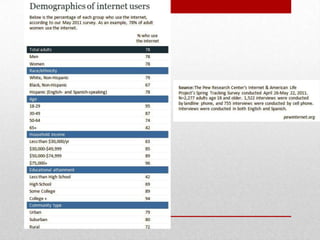
  • #11 If you doubt that people in the US are online, these numbers should tell the story. This is 2011 data by the way 
  • #12 This is how most of us perhaps have looked at the web, we were there as it was being built, and we haven’t taken time to notice things might have changed. We used to spend A LOT of time making sure that we got a good web address, put out lots and lots of flyers with out web addresses. We figured we would all be known at THE AUTHORITY on a subject so that over time, people would just inherently know to come to our sites.
  • #13 But that’s not the case anymore. People want information to come to them, to be part of their daily experience. How many times have you known which site you want to go to, but STILL go to a Google search and type it out? Or you are doing other work online and a sidebar has information that attracts you? The web is changing so that the WAY you use the web helps information find you. If you click on 20 pages with food recipes, all that information is going to be collective and soon you’ll begin to notice that some websites (i.e. social, search, ect…) might start suggesting information FOR you.
  • #14 People have access to so much information, that many times they go first to the web and then to you. Evidence? If you are in outreach and education are any of the above happening for you? Are you getting MORE people on your programs, more money to do publications? Becoming cheaper to advertise?
  • #15 Are you getting this many calls in a day yet?
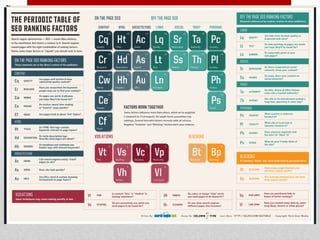
  • #16 So what’s important that you should pay attention to social media EVEN if you haven’t the slightest inclination to use it yourself. That’s okay, because you are not the sole purveyor of your information! Shocking! As a matte of fact, other people are probably sending your information around the web for you. Wow! So why is that a big deal???? In 2011, as far as we can tell (and it’s a big secret), search engines changed how they “rank” a page. Do we care about search engines? Review slide #14….Google 4,717,000,000/day.
  • #17 This great graphic by Third Door Media is “the Periodic Table of SEO Ranking Factors” that came out in 2011 (you can use Google to search this….hahahaha). We are conditioned by years of memo’s to know that our websites better have all kinds of fancy architecture to help websites be found. But, what search engines are ALSO concentrating on is “off the page seo” and a big part of that is social media.
  • #18 It won’t be about how pretty or proper you website is. It’s about how users feel about your site, how many times are things on your site shared (suggested to others, Pinned). Timely, and how many of your personal circle of friends might also visit that site. Peer-to-peer recommendations are going to be big (they already are). Wait a minute, could this be mimicking REAL LIFE? If your friend tells you to eat at Restaurant A, that’s probably going to be more meaningful that stangers telling you that.
  • #19 Considering that on any given day millions – no BILLIONS- of searches for information are undertaken on the web, what happens to things that are NOT on the web? It’s a bit of an organizational challenge. If you are HBO and ShowTime, ESPN and MTV. You have already figured this out! Raise your hands if you think that HBO relies on TV to attract consumers??????
  • #20 So in the end, we have in many cases (as educators) pushed the envelope over to a department. Don’t we need big bucks and minds to “Market” in today’s media-scape????? Have you ever heard of “Crocking Girls” or “Drudge Report” or “People of Walmart”? Do you think they have a “marketing” department????? There are thousand of examples on the web where people without any marketing department, without any budget have brought their websites to the VERY top of searches. HOW?????
  • #21 Like everything else, its about strategy. If you are in the business of information delivery, you’ve got to build a strategy (that includes using the social networks, and current media-scape) if you hope to get your information out there. There’s a great philosophy surround the number 150. The number 150 is also known at the “Dunbar” number. Dunbar theorized that a person can maintain only 150 meaningful connections (relationships) at any time. Over time, of course who is the 150 changes, but that your brain can maintain connections to 150 relationships. So for those of your who are in the business of connecting your information to people, the “goal” is to ask yourself, how can this information make it into the top 150? Do you want people to care about XYZ? Build a relationship with say ecologically sustainable environments? How are you going to build a relationship to break into the 150?
  • #22 Many people feel like the relationship online is very much like their “personal” profiles online. The reason’s why YOU use social networks are NOT the way in which you will use them for outreach and education. For many of you, this is a relief! One of the barriers that you may be building is that YOU have to be everyone’s personal friend.
  • #23 Change the focus to an organizational focus. Why and where does your CONCEPT/Company want to be online and why?????
  • #24 For this group, when you are talking water, you are talking watersheds, and THIS is the reason to be online.
  • #25 The mindset for educators is that its not about purging yourself of all the data you have meticulously collected over the years. Having stream gauge data is GREAT for a very small (but important set) of people, but there is a really large set of people that need you (the experts) to interpret and currate that into ……INFORMATION.
  • #26 Many of the obstacles are going to be at the organizational level. Understanding the barriers are important. Being in today’s social networks and among the media-scape isn’t the same as it was when people thought everything funneled like “news”. There are many very different informal strategies that all play a role in outreach and education.
  • #27 This meeting isn’t about the SPECIFIC tools we use to engage in social networking, or the media-scape. There are many, many great classes on those, and we also teach those throughout the year (http://irnr.tamu.edu). But, even if you never utilize any of those online tools, you’ll benefit from understanding how to make everything you do transferable to social networks. If you don’t think that’s important, please restart this slide show.
  • #28 Surprise????
  • #29 If your website is “shareable” socially, other people who find your information valuable can share it for you. This is called “reach”. You don’t have to be the only one doing the work. If you have information that can be shared, and its good, encourage others to share it.
  • #30 Don’t just say “share our website”. Make sure the ITEMS within your website are socially sharable. Here’s some ways to evaluate your own websites.
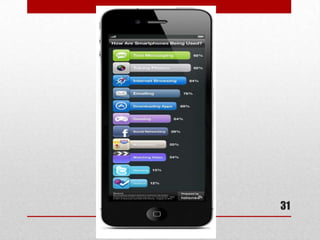
  • #31 What!!! We barely have a desktop version!
  • #32 Ummmm
  • #33 Want to catch up on responsive design? Follow Luke Wroblewski. Mobile is and isn’t about just smartphones. Its about recognizing that users now connect on a variety of devices. Are you even thinking about that? Should you be?
  • #34 Don’t just jump onto Facebook or Twitter because they are popular. Do they fit your organizational needs?
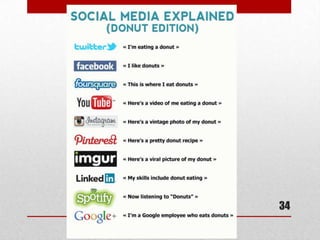
  • #35 Best chart ever! Social media explained by donuts.
  • #36 Don’t be afraid to set some goals and follow through with them. How are you going to undertake them?
  • #38 150, how are you going to get there?
  • #40 Remember babies spend lots of time listening before they utter their first word. Just sayin’
  • #41 For conservation organizations in Texas, two excellent examples