Going Social Children’s Aid Society Toronto April 14, 2010 Aerin Guy, SpaceRace
Welcome! Thank you for inviting me
About me
@aeringuy [email_address] www.gospacerace.co m LinkedIn:  Aerin  Guy Facebook:  Aerin Guy Delicious: Aerin Guy
Agenda 1.  Me, and you 2.  Social Web:  An overview 3.  Tools of the trade 4.  Case studies 5. Setting goals and metrics 6.  Questions and follow up
Let’s start with something visual http://www.youtube.com/watch?v=6ILQrUrEWe8
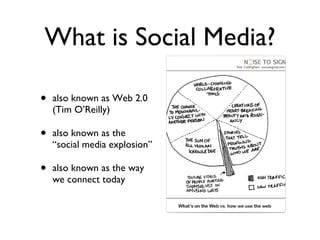
What is Social Media? also known as Web 2.0 (Tim O’Reilly) also known as the “social media explosion” also known as the way we connect today
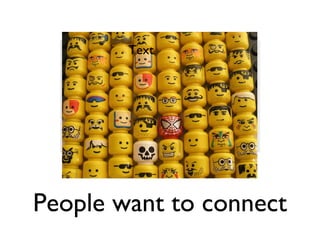
People want to connect Text
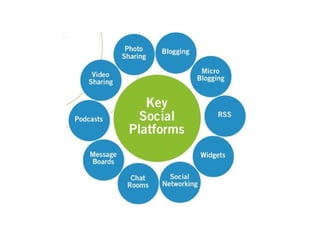
social media  social media refers to the tools we use to communicate in a wired world also refers to the online content we create also known as web 2.0 (and 3.0 with greater networking tools and collaborative capabilities)
 
shift represents a shift in how people discover, read, and share news and information; supports human need for interaction if I want you, I will find you transforms “broadcast” methods into “dialogues” democratization of information - content consumers to content producers  WIKIPEDIA
search exercise Imagine that you are someone else who is looking for information on your organization.  Write down the types of search you would perform.  What keywords would you use?  Where would you check?
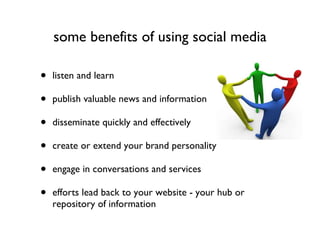
some benefits of using social media listen and learn publish valuable news and information disseminate quickly and effectively create or extend your brand personality engage in conversations and services efforts lead back to your website - your hub or repository of information
Communications history broadcasting 2 way, 3 way, many ways
Turn the bullhorn around  (Tara Hunt,  The Whuffie Factor) (Tara Hunt,  The Whuffie Factor)
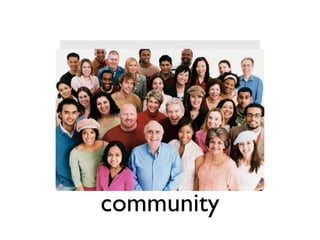
community
community today’s social media is about community communities of practice communities of shared interests communities solving problems tomorrow’s social media....that’s literally 24 hours away
by understanding how social media supports the human desire for conversation, organizations can open up vibrant interactions with individuals and communities
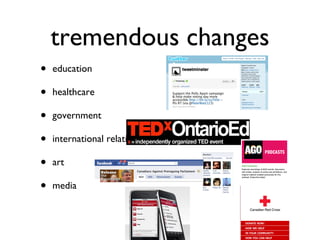
tremendous changes education healthcare government international relations art media
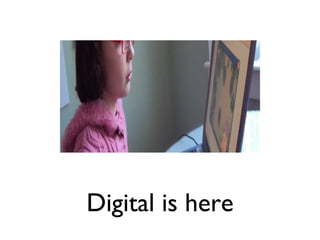
Digital is here
The web is about conversations and connections,  not top down delivery of information or messages.
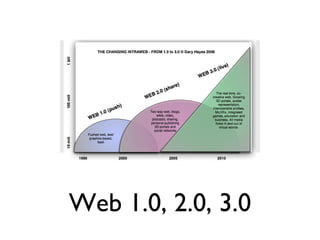
Web 1.0, 2.0, 3.0
New goals?
New audience
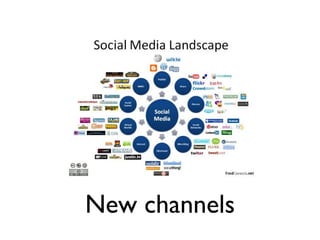
New channels
New goals share resources connect people establish presence fundraise
New audience digital natives Google (and others)- Search Smartphone users formats beyond borders
 
New channels web  video social networks blogs mobile content everywhere
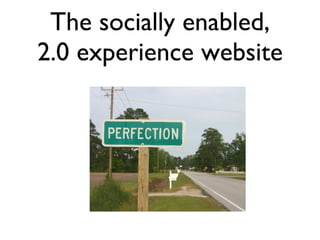
The socially enabled, 2.0 experience website
content worth talking about RSS social sharing feedback findable
Blogs
high ranking in organic search at least 44% of all web interactions begin with search search engines love blog headlines, as they indicate what can be found on the page search engines also love blogs because they are frequently updated recent + relevant =  RANKING! blogging: Be FOUND!
 
Twitter is a real-time micro-blog real time word of mouth 140 character max forces “tweets” to be powerful, concise and well-chosen follow and be followed highly searchable great way to provide links, respond instantly, and connect with “constituents” using Tweetdeck (or HootSuite) can help organize your followers into manageable groups Tweet from mobile devices with Tweetie, UberTwitter, Echofon
Tweetdeck/Hootsuite most users access Twitter through a third-party application manage multiple accounts track mentions, direct messages search discussions, topics, categories
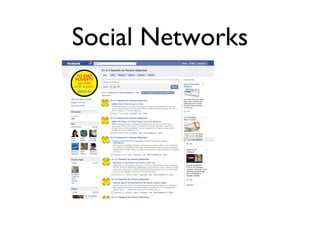
Social Networks
goals what are the goals of your audience/community? let’s come up with some
People Who are you trying to reach? Who’s your audience? Where do they hang out? What’s the best way to reach them?
Objectives What are you trying to achieve? Increase in membership? Brand repositioning? Better customer service? How will you measure your success?
Strategy how will relationships with your audience change? What will be expected of you as an organization? How will you handle negative comments?
Technology now you know who, why and how time to answer “what” Wikis? Community? Twitter? Facebook? Flickr?  Video?
Metrics
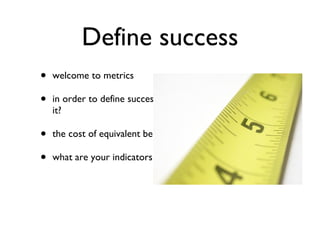
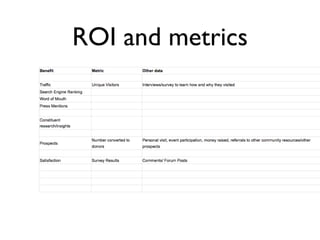
Define success welcome to metrics in order to define success, how are you going to measure it? the cost of equivalent benefits what are your indicators?
ROI and metrics
Reality sets in what you need to do this a new tax? RST :) resources, time, staffing
cost effective no budget?  Facebook, Twitter, blog, optimize existing website wee budget?  video, file sharing software, microsite big budget?  campaign assistance & facilitation, website redesign many agencies will do pro-bono work for charities/NFPs sources can be craigslist, kijiji, student sites, hire an intern MyCharityConnects at NetChange Week, June 2010 baby steps
Building Capacity: 5 BIG ISSUES Inertia problem - most organizations were founded prior to the internet....they aren’t used to having control issues, intimate relationships with audiences, and they think they control their brands. Leadership issue - often the leaders are pre-internet. Difficult to get buy-in.  Threatened.  “This is a fad”  “Our customers don’t want this” Advocate issue - who’s the squeaky wheel? Silo issue - “that’s marketing’s job”. “IT handles our web stuff”  Believe me, neither should hold the keys to the kingdom. Fear issue - it’s all so new, and changes so quickly,  budgetary responsibility
how it can work positioning.  “we are the spearhead of a movement that is changing this issue.  we are a vehicle for making change.” engage leadership in new thinking.  get help. involve social media/coms people at management/strategic level.  Obama’s campaign would be a good example! Hire from the millennial generation.  Their insight as digital natives will improve the strategic conversations. Speak “human”.  People like people. Relationships are where it’s at. Get out of “press release” mode.
Hot tips Develop a deep understanding of your “clients”. Groups who are successful are able to tap into the knowledge of who they are trying to build a relationship with. Connect people directly.  Bringing people together can be scary.  Power in numbers! Your value is in your ability to do this. Be open, ego free.....and let go of control. You never had it anyways. Emulate, innovate. Fail, experiment. Lather, rinse, repeat.
case studies:  www.stableandaffordable.com www.homelesshub.ca ODEN network: Mayor’s Challenge www.inclusionaryhousing.com
Campaign storm
Questions
Thank you

Going Social

  • 1.
    Going Social Children’sAid Society Toronto April 14, 2010 Aerin Guy, SpaceRace
  • 2.
    Welcome! Thank youfor inviting me
  • 3.
  • 4.
    @aeringuy [email_address] www.gospacerace.com LinkedIn: Aerin Guy Facebook: Aerin Guy Delicious: Aerin Guy
  • 5.
    Agenda 1. Me, and you 2. Social Web: An overview 3. Tools of the trade 4. Case studies 5. Setting goals and metrics 6. Questions and follow up
  • 6.
    Let’s start withsomething visual http://www.youtube.com/watch?v=6ILQrUrEWe8
  • 7.
    What is SocialMedia? also known as Web 2.0 (Tim O’Reilly) also known as the “social media explosion” also known as the way we connect today
  • 8.
    People want toconnect Text
  • 9.
    social media social media refers to the tools we use to communicate in a wired world also refers to the online content we create also known as web 2.0 (and 3.0 with greater networking tools and collaborative capabilities)
  • 10.
  • 11.
    shift represents ashift in how people discover, read, and share news and information; supports human need for interaction if I want you, I will find you transforms “broadcast” methods into “dialogues” democratization of information - content consumers to content producers WIKIPEDIA
  • 12.
    search exercise Imaginethat you are someone else who is looking for information on your organization. Write down the types of search you would perform. What keywords would you use? Where would you check?
  • 13.
    some benefits ofusing social media listen and learn publish valuable news and information disseminate quickly and effectively create or extend your brand personality engage in conversations and services efforts lead back to your website - your hub or repository of information
  • 14.
    Communications history broadcasting2 way, 3 way, many ways
  • 15.
    Turn the bullhornaround (Tara Hunt, The Whuffie Factor) (Tara Hunt, The Whuffie Factor)
  • 16.
  • 17.
    community today’s socialmedia is about community communities of practice communities of shared interests communities solving problems tomorrow’s social media....that’s literally 24 hours away
  • 18.
    by understanding howsocial media supports the human desire for conversation, organizations can open up vibrant interactions with individuals and communities
  • 19.
    tremendous changes educationhealthcare government international relations art media
  • 20.
  • 21.
    The web isabout conversations and connections, not top down delivery of information or messages.
  • 22.
  • 23.
  • 24.
  • 25.
  • 26.
    New goals shareresources connect people establish presence fundraise
  • 27.
    New audience digitalnatives Google (and others)- Search Smartphone users formats beyond borders
  • 28.
  • 29.
    New channels web video social networks blogs mobile content everywhere
  • 30.
    The socially enabled,2.0 experience website
  • 31.
    content worth talkingabout RSS social sharing feedback findable
  • 32.
  • 33.
    high ranking inorganic search at least 44% of all web interactions begin with search search engines love blog headlines, as they indicate what can be found on the page search engines also love blogs because they are frequently updated recent + relevant = RANKING! blogging: Be FOUND!
  • 34.
  • 35.
    Twitter is areal-time micro-blog real time word of mouth 140 character max forces “tweets” to be powerful, concise and well-chosen follow and be followed highly searchable great way to provide links, respond instantly, and connect with “constituents” using Tweetdeck (or HootSuite) can help organize your followers into manageable groups Tweet from mobile devices with Tweetie, UberTwitter, Echofon
  • 36.
    Tweetdeck/Hootsuite most usersaccess Twitter through a third-party application manage multiple accounts track mentions, direct messages search discussions, topics, categories
  • 37.
  • 38.
    goals what arethe goals of your audience/community? let’s come up with some
  • 39.
    People Who areyou trying to reach? Who’s your audience? Where do they hang out? What’s the best way to reach them?
  • 40.
    Objectives What areyou trying to achieve? Increase in membership? Brand repositioning? Better customer service? How will you measure your success?
  • 41.
    Strategy how willrelationships with your audience change? What will be expected of you as an organization? How will you handle negative comments?
  • 42.
    Technology now youknow who, why and how time to answer “what” Wikis? Community? Twitter? Facebook? Flickr? Video?
  • 43.
  • 44.
    Define success welcometo metrics in order to define success, how are you going to measure it? the cost of equivalent benefits what are your indicators?
  • 45.
  • 46.
    Reality sets inwhat you need to do this a new tax? RST :) resources, time, staffing
  • 47.
    cost effective nobudget? Facebook, Twitter, blog, optimize existing website wee budget? video, file sharing software, microsite big budget? campaign assistance & facilitation, website redesign many agencies will do pro-bono work for charities/NFPs sources can be craigslist, kijiji, student sites, hire an intern MyCharityConnects at NetChange Week, June 2010 baby steps
  • 48.
    Building Capacity: 5BIG ISSUES Inertia problem - most organizations were founded prior to the internet....they aren’t used to having control issues, intimate relationships with audiences, and they think they control their brands. Leadership issue - often the leaders are pre-internet. Difficult to get buy-in. Threatened. “This is a fad” “Our customers don’t want this” Advocate issue - who’s the squeaky wheel? Silo issue - “that’s marketing’s job”. “IT handles our web stuff” Believe me, neither should hold the keys to the kingdom. Fear issue - it’s all so new, and changes so quickly, budgetary responsibility
  • 49.
    how it canwork positioning. “we are the spearhead of a movement that is changing this issue. we are a vehicle for making change.” engage leadership in new thinking. get help. involve social media/coms people at management/strategic level. Obama’s campaign would be a good example! Hire from the millennial generation. Their insight as digital natives will improve the strategic conversations. Speak “human”. People like people. Relationships are where it’s at. Get out of “press release” mode.
  • 50.
    Hot tips Developa deep understanding of your “clients”. Groups who are successful are able to tap into the knowledge of who they are trying to build a relationship with. Connect people directly. Bringing people together can be scary. Power in numbers! Your value is in your ability to do this. Be open, ego free.....and let go of control. You never had it anyways. Emulate, innovate. Fail, experiment. Lather, rinse, repeat.
  • 51.
    case studies: www.stableandaffordable.com www.homelesshub.ca ODEN network: Mayor’s Challenge www.inclusionaryhousing.com
  • 52.
  • 53.
  • 54.

Editor's Notes

  • #45 come up with measurements based on a specified time frame and arena. Do you have 3 positive conversations a week on a project you’re working on? Where are the arenas you are trying to reach people? where are your competitors - and what have they done successfully?